Edward Lear, Thomas Woolner, and Edward Wilson

Edward Lear first met Edward Wilson in Rome in February 1860, when the latter brought him a letter from his friend and PRB fellow Thomas Woolner. That same night he wrote to Woolner, obviously in a very good mood, one of his humorous letters:

94o V. Condotti, Roma,
February 16, 1860.

My Dear Woolner,

o my deerunkel [Lear called William Holman Hunt “pa or, more often, “daddy” and Woolner “uncle”]—Mr. Edward Wilson has brought me your letter of Jany 19th this afternoon, at 4 p.m. So I walked round the Borghese villa with him, & thought him a very nice fellow;—& if he hadn’t been so, I should have seen what I could of him: for your sake unkel. I have asked him to dine tomorrow, tête-a-tête, & shall feed him with stewed beef & maccaroni & you may depend on my doing all I can for him, as far as my little possible goes. For in 10 days (his limit of time here) much cannot be done. With regard to Naples & other parts of Hitterly, I fear I can do less. . . . Tell my pa he is a nasty unnatural old brute of a parient, as lets his own flesh & blood pine & fret away in furrin parts, without his never writing nothink to them. I am immensely glad you give such a good account of dead Daddy—& long to hear of the picture being finished. I approve of both your dancings, . . . a couple of little apes as you both of you be! For all that I wish you were both of you here. I really do wish you could come before I go hence and am no more seen in Rome, for I hate the place more & more & more & more. I heard of your being at Farringford from Mrs. Tennyson. . . . Don’t you delight in Tithonus? I am glad you went over to Swainston: Sir J. Simeon has done himself & his religion credit by his good & manly letter. Thank you for what you say of my pictures: it is a really great pleasure to know that Fairbairn likes his Petra so much. . . . Dear me! I wish you could come out here for a little time . . . . you might see all Rome so quietly as you never would have another roppertunity of doing. So might Pa. I am glad to hear of your doing Sir W. Hooker & Sedgwick . . . my plans are much changed since I came here, and I find I must put off Palestine till Autumn. And thus I am going on with paintings of Palermo, Dead Sea, Parnassus. . . . Beirût, & Damascus, with some drawings,—But I also wish to paint the Seeders of Lebanon from the big Seeders at Sir J. Simeon’s before I come to town. I am convinced of this: a man cannot too perpetually & too wiggorously keep a beginning & a setting forth of new themes for work: if so be he goes on to finish them. After I’ve done all the above toppicks, I trust to go to Jerusalem & after that perhaps to the troppicle regents, & the Specific highlands and never comes a Hewropean trader & a lustrous creeper in a flag sliding over summer trailers which accounts for the same.

O my belovydunkel, my eyes are tired with the light, and my’ ed is a akin: so I can’t right any maw, beinng half asleep. Give my love to my dear pa, & to Brother Bob Martineau, & to my Grandfather Maddox Brown, which I always keep seeing his picture of “Work” before me.—(o my!) . . . Good-bye my dear boy. I am truly glad you are going on so well. Write me a line by post some day for it is a pleasure to hear of you.

And believe me,
Dear Woolner,
Yours affly.
Edward Lear.

Do write & send me the address of your Studio.—I hope though, you’ll get a block of marble for the little Fairbairns soon.

Woolner, Amy. Thomas Woolner, R.A. Sculptor and Poet. His Life in Letters. New York: E.P. Dutton, 1907. 185-6.

In the diaries Lear dates Wilson’s arrival on 17 February 1860:

At 4½ one Mr. Edward Wilson of Melbourne brought me a letter from T. Woolner, ― so I walked round the Borghese with him & asked him to dine tomorrow. Woolners letter is very nice.

Lear’s reaction to Wilson was less than enthusiastic; on 24 February he wrote:

Mr. Wilson came ― & took on hisself [sic] to lecture me for not going out, overwork, Hugh Miller &c. &c. ―: to which I thought ― o ass! ― but said nothing. ―

They saw each other sporadically in Rome, and Lear was a bit offended when, meeting Wilson in Tivoli, the Australian seemed surprised of Lear’s unwillingness to leave Giorgio, who had just heard of his little daughter’s death, alone: “Met Wilson, who seemed to think it odd I could not join his party: he is potius aper” (6 April). “Potius aper” being Lear’s way to define someone “rather a bore,” via the Latin for “rather a boar.”

At the end of the year Lear annotated in his diary while staying in Oatlands to paint the “Seeders of Lebanon:”

Edward Wilson ― a nice & kind letter, asking me to a dinner at the Crystal Palace as a farewell. I wrote an answer ― No: ― but I am sorry I can’t convey to Edward Wilson what I feel about him: a kind hearted man: ― yet we did not pull well together. ―― (2 October 1860.)

More on Edward Wilson: Australian Dictionary of Biography, Wikipedia, T. Woolner’s bust of Wilson at the State Library of Victoria and relative entry,

Wilson, Edward. Rambles at the Antipodes: A Series of Sketches of Moreton Bay, New Zealand, the Murray River and South Australia, and The Overland Route. London: W.H. Smith and Son, 1859 (Google Books).

Posted in Edward Lear | Tagged , , , , | 1 Comment

The Sprout and the Cabbage

The Sprout and the Cabbage went to sea
In a suitable egg shell boat.
The waves were so high
They thought they would die,
But viscosity kept them afloat.
The sprout cried out: “Oh, Cabbage, my dear!
Wrap your green leaves around me!
Hold on to me tight, and all through the night,
We’ll stay safe in this treacherous sea!”
But the cabbage replied, as they lurched to one side:
“Steady! You lecherous lout!
My life would be wrecked, if my family suspect
I’m at sea with a sex- crazed sprout!”

The Sprout, thus chastised,
Feared their boat might capsize,
And made no further advance.
When the weather had calmed
He declared himself charmed
By the cabbage’s virginal stance.

Then the moon appeared, with the stars above
And the Sprout serenaded his true Cabbage love:
“Oh Cabbage!” he sang, as he strummed his guitar
“What a beautiful big round Cabbage you are!”
The Cabbage’s heart, like the sea had before,
Pounded and swelled – could this be l’amour?
“Oh kiss me, oh kiss me!” the Cabbage declared,
And the Sprout leapt to do as the Cabbage now dared.

So the Sprout and the Cabbage spooned through the night
As the moon shone down a silvery light.
“My veggie! My dear!” they both called out.
“Oh Cabbage! Oh, Cabbage!” “Oh, Sprout! Oh, Sprout!”

In the morning, they woke, side by side
“Oh, Cabbage, my love!” the enraptured Sprout cried;
“Marry me Cabbage, and away we will go,
To a large open field, and there we will grow,
And ripen and bloom and have lots of seed,
There with each other, for that’s all we need!”

But the Cabbage replied “That’s all very fine,
But there’s things I must have, if you want to be mine!
Like quince, and mince, and a runcible spoon,
And shoes for a dance, by the light of the moon!
And money and honey, and a little pig’s ring!
So you’ll have to do more than just strum and sing!
To get all we need will cost a few bob;
I’m afraid, Sprout, it means, you’d best get a job!”

Sprout sadly sighed, for a working life
Was the price he must pay for his dear Cabbage wife.
And so, every day, he slaved away,
For the rent of a small double room.
But then every night, to their endless delight,
They danced by the light of the moon.
Yes, Cabbage and Sprout, each night they went out
And danced by the light of the moon.

This parody of Edward Lear’s “The Owl and the Pussy-cat” was posted last July by Martin Brown on his Cabbagefactory blog; more Learish and much nonsense material is available.

More on Martin Brown, and more.

Posted in Edward Lear | Tagged , , | Leave a comment

The Frog and the Heron: A Different Sort of Romance

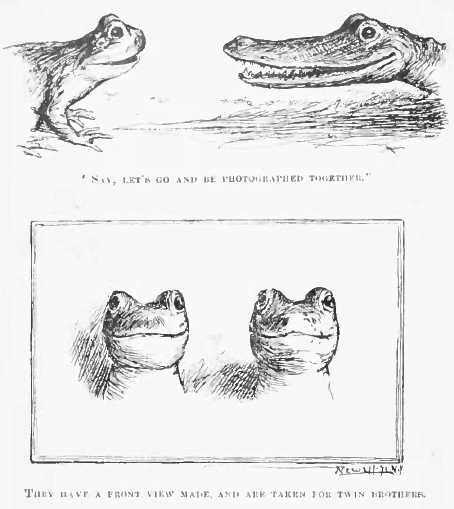
The following poem by Peter Newell,  in Harper’s Young People, vol. XIV, 1893, p. 824,  shows that the theme of interspecies sexual-sentimental relationships would be used at least until the end of the century. Given his choice of a title, Newell might have been inspired by Du Maurier’s strip, “The Frog and the Duck: A Romance,” after all Punch collections were widely available; however, his ending is both more cynical and more realistic.

A LITTLE ROMANCE

It was a Frog and Heron fair
One evening chanced to meet,
The bird had brought her bill along,
And Froggie’d brought his feet.

And since they neither one could speak
The tongue the other knew,
They could not well converse at all,
And so the Heron blew

A pretty tune upon her bill,
While Froggie danced with glee.
He understood her music sweet,
His merry tripping she.

Full soon they fell in love, and ere
The rising of the sun
The Heron gobbled Froggie up,
And now the two are one.

Posted in Comics, Edward Lear, Peter Newell | Tagged , , , , | 1 Comment

The Sanity of Nonsense. Round the World with Edward Lear

Bidding a farewell to fiction
Of the fashionable type,
Whether based on drug-addiction,
“Triangles” or merely tripe,
Healthier recreation choosing,
Simpler fare and better cheer,
I propose to go a-cruising
Round the world with Edward Lear.

Tell me not the thrills that Argo
Gave, or modern liners give:
I shall sail as supercargo
In the Jumblies’ super-sieve,
Where I’ve booked a berth umbrageous
On the Quangle-Wangle’s Hat,
Next to Dong and quite contagious
To the frisky Bisky Bat.

On the coasts of Coromandel,
Where the oblong oysters grow,
I shall hum the works of Handel
To the Yonghy-Bonghy-Bo;
Or contribute variations
On the banjo and the bones
To the dolorous lamentations
Of the Lady Jingly Jones.

There I’ll hold harmonious parley
With the foes of common sense ―
Aunt Jobiska, Uncle Arly,
Priests of “sweet desipience”;
And discuss with them quite frankly
Should the fearsome Cummerbund
And the perilous Hills of Chankly
Bore, be visited or shunned.

Cutlets (veal) shall grace our table
From the Orient Calf of Tute;
(Strange that Brewer’s Phrase and Fable
On the subject should be mute!)
While to lubricate our throttles,
When we reach that City, Tosh,
We shall ship a billion bottles
Of the peerless Attery Squash.

Lastly, in my helicopter,
Freed from all internal ills
Thanks to the judicious Propter
And his Nicodemus Pills,
I shall watch the toeless Pobble,
Unembittered by his pain,
Homeward delicately hobble
O’er the Great Gromboolian Plain.

*  *  *

Though, more potent influence raining
Stars may swim into our ken,
Though new creeds succeed in gaining
Mastery of the souls of men;
None is surer of translating
Young and old into a sphere
Purer, more exhilarating
Than the Lunacy of Lear.

C.L.G.

The Times (London, England), Thursday, 16 June 1938, p. 19; issue 48022.

Posted in Edward Lear | Tagged , , | Leave a comment

The Frog and the Duck: A Romance

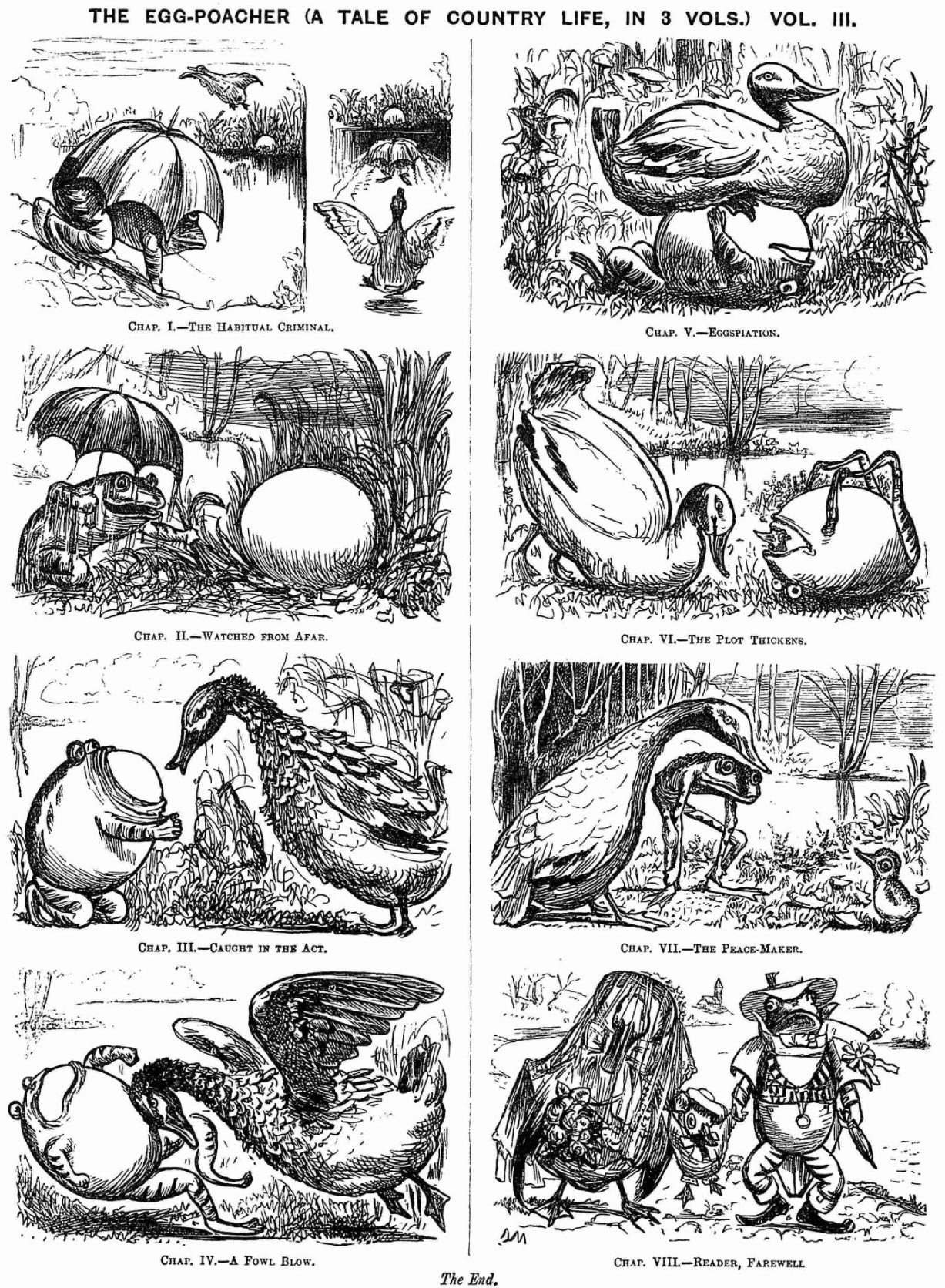
George du Maurier “took, in 1869-1870, a brief Darwinian respite from his usual labors of satirizing the Victorian drawing room” and, among other things, produced an “unusually extensive and charmingly anthropomorphic picture-story” (Kunzle 293), which appeared in three fortnightly instalments in Punch: April 10, April 24 and May 8, 1869 (vol. 56, pp. 146, 174 and 194).

egg-poacher-1s

egg-poacher-2s

egg-poacher-3sAs Kunzle himself observes, the story is based on a complex set of reversals which involve social conventions (a marriage enforced by the female after the birth of offspring) as well as the natural order of things. In this respect the tale is not different from Edward Lear’s “The Owl and the Pussy-cat” with its final interspecies marriage.

Both stories end with the traditional marriage but, unlike Lear, Du Maurier emphasizes the less agreeable elements of interspecies relationships: the first two instalments are centered on predation — one of the most obvious manifestations of Darwin’s struggle for survival — and in particular on what Rose Lovell-Smith calls the “egg-thief motif”.

By 1869 the topos had already had a long history, going back at least to J.J. Audubon’s representation of birds’ nests under attack by serpents: plates 21 (Mocking Bird) and 116 (Ferruginous Thrush) of his Birds of America (1827-1838). It had been taken up in illustrations and natural-history books and perhaps used by Lewis Carroll in the Pigeon episode of Alice’s Adventure in Wonderland (chapter 5).

Lear, notwithstanding his experience as a zoological illustrator, appears less interested in the real-world interactions of the species involved: owls and cats, both preying on mice, are competitors, though in the extreme conditions imagined by Stewart Lee in his 2004 show Pea Green Boat they might well become enemies.

Du Maurier’s choice of a frog as the predator — a parodic version of the more aggressive serpents usually associated to the practice — is in itself a reversal of the natural order, as frogs do not prey on eggs while some ducks feed on amphibians. He then concludes the story by again reversing the predator-victim relationship, when the frog is first used to hatch the egg and then forced into marriage.

The story, however, also functions as a parodic reversal of a more traditional, non-evolutionary theme: it would be difficult not to see in the raping bird a burlesque version of Leda’s swan, again with inverted sexual roles: the duckling which emerges from the egg, while mostly like the mother, has the frog’s eyes and is therefore a hybrid.

Kunzle, David. The History of the Comic Strip: The Nineteenth Century. Berkeley: University of California Press, 1990.

Lovell-Smith, Rose. “Eggs and Serpents: Natural History Reference in Lewis Carroll’s Scene of Alice and the Pigeon.” Children’s Literature 35 (2007): 27-53 (Muse).

See: George du Maurier, Stewart Lee’s “deconstruction” of The Owl and the Pussy-cat.

Here: The Frog and the Heron: A Different Sort of Romance.

Posted in Comics, Edward Lear, Lewis Carroll, Peter Newell | Tagged , , , , , , | 6 Comments

The Hunt for the Scroobious Pip

The Hunt for the Scroobious Pip. Photograph: Tony Bartholomew

The Hunt for the Scroobious Pip. Photograph: Tony Bartholomew

The writer/director team of Andrew Pollard and Adam Sunderland have a fine reputation for turning slightly old-fashioned children’s classics into engagingly low-budget entertainments. They have previously made minimalist masterpieces out of Heidi and The Water Babies: now it’s the turn of Edward Lear’s inspired nonsense verse, whose relative neglect among children’s theatre-makers is as mysterious as the elusive Pip itself.

Read the full review at guardian.co.uk. Also The Stage.

Posted in Edward Lear | Tagged , , | Leave a comment

Autographs

The Victorian age saw a remarkable increase in the cult of personality and a consequence of this was a growing interest in collecting famous people’s autographs. An insatiable demand for historical manuscripts and celebrities’ signatures led to the creation of a public market: starting in the early 1830s, auctioneers held special sales of books and autographs. Thomas Thorpe, one of the best-known booksellers in London, soon became the leading dealer and by 1841 he was able to offer his customers a catalogue of about 16,000 items.

Autograph albums focussing on the owner’s friends were also very common from the early years of the XIX century, and Edward Lear often contributed to those of people he met with drawings and/or short poems.

Occasionally he also sent other people’s autographs to friend-collectors, which is not surprising as he knew many of the important people of the period. On 16 October 1860, for example, he records sending a number of autographs to Gussie Bethell:

Breakfast. 2 nice letters ― from T.G. Baring, ― asking me there: ― & from Gussie Bethell ― asking for Autographs. ― So I sent her Hallam Tennyson’s ― Count de Paris’s, & Holman Hunts. ―

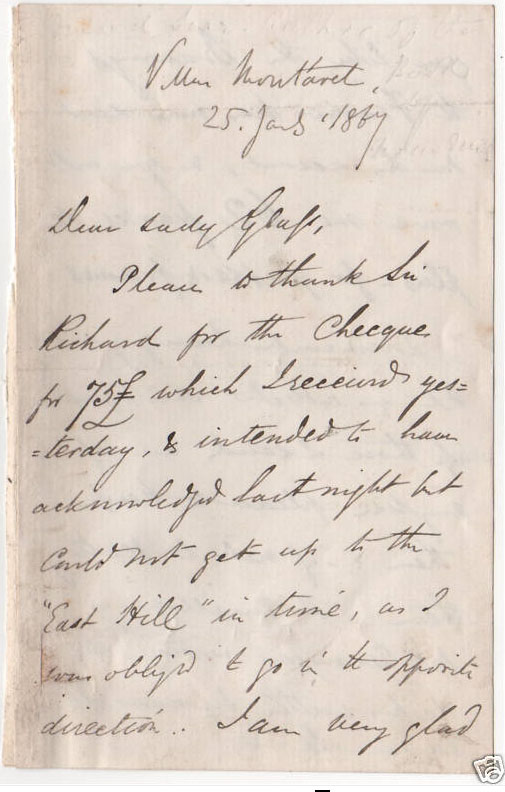
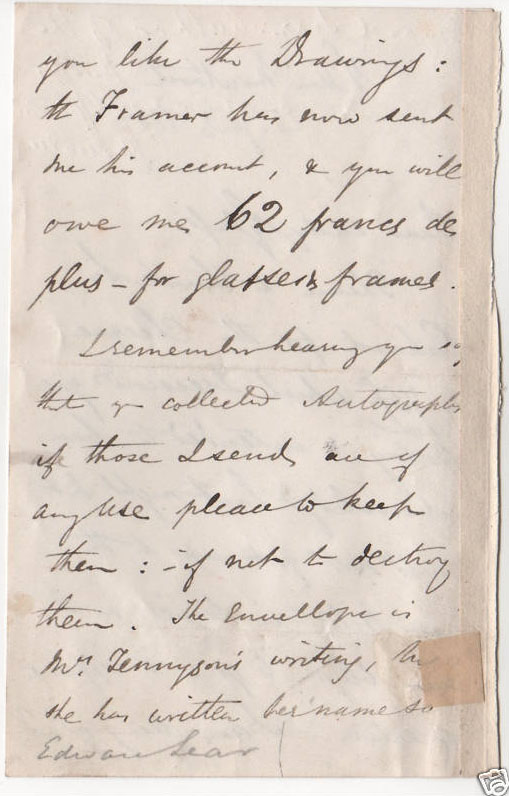
He did the same for Lady Glass in a letter of 1867 which, ironically, was auctioned on eBay some time ago as incomplete: the page containing Lear’s signature having been removed, probably in order to sell the autograph separately. Here is the text of the remaining two pages:

Villa Montaret,
25 January 1867.

Dear Lady Glass,
Please to thank Sir Richard for the Cheque for 75£ which I received yesterday, & intended to have acknowledged last night but could not get up to the “East Hill” in time, as I was obliged to go in the opposite direction.  I am very glad you like the Drawings: the Framer has now sent me his account, & you will owe me 62 francs de plus ― for glasses & frames.
I remember hearing you say that you collected Autographs, if those I send are of any use please to keep them: ― if not to destroy them.  The envellope [sic] is Mrs. Tennyson’s writing, and she has written her name so [page(s) missing]

Autographs were still fashionable in the the late Victorian age, when the Picture Magazine, for the most part devoted to reprinting miscellaneous visual material, included a few pages of famous people’s autographs in each of its early numbers.

Also see: A Short History of Collecting Autographs.

Posted in Edward Lear, General | Leave a comment

Another Owl, Another Pussy-cat

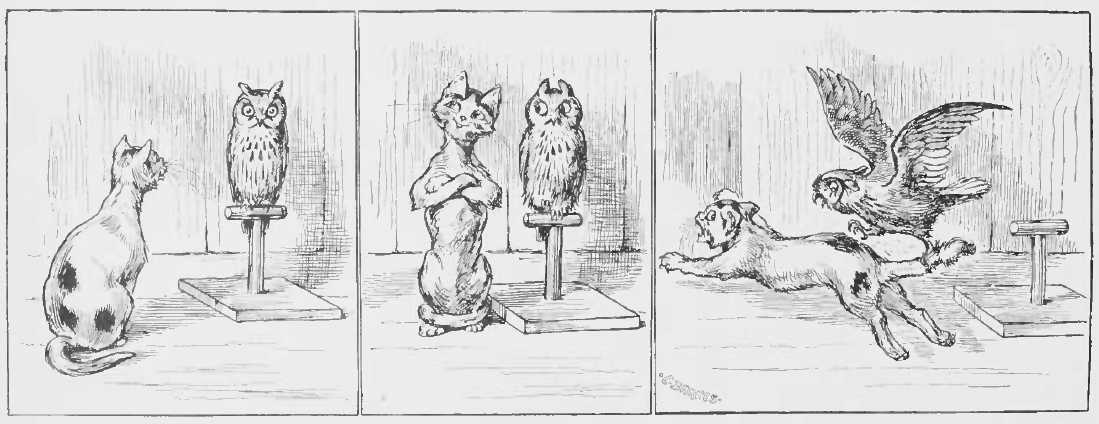
  1. “They call that thing a cat owl. Humph! It may have resembled one of my family before it was stuffed. But now — well —
  2. “I’ll leave it to anybody; does that bundle of hay and feathers look anything like –“
  3. This cat owl  didn’t happen to be stuffed, and could stand such calumny no longer.

C. Barnes, Harper’s Young People, vol. XIV, 1893, p. 336.

Peter Newell also used the structural similarities of animals in a strip that appeared a few months earlier in the same paper:

Harper’s Young People, vol. XIV, 1893, p. 136.

Posted in Comics, Edward Lear, Peter Newell | Tagged , , , | Leave a comment

A Startling Illusion

Peter Newell, The Bubble: A Startling Illusion

Harper’s Young People, vol. XIV, 1893, p. 40.

Posted in Comics, Peter Newell | Tagged , , , | Leave a comment

Who is Karel Drofnatski?

I first came across Karel Drofnatski’s name when reading a review of Bryn Terfel’s CD Silent Noon (DG 000289 477 5336 0, 2004) which includes arrangements of Edward Lear’s “There was an old man with a nose” (“The Aquiline Snub”) and “There was an old man of the Isles” (“The Compleat Virtuoso”). I was quite intrigued, so I also got On This Island (Hyperion CDA 67227, 2001) which I discovered included two more of Drofnatski’s arrangements.

While checking the Edward Lear Discography today I decided to investigate a little and, as I suspected already, found that Karel Drofnatski was a pseudonym used by Sir Charles Villiers Stanford (1852-1924) for his arrangements of Lear’s limericks:

Last, but certainly not least in Stanford’s oeuvre, are the Nonsense Rhymes, settings of 14 limericks by Edward Lear, written for the amusement of his friends. The dates of composition are not known, nor were they published until 1960. The stratospheric opus numbers — 365-78 — are all part of the donnish humour. (In reality, Stanford’s opus numbers reached just under 200.) The work’s full title is ‘Nonsense Rhymes by Edward Lear set to music by Karel Drofnatski,’ a composer who was evidently born at a town on the River Yeffil in the province of Retsniel. (Anyone with a retrogradable turn of mind will quickly decode this.) The settings comprise a series of baroquely elaborate spoofs, each targeting a different composer or style and incorporating wittily embedded quotation, all explained in elaborate after-notes to each song. For example, ‘The Hardy Norse-Woman’ (setting the limerick ‘There was an old man of the Isles’) to ‘Max von Beetelssohn;’ ‘The Absent Barber’ (‘There was an old man with a beard’) to Handel (with help from Sir Henry Bishop); and ‘The Aquiline Snub’ (‘There was an old man with a nose’) to J.S. Bach (Ex. 2.17). There are also parodies of Brahms, Tchaikovsky and Wagner and an all-purpose ‘Limerich ohne Worte:’ ‘a specimen pattern or model, to which any poem of the limerick type can be sung.’ They are so much more amusing than the Irish humours of ‘Johneen’ and the like. But… one feels that when one prefers Stanford’s pastiches to his serious songs, then something must be amiss: that perhaps Stanford didn’t aim very high. (Hold, Trevor. Parry to Finzi: Twenty English Song-Composers. Woodbridge: The Boydell Press, 2002. 56-7.)

The 1960 edition of the manuscript was published in London by Stainer & Bell. The whole series has been recorded by Philip Lawson (baritone) and Howard Moody (piano) for VIF Records in 1997 in their Lyrics and Limericks CD.

Posted in Edward Lear | Tagged , , , | 1 Comment