There is an interesting article in the the London Review of Books (vol. 32, no. 24, 16 December 2010), “Quashed Quotatoes,” in which Michael Wood reviews a new edition of James Joyce’s Finnegans Wake. The opening paragraphs discuss Joyce’s debt to Lewis Carroll:
Lewis Carroll seems an obvious precursor of James Joyce in the world of elaborate wordplay, and critics have long thought so. Harry Levin suggested in 1941 that Carroll’s Humpty Dumpty was ‘the official guide’ to the vocabulary of Finnegans Wake. Why wouldn’t he be? He was the inventor of the portmanteau word.
Wood then notes that in 1927 Joyce wrote that he had never read Carroll until a friend “gave me a book, not Alice, a few weeks ago – though, of course, I heard bits and scraps.” A long list of Carrollian references in the Wake follows, showing that Joyce was well aware not only of Sylvie and Bruno (the book he presumably was given by the friend, according to Atherton) but of both Alice books and of Collingswood’s Life.
I have not looked into my copy of Finnegans Wake for many years, but I distinctly remember that Joyce’s method sounded quite different from Carroll’s, which at least in Humpty Dumpty’s interpretation consists in using isolated words packing two, sometimes more, clear-cut meanings: so “mimsy” stands for “miserable and flimsy,” the “Snark” is a monster consisting of parts of a “shark,” “snake,” and perhaps “snail.”
Carroll’s only extended passage containing nonsense words is the first stanza of the “Jabberwocky,” also discussed by Wood; it mixes portmanteu and pseudo-Anglosaxon words, which are then comically interpreted by Humpty Dumpty. In all instances, however, Carroll’s invented words are discrete units, having a definite, univocal meaning, set in an English syntactic structure.
Joyce has a few passages like this:
One yeastyday he sternely struxk his tete in a tub for to watsch the future of his fates but ere he swiftly stook it out again… (p. 4)
in which we can see two distinct meanings packed in one sententece: “to wash the features of his face,” and “to watch the future of his fate,” but for the most part Joyce aims at multipying meanings without keeping a strict syntactic and narrative control over all the threads started by the phrase; given the context, in fact, the reader is invited to try all possible permutations:
to watch the features of his face
to wash the future of his fate
to watch the future of his face
to wash the features of his fate
to watch the features of his fate
to wash the future of his face
which produces a cloud of meanings, only some of which are relavant to the narrative; the others – funny as they may be – are purely ornamental.
The boundaries between words, moreover, are not always respected by Joyce, something I do not remember seeing in Carroll:
The house of Atreox is indeedust… (p. 55)
where, after a typical partmanteau combining the “House of Atreus” with the latin atrox (cruel, atrocious), a single word conflates a whole phrase, “is indeed in the dust.”
Joyce’s method is more reminiscent of several passages in Edward Lear’s letters, which Joyce might have seen, as the two volumes were published in 1907 and 1911. Here are extracts from a letter of 18 November 1858 to Chichester Fortescue:
16. Hupper Seemore Street,
Portman □. 18thNov. /58.
Coming home at 11.30, from Mr. Stanley’s, I find your Wusstussher noat. ― Thank God I ain’t to be rubbed by a beastly fiend with a wet sheet: ― But I believe you will be all the better for it. Is Ward Braham rubbed rubbing rubbable or rubbabibbabubbapbimbubabebabblllleee {115} also? ― I rote to you this morning: ― but, how the debble could your letter reach me to-night? …
Returning here, I find varicose gnoats. …
O mi! how giddy I is! ― Perhaps it is along of the cliff of Ain Giddi: perhaps of the glass of sherry & water close by ― only I ain’t drank it yet.
I wen tup two the Zoological Gardings, & drew a lot of Vulchers: also I saw the eagles & seagles & beagles & squeegles: leastwise the big bears & all the other vegetables.
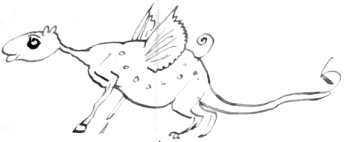
also the little dragging, who is the Beast of the Revialations.
Further instances can be seen in the letter to Woolner I posted some time ago. Of course, Lear’s main purpose here is to create a comical effect rather than to multiply the meanings.
According to James Atherton’s Books at the Wake Joyce refers to Edward Lear in a few passages, in particular
- 65.4: “Now listen, Mr Leer! And stow that sweatyfunnyadams Simper!”
- 275.27: “crankly hat” (Chankly Bore and Quangle Wangle Hat)
- 406.5: “the roastery who lives on the hilli” (at 406.2 there is also “Blong’s best” which may refer either to the Bong tree or the Dong with a luminous nose)
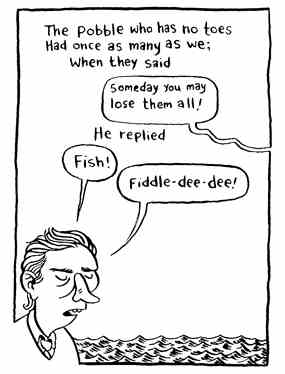
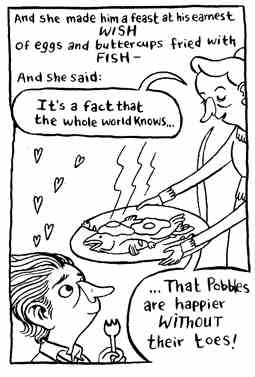
- 334.24: “pobbel,” and 454.35: “pobbel queue’s remainder.”
Curiously, none of these references is to works included in the only Lear book Joyce owned, an Everyman’s Library Book of Nonsense by Lear and others (it also included, for example, The English Struwwelpeter).
Readers of Joyce’s Work in Progress were quick to spot Learian echoes: Vladimir Dixon ― once thought to have been Joyce himself but now revealed as a real person ― concluded his “Litter to Mr. Germs Choice” with
I would only like to know have I been so strichnine by my illnest white wresting under my warm Coverlyette that I am as they say in my neightive land “out of the mind gone out” and unable to comprehen that which is clear or is there really in your work some ass pecket which is Uncle Lear?
No doubt a reference to Shakespeare’s “Nuncle Lear,” but it would be difficult not to see the inventor of nonsense in it.
Also in Our Exagmination, the review entitled “Writes a Common Reader” is signed G.V.L. Slingsby, i.e. Guy Violet Lionel Slingsby, the protagonists of Edward Lear’s “Story of the Four Little Children Who Went Round the World.” Sylvia Beach tells the story behind this piece, but is wrong in citing “The Jumblies” as the source for the name:
Joyce thought an unfavourable article should be included in the volume. This wasn’t easy to find in the immediate neighborhood, where everybody I knew was strongly pro “Work in Progress.” However, I had heard one of my customers, a journalist, express herself strongly against the new Joycean technique, and I asked her if she would be willing to contribute an article to the publication, saying, rather rashle, she could go as far as she liked. This lady wrote the article entitled “Writes a Common Reader,” and she came down so hard on Joyce that I was quite displeased with “G.V.L. Slingsby,” as she signed herself, a name taken from Lear’s “The Jumblies.”
References
Atherton, James S. The Books at the Wake: A Study of Literary Allusions in James Joyce’s Finnegans Wake. SIU Press, 2009. (pp. 124 ff for the chapter on “Lewis Carroll: The Unforseen Precursor,” available on Google Books.)
Beach, Sylvia. Shakespeare and Company. U of Nebraska Press, 1991; original publication New York: Harcourt, Brace, 1959.
Beckett, Samuel and others. Our Exagmination Round his Factification of Incamination of Work in Progress. London: Faber & Faber, 1972. (Contains Dixon’s and Sligsby’s essays.)
Kolocotroni, Vassiliki, Jane Goldman and Olga Taxidou. Modernism: an anthology of sources and documents. University of Chicago Press, 1998. (p. 448 for information on Vladimir Dixon.)
Letters of Edward Lear. Edited Lady Strachey. London: T. Fisher Unwin, 1907.
Later Letters of Edward Lear. Edited by Lady Strachey. London: T. Fisher Unwin, 1911.
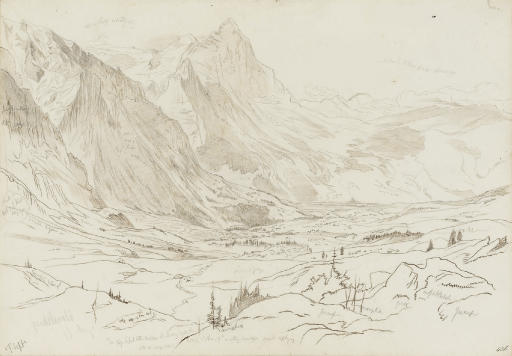 View of Gründelwald, Switzerland



 A Blog of Bosh