Here is another song from the Mr. Lear show in Paris, and an invitation for tomorrow’s performance:

Here is another song from the Mr. Lear show in Paris, and an invitation for tomorrow’s performance:
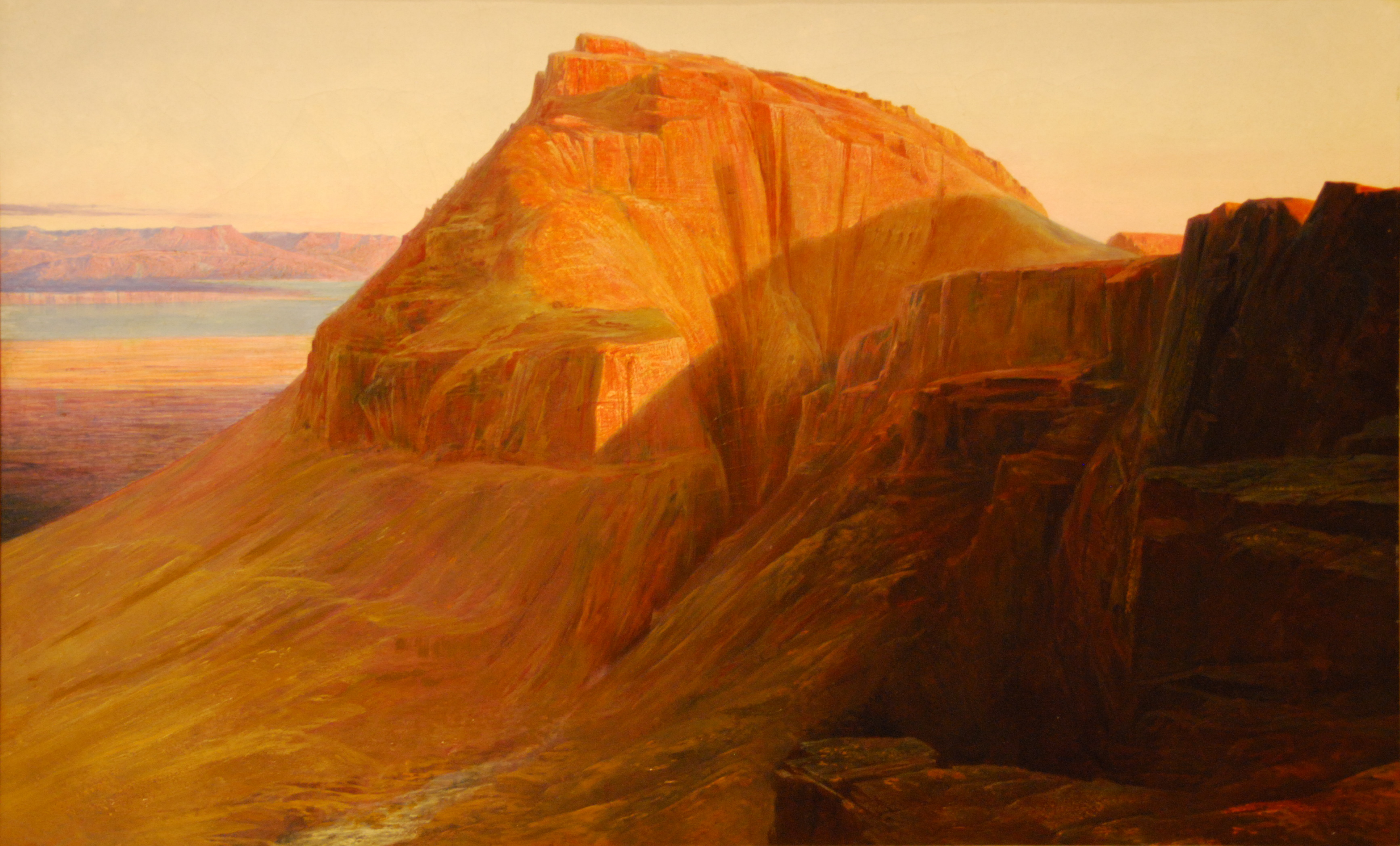
Masada was probably the painting that decided Edward Lear’s fortune as a painter, and its effect was far from positive; however, 11 February 1861 was a particularly happy day for Lear as the Times published a “favourable notice” of his “Rock Fortress of Masada, on the Dead Sea” then on show at the British Institution:
… for truth and conscientious work, perhaps the most noticeable thing in these rooms, is Mr. Lear’s large picture of the ‘Rock Fortress of Masada, on the Dead Sea’ (349). The time is early morning; from a foreground of arid cliff rise the yellow sandstone buttresses, on the very top of which stand perched the scanty ruins of the stronghold of Eleazar, overlooking the deep slaty blue of the plain that stretches to the Dead Sea, whose steely waters are backed by the wall-like mountains of Moab. Overhead is a limpid, gray sky, with a few wreaths of cloud.
“Exhibition of the British Institution.” The Times, 11 February 1861, 10.
Unfortunately, as far as I know, this was the only favourable review he had. That same day, The Morning Chronicle also published a review of the exhibition, by someone who evidently did not much appreciate landscape painting:
One large and ambitious landscape will force itself upon attention; it will not, we think, win admiration, although it is painted by a name which has always been associated with the idea of a highly-promising painter. “The Fortress of Masada on the Dead Sea,” by Edward Lear (349), is a painful failure, because the price set upon the picture (£525) shows that Mr. Lear looks upon it as an important work. It is one of those pictures in which art is sacrificed in the attempt to attain the absolute representation of a peculiar and arbitrarily chosen aspect of nature.
Upon the whole we are inclined to think that the most noticeable landscape in exhibition is the one by T. Danby, which we have before alluded to…
“Exhibition of the Works of British Artists at the British Institution.” The Morning Chronicle, 11 February 1861.
On 2 March The Illustrated London News also made a negative mention of Lear’s painting:
A large waste of canvas is that of Mr. Edward Lear’s, presenting a view of “The Fortress of Masada, on the Dead Sea” (349), and which is hung in the centre of one of the walls in the middle room, a place altogether unsuited for pictures of these dimensions. This old fortress, situated on an almost isolated rock of about 1500 feet in height, was built in the second century before Christ by Jonathan Maccabeus, and subsequently enlarged and strengthened by Herod the Great. After the destruction of Jerusalem by Titus it was one of the last strongholds of the Hebrews, who, when at last obliged to surrender it, slew their wives and children, and afterwards themselves, rather than they should fall into the hands of their cruel enemies. The place has been ever since desolate, and, as may be judged by the nature of the site, presents few opportunities for the painter’s art. The picture consists of one huge mountain peak, backed by an indistinct blue expanse of sky and stagnant water, and in the foreground a mass of granulated iron, or volcanic rock. It is a pity to see time and materials misapplied to the extent they are here upon such a work.
“British Institution. [Third Notice.]” The Illustrated London News, 2 March 1861, p. 201.
The Saturday Review would also find the subject objectionable in its later notice of the exhibition:
“The Fortress of Masada, on the Dead Sea” (349), by Edward Lear, is a spot to which some memorable historic associations are attached. The word “Masada” is said in Stanley’s Sinai and Palestine to mean the lair, or fastness, and the place was so called as being emphatically the stronghold of the country. It was to Jerusalem what Königstein has been to Dresden in modern times ― an impregnable fortress to which the treasures were sent for security whenever danger was impending. Mr. Lear has conveyed with fine effect the singular and desolate aspect of the now unoccupied heights, and has introduced two figures, which are, we presume, intended to recal [sic] the time when a remnant of the Jews had taken refuge there from the armies of Titus. We cannot help thinking that these figures rather distract from the impressiveness of the scene by giving an air of unreality; and their historical propriety is at least questionable, as the summit of the hill was then fortified and surrounded with towers, so that the place cannot have had its present wild and deserted appearance…
“British Institution.” The Saturday Review, 6 April 1861, p. 341.
On 16 December 1874, Judy ran a review of nursery rhyme books, which includes a reference to Edward Lear. He is mentioned as the author of… Alice in Wonderland. While I have often received e-mails asking about the famous poems by Lewis Carroll, “The Owl and the Pussy-cat” this is the first time I have seen the Alice books attributed to Lear. It shows, if it were still necessary, that “nonsense” as a genre quickly became part of the literary landscape, notwithstanding the differences between Lear and Carroll that are so obvious today. Here is the article:
NONSENSE FOR BIG AND LITTLE BABIES
I hate and despise the good and clever hard-headed matter-of-fact idiot who sees nothing to admire and laugh over in nursery books. There are some solemn noodles, too (I’d stuff them with straw had I my way), who cannot discriminate between delicious nonsense and unmeaning tomfoolery, as there are great literary creatures who sneer at low comedy and fancy the while they can write tragedy, as though a sense of humour were not absolutely necessary in such a case to keep the Great Creatures’ feet upon the right side of the narrow boundary line separating the sublime from the ridiculous.
Thank Heaven, I am not as one of these. My head is bald, my beard is white, my waistcoat protuberates at the lower buttons, and my gay old joints are somewhat creakily inclined, yet I can roar at nursery nonsense as though I were a big baby, which, to tell the truth, I dare say I am. In fact I know I am, and some of these fine days I will take you ― if you are very good and pretty ― into a little back room of mine, where there is a little shelf full of choice volumes, which are very dear to me. CHRISTINA ROSSETTI’s charming “Sing-Song,” gracefully illustrated by ARTHUR HUGHES; half a dozen delightful books full of CHARLES BENNETT’s grotesque and fanciful pictures; TOM HOOD’s “Loves of Tom Tucker;” EDWARD LEAR’s “Alice in Wonder Land;” RICHARD DOYLE’s “Fairies;” and a score of other old friends of mine. Every season my good bookseller, knowing my little weaknesses, sends me a huge parcel of baby literature to select from, and every now and then I add something to that sacred shelf. Let us see; what have we here this merry Christmas time in the year eighteen hundred and seventy-four? Firstly, “The Marquis of Carabas, his Picture Book” (ROUTLEDGE), with thirty-two pages of illustrations by WALTER CRANE, relating to “Puss in Boots,” “Old Mother Hubbard,” “Valentine and Orson,” and an absurd “A B C.” Mr. Crane’s fun is not of a very boisterous nature, but there is some quaint quiet humour about him, and his drawing and colouring are, as a general rule, admirable, and the details delightful. Both this and the “Goody-Two Shoes” volume (ROUTLEDGE) will be vastly admired, both by the young folks and their papas and mammas.
“Gingerbread” (ROUTLEDGE), a shilling book full of coloured pictures by BUSCH, is of course, being BUSCH’S, awfully droll; and I do not see how you could well help laughing at the great cat-and-mouse tale, even if you are not a baby.
“Old Nursery Rhymes, with the Old Tunes,” set to music (ROUTLEDGE), is a capital idea worked out by E.G.D., and will, no doubt, be as great a hit as the “Little Niggers” and other books on somewhat the same principle.
The “Comptown Races” and the “Funny Little Darkies” (NIMMO) are bright and gorgeous, but hardly seem suited for children. ERNEST GRISET’s “Funny Picture Book,” however, is wonderfully comic and grotesque. It might perhaps, in some cases, have been better without the words; but it is, unfortunately, observable in nearly every nursery book. ERNEST GRISET was never seen to greater advantage than in this droll volume.
“A Choice Collection of Queens and Kings, and other Things” (CHATTO & WINDUS), is a book I find it rather difficult to describe, for I believe it is intended for the special edification of big babies only. It is written, the title-page says, by S.A. the Princess HESSE SCHWARTZBOURG, but I can find no such personage in the “Almanac de Gotha,” and do not believe there ever has been such a princess. Yet she is undoubtedly a foreign lady, with a language peculiar to herself, and a solemnity in talking downright nonsense truly royal. The three sapient gentlemen who made a sea voyage in a washing-tub would surely have stayed at home had they lived in the same period as Her Royal Highness, and helped her through some of the social problems she propounds. Those who would study the cruel perplexities of the Queen of Quildiqued, who could not sneeze without here head, and so, whene’er she caught a cold, she gave it (whether the head or the cold is not distinctly stated) to a friend to hold; or of the King of Hoddidoddi, who wore his head upon his body, though people said, when he was dead, he wore his body on his head; or of the Queen of Kalliboo, who dreamt she was a Wankipoo, yet, strange to say, when she awoke, she thought she was a Queekiquoke; yet, stranger still, her aged mother vowed she was neither one nor t’other. Those who would go deeper into these matters, and learn what Wankipoos, and Queekiquokes really are, and where and how you catch them, had better seek information in the proper quarter.
It is true that there are not wanting solemnly heavy respectable persons who may say that life is too short, and there are too many other serious things to think about; but I am not quite so sure this is the case, and I am inclined to agree with the Lord High Chamberlain, Fo Fel, who had secret he would tell, ―
He said, Kochiki hiki Pum,
But other people said Ko Fum;
Myself (SAYS THE PRINCESS), I rather think Ko Foo,
But that, my dears, ’twixt me and you.
I don’t at all see, for my part, why, this Christmas time, we should not put aside all unpleasant and difficult subjects, and try to settle this momentous question.Ought it to have been Ko Fum of Ko Foo, or was the Lord Chamberlain really right for once in his life?
Judy, or the London Serio-Comic Journal, Wednesday, 16 December 1874, p. 90.
By this time, Judy was owned by the Brothers Dalziel. For a previous review of Edward Lear’s nonsense books in the same paper see this post.
John Well’s phonetic blog discusses what we can learn on Victorian pronunciation from Edward Lear’s limericks.
The Opinionator NY Times blog suggests that Victorian naturalists might be a model for some of Lear’s most famous characters: The Brittle-Stars Danced. The Stingray Smoked a Pipe.
The Financial Times has an article by Jackie Wullschlager on the new Birmingham exhibition of Pre-Raphaelite drawings: The Poetry of Drawing: Pre-Raphaelite Designs, Studies and Watercolours.
So far, Lear has mentioned his nonsense rhymes very little in the Diaries; for instance on 19 September 1860, while at Little Green with the Hornbys, one of the families that most appreciated his nonsense, he writes:
I sang nonsense for the children: & afterwards much Tennyson for the elders.
On 30 January 1860, he records taking part in an old-friends meeting at the Knights in Rome and unsuccessfully using the Book of Nonsense as a means of identifying himself:
[At] 8 to Knights, Charles, & Helen, ― Monsignor Pentini, ― D.F. Chigi, the 2 Bertie Mathews, & Karristy. All there had never met all together since 1843, & 1844 ― 16 years ago. Pentini was as ever, kindly & good, ― but did not recognize me all thro’ dinner, tho’ very much interested about Terra Santa ―: afterwards, being shown the “Book of Nonsense,” he suddenly became enlightened, ― but partially confounded me with Abeken, [Probably Wilhelm Ludwig Abeken, an archeologist who was also in Italy in the years around 1837. ] & asked after my “Leone & Scimia.” ―
On 1 February 1861, however, we suddenly read:
I came to Dalzell’s [sic], & gave the 2 nonsenses to woodcut.
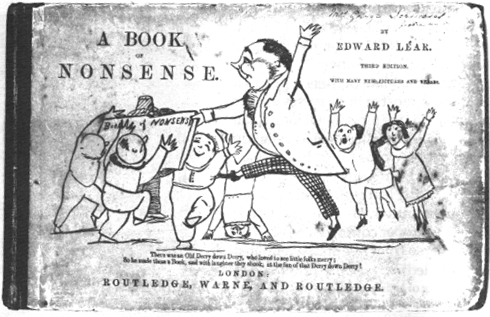
Lear had clearly started planning a new edition of the Book of Nonsense and was thinking of using woodcuts rather than the lithographic process he had used for the 1846 and 1855 editions, probably in order to reduce costs.
There will be more references to work on new “nonsenses” in the coming weeks, but you will have to wait for those; however, here is a passage from a letter he wrote to Emily Tennyson on 6 March:
… since I asked people to come & see my pictures, they come, ― horridly & disjointedly; sometimes 20 at a time ― of all kinds of phases of life: sometimes ― for 3 hours no one comes: ― so then I partly sleep, & partly draw pages of a new Nonsense book. If I sleep, I wake savagely at some newcomer’s entrance, & they go away abashed. If I write nonsense, I am pervaded with smiles, & please the visitors.
[V. Noakes. Edward Lear 1812-1888 at the Royal Academy of Arts. London: Roayal Academy of Arts, 1985. 170.]
The Brothers Dalziel are probably the best-known wood engravers of the Victorian age ― they did volumes of illustrated Tennyson poems and Carroll’s Alice books for example. In their 1901 memoir, they wrote of their role in the publication of this third edition:
Early in the Sixties we made the acquaintance of Edward Lear, who was a landscape painter of great distinction, a naturalist, a man of high culture, and a most kind and courteous gentleman. He came to us bringing an original chromo-lithographic copy of his “Book of Nonsense” ― published some years before by McLean of the Haymarket. His desire was to publish a new and cheaper edition. With this view he proposed having the entire set of designs redrawn on wood, and he commissioned us to do this, also to engrave the blocks, print, and produce the book for him. When the work was nearly completed, he said he would sell his rights in the production to us for £100. We did not accept his offer, but proposed to find a publisher who would undertake it. We laid the matter before Messrs. Routledge & Warne. They declined to buy, but were willing to publish it for him on commission, which they did. The first edition sold immediately. Messrs. Routledge then wished to purchase the copyright, but Mr. Lear said, “Now it is a success they must pay me more than I asked at first.” The price was then fixed at £ 120, a very modest advance considering the mark the book had made. It has since gone through many editions in the hands of F. Warne & Co.
Lear told us how “The Book of Nonsense” originated. When a young man he studied very much at the Zoological Gardens in Regent’s Park. While he was engaged on an elaborate drawing of some “Parrots,” a middle-aged gentleman used to come very frequently and talk to him about his work, and by degrees took more and more interest in him. One day he said, “I wish you to come on a visit to me, for I have much that I think would interest you.” The stranger was the Earl of Derby. Lear accepted the invitation, and it was during his many visits at Knowsley that these “Nonsense” drawings were made, and the inimitable verses written. They were generally done in the evening to please the Earl’s young children, and caused so much delightful amusement that he redrew them on stone, and published them as before stated. That is how this clever, humorous book came into existence; a work that will cause laughter and pleasure to young and old for all time. John Ruskin says of Lear’s “Book of Nonsense “:
“Surely the most beneficent and innocent of all books yet produced is the ‘Book of Nonsense,’ with its corollary carols, inimitable and refreshing, and perfect in rhythm. I really don’t know any author to whom I am half so grateful for my idle self as Edward Lear. I shall put him first of my hundred authors.”
[The Brothers Dalziel. A Record of Fifty Years’ Work in Conjunction with Many of the Most Distinguished Artists of the Period. 1840-1890. London: Methuen and Co., 1901. 317-318.]
The NY Times reports that the Master Drawings New York 2011 show is in full swing, and features an Edward Lear watercolour of “The Cedars of Lebanon:”

Andrew Wyld, a London dealer, among many interesting pictures, has several more Edward Lear drawings, among them an oil of “Corfu from the Village of Ascension:”
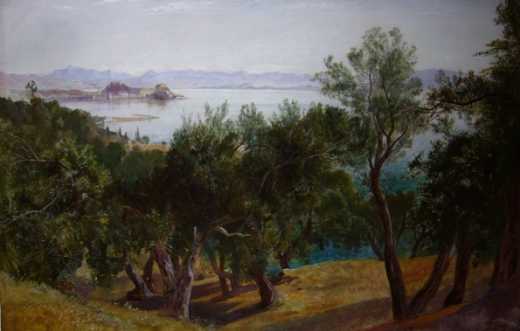
and “Lake Lugano from Monte Generoso,” drawn in 1878, much later than the 1854 watercolours I have been posting:

Peacay of BibliOdyssey posts “some delightful scratchy illustrations from the 1962 book by Ruth Park, ‘The Adventures of the Muddle-headed Wombat'” in honour of Australia Day.
So here is my homage. Dante Gabriel Rossetti’s lament for the death of his wombat, a beast which, according to some, also appears in Carroll’s Alice:
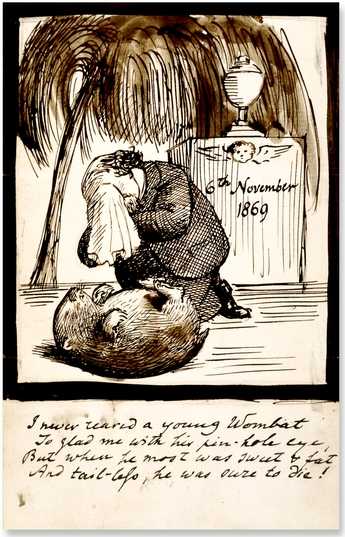
© Trustees of the British Museum
‘I never reared a young wombat
To glad me with his pin-hole eye,
But when he was most sweet and fat
And tail-less he was sure to die’
The inscribed verse is a parody of Thomas Moore’s Lalla Rookh (1817): ‘I never nurs’d a dear gazelle / To glad me with its soft black eye, / But when it came to know me well / And love me, it was sure to die!’ Instead of being layed to rest in the handsome tomb we see here, the unfortunate marsupial was actually stuffed and placed in Rossetti’s entrance hall.
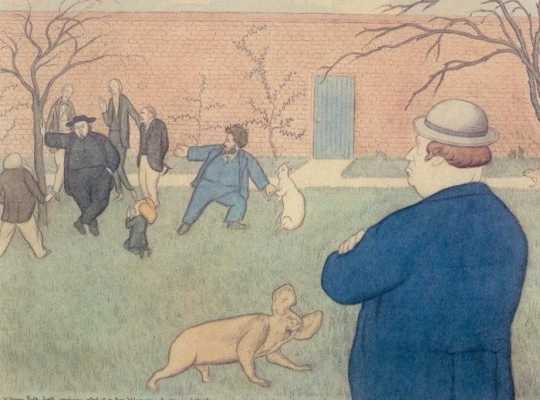
I can’t remember where I got the image above, but it is in the same note as an essay by Harold White Fellow on “Rossetti’s Wombat: A Pre-Raphaelite Obsession in Victorian England,” in the National Library of Australia site. Of particular interest for lovers of Edward Lear:
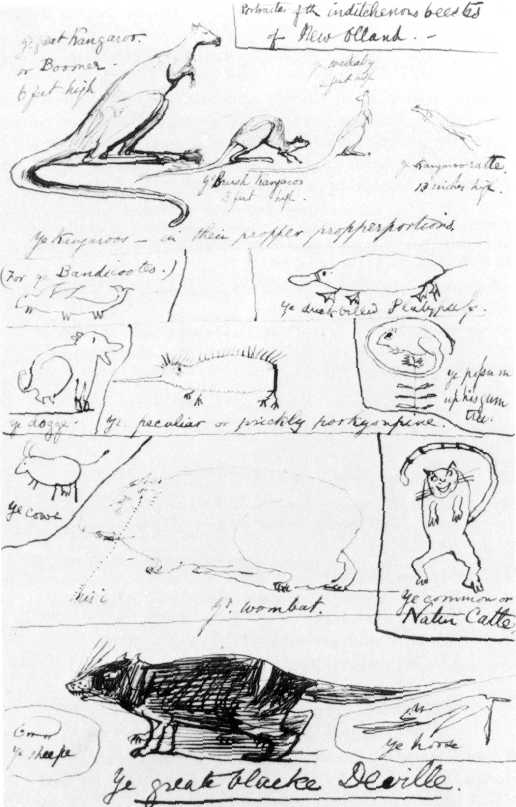
But the most important development in the establishment of the wombat’s English reputation was the appearance in 1855 of John Gould’s de luxe The Mammals of Australia. Gould was in Australia much earlier, in the 1830s, and it was certainly through Gould that the artist Edward Lear, who illustrated Gould’s Birds but unfortunately not the Mammals, made a wonderful sheet of whimsical drawings of the ‘Inditchenous Beestes of New Olland’, a rarity which is today in the collection of the Pierpont Morgan Library in New York. These are plausibly accurate caricatures of various species of kangaroo and wallaby, the platypus, the ‘possum up his gum tree’ and the Tasmanian Devil. There are also mad renderings of the bandicoot, echidna and native cat, not to mention representative appearances in the margin of the cow, the dog, the sheep and the horse. Splendidly rotund and occupying the largest amount of space towards the bottom centre of the sheet is the wombat, with his ‘i’.
Below is a small scan of the Lear image, which was published in the Academy of Art exhibition catalogue.
Two more views from Edward Lear’s 1854 tour of Switzerland.
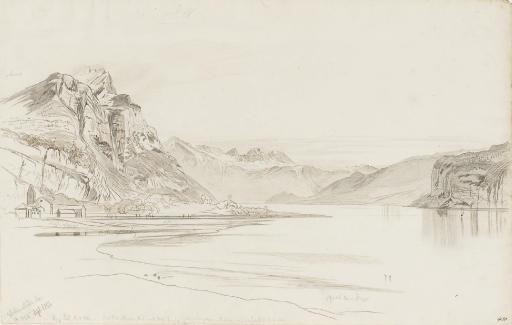
View of Wallenstadt See, Switzerland
inscribed and dated ‘Wallenstadt See./24 & 25 Sept. 1854’ (lower left) and numbered ‘430’ (lower right) and extensively inscribed with colour notes and indistinct inscription ‘I see FL, Chapman, HL & 2 Miss … pale powdery snow with pines …’ (lower centre)
pencil and pen and brown ink on paper
12¾ x 20¼ in. (32.3 x 51.4 cm.)
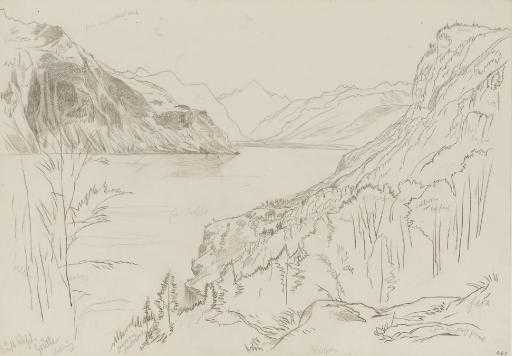
View of Grütte, Switzerland
inscribed and dated ’15th & 16 Sept./Grütte./evening’ (lower left) and numbered ‘443’ (lower right) and further inscribed with colour notes and ‘pines always intensely small’ (upper left)
pencil and pen and brown ink
13¾ x 19¾ in. (34.9 x 50.1 cm.)
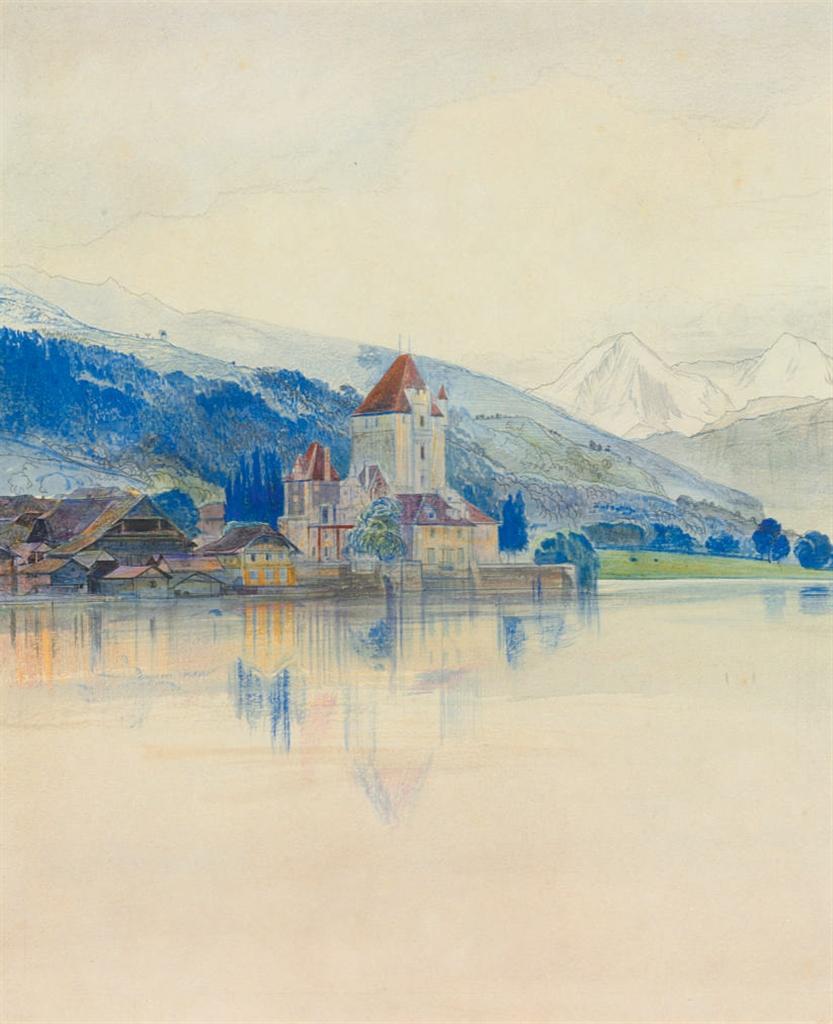
Lake Thun with the Schlöss Oberhofen
pencil and watercolour on paper
12 3/8 x 10¼ in. (31.4 x 26 cm.)
Lear left London for a walking tour of Switzerland on August 1854. On 6 August he wrote to his sister Ann ‘I had no idea really of the beauty of Switzerland – for I never was in the really fine parts, except in 1841 – when I came thro’ by night … The Lake of Thun is one of the most beautiful of all the Swiss Lakes; -such a wonderful pea-blue sea-green!’
To Ann: “I set out to walk to Interlacken[sic]… along the north side of the Lake which is like a garden or park till, towards the east end, when one walks through beautiful shady woods.”
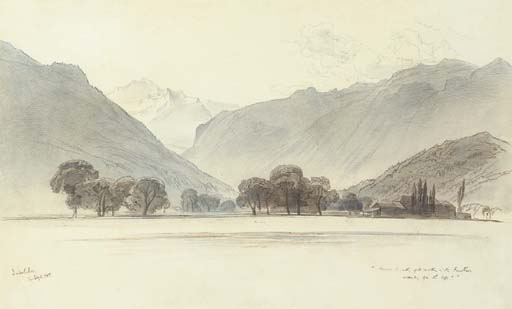
View of Interlaken, Switzerland
inscribed and numbered ‘Interlaken/2.Sept.185’ (lower left) and further inscribed ‘How is the father of the [?] mother in the Faulhorn/ascending on the top?’ (lower right) and further inscribed with colour notes
pencil, blue and brown ink and grey and blue wash
11 x 18¼ in. (28 x 46.5 cm.)
 A Blog of Bosh