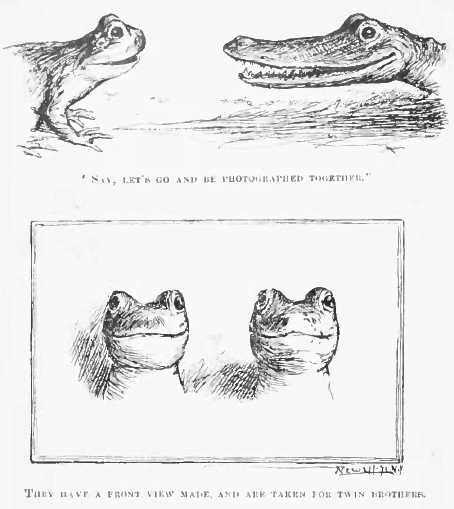
The Frog and the Duck: A Romance

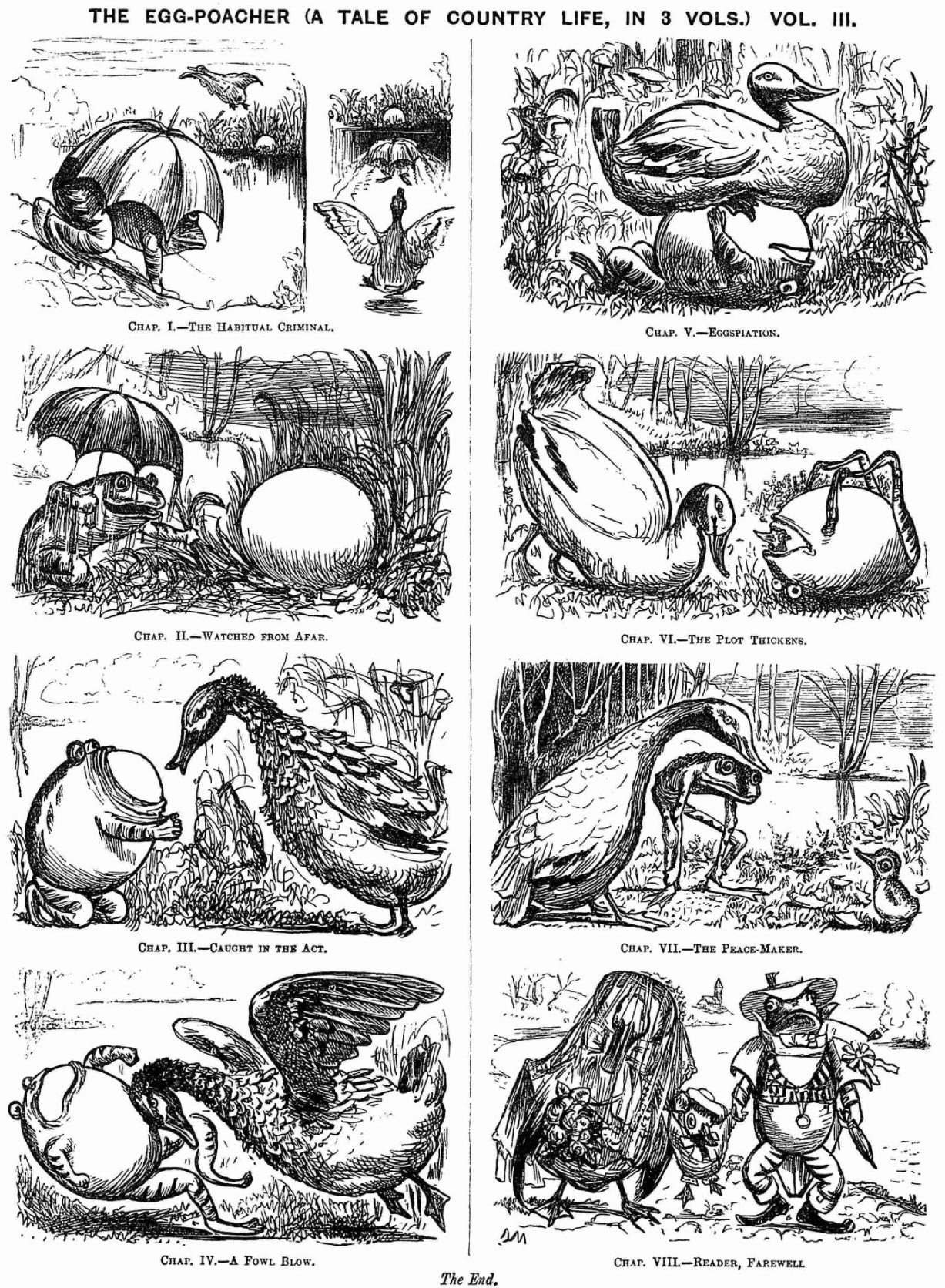
George du Maurier “took, in 1869-1870, a brief Darwinian respite from his usual labors of satirizing the Victorian drawing room” and, among other things, produced an “unusually extensive and charmingly anthropomorphic picture-story” (Kunzle 293), which appeared in three fortnightly instalments in Punch: April 10, April 24 and May 8, 1869 (vol. 56, pp. 146, 174 and 194).

egg-poacher-1s

egg-poacher-2s

egg-poacher-3sAs Kunzle himself observes, the story is based on a complex set of reversals which involve social conventions (a marriage enforced by the female after the birth of offspring) as well as the natural order of things. In this respect the tale is not different from Edward Lear’s “The Owl and the Pussy-cat” with its final interspecies marriage.

Both stories end with the traditional marriage but, unlike Lear, Du Maurier emphasizes the less agreeable elements of interspecies relationships: the first two instalments are centered on predation — one of the most obvious manifestations of Darwin’s struggle for survival — and in particular on what Rose Lovell-Smith calls the “egg-thief motif”.

By 1869 the topos had already had a long history, going back at least to J.J. Audubon’s representation of birds’ nests under attack by serpents: plates 21 (Mocking Bird) and 116 (Ferruginous Thrush) of his Birds of America (1827-1838). It had been taken up in illustrations and natural-history books and perhaps used by Lewis Carroll in the Pigeon episode of Alice’s Adventure in Wonderland (chapter 5).

Lear, notwithstanding his experience as a zoological illustrator, appears less interested in the real-world interactions of the species involved: owls and cats, both preying on mice, are competitors, though in the extreme conditions imagined by Stewart Lee in his 2004 show Pea Green Boat they might well become enemies.

Du Maurier’s choice of a frog as the predator — a parodic version of the more aggressive serpents usually associated to the practice — is in itself a reversal of the natural order, as frogs do not prey on eggs while some ducks feed on amphibians. He then concludes the story by again reversing the predator-victim relationship, when the frog is first used to hatch the egg and then forced into marriage.

The story, however, also functions as a parodic reversal of a more traditional, non-evolutionary theme: it would be difficult not to see in the raping bird a burlesque version of Leda’s swan, again with inverted sexual roles: the duckling which emerges from the egg, while mostly like the mother, has the frog’s eyes and is therefore a hybrid.

Kunzle, David. The History of the Comic Strip: The Nineteenth Century. Berkeley: University of California Press, 1990.

Lovell-Smith, Rose. “Eggs and Serpents: Natural History Reference in Lewis Carroll’s Scene of Alice and the Pigeon.” Children’s Literature 35 (2007): 27-53 (Muse).

See: George du Maurier, Stewart Lee’s “deconstruction” of The Owl and the Pussy-cat.

Here: The Frog and the Heron: A Different Sort of Romance.

Posted in Comics, Edward Lear, Lewis Carroll, Peter Newell | Tagged , , , , , , | 6 Comments

The Hunt for the Scroobious Pip

The Hunt for the Scroobious Pip. Photograph: Tony Bartholomew

The Hunt for the Scroobious Pip. Photograph: Tony Bartholomew

The writer/director team of Andrew Pollard and Adam Sunderland have a fine reputation for turning slightly old-fashioned children’s classics into engagingly low-budget entertainments. They have previously made minimalist masterpieces out of Heidi and The Water Babies: now it’s the turn of Edward Lear’s inspired nonsense verse, whose relative neglect among children’s theatre-makers is as mysterious as the elusive Pip itself.

Read the full review at guardian.co.uk. Also The Stage.

Posted in Edward Lear | Tagged , , | Leave a comment

Autographs

The Victorian age saw a remarkable increase in the cult of personality and a consequence of this was a growing interest in collecting famous people’s autographs. An insatiable demand for historical manuscripts and celebrities’ signatures led to the creation of a public market: starting in the early 1830s, auctioneers held special sales of books and autographs. Thomas Thorpe, one of the best-known booksellers in London, soon became the leading dealer and by 1841 he was able to offer his customers a catalogue of about 16,000 items.

Autograph albums focussing on the owner’s friends were also very common from the early years of the XIX century, and Edward Lear often contributed to those of people he met with drawings and/or short poems.

Occasionally he also sent other people’s autographs to friend-collectors, which is not surprising as he knew many of the important people of the period. On 16 October 1860, for example, he records sending a number of autographs to Gussie Bethell:

Breakfast. 2 nice letters ― from T.G. Baring, ― asking me there: ― & from Gussie Bethell ― asking for Autographs. ― So I sent her Hallam Tennyson’s ― Count de Paris’s, & Holman Hunts. ―

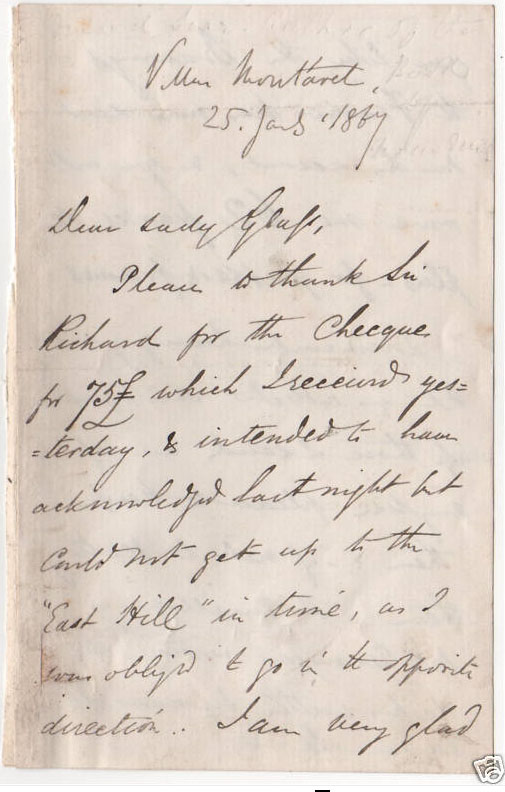
He did the same for Lady Glass in a letter of 1867 which, ironically, was auctioned on eBay some time ago as incomplete: the page containing Lear’s signature having been removed, probably in order to sell the autograph separately. Here is the text of the remaining two pages:

Villa Montaret,
25 January 1867.

Dear Lady Glass,
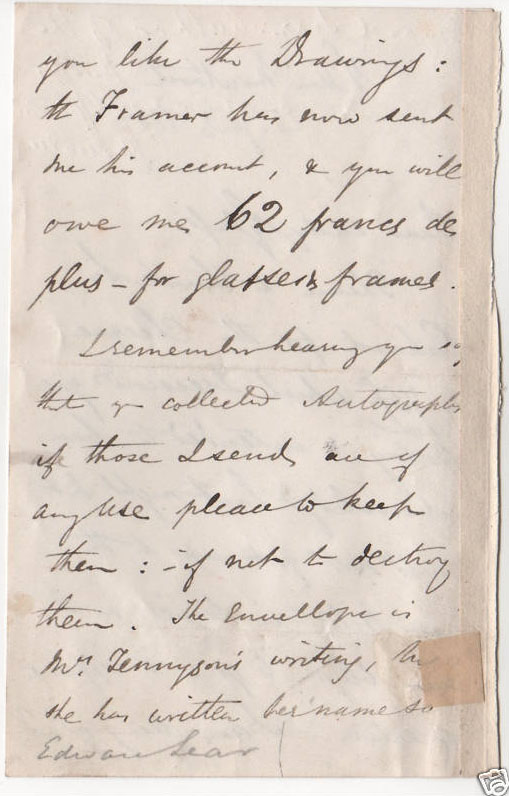
Please to thank Sir Richard for the Cheque for 75£ which I received yesterday, & intended to have acknowledged last night but could not get up to the “East Hill” in time, as I was obliged to go in the opposite direction.  I am very glad you like the Drawings: the Framer has now sent me his account, & you will owe me 62 francs de plus ― for glasses & frames.
I remember hearing you say that you collected Autographs, if those I send are of any use please to keep them: ― if not to destroy them.  The envellope [sic] is Mrs. Tennyson’s writing, and she has written her name so [page(s) missing]

Autographs were still fashionable in the the late Victorian age, when the Picture Magazine, for the most part devoted to reprinting miscellaneous visual material, included a few pages of famous people’s autographs in each of its early numbers.

Also see: A Short History of Collecting Autographs.

Posted in Edward Lear, General | Leave a comment

Another Owl, Another Pussy-cat

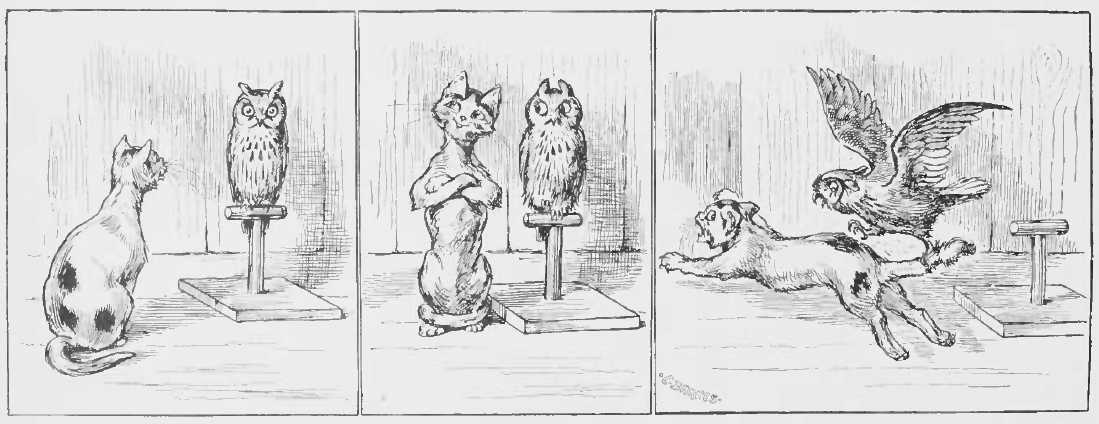
  1. “They call that thing a cat owl. Humph! It may have resembled one of my family before it was stuffed. But now — well —
  2. “I’ll leave it to anybody; does that bundle of hay and feathers look anything like –“
  3. This cat owl  didn’t happen to be stuffed, and could stand such calumny no longer.

C. Barnes, Harper’s Young People, vol. XIV, 1893, p. 336.

Peter Newell also used the structural similarities of animals in a strip that appeared a few months earlier in the same paper:

Harper’s Young People, vol. XIV, 1893, p. 136.

Posted in Comics, Edward Lear, Peter Newell | Tagged , , , | Leave a comment

A Startling Illusion

Peter Newell, The Bubble: A Startling Illusion

Harper’s Young People, vol. XIV, 1893, p. 40.

Posted in Comics, Peter Newell | Tagged , , , | Leave a comment

Who is Karel Drofnatski?

I first came across Karel Drofnatski’s name when reading a review of Bryn Terfel’s CD Silent Noon (DG 000289 477 5336 0, 2004) which includes arrangements of Edward Lear’s “There was an old man with a nose” (“The Aquiline Snub”) and “There was an old man of the Isles” (“The Compleat Virtuoso”). I was quite intrigued, so I also got On This Island (Hyperion CDA 67227, 2001) which I discovered included two more of Drofnatski’s arrangements.

While checking the Edward Lear Discography today I decided to investigate a little and, as I suspected already, found that Karel Drofnatski was a pseudonym used by Sir Charles Villiers Stanford (1852-1924) for his arrangements of Lear’s limericks:

Last, but certainly not least in Stanford’s oeuvre, are the Nonsense Rhymes, settings of 14 limericks by Edward Lear, written for the amusement of his friends. The dates of composition are not known, nor were they published until 1960. The stratospheric opus numbers — 365-78 — are all part of the donnish humour. (In reality, Stanford’s opus numbers reached just under 200.) The work’s full title is ‘Nonsense Rhymes by Edward Lear set to music by Karel Drofnatski,’ a composer who was evidently born at a town on the River Yeffil in the province of Retsniel. (Anyone with a retrogradable turn of mind will quickly decode this.) The settings comprise a series of baroquely elaborate spoofs, each targeting a different composer or style and incorporating wittily embedded quotation, all explained in elaborate after-notes to each song. For example, ‘The Hardy Norse-Woman’ (setting the limerick ‘There was an old man of the Isles’) to ‘Max von Beetelssohn;’ ‘The Absent Barber’ (‘There was an old man with a beard’) to Handel (with help from Sir Henry Bishop); and ‘The Aquiline Snub’ (‘There was an old man with a nose’) to J.S. Bach (Ex. 2.17). There are also parodies of Brahms, Tchaikovsky and Wagner and an all-purpose ‘Limerich ohne Worte:’ ‘a specimen pattern or model, to which any poem of the limerick type can be sung.’ They are so much more amusing than the Irish humours of ‘Johneen’ and the like. But… one feels that when one prefers Stanford’s pastiches to his serious songs, then something must be amiss: that perhaps Stanford didn’t aim very high. (Hold, Trevor. Parry to Finzi: Twenty English Song-Composers. Woodbridge: The Boydell Press, 2002. 56-7.)

The 1960 edition of the manuscript was published in London by Stainer & Bell. The whole series has been recorded by Philip Lawson (baritone) and Howard Moody (piano) for VIF Records in 1997 in their Lyrics and Limericks CD.
Posted in Edward Lear | Tagged , , , | 1 Comment

Edward Lear, the Chaworth Musters, and Lord Byron

Lear never lost an opportunity to explore the places made famous by Lord Byron’s passage, or to hear anecdotes about him. In June 1859, while visiting the Empsons at Wellow, near Southampton, he had the luck to meet one Mr. Long, “to whom at Harrow he, Lord B., always gave 5 guineas when he came down. Mr. L. says Trelawny’s account is infamous ― & false: that B. had only one club foot: that he had seen him frequently ― continually naked in bathing, & that he never wore drawers” (13 June 1859).

Lear must have been very happy to receive a visit from John Chaworth Musters, “of Jerusalem & Annesley fame,” on 9 May 1859, just as he was getting ready to leave Rome. Apparently he had met the young man in Palestine the previous year and now found he had got married in the meantime.

Annesley, Musters’s home, was famous as the residence of the Chaworth family, strictly connected to the Byrons, who lived a few miles away in Newstead. William, fifth Lord Byron, “was, by the vote of one hundred and eighteen of his peers, convicted of the crime of manslaughter in causing the death of William Chaworth, Esquire, of Annesley, in a room of the ‘Star and Garter’ Tavern, Pall Mall, but on the charge of murder he was acquitted” (Tristram, Outram. “An Old Mystery in a New Light. The Byron-Chaworth Affair.” The English Illustrated Magazine, 34, November 1905, 122-37. GB.)

Mary Ann Chaworth at 19

Forty years later, George Gordon, sixth Baron Byron, William’s great nephew, who was to become a star Romantic poet, fell in love with Mary Chaworth, grand niece of the Mr. Chaworth the fifth Baron had killed, and full of disappointment composed a “Fragment. Written shortly after the marriage of Miss Chaworth:”

Hills of Annesley, bleak and barren,
Where my thoughtless childhood stray’d,
How the northern tempests, warring,
Howl above thy tufted shade!

Now no more, the hours beguiling,
Former favourite haunts I see;
Now no more my Mary smiling
Makes ye seem a heaven to me.

Not the kind of poetry that would make him great.

“The young lady herself combined with the many worldly advantages that encircled her, much personal beauty, and a disposition the most amiable and attaching. Though already fully alive to her charms, it was at this period (1804) that the young poet seems to have drunk deepest of that fascination whose effects were to be so lasting; six short weeks which he passed in her company being sufficient to lay the foundation of a feeling for all life. With the summer holidays ended this dream of his youth. He saw Miss Chaworth once more in the succeeding year, and took his last farewell of her on that hill near Annesley, which, in his poem of ‘The Dream,’ he describes so happily as ‘crowned with a peculiar diadem.'” In August, 1805, she was married to John Musters, Esq.; and died at Wiverton Hall, in February, 1832, in consequence, it is believed, of the alarm and danger to which she had been exposed during the sack of Colwick Hall by a party of rioters from Nottingham. The unfortunate lady had been in a feeble state of health for several years, and she and her daughter were obliged to take shelter from the violence of the mob in a shrubbery, where, partly from cold, partly from terror, her constitution sustained a shock which it wanted vigour to resist. (The Works of Lord Byron: with his Letters and Journals, and His Life, by Thomas Moore, vol. 7, 43 and note 2. GB.)

A much less romantic account of the affair, and perhaps one that is easier to believe, is the one in Ethel Colburn Mayne’s Byron (New York: Charles Scribner’s Sons, 1912, 53-68. GB) where however we find (p. 59):

The days were spent in riding with Mary and her cousin, in sitting lost in dreams beside her, and in shooting at a door which opened on the terrace of the Hall, and which, when Moore wrote, “still bore the marks of his shots.”

During his first visit to Annesley in November 1859, the young Mrs. Chaworth Musters told him everything about the family’s tragic history from the time of Mary, and showed him around the house; Lear was amazed to see that “the door, with pistol shots of Lord B. still  stands” (19 November 1859). So interested was he in Mary Chaworth’s family that the following day he drew a family tree of her descendants (20 November 1859).

The highlight of his visit to the Chaworth Musters in 1860 was a ride to Byron’s residence in Newstead and a tour of the house, now owned by one Colonel Wildman:

We walked half round the water ― & I drew. Then the house ―: the lower monked rooms: the Cloisters, the gardens, so beautiful! The terraces! the close alleys & ponds: the balustrades & the Abbey arches ― the Dogs tomb. ― Inside, the tapestry & rooms, & endless care of Col. Wildman: the room of Byron  ― just as it was: the great drawing room ― & the dining room: the skull ― &c. &c. All so sad & wild & strange, remembering too as I did all my early thought & reading ― & that I had thought also at Janina & Greece ― & Spezzia. ― A strange dream. (3 November 1860)

Lear realized that the Chaworth Musters were a little annoyed at his interest “for indeed they consider … that Lord B.’s verses & admiration of their grandmother was a liberty,” but he seems to have been unable to check his enthusiasm.

Also see The Chaworth-Musters family: a brief history.

Posted in Edward Lear | Leave a comment

Lear on Facebook

I did not know Edward Lear had a Facebook profile until Benjamin Charavner emailed me. On the other hand, who hasn’t one nowadays?

I find the music there stangely meloobious.

Posted in Edward Lear | Tagged , , | Leave a comment

The French Princedom

It is well known that Edward Lear gave painting lessons to Queen Victoria and was never forgotten by the royal family. The Prince of Wales, for instance, visited his studio while in Rome in 1859 and Lear sounds relieved after having recorded in his diary a number of the Prince’s visits to other artists in the previous month. He noted that “he staid 1 hour & 5 minutes” and found that “nobody could have nicer or better manners than the young Prince, nor be more generally intelligent & pleasing” (29.iii.59, see all diary entries).

But Lear was also more or less regularly in contact with former French royalty, or “French Princedom” as he writes on 29 October 1860, whom he met at Lady Waldegrave’s various residences.

The Duc and Duchesse d’Aumale were enthusiastic neighbours of the Countess and often visited or invited her and her guests. Despite disapproving the formality of such occasions (“they do not forego royal ways,” he writes on 27 October), Lear rather liked the members of this small aristocratic French colony.

Aumale, circa 1880.

Prince Henri, Duc d’Aumale (1822-1897) lived at Orleans House, near Lady Waldegrave’s Strawberry Hill. He was immensely rich, having inherited a fortune of 66 million livres (approximately £200 million today) as well as the lands and wealth of his godfather, Louis VI Henri de Bourbon-Condé, the last prince de Condé. In 1844 he had married Princess Maria Carolina Augusta of Bourbon-Two Sicilies, daughter of Leopold, Prince of Salerno and his wife Archduchess Maria Clementina of Austria, in Naples. They had two sons, the “young” Prince de Condé (Louis Philippe Marie Léopold of Orléans, Prince of Condé, 1845–1866) whom, being “genuinely pro-English,” both Lady Waldegrave and Lear especially liked, and the Duc de Guise (François Louis of Orléans, Duke of Guise, 1854–1872).

From the time of their introduction to Lady Waldegrave, she “was never free of the Orleans family… They monopolized her, they exhausted her, they bored her. They alienated her other friends by their everlasting presence, they infuriated her by their ingratitude to England where twice in exile they were welcomed” (Hewett, Fortescue 98).

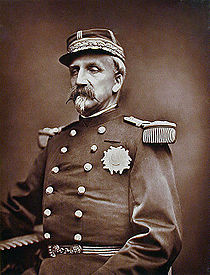
After the death of the Duchesse d’Orléans, Aumale took charge of her two sons, the Comte de Paris and the Duc de Chartres.

Comte de Paris, 1862

Philippe d’Orléans, Comte de Paris (1838–1894) was the grandson of Louis Philippe I, last King of the French and became the Prince Royal, heir-apparent to the throne, when his father, Prince Ferdinand-Philippe, died in a carriage accident in 1842.

On 8 October 1860, Lear left Oatlands, where he was painting the Cedars of Lebanon, to show his drawings to Paris, Chartres and Joinville: “They were much pleased: as I was with them, especially with the C.te de Paris, who is peculiar for fun, amiability, & knowledge of what he has seen.”

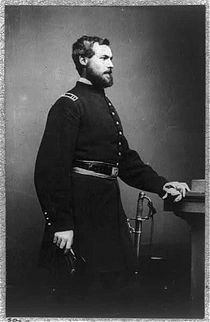
This trio (François Ferdinand d’Orléans (1818-1900), prince de Joinville being the young men’s uncle and a brother of Aumale’s) would then  take part in the American Civil War on the side of the Northern forces, just when French and British sympathies were intensely pro-South, no doubt another embarassment for Lady Waldegrave.

On arriving at Strawberry Hill on 27 October 1860 Lear heard that they were “all to dine ― o! botheration ― at Orleans House ― so at 8 we went there. Dinner party ― the Duke & Duchess ― & young Prince de Condé: ― Lady of honour, Tutor, Marquis de Somebody & son. Dinner good, but an awful bore to me ― who can’t bear royalty life.”

Jean-Léon Gérôme, Duel after a Masquerade, painted for the duc d'Aumale in 1857

Not even the prints he can admire after dinner save the night for him: “Afterwards saw some very valuable miniatures, from Francis 1st  downwards. Louis 14 ― 15 &c. & Louis Philippe at 12: ― with the Prince of Salerno as a naked Cupid of 3! DelaRoche’s murder of the Duc de Guise ― & Gerome’s Duel ― & a Lumi are striking pictures, with Scheffer’s last work, The Queen of the French’s portrait. But I grew “very weary” ― & was too glad to talk to Sir H. Willoughby ― & came away at 10.30.”

Paul Delaroche, L'assassinat du duc de Guise

Also see Osbert Wyndham Hewett’s ‘… and Mr. Fortescue.’ A Selection from the Diaries from 1851 to 1862 of Chichester Fortescue, Lord Carlingford K.P. (1858) and Strawberry Fair. A Biography of Frances, Countess Waldegrave, 1821-79 (1956).

Posted in Edward Lear | Tagged , , , | Leave a comment

A Game of Croquet without Rules

Published in Harper’s Young People June 30, 1885

Posted in Peter Newell | Tagged , , , , | Leave a comment