Edward Lear Letters at the Glamorgan Archives

A group of important documents from the Aberdare family, previously on loan, have been permanently acquired by the Glamorgan Archives. These include a number of letters from Edward Lear to Henry Bruce and his wife, Arabella Beadon. One of these features a self caricature showing Lear riding his cat Foss.

Henry Austin Bruce, whom Lear met in Rome about 1844 (Levi 108) was created first Baron Aberdare by Queen Victoria in 1873. The family’s large fortune was due to the coal mines they owned in Wales and Bruce was one of Lear’s most generous patrons.

For more information on the acquisition see BBC News, BristolWired, or walesonline.co.uk.

Posted in Edward Lear | Tagged , , , , , | Leave a comment

Edward Lear and G.F. Bowen

Lear first met George Fergusson Bowen in Rome in 1847, accepted his invitation to visit Corfu, and even considered the possibility of taking a post at the University of Corfu. In a letter to Ann during his first visit to Corfu, he is “my very good friend Mr. Bowen.”

However, by 1858, when we can read his unmediated opinions in the diaries, Bowen has become a “brute” (11 September 1860) and a “beast” (22 August 1859). The reason for this change was no doubt Bowen’s scheming against Lear’s friend Franklin Lushington, a judge of the Supreme Court of Justice in the Ionian Islands at the time.

Becoming Chief Secretary to Sir John Young, Lord High Commissioner of the Ionian Islands, in 1854, he was then appointed first Governor of Queensland (1859, Lear heard of this on 10 May 1859), then in rapid succession of New Zealand (1867), Victoria (1873), Mauritius (1879), and Hong Kong (1883) until his retirement in 1887.

While in Corfu, Bowen married the Contessa Diamantina di Roma, who would be quite popular during their residence in Brisbane, according to “Diamantina Roma – First Governor of Queenslands’ wife. A biographical note” by the current appointed Governor of Queensland, Ms Quentin Bryce, AC. (More info.)

I found the links via Jim Potts’s Corfu Blues blog, where he posts the full poem quoted in the “Note:”

Diamantina Roma and the Postings of Governor Bowen

That selfish brute Bowen
Got Corfu, then Brisbane,
New Zealand and Melbourne !
Missed out on New South Wales !
Twenty years down under,
Sir Gorgeous Figginson Blowing+,
Too long for Diamantina,
A lady of  delicate health.
Ill on the day of the Ball.
Men of the toga, from Oxford
(Consolidate ! Assimilate!)
Cared little, if at all.
Diamantina of the isles of Greece,
Hosting endless boring dinners
And receptions great and small,
You always yearned for perfect peace
Amongst the Corfu olive groves.
I know when  it  began to pall.

Also of Learian interest is the announcement of an exhibition in 2012.

Jim Potts has recently published a book about The Ionian Islands and Epirus: A Cultural History which can be previewed on Google Books.

Posted in Edward Lear | Tagged , , , , , | Leave a comment

Here we go!

Just a short post to see that the new blog and the RSS feeds are working properly. For information on this new (and hopefully improved) Blog of Bosh see the About page.

Posted in General | Tagged | Leave a comment

Edward Lear by Ian Malcolm

You can now read Ian Malcolm’s 1908 overview of Lear’s career (mostly from the point of view of the Baring family) in the Nonsense section of the site bookshelf:

Ian Malcolm, “Edward Lear.” The Cornhill Magazine, vol. 24, January 1908, pp. 25-36, as reprinted in The Living Age, vol. 256, no. 3319, 15 February 1908, pp. 467-75.

I have also added, in the Comics section, a long article on Ally Sloper:

Elizabeth Robins Pennell. “The Modern Comic Newspaper. The Evolution of a Popular Type.” The Contemporary Review, vol. 50, October 1886, pp. 509-23.

Posted in Comics, Edward Lear | Leave a comment

The Jumblies Comic

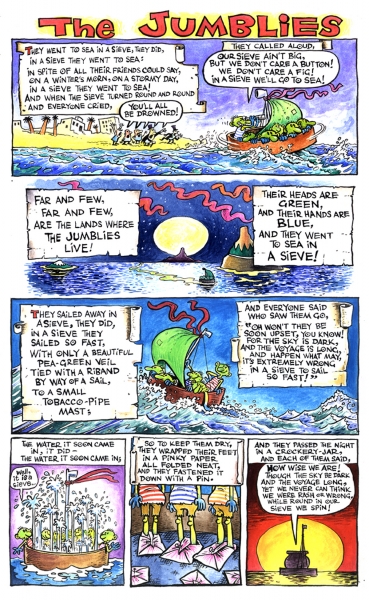
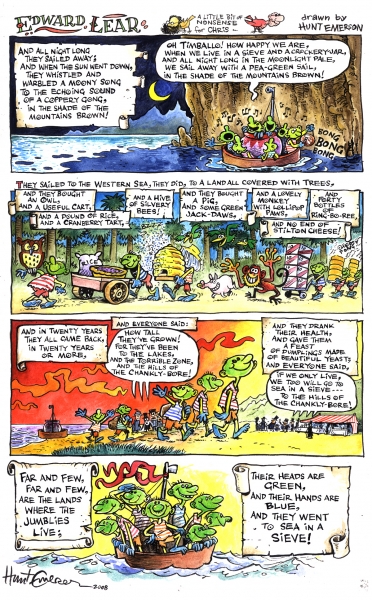
Hunt Emerson, whose comic book adaptation of Edward Lear’s “The Owl and the Pussy-cat” was mentioned in a previous post, has also posted a version of “The Jumblies,” executed as a private commission. Click on the images below to get larger ones.

Jumblies_1Jumblies_2

Posted in Comics, Edward Lear | Leave a comment

An Exile in Paradise

Derek Smith of Lear Productions informs me that their documentary on Lear’s travels in Albania and Greece, which won the Arts Silver World Medal at the 2009 New York Festivals International Television Programming and Promotion Awards, will be shown again on Sky Arts in December on both high definition and standard definition channels (the links below are not working for me at the moment, but were last night):

Posted in Edward Lear | Leave a comment

Edward Lear and George Grove

One of the most famous of Edward Lear’s self caricatures is certainly the one in which he portrays himself while looking straight into the eyes of a strange “bug,” which is itself gazing at him. I had never cared to check where the image came from, but today, while doing some reasearch for the Diaries project, I found it illustrated a letter Lear sent to George Grove, immortalised in the title of Grove’s Dictionary of Music and Musicians.

remarkable_fungus_(Grove)

Lear was first introduced to Grove by William Holman Hunt on 14 November 1859 and, from the confidential tone of the letter below, a friendship was formed, probably based on the interest in the East the two men shared. The letter also makes clear that the “bug” is actually a toadstool.

Here is the relevant passage, including the nonsense-rich letter, from Graves’s 1903 biography of Grove:

On his return to Sydenham, Grove was at once engaged in the preparations for the Flower Show, held at the Crystal Palace on September 20th {1860}, when he was specially attracted by the Gladiolus exhibit. Next day he remarks in his note-book that “the round hills about Caterham struck me as not unlike Benjamin. For the smooth rocklike flagstones see the East Hill at Hastings half way up,” and the possibility of his paying a second visit to Jerusalem is mentioned in a letter written a month later to his friend, Mr. Bergheim. Entries in his note-books prove him to have already begun to take an interest in the music of Schubert — who afterwards became “his existence” — while a further proof of his Solomon-like versatility is shown by a sudden desire to collect toadstools, evidence of which is forthcoming in the following highly characteristic illustrated letter from Edward Lear, the artist and humorist, to whom he had been attracted by their common interest in the East:

“Oatlands Park Hotel,
“Walton On Temms, Surrey,
“15 Nov. 1860.

“Dear Grove

“I Hasten to inform you that in a wood very near here, there are Toadstools of the loveliest and most surprising colour and form:— orbicular, cubicular and squambingular, and I even thought I perceived the very rare Pongchambinnibophilos Kakokreasopheros among others a few days back. You have therefore nothing better to do than to come with Penrose and hunt up and down St. George’s Hill for the better carrying out of the useful and beastly branch of science you have felt it your duty to follow. Provided also that you bring your own cooking utensils you may dine off your gatherings though I won’t partake of the feast, my stomach being delicate.

“Seriously, however, I should indeed like to see both F. Penrose and yourself here:— couldn’t you send a line first, and come over to luncheon? though it would be far better if you came and dined and slept and then toadstooled all the next day—back to Sydenham or as you pleased. Saturdays and Sundays are my only insecure days, but those are the days also you would be least likely to think of coming. Daddy [i.e. Holman] Hunt writes to me that he is coming soon:— it would be very nice if we could all combine.

“Besides the seedars — you would see 11 other unfinished vorx of art—not to speak of a good many sketches. My life passes daily in a different place, Lebanon, Masada, the Tiber, — the Cervara Quarries, — Philates, Zagori, — Philae, — S. Sabbas, — Damascus, Bethlehem, Beirut, and Interlaken. But I confess that a little more society would sometimes be pleasant — for painting, Greek, music, reading and penning drawings are all used up by the end of the day. Various friends, however, write and come — so I don’t complain.

“If you let me know — shall I send out and gather toadstools in hampers for you? You can sit and pick them in the large hall.

“O ! that I could get back to Jerusalem this spring !

“Goodbye.
“Yours,
” Edward Lear.”

Graves, Charles Larcom. The life & letters of Sir George Grove, Hon. D.C.L. (Durham), Hon. LL.D. (Glasgow), formerly Director of the Royal College of Music. London: Macmillan, 1903, pp. 79-81. (Google Books)
Posted in Edward Lear | Leave a comment

Polly Sleepyhead

My translation of the early episodes of Peter Newell’s Naps of Polly Sleepyhead will be in Italian libraries next week, and the publisher, orecchio acerbo, has a book trailer on YouTube:

This is going to be in the Little Big Books format, which I found suits Polly’s adventures very well.

Posted in Comics, Peter Newell | Leave a comment

Verbeek's Botanies

Sunday Press has announced the availability of their new collection reprinting in full colour the whole run of  Gustave Verbeek’s The Upside-Downs of Lady Lovekins and Old Man Muffaroo, the late Terrors of the Tiny Tads, as well the first complete collection of The Loony Lyrics of Lulu. While writing an introduction for this last strip I collected more material on Verbeek’s connections to Nonsense literature than could fit the pages of the book, so I’ll be posting some of my notes here in the coming weeks.

The Terrors of the Tiny Tads ran in the New York Herald for several years and its style, both graphic and narrative, changed considerably. The more obviously nonsense-influenced strips tend to be the early ones, which are rougher in appearance and tell more violent stories.

The series is famous for its hybrid animals, but several episodes included vegetable beings in the tradition of Edward Lear’s “Botanies.” The June 23, 1907 episode, for instance, presents a series of predator-flowers that are probably at least in part based on Lear’s “Tigerlilia Terribilis” and “Barkia Howlalowdia” (click to read the whole strip):

ttt_1907-06-23_d

tigerliliabarkia

Verbeek’s Dandelioness, which does not really look particularly ferocious, will reappear in the October 3, 1909 strip in a much less violent context:

ttt_1909-10-03_d

Sometimes the vegetable nature of the hybrids is dominant, as in the examples above, sometimes the animal part is the stronger and the creatures can move, and often become dangerous, as in this December 1, 1907 strip:

ttt_1907-12-01_d

Posted in Edward Lear, Gustave Verbeek | Leave a comment

The Grave of Edward Lear

Mr. Eden Phillpotts, […] who lives in Devonshire and spends all his time in the beautiful English country, has written a book called “My Garden,” which will be published by the English Country Life. It is the thoughts of a literary man who is something of a gardener. There is no subject upon which Mr. Phillpotts writes that he does not illuminate, and I hope that some enterprising American publisher will soon issue his garden book.

Mr. Phillpotts has been good enough to send me a sonnet on ” The Grave of Edward Lear” that he published recently in that admirable journal, The Tribune, of London. Here it is:

Amid the silent lodges of the dead,
Beneath the terraced hills of Italy,
He lies, with sunny cypress at his head
And mourning purple of the fleur-de-lys
Upon his marble. Roses white and red
Twine there, and round about the mystery
Of olive groves their twinkling silver spread
Along the sapphire of the Inland Sea.
Sleep, laughter-maker of a vanished day.
What merry jester of them all can vie
With your mad fancies, whimsical and gay?
No sorrow here! We’ll pass this pillow by
In happiness of gracious thoughts, and pay
The tribute of a smile; but not a sigh.

In sending this sonnet to The Tribune, Mr. Phillpotts wrote:

Among the notes and sketches brought home with me from my holiday in France and Italy, I find this little sonnet, written last month. Edward Lear, the famous author of the ‘Nonsense Book’ — perhaps the first real nonsense book ever written — lies at San Remo, and his flowery grave inspired these lines.

It is not all of us who could express our feelings for Edward Lear as gracefully as Mr. Phillpotts has done. We all love him, and have loved him from our childhood to older age. He has left no successor. There are any number of men and women writing nonsense, but it is not the nonsense of Edward Lear.

The Critic, vol. 49, no. 1, July 1906, pp. 11-3.

Eden Phillpotts‘s poem was then published in his Wild Fruit (London: John Lane, 1911, p. 100).

Posted in Edward Lear | Leave a comment