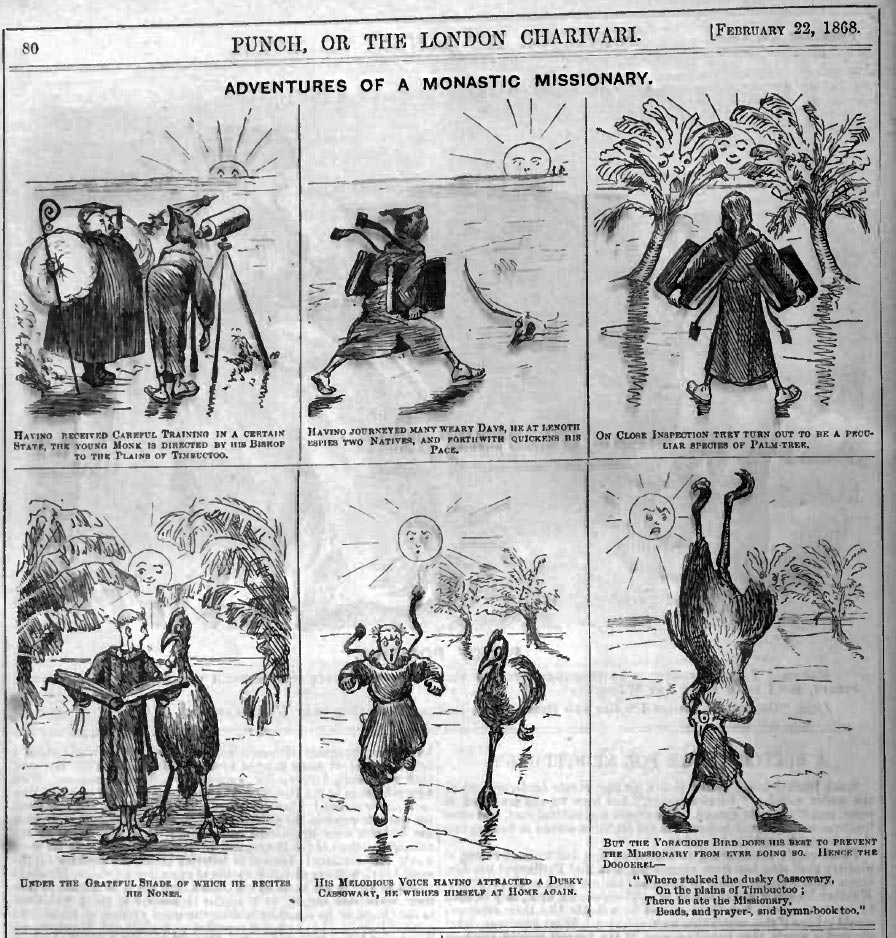
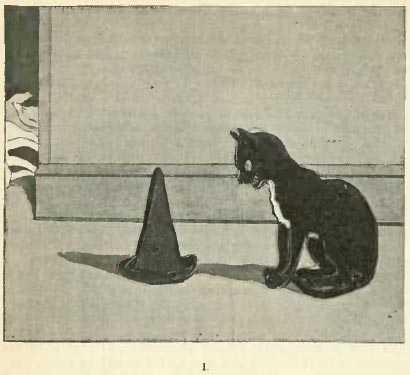
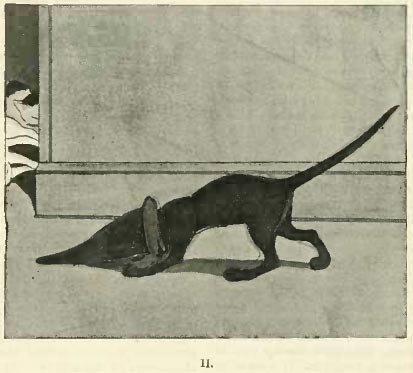
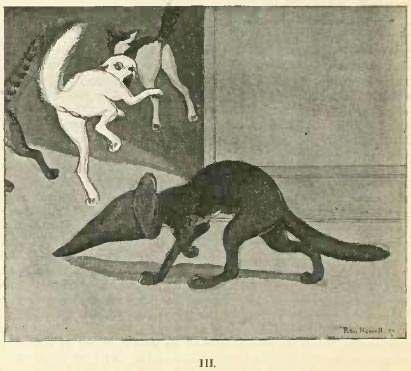
The tragic consequences of being a missionary in Timbuctoo were the subject of one of the infrequent comic strips in Punch (22 February 1868, vol. 54, pp. 80-1).
The little poem around which the story turns is known in several different versions and has been variously attributed, but, as far as I know, no final agreement has been reached; most commentators, however, seem to agree as to the circumstance in which it was composed: the 1829 poetry challenge won by the young Tennyson, whose subject was “Timbuctoo.” You will find some of the versions and hypotheses at the end of this post.
The quatrain is a good illustration of how nonsense is often generated; Lear’s limericks, which almost invariably have a city name at the end of the first line, repeatedly use the same techique. Rhyming with “Timbuctoo” is a challenge, but the phonological sequence |’ɪmbʌktu:| suggested “hymn-book, too” and the hymn-book a missionary, whose sound in turn made “cassowary” a possibility. The notorius undiscerning voracity of the bird sealed the poor preacher’s fate.
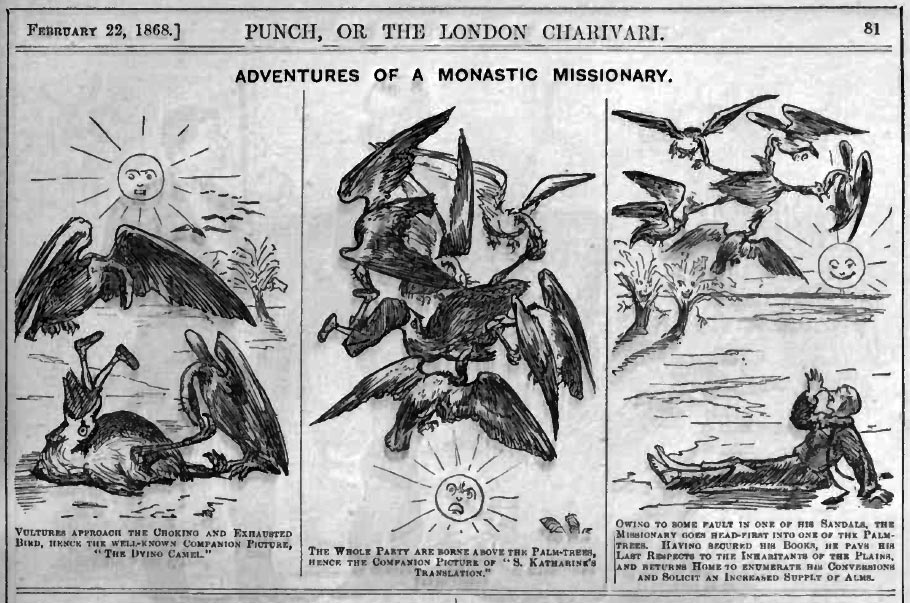
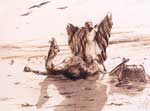
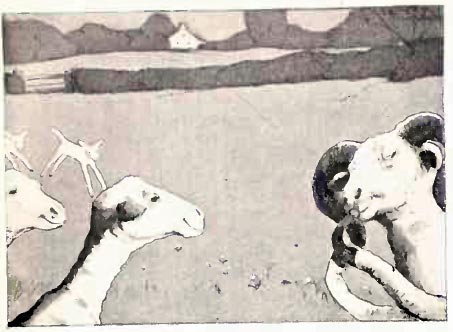
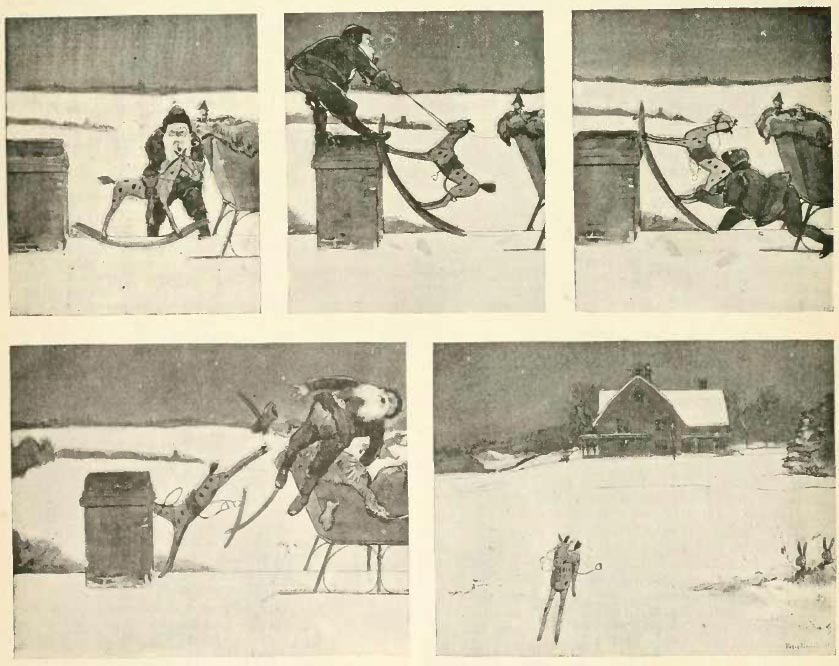
The Punch artist added a coda to the story which combines a traditional escape from danger with parodies of presumably well-known pictures: “The Dying Camel” of the first panel is a reference to Henry Hope Crealock‘s “Arab and Dying Camel,” even the very small picture I was able to find is enough to show the similarities:
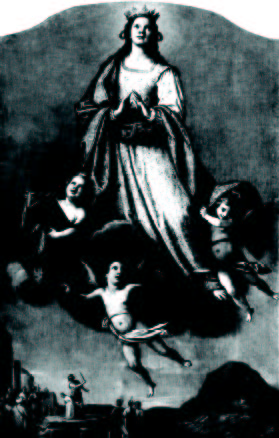
The reference in the second panel is more difficult to identify: Saint Catherine of Alexandria‘s body was carried to Mount Sinai by angels, but the only depiction of the event I have been able to find is a 1612 painting by Jacopo Chimenti which does not really have much in common with Punch‘s picture:
Notes & Queries, 3rd Series, IV. September 5, 1863, p. 188.
RIDDLE: RHYME TO TIMBUCTOO. What is the answer to the following?
“My first, invisible as air,
Apportions things of earth by line and square.
The soul of pathos, eloquence and wit,
My second shows each passion’s changeful fit.
My whole, though motionless, declares
In many ways how everybody fares.”
While on such a subject, I add that I have heard from at least a dozen quarters that I am the author of a rhyme to Timbuctoo which has amused many. The rhyme is as follows:
I would I were a cassowary,
On the plains of Timbuctoo ;
I’d catch and eat a missionary,
Legs and arms and hymn-book too.
This is not mine ; but I believe I was one of the first dozen who heard it. A. DE MORGAN.
Notes & Queries, 7th Series, I. February 27, 1886, p. 171.
RHYMES ON TIMBUCTOO (7th S. i. 120).— A. F. will find the lines referred to given by PROF. A. De MORGAN in ‘N. & Q.,’ 3rd S. iv. 188. He seems to have known who wrote them. It is a pity he did not say. The version I have always heard differs slightly from that there given, being as follows:—
If I were a cassowary
On the plains of Timbuctoo,
I would eat a missionary,
Blood and bones and hymn-book too;
and I always understood it was an impromptu of Theodore Hook’s in response to a challenge that he could not make a rhyme to Timbuctoo.
A. F. will find the same rhyme with different verses in ‘N. & Q.,’ 3rd S. x. 330 and 4th S. vi. 308. Here is another rhyme, however :—
When Jim and I stalked cassowaries
On the plains of Timbuctoo,
We met three wily adversaries,
I booked one and Jim booked two.
J. B. FLEMING.
I have understood that Bishop Samuel Wilberforce composed this quatrain, being challenged to find a rhyme to the word Timbuctoo. It is as follows:—
If I were a Cassowary
On the plains of Timbuctoo,
I would eat a missionary,
Coat and bands, and hymn-book too.
A. J. M.
[MR. F. C. BIRKBBCK TERRY writes to the same effect as A. J. M., and supplies a slightly different version.]
Ibid., p. 235
RHYMES ON TIMBUCTOO (7th S. i. 120, 170).— Bishop Wilberforce was far too good an ornithologist to place a cassowary in Africa. The first line of the rhymes might be changed to
If I were a lion hairy.
But why should the missionary’s death be made the subject of the lines? The gentle bird, the cassowary, being dismissed as a creature unknown in Africa, the following rhymes might be fitted to “missionary” and “Titnbuctoo,” if that is the feat to be accomplished:—
Riding on a dromedary
O’er the plains of Timbuctoo,
Comes the British missionary,
With his tracts and hymn-book too.
J. DIXON.
Ibid., p. 337
RHYMES ON TlMBUCTOO (7th S. i. 120, 171, 235).- These rhymes possess a literary interest, and imply a definite date, of which your correspondents do not seem to be aware. In 1829 Alfred Tennyson, then an undergraduate at Trinity, gained the Chancellor’s medal for a prize poem, for which the assigned subject was Timbuctoo. Cambridge tradition affirms that when the subject was given out it was said to be impossible to find a rhyme to Timbuctoo, and several university wits tried their hands at a sort of burlesque competition for the prize, with results which your correspondents have chronicled. The orthodox version of the best of those you give is, I believe,—
If I were a cassowary
On the plains of Timbuctoo,
I would eat a missionary,
Prayer Book, Bible, and hymn book too.
Charles P.G. Scott. “The Malayan Words in English. (First Part.)” Journal of the American Oriental Society, XVII, 1896, pp. 93-144.
The bird is mentiond, under a name now current as emu, in the following passage:
In Banda and other Ilands, the bird called Emia or Eme, is admirable. It is foure foot high, somewhat resembling an Ostrich, but hauing three clawes on the feet, and the same exceeding strong: it hath two wings rather to helpe it running, then seruiceable for flight: the legges great and long.
1613 PURCHAS, Pilgrimage, p. 430.
The first English mention of the name cassowary appears to refer to a bird brought to England:
St. James his Ginny Hens, the Cassawarway moreover. (Note by Coryat. An East Indian bird at St. James in the keeping of Mr. Walker, that will carry no coales, but eat them as whot you will.)
1611 PEACHAM, in Paneg. verses on Coryat’s Crudities, sig. 1. 3 r° (1776). (S. D.)
A Cassowaries or Emeus Egg.
1673 J. RAY, Journ. Low Countr., p. 28. (S. D.)(See other quotations in S. D. and N. E. D.)
The Cassawaris is about the bigness of a large Virginia Turkey. His head is the same as a Turkey’s; and he has a long stiff hairy Beard upon his Breast before, like a Turkey.
1705 FUNNEL, in Dampier’s Voyages, 4:266 (1729). (Y.)Cassawary, or Emeu, a large Fowl, with Feathers resembling Camels-Hair.
1708 and 1715 KERSEY.
Another large and extraordinary bird is the Cassowary, which inhabits the island of Ceram only. It is a stout and strong bird, standing five or six feet high, and covered with long coarse black hair-like feathers. The head is ornamented with a large horny casque or helmet, and the bare skin of the neck is conspicuous with bright blue and red colours. The wings are quite absent, and are replaced by a group of horny black spines like blunt porcupine quills…. This bird is the helmeted cassowary (Casuarius galeatus) of naturalists, and was for a long time the only species known.
1869 WALLACE, Malay Archipelago (1890) p. 305.See also 1774 GOLDSMITH, Hist, of the earth (1790), 5:6, p. 67, 73 (Jodrell); 1856 CRAWFURD, Descriptive diet., p. 84; 1869 BICKMORE, Travels in the East Indian Archipelago, p. 150; 1889 WALLACE, Darwinism, p. 115.
The unreflecting voracity of the bird appears in the quotation in which he eats coals “as hot as you will.” In the “experience,” or at least in the travels, of a warlike German, quoted by Yule (1644-1659) he, the cassowary, swallowd 50 bullets, of a size not stated. According to a popular rime, the cassowaries of Timbuctoo, which are ignored by the leading ornithologists, make light of a still heavier diet:
If I were a cassowary,
Far away in Timbuctoo,
I would eat a missionary,
Hat and boots and hymn-book, too.
a. 1880 Auctor incert., loc. non cit.
The New York Times, 25 February 1906
That Poor Missionary!
Was it a Cassowary, a Dromedary, or a “Lion Hairy” That Ate Him?
To the Editor of the New York Times:
How do such perversions of the authentic version occur? Written by Thackeray as a challenge to find a rhyme for Timbuctoo, when Tennyson in 1829 won the Chancellor’s medal at Cambridge with the poem “Timbuctoo,” the final rendering reads:
Riding on a dromedary
O’er the plains to Timbuctoo,
There I met a lion hairy
Eating up a missionary,
Hat, and coat, and hymnbook, too.
Thackeray first wrote “cassowary,” but changed it to “lion hairy,” when informed the habitat of the cassowary was Malaysia, a few thousand miles southeast of the Saharan plains.
EnCycLopedi-CusS.
New York, Feb. 22, 1906.
 A Blog of Bosh