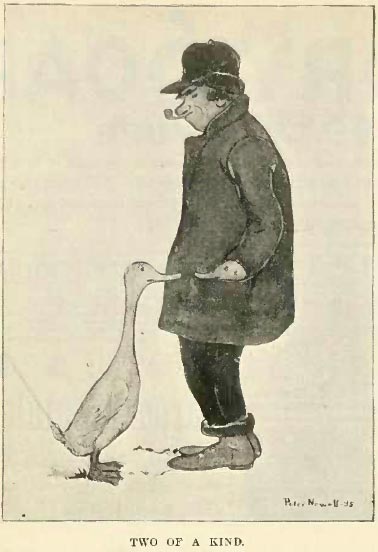
Peter Newell from Harper’s Round Table, vol. XVI, no. 820, 16 July 1895, 736.
Peter Newell from Harper’s Round Table, vol. XVI, no. 820, 16 July 1895, 736.
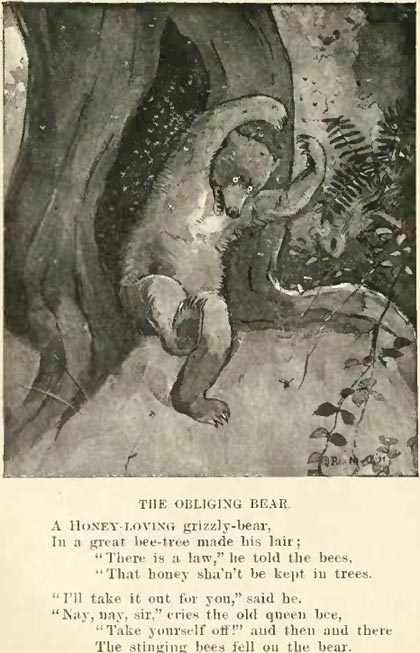
A HONEY-LOVING grizzly-bear,
In a great bee-tree made his lair;
“There is a law,” he told the bees,
“That honey sha’n’t be kept in trees.“I’ll take it out for you,” said he.
“Nay, nay, sir,” cries the old queen bee,
“Take yourself off!” and then and there
The stinging bees fell on the bear.
Peter Newell from Harper’s Round Table, vol XVI, no. 827, 3 September 1895, 904.

There were three little owl that had slept all day
In their downy nest in a dead tree’s hollow;
Said the first: “It’s time to go out and play,
I hear the good-night of the chimney-swallow!”
“Oh no,” said the second; “the sun is high,
Who wants to be blind as a bat? — not I!”
But the third said: “Rats! we have slept enough!”
Let’s go, anyhow, and play blindman’s buff!”
Peter Newell from Harper’s Round Table, vol. XVI, no. 825, 20 August 1895, 856.

A HOPPERGRASS, one sunny day,
Turning hand-springs amid the hay,
O’erleaped himself, and fell into
A piggin of good apple brew.
“Shame on you, thirsty little one,”
Cried the haymakers in the sun;
The hopper took one draught, and then,
Ere he flew off, addressed the men:
“Good sirs,” quoth he, “although one swallow
Does not make summer, it would follow
That several swallows were at fault
If you had made that summersault.”
Peter Newell from Harper’s Round Table, vol. XVI, no. 823, 6 August 1895, 808.
In a previous post I noted a rare instance of contemporary reference in Gustave Verbeek’s Terrors of the Tiny Tads. Here is another from the strip for 19 May 1907, a few weeks after the appearance of the “Cowboisterous Kangaroosevelt Bear:”
Here comes the Rockefellerphant, so wealthy and so bold,
His stomach like a money bag, all full of shining gold.He eats the Cinnamoney tree that grows upon the plains.
The Tiny Tads they see him, and they envy him his gains.They tempt him with Subpoeanuts, but he turns away with fright,
And after following him for miles, they lose him in the night.

Click on the image for the full strip which — as is often the case with the Terrors of the Tiny Tads — ends with the Tads feasting on one of the “jumbled beasts” that live in their land.
Meanwhile, in his indispensable Stripper’s Guide blog, Allan Holtz has a post on the 1909 rerun of a series Verbeek had published in Judge in 1900-03, not 1901-02 as Holtz states. Three examples of the original pages can be seen on the Ohio State University’s Treasury of Fine Art:
(Make sure you read them in Full Screen XXL mode.)
Verbeek had been producing such wordless strips for several years since — according to Andy Konkykru — a very similar one, “The Hunter’s Strategy,” appeared in Harper’s Round Table‘s Annual for 1897.
“Wicked Willie’s Dream” by Walter M. Dunk appeared in Harper’s Round Table, vol. XVI, no. 821, 23 July 1895, 760 (click for full story):

It clearly anticipates Winsor McCay’s Little Nemo in Slumberland, in particular for Willie’s position after his fall, but the idea of explaining an uncanny series of events as a dream at the very end of the story had been floating around for a long time. Sigmund Freud included a cartoon which might be taken from McCay’s Dreams of the Rarebit Fiend in his Interpretation of Dreams (1900):

Clicking on the image you will get an image of the page annotated by Sàndor Ferenczi from the Library of Congress Freud collection.
Edward Lear’s early picture story, “The Adventures of Daniel O’Rourke” (from Lear in the Original (New York: H.P. Kraus, 1975, 185-98, see earlier post) — adapted from “Daniel O’Rourke,” in Fairy Legends and Traditions of the South of Ireland (London: John Murray, 1834, 134-44) — ends in the same way, with the metamorphosis of a whale into Daniel’s wife Judy, who wakes him from his alcoholic nightmare:

Note the caption with its pun on interrupts / interprets.
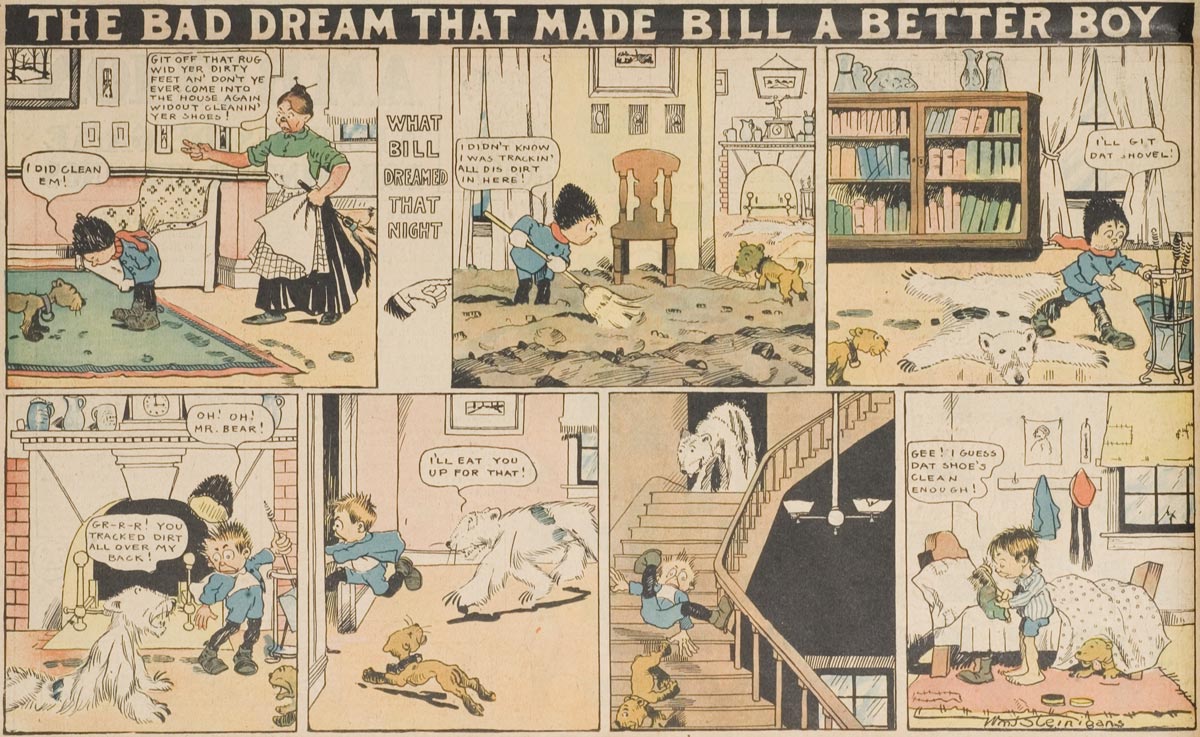
Dunk’s strip seems to belong to a tradition in which the bad dream prompts the reformation of the “wicked” dreamer, which will reappear in newspaper comics, for example in William Steiningns’s The Bad Dream that Made Bill a Better Boy, which ran in the New York World from 13 August 1905 to 16 April 1911:
The blog has been quiet for a long time, as I have been very busy and had to keep up with the daily publication of Edward Lear’s diaries. However, I have at last found time to add an article on Peter Newell to the nonsenselit.org bookshelf:
As a bonus I am adding a set of 10 postcards from the Detroit Publishing Co. “Artist Series” from Peter Newell’s Pictures and Rhymes (1899). The seller on eBay dated them circa 1905, I only downloaded the images, so the quality is not good.
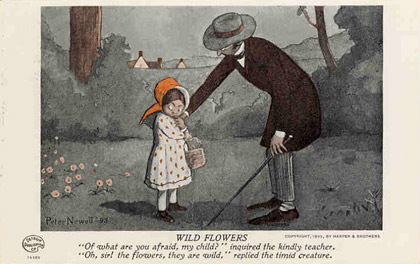

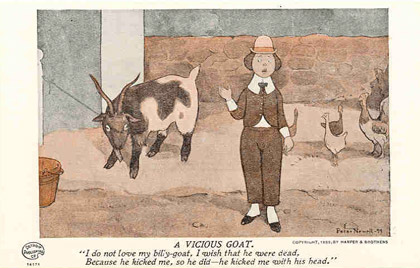
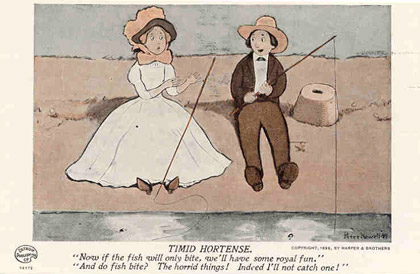


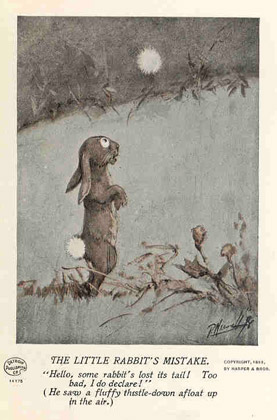


Just a quick post to mention a few new resources relating to Edward Lear:
Finally, if you are lucky enough to be in the UK, why not see King Pelican, a new play by Chris Goode on Edward Lear at the Drum Theatre in Plymouth:
London, 1861. Years before starting to write his nonsense verses (most famously The Owl and the Pussycat), Edward Lear is a struggling landscape painter, hoping to secure his reputation with a series of giant canvases.
But for Lear – epileptic, queer, lonely and beset by illness – things are never easy, and the declining health of his beloved sister Ann brings further cause for concern.
Then, into his studio one day walks a boy with a parcel to deliver…
Chris Goode’s haunting new play, made especially for the Drum, is a tender, offbeat fantasy about one of Victorian literature’s best-loved but least-known figures.

By the way, BBC Radio 4 broadcast The Need for Nonsense on 9 February, also a play on Lear’s relationship with his servant Giorgio. Unfortunately, it is no longer available in the Listen Again section of the site.
Below is a pen and ink calligraphic drawing by Jacob Labotz representing a cat and an owl. Online translator software is not very good with 18th-century Dutch, but it is obvious they are fighting for the possession of the mouse the owl is holding in his bill. The image is part of a series Labotz produced around 1775 (available at the Regionaal Archief Alkmaar web site).
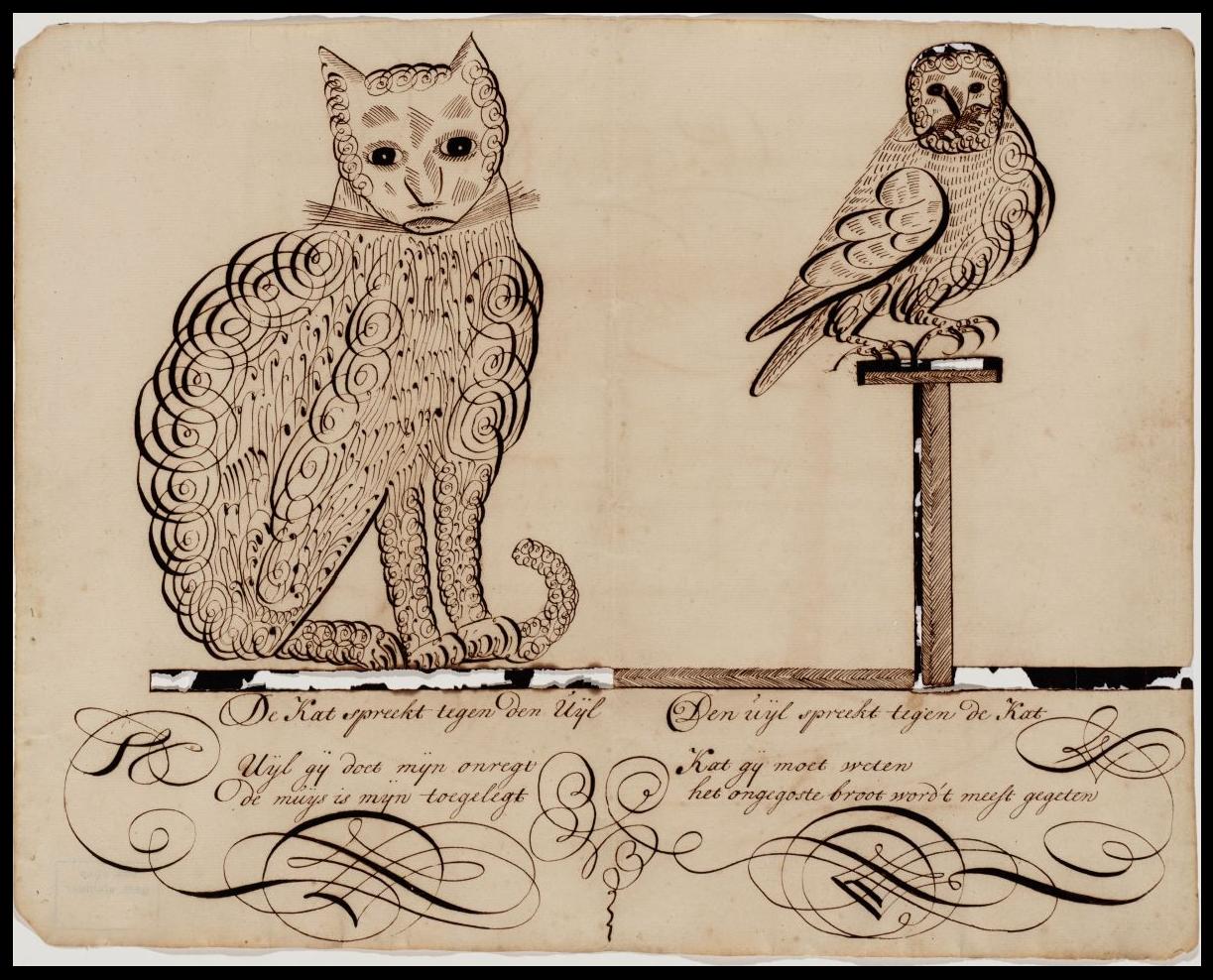
While it is hard to imagine that Edward Lear saw this, it shows that the association of the two animals was a logical one, both prefer the night, hunt mice and spend a lot of time on trees, at least cats of the nursery-rhyme variety do, as in the famous quasi-limerick:
Diddlety, diddlety dumpty,
The cat ran up the plum tree;
Half a crown
To fetch her down,
Diddlety, diddlety, dumpty.
Given the similarities they are natural competitors, as in Labotz’s rhyme, while Lear’s “The Owl and the Pussy-cat” is set in an upside-down world in which the two animals can fall in love with each other.
By the way, climbing on trees appears to be a very dangerous activity for cats, as Lear himself testified in a draft for “The Children of the Owl and the Pussy-cat,” in which they tell the story of their mother’s unfortunate end:
In Sila forest on the East of fair Calabria’s shore
She tumbled from a lofty tree — none ever saw her more.
(Thanks to peacay of BibliOdyssey.)
You may remember that RS Productions started working on a documentary on Edward Lear’s travels in Greece and Albania almost two years ago, and I linked to a promo last year.

Director Derek Smith and cameraman Chris Sutcliffe at the peaks of Meteora
The first of the three parts is now going to be broadcast in Britain by SkyArts 2 and SkyArts HD on 16 January at 1 am and 17 January at 2pm. See the presentation and programme listings.
 A Blog of Bosh