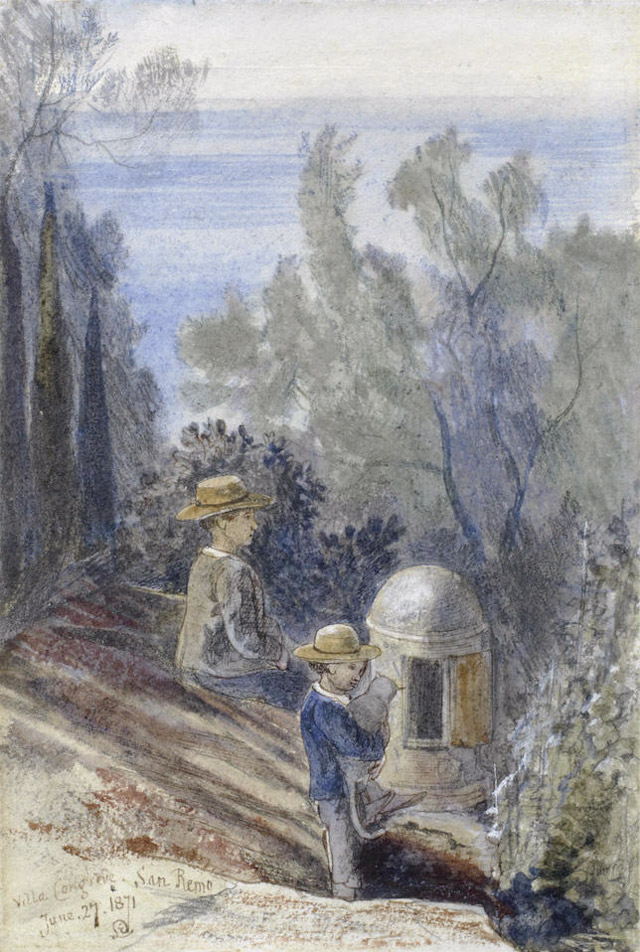
Edward Lear, Hubert and Arnold Congreve (1871)

This one is a very unusual picture for Edward Lear, and I think it shows clearly why he avoided placing large human figures in the foreground of his paintings. Here the two boys are drawn in a stiff pose and appear completely separated from the surrounding landscape: they have nothing of the cartoony life of his nonsense drawings or even of the cat one of them is holding.

el_congreve

Edward Lear, Hubert and Arnold Congreve, one carrying a cat on a slope above the Villa Congreve, San Remo.
Signed with monogram, dated and inscribed ‘Villa Congreve. San Remo/June.27.1871’ (lower left). Pencil, pen and watercolour with touches of gum arabic. 17.2 x 11.8cm (6 3/4 x 4 5/8in).

Bonhams.

Posted in Edward Lear | Tagged , , | 4 Comments

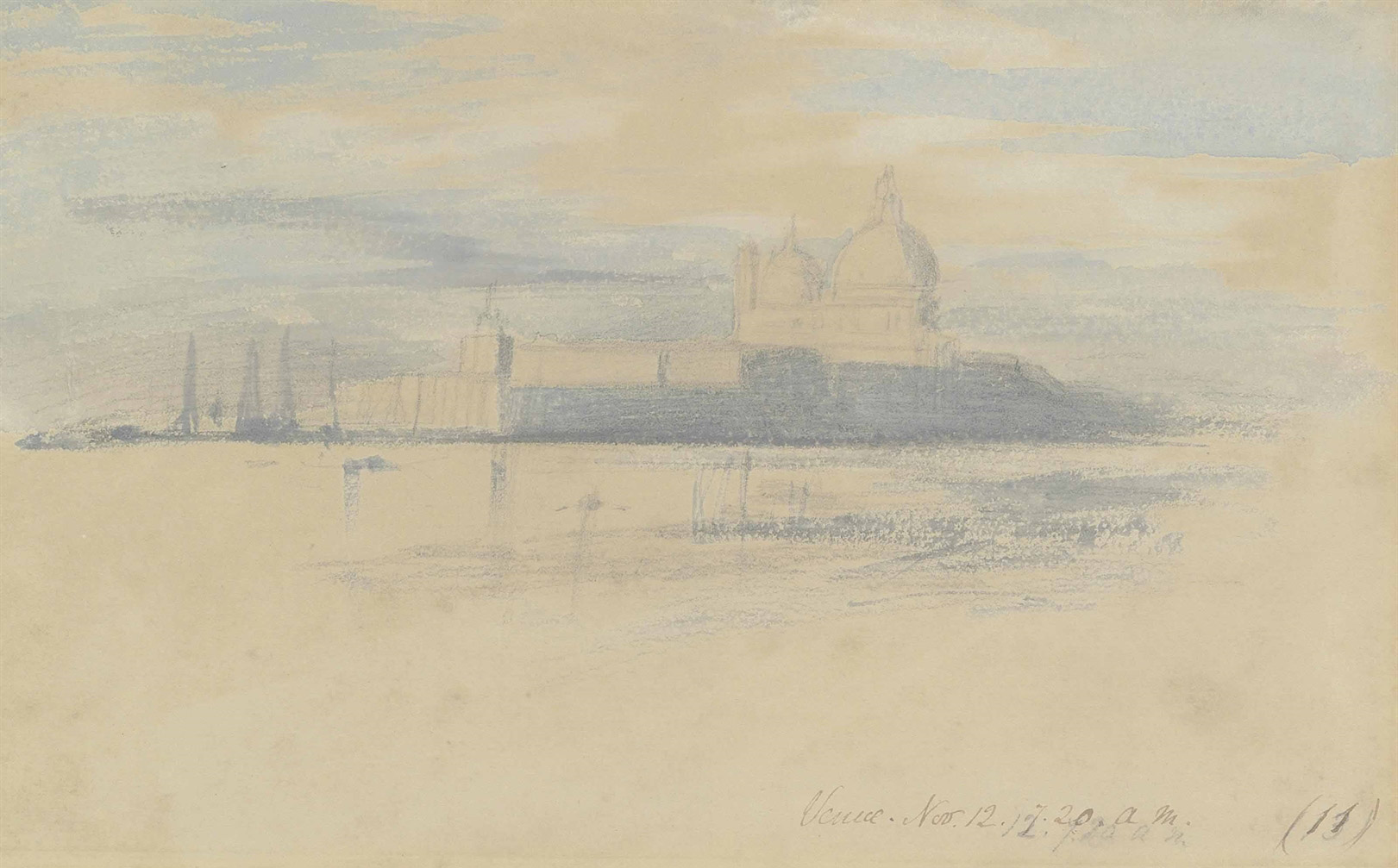
Edward Lear, The entrance to the Grand Canal, Venice

el_venice-s

Edward Lear, The entrance to the Grand Canal, Venice.
Inscribed ‘Venice. Nov. 12. [1865?] 7.20.am. (11)’ (lower right). Pencil and watercolour on paper. 6 1/8 x 10 in. (15.5 x 25.4 cm.)

Christie’s.

Posted in Edward Lear | Tagged , , , | Leave a comment

Edward Lear Exhibition in Henley-on-Thames

A small exhibition devoted to Edward Lear has recently opened at the River and Rowing Museum in Henley-on-Thames; here is the descrption on the museum website:

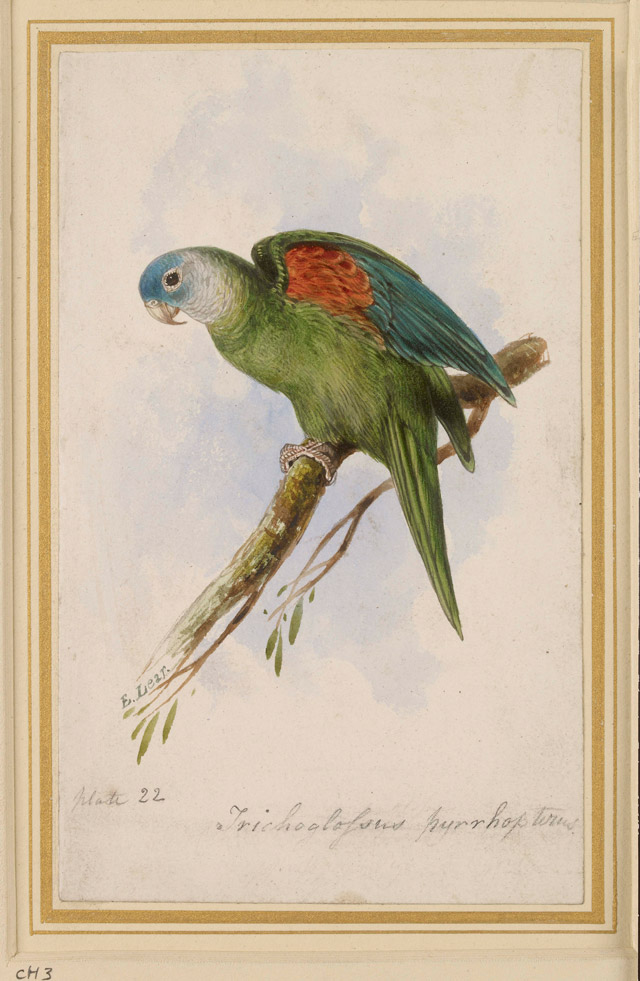
Orange-winged-Lorikeet-s

Edward Lear: Travel and Nonsense
15 Oct – 10 Jan
From extraordinary sketches of landscapes and nature, to the nonsense drawings and verses for which Lear is so well known, the exhibition presents around 30 framed works alongside manuscripts and original book publications.The exhibition is coming from the Ashmolean Museum in Oxford, home of the largest and most comprehensive collection of Lear’s work in the UK, with important loans from private collections, which are rarely on public display.
The Exhibition is organised by the Ashmolean Museum, University of Oxford.

Thanks to Sara Lodge for the information.

Posted in Edward Lear | Tagged , , , | 2 Comments

Edward Lear’s Stratton Adventure and an Adventure with a Lady

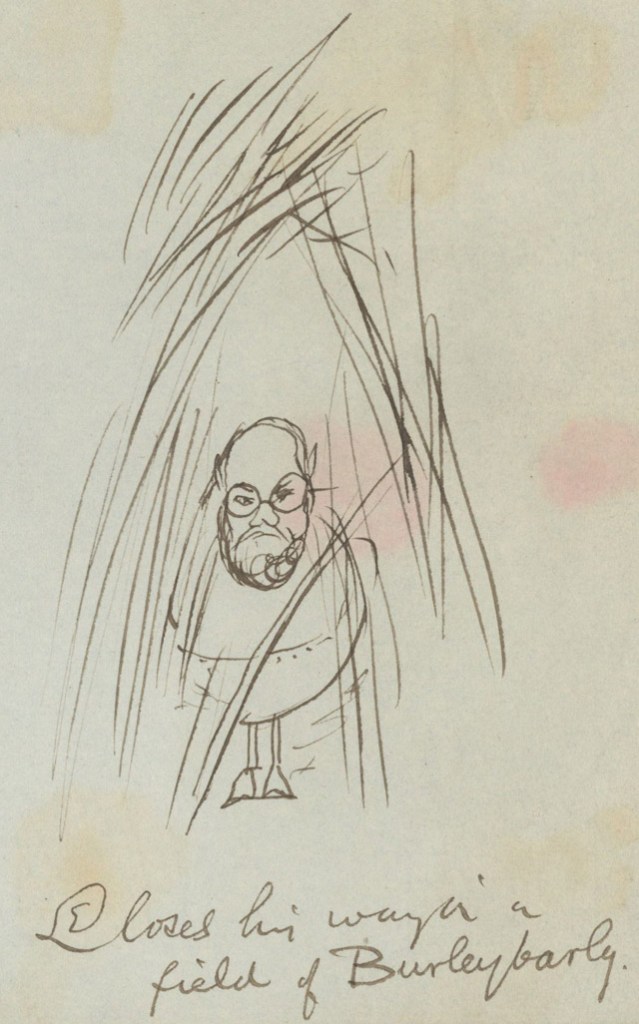
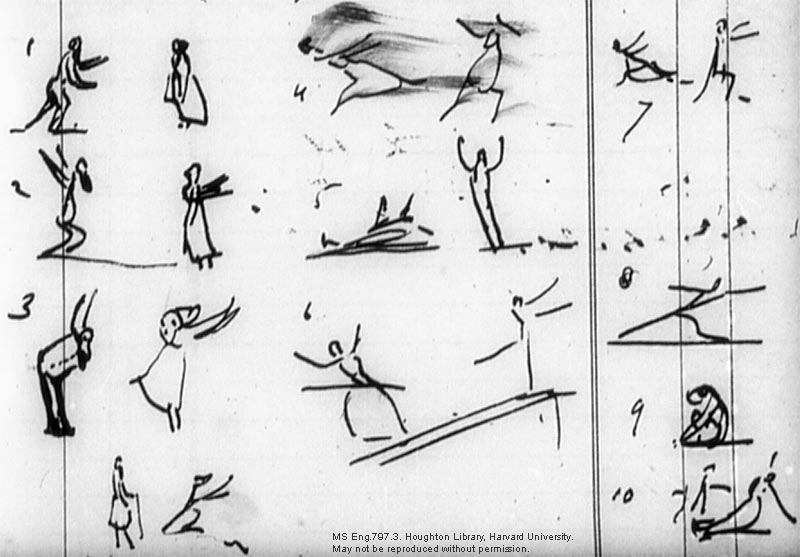
“Self-portraits. 18–. MS Typ 55.20. Houghton Library, Harvard University, Cambridge, Mass.” contains what appears to be part of a picture story: it tells of an adventure on a walk while at Stratton. Edward Lear often visited his old friend and patron T.G. Baring there, i.e. in October 1860 and September 1862 (see Diaries).

stratton-1

EL sits on a rail to examine an ear of corn.

stratton-2

EL loses his way in a field of Burleybarley.

Lear often recorded peculiar adventures with short picture stories, at least once also in the Diaries (28 August 1858), when he had an “adventure with the lady on the landing place;” the story is not at all clear to me:

1858-08-28_pict_s

Also see: Edward Lear’s Picture Letters, Mr Lear Recovers His Hat.

Posted in Edward Lear | Tagged , , , | 2 Comments

New Edward Lear Manuscripts from Houghton Library

The following items fromHoughton Library have been added to the Manuscripts page:

Edward Lear drawings of Central India, 1875. MS Typ 55.5.
49 original landscape drawings on 31 mounts (31 sheets), in watercolor, pen and graphite. From Lord Northbrook’s collection, volume 2 only; inside front cover includes bookplate of Lord Northbrook (Thomas George Baring, Earl of Northbrook (1826-1904)). Title on cover: Vol. II. Central India 1875. Lord Northbrook; volume lacks a titlepage.
Online facsimile.

Alphabet no. 6 : manuscript, undated. MS Typ 55.15.
For each letter there is a 4-line verse. A begins “Appaty, Bappaty, Appaty A /Two nice apples for me to day.” In the right margin there is a sketch, of 2 apples for A.
Incomplete: the letters Q to Z are initials only.
Online facsimile.

The cummerbund: an Indian poem. MS Typ 55.16.
Autograph manuscript in black ink. A note at the end including a glossary is crossed out.
Online facsimile.

MS Typ 55.18. Houghton Library, Harvard University.

MS Typ 55.18. Houghton Library, Harvard University.

[Pig confronting ‘corcadill’]. [18–]. MS Typ 55.18.
Actually contains a caricature self-portrait.
Online facsimile.

[‘Piggie’ confronting ‘corcadill’]. [18–]. MS Typ 55.19.
The real thing. With a slip reading: “Might you not bring back a small Corcadill for Piggie to play with on the Lawn at Stratton: –only he.” Part of a letter.
The back has a small picture of a hunter confronting an animal, the “Corcadill”?
Online facsimile.

Self-portraits. 18–. MS Typ 55.20.
Two drawings; presumably part of a picture story. Undated
Online facsimile.

Some incidents in the life of my uncle Arly. MS Typ 55.22.
Autograph fair-copy manuscript of a poem in 7 verses, with original postmarked envelope addressed to Wilkie Collins. Dated “Villa Tennyson, Sanremo, 7 March 1886.”
Online facsimile.

Also found through Houghton’s Hollis search:

“Better a Railing at the Top of the Cliff than a Hospital at the Bottom!”: the use of Edward Lear’s nonsense ABC as a didactical tool in the development of  pronunciation skills in young lerarners of English. A dissertation by Margaret Wallace Nilsson at Uppsala University Library, 2011. [pdf file]

Posted in Edward Lear | Tagged , , , , | Leave a comment

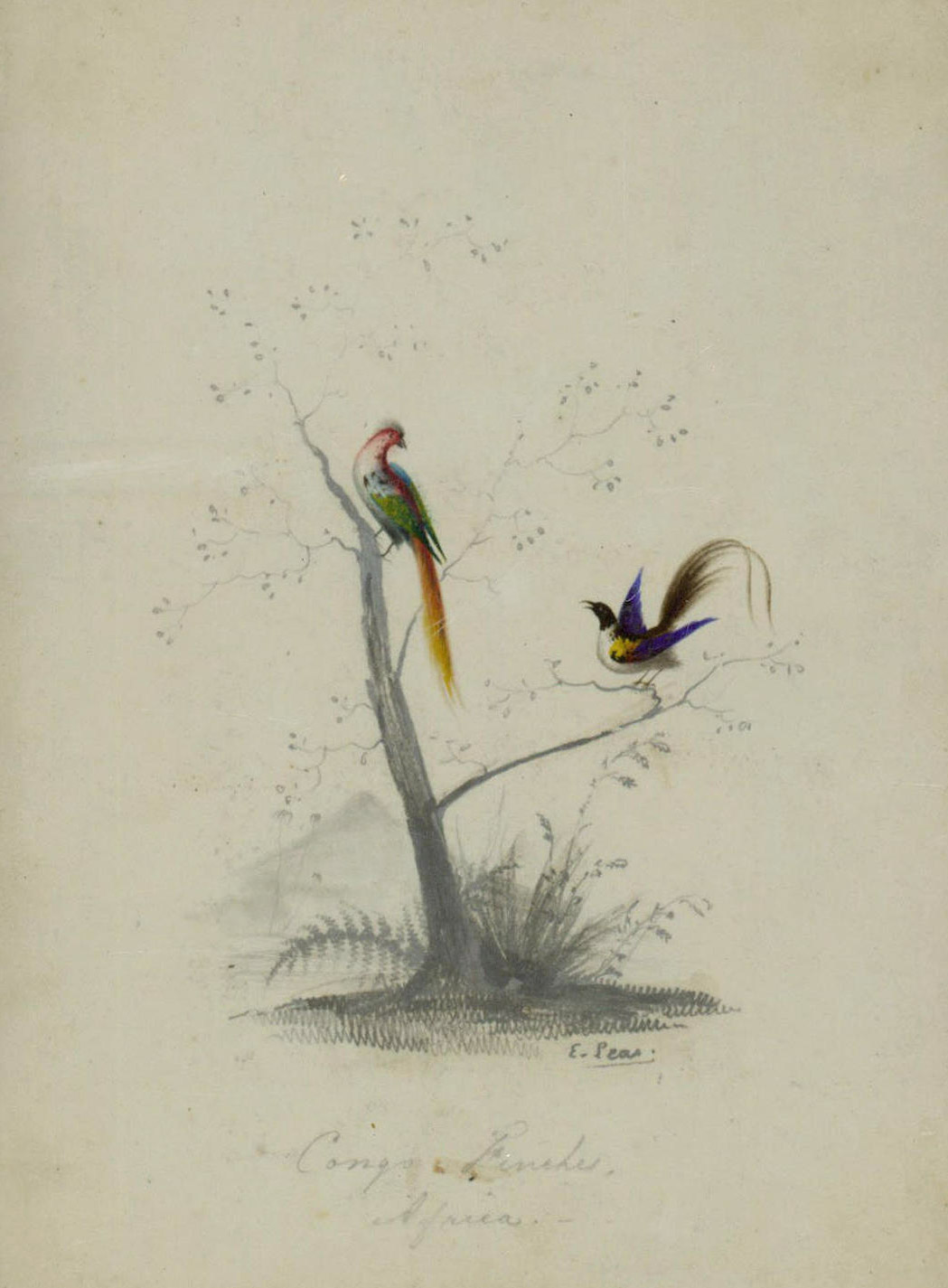
Edward Lear, Congo Finch

el_cock-s

Edward Lear, Congo Finch, Africa.
235 x 189mm., c.1825-30.

Bonhams.

Posted in Edward Lear | Tagged , , | Leave a comment

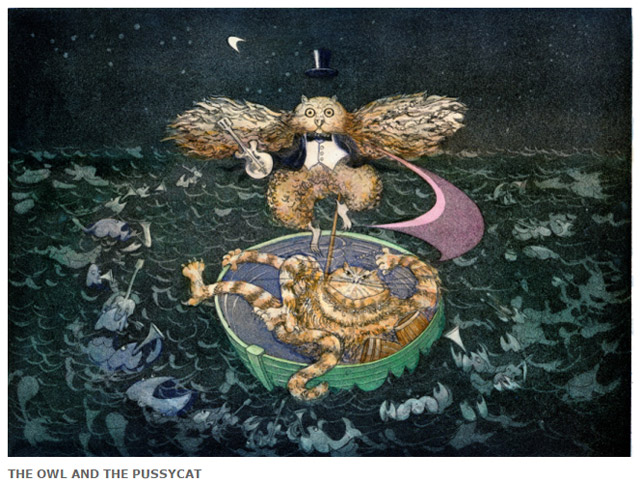
Spike Milligan’s Musical Interlude with Edward Lear

sp_oap-s

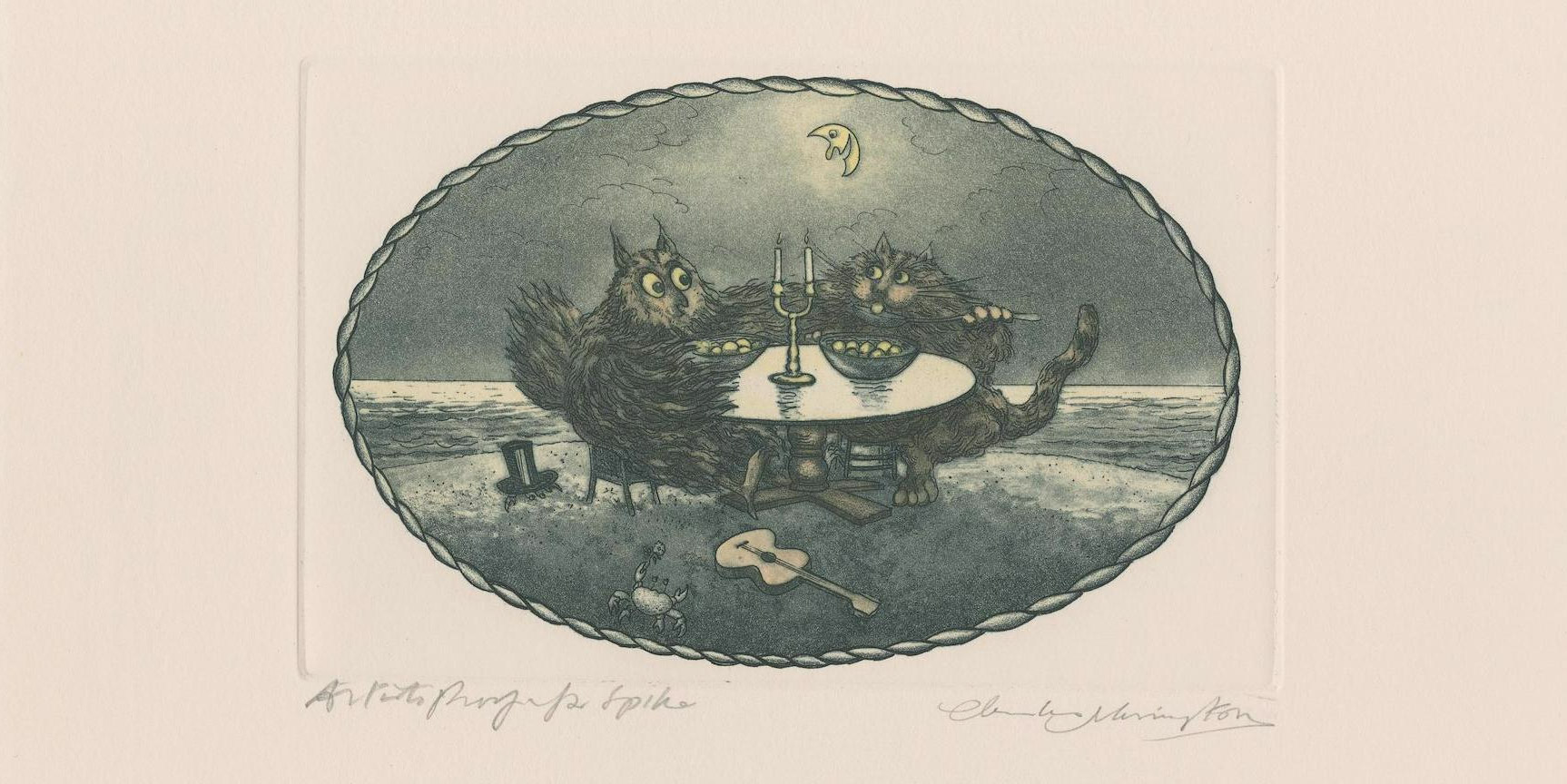
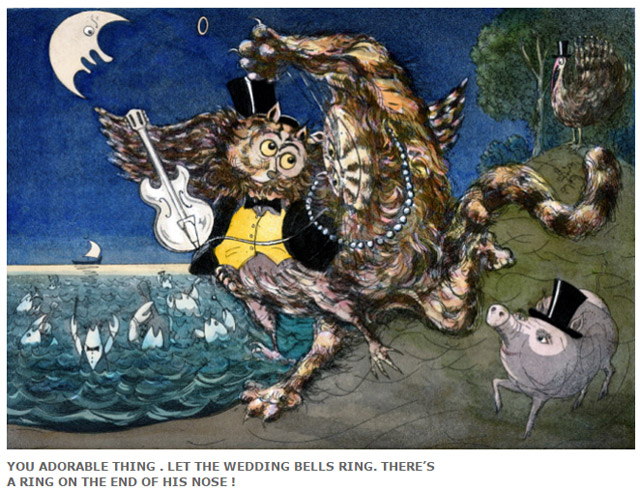
Charles Newington: “A Musical Interlude With Mr Edward Lear,” circa 2001.
A folio of seventeen aquatints, each signed by the artist and inscribed in pencil: Artists Proof for Spike Milligan, the majority also titled, together with CD and other related items, the larger sheets 38 x 45cm (15 x 17¾in).

This was a project written and produced by composer Jonathan Hodge and actor Julian Littman, with Spike acting as Narrator. Printmaker Charles Newington had previously ilustrated Spike’s book, ‘Frankenstein According To Spike Milligan’. This series of prints were produced as part of the project, limited to an edition of 75.

Bonhams.

Newington’s website announces a Lear-themed show at the Chelsea Arts Club which should have opened on 29 September: he also promises that the Lear project with Spike Mulligan “will be available on this website shortly.”

More pictures for the project can be seen on Newington’s old website:

newington-0

newington-1

newington-7


newington-3

newington-4

newington-5

newington-6

Posted in Edward Lear | Tagged , , , | Leave a comment

Edward Lear, the “Four children,” and Elizabeth Hornby

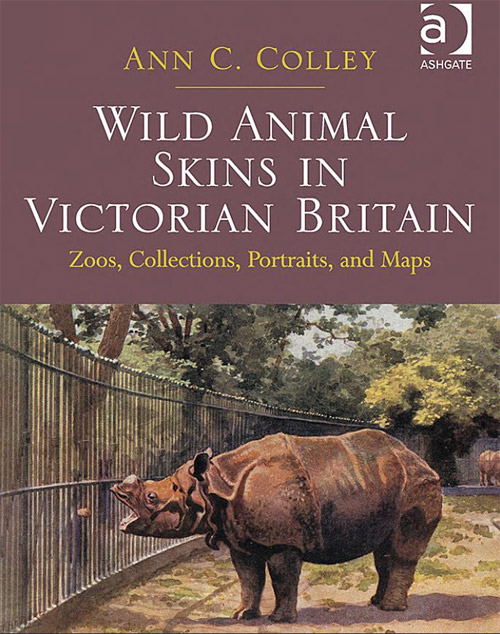
colley-cover

A few weeks ago I reported the publication of an issue of Rivista di studi vittoriani devoted to Edward Lear; Ann C. Colley’s essay, “Edward Lear and Victorian Animal Portraiture,” has been greatly expanded and published as chapter 3 of her new book: Wild Animal Skins in Victorian Britain: Zoos, Collections, Portraits, and Maps (Farnham: Ashgate, 2014).

This is interesting in itself, but some of the additions are particularly intriguing: for example I don’t remember reading that “Pussy” was Admiral Phipps Hornby’s daughter Elizabeth Hornby’s nickname, as it appears “embossed in gold” on the cover of her South American diary (of which more below). Bringing her — and her adventures in animal and skin procurement for herself and her uncle, the 13th Lord Derby — into the story strengthens Colley’s association of “The Story of the Four Little Children Who Went Round the World” with Lear’s Knowsley residence.

ehornby-1

Also of great interest is Colley’s analysis of Elizabeth’s diary, now at the Caird Library of the National Maritime Museum, Greenwich, which appears to contain a large number of wtercolour illustrations, somehow recalling, though on a larger scale, Lear’s several picture reports of his trips; e.g. his 1841 tour of Scotland with Phipps Hornby or his Sicilian adventures with John Proby in 1847.

ehornby-2

In lieu of an abstract, here is what Colley herself writes of the relevant parts of the book on pp. 5-6 of the “Introduction:”

… an Afterword [to chapter 2, “A Skin Disorder”] “In the Field,” [pp. 74-86 in the text] examines the unpublished correspondence and notebooks of two avid nineteenth-century collectors: the 13th Earl of Derby, and his 22-year-old niece, Elizabeth Hornby, who collected and stuffed wild skins for her own modest display as well as for her uncle’s more ambitious menagerie and museum while she resided in South America from 1847 to 1850.

Chapter 3, “Stuff and Nonsense: Skin and Victorian Animal Portraiture,” uses the occasion of Edward Lear’s relationship with the 13th Earl of Derby (Lear was hired by him to illustrate the exotic animals kept on his 45,000-acre estate) as well as one of Lear’s nonsense verses [!] (“The Story of the Four Little Children Who Went round the World”), which was based upon his experiences while working for Lord Derby, to consider the centrality of skin in Victorian animal portraiture and taxidermy. The chapter offers an occasion to think about the function as well as the meaning of skin in taxidermy and to focus on the depiction of skin in natural history portraits. The discussion of this topic leads to the suggestion that Lear, through his nonsense verses, as well as in his natural history illustrations, rebelled against the almost exclusive attention to the skins or sufaces of the portrayed animals. He preferred to get “under the skin” and proffer a glimpse of a creature’s subjectivity. As if releasing his subjects from the conventions of nineteenth-century natural history illustration and portraiture, Lear challenged the colonial’s or the collector’s commanding gaze and liberated his subjects from the prerogatives of classification, ownership, and commodity.

Of course “The Story of the Four Little Children” is not “one of Lear’s verses” but one of the few short stories he wrote!
Posted in Edward Lear | Tagged , , , | 2 Comments

Edward Lear on the BBC

I periodically check the BBC website for news on Edward Lear and especially programmes relating to him; my latest find is a dramatization of “The Jumblies” for the Storytime series on BBC School Radio.

storytime

But of particular interest will be next Monday’s, 19 October 2015, BBC Four broadcast of an episode of The Secret Life of Books devoted to “Edward Lear’s Nonsense Songs.” Anyone able and willing to record it for the unlucky ones living outside the UK?

np

Nicholas Parsons had also been one of the protagonists, with Vivien Noakes, of a 2008 “Great Lives: Edward Lear” episode on BBC Redio 4, which is still available for listening.

Posted in Edward Lear | Tagged , , , | Leave a comment

Edward Lear, Another Letter to Vincent (with Self-Caricature)

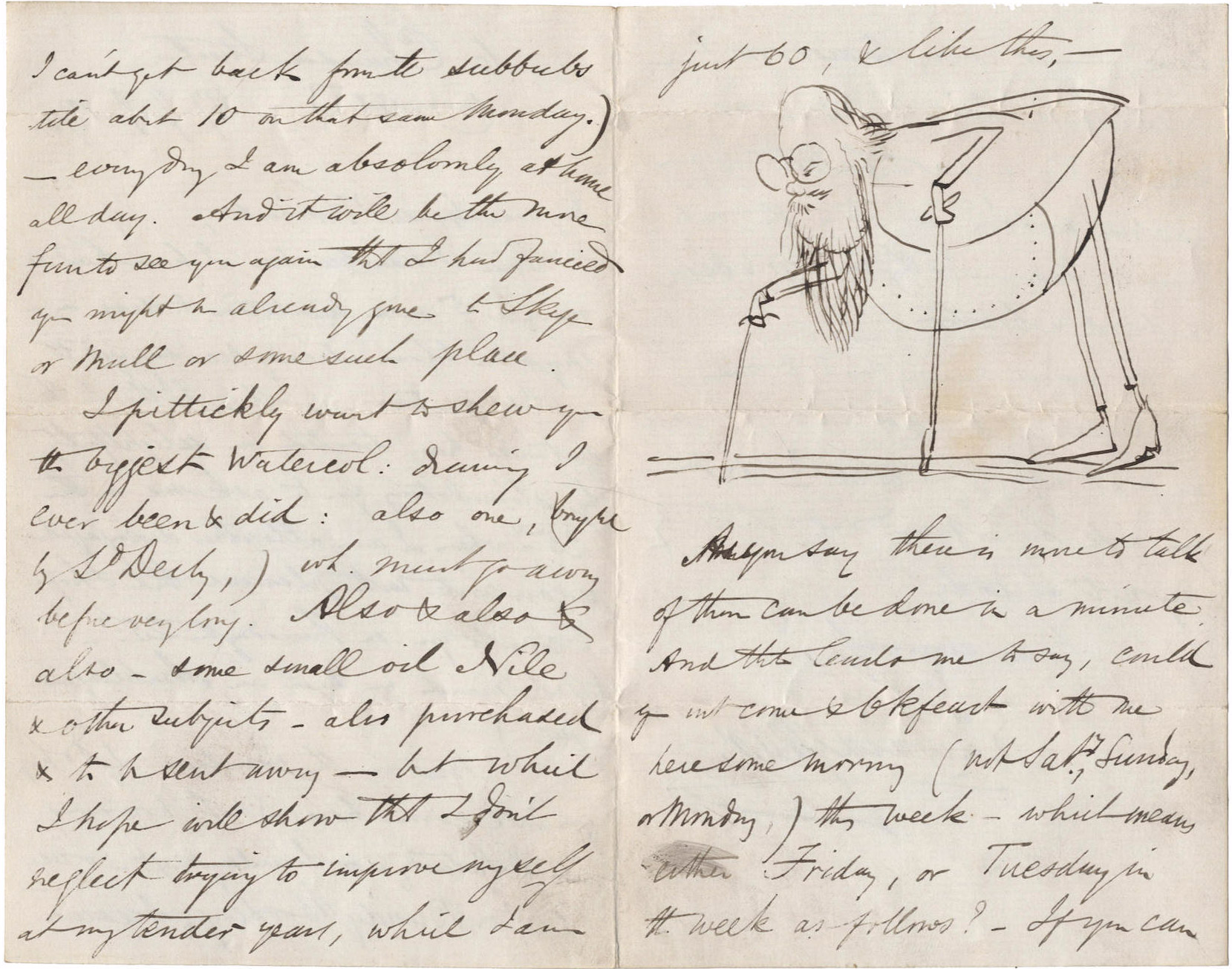
el_letter-to-vincent-2-s

Edward Lear, ‘I am just 60, & like this’ a fine self-caricature of the aged Edward Lear, soon after completing “the biggest Watercol: drawing I ever been & did”. The recipient, Spencer Vincent (1825-1889), was himself an accomplished amateur artist; a memorial exhibition of his work, mainly paintings done in the Scottish Highlands, being held at the Burlington Fine Arts Club in 1890. For Lear’s letters to and about his dog, Fan, see the previous post.

Autograph letter signed (“Edward Lear”), to his friend Spencer Vincent (“My dear Spencer Vincent”), illustrated with a portrait of the artist at sixty, bent horizontal and supporting himself on two sticks, and asking him to come and see his pictures (“…I pittickly want to shew you the biggest Watercol: drawing I ever been & did: also one, (bought by Ld Derby,) wh. must go away before very long. Also & also & also – some small oil Nile & other subjects – also purchased & to be sent away – but which I hope show that I don’t neglect trying to improve myself at my tender years…”), 4 pages, last leaf dust-stained, 8vo, Chandos Street, London, 17 July 1872.

Bonhams.

Posted in Edward Lear | Tagged , , , | 1 Comment