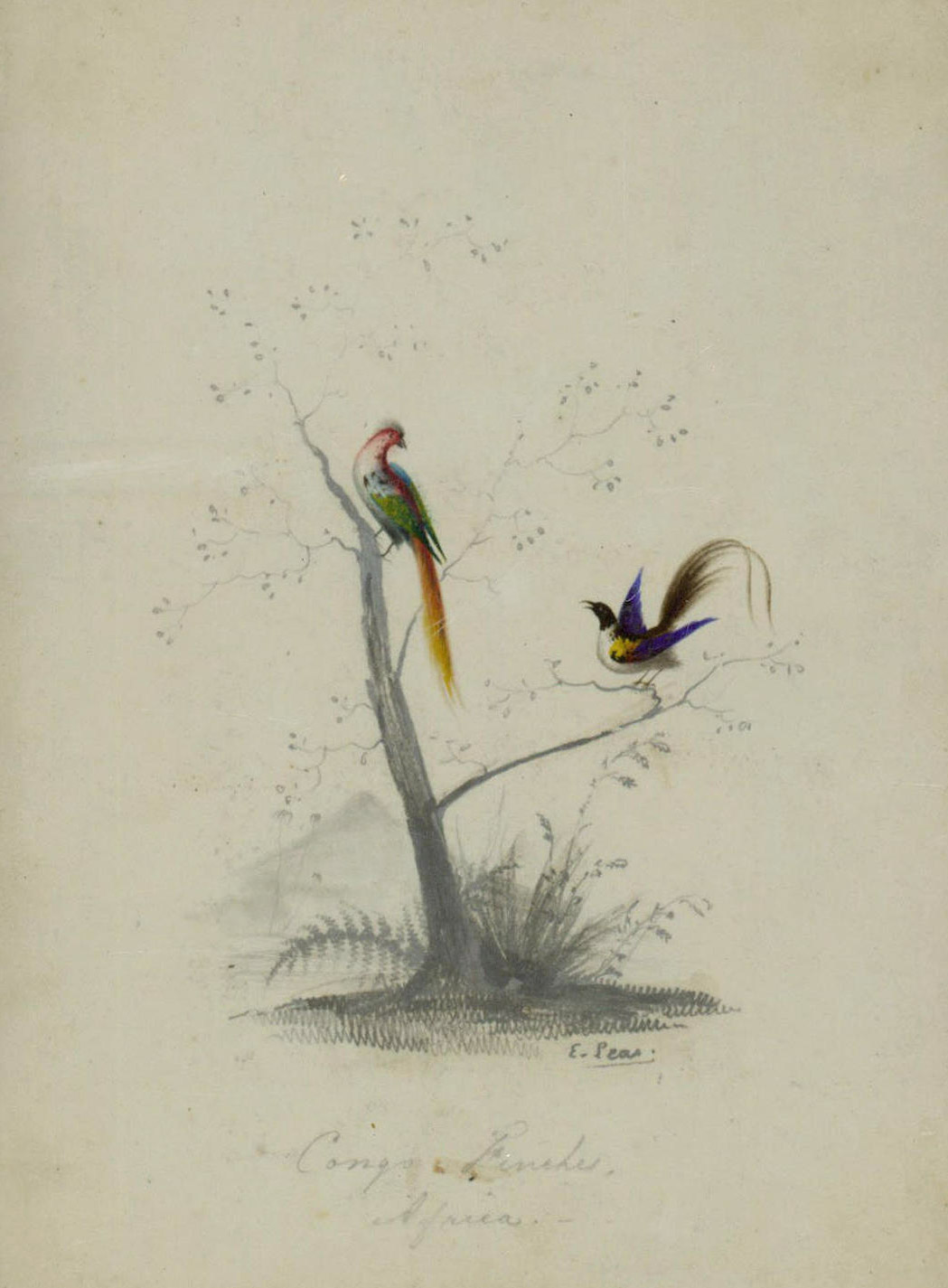
Edward Lear, Congo Finch, Africa.
235 x 189mm., c.1825-30.
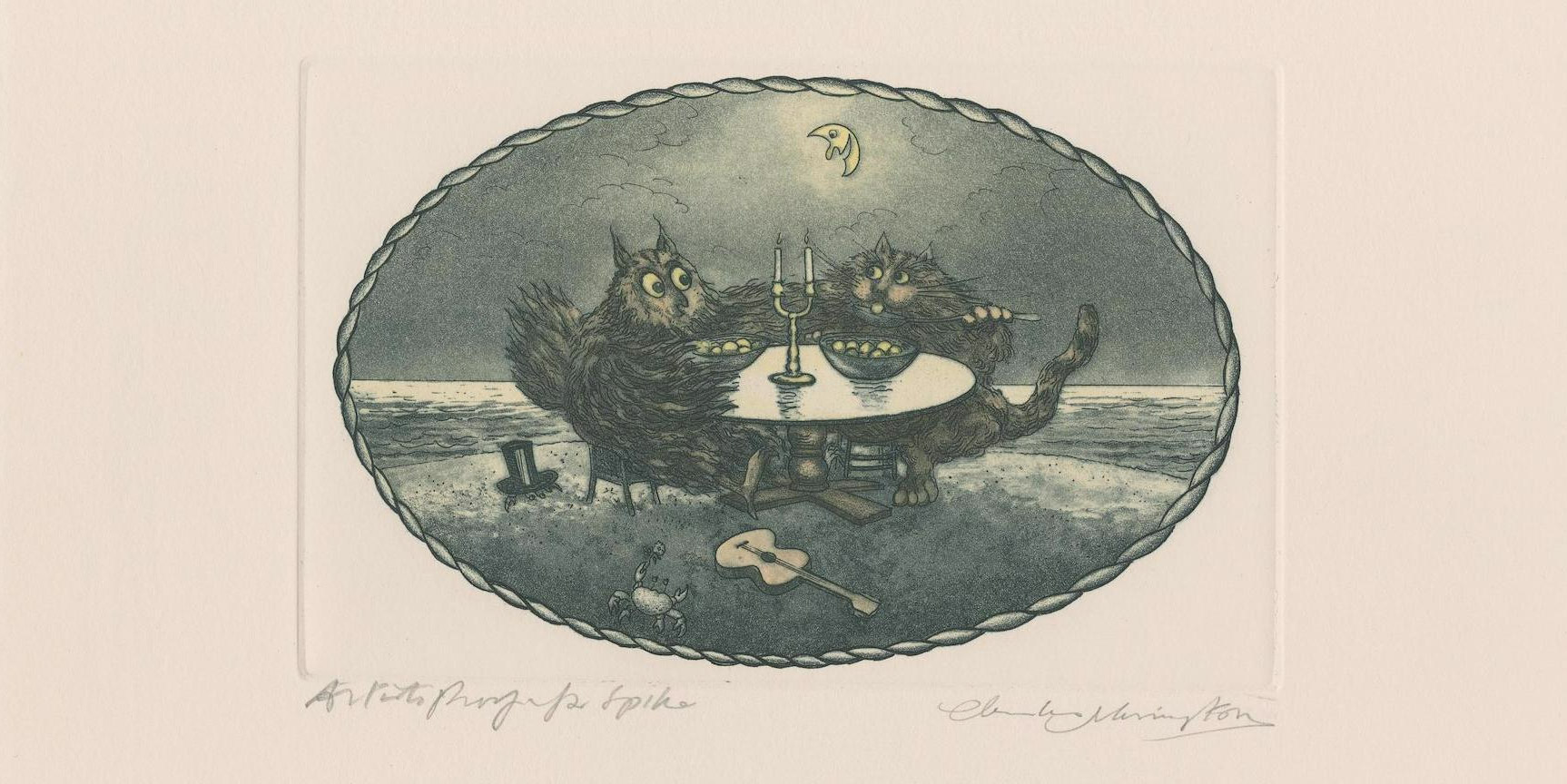
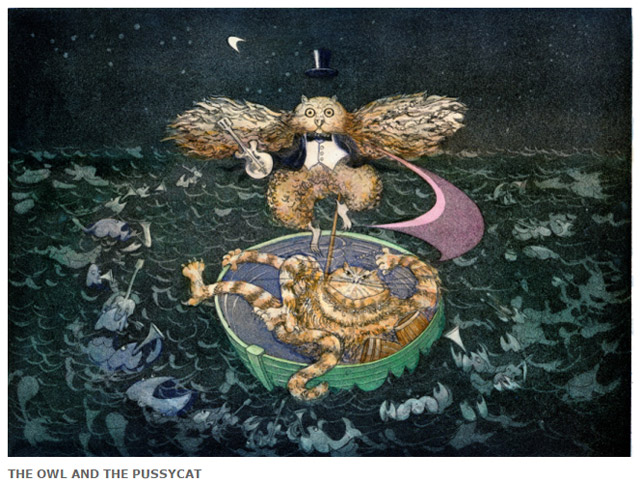
Charles Newington: “A Musical Interlude With Mr Edward Lear,” circa 2001.
A folio of seventeen aquatints, each signed by the artist and inscribed in pencil: Artists Proof for Spike Milligan, the majority also titled, together with CD and other related items, the larger sheets 38 x 45cm (15 x 17¾in).
This was a project written and produced by composer Jonathan Hodge and actor Julian Littman, with Spike acting as Narrator. Printmaker Charles Newington had previously ilustrated Spike’s book, ‘Frankenstein According To Spike Milligan’. This series of prints were produced as part of the project, limited to an edition of 75.
Newington’s website announces a Lear-themed show at the Chelsea Arts Club which should have opened on 29 September: he also promises that the Lear project with Spike Mulligan “will be available on this website shortly.”
More pictures for the project can be seen on Newington’s old website:



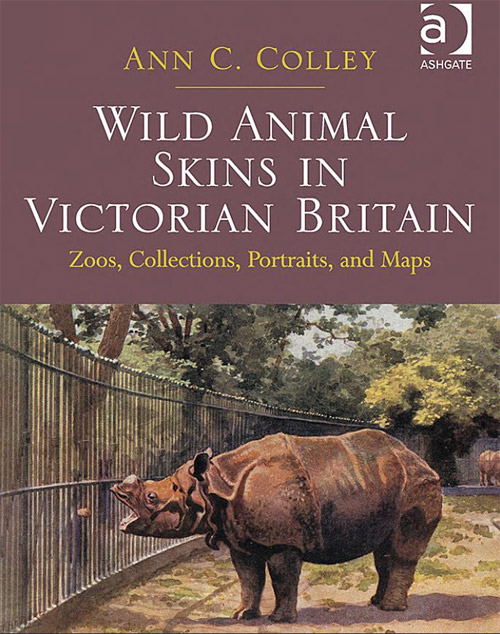
A few weeks ago I reported the publication of an issue of Rivista di studi vittoriani devoted to Edward Lear; Ann C. Colley’s essay, “Edward Lear and Victorian Animal Portraiture,” has been greatly expanded and published as chapter 3 of her new book: Wild Animal Skins in Victorian Britain: Zoos, Collections, Portraits, and Maps (Farnham: Ashgate, 2014).
This is interesting in itself, but some of the additions are particularly intriguing: for example I don’t remember reading that “Pussy” was Admiral Phipps Hornby’s daughter Elizabeth Hornby’s nickname, as it appears “embossed in gold” on the cover of her South American diary (of which more below). Bringing her — and her adventures in animal and skin procurement for herself and her uncle, the 13th Lord Derby — into the story strengthens Colley’s association of “The Story of the Four Little Children Who Went Round the World” with Lear’s Knowsley residence.

Also of great interest is Colley’s analysis of Elizabeth’s diary, now at the Caird Library of the National Maritime Museum, Greenwich, which appears to contain a large number of wtercolour illustrations, somehow recalling, though on a larger scale, Lear’s several picture reports of his trips; e.g. his 1841 tour of Scotland with Phipps Hornby or his Sicilian adventures with John Proby in 1847.

In lieu of an abstract, here is what Colley herself writes of the relevant parts of the book on pp. 5-6 of the “Introduction:”
… an Afterword [to chapter 2, “A Skin Disorder”] “In the Field,” [pp. 74-86 in the text] examines the unpublished correspondence and notebooks of two avid nineteenth-century collectors: the 13th Earl of Derby, and his 22-year-old niece, Elizabeth Hornby, who collected and stuffed wild skins for her own modest display as well as for her uncle’s more ambitious menagerie and museum while she resided in South America from 1847 to 1850.
Chapter 3, “Stuff and Nonsense: Skin and Victorian Animal Portraiture,” uses the occasion of Edward Lear’s relationship with the 13th Earl of Derby (Lear was hired by him to illustrate the exotic animals kept on his 45,000-acre estate) as well as one of Lear’s nonsense verses [!] (“The Story of the Four Little Children Who Went round the World”), which was based upon his experiences while working for Lord Derby, to consider the centrality of skin in Victorian animal portraiture and taxidermy. The chapter offers an occasion to think about the function as well as the meaning of skin in taxidermy and to focus on the depiction of skin in natural history portraits. The discussion of this topic leads to the suggestion that Lear, through his nonsense verses, as well as in his natural history illustrations, rebelled against the almost exclusive attention to the skins or sufaces of the portrayed animals. He preferred to get “under the skin” and proffer a glimpse of a creature’s subjectivity. As if releasing his subjects from the conventions of nineteenth-century natural history illustration and portraiture, Lear challenged the colonial’s or the collector’s commanding gaze and liberated his subjects from the prerogatives of classification, ownership, and commodity.
Of course “The Story of the Four Little Children” is not “one of Lear’s verses” but one of the few short stories he wrote!
I periodically check the BBC website for news on Edward Lear and especially programmes relating to him; my latest find is a dramatization of “The Jumblies” for the Storytime series on BBC School Radio.
But of particular interest will be next Monday’s, 19 October 2015, BBC Four broadcast of an episode of The Secret Life of Books devoted to “Edward Lear’s Nonsense Songs.” Anyone able and willing to record it for the unlucky ones living outside the UK?

Nicholas Parsons had also been one of the protagonists, with Vivien Noakes, of a 2008 “Great Lives: Edward Lear” episode on BBC Redio 4, which is still available for listening.
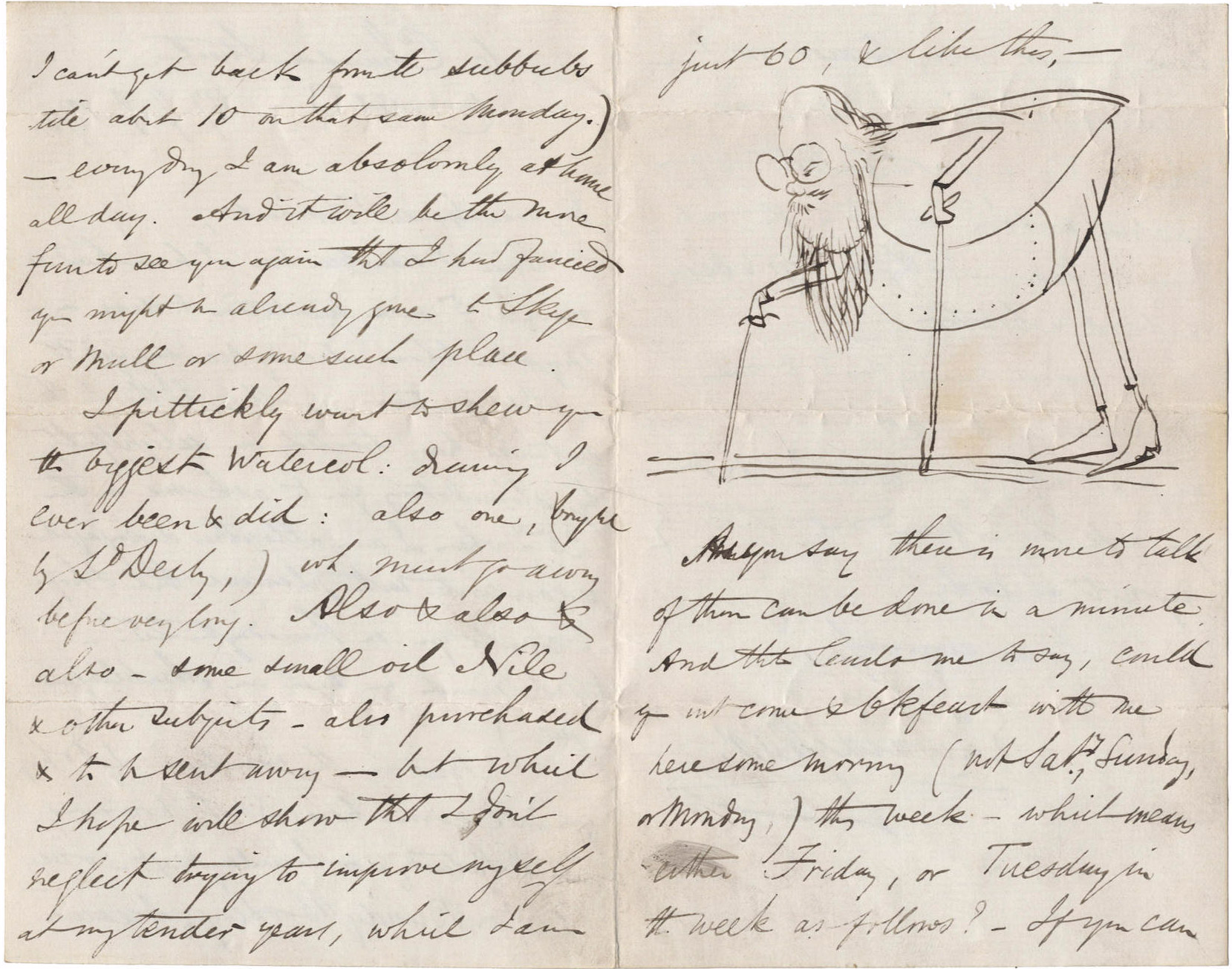
Edward Lear, ‘I am just 60, & like this’ a fine self-caricature of the aged Edward Lear, soon after completing “the biggest Watercol: drawing I ever been & did”. The recipient, Spencer Vincent (1825-1889), was himself an accomplished amateur artist; a memorial exhibition of his work, mainly paintings done in the Scottish Highlands, being held at the Burlington Fine Arts Club in 1890. For Lear’s letters to and about his dog, Fan, see the previous post.
Autograph letter signed (“Edward Lear”), to his friend Spencer Vincent (“My dear Spencer Vincent”), illustrated with a portrait of the artist at sixty, bent horizontal and supporting himself on two sticks, and asking him to come and see his pictures (“…I pittickly want to shew you the biggest Watercol: drawing I ever been & did: also one, (bought by Ld Derby,) wh. must go away before very long. Also & also & also – some small oil Nile & other subjects – also purchased & to be sent away – but which I hope show that I don’t neglect trying to improve myself at my tender years…”), 4 pages, last leaf dust-stained, 8vo, Chandos Street, London, 17 July 1872.
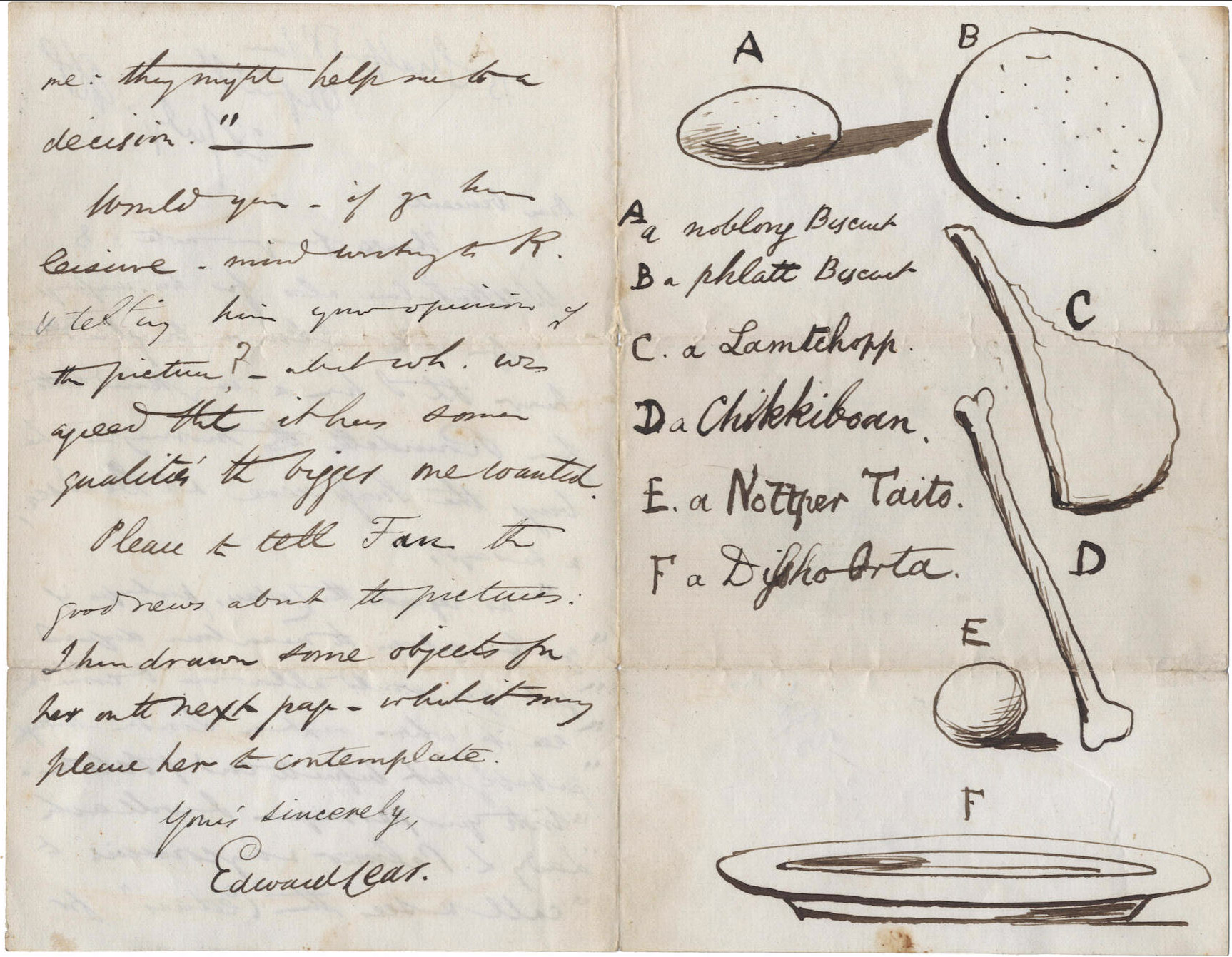
Edward Lear: Two autograph letters signed (“Edward Lear”), to Spencer Vincent (“Dear Vincent”) and his dog (“Dear Fan”), the letter to the human containing a full-page picture of food for the dog to contemplate, with each morsel captioned (“…A. a noblong Biscuit/ B. a phlatt Biscuit/ C. a Lamtchopp./ D. a Chikkiboan./ E. a Nottper Taito./ F. a Dissho Orta…”); that to the dog, hoping that she has recovered from her rheumatism “arising from being with your Master at the Isles of Skye & Mull & Misty & such like wet places” and asking her to tell her master that he has now returned to England (“…I cannot offer you a biscuit, because I have not got any, but there is a pleasant prospic from my window up a mews, and a cab stand close by, from which you might make an excursion in a Hansom…”) and that he is publishing his book on Corsica (“…Say to your Master that I have been drawing on wood… & have done 30 vignettes & 34 plates with my own hand & that they are all for illustration of my book on Corsica, which I am about to publish by subscription at One pound. Do not, my dear Fay, confuse this pound with a pound of meat…”), after a series of doggie-cum-papal jokes, Lear concludes: “Adieu! my beloved little doggie! May you always have millions of bones to pick, & may you never grow older, & may you pass your later days happily in sneezing at the sun” and subscribes himself “Your sincere 2 legged friend”, 7 pages, some dust-staining (especially to blank page of first letter and last of the second), some pencil doodles to blank page, 8vo, Stratford Place and Duchess Street, London, 28 July 1868 and 29 July [1869].
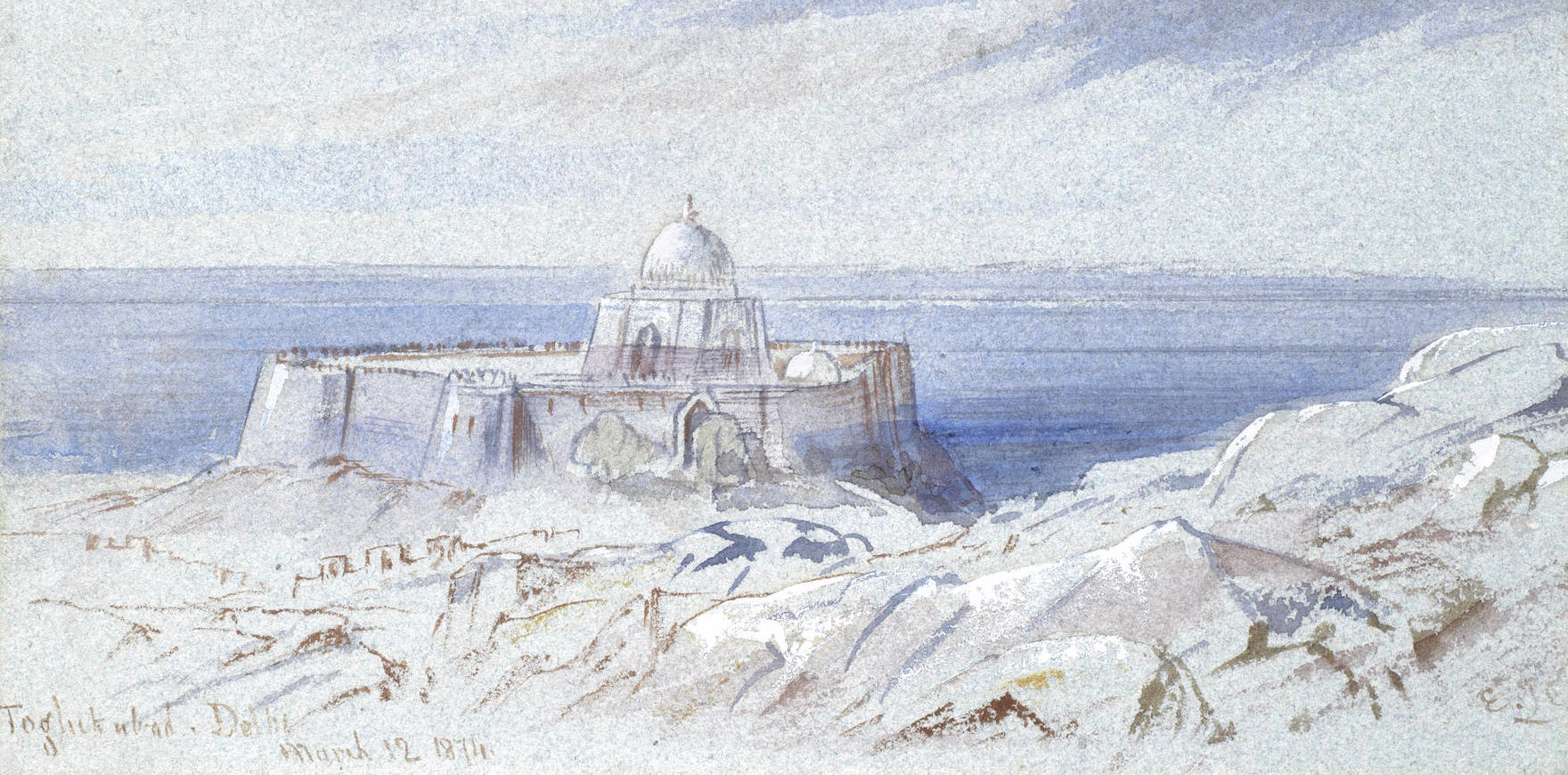
Edward Lear, Tughlaqabad Fort, Delhi.
Signed ‘E.Le’ (lower right) and inscribed and dated ‘Tuglukubad.Delhi/March 12 1874’ (lower left). Watercolour over traces of pencil. 11 x 22cm (4 5/16 x 8 11/16in).
Lear went on a sketching trip to India in 1873-74 at the invitation of his friend, Lord Northbrook, then Viceroy. Lear stayed for 10 days in Delhi and described how he passed his time ‘..making Delhineations of the Dehlicate architecture as is all impressed on my mind as inDehlibly as the Dehliterious quality of the water of that city’ (The Later Letters of Edward Lear, ed. Lady Strachey, London, 1911, p. 171).
As announced a few days ago in The Dominion Post, an exhibition of the Edward Lear material in New Zealand has opened at the Expressions Arts and Entertainment Centre in Upper Hutt.
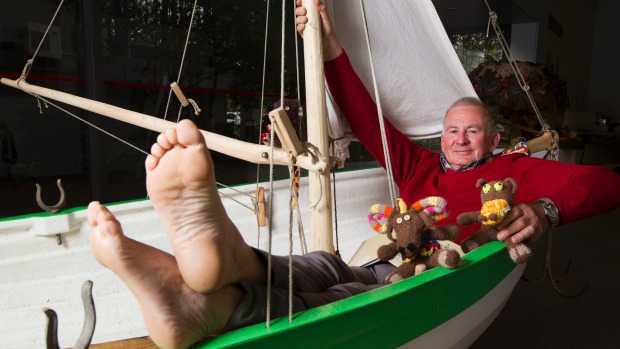
A long interview with Edward Lear’s descendant, Dr. Peter Gillies, from Radio New Zealand’s website, reveals that most of the material in the exhibition has appeared on this blog: Lear family portraits and Edward’s personal possession. However, Dr. Gillies also mentions “original limericks” and “15 letters to Holman Hunt” containing self-caricatures.
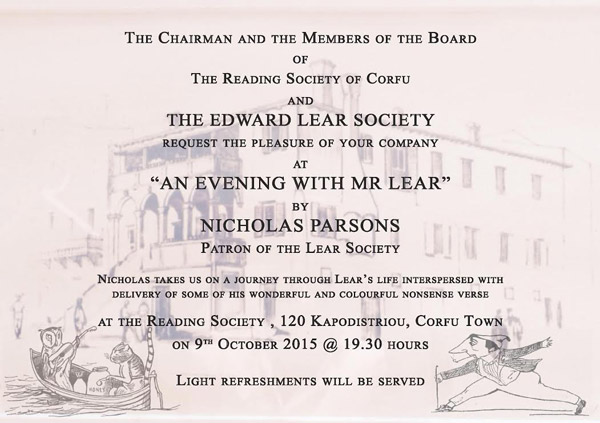
The Reading Society of Corfu will be hosting an event, “An Evening with Edward Lear,” with Nicholas Parsons on 9 October next, at 7.30 pm:
It seems I missed this important post on Gustave Verbeek (or Verbeck as the preferred spelling now seems to be) from the Stripper’s Guide in the series of Ink-Slinger Profiles by Alex Jay: Gustave Verbeck.
Here are three strips from Verbeek’s second series, The Twinklies, with rhymes by Paul West, which ran from 4 January to 15 February 1903:

New York World, 4 January 1903.

New York World, 11 January 1903.
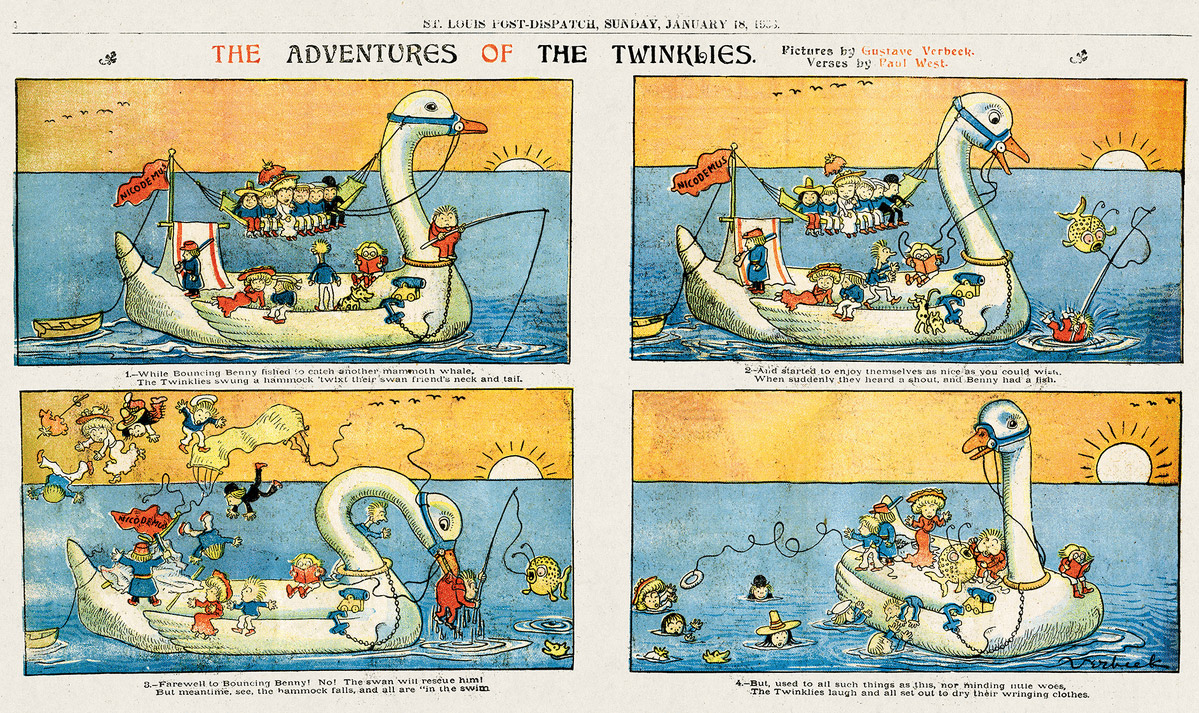
New York World, 18 January 1903.
All samples from Peter Maresca’s Origins of Sunday Comics.
 A Blog of Bosh