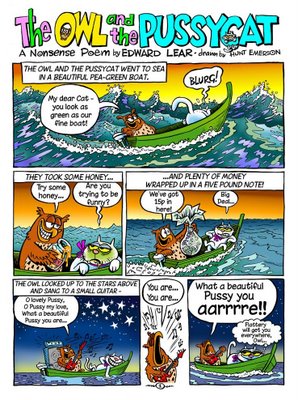
Full Owl and Pussy-Cat from The Beano

On the Beano site you can now read the full comic-book adaptation of Edward Lear’s “The Owl and the Pussy-Cat” by Hunt Emerson. The last page includes a short biography of the poet.

Posted in General | 1 Comment

Non-Limericks 1: W.M. Thackeray

In his recent book on the Father of the Comic Strip: Rodolphe Töpffer (Jackson: University Press of Mississippi, 2007), David Kunzle also discusses British parallels to the Genevan inventor of comics; among them a special section is devoted to William Makepeace Thackeray, in which Kunzle states that the Picture Magazine (vol. III, 1894) published one of Thackeray’s picture stories along with “some five illustrated limericks headed ‘Simple Melodies‘. The date 1832 on this sheet… puts Thackeray’s illustrated limericks well ahead of those famous avatars of nonsense verse printed by Lear in his first Book of Nonsense.” (p. 167).

Simple Melodies title page

A quick look at the small images reproduced in an article by Thierry Smolderen on Coconino World’s Village des Auteurs (“Thackeray and Töpffer. The Weimar Connection”) convinced me that the Simple Melodies were not really limericks, though they looked a lot like them. Thanks to Google Books I have now found that the poems (six of them against the four shown in Smolderen’s article) were also republished as illustrations to the second part of an essay by Lewis Melville on “Thackeray as Artist” in The Conoisseur. An Illustrated Magazine for Collectors. Vol. VIII (January-April 1904), pp. 25-31, 152-5. Melville, by the way, is more precise than Kunzle and defines the compositions “nursery rhymes”.

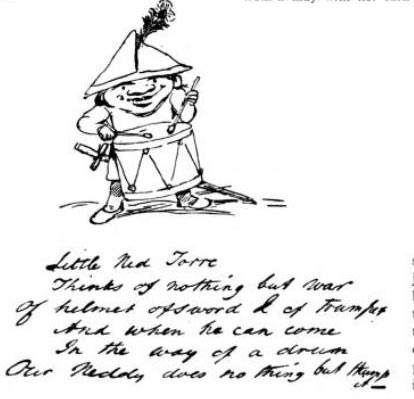
Simple Melodies: Ned Torre

While they are clearly not limericks, they consist of six lines with three different rhymes, they have a lot in common with Lear’s ones and were probably devised on the basis of the early limerick books of the 1820s:

  1. Each short poem is accompanied by a single picture;
  2. Each poem is about one character and describes his/her idiosyncratic behaviour, sometimes the characters are two, and then their relationship is the focus;
  3. The fun is generated by the juxtaposition of image and text.

Simple Melodies: Dicky Snooks

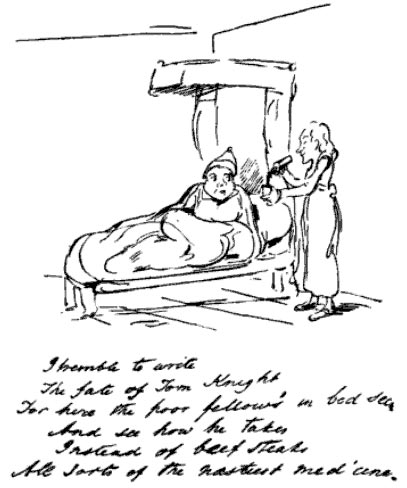
That Thackeray was also inpired by that archetype limerick of the “Sick Man of Tobago” (from Anecdotes and Adventures of Fifteen Gentlemen. London: John Marshall, [1821]) is, I think, amply demonstrated by two of the six Melodies:

I humble to write
The fate of Tom Knight
For here the poor fellow’s in bed seen
And see how he takes
Instead of beef steaks
All sorts of the nastiest med’cine.

Simple Melodies: Mary Knight

Miss Mary Knight
Has a small appetite
But Thomas her brother’s a glutton
For breakfast he takes
Two pounds of beefsteaks
And for dinner a leg of roast Mutton.

Further characteristics connecting Thackeray’s poems to Lear’s limericks are the interest in food shown in the examples above, as well as the informal, childish drawing style, in part no doubt due to the fact that Thackeray’s poems were not published, which is very different from the formal engravings typical of contemporary books and magazines. Thackeray himself liked to say that “he was not half so bad as the woodcutters made him appear” (Melville in The Conoisseur, p. 155), while Lear chose to use lithography as a means of maintaining his simple style.

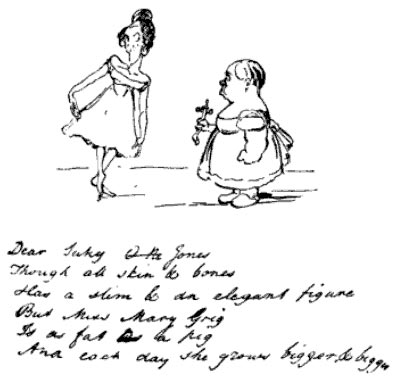
Some of the Melodies also seem to follow the cautionary-tale tradition; in addition to “Good Dicky Snooks” above, which recommends study, the two remaining poems, like “Miss Mary Knight” above, celebrate moderation in eating:

Simple Melodies: Suky Jones

Dear Suky Jones
Though all skin & bones
Has a slim & an elegant figure
But Miss Mary Grig
Is as fat as a pig
And each day she grows bigger & bigger.

Simple Melodies: Miss Perkins

Little Miss Perkins
Much loved pickled Gerkins
And went to the Cup board & stole some
But they gave her such pain
She ne’er ate them again
She found them so shocking unwholesome.

Bob Turvey, in the July 2008 issue of The Pentatette (“William Makepeace Thackeray: Writer of Limericks Pre-Lear?”, p. 6), criticizes Kunzle’s definition of Thackeray’s poems as limericks and he is certainly right; however, I can’t see much difference between the Simple Melodies and many other examples usually accepted as belonging to the prehistory of the form (see my “The Limerick”, originally publishedin three parts in The Pentatette, November 1996- January 1997, for examples). Thackeray’s “nursery rhymes” should in my opinion be considered idiosyncratic variants based on the limerick books which had been published in the first half of the previous decade.

The Pentatette of September 1995, p. 4, reports that Thackeray did write limericks:

According to The Compleat Flea by Brendan Lehane (Viking Press, 1969), W.M. Thackeray’s “Wealthy Old Man of Tabreez” was one of several drawings-with-limericks sketched by Thackeray and friends of his, perhaps to amuse themselves one evening,

There’s a wealthy old man of Tabreez
With a maudlin affection for fleas.
He’ll grin with delight
When they scratch him and bite —
Perverted old man of Tabreez.

Did you know that here at nonsenselit.org you can read all the known 1820s limerick books?

Posted in Comics, Edward Lear, Limerick | Tagged , , , | 1 Comment

The Explorigator

The Explorigator

Rush to Barnacle Press to enjoy the full run of The Explorigator, one of the most original, and nonsensical, comics of all times and meet a crew on a par with the one that set out to hunt the Snark.

Posted in Comics, Lewis Carroll | Tagged , , | Leave a comment

Edward Lear in The Beano

Lew Stringer posts on Hunt Emerson’s comic strip adaptation of Edward Lear’s “The Owl and the Pussy-Cat.”

If anyone has scans of the complete three-page story I would be interested in getting them (I can’t find The Beano here in Italy.)

Posted in Edward Lear | Tagged , | Leave a comment

Shadows

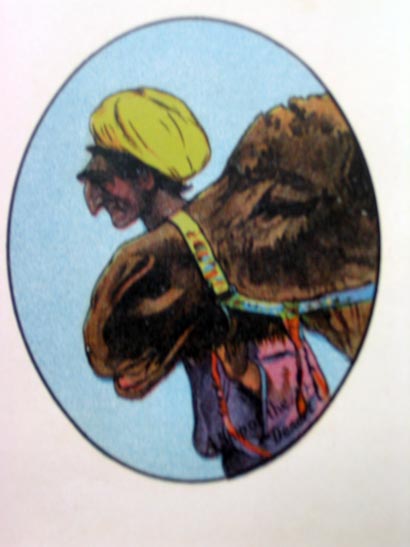
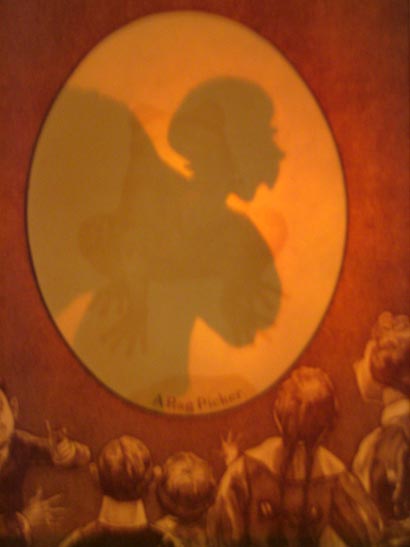
After the success of his two Topsy-Turvys, Peter Newell published A Shadow Book (New York: The Century Co., 1896) in which after looking at a picture, e.g. of an Arab leading a camel,

you turn the page and place it in front of a light source, so that the image you now see represents something else, this case “A Rag Picker:”

Unfortunately, the images above were taken with a camera and do no justice to the real book: in many cases the different densities of the tints in the “front” picture produce nuances in the shadow one which enhance the effect. If I ever manage to find a way to get good images without ruining my copy, I’ll post the whole series.

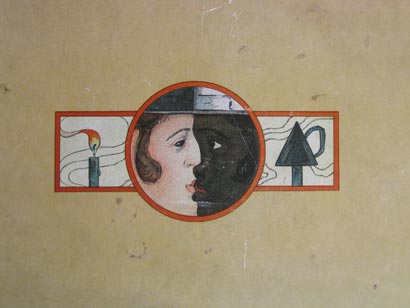
It is likely that the book sold as well as the earlier ones, though it is harder to find as in many cases it was probably burnt by inattentive children who followed Newell’s back-cover suggestion of using a candle:

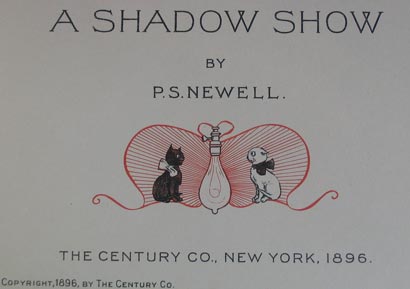
Better luck probably had those who preferred, or could afford, to use a light bulb, as recommended in the title page:

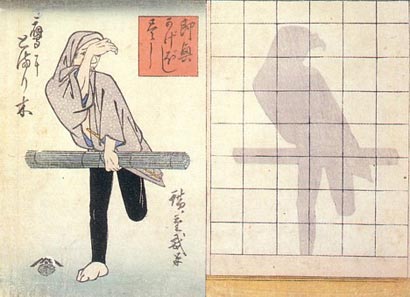
Shadow pictures, Kage-e, seem to have been common in woodblock prints of the Edo period in Japan, according to the pinktentacle blog. Here is one of the several instances posted:

In this case, first you looked at the shadow image cast on a door (in the example a hawk), and then discovered the real subject, a man in a very peculiar attitude.

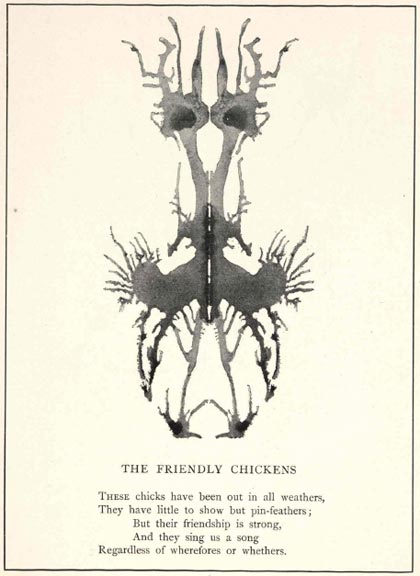
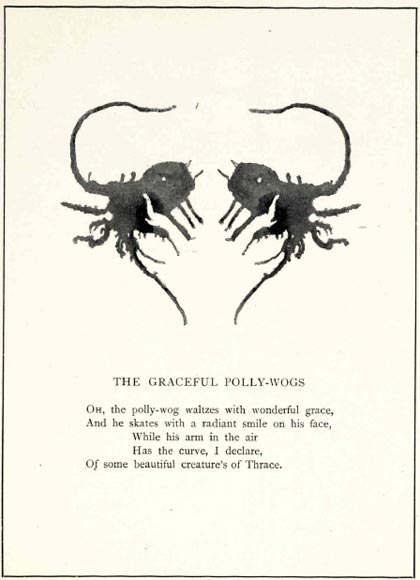
1896 must have been the annus mirabilis of shadow books for the Century Co.: they also published Gobolinks, or Shadow-Pictures for Young and Old by Ruth McEnery Stuart and Albert Bigelow Paine. These were not real shadow pictures, but rather images obtained with a process involving, at least in part, chance:

Drop a little ink on a sheet of white paper. Fold the sheet in the center and press the ink-spots together with the fingers. All of the pictures in this book were made in this manner — none of them having been touched with a pen or brush.

To each of the images thus generated a short poem is added, in some cases a limerick:

On Peter Newell, also see Philip Hofer, “Peter Newell’s Pictures & Rhymes.” The Colophon. A Book Collectors’ Quarterly. Part Nineteen. New York, 1934.

Posted in Comics, Limerick, Peter Newell | Leave a comment

War Games and More Peter Newell Patents

If you enjoyed my previous posts on Peter Newell’s toy and toy-book patents, you cannot miss these on War Games from the Boer War and War Games from World War II from Steve van Dulken’s Patent Blog at the British Library.

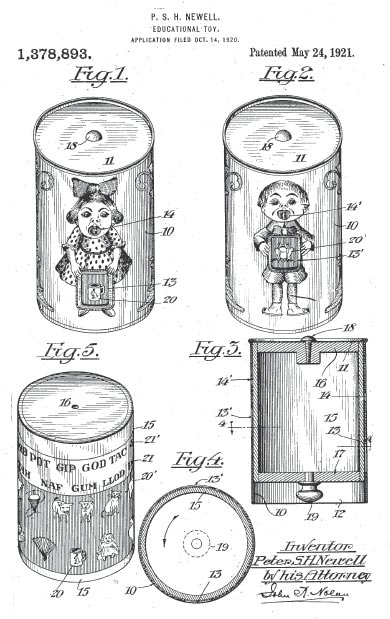
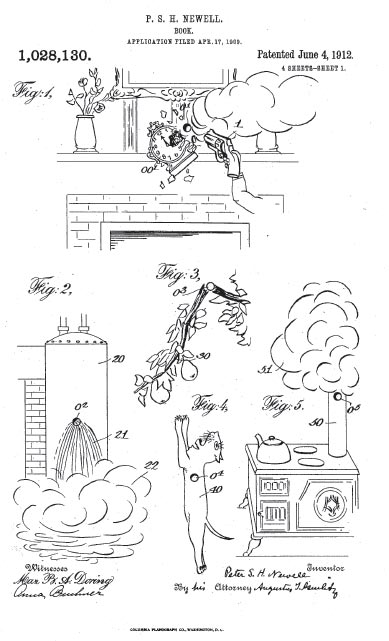
Here, by the way, is another “Educational Toy” patented by Newell in 1921:

Peter Newell's Educational Toy

This invention relates to educational toys intende more especially for children; and the object of my invention is to provide a simple, convenient, attractive and instructive device whereby a succession of figures or pictures representing animals or objects of various kinds can be individually presented to view, together with the letters in sequence of the name of each animal or object thus presented in picture form…

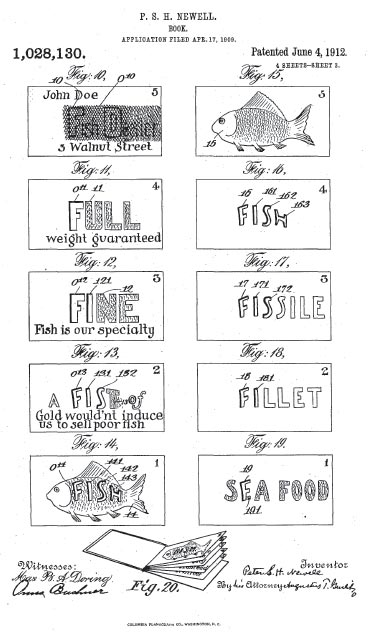
This one, filed under the unlikely title of Vlamoakaph Co, includes the Jungle Jangle patent I already posted as well as one for The Hole Book (with scenes that were not used for the book),

Peter Newell's Hole Book Patent

and applications of the same principle “to commercial as distinguished from literary productions.”

Commercial Application Patent

Posted in Peter Newell | Leave a comment

The Pig-Faced Woman and the Limerick

In the early months of 1815 London was swept by reports of a pig-faced lady living in Manchester Square:

In the earlier part of this century, there was a kind of publication in vogue, somewhat resembling the more ancient broadside, but better printed, and adorned with a rather pretentious coloured engraving. One of those, published by Fairburn in 1815, and sold for a shilling, gives a portrait of the pig-faced lady, her silver trough placed on a table beside her. In the accompanying letter-press, we ore informed that she was then twenty years of age, lived in Manchester Square, had been born in Ireland, of a high and wealthy family, and on her life and issue by marriage a very large property depended. ‘This prodigy of nature,’ says the author, ‘is the general topic of conversation in the metropolis. In almost every company you join, the pig-faced lady is introduced, and her existence is firmly believed in by thousands, particularly those in the west end of the town. Her person is most delicately formed, and of the greatest symmetry; her hands and arms are delicately modelled in the happiest mould of nature; and the carriage of her body indicative of superior birth. Her manners are, in general, simple and unoffending; but when she is in want of food, she articulates, certainly, something like the sound of pigs when eating, and which, to those who are not acquainted with her, may perhaps be a little disagreeable.’ (The Book of Days: A Miscellany of Popular Antiquities. Edited by R. Chambers. London and Edinburgh: W. & R. Chambers, 1832, v. 2, p. 256.)

Captain Gronow in his Recollections and Anecdotes (1863. London: John C. Nimmo, 1900, v.1, pp. 255-7) tells a different story:

Among the many absurd reports, and ridiculous stories current, in former days, I know of none more absurd, or more ridiculous, than the general belief of everybody in London, during the winter of 1814, in the existence of a lady with a pig’s face. This interesting specimen of porcine physiognomy was said to be the daughter of a great lady residing in Grosvenor Square.

It was rumoured that during the illuminations which took place to celebrate the Peace, when a great crowd had assembled in Piccadilly and St. James’s Street, and when carriages could not move on very rapidly, “horresco referens!” an enormous pig’s snout had been seen protruding from a fashionable-looking bonnet in one of the landaus which were passing. The mob cried out, “The pig-faced lady! the pig-faced lady! Stop the Carriage stop the Carriage!” The coachman, wishing to save his bacon, whipped his horses, and drove through the crowd at a tremendous pace; but it was said that the coach had been seen to set down its monstrous load in Grosvenor Square.

John Ashton, in Social England under the Regency (London: Chatto & Windus, 1899, pp. 219-22) adds a few details and also has a print, “Waltzing a Courtship” (1815), showing the supposed pig-faced woman dancing with a “short deformed man,” a caricature of Lord Kirkcudbright (as described under the title “Waltzing in Courtship” as no. 12630 in George. Catalogue of Prints and Drawings in the British Museum. Division I. Political and Personal Satires. v. 9, p. 602).

Waltzing a Courtship

The pose of the two dancers — and in particular their feet, as well as the man’s right arm — is the same Edward Lear would use thirty years later for his dancing characters, e.g.
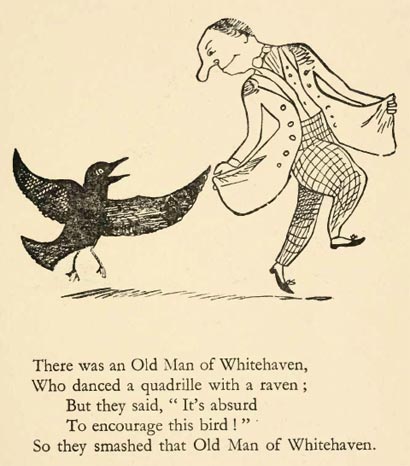
The mingling of human and animal features, though never by simply juxaposing incongruous body parts as here, is also typically learian:

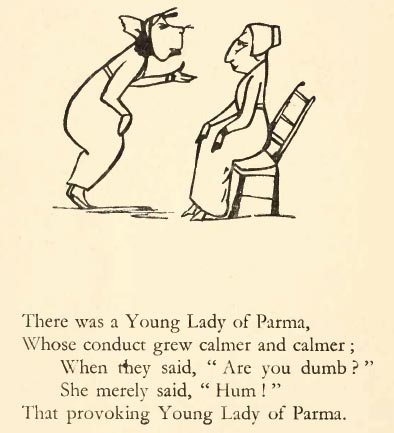
One of Lear’s limerick illustrations even includes a pig-faced woman, though she is not the protagonist:
On 15 March 1815 another print appeared which might provide further, more interesting clues on the rise of the limerick book in the early 1820s. This one was by George Cruikshank and put together two deformed figures, the hog-faced lady and the “spanish Mule of Madrid,” a reference to Ferdinand VII, king of Spain (see George, Catalogue of Prints and Drawings in the British Museum. Division I. Political and Personal Satires. v. 9, pp. 513-4, no. 12508, for an explanation):


© Trustees of the British Museum

What makes this print interesting for the history of the limerick is the fact that it contains all the elements of the early, and of Lear’s, collections except the metrical form itself: each picture presents a single peculiar character identified by geographical location, and the whole forms a gallery of lunatics, whose “story” is told in the captions below.

Studies of the origins of the limerick have mostly focused on the rise of the five-line poem, but — given the preponderance of illustration over text in all the early collections and, again, in Lear — it is perhaps time to look in other directions, and none appears more promising than the huge output of satirical prints in the early decades of the 19th century.

(For a full account of the myth of the pig-faced woman, which goes back to the beginnings of the 17th century, see Jan Bondeson, The Two-Headed Boy, and Other London Medical Marvels. Ithaka: Cornell University Press, 2000, pp. 95-119.)
Posted in Edward Lear, Limerick | 1 Comment

A Photographer's Day Out… with Edward Lear

Nancy Hill, a photographer and writer as well as old time fan of Edward Lear’s nonsense, has a new site showcasing her photographic work. Of particular interest are two portfolios: Fools and Limericks.

Posted in Edward Lear, General | Leave a comment

A Short Peter Newell Animation

I did not know that orecchio acerbo, who published my Italian translation of Peter Newell’s Slant Book last year, had also produced a short booktrailer which you can see on YouTube:

You can also download a pdf of the Italian edition of the whole book from orecchio acerbo’s site.

Posted in Peter Newell | Leave a comment

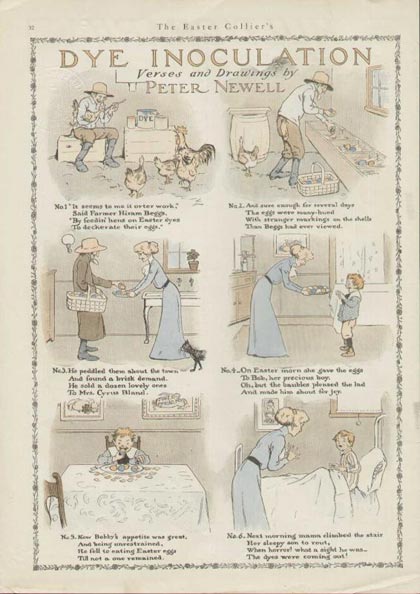
Dye Inoculation by Peter Newell


Newell, Dye Inoculation

No. 1
“It seems to me it orter work,”
Said Farmer Hiram Beggs,
“By feeding Hens on Easter dyes
To deckerate their eggs.”

No. 2
And sure enough for several days
The eggs were many-hued
With stranger markings on the shells
Than Beggs had ever viewed.

No. 3
He peddled them about the town
And found a brisk demand.
He sold a dozen lovely ones
To Mrs. Cyrus Bland.

No. 4
On Easter morn she gave the eggs
To Bob, her precious boy,
Oh, but the baubles pleased the lad
And made him shout for joy.

No. 5
Now Bobby’s appetite was great,
And being unrestrained,
He fell to eating Easter eggs
Till not a one remained.

No. 6
Next morning mama climbed the stair
Her sleepy son to rout,
When horror! what a sight he was —
The dyes were coming out!

The Easter Collier, p. 32.

I don’t know the date, as I got this image from an eBay auction; it appears in the Beineke’s library catalogue of Peter Newell’s family papers among the unidentified or unpublished comic strips.

Posted in Comics, Peter Newell | Leave a comment