Joge-e: Two-Way Pictures

In the second half of the nineteenth century the west shows a sudden interest in images that can be seen upside down. There are several examples, the most famous being probably Peter Newell’s Topsys and Turvys (New York: The Century Co., 1893), followed by a second volume in 1894, and Gustave Verbeek’s comic strip, Upside-Downs Of Little Lady Lovekins And Old Man Muffaroo (1903-1905). At least another book had been published previously, Upside Down, or, Turnover Traits from Original Sketches by the Late William McConnell (London: Griffin and Farran, 1868), with texts by Tom Hood, in which each of the 15 pictures is meant to represent both a person and an animal to which it is compared.

As Greedy as a Pig (William McConnell)

This kind of picture appears to have been very popular in Japan from the beginning of the century, according to a post at the Pink Tentacle blog:

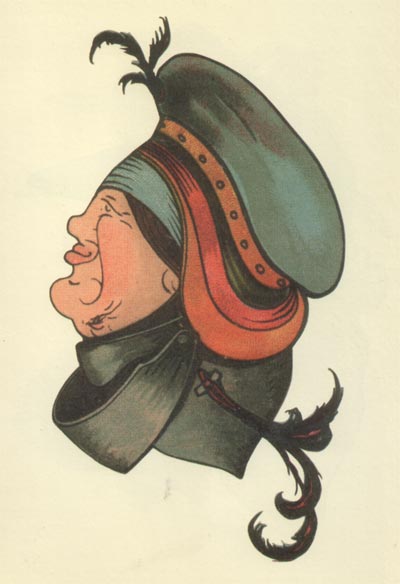
Joge-e, or “two-way pictures,” are a type of woodblock print that can be viewed either rightside-up or upside-down. Large numbers of these playful prints were produced for mass consumption in the 19th century, and they commonly featured bizarre faces of deities, monsters or historical figures (including some from China). Only a few examples of original joge-e survive today.

Joge-e

All of these images represent only the faces of characters, just like the pictures in Dreh’ mich um, rund herum! by Otto Bromberger, published in Germany in the 1890s.

Turn me round (Bromberger)

Other interesting items at Pink Tentacle include:

Mythical 16th-century disease critters
Edo-period monster paintings by Sawaki Suushi

Posted in Gustave Verbeek, Peter Newell | 1 Comment

Edward Lear to the Rev. Ellis Ashton

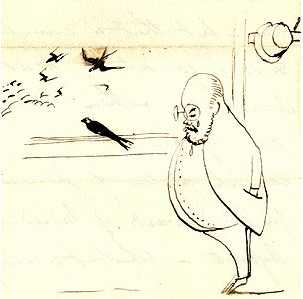
Here is a previously unpublished letter by Edward Lear which was offered some time ago on eBay. It includes one of his delightful self-caricatures representing the painter watching the swallows.

15 Stratford Place,
Oxford Street, W
4 Sept. 1865.

My dear Mr. Ashton,

You are right about me & the swallows – for I AM here still. You see the said swallows are better off than Landscape painters in this — that they can fly OVER Quarantines, & are not obliged to live IN them. I was going off to Dalmatia, when the Cholera put a seal on all the Shore Ports & landings — & then I fixed on Spain, where, as precisely the same thing has occurred. — I am obliged to remain here — I am in consequence dreadfully cross & disagreeable.

It is very kind of you to remember the Photograph — which is very nice, & extremely interesting. I agree with Sir Thomas that he did NOT improve much at all after he had painted that portrait.

There were 507 people at my Studio this season, (including yourself,) so you can suppose that the Contrast of London daily life is sufficiently great. Except Digby Wyatt — Admr. Robinsons, & the Edgar Drummonds I know no one here — but that is enough: — & so I go into the near Country now & then — but generally am at work on a largish picture of Jerusalem for Mr. Edwards of Mosedale House Aigburth — which I wish you & Lucy may see whenever it is done. My kindest regards to her, & believe me,

Dear Mr. Ashton,
Your’s affectionately,
Edward Lear

Lear watching the swallows

Lear wrote this letter — addressed to the Rev. Ellis Ashton, Vicarage, Huyton, Prescot, Lancashire — while in England and unsure on where to go next. He would finally set off for Venice after receiving a commission from Lady Waldegrave for a painting of the lagoon city.

Among the people he mentions are Sir Digby Wyatt — whom he had met in Rome in the 1840s — Admiral Sir Robert Spencer Robinson and Edgar Drummond — a member of the banking family that managed Lear’s money.

The painting of Jerusalem Lear was working on at the time would give him some problems, as in a letter to Lady Waldegrave of 23 January 1866 he was complaining that “these things and Mr. Edwards not paying me, with flies and a pain in my toe all affect me at once.” And again on 13 February: “And Mr. Edwards, for whom I painted the Jerusalem, from July to November, and for whom I made it so large a picture on account of auld lang-syne, has never paid for it.” This should be Samuel Price Edwards, collector of tariffs and duties at Liverpool Port.

[This letter was sold for £4,000 at Dreweatts & Bloomsbury Auctions on 24 October 2007.]

Posted in Edward Lear | Leave a comment

Poems and Essays in Honour of Edward Lear

In July 2000 Charles Lewsen gave a performance at the Redgrave Theatre in Bristol of the solo theatre piece, How Pleasant to Know Mr. Lear, first given in 1968 at Hampstead Theatre and the Edinburgh Festival, and subsequently at venues throughout Britain, and festivals in Tel Aviv and Charleston, South Carolina. One such performance also resulted in a difficult-to-find LP.

The Bristol performance was given in aid of the Friends of the Bristol Oncology Centre, who published an illustrated Souvenir Programme with a range of poetic and scholarly insights into aspects of Lear including his epilepsy, and what is probably the only tribute to Foss by a poet other than Lear.

Now Mr. Lewsen informs me that some copies of the “Poems and Essays in Honour of Edward Lear” are still available and can be obtained contacting:

The Friends of the Bristol Oncology Centre
Horfield Road, Bristol BS2 8ED
phone & fax 0117-928 3432

Detailed contents and ordering information.

Posted in Edward Lear | Leave a comment

The Adventures of Edward Lear

You may remember that a few months ago I posted on a projected TV series on Edward Lear’s journey through Albania in 1848. A promo of the documentary is now available on YouTube.

Posted in Edward Lear, Podcasts | Leave a comment

The Akond of Swat and the Ghazal

A.E. Stalling has a very interesting post on Edward Lear on her blog at Poetry Foundation. After a short general introduction, she states that

The Akond of Swat, […] with its strict adherence to the form and “exotic” eastern locale, [… is] a ghazal, and consciously so.

The idea, as far as I know, was first advanced by Julie Rybicki in an e-mail to the Edward Lear mailing list on 23 June 2002:

Post the formalism conference I attended, I was/am reading a book called “An Exaltation of Forms: Contemporary Poets Celebrate the Diversity of Their Art” (Edited by Annie Finch & Kathrine Varnes. Ann Arbor: U of Michigan Press, 2002, (USA). I was reading the chapter called “Ghazal: To Be Teased into DisUnity” by Agha Shahid Ali and the form sounded very familiar–and I realized that Lear’s “TheAkond of Swat” fit the form almost perfectly. (Though Lear used twiceas many rhymes than the form requires.)

Put simply, the ghazal is a Middle Eastern poetry form where there are two line stanzas, interchangeable in order, that all end with the same word or phrase. (“The Akond of Swat”). Right before this 2nd line “chorus” is a monorhyme (In Lear, “squat, hot, trot, cot, dot, blot, plot,” etc.)

Even Lear’s suggestions for how the poem should be read/performed(having the chorus shouted out, p. 526 of Noakes’ notes in “TheComplete Verse and Other Nonsense”) sound like the traditional way Ghazals were performed with a poet and an audience. Since Lear composed the poem in India, one of the countries where Ghazals have been traditionally written, it is possible he ran into some ghazals in his travels and borrowed the form.

Or not, who knows. But I always thought that poem had a very unusual form and it’s interesting that the form pre-existed Lear’s poem. (The form is medieval.)

Julie’s opinion that the Akond of Swat fits “almost perfectly” a ghazal is, in my opinion, to be preferred to Stalling’s firm statement, following which she even identifies a particular form of Ghazal as the source:

Actually, when I approached Dick Davis, the poet and Persian scholar, about the ghazal-ness of the “Akond of Swat,” he agreed with me, but pointed out that “To be really picky Lear probably meant the poem as a qasideh, not a ghazal. The qasideh and ghazal are formally identical (except the qasideh is usually much longer than the ghazal) and are distinguished by subject matter – the ghazal being erotic/lyrical, the qasideh being a praise poem. The A of S is clearly a mock praise poem.”

Lear’s poem certainly sounds like a ghazal, but if we consider its lineation several differences crop up. The ghazal is a “short poem in lyric form” and consists of a limited number of couplets (bayt, pl. abayat), usually between 5 and 17, each of which ends with the same words (radif) preceded by the rhyme proper (qafiya); the first couplet (matla) respects these restrictions in both lines, the last (maqta) very often contains a reference to the poet’s name: a sort of signature (L.P. Elwell-Sutton, The Persian Metres. Cambridge: Cambridge University Press, 1976, p. 245). Here is a modern example by Agha Shahid Ali (1949-2001), Ghazal (for Daniel Hall), it first appeared in the Boston Review (24.2, April-May 1999):

I’ll do what I must if I’m bold in real time.
A refugee, I’ll be parolled in real time.

Cool evidence clawed off like shirts of hell-fire?
A former existence untold in real time . . .

The one you would choose: were you led then by him?
What longing, O Yaar, is controlled in real time?

Each syllable sucked under waves of our earth–
The funeral love comes to hold in real time!

They left him alive so that he could be lonely–
The god of small things is not consoled in real time.

Please afterwards empty my pockets of keys–
It’s hell in the city of gold in real time.

God’s angels again are-for Satan-forlorn.
Salvation was bought but sin sold in real time.

The throat of the rearview and sliding down it
the Street of Farewell’s now unrolled in real time.

I heard the incessant dissolving of silk-
I felt my heart growing so old in real time.

Her heart must be ash where her body lies burned.
What hope lets your hands rake the cold in real time?

Dear Friend, the Belovèd has stolen your words–
Read slowly: the plot will unfold in real time.

This ghazal consists of eleven abayat, the qafiya (|-old|) and radif (“in real time”) recur in lines 1-2 (the matla), 4, 6 and so on.

In order to read The Akond of Swat as a ghazal we must take the refrain “the Akond of Swat” as the radif; Lear however has increased the complexity, and the comic effect, of the metre by choosing a qafiya (“squat,” “hot,” “trot,” and so on) which rhymes with the radif and having them preceded by a separately rhyming couplet. The main difference from the strict ghazal is the fact that the qafiya and radif are added to the couplet structure rather than “forming an integral part” of the second line (Elwell-Sutton, The Persian Metres, p. 225).

Lear had probably seen a number of ghazals in Englsh as there had been a fad for Persian poetry at the turn of the century; however there was no consensus on the form such translations should take and most had used widely differing metres.

After discussing the idea with Julie, and planning an article on the subject which was never completed, we came to the conclusion that the metre of the Akond had a much more complex origin than the simple imitation of an eastern verse form, but of this more in a future post.
Posted in Edward Lear | 1 Comment

Animation Links

A few more interesting posts from the incredibly lively world of animation blogs:

Michael Sporn has four new nonsense-related articles:

  1. Fantasia Program 1 & 2: a souvenir booklet sold with the initial roadshow presentation of Fantasia.
  2. Alices: on the clash on Alice animations between Disney and Lou Bunin.
  3. Belloc’s Bestiary.
  4. Steig’s Bdsplr: on William Steig’s children books.

mickey_thro_the_mirror.jpg

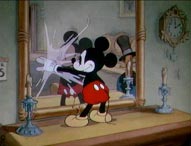
Mark Meyerson has three posts on Walt Disney’s classic short Through the Mirror, featuring Mickey Mouse: 1, 2, 3, 4.

Posted in Comics, General | Leave a comment

More Early Essays on Edward Lear

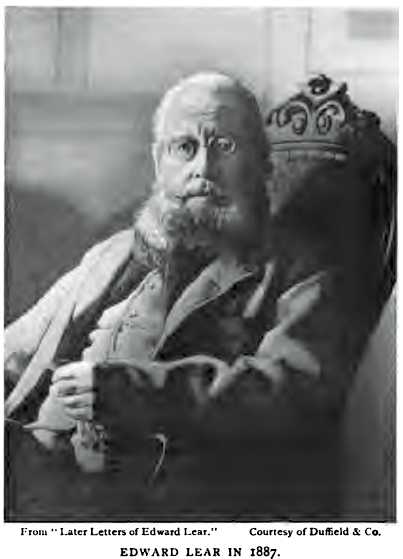
Edward Lear in 1887

Two new early essays on Edward Lear are available at the nonsenselit.org’s library:

Holbrook Jackson, “Masters of Nonsense.” All Manner of Folks: Interpretations and Studies. London: Grant Richards Ltd., 1912; pp. 30-44.

Hildegarde Hawthorne, “Edward Lear.” St. Nicholas: A Monthly Magazine for Boys and Girls, Volume XLIV, part I, November 1916 – April 1917; pp. 71-3.

Posted in Edward Lear | Leave a comment

The Quadrille

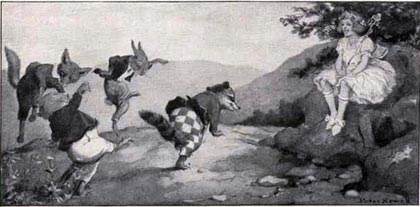
Here is a poem, made of three limericks, by Louise Ayres Garnett and illustrated by Peter Newell. I’m taking it from an eBay auction, the description dates it to 1922 but does not say where it is taken from:

Garnett - Newell, The Quadrille (1922)

Four quadrupeds danced a quadrille
On the summit of Somebody’s hill,
And a lily-white queen
Looked on at the scene
And envied the quadrupeds’ skill.

For they’d hop and they’d circle and leap,
And yet perfect time they would keep;
And all were so deft
In the “Allemande left”
That they vowed they could do it asleep.

They said to the queen, “Will you dance?
We’ve many new figures from France.”
She replied, “If I could,
I feel that I should;
But it’s hard with just two legs to prance!”

Posted in Peter Newell | Leave a comment

Nonsense Poetry in Schools

A controversy seems to have been raised by the Ofsted report on poetry in schools, which maintains that British pupils are not prepared to appreciate classic poetry because of a focus on a few poems, which are considered not “genuinely challenging.”

When it comes to citing these supposedly unstimulating poems, newspapers, in particular the Times that started it all and Reuters, have chosen to emphasize nonsense such as Lewis Carroll’s “Jabberwocky” and Edward Lear’s “The Owl and the Pussy-cat.”

While the report itself does not sound so negative as the newspapers have chosen to make it appear, see the summary, it seems to me that the problem is not so much nonsense poetry, which might also be considered too challenging, as the lack of variety. On the other hand, the fact that the same poems are chosen in most schools simply means that teachers prefer to support an established canon: not necessarily a bad thing, in my opinion, unless it is the result of indolence.

Posted in Edward Lear, General, Lewis Carroll | Leave a comment

Animation News

Animation is one of the liveliest subjects on the Internet at the moment; among the mass of interesting posts, Michael Sporn’s two new articles (1 & 2) on the representations of the blank map in Lewis Carroll’s The Hunting of the Snark are not to be missed.

Blank Map in Carroll’s Hunting of the Snark

Of great interest to nonsense-lovers should also be the production sheets for Disney’s Alice in Wonderland, Hans Perk has scanned and published 75 of them so far.

Posted in Comics | Leave a comment