Peter Newell, American Comic Illustrator

The blog has been quiet for a long time, as I have been very busy and had to keep up with the daily publication of Edward Lear’s diaries. However, I have at last found time to add an article on Peter Newell to the nonsenselit.org bookshelf:

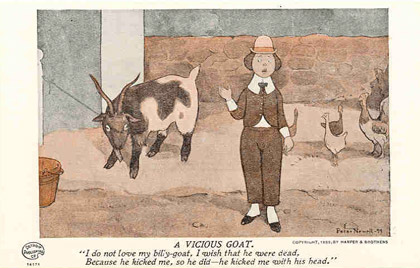
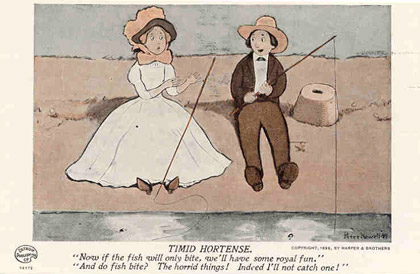
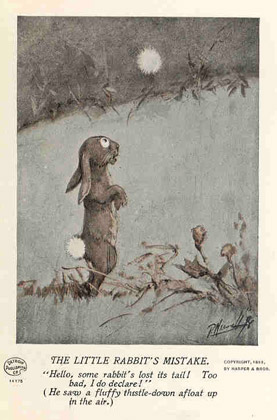
As a bonus I am adding a set of 10 postcards from the Detroit Publishing Co. “Artist Series” from Peter Newell’s Pictures and Rhymes (1899). The seller on eBay dated them circa 1905, I only downloaded the images, so the quality is not good.

pc_01

pc_02

pc_03

pc_04

pc_05

pc_06

pc_07

pc_08

pc_09

pc_10

Posted in Comics, Peter Newell | Leave a comment

New Edward Lear Resources

Just a quick post to mention a few new resources relating to Edward Lear:

Finally, if you are lucky enough to be in the UK, why not see King Pelican, a new play by Chris Goode on Edward Lear at the Drum Theatre in Plymouth:

London, 1861. Years before starting to write his nonsense verses (most famously The Owl and the Pussycat), Edward Lear is a struggling landscape painter, hoping to secure his reputation with a series of giant canvases.

But for Lear – epileptic, queer, lonely and beset by illness – things are never easy, and the declining health of his beloved sister Ann brings further cause for concern.

Then, into his studio one day walks a boy with a parcel to deliver…

Chris Goode’s haunting new play, made especially for the Drum, is a tender, offbeat fantasy about one of Victorian literature’s best-loved but least-known figures.

King Pelican

By the way, BBC Radio 4 broadcast The Need for Nonsense on 9 February, also a play on Lear’s relationship with his servant Giorgio. Unfortunately, it is no longer available in the Listen Again section of the site.

Posted in Edward Lear | Leave a comment

De kat en de uil

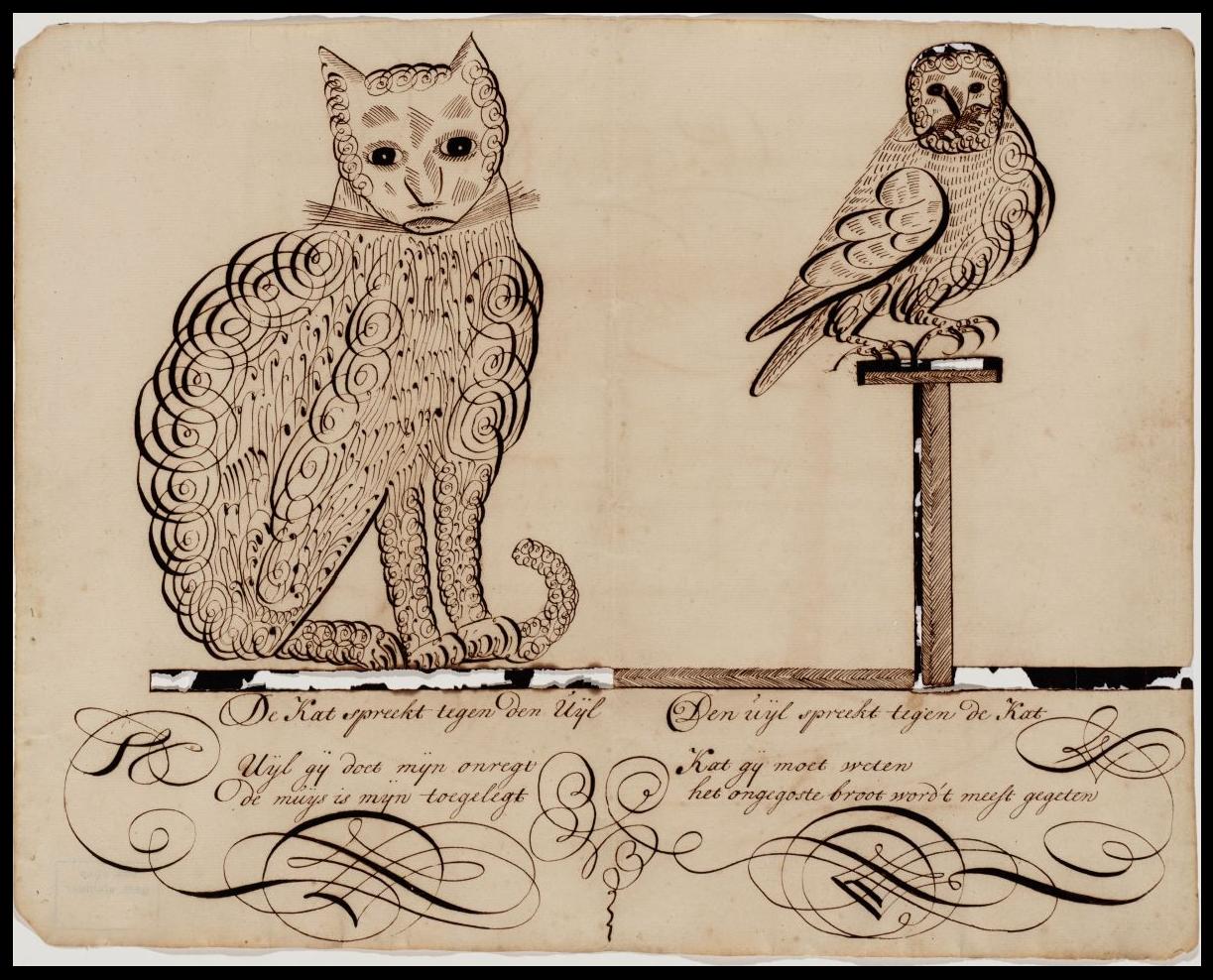
Below is a pen and ink calligraphic drawing by Jacob Labotz representing a cat and an owl. Online translator software is not very good with 18th-century Dutch, but it is obvious they are fighting for the possession of the mouse the owl is holding in his bill. The image is part of a series Labotz produced around 1775 (available at the Regionaal Archief Alkmaar web site).

kat_uil

While it is hard to imagine that Edward Lear saw this, it shows that the association of the two animals was a logical one, both prefer the night, hunt mice and spend a lot of time on trees, at least cats of the nursery-rhyme variety do, as in the famous quasi-limerick:

Diddlety, diddlety dumpty,
The cat ran up the plum tree;
      Half a crown
      To fetch her down,
Diddlety, diddlety, dumpty.

Given the similarities they are natural competitors, as in Labotz’s rhyme, while Lear’s “The Owl and the Pussy-cat” is set in an upside-down world in which the two animals can fall in love with each other.

By the way, climbing on trees appears to be a very dangerous activity for cats, as Lear himself testified in a draft for “The Children of the Owl and the Pussy-cat,” in which they tell the story of their mother’s unfortunate end:

In Sila forest on the East of fair Calabria’s shore
She tumbled from a lofty tree — none ever saw her more.

(Thanks to peacay of BibliOdyssey.)

Posted in Edward Lear | Leave a comment

An Exile in Paradise

You may remember that RS Productions started working on a documentary on Edward Lear’s travels in Greece and Albania almost two years ago, and I linked to a promo last year.

Director Derek Smith and cameraman Chris Sutcliffe at the peaks of Meteora

Director Derek Smith and cameraman Chris Sutcliffe at the peaks of Meteora

The first of the three parts is now going to be broadcast in Britain by SkyArts 2 and SkyArts HD on 16 January at 1 am and 17 January at 2pm. See the presentation and programme listings.

Posted in Edward Lear | Leave a comment

The Cowboysterous Kangaroosevelt Bear

Theodore Roosevelt‘s refusal, in 1902, to shoot an imprisoned bear spawned a long series of political cartoons and, since the bound animal was often represented as a cub, and brought to the creation of the Teddy Bear.

junglejangle_4

Teddy Roosevelt in Peter Newell's Jungle Jangle

Roosevelt’s hunting mania was the subject of a 1909 booklet by Peter Newell, Jungle Jangle, and of one of the earliest animated shorts.

Gustave Verbeek‘s Terrors of the Tiny Tads, which ran in the New York Herald Sunday comics supplement from 28 May 1905 to 25 October 1914, did not usually refer to contemporary political or social issues, but did not miss an opportunity to introduce a “cowboysterous” “Kangaroosevelt Bear” in the stip for 21 April 1907. The arrival of this heroic chimera saves one of the Tads ― who, perhaps in honour of his saviour, becomes a “Taddy” in the next panel ― from the terrible Hippopotamuskrat:

cowboisterous_kangaroosvelt

Verbeek's cowboysterous Kangaroosevelt Bear (click on the image to read the whole story)

Posted in Comics, Gustave Verbeek, Peter Newell | 1 Comment

Il libro esplosivo

My Italian translation of Peter Newell’s Rocket Book, Il libro esplosivo, has been out for some time now. The publisher, orecchio acerbo, have a beautiful book trailer on YouTube:

While you are there, don’t miss the short for Stefano Benni’s first children’s book, Miss Galassia:

Posted in General, Peter Newell, Podcasts | Leave a comment

Edward Lear's Nervous Family

Yale University’s Beinecke Rare Books and Manuscripts Library has scans of a few of their Edward Lear manuscripts online; the small collection includes self-caricatures taken from letters and original cartoons for the Nonsense Botanies, but also the full manuscript of “The Nervous Family,” a parody of an old song “augmented” by Lear.

Unlike Lewis Carroll, Edward Lear never published explicit parodies of other people’s poems, which is not to say that he did not write any. On the contrary, his early poems, starting with “Eclogue,” based on Collins’s “Hassan, or the Camel Driver,” are very often parodies. Lear was also fond of providing his own comic illustrations to popular poems (see my previous Irish Sources of Edward Lear’s Early Picture Stories).

Although he did not have a formal musical education, Lear also enjoyed singing at the piano; in later life he was quite successful with his arrangements of Tennyson’s songs (see Lear Vamping), a selection from which was published in 1859 (the entries in his Diaries for September-November 1858 record his collaboration with E.F. Rimbault to prepare this edition). As a young man in Knowsley he probably preferred lighter subjects to entertain Lord Derby and his guests, and in this context adding a few stanzas to a well-known comic song would have been a good idea.

I have been unable to find “The Nervous Family,” the “published song” Lear decided to add to, but it is mentioned in the advertising section of Comic Songs to Popular Tunes. Ninth Collection, by J. Beuler (London: J. Beuler, 1833) as having already been published by the same “J. Beuler, 4, Bury Place, Bloomsbury, London” in a collection of Songs with accompaniment for the Piano-forte.

The song, in any case, was the parody of an older one, “We’re a’ Noddin,” composed by William Hawes on a poem, two versions of which can be found in The Universal Songster; or, Museum of Mirth: Forming the Most Complete, Extensive, and Valuable Collection of Ancient and Modern Songs in the English Language. Twenty-nine Wood-cuts by George and Robert Cruikshank engraved by J.R. Marshall. Vol. 1. London: Jones and Co., 1834, 208:

WE’RE A’ NODDIN.

(Original Words.)

CHORUS.
WE’RE a’ noddin, nid, nid, noddin,
We’re a’ noddin, at our house at hame.

Gude e’en to you, Kimmer, and how do ye do?
Hiccup — quo’ Kimmer, the.better that I’m fou.
We’re a’ noddin, &c.

Kate sits i’ the neuk, sippin’ hen broo,
Deil tak Kate, and she be na noddin too!
We’re a’ noddin, &c.

How’s a’ wi’ you, Kimmer, and how do ye fare?
A pint o’ the best o’t, and twa pints mair.
We’re a’ noddin, &c.

How’s a’ wi’ you, Kimmer, and how do ye thrive?
How mony bairns hae ye? — Quo’ Kimmer, I hae five.
We’re a’ noddin, &c.

Are they a’ Johnny’s?—Eh! atweel na;
Twa o’ them were gotten when Johnny was awa.
We’re a’ noddin, &c.

Cats like milk weel, and dogs like broo,
Lads like lasses weel, and lasses lads too.
We’re a’ noddin, &c.


О, WE’RE A’ NODDIN AT OUR HOUSE AT HAME.

(As altered, and sung in London, &c.)

O, WE’RE a’ noddin, nid, nid, nodding,
O we’re a’ noddin at our house at hame.
When the dame’s asleep, and the gude man’s fu’,
When lads love lasses, and lasses love so true,
Kate sits i’ the neuk, and her Jo sits by.

And the moon shines bright as the love in her eye.
And they’re a’ noddin, &c.

And how d’ye kimmer? and how d’ye, dear?
How long hae ye loved me? — a twalmonth or near;
I ha’ lov’d ye a twalmonth, dearer than life,

And e’re a day aulder, I’se mak’ ye my wife.
And be aye noddin, &c.

And how d’ye kimmer? and how d’ye thrive?
O’ siller and goud I ha plenty to wive;
Gie’s your hand then, my Jo, — O, na, na, na,

My hand it was promised to Willie far awa!
And we’re a’ noddin, &c.

The latter, the version used in Lear’s parody, is attributed to Robert Burns, from Johnson’s Scots Musical Museum, vol. 3, 1790. The two first stanzas, however, appear in Herd’s collection, 1776. John Lockhart, The Works of Robert Burns; Containing His Life. (New York: William Pearson, 1835), 167.

A score for the poem, but with different words, appeared in Davidson’s Universal Melodist. Vol 1 (London: G.H. Davidson, 1853), 192:

Hawes’s song was wildly popular in the 1820s, so much as to be the cause of a copyright-infringement case, as told in The Georgian Era: Memoirs of the Most Eminent Persons. Vol. 4. (London: Vizetelly, Branston and Co., 1834), 280:

“Mr. Hawes had previously acquired a deservedly high celebrity as the composer and harmonizer of various songs, duets, &c. On the production of Montrose, or the Children of the Mist, at Covent Garden, in February, 1822, Miss Stephens sang two songs arranged by Mr. Hawes, Charlie is my Darling, and We’re a’ Noddin. The latter acquired great popularity, and being pirated and published in one of the magazines, by Mr. Taylor, jun., Mr. Hawes applied to the lord-chancellor for an injunction; but after having, in support of his copyright, expended £120, and Mr. Taylor, in his defence, £70, the lord-chancellor (Eldon,) finally declared that he knew nothing of music, and left each party to pay his own costs!!”

The detailed version is offered by the Gentleman’s Magazine, 42, January-June 1822 p. 270:

Thursday, March 14.
In the Court of Chancery (Hawes v. Sams.) Mr. Shadwell applied to the Court for an injunction to restrain the defendant, Mr. Sams, from publishing the song “We’re a’ noddin, nid, nid, noddin,” which, he said, was an old song, but with new music arranged by the plaintiff. The defendant had thought proper to publish it in the monthly publication, called the “Gazette of Fashion,” with the precise music of the plaintiff. The Lord Chancellor said he had got the “Gentleman’s Magazine” from the first number down to the present, in each of which a song had been published. He did not like to cut up a book of this description because this song was in it. His Lordship refused the application. — A Motion has since been made in the Vice-Chancellor’s Court, but has met with the same ill success.

The song appears to have been very fashionable in the 1820s, when it was repeatedly published in different versions, but it clearly remained a favourite for a long time e.g. We’re a Noddin, with Variations for Flute, with an Accompaniment for the Piano Forte, by Wm. Card. London. Lavenu. (1824), Trois Airs variés pour la Piano-forte, par Henri Hertz. — No. 1. Partant pour la Syrie; — 2. La Swissesse au bord du lac; — 3. We’re a Noddin (1828), Thalberg’s fantasia on “We’re a’ noddin” (The Musical World, XXIX, 1851, p. 251) as well as the above-mentioned version.

Here, at last, is the text of Edward Lear’s manuscript:

The Nervous Family

(Tune –

We’re a’ noddin,
nod, nod, noddin,
& we’re a’ noddin,
at our house at home)

1

We’re all nervous, very very nervous,
And we’re all nervous, at our house in town,
There’s myself, & my Aunt, & my Sister, & my Mother, —
And if left in the dark we’re quite frightened at each other!
Our Dog runs away if there’s a stranger in the house,
And our Great Tabby Cat is quite frightened at a mouse, —

For we’re all nervous, very &c.

2

My poor shaking Aunt can’t work at the needle,
And my shaking hand spills half my cup of tea.
When wine at her dinner my timid sister’s taking —
She drops it on the table, so much her hand is shaking —
And my poor old shaky Mother when to take her snuff she tries
To pop it in her nose, — she pops it in her eyes.

For she’s so nervous, very &c.

3

We all at dinner, shake – shake at carving,
And as for snuffing Candles, we all put out the light;
T’other evening after dinner we all to snuff did try,
But my Aunt couldn’t do it, nor my Sister, nor could I.
“Chill! Give me the snuffers!” said my Mother in a flout,
I’ll show you how to do it!” – so she did, & snuffed it out,

For she’s so nervous,
very very nervous, — —
& we’re all of us nervous
at our home in town.

{Thus far is part of an old published song – the rest is mine. E.L.}
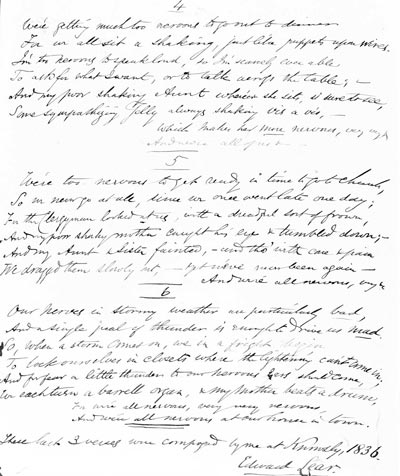
4

We’re getting much too nervous to go out to dinner
For we all sit a shaking, just like puppets upon wires.
I’m too nervous to speak loud, so I’m scarcely ever able
To ask for what I want, or to talk across the table;
And my poor shaking Aunt where’er she sits, I sure to see,
Some sympathizing Jelly always shaking vis a vis, —

Which make her more nervous, very very &c.
And we’re all of us too –

5

We’re too nervous to get ready in time to go to church,
So we never go at all, since we once went late one day;
For the clergyman looked at us, with a dreadful sort of frown,
And my poor shaky mother caught his eye & tumbled down; —
And my Aunt & Sister fainted, — and tho’ with care & pain
We dragged them slowly out, — yet we’ve never been again –

And we’re all nervous, very &c.

6

Our nerves in stormy weather are particularly bad,
And a single peal of thunder is enough to drive us mad.
So, when a storm comes on, we in a fright begin
To lock ourselves in closets where the lightening can’t come in;
And for fear a little thunder to our nervous Ears should come,
We each turn a barrel organ, & my Mother beats a drum,

For we’re all nervous, very very nervous,
And we’re all nervous at our house in town.

These last 3 verses were composed by me at Knowsley, 1836.

Edward Lear.

The Edward Lear version of the song was first published, together with an alternative, very different one which appears to take its metre from the original “We’re a’ Noddin,” in The Complete Verse and Other Nonsense (ed. Vivien Noakes, London: Penguin, 2001, 53) and has been arranged for chorus by Benjamin Lees and performed by The Young People’s Chorus of New York: you can listen to part of the song and buy the CD containing it at CDBaby (the song is also available on iTunes). A review of the concert reveals that Lees was also inspired by Lear’s limericks to compose the interesting-sounding Vocalise:

The Nervous Family, commissioned by Young People’s Chorus, introduced the young chorus to the stage, and a double bassoon accompaniment added to the mix. The students, in yellow, red, and lavender, with young ladies in scarves and young men in jackets, were theatrically ready, as they kept repeating the word “nervous” in a humorous and surreal fashion. Lees’ Vocalise, a world premiere, inspired by Edward Lear limericks, reconfigured the chorus, as they sang only a one syllable short-A vowel, over and over, in melancholy, but melodic tones.
Posted in Edward Lear, Lewis Carroll, Podcasts | Leave a comment

The Edward Lear Diaries Project

Edward Lear’s diaries have been used by all major biographers and extracts have been published in books about  particular locations, most notably by Philip Sherrard for Corfu and Rowena Fowler for Malta. Except for the Indian Journal, published by Ray Murphy 1953, no one has published long sequences in full, which is not surprising, given their sometimes repetitive nature, due to Lear’s punctiliousness in recording the weather, breakfasts and Greek lessons.

The diaries, however, also preserve Lear’s moods and working habits and are indispensable to date his artistic output; they also provide interesting information on places and travelling habits in the second half of the 19th century. And, of course, they record the day-to-day life of one of the great humorists of the Victorian age; a man who, as his lifelong friend Franklin Lushington wrote after his death, deserved “love for his goodness of heart & determination to do right.”

Coming to the point, I have started a new blog devoted to the diaries which will post transcripts of all the entries from 1 January 1858 to 12 May 1862, Lear’s fiftieth birthday. The original idea was to publish each entry 150 years after it was written, but the delay I have accumulated forces me to post 1858 in instalments of about five entries a day until the end of the year. The first five are online now and regular posting will start on Tuesday, 7 October.

This is a long-term project which will come to an end on 12 May 2012 (the bicentenary of Edward Lear’s birth), but I promise I will be regular in my posting, something that cannot be said for the Blog of Bosh.

Posted in Edward Lear | 2 Comments

Irish Sources of Edward Lear's Early Picture Stories

In a previous post I quoted a passage from Prothero’s biography of Arthur Penrhyn Stanley reporting the event that might have originated Edward Lear’s picture story “St. Kiven and the Gentle Kathleen,” an illustrated version of Tom Moore’s “By that lake, whose gloomy shore” (Irish Melodies, vol. 4, 1811). No certain date can be given for this set of illustrations, 1835-36 is a possibility if the events at Glendalough were the source, though Lear also produced illustrations for other poems from the Irish Melodies: “Go where glory waits thee” and “Rich and  rare were the gems she wore,” both from volume 1 (1807), as well as “Eveleen’s Bower” from volume 2 (also 1807).

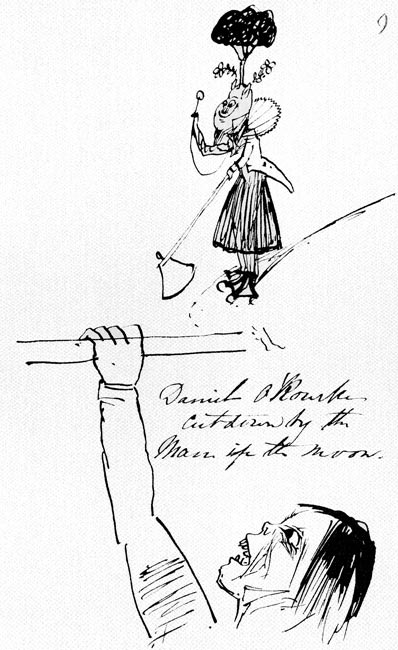
Lear’s interest in Ireland and its traditions was certainly stimulated by his strict connection with the Stanley family, who had large possessions in the island; it was probably during one of his frequent stays at Knowsley between 1832 and 1837 that he produced sets of illustrations, first published in Lear in the Original, for two traditional Irish stories, “The Adventures of Daniel O’Rourke” and “The Adventures of Mick,” from “Daniel O’Rourke” and “Legend of Bottle Hill,” two short stories published in Fairy Legends and Traditions of the South of Ireland (London: John Murray, 1834 — but there are editions as early as 1825 — pp. 134ff. and 33ff. respectively).

These pictures, together with the Moore adaptations (excluding St. Kiven) were part of an album Lear probably produced for some member of the Hornby family, whom Lear met at Knowsley.

I have recently identified the source for another set of Lear illustrations, first published by Vivien Noakes in The Complete Nonsense and Other Verse (London: Penguin, 2001,  pp. 40-2): “I slept, and back to my early days.” The original appeared, under the title “A Dream,” in The Dublin University Magazine: A Literary and Political Journal. (Volume I, Issue 2. February 1833, p. 145):

I slept — and back to my early days
Did wandering fancy roam,
When my hopes were bright, and my heart was light,
And my own a happy home.

And I dream’d I was young and innocent,
And my brow untrac’d by care,
While my parents smil’d on their darling child,
And breath’d for his weal a prayer.

Once again I was rising before the sun,
For in childhood I was told,
If its earliest ray on my head should play,
It would turn each tress to gold.

I was kneeling again on the grassy knoll,
Where I never may kneel more,
And I pray’d and was blest with that holier rest,
Whose halcyon reign is o’er.

I was sporting again through the fields and flowers,
And felt at each step new joys; —
But I woke with a sigh that e’er memory
Should revive what time destroys.

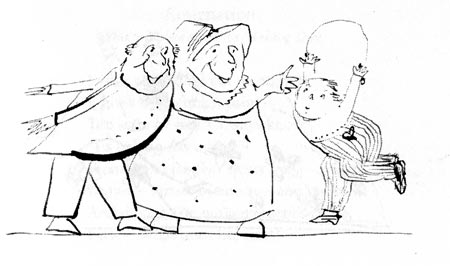
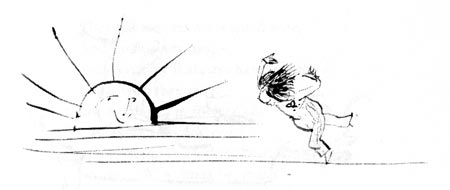
Lear provided five illustrations and copied four of the five stanzas (leaving out the last but one) and seems to have written down the text from memory as there are several, though small, variants. Unlike Lewis Carroll, Lear very seldom, if ever, parodied poems, and in this case too he provides a simple paraphrase for passages he probably could not remember; the comic effect is obtained in part by introducing a conventionally low speech register (“vos” for “was” and so on), but mostly through the pictures which, as often happens in nonsense, are literal representations of worn metaphors:

I slept, and back to my early days
Did wandering fancy roam —
When my heart vos light and my opes vos bright
And my own a appy ome.

When I dreamed I was young and hinnocent —
And my art vos free from care,
And my Parents smiled on their darling child,
And breathed for his [ ] a prayer.

Once again I was rising before the sun,
For in childhood I was told —
If its earliest ray on my head should play —
It would turn each tress to gold.

Once again I vos roaming through fileds and flowers,
And I felt at each step new joys —
But I woke with a sigh that memory
Should revive what time destroys.

When I first found the anonymously-published poem I felt sure it was by James Clarence Mangan, but it does not appear in the 4-volume collected works recently published, and David James O’Donoghue (The Life and Writings of James Clarence Mangan. Edinburgh: Patrick Geddes & Colleagues, 1897: 77) states that Mangan started contributing to the magazine early in 1834, i.e. a full year after this poem appeared. This date is confirmed by Wayne E. Hall: “In January 1834, James Clarence Mangan published translations from the German verse of Schiller, beginning a relationship with the DUM that would see far more of Mangan’s translating” (Dialogues in the Margin. A Study of the Dublin University Magazine. Washington: The Catholic University of America Press, 1999, p. 42).

The fact in any case confirms that Lear, at least in the periods when he was staying at Knowsley, had access to Irish magazines and might have got to know some of Mangan’s poems, a fact which would throw a new light on his later Nonsense songs, whose similarities with the Irish poet’s more absurd compositions have been first noted by O’Donoghue himself:

He [Mangan] could write admirable nonsense when he liked, and the late Edward Lear might have got a hint or two from him for those “Nonsense” books which are held not undeservedly in such high estimation by present-day critics (p. 32).

It is perhaps worth noting that Mangan did write, or translate from the German of Justinus Kerner’s “Täuschung,” a poem which is remarkably similar to the one illustrated by Lear. It was entitled “Dreams” and was published in The Dublin University Magazine (Volume VIII, Issue 44, August 1836, pp. 153-4; also in The Collected Works of James Clarence Mangan. Poems: 1818-1837. Edited by Jacques Chuto et al. Dublin: Irish Academic Press, 1996, pp. 243-4):

I slumbered in the moonless midnight hour;
And in my dream I lay,
Methought, reclining in a sunlit bower,
Circled with flowrets gay.

Awaking, I looked forth. I saw the trees
Reft of their leafy worth;
I heard the hissing of the rains, as these
Pelted the naked earth.

Again I slumbered. In a lovely land,
Breathing soft Summer airs,
I stood. Warm friends about me pressed my hand,
And I pressed theirs.

Awaking, I beheld the assassin near,
Armed with the deadly knife.
Was it the phantom of a sudden fear
No! ’twas a shape of Life.

Oh! might I bid thee now farewell for aye,
Illusive scene of pain!
My world is all within — without alway
I seek for it in vain!

——

Such was, crewhile, the dreary song I sang,
When but betrayed by one;
Soon two proved false, and with a double pang
I dragged Existence on.

But ah! the broken vows I since bewail
No lay, though long, could sing;
The wearied fingers in their task would fail
Upon the mournful string.

More here.

Posted in Comics, Edward Lear | 8 Comments

Non-Limericks 2: Alfred Crowquill

Like Thackeray, Alfred Crowquill (pseudonym for Alfred Henry Forrester) has his place in the prehistory of comics thanks to an 1849 booklet entitled A Goodnatured Hint about California, a satire of the California gold rush. Besides publishing a successful series of illustrated fairy tales, Crowquill collaborated with several magazines of the time, Punch among them.

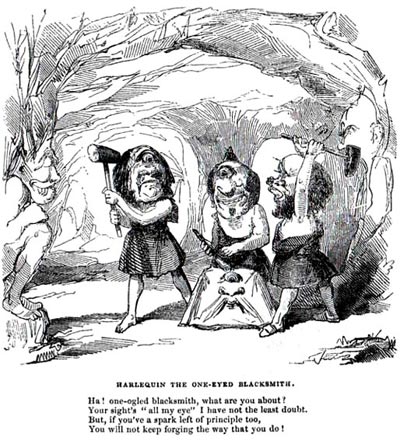
One of his special interests was the pantomime, a shown by another proto-comic he published in 1849, Pantomime, to be Played as it Was, Is, and Will Be, at Home (also available in at Coconino World). For some years, he produced “designs, devices and effects” for pantomimes, and he drew a number of “pantomimic extravaganzas” for the magazines. Among these, “The Christmas Pantomimes,” for The Illustrated London News of 31 December 1842 (pp. 536-37) is available from the Victorian Web under the title Alfred Crowquill’s Limericks for Eight London Pantomimes. Useless to say, the eight poems have nothing at all to do with the limerick, they consist of short poems in couplets, each with its own caricature illustration:

Crowquill Pantomimes

While dictionaries normally define it as “rhymed nonsense poem consisting of five lines,” it is clear that the word “limerick” is losing its specificity and for many people does no longer refer to the five-line nonsense poem popularized by Edward Lear; I would suggest that its current meanings are two:

  1. For most people, a short humorous poem with sexual innuendo;
  2. For scholars, a short 19th-century humorous poem accompanied by a caricatural drawing.

Nothing remains of the original nonsense connotation, except the humour, though it must be admitted that defining “nonsense” is not easy, and the “five” has become a generic “short.”

Posted in Comics, Edward Lear, Limerick | 2 Comments