Edward Lear, St Sabbas the Sanctified

Edward Lear, The monastery of St Sabbas the Sanctified (Mar Saba), near Bethlehem.
Nnumbered, inscribed and dated ‘Deir Mar Sabbas./May 1.1858/Deir Mar Sabbas/(127)’ (lower right) and further inscribed with colour notes
pencil, pen and brown ink and watercolour on paper. 13¾ x 19¾ in. (35 x 50.2 cm.).

The Great Lavra of St Sabbas the Sanctified, known in Arabic as ‘Mar Saba’ is a Greek Orthodox monastery overlooking the Kidron Valley in the West Bank, east of Bethlehem.

Lear referred to his visit to Santa Saba in May 1858 in a letter to his sister dated 21 May and in one to Hallam Tennyson dated 18 September (R. Pitman, Edward Lear’s Tennyson, 1988, pp. 88-89). To his sister Ann he wrote that he executed ‘some good drawings’ of Santa Saba on 1 May 1858, despite the fact that ‘the whole place, even on May 1st was so like an oven that I felt as if I should be baked’. In the 1880s Lear returned to the subject of Santa Saba for an illustration to Tennyson’s poem The Palace of Art (op.cit., p. 89). A drawing of Santa Saba executed on 30 April 1858, showing the subject in different lighting, is in a private collection and another similar in size to the present picture, Mar Sabbas, numbered ‘122’ and dated 30 April 1858, is in the Houghton Library (R. Falchi and V. Wadsworth, Edward Lear, ex. cat., San Remo, 1997, p. 249).
Christie’s.

Posted in Edward Lear | Tagged , , , | Leave a comment

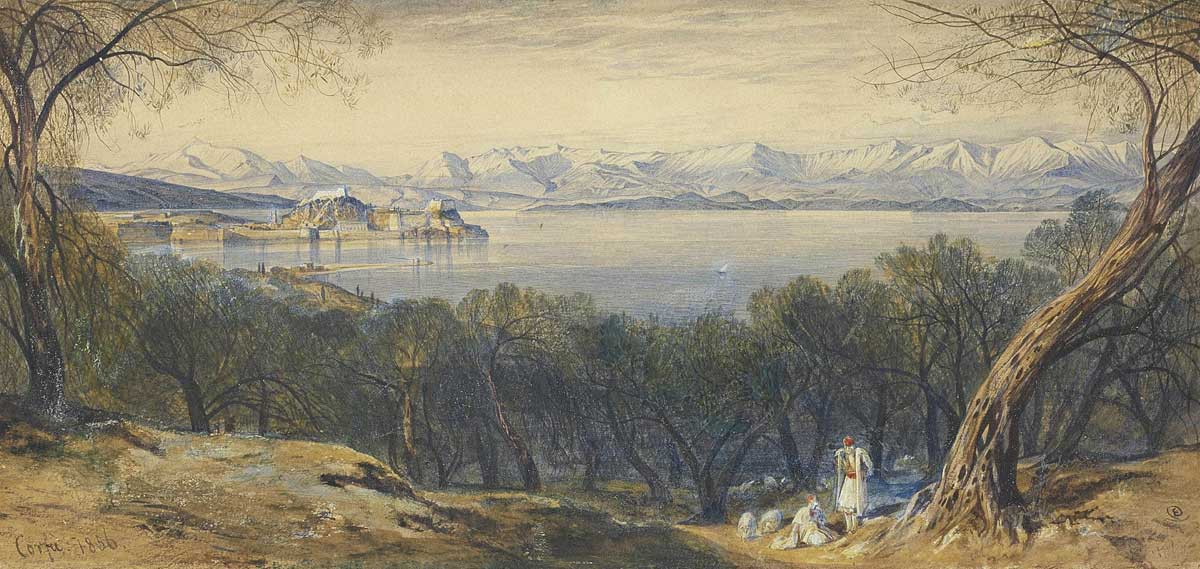
Edward Lear, The Citadel from Ascension

Edward Lear, Distant view of the Citadel from the village of Ascension, Corfu.
Signed with monogram (lower right) and inscribed and dated ‘Corfu. 1856.’ (lower left). Pencil and watercolour heightened with touches of bodycolour. 7 x 14¾ in. (17.8 x 37.5 cm.).

Lear lived on Corfu from 1855 to 1858 following a brief visit to Corfu in the summer of 1848 when he was entranced by the island: ‘I wish I could give you any idea of the beauty of this island, it really is a Paradise. The extreme gardeny verdure – the fine olives, cypresses, almonds, & oranges, make the landscape so rich’. Built by the Venetians who had controlled the island for five hundred years, the Citadel dominated the landscape, creating a focus for the variety of panoramas that Lear developed. A number of his finest paintings illustrate the island’s topography, and many of his drawings were worked up into lithographic plates for his book Views in the Ionian Islands (1863).

The landscape that surrounded the hills of Gastouri and the village of Ascension (now Análipsis), named after the chapel on the hilltop where the Feast of Ascension took place, provided Lear with particularly expansive and breath-taking views down through luscious olive groves, across the water towards the snow-capped mountains of Albania: ‘[N]o place in all the world is so lovely I think. The whole island is in undulations from the plain where the city is, to the higher hills on the west side; & all the space is covered with one immense grove of olive trees – so that you see over a carpet of wood wherever you look; & the higher you go, the more you see, & always the Citadel & the Lake, & then the Straits, with the great Albanian mountains beyond’.

Christie’s.

Posted in Edward Lear | Tagged , , , | 1 Comment

Edward Lear and the Scientists

Rowena Fowler writes to announce a must-see exhibition: “Edward Lear and the Scientists,” at the Royal Society, 6-9 Carlton House Terrace, London SW1Y 5AG.

I have now received my copy of the special Edward Lear issue of the Harvard Library Bulletin (Summer-Fall 2011. Volume 22: Numbers 2-3) containing Robert McCracken Peck’s “The Natural History of Edward Lear,” an essay which provides the first really detailed study of Lear’s work as a zoological illustrator and illuminates several aspects of his activity in these early years: essential reading in preparation of the Royal Society exhibition.

The volume also includes an essay by Hope Mayo on “The Edward Lear Collection at Harvard University,” a history of its development, in particular thanks to W.B. Osgood Field and Philip Hofer.

After the flood of articles celebrating the bicentenary, very little has appeared in the papers. Here is an article in Italian: Edward Lear e le altre penne straniere che hanno raccontato la Calabria, by Anna Foti, RTV.

Also of interest: The ‘nonsense’ works of the late Edward Gorey, by Philip Valys, Sun Sentinel.

Posted in Edward Lear | Tagged , , , | Leave a comment

Edward Lear Bust Unveiled in Corfu (and a limerick!)

A bust of Edward Lear was unveiled at the Cavalieri Hotel in Corfu on 24 May. The article also mentions an Edward Lear society I had never heard of before. Here is a picture of the bust by Franco-Hellenic sculptor Margo Roulleau-Gallais:

One more thing I did not know was that the Harold B. Lee Library “is fortunate to own several original letters and drawings by Edward Lear.” And they give a sample I don’t remember seeing before:

More on old Derry-down-Derry:

Posted in Edward Lear | Tagged , , , | 1 Comment

Weekend Reading & Listening

Charles Lewsen kindly sent me a number of photographs of the celebrations for Edward Lear’s bicentenay in London on 12 May and I have created a Facebook album you might like to see.

This week’s Guardian Book Podcast:

Poet and broadcaster Michael Rosen tells us why we should all get over Dickens and instead celebrate the bicentenary of nonsense writer Edward Lear. He explains why Lear is such a key figure in the history of poetry for children, charting his influence from the metaphysical whimsy of Norton Juster to the dark adventuring of Maurice Sendak’s Where the Wild Things Are. He also makes the case for The Owl and the Pussycat as one of the great English love poems for romantics of all ages.

Turtle Bunbury has a piece on Edward Lear and in particular his relationship with Ireland.

Two short articles that mention the Edward Lear exhibition opening today in Corfu:

If you are lucky enough to be in Paris, you will have another opportunity (the last one I’m afraid) to see the Mr. Lear group at the Théatre de la Reine Blanche: “A cette occasion, le Band vous promet un concert de pur Nonsense post-rock.”

Meanwhile, Slingsby, an Australian theatrical company, have announced a new opera to celebrate Edward Lear, the Father of Nonsense Literature: more info here, but consider that the date of the premiere has been moved to 26 April 2013:

Based on the life of Edward Lear, Ode To Nonsense tells the imagined last hour of Lear’s life.

Not enough? Then why not go and see An Evening of Neo-Absurdism: Phil Jacobs, the author, writes that “the material is very nonsensical… Any friend of Edward’s is a friend of ours!”

Posted in Edward Lear | Tagged , , , | Leave a comment

More Edward Lear Celebrations

BBC Radio 4 has two more programmes including references to the Edward Lear celebrations on 12-13 May:

  • Limerick Creator at 200 is an interview with Michael Rosen;
  • Roger McGough’s Poetry Please of 21 May kicks off with a reading of Edward Lear’s “How Pleasant to Know Mr Lear” (6 days left to listen to the programme on iPlayer). McGough also announces a full programme devoted to Lear, send your requests.

More to read:

Posted in Edward Lear | Tagged , | Leave a comment

The Cockatoostep and the Caterwaltz

More Terrors of the Tiny Tads by Gustave Verbeek, from 15 February 1914:

Posted in Comics, Gustave Verbeek | Tagged , , | Leave a comment

Unnatural History Lessons

The early newspaper comic supplements used a wide variety of materials to fill their pages, among them alphabets — which could be put to several uses: satiric or purely nonsensical — seem to have been particularly appreciated. Here is an example from the New York Journal of 6 February 1898:

In this particular case, the theme looks back to Edward Lear’s and Lewis Carroll’s composite plants and animals, as well as to a long XIX century tradition of chimerae, and forward to Gustave Verbeek’s Terrors of the Tiny Tads and Loony Lyrics of Lulu, JP Benson’s Woozlebeasts, and many other istances.

Posted in Comics, Edward Lear, Gustave Verbeek, Lewis Carroll | Tagged , , , , | 1 Comment

OED Word of the Day: Guess

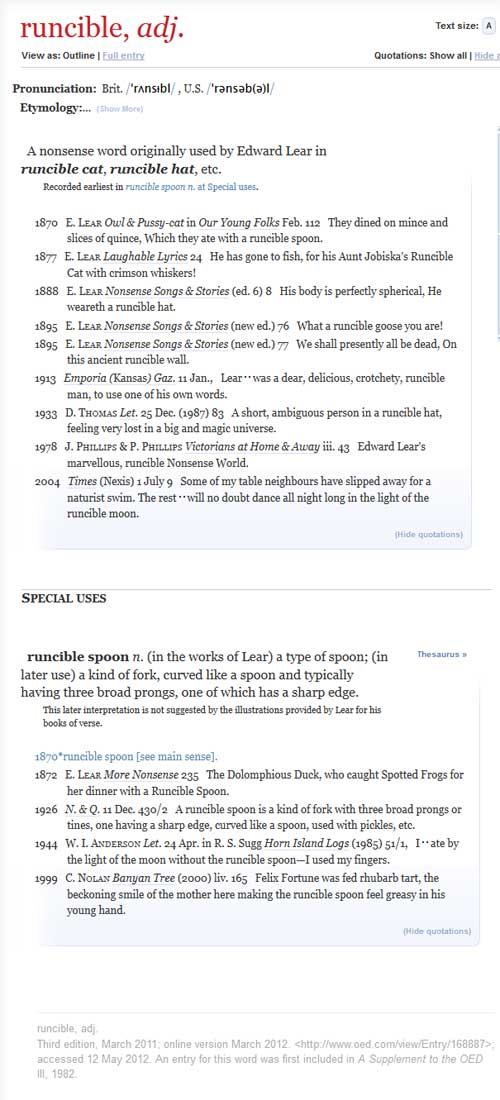
The Word of the Day for the Oxford English Dictionary is, of course, … Runcible!

Don’t miss the Oxford Dictionaries blog post: Higher-cynths, lower-cynths, and Seeze Pyders: why Lear’s ‘nonsense’ language is more than just fun

A screen capture, as it will disappear tomorrow:

Posted in Edward Lear | Tagged , | Leave a comment

Bicentenary

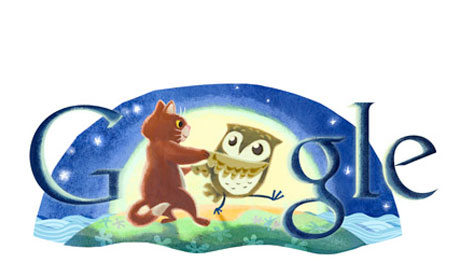
The day of Edward Lear’s 200th birthday has come and celebrations are everywhere on the web. Google, with its beautiful doodle, has stimulated interest in the tech sector (also), too.

It is mentioned by the Guardian, which also published a retrospective of its articles related to Lear (Edward Lear Master of the Nonsense Rhyme).

BBC Radio 4 broadcast the episode of Great Lives devoted to Lear by Nicholas Parson (listen now). On Wednesday (at 11.15, 21.15, and 4.15 on Thursday), you will be able to listen to Julia Blackburn’s Need for Nonsense (“The sad, contradictory tale of Edward Lear, famed Victorian artist and scribe of gleefully silly verse”).

Also:

Posted in Edward Lear | Tagged , | 2 Comments