
Edward Lear, An extensive view of Damascus.
Numbered ‘(221)’ (lower right) and further inscribed with colour notes
pencil, pen and brown ink and grey and blue wash, heightened with white on paper, unframed. 13¾ x 21½ in. (35 x 54.6 cm.).
Edward Lear, An extensive view of Damascus.
Numbered ‘(221)’ (lower right) and further inscribed with colour notes
pencil, pen and brown ink and grey and blue wash, heightened with white on paper, unframed. 13¾ x 21½ in. (35 x 54.6 cm.).
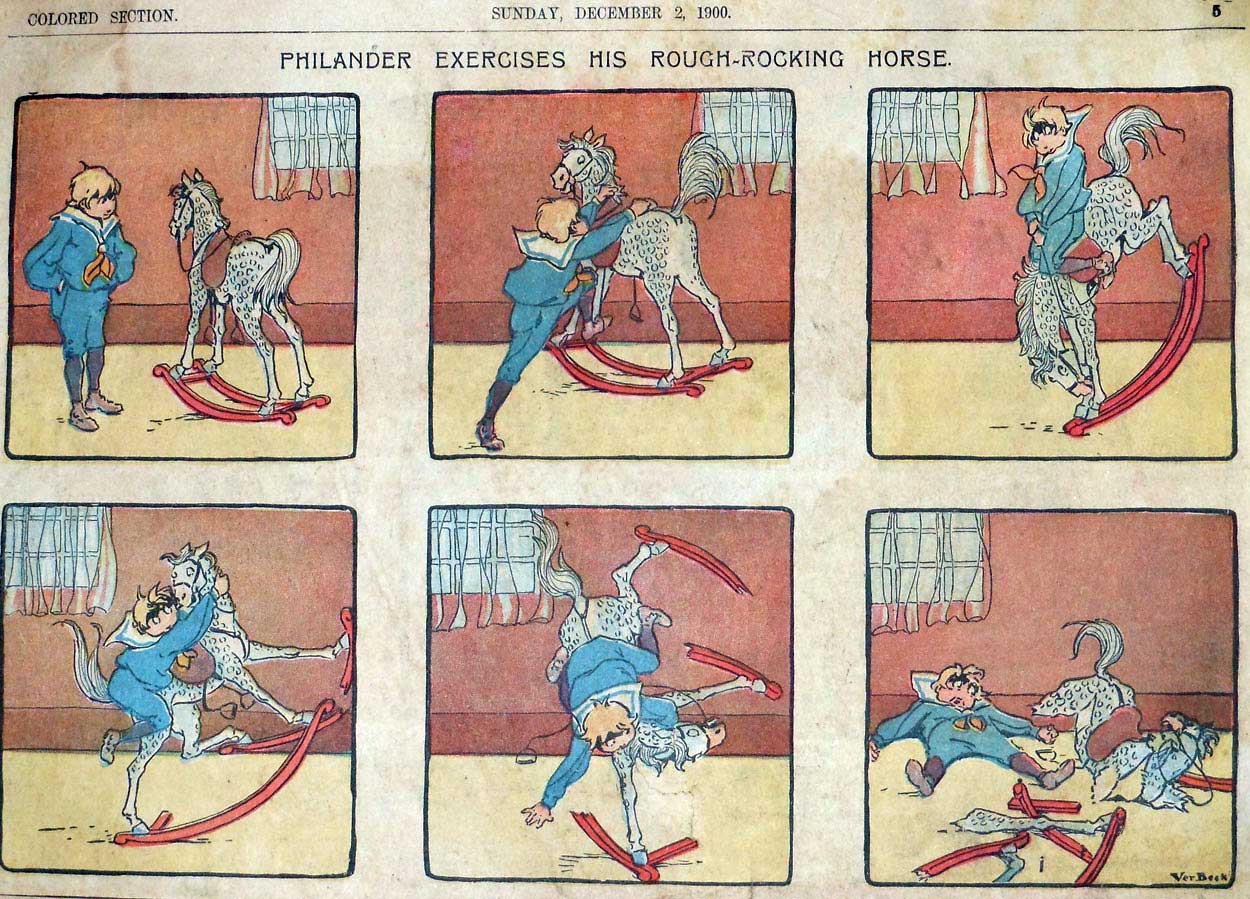
A very early example of a Verbeek newspaper comic strip, probably recycled from his 1890s French production, the date is 2 December 1900. Notice the signature as VerBeck:

Edward Lear, The market square, Coblenz, Germany.
Partially inscribed and dated ‘[Co]blenz. 1837./August 12.’ (upper left). Pencil heightened with touches of white on blue-grey paper, the corners cut. 6 5/8 x 10 1/8 in. (16.8 x 25.7 cm.).

Edward Lear, Sion, Switzerland.
Inscribed and dated ‘Sion. 17. Sept. 1837’ (lower right) and further inscribed ‘H’ (lower right). Pencil heightened with white on blue-grey paper, the corners cut. 9 7/8 x 13 5/8 in. (25.1 x 34.5 cm.).
This is part of a group of drawings dating from Lear’s tour of Europe in the summer of 1837. Having spent the early summer of 1837 in Devon, Lear returned to London in early July and from there set off for the Continent on the Antwerp packet boat on 10 July in the company of his sister Ann with whom he travelled as far as Brussels. He then passed through Luxembourg, Germany and Switzerland before spending September and October in the Italian Lakes, reaching Florence in November and Rome in early December. For most of the next ten years, Lear spent the winter in Rome and visited the rest of Italy in the summer.
The highly finished pencil work with white highlights is typical of Lear’s early style.

Edward Lear, Karnak on the Nile, Egypt.
Inscribed and dated ‘El Karnák/16. Feby. 7AM. 1854’ (lower left) and inscribed and dated again ‘El Karnak./16.Feby.1854./7.a.m.’ (lower right) and extensively inscribed with colour notes. Pencil, pen and brown ink and yellow and blue wash heightened with white on blue-grey paper. 8 3/8 x 13¾ in. (21.3 x 35 cm.).
The present drawing was executed during Lear’s second visit to Egypt and first trip up the Nile. The artist was in Cairo in December 1853. He left soon after Christmas in a large party of English people for a ten week journey to the First Cataract and back. Before departing he wrote to his sister promising ‘not to go into any pits, or caves; for I hate dust & mummies & dark holes’. He experienced terrible loneliness despite the company, but was excited by the landscape and wildlife, and spent ten happy days at Philae before starting the return journey on 8 February, reaching Luxor a week later. Guidebooks advised visitors arriving in Luxor to spend their first day at Karnak, and this appears to be what Lear did. The present drawing, which must have been one of the first he executed there, shows not the famous temple of Amun, but a view westward towards the Valley of the Kings. The temple appears in a drawing made on the following day, 17 February.
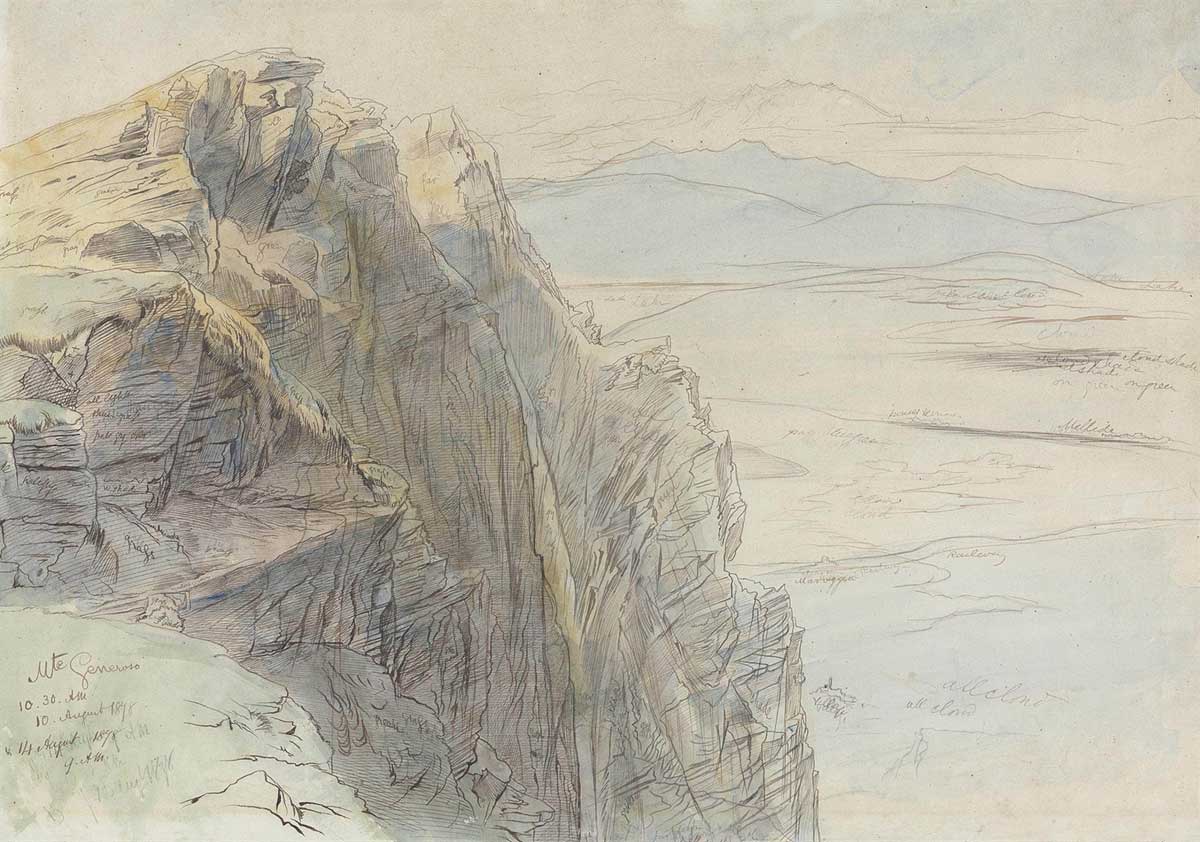
Edward Lear, Monte Generoso, Switzerland.
Inscribed and dated ‘Mte Generoso/10.30.AM/10. August 1878/& 14 August 1878/9.AM.’ (lower left) and extensively inscribed with colour and topographical notes, and numbered ’12’ (verso). Pencil, pen and brown ink and watercolour. 15¼ x 22 in. (38.7 x 55.9 cm.).
Lear visited Monte Generoso in the summer of 1878 where he was amazed by the far-reaching views. In a letter to his nephew he commented that ‘the views near the Hotel are wonderful. There is one point from which you may (perhaps) see all the plains & lakes of Italy, besides the rivers Jordan, Mississippi & Amazon, the whole course of the Nile, – as well as the cities of Peking, St. Petersburg & Copenhagen, not to speak of the straits of Jamaica & Joppa with the adjacent islands of Cappadocia, Ceylon and Islington’ (27 July 1878).
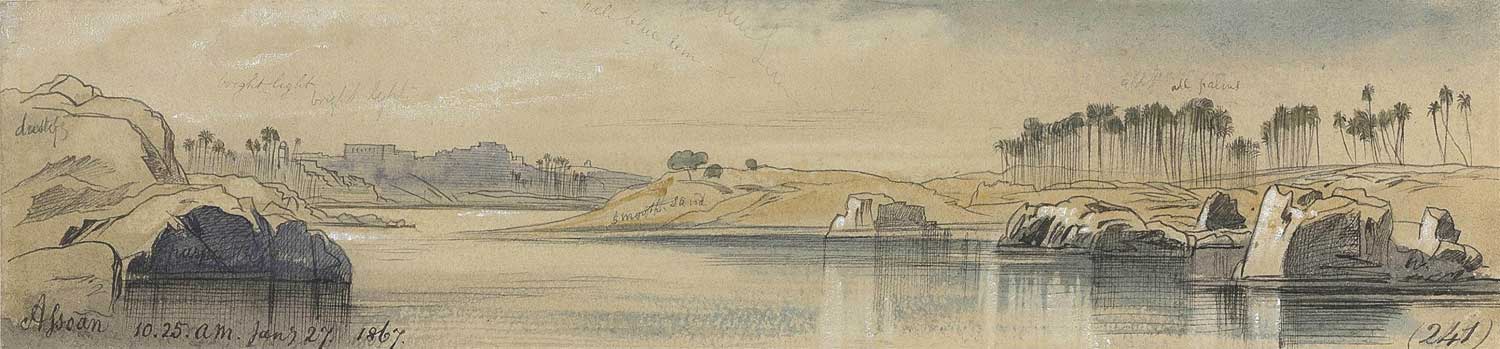
Edward Lear, Aswan on the Nile, Egypt.
Inscribed and dated ‘Assoan [sic] 10.25. AM. Jany 27. 1867.’ (lower left) and numbered ‘(241)’ (lower right) and further inscribed with colour notes and further inscribed ‘lowest’ (on the reverse). Pencil, pen and black ink and watercolour, heightened with touches of white. 2½ x 10½ in. (6.4 x 26.6 cm.).
This small, jewel-like watercolour dates from Lear’s second and final Nile trip of 1867. Before his first visit of 1854 he had written, ‘the contemplation of Egypt must fill the mind, the artistic mind I mean, with great food for rumination of long years’. He was deeply impressed by what he called ‘the great granite hills of Assouan’.
At the beginning of 1867 Lear travelled south from Cairo, picking up his Canadian cousin Archie Jones at Luxor. They reached the second cataract, the most southerly point of their journey, on 4 February. At Aswan, where Lear executed the present drawing at 10.25 on the morning of 27 January, he also executed a larger panoramic drawing of the river, which he numbered ‘245’. That was done at 5.30 pm. At 11.30 am, immediately after executing the present drawing, he turned his attention away from the river and drew the Aswan quarries. The quarry drawing, which is rectangular in format, is numbered ‘242’.
The following day Lear rose early and executed more drawings at Aswan, at 8.30 am and 9-10 am, before leaving for Es Shelaal, where he executed his next view at 4.45 pm. These three drawings are numbered 246, 248 and 249. The drawing numbered 247, which has not been found, must have been executed between 8.30 and 9.00 am at Aswan. The drawing numbered 260 was done at 2.30pm on 29 January and is inscribed ‘Shelaal’. By the 30 January Lear was at the first cataract at Philae.
Within this remarkable sequence of dated drawings, the present drawing (241) and the examples numbered 246 and 260 are all panoramic river views measuring between 2 and 3 inches in height and 10 and 11 inches in width. Of these three, the present example is by far the most refined.
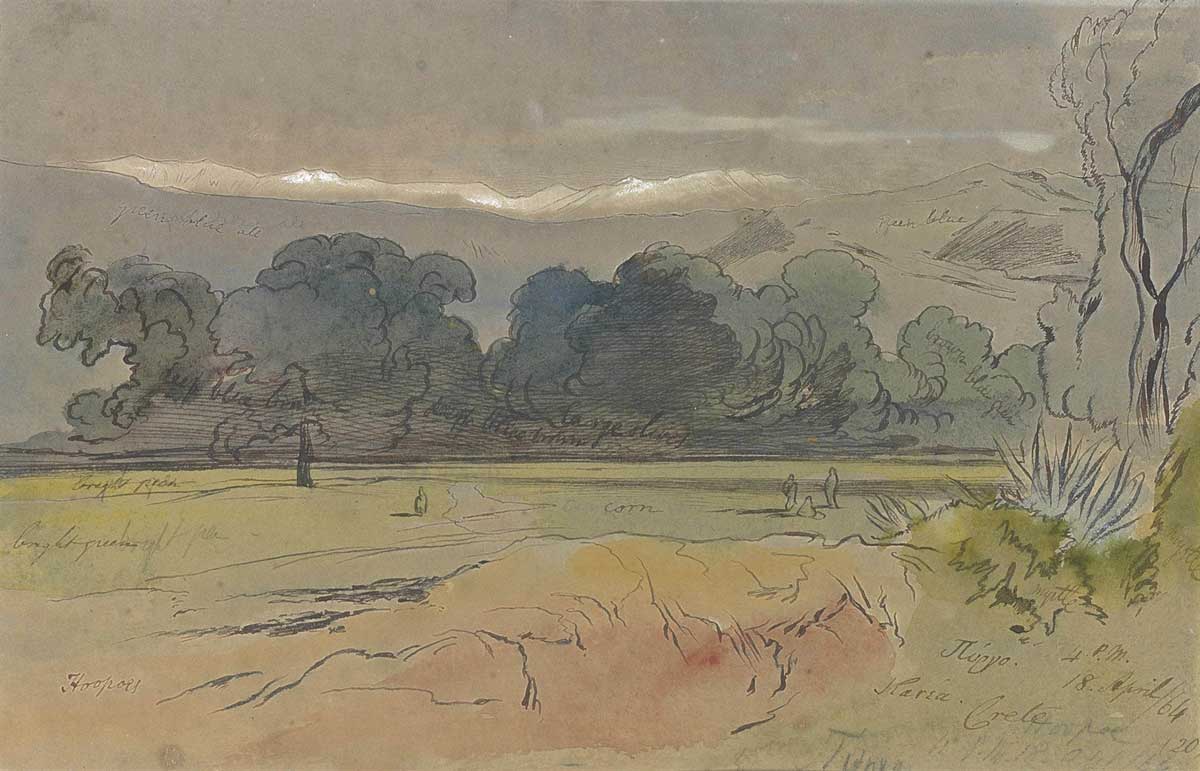
Edward Lear, Khaneá (or Canea), Crete.
Inscribed, numbered and dated ‘…4 P.M./18.April/64/Kanea. [in Greek] Crete (20)’ (lower right) and further inscribed ‘Hoopoes’ (lower left) and variously inscribed with colour notes. Pencil, pen and ink and watercolour on blue paper. 6 3/8 x 9 7/8 in. (16.2 x 25.1 cm.).
The present drawing was executed in the neighbourhood of Canea during Lear’s visit to Crete in 1864. He left Corfu on 4 April, travelled via Athens, and arrived at Canea, the chief harbour in the west of Crete, on 11 April, a few days before the present drawing was executed. From 14 April, Lear stayed in Mr Guarracino’s country house at Halépa, exploring the district, and then left Crete on 31 May for England.

Edward Lear, Taormina, Sicily.
Nnumbered ‘158 [crossed out] 165’ (lower left, overmounted) and ‘(165)’ (lower right, overmounted) and further inscribed with colour notes
pencil, pen and brown ink and blue and ochre wash on paper. 13 7/8 x 19¾ in. (35.4 x 50.3 cm.).
Edward Lear visited Sicily in the spring of 1842. He returned in the company of a young friend, John Proby, at the beginning of May 1847. The second visit coincided with a period of political upheaval, when it seemed likely that foreigners might soon be excluded from Italy. Lear resolved to spend as much time there as he could, starting in the south in Sicily.
In a letter to Chichester Fortescue written in October 1847 Lear told his friend that he had stayed at ‘Taormina the Magnificent’ for four or five days. The artist had been captivated by Taormina on his earlier visit and had drawn the classic view from the Greek theatre towards Mount Etna. To execute the present drawing Lear would have had his back to Etna – he is looking up at the town towards the rocky peak of Castelmola.
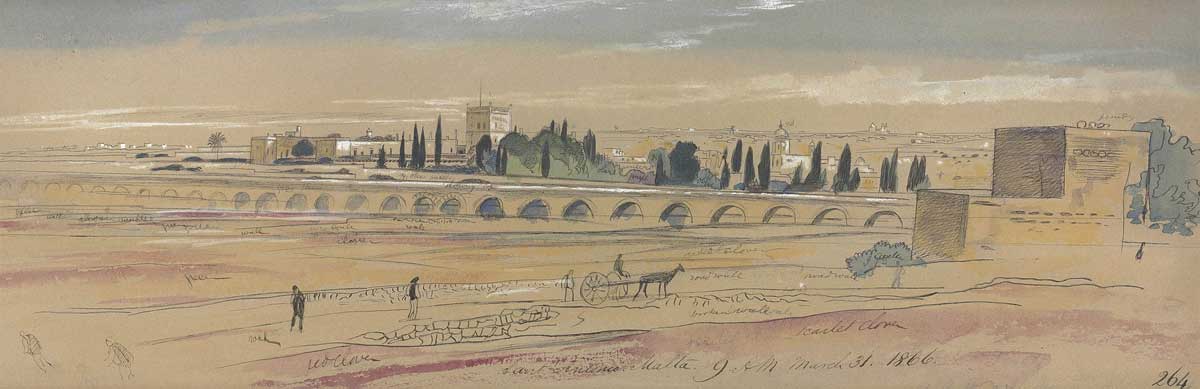
Edward Lear, Sant’ Antonio, Malta
Iinscribed and dated ‘Sant’ Antonio. Malta. 9. AM. March 31. 1866.’ (lower centre) and numbered ‘264’ (lower right) and variously inscribed with colour notes. Pencil, pen and brown ink and watercolour heightened with touches of white on buff paper. 6¼ x 19¾ in. (15.8 x 50.2 cm.).
After spending part of the winter in Italy Lear journeyed to Malta for his health from December 1865 to April 1866, having visited there previously in 1862. Sir Henry Storks, who had been High Commissioner of the Ionian Islands was now Commander-in-Chief in Malta. Lear arrived, but found that Storks had just departed. Lear remained in Malta for three months.
 A Blog of Bosh