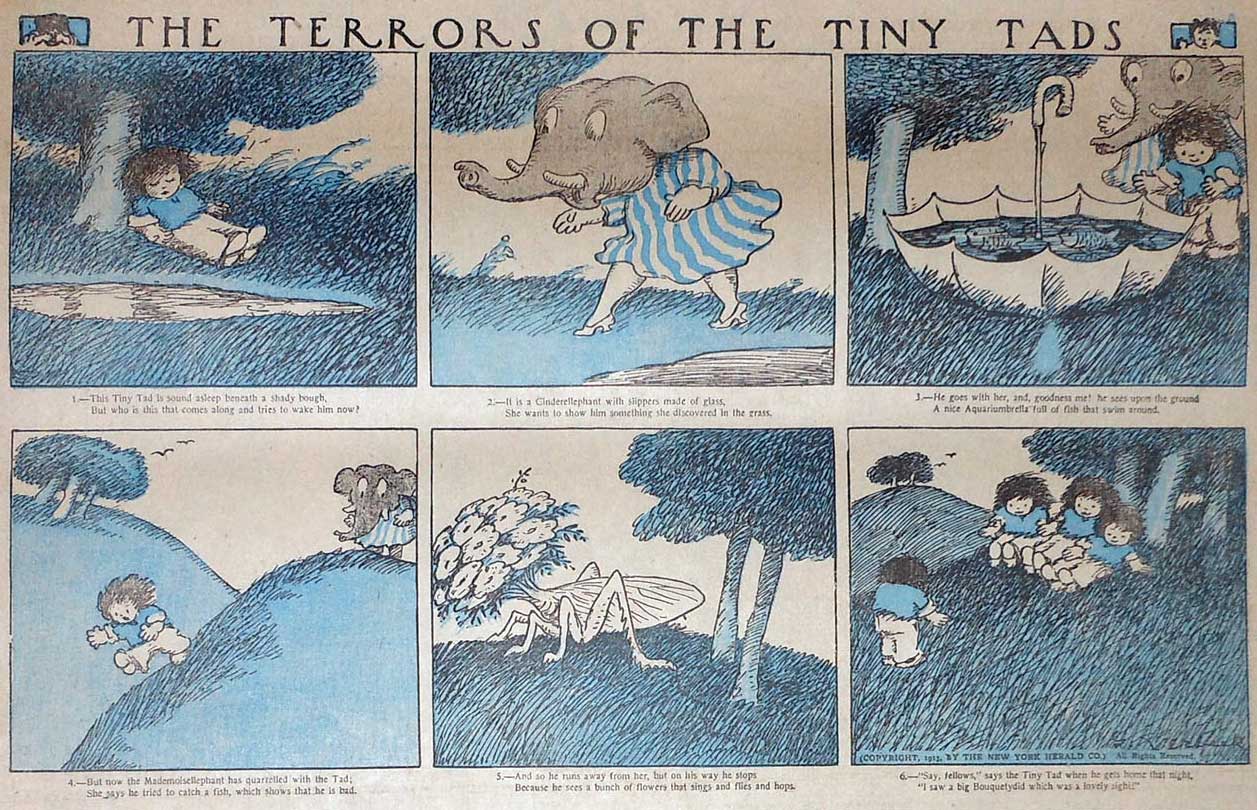
Mademoiselle Cinderellephant

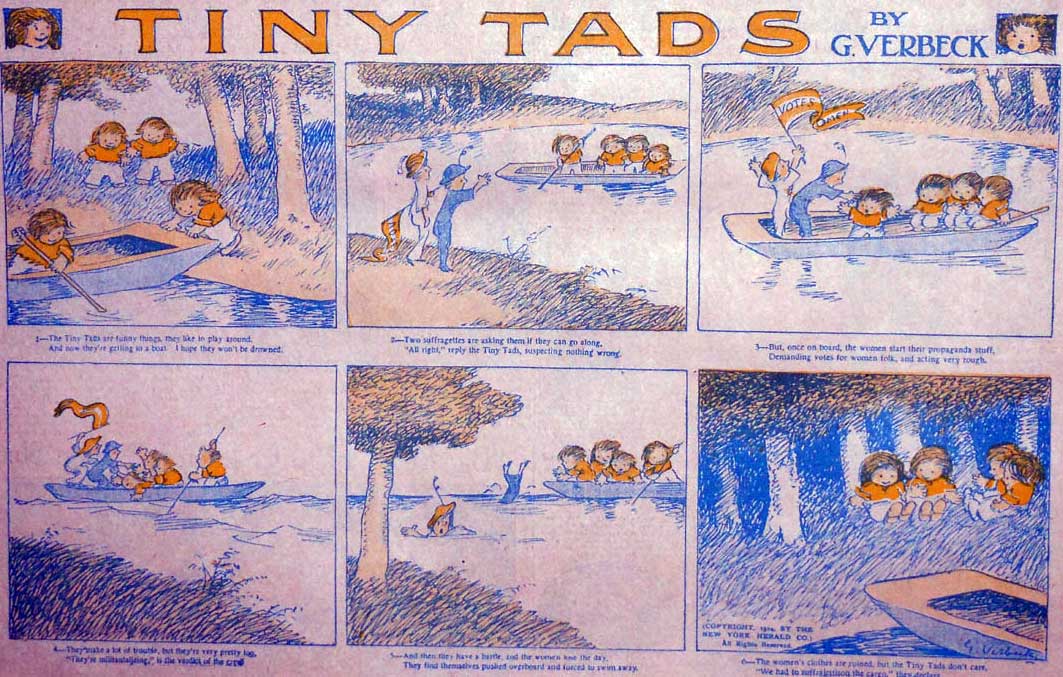
Here is a nice adventure of Gustave Verbeek‘s Tiny Tads, from the Boston Sunday Post of 13 July 1913:

Peter Maresca’s Sunday Press has published The Upside-Down World of Gustave Verbeek (for which I wrote an article I’ll post here sooner or later) which includes a full run of the Upside-Downs and The Loony Lyrics of Lulu (based on limericks!), and a large selection of The Terrors of the Tiny Tads, as well as other less-well-known series.

Posted in Gustave Verbeek | Tagged , , | Leave a comment

Polly Sleepyhead and the Screen

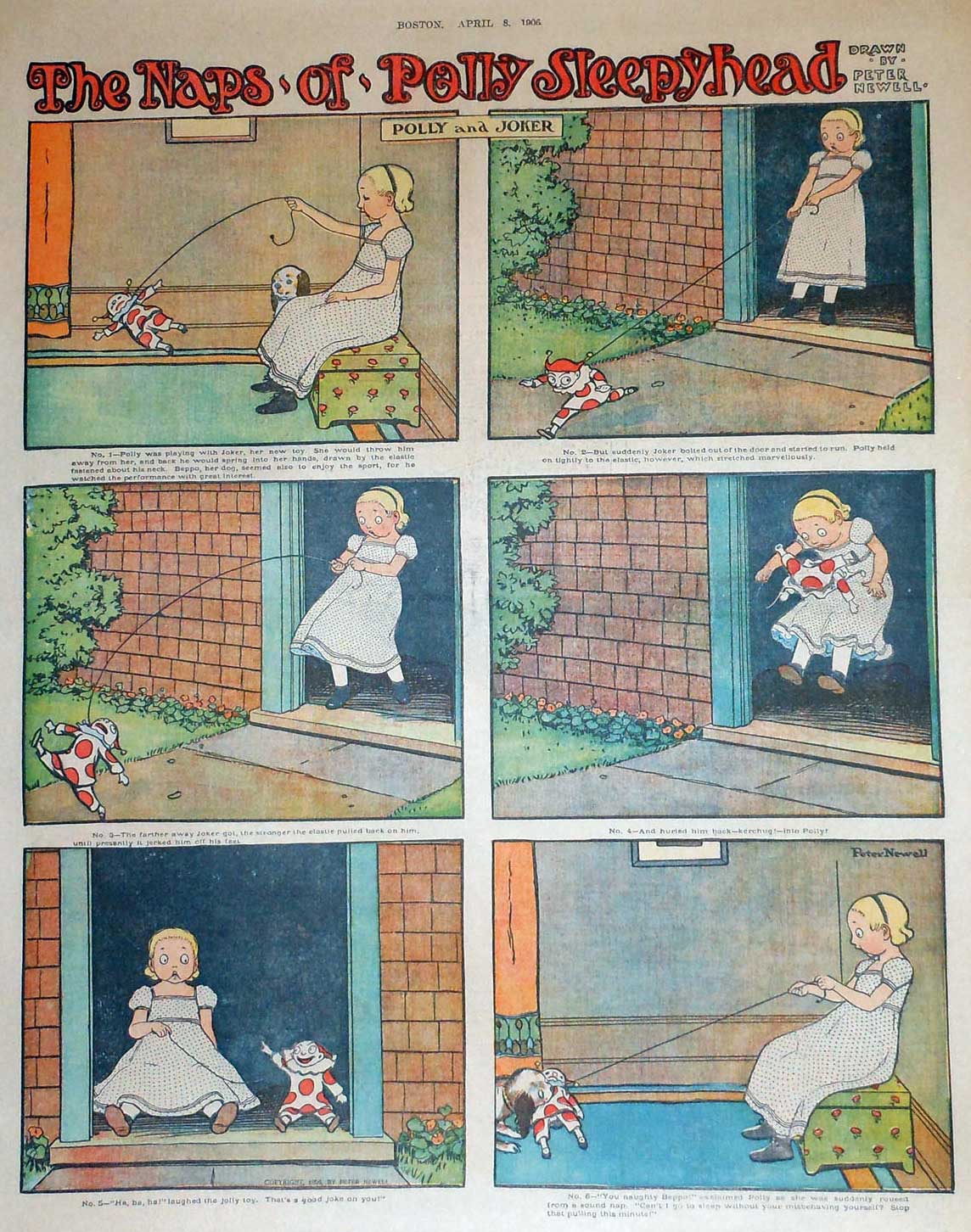
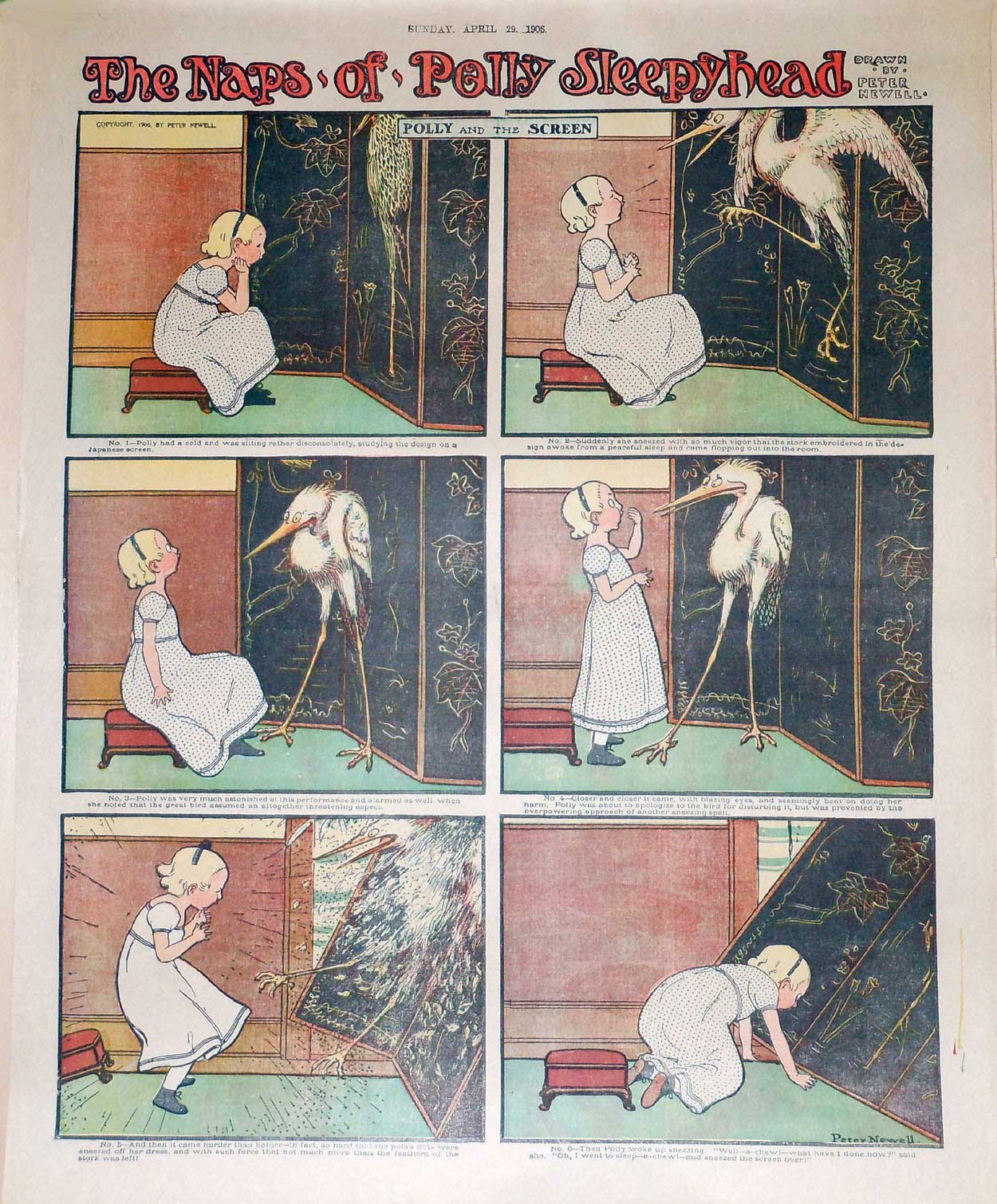
A few years ago I put online an almost complete set of Peter Newell’s comic-strip series, The Naps of Polly Sleepyhead, which appeared in the Chicago Tribune and in a few other newspapers from 25 February 1906 to 22 September 1907. Unfortunately the images are b/w and in some cases they are difficult to read.

This is especially true of the strip from 29 April 1906; here is the original coloured version, which I got from an eBay auction:

Posted in Peter Newell | Tagged , | 2 Comments

Zoological Sketches

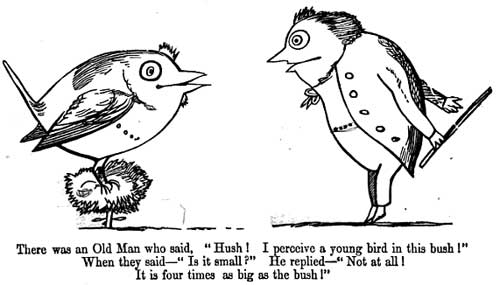
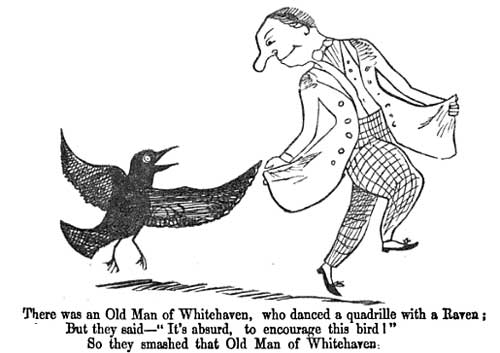
Osmosis between humans and animals is one of the recurring features of Edward Lear’s limericks, and one of the most often commented on by critics. It often involves birds as in the following cases, all from A Book of Nonsense:

Lear was the first to use the idea for purely nonsensical purposes, but George Cruikshank had already produced several satiric images in which humans assume animal characteristics, most notably perhaps in Plate I of My Sketch Book, no, IV (1834):

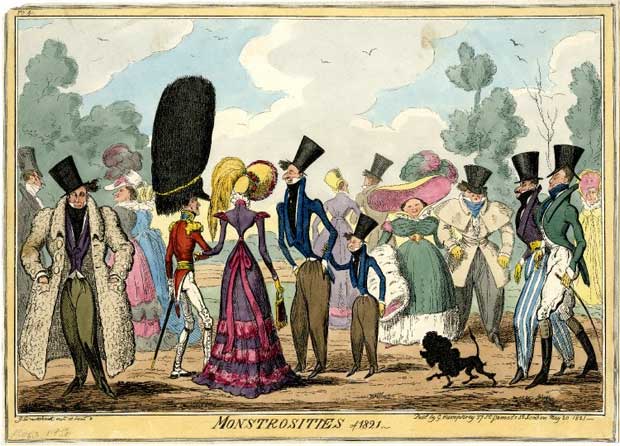
This plate, in turn, was a development of an older series which had kept Cruikshank engaged for several years, “Monstrosities of … .” Here is the plate for 1821, for instance:

© The Trustees of the British Museum

Cruikshank’s influence on the appearance and, especially, the posture of Lear’s “old men” and “old ladies” is quite obvious.

Posted in Cruikshank, Edward Lear | Tagged , , , | 1 Comment

Edward Lear Bicentenary: an Update

Cambridge University’s Institute of Continuing Education is organizing a weekend course on Nonsense literature, covering all aspects from the origins of the nursery rhymes to The Hitchhiker’s Guide to the Galaxy, on 11-13 May and the programme looks very interesting. Of course a lecture is devoted to Edward Lear’s life and work. Places are still available and you can download Course Material and an Application Form.

From 30 April to 4 May, at 10.45 pm, BBC Radio 3 will be broadcasting a series of essays celebrating Edward Lear’s bicentenary. The essayists include Sara Lodge, Matthew Bevis and Ralph Steadman, who has drawn a wonderful nonsense bird – the long-lashed, three-booted wheedle-nittle – for the occasion. See comments to this post.

From 7 May to 8 June at The Poetry Café at 22 Betterton Street, Covent Garden WC2H 9BX, 45 illustrators are showing images they have made from Edward Lear’s poetry. For opening times see here or phone 0207-420 9880.

Sunday 13 May 14.30 – 16.00, Nonsense! The Wonderful World of Edward Lear, The Conference Centre, the British Library. The Jumblies, the Yonghy-Bonghy-Bo, The Dong with the Luminous Nose and of course The Owl and The Pussycat, are just a few of the fabulous nonsense poems of the remarkable Edward Lear, who was born 200 years ago. Join wonderfully entertaining poets Michael Rosen and Roger McGough, plus special guests, for this glorious celebration of one of our best loved writers.

Tortoises, Terrapins, and Turtles Drawn from Life by James De Carle Sowerby and Edward Lear. London, Paris and Frankfort: Henry Sotheran, Joseph Baker & Co., 1872 is now available online at the Biodiversity Haritage Library website.

Posted in Edward Lear | Tagged , | 1 Comment

Edward Lear, An Arab Encampment at Wady Feiran

Edward Lear, An Arab Encampment at Wady Feiran.
Signed  with  the  monogram  and  dated  1869  lower  right; inscribed Wady  Feiran  lower  left.
Watercolour  over  pencil  heightened  with  bodycolour  and  gum  arabic  on  paper, 17.5  by  37cm.,  7  by  14½in.

This highly finished studio work depicts travellers and their camels resting at Wady Feiran; a river running to the east of the Gulf of Suez. Visible in the distance are the dramatic mountains of Sinai. The watercolour is based on studies executed by Lear during his trip to Egypt and Palestine in late 1866 and early 1867. Lear started these travels with Archie Jones, his Canadian cousin, whom he had met in Luxor. Together they journeyed to Esnah, Edfu and as far as Philae, before parting company. Lear continued on, with his man-servant Giorgio, to Sakkara and Memphis before turning his thoughts to Palestine. Lear planned to cross the desert to Gaza and go inland to Jerusalem before travelling north to Galilee. On 22 March 1867 he left Cairo and by April he had reached Jerusalem. However, soon after he arrived he fell ill and this, together with the number of pilgrims approaching Jerusalem for Easter, prevented him from travelling further north. By the 20 April he was back in Alexandria before travelling by boat to Brindisi.

Sotheby’s.

Posted in Edward Lear | Tagged , , | Leave a comment

Edward Lear, Philae

Edward Lear, Philae.
Signed  with  the  monogram  lower  right;  signed  and  dedicated  on  the  stretcher  Painted  for  Miss  Clementina  Macdonald  Lockhart  Edward  Lear
oil  on  canvas
24  by  46cm.,  9½  by  18¼in.

Lear’s oil paintings, with few exceptions, were derived from his rapid ‘on the spot’ pencil or pen sketches, and the present work relates closely to his watercolour of the same subject, dated 1867. Lear had first visited Philae thirteen years earlier, when he spent ten days exploring the island, setting up camp in the Temple of Isis. He developed a strong sense of attachment to the place and wrote: ‘The great Temple of Isis […] is so extremely wonderful that no words can give the least idea of it’ (Lear to his wife Ann, 7 February 1854, quoted in Vivien Noakes, Edward Lear Selected Letters, Oxford, 1988). As well as many watercolours, Lear painted at least twenty oils of Philae, often concentrating on its impressive setting rather than the ruins themselves.
The present oil is taken from a viewpoint on the rocky bank of the Nile to the west of the island. The focus is upon the foreground and the colours and rounded forms of the rocks are depicted in minute detail. The island takes a secondary role in the picture and the Ptolemaic Temple of Isis and the Kiosk of Trajan are dwarfed by the towering cliffs along the banks of the Nile.

Provenance:
Miss Clementina Macdonald Lockhart (a gift from the artist)
Spink, London
John, Lord D’Ayton; thence by descent to the present owners.

Sotheby’s.

Posted in Edward Lear | Tagged , , | 1 Comment

Edward Lear, Sheik Abadeh

Edward Lear, Sheik Abadeh on the Nile.
Signed  with  the  monogram  lower  right;  inscribed  on  a  label  on  the  stretcher: Edward  Lear/San  Remo/London  Agents/Ford  and  Dickinson/90  Wardour  Street/£25/£20.
Oil  on  canvas, 24  by  46.5cm.,  9½  by  18¼in.

On his first trip up the Nile in 1854, Lear was moved to write to his sister Ann: ‘So far, it is a magnificent river, with endless villages – hundreds & hundreds on its banks, all fringed with palms, & reflected in the water; – the usual accompaniments of buffaloes, camels etc. abound, but the multitude of birds it is utterly impossible to describe, – geese, pelicans, plovers, eagles, hawks, cranes, herons, hoopoes, doves, pigeons, king fishers & many others. The most beautiful feature is the number of boats, which look like giant moths, – & sometimes there is a fleet of 20 or 30 in sight at once’ (4 January 1854; quoted in Vivien Noakes, Edward Lear: The Life of a Wanderer, London, 1968, p. 122).
Although Lear was fascinated by the beauty of the scenery and wildlife he saw whilst travelling up the Nile, it was the colours which astonished him most. When he made his second trip up the Nile thirteen years later, in January and February 1867, he realised that his watercolours seemed drained of colour and he wrote ‘In no place – it seems to me, can the variety & simplicity of colours be so well studied as in Egypt; in no place are the various beauties of shadow more observable, or more interminably numerous’ (Diary, 25th February 1857; quoted in Vivien Noakes, Edward Lear 1812-1888, London, 1985, p. 114). This time he travelled up the Nile as far south as the second cataract just beyond Wadi Halfa and after he returned home he used his sketches and colour notes as preparatory studies for a number of oils including the present work. Here, the glazes of pure paint capture the brilliance of the light which Lear had so carefully studied.

This painting was executed after 1871, when Lear settled in San Remo.

Provenance:
Frances Braham, Lady Waldegrave and her husband Chichester Fortescue, Lord Carlingford
Constance Braham, Lady Strachey (by descent from the above)
Lord O’Hagan M.E.P. (by descent from the above; sale: Sotheby’s, London, 3 November 1993, lot 22)
John, Lord D’Ayton (purchased at the above sale); thence by descent to the present owners.

Sotheby’s.

Posted in Edward Lear | Tagged , , | Leave a comment

Edward Lear, Waiee, India

Edward Lear, Waiee, Bombay Presidency, India.
Pencil and grey wash on paper with watermark ‘J WHATMAN/1881’
15¼ x 22¼in. (39 x 56.5cm.).

Lear travelled in India between 1873 and 1875. He docked at Bombay on 22 November 1873 from where he travelled north to Lucknow to join the Vice-regal party of Lord Northbrook.
This is a preliminary sketch for one of the Tennyson drawings subtitled as above to illustrate the lines from the poem Mariana, ‘…. the day, was sloping towards his western bower.’
Probably dated from late 1884 or early 1885, this work is based on an earlier drawing Lear executed in India – hence the absence of annotations.

Christie’s.

Posted in Edward Lear | Tagged , , | Leave a comment

ARG!’s Edward Lear Cartoons

Producer-Director Artie Romero, of ARG! Cartoon Animation, has announced on the bicentenary Facebook page that

“Edward Lear’s Nonsense Stories,” our series of short cartoon webisodes for YouTube will premiere on Sunday, April 1st, 2012. Yes, April Fools Day. On that date there will be a very prominent link to this show’s new channel on our animation studio’s website, Artie.com. We are now putting the finishing touches on the first season’s 33 shows. In honor of Mr. Lear’s 200th birthday, there will also be an anthology of the first six shows shown on the fourth season of “Sprockets and Splices,” a showcase of independent film shorts. It’s a nationwide syndicated television program in the U.S. Each “Edward Lear’s Nonsense Stories” will feature one Lear limerick from A Book of Nonsense (1846).

Previews of the cartoons are already available on YouTube, and you can view them from this page.

Posted in Edward Lear | Tagged , , | 1 Comment

More and More Bicentenary Events

Yesterday afternoon Michael Rosen’s Word of Mouth programme on BBC 4 was devoted to Edward Lear and Nonsense literature in general:

Michael Rosen and guests celebrate nonsense at an event recorded at Radio 4’s More The Words festival in Bristol. Michael’s guests include the children’s writer Philip Ardagh, the actor Paul Nicholson, and nonsense experts Anna Barton and James Williams. With help from an audience of adults and children at Bristol Central Library, Michael will be filling a cauldron with nonsense poems, prose, limericks and tongue twisters, with a few nonsense sounds thrown in to bring out the flavour. And the programme will mark the 200th anniversary of Edward Lear’s birth with discussion of the writer’s life and work.

The programme will be broadcast again on Monday, 26 March, at 23:00, but you can listen to it right now.

William Holman Hunt’s portrait of Edward Lear, 1857.

More exhibitions of Edward Lear’s works have been announced:

  • National Museums Liverpool hold a number of Edward Lear Watercolours. They are all extremely beautiful and they will be on display starting on the 28th of April at The Walker Art Gallery to celebrate his bicentenary. An extended web feature will also be available.
  • “How Pleasant to Know Mr Lear” written and presented by Nicholas Parsons.
    Nicholas presents a portrait of the nonsensical genius, Edward Lear conveying a rounded picture of the man’s amazing life and unusual personality. A varied selection of his comic and serous verse is performed including The Owl & The Pussycat, The Jumblies, The Pobble, The Quangle Wangle, The Yonghy-Honghy-Bo, Uncle Arly and The Dong with the Luminous Nose.
    Knowsley Hall, Liverpool. Cost £75 includes canapés and champagne on arrival 3 course meal and half bottle of wine per person. Places are limited so book early to avoid disappointment. Call our events team on 0151 489 4827 to book your place today.
    Nicholas Parsons nominated Edward Lear for BBC Radio 4’s series, “Great Lives.” Here you can still listen to the programme.
  • The Ashmolean Museum in Oxford are going to put on a display of their Edward Lear Collection to coincide with the date of the conference (21-22 September, Jesus College, Oxford). It will run from 20 September 2012 to 6 January 2013.
Posted in Edward Lear | Tagged , | Leave a comment