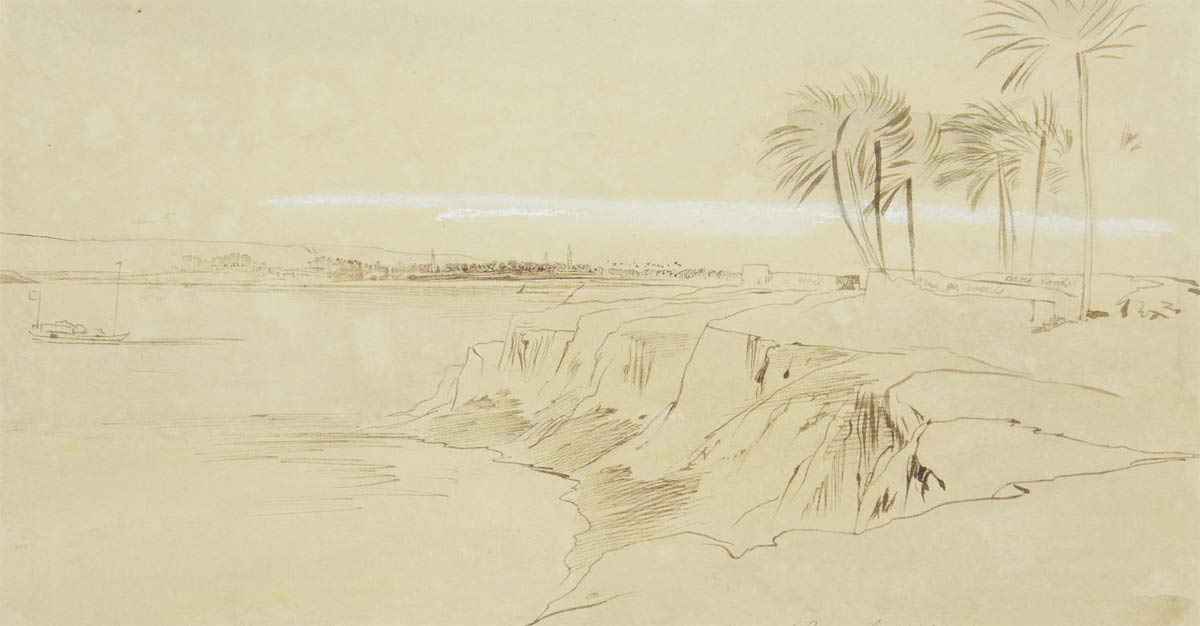
Edward Lear, Nile study.
Dated and inscribed ‘Kmm.4 March 1854/9.A M’ (lower right) and further annotations throughout. Pen and ink, heightened with white and wash, unframed. 15.5 x 25cm (6 1/8 x 9 13/16in).
Edward Lear, Nile study.
Dated and inscribed ‘Kmm.4 March 1854/9.A M’ (lower right) and further annotations throughout. Pen and ink, heightened with white and wash, unframed. 15.5 x 25cm (6 1/8 x 9 13/16in).

Edward Lear, Girgente, Sicily. Inscribed and dated ‘Girgente June 1. 1847’ (lower left) and numbered ‘(82)’ (lower right) and further inscribed with notes. Pencil, pen and brown ink, blue and ochre wash, on buff paper, 24 7/8 x 19¾ in. (32.2 x 50.2 cm.).
Lear first visited Sicily in the spring of 1842 and in the early summer of 1847 he returned. He caught the steamer to Palermo, where he was met by John Proby, heir to the Earl of Carysfort, who wished to learn sketching from Lear. On 11 May they set out together, travelling all round the island, visiting Syracuse and Mount Etna. Of Girgenti Lear wrote to his sister Ann ‘Nothing on earth can be so beautiful as Girgenti with its 6 temples – I speak of the old town and the flowers and birds are beyond imagination lovely.’ (P. Levi, Edward Lear, A Biography, London, 1995, p. 94.). Another view of one of the Temples of Girgenti was drawn by Lear (Christies, London, 7 June 2001, lot 169) the day before the present work on 31st May 1847 and both employ similar ochre tones to capture the warmth of the stones. Lear also used Girgenti as an illustration to the last line of Alfred Tennyson’s poem You ask me, why, though ill at ease, written circa 1833.
Franklin Lushington (1823-1901) and Lear met on the voyage to Malta in the spring of 1849, and Lear wrote ‘My companion is Mr. F. Lushington a very amiable & talented man – to travel with who is a great advantage to me as well as a pleasure’ (Lear to his sister Anne, V. Noakes, Edward Lear, The Life of a Wanderer, London, 1985, p. 76.). They formed a close and life-long friendship and after Lear’s death in 1888 Lushington wrote that ‘he has always been the most charming & delightful of friends to me; & apart from all his various qualities of genius, I have never known a man who deserved more love for his goodness of heart & his determination to do right; & I don’t think any human being knew him better than I did. There never was a more generous or more unselfish soul’ (Lushington to Mrs. Charles Street, exhibition catalogue, V. Noakes ed.,Edward Lear 1812-1888, London, 1985, p. 199). Lushington was the executor of Lear’s estate, Lear left all his papers and paintings to him, and the proceeds from the sale of the Villa Tennyson and its contents to Franklin’s eldest daughter Louisa Gertrude.
Below are a picture and a transcript of Edward Lear’s “Some Incidents in the Life of My Uncle Arly.” The manuscript was sold at Bonhams in May 2013 as part of the Roy Davids Collection. Part III. Poetry: Poetical Manuscripts and Portraits of Poets (auction 20923, lot 279).
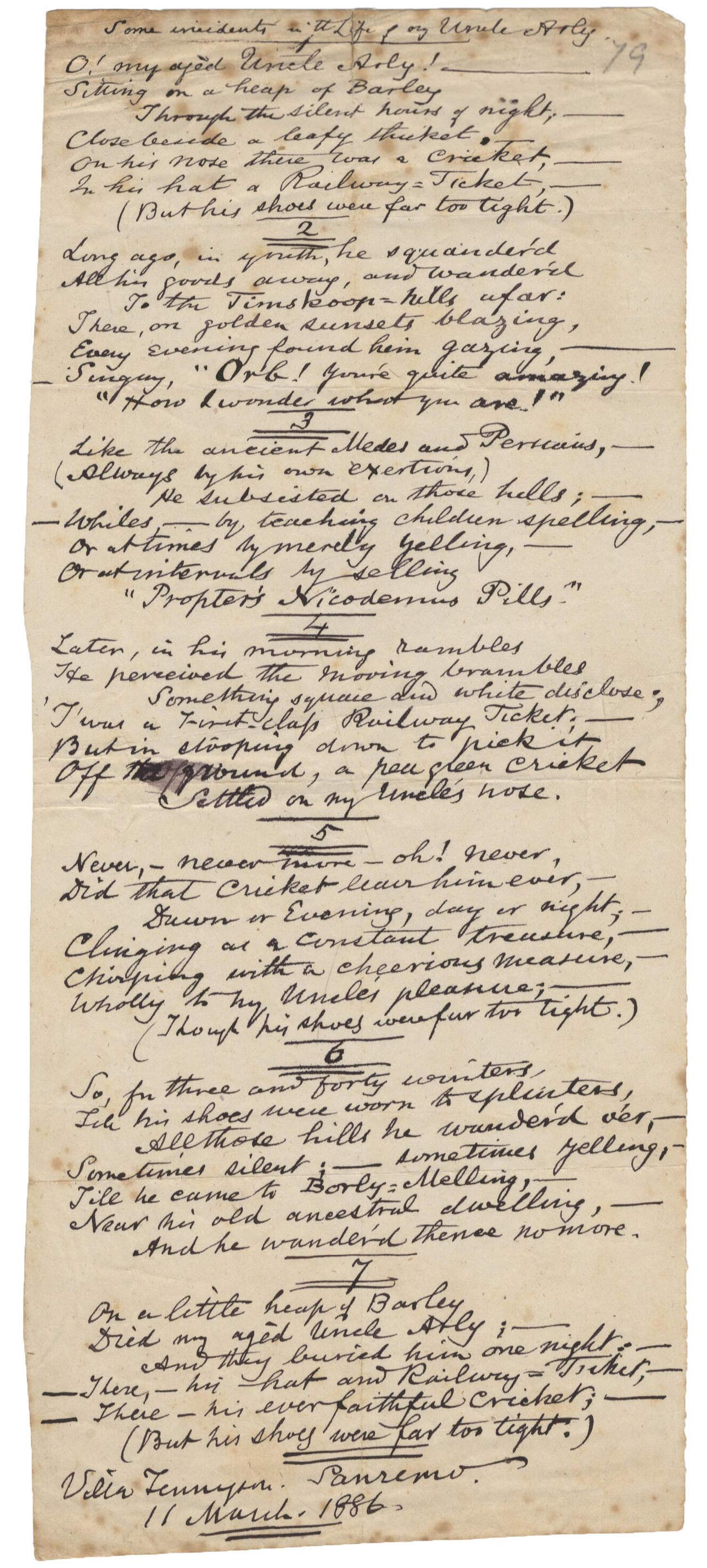
1
O! my agèd Uncle Arly! ―――
Sitting on a heap of Barley
Through the silent hours of night; ――
Close beside a leafy thicket. ――
On his Nose there was a Cricket, ――
In his hat a Railway=Ticket, ――
(But his shoes were far too tight.)
2
Long ago, in youth, he squander’d
All his goods away, and wander’d
To the Timskoop=hills afar:
There, on golden sunsets blazing,
Every morning found him gazing, ―――
― Singing, “Orb! you’re quite amazing!
“How I wonder what you are!”
3
Like the ancient Medes and Persians, ―
(Always by his own exertions,)
He subsisted on those hills; ――
― Whiles, ― by teaching children spelling, ―
Or at times by merely yelling, ―
Or at intervals by selling
“Propter’s Nicodemus Pills.”
4
Later, in his morning rambles
He perceived the moving brambles
Something square and white disclose;
’T’was a First-class Railway Ticket; ――
But in stooping down to pick it
Off the ground, a pea green Cricket
Settled on my Uncle’s nose.
5
Never, ― never more ―- oh! Never,
Did that Cricket leave him ever, ――
Dawn or Evening, day or night; ―
Clinging as a constant treasure, ――
Chirping with a cheerious measure, ―
Wholly to my Uncle’s pleasure; ―――
(Though his shoes were far too tight.)
6
So for three and forty winters,
Till his shoes were worn to splinters,
All those hills he wander’d o’er, ―
Sometimes silent; ― sometimes yelling, ―
Till he came to Borly=Melling, ―
Near his old ancestral dwelling; ―
And he wander’s thence no more.
7
On a little heap of Barley
Died my agèd Uncle Arly; ――
And they buried him one night: ―[1]
― There, ― his hat and Railway=Ticket, ―
― There ― his ever faithful Cricket; ――
(But his shoes were far too tight.)
Villa Tennyson. Sanremo.
11 March. 1886.
[1] Lear omits a line, “Close beside the leafy thicket; ―” which appears in The Complete Nonsense Book, edited by Lady Strachey in 1912.
Here is the catalogue description including the auction results:
LEAR’S LAST POEM. ‘Some incidents in the Life of My Uncle Arly’, which is in the metre of his friend Lord Tennyson’s ‘The Lady of Shallot’, is full of autobiographical references, most obviously to Lear’s life as an incessant ‘wanderer’. It was also his own obituary. Drafting it over a period of thirteen years, partly on the endpapers of The Letters of Horace Walpole in 1873 and of Addison and Steele’s The Spectator in 1885, he completed it on 1 March 1886 and sent presentation copies to at least thirteen friends. These included Wilkie Collins, whom Lear said he resembled so closely that he was often mistaken for him; Collins considered it Lear’s best poem. Another copy went to John Ruskin (‘Roughskin’), the great art-critic and Utopian, after he had written in the Pall Mall Magazine: ‘I really don’t know any author to whom I am half so grateful, for my idle self, as Edward Lear. I shall put him first of my hundred authors’. In his letter to Ruskin on that occasion Lear esteemed it ‘a thing to be thankful for that I remain as great a fool as ever I was.’
The present manuscript Lear sent to Mary, the wife of Sir Matthew Digby Wyatt (1820-1877), architect, Secretary of the Great Exhibition and first Slade Professor of Fine Arts in Cambridge. It is dated 11 March 1886, ten days after Lear recorded he had finished writing the poem. Lady Wyatt (‘Dear Mrs Digby’) was the recipient of a number of enchanting phonetic letters from Lear, in one of which he sent verses written with a ‘lithp’ (‘O Thuthan Thmith! Thweet Thuthan Thmith…’), explaining that ‘my teeth have thufferred tho mutth, & it theemeth to me that it will produthe a thenthation in the muthical thphereth…’ (see also Roy Davids Collection Part II lot 295).
The notable differences between the present manuscript and the printed version are in the title, line 10 [he is consistent in dotting ‘i’, otherwise the third minim of the ‘m’ in Timskoop might have been assumed to be an ‘i’] the alternative reading for line 42 and the omission in the manuscript of line 46 of the printed version, doubtless just by mistake since there is no reason to assume that the seventh stanza should be the only one without seven lines. Lear began line 27 by writing ‘Off’ indented as if it were the last line of a stanza and, realising his error, immediately smudged it and started the line again correctly aligned. The paper is a little foxed; Lear is writing with something very akin to printers’ ink.
In her life of Edward Lear, Vivien Noakes hints at deeper and darker meanings beneath the benignly whimsical surface of ‘Uncle Arly’.
PROVENANCE: Mary Digby Wyatt.
REFERENCES: The Complete Nonsense of Edward Lear, edited by Holbrook Jackson, 1979; John Lehmann, Edward Lear and his World, 1977; Selected Letters, edited by Vivien Noakes, 1988; Vivien Noakes, Edward Lear the Life of A Wanderer, 1968; Vivien Noakes, Edward Lear 1812-1888, Royal Academy of Arts Catalogue, 1985; Susan Chitty, That Singular Person Called Lear, 1988; Angus Davidson, Edward Lear: Landscape Painter and Nonsense Poet, 1933.
Sold for £10,000 inc. premium
In a previous post I showed that Edward Lear was probably at least partially indebted to George Cruikshank for the frequently recurring osmosis between humans and animals, and I posted Cruiskhank’s Montrosities of 1821 as an example of extremely caricatural figures which might have inspired the Nonsense writer. The “Monstrosities” series also probably provided a model for Lear’s famously dancing characters:
Here is Cruikshank’s Dandies of 1817 & Monstrosities of 1818:

© The Trustees of the British Museum
The British Museum description for this print reads:
A Hyde Park scene burlesquing the fashions of the day. Men walk arm-in-arm, so do two ladies, and a man and woman, and there are solitary figures, one of whom is a much-bedizened elderly woman using a sunshade as walking-stick, and followed by a pompous over-dressed footman (left) carrying a lap-dog and holding a cane. Alterations since 1816 include a fashion for walking on tip-toe; the ladies’ stoop (see Nos. 12939, 13084) is less pronounced; their skirts are longer; their bonnets much higher; their dresses are still very short-waisted and project from the shoulders, but they are less décolletée. The men no longer wear trousers gathered at the ankle, but two wear wide short trousers; two wear riding-breecheswith top-boots. All, including an officer in uniform, have the high waists, projecting busts, high shoulders, and tight sleeves characteristic of the dandy (cf. No. 13029); collars are still high, their corners are more often pointed than (as earlier) round. A Life Guards officer, arm-in-arm with a dandy wearing short trousers over spurred boots, is conspicuous on the extreme right. (M. Dorothy George, ‘Catalogue of Political and Personal Satires in the British Museum’, IX, 1949.)
It seems that walking on tip-toe was all the fashion among dandies, and not only in London; here is George Cruikshank’s A Peep at the French Monstrosities, le Palais Royal de Paris, also 1818:
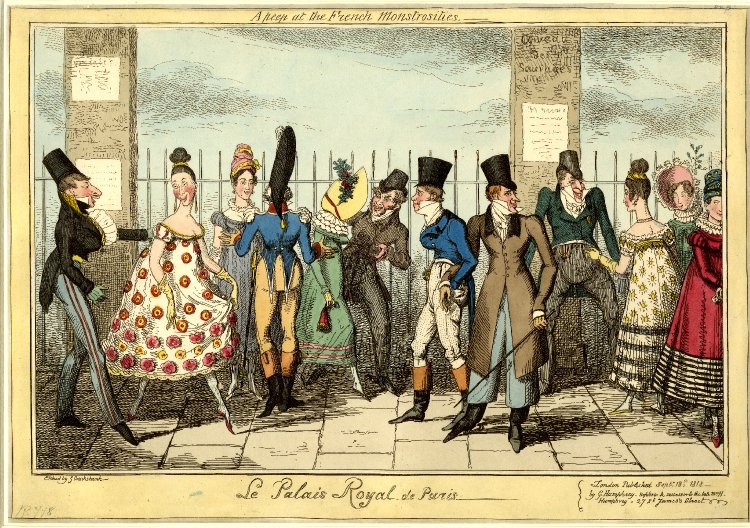
© The Trustees of the British Museum
In February 2011 I posted a review of some Christmas books for 1874, “Nonsense for Big and Little Babies” from Judy. Among the books reviewed was A Choice Collection of Queens and Kings, and other Things by S.A. the Princess Hesse Schwartzbourg, which greatly intrigued me. It took me months to find a copy (it was actually offered to me at an almost-reasonable price), more months to have it decently photographed and many more months for me to cut, resize and otherwise edit the pictures, but I am now happy to be able to annouce that the full book is available for your perusal at nonsenselit.org.
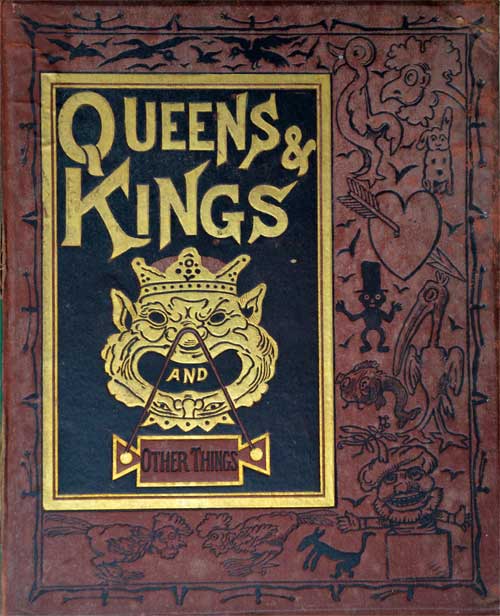 I was very surprised to find that the author was Marie Duval, a nom d’artiste for Isabelle Emilie de Tessier, usually mentioned as the artist who developed Ally Sloper, created by Charles Henry Ross.
According to Ellen Clayton “Miss Duval is probably seen at her best in coloured subjects, as, for example, in a nursery book published by Messrs. Chatto and Windus, called ‘Queens and Kings, and other Things,’ to which she contributed numerous grotesque subjects under the stately pseudonym of the Princess of Hesse Schartzbourg.” (Clayton, Ellen Creathorne. English Female Artists. London: Tinsley Brothers, 1876. Volume 2, pp. 330-333. Full chapter.)
Apart from what Clayton wrote, and she does not seem to be very reliable, very little is known of Marie Duval. According to the DNB, Isabelle Emilie de Tessier (“Marie Duval”) was born in Paris in 1850 or 1851 and married Charles Henry Ross “about 1869.” However, John Adcock, who appears to have checked the census records, confidently states that she “was 13 years old in 1861 and lived at 52 New Church Street, Marylebone, with her parents, Joseph and Adele. She was born in Marylebone, London in 1847.”
It is also unlikely that “Marie Duval” was married to Ross before 1871, as she was then mentioned in a divorce case as the lover of another actor:
In respect to the adultery, Mrs. Unwin stated that she lived in Nelson-square, Blackfriars-road, and in the summer of 1870 Miss Duval came to lodge in her house. After she did so she was visited by the respondent, who went by the name of Granville and often remained with her all night. In the autumn of 1871 she got so disgusted with their conduct that she had them both turned out of the house. The Court considered that both charges had been proved and pronounced a decree nisi with costs against the respondent (Adcock).
There may even have been no marriage; Charles Ross Jr., born in 1875, refers to Duval as “his [Ross Senior’s] wife,” and Clayton does not mention a marriage in her 1876 chapter on Duval. Adcock concludes that “she may have been living with CHR in a common-law arrangement although she was living as Mrs. Ross at the time of her death in 1890.”
Marie Duval’s death is registered in Wandsworth, London, in the second quarter of 1890, age 39, (she was actually 42). In the 1891 census CHR is living (as Charles Harry Ross) at 501 Wandsworth Road, Clapham, a widower and author. He has a son, Charles Jnr., aged 16, born in 1875 in Clapham, (other sources say Battersea), who is described as an artist (Adcock).
Duval and Ross were certainly acquainted by 1869, however, as she acted in some of his theatrical productions and her first contributions to Judy date to August 1869, when Ross was not yet editing the magazine. As soon as he became editor of Judy, Ross wrote to the Theatrical Journal, 30.1558, October 1869, p. 331, to praise Marie’s drawing style and anxious to distinguish it from his own:
Dear Sir, ― Will you permit me to correct a trifling error in your critic’s notice of the New Royalty Theatre, which unintentionally does an injury to a very clever young lady. Mademoiselle Marie Duval does contribute every week to Judy as your critic says, but her pictures are not imitations of “Mr C.H. Ross’s absurd style” and can very easily be distinguished from that gentleman’s production, because Mademoiselle is an artist and C.H.R. is not. ― I am, dear sir, yours very faithfully, Chas. H. Ross, Editor of Judy. Judy Office, 73, Fleet-street, Oct. 14.
The relevant passage in the previous issue of the Theatrical Journal (30.1557, October 1869, p. 325) reads:
Is this the young lady who periodically contributes to a serio-comic journal those grotesque pictures so abviously in imitation of Mr C.H. Ross’s absurd style that it is occasionally difficult to determine, with any degree of correctness, which sketches are by Miss Duval and which by Mr Ross?
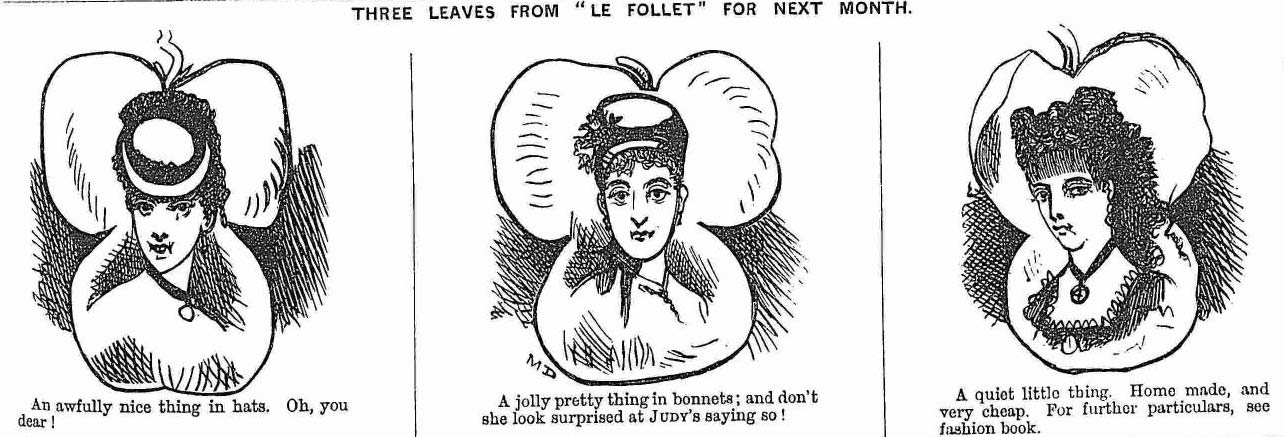
Marie Duval’s earliest signed appearance in Judy, 25 August 1869, p. 173.
The problem of distinguishing their styles persists, as the difficulty of attributing the pictures has led to her contribution to the development of Ally Sloper, “the first comic superstar,” being underestimated. David Kunzle, who has devoted several articles to her rediscovery describes her influences:
Models of the Duval Ally Sloper style were Richard Doyle […] the pioneer of a child-like outline style in his drawings for Punch, and Wilhelm Busch, creator of an artfully simplified caricatural style […] There are in Duval linear short cuts, degrees of simplified foreshortening, and a nonchalance in handling figures hurtling through the air, which can only come from the German artist. Unmistakable borrowings of Busch motifs, moreover, figure in both Ally Sloper and other Duval strips. (Kunzle, David. “Marie Duval: A Caricaturist Rediscovered.” Woman’s Art Journal 7.1. (1986): 26-31. 30. Also see “Marie Duval and Ally Sloper.” History Workshop Journal 21.1 (1986): 133-40; “The First Ally Sloper: The Earliest Popular Cartoon Character as a Satire on Victorian Work Ethic.” Oxford Art Journal 8.1 (1985): 40-48)
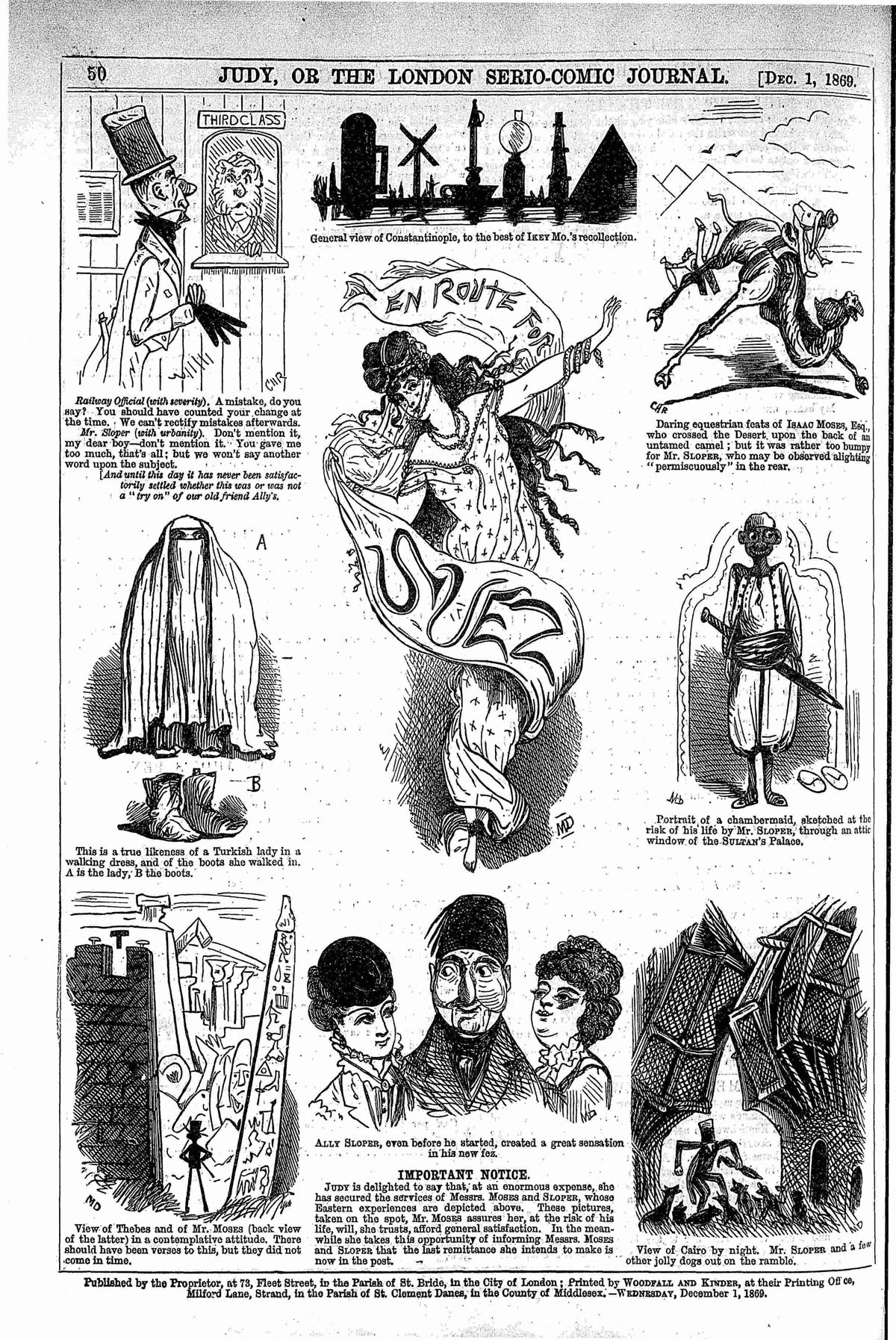
An Ally Sloper page in which Marie Duval and CH Ross collaborated. Judy, 1 December 1869, p. 50.
A Choice Collection of Queens and Kings, as well as her ‘associate’ Charles Henry Ross’s several books of rhymes, show Duval’s interest in Nonsense literature and a probable influence of Edward Lear, whose Book of Nonsense displays an even more radically simplified drawing style and shows people in highly unlikely attitudes. Duval, moreover does include a few limericks in the Queens and Kings: 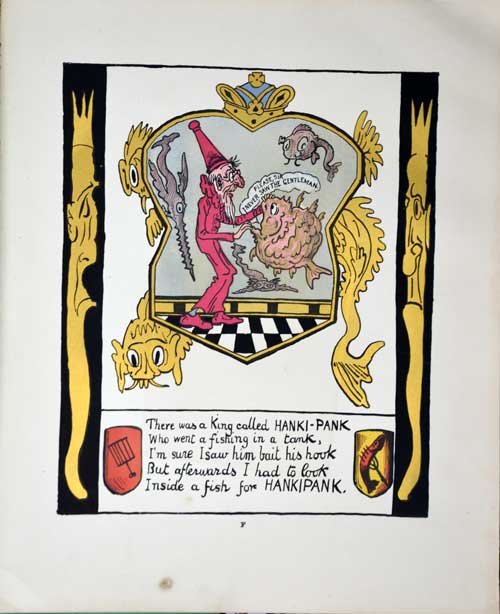 Not everybody liked her drawings; in “The Woman about Town” section in The Sporting Times, no. 380, 18 May 1872, p. 156, we read:
By the way, who does those horrid little woodcuts in Judy? The large cartoon is generally very good, and so are the sketches by Adelaide Claxton, but there are always a few wretched scratches signed “M.D.,” signifying “Miserable drawing,” I suppose, though some do say it stands for Marie Duval, or something of the kind ― which are frequently very bad “translations” of the piquant illustrations of Grevin and other artists in Le Journal Amusant and Le Journal Petit Rire, two serials for which I acknowledge a strong penchant. If “M.D.” cannot draw properly or with humour, he or she should be kicked out of Judy’s sanctum ― at least this is what I should command the publisher to do were I editor. But there is no accounting for tastes, and if some editors choose to show the world what dolts they can be, there are none to say them nay in this free and enlightened country.
Later in life, Marie Duval was generally presented as an example of an independent woman: Annie M. Hone, writing on “Woman’s Enterprise and Genius” in Myra’s Journal of Dress and Fashion, no. 5, 1 May 1888, p. 274, gives some information on young Marie Duval, without even mentioning her activity as an actress:
Isabelle Emilie de Lessier [sic] (“Marie Duval”) bagan her career of self-support as governess at the age of seventeen. A special talent being displayed in drawing caricatures, she contributed popular subjects to newspapers and magazines, being the first lady comic artist, and entirely self-taught. She has also supplied the illustrations for numerous books and been a constant contributor to “Judy.”
A few years after her death, Duval is again mentioned as a model for enterprising women, here too is her name spelled wrongly, revealing the source:
Art and Literature are sisters, and the artistic possibilities of women have come rapidly to the front of late years. To those cynics who declare women have little or no sense of humour, the postion of Mdlle. de Lessier (“Marie Duval”) is sufficient retort. She occupies a unique position as the first lady comic artist, showing the way to many whose talents lie in this direction. Her caricatures are full of subtle wit; and as she has been entirely self-taught, she is deserving of a peculiar gratitude, as proving the applicatiion of which most women are capable. It is to this power they owe their success. (F.H. “Women’s Work: Its Value and Possibilities.” The Girl’s Own Paper. October 27, 1894. 51)
Almost two years ago I posted William Michael’s Rossetti’s reminiscences of Edward Lear. Neither Rossetti nor Hunt, in his memories on Edward Lear in Pre-Raphaelitism and the Pre-Raphaelite Brotherhood (London: Macmillan & Co., 1905, vol 1, pp. 328ff) mention that Lear was also a member of the Hogarth Club, though only for a short time. He appears in the list of “artistic” members for 1859,
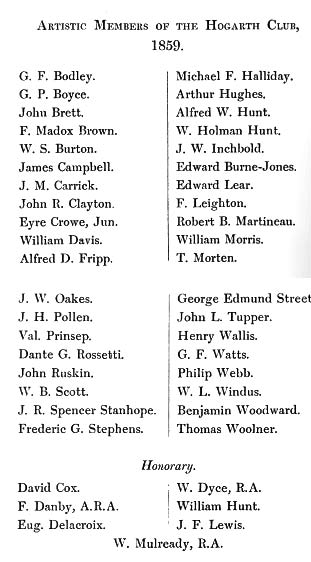
Ruskin: Rossetti: Preraphaelitism. Papers 1854 to 1862. Arranged and edited by W.M. Rossetti. London: George Allen, 1899. 216-217.
but, as he wrote in his diary for 1 July 1859, he “gave up the Hogarth Club” (also see 28 May and 28 June 1859).
Deborah Cherry (“The Hogarth Club: 1858-1861.” The Burlington Magazine 122.925 (1980): 237-44) writes:
The Hogarth Club, an exhibiting society and social club, was founded in April 1858 and dissolved in December 1861. Its members — divided into two classes of ‘artistic’ and ‘non-artistic’ — included painters, sculptors, architects, writers, collectors, professional men and their friends. Those who lived in London were termed ‘resident’.
Lear, not being resident, must have found it difficult to take advantage of the exhibitions organised in its premises, and the venture does not appear to have been particularly successful as few members actually submitted paintings for display.
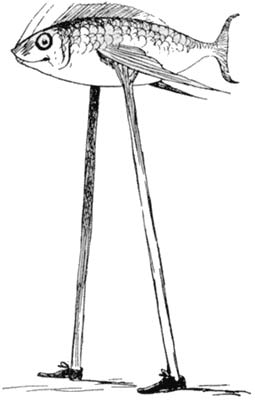
The fizzgiggious Fish,
who always walked about upon Stilts,
because he had no legs.
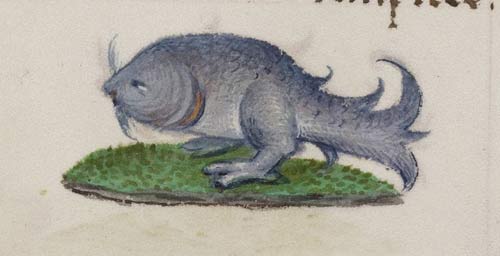
Hours of Joanna the Mad (Add MS 18852), a spectacular Book of Hours that was produced for Joanna of Castile (more frequently, and somewhat unfairly, known as Joanna the Mad) in Bruges between 1496 and 1506. See the British Library Medieval Manuscripts Blog.
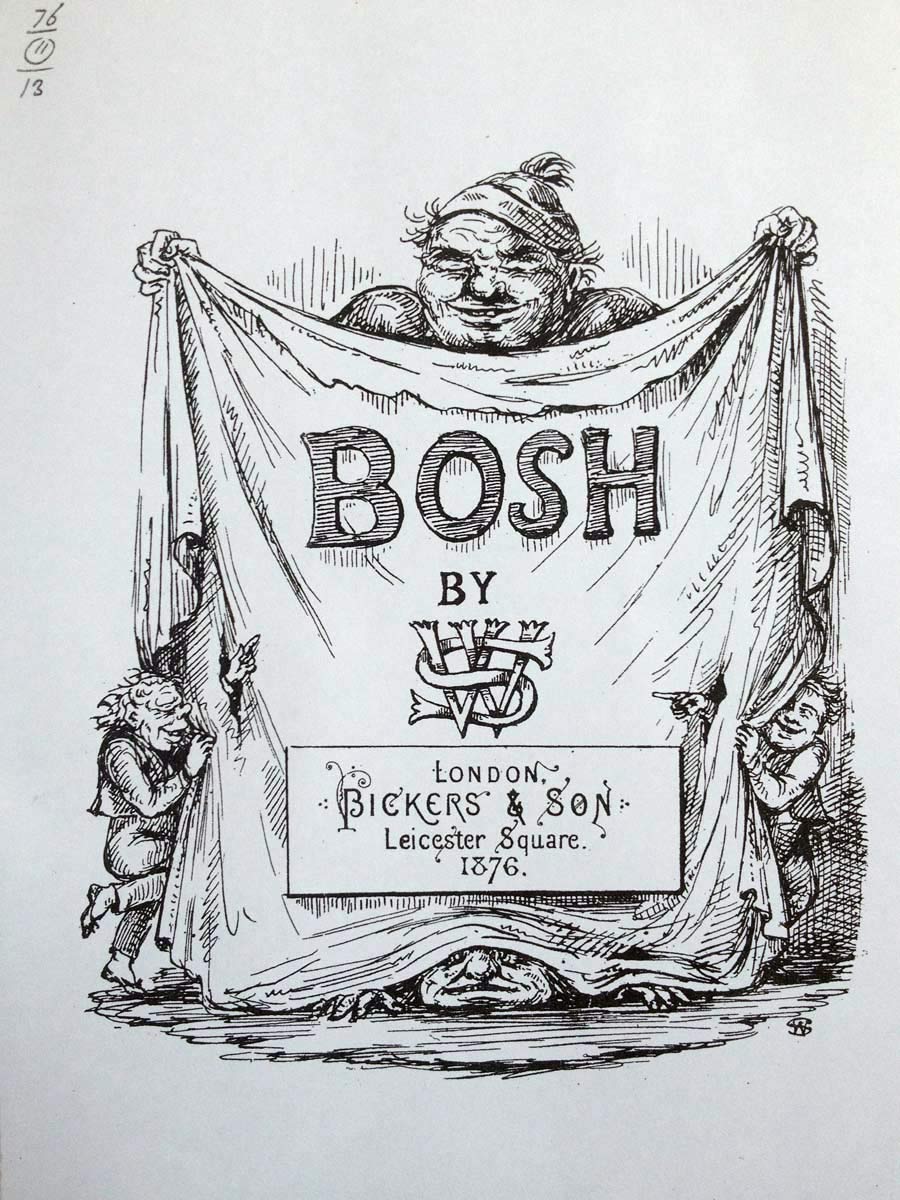
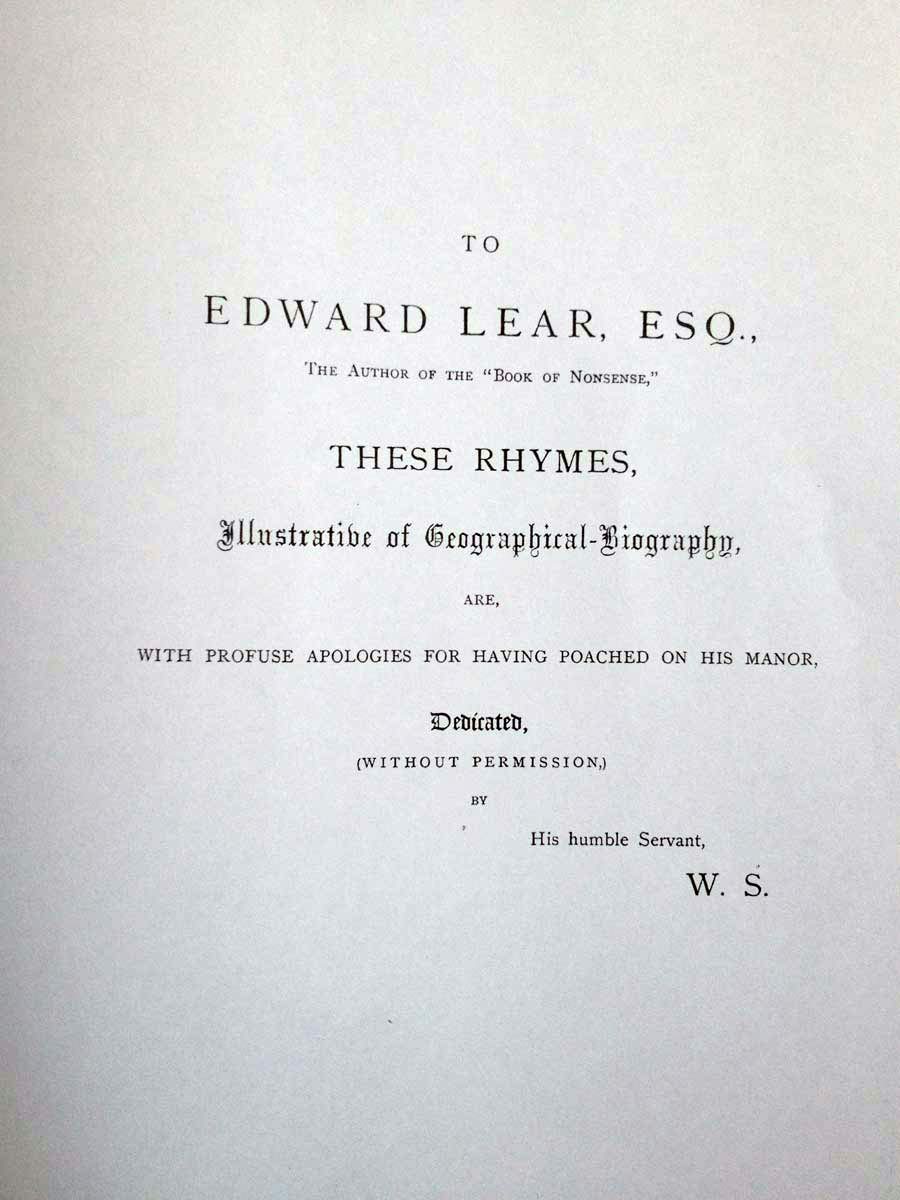
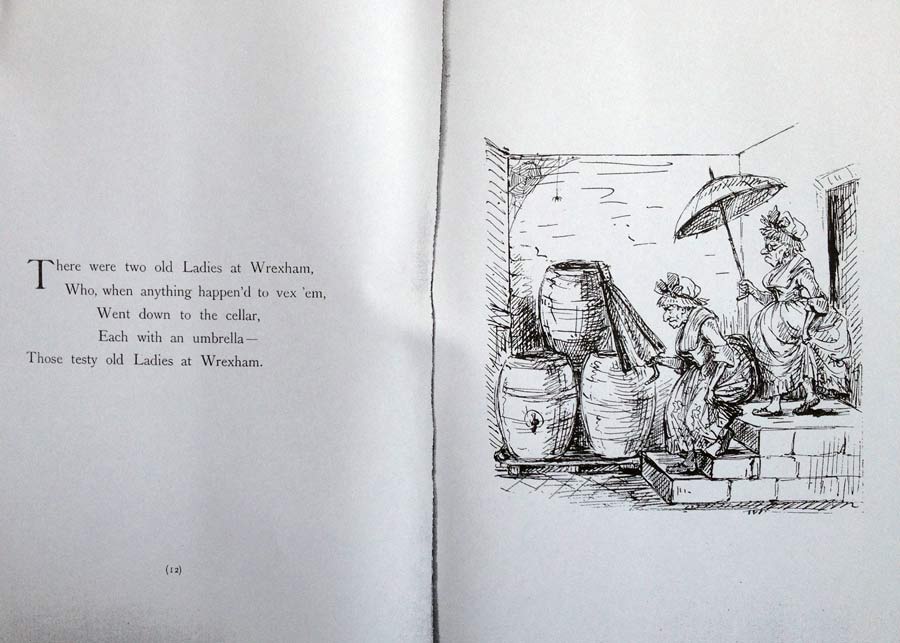
In a previous post, The Father of Nonsense, I published an 1877 letter in which Edward Lear thanked one W.S. for the dedication of a Book of Bosh, usually taken to be The Book of Bosh. With which are incorporated some amusing and instructive nursery stories in rhyme. [With illustrations.] ff. 26. Griffith, Farran & Co.: London, [1889.], and noticed that it was more likely to be the 1876 Bosh by W.S. London: Bickers & Son.
Bob Turvey, who owns a large collection of limerick books, kindly sent me three images — the title page, the dedication to Edward Lear and the rhyme Lear mentions in the letter — which fully confirm this is the volume W.S. sent Lear. Here are the pictures:
Last year I posted Edward Lear’s version of Humpty Dumpty, and was reminded of Aliquis’s Pictorial Humpty Dumpty (London: Tilt & Bogue, 1843), another “panorama” by the author of The Flight of the Old Woman Who Was Tossed Up in a Basket (London: D. Bogue, 1844; see it on nonsenselit.org, or buy it from Optical Toys).
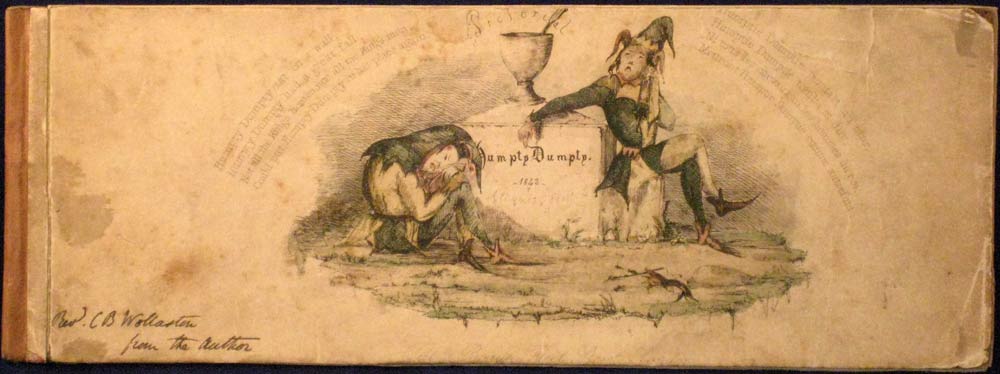
The Pictorial Humpty Dumpty consists of seven hand-colored engraved panels (3 1/2 x 9 1/2 in; 88 x 240 mm) in accordion format within cloth-backed, hand-colored boards opening to a total of sixty-three inches. Verses in English, Welsh, French, Hebrew, German, Latin, Italian, and Greek. This is the second issue, with the rhyme translated in six languages (the first, according to this page, lacked Italian and Welsh and was not coloured). Below are the best images of the whole I was able to find:



“Aliquis” is generally considered the pseudonym of Samuel Edward Maberly, M.A. of Christ Church, Oxford, who was born on 11 April 1818, the youngest son of Joseph Maberly, esq. of Harley-street, and christened in Ambrosden, Oxon, on 11 June of that year. He was curate of Mells, Somerset, where he died on 21 May 1848, or (according to The Gentleman’s Magazine, 30 August 1848, p. 215) on 22 May.
The association of “Aliquis” and Maberly is, I think, based on his presumed authorship of “Floreat Etona. Eton sketch’d, a series of designs illustrative of an Eton life, as it was in my time,” first published in eight parts (Oxford: James Wyatt and son, 1841) and then repackaged as Eton sketched: a series of designs illustrative of an Eton life by Quis? (Oxford: Baxter, 1841; see Yale University Library Catalog). “Quis” is also mentioned as the author of “Eton as it is,” in The Victoria Magazine, Nov., Dec, 1864; Jan., 1865. Vol. IV. Nos. 19-21. Either the two “Quis” are different or the 1864-65 magazine is (re)printing twenty-year-old material.
The identification of the 1841 “Quis” with Maberly is mentioned in an article in the Keats-Shelley Review, vol. 8, p. 159:
Illustrations of Life at Eton in the 1830s
These sketches by ‘Quis’ provide a facinating insight into the boys’ daily life at Eton in the early part of the nineteenth century. Although published in 1841, some thirty years after Shelley left, they record incidents and scenes that he would have found familiar from his own time. Most of the scenes show life in the early 1830s when Dr Keate was still Head Master. ‘Quis’ is thought to be Samuel Maberly who was a boy at Eton between 1830 and 1836.
The above is the only passage available on Google Books and I have not been able to find any other references; neither have I seen the sketches of Eton life, and cannot judge whether they resemble those of the two concertina books.
In 1980, Marina Warner published an article on Queen Victoria’s art, which included a short examination of what Edward Lear taught her. Here is the relevant section:
Under Albert’s bracing influence, Victoria wanted to improve, and as soon as the brand new Osborne House could accomodate guests, artists were invited down to stay to coach the Queen.
Edward Lear (1812-1888) was known to Victoria and Albert through the handsome topographical accounts he had published of his travels through the little known rural campagna of the Abruzzi in Italy. Victoria invited him to Osborne in July 1846, a few months after the appearance of the two-volume illustrated Excursions in Italy. On 17th July, Victoria reported, ‘Gave Vicky her religious lesson, as most days, and wrote and drew. Had another lesson with Mr. Lear, who much praised my 2nd copy. Later in the afternoon I went out and saw a beautiful sketche he had done of the new house.’
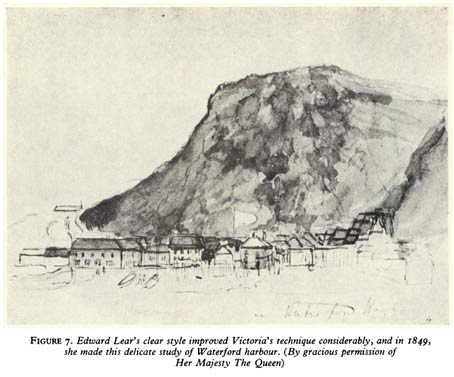
The Italianate turret which was to become the trademark of nineteenth-century holiday villas from the Isle of Wight to San Francisco was designed by the master builder Thomas Cabitt in collaboration with Prince Albert. Victoria’s work is much more slapdash by comparison, but it show the clear improvement that Lear achieved. He concentrated her eye on detail, showed her how to compose a picture with eloquence and sweep, and above all, made her understand that not everything in a scene should be represented, but that the right emphasis at the right moment is the key. He also introduced her to the subtle combination of ink and wash, which she began to use to effect later, as in the study of Waterford harbour in 1849 (figure 7).
Lear only taught the Queen for three weeks; sadly, we do not know how the Nonsense Songs writer found his Queen, nor why their encounter never repeated. About three years after Leat’s visit, another skilful water-colourist was summoned to attend her. William Leighton Leitch (1804-1883) became Victoria’s teacher, and the teacher of her children for over twenty years, until the excruciating migraines which tormented him forced him to retire.Warner, Marina. “Queen Victoria as an Artist: From Her Sketchbooks in the Royal Collection.” Journal of the Royal Society of Arts 128.5287 (1980): 421-36. 427-428.
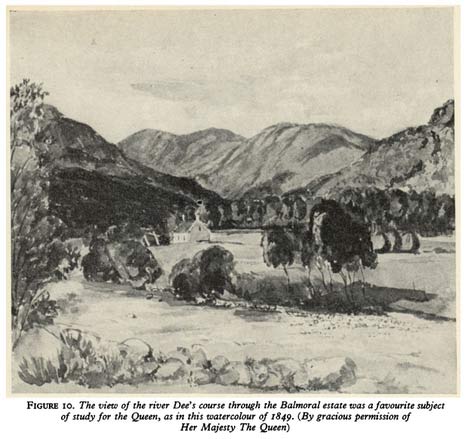
Of course, it is not true that we do not know “how the Nonsense Songs writer found his Queen,” as the episode is discussed in all the Lear biographies. Peter Levi (Edward Lear: A Biography. New York – London: Scribner, 1995. 85) suggests that the reason why the encounter was never repeated was the fact that he did not live permanently in England.
Vivien Noakes even quotes from “an edited transcript of Queen Victoria’s diary preserved at the Royal Archives in Widsor:”
15 July 1846. Osborne. Had a drawing lesson with Mr Lear, who sketched before me and teaches remarkably well, in landscape painting in water colours…
16 July 1846. Osborne. Copied one of Mr Lear’s drawings and had my lesson downstairs, with him. He was very pleased with my drawing and very encouraging about it…
17 July 1846. Osborne. I had another lesson with Mr Lear, who much praised my 2nd copy. Later in the afternoon I went out and saw a beautiful sketch he has done of the new house…
18 July 1846. Osborne. After luncheon had a drawing lesson, and am, I hope, improving…
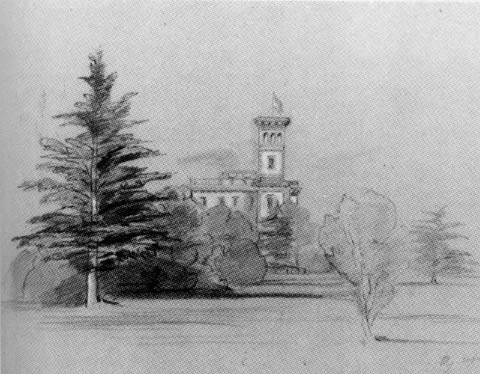
A bad scan of “The Queen’s sketch made under Lear’s tuition when Osborne was half built,” from P. Levi’s Edward Lear.
Lear’s impressions are then reported:
Lear wrote down the details of his stay at Osborne, but all that has survived is one memory that he recalled after the Prince’s death in 1861: ‘Prince Albert showed me all the model of the House, (then being built only,) & particularly a Terrace, saying ― “This is what I like to think of ― because when we are old, we shall hope to walk up & down this Terrace with our children grown up into men & women.”‘
At the end of July Queen Victoria returned to London and the lessons were resumed in Buckingham Palace. It was probably here that two embarassing incidents occurred that Lear like to recall. He was accustomed now to mixisng with earls and viscounts, but he had no experience of the finer points of Court etiquette ― though he did know that he enjoyed standin on the rug in front of the fire warming his coat-tails. Each time he took up this position facing the Queen, the attendant Lord-in-Waiting invited him to see something on the far side of the room. The charade was repeated several times and no one explained what was going on. It was only later that Lear realised that a subject must not stand with his back to the fire in the presence of monarchs.
But Queen Victoria had apparently taken a liking to her drawing master and she decided to show him some of her bijou treasures, which were kept in display cases. Lear was delighted with what he saw and exclaimed exuberantly: ‘Oh! how did you get all those beautiful things?’ Calmly Her Majesty replied, ‘I inherited them, Mr Lear.’
Noakes, Vivien. Edward Lear: The Life of a Wanderer. Rev. and enl. ed. Stroud: Sutton, 2004. 61-62.
The first episode, which sounds more likely, is part of a letter to Chichester Fortescue in Letters of Edward Lear, p. 214, but the manuscript, as she notes, does not have the passage quoted by Noakes. The two other stories were probably much embellished by Lear while telling them, and are to be found in Lady Strachey’s Introduction to the Letters. So, perhaps Warner is not wrong when she says we do not have Edward Lear’s direct testimony of his lessons with Victoria.
Both Queen Victoria’s surviving sketches made under the supervision of Edward Lear and Lear’s own drawing of Osborne can be seen in the Royal Academy of Arts catalogue, pp. 159-160.
 A Blog of Bosh