Edward Lear, Porto Tre Scoglie, Albania

el_scoglie-s

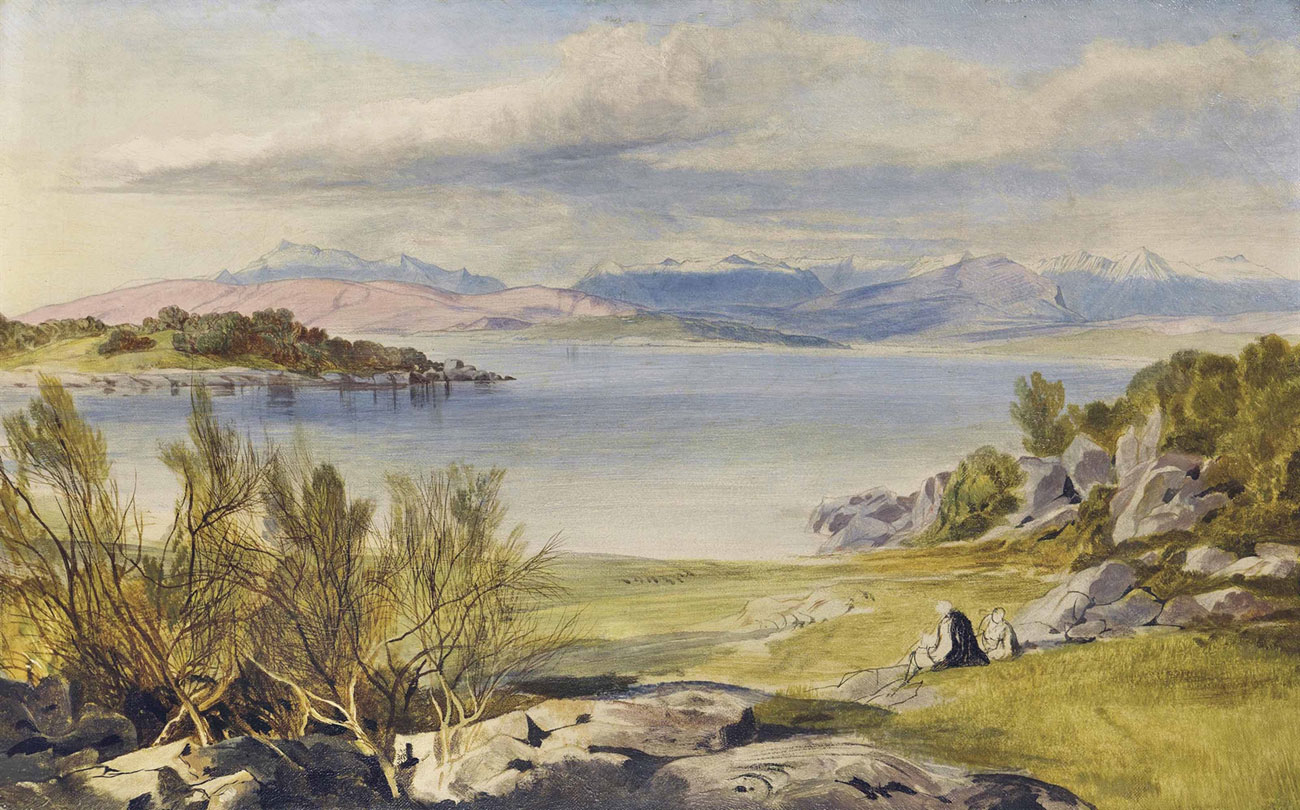
Edward Lear, Porto Tre Scoglie, Albania.
Oil on canvas. 13 x 20 ¾ in. (33 x 52.8 cm.)

This view was made by Lear in April 1857 on a short trip to Trescogli (modern Ksamili) to the north of Butrint in Albania. Lear sailed from Corfu where he had taken a house for the winter. Butrint was an ancient Greek and later Roman city, now under excavation. ‘We were off on the 2nd April in Lushington’s boat Midge – I taking George, the canteen or box of cooking things, my bed, paper for drawing, etc., & Edwards taking his servant, Fillipo (a Maltese). We had a perfectly quiet passage across of only 3 hours & anchored in the little harbour of Trescogli – enjoying all the afternoon on making drawings – below the tall white heath all in bloom – & comfortable dinner & quiet night’ (Edward Lear, The Corfu Years, Athens and Dedham, 1988, p. 108). The trip was taken with James Bevan Edwards (1834-1922), later a senior British army officer and politician, who was the son of Samuel Price Edwards, a keen patron of Lear’s whose collection of works included Corfu, from Ascension (1859, sold in these Rooms on 16 December 2015, lot 128), Petra, The Theatre (1859), Turin (1862) and Jerusalem (1862, Ashmolean Museum, Oxford).

Lear made his first expedition to Albania between September and November 1848, an area that few foreigners had ever explored. He found the area fascinating: ‘You have majestic cliff-girt shores; castle-crowned heights, and gloomy fortresses; palaces glittering with gilding and paint; mountain-passes such as you encounter in the snowy regions of Switzerland; deep bays, and blue seas with bright, calm isles, resting on the horizon; meadows and grassy knolls; convents and villages; olive-clothed slopes, and snow-capped mountain peaks; – and with all this a crowded variety of costume and pictorial incident such as bewilders and delights an artist at each step he takes’ (E. Lear, Journals of a Landscape Painter in Albania, London, 1851, pp. 4-5).

We are grateful to Briony Llewellyn for her help in preparing this catalogue entry.

Christie’s.

Posted in Edward Lear | Tagged , , , , | Leave a comment

Edward Lear, Mount Lebanon (1866)

el_mount-lebanon-s

Edward Lear, Mount Lebanon.
Signed with monogram (lower right). Oil on canvas, in the artist’s original frame. 15 ¼ x 27 5/8 in. (39 x 70 cm.) Painted in 1866.

Leaving Jerusalem in 1858, Lear travelled to Lebanon, arriving in Beirut on 11 May. ‘This place’ he wrote to his sister Ann on 14 May 1858, ‘is quite different from anything in southern Palestine – & reminds me more of Naples by its numerous villas & gardens, & the civil & gay people. I was only looking about me yesterday, but today I shall make a drawing of Mt. Lebanon, & the Bay & town – which are really lovely as a whole…’ A few weeks later, in a letter to his friend and patron Lady Waldegrave, he noted that that ‘all the Lebanon Country is safe & pleasant…the higher portions of Lebanon, i.e. the outer side – recall Etna’ (27 May 1858).

The horizontal layout of the painting is emphasised in Lear’s carefully considered composition, filled with an astounding depth of colour and light, with the rocky promontory looming out of the foreground leading the eye across the azure water to the city at the base of the luminous mountain.

We are grateful to Briony Llewellyn for her help in preparing this catalogue entry.
Christie’s.

Posted in Edward Lear | Tagged , , , , | Leave a comment

Edward Lear, View of the Citadel, Corfu

el_citadel-s

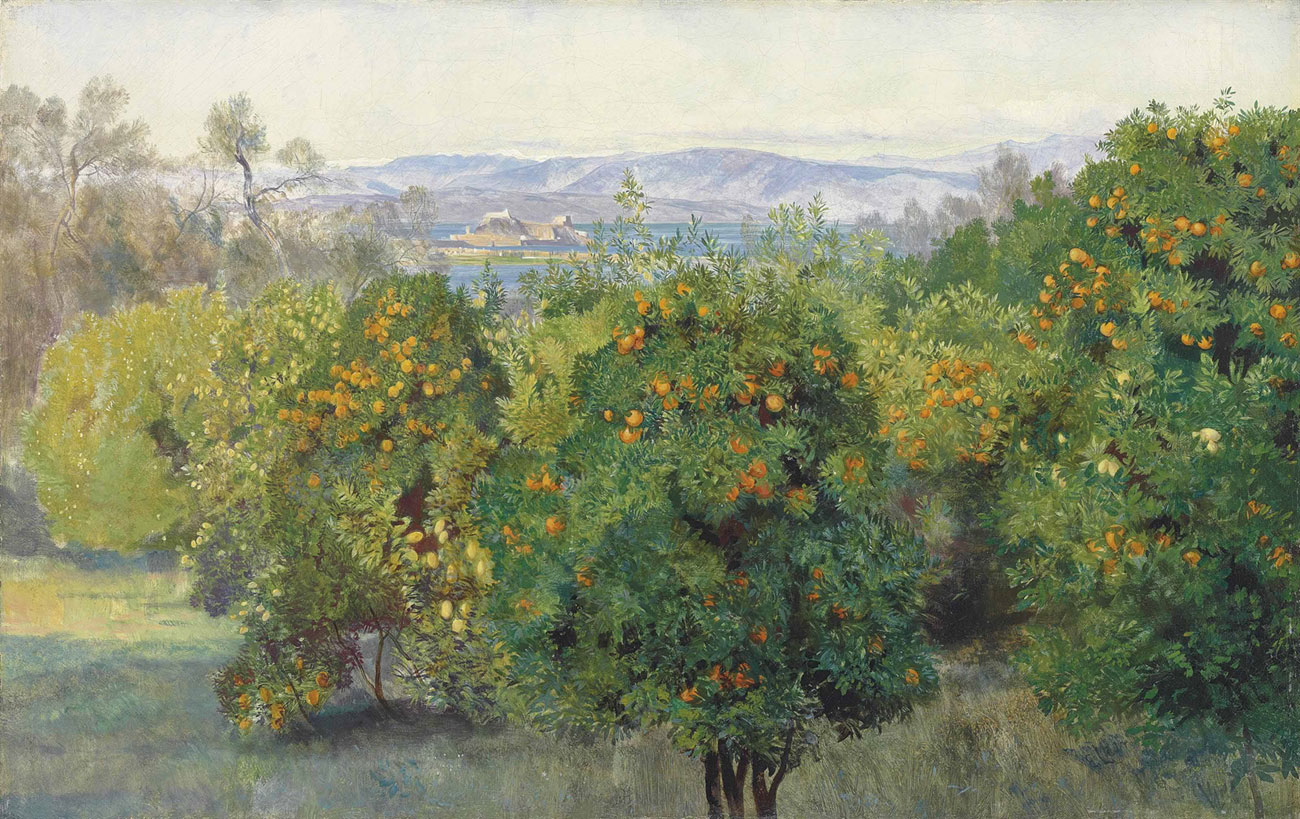
Edward Lear, View of the Citadel, Corfu, with an orange grove in the foreground.
Signed ‘E. Lear’ (lower right). Oil on canvas. 19 x 30 in. (48.3 x 76.2 cm.)

Lear first visited Corfu in 1848. He returned in the winter of 1855-6 and effectively made the island his home until 1864. The artist was obsessed by the island’s beauty from his first visit. In April 1848 he wrote: ‘This afternoon I have been wandering all about & nothing can be more lovely than the views; I never saw more enchanting. The extreme gardeny verdure, the fine olives, cypresses, almonds, & oranges, make the landscape so rich, & the Albanian mountains are wonderfully fine’. He could have been describing the view portrayed here, seen from the hillside above the village of Ascension, now Analypsis, with the Citadel of Corfu and the mountains of Albania seen in the distance. The village was Lear’s particular favourite, and the view from its environs was the subject of some fifteen pictures. As he wrote in a letter to his sister Ann on 25 December 1855 ‘Oh! If you had but seen the day here! Perfectly cloudless, warm & sunny, & with every orange & myrtle & olive tree alive with sunshine, & all the bright snow hills on the other side of the water pink & lilac & blue!’. It is probable that this picture was worked up from sketches executed in 1856-7. It is certainly datable to before 1861 when Lear started using his monogram.

We are grateful to Briony Llewellyn for her help in preparing this catalogue entry.

Christie’s.

Posted in Edward Lear | Tagged , , , , | 2 Comments

Edward Lear, In the Campagna (1844)

el_campagna-s

Edward Lear, In the Campagna, Rome.
Signed ‘Edwd Lear’ (lower left) and dated ‘1844’ (lower right). Oil on canvas. 9 ¾ x 18 1/8 in. (24.8 x 46 cm.)

The Roman Campagna was a place that Lear often returned to in the course of his travels having been captivated by ‘the long lines of acqueducts [sic] and tombs on the desolate and beautiful Campagna’ (E. Lear, Letter to his sister Ann, 14 December 1837). On a later visit he wrote that ‘there is a charm about this Campagna when it becomes all purple & gold, which it is difficult to tear one’s self from. Thus-climate & beauty of atmosphere regain their hold on the mind-pen & pencil’ (E. Lear, Letter to Ann, 27 March 1848).

A watercolour by Lear of the same view (including the small settlement to the right) is inscribed and dated ‘Campagna di Roma/Feby 17.1844’. It was in the collection of the banker John Scandrett Harford (1787-1866) and was passed down in his family until 2015 (now with Guy Peppiatt Fine Art).

We are grateful to Briony Llewellyn for her help in preparing this catalogue entry.
Christie’s.

Posted in Edward Lear | Tagged , , , , | Leave a comment

Edward Lear, A View near Gheneh (1884)

el_gheneh-s

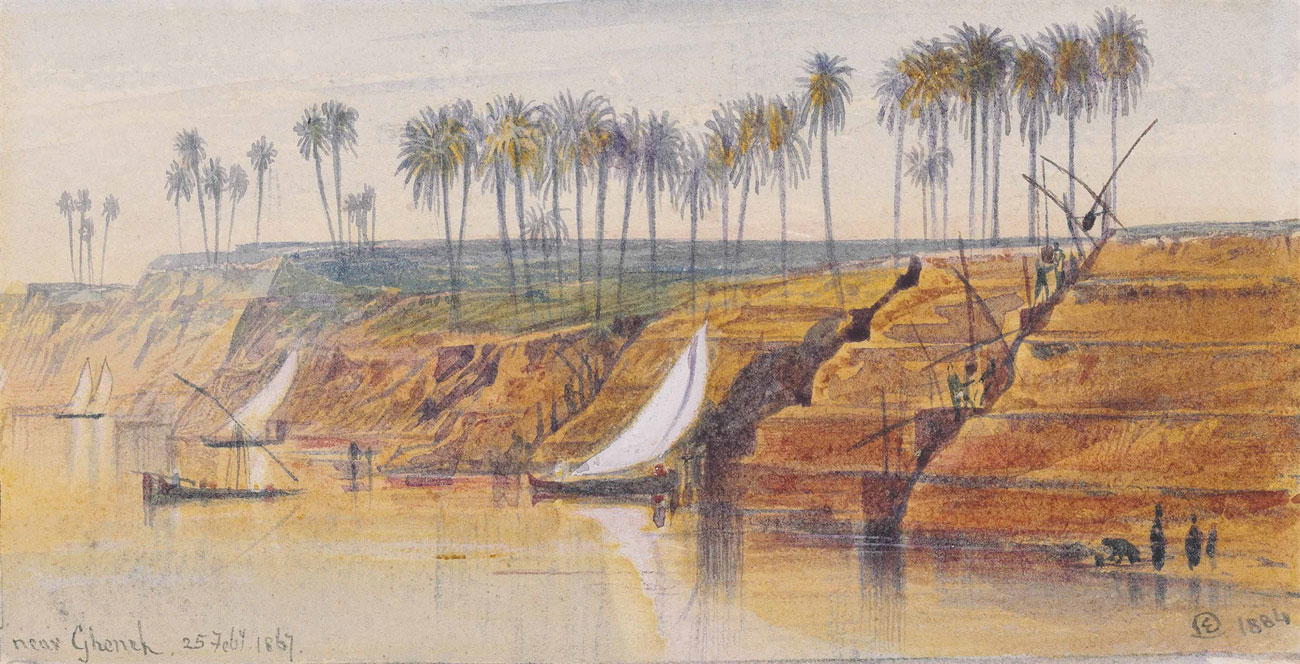
Edward Lear, A view near Gheneh, Egypt.
Signed with monogram and dated ‘1884’ (lower right) and inscribed and dated ‘near Gheneh. 25 Feby. 1867.’ (lower left) and further inscribed ’50 NEAR Gkeneh’ (verso). Pencil and watercolour heightened with white. 3 ¾ x 7 ¼ in. (9.5 x 18.4 cm.)

The sketch for the present watercolour was begun near the end of Lear’s trip along the Nile, as the date of 25 February attests. The day before, he had been at Karnac recording the architecture and surroundings. By contrast, here, Lear’s interest is in capturing the Egyptian way of life. The present watercolour demonstrates the artist’s enduring fascination with the ‘magnificent river, with endless villages – hundreds & hundreds on its banks, all fringed with palms, & reflected in the water… [and the] boats which look like giant moths’ . (V. Noakes, Letters of Edward Lear, London, p. 122).

Christie’s.

Posted in Edward Lear | Tagged , , , , | Leave a comment

Edward Lear, Kom Ombo (1884)

el_kom-ombo-s

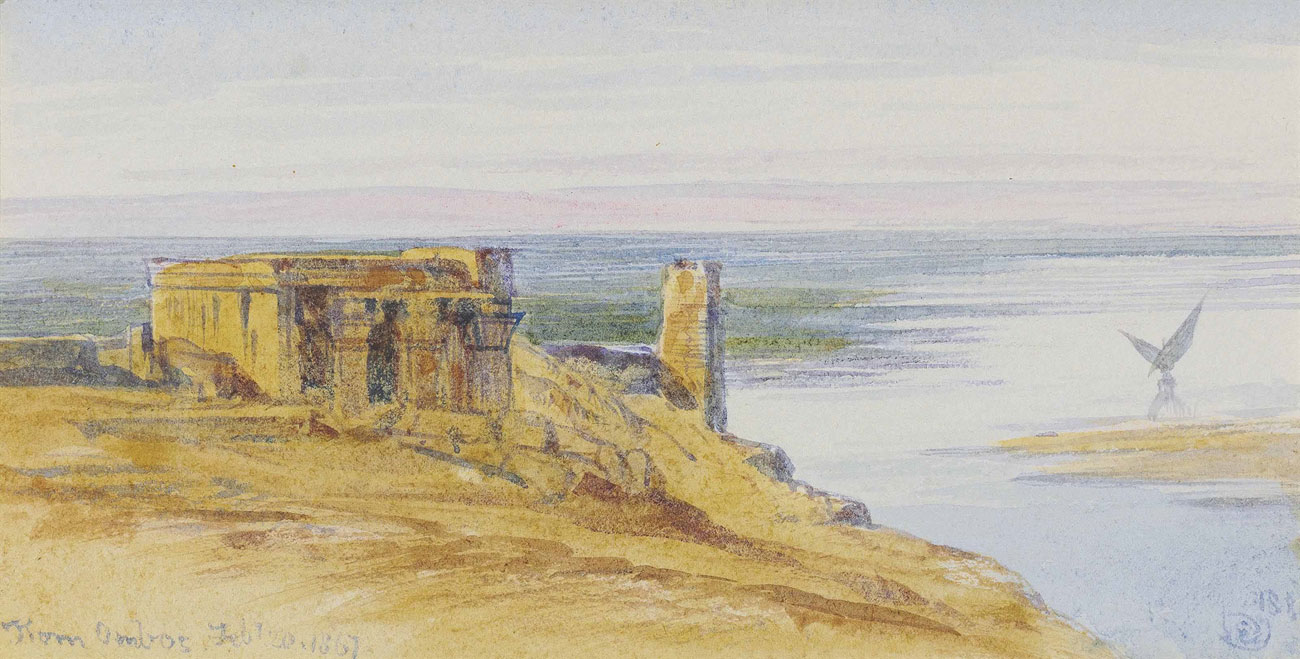
Edward Lear, Kom Ombo, Egypt.
Signed with monogram and dated ‘188[4]’ (lower right) and inscribed and dated ‘Kom Ombos. Feby 20. 1867′ (lower right) and further inscribed ’43. Kom Ombos.’ (verso). Pencil and watercolour. 3 7/8 x 7 ¼ in. (9.8 x 18.4 cm.)

Kom Ombo stands between Aswan and Edfu, about 48 km north of the Aswan. It stood on an important ancient crossroads between the caravan route from Nubia and the trails from the gold mines in the eastern desert areas. The temple complex was constructed during the Graeco-Roman period in the 2nd Century BC and the main buildings stand on a sandy hill overlooking the surrounding countryside and the Nile which runs between steep, narrow banks of sandstone.

Christie’s.

Posted in Edward Lear | Tagged , , , , | Leave a comment

Edward Lear, View from Dabod (1880)

el_dabod-s

Edward Lear, View from Dabod, looking south, Egypt.
Signed with monogram and dated ‘1880’ (lower right); and inscribed and dated ‘from/ Dabod 17 Feby. 1867’ (lower left), and further inscribed and numbered ‘,35. From Dabòd, looking South.’ (verso). Pencil and watercolour. 3 7/8 x 7 ¼ in. (9.8 x 18.4 cm.)

The Temple of Dabod, begun in the early 2nd Century BC, was originally located about 10 km south of Aswan on the western bank of the Nile. During the building of the Aswan High Dam circa 1960, the temple was dismantled and subsequently given to Spain, in gratitude for their assistance in saving Abu Simbel. It was subsequently erected in the Parque del Oeste, Madrid.

Christie’s.

Posted in Edward Lear | Tagged , , , , | Leave a comment

Edward Lear, A Felucca on the Nile (1884)

el_felucca-s

Edward Lear, A felucca on the Nile, Abu Simbel in the distance, Egypt.
Signed with monogram and dated ‘1884’ (lower right) and inscribed and dated ‘Ipsam [?] Feby 9 1867’ (lower left). Watercolour heightened with white. 3 ¾ x 7 ¼ in. (9.5 x 18.4 cm.)

In this distant view of Abu Simbel Lear concentrated on the way the sculptures relate to their landscape and the overall topography of the area. Indeed in his diary entry for 9 February Lear wrote ‘on deck till 1.30. Last memorials of Abou Simbl [sic] -(the position of which I certainly never saw given in any drawing – tho of near views many)’. There is an on-the-spot sketch of the same subject, from almost the same viewpoint, but without the felucca, in the Yale Center for British Art, New Haven.

This watercolour is of particular interest given that between 1964 and 1968 the entire temple complex was dismantled brick by brick and reassembled on the top of the cliffs, in order to save it from being destroyed by the Aswan High Dam.

Christie’s.

Posted in Edward Lear | Tagged , , , , | Leave a comment

Edward Lear, View of Villefranche

el_villefranche-s

Edward Lear, View of Villefranche, Côte d’Azure, France.
Signed with monogram (lower right). Pencil and watercolour heightened with bodycolour and with gum arabic. 4 5/8 x 7 ¼ in. (11.7 x 18.4 cm.)

Lear spent the winter of 1864-5 in the South of France. He took lodgings in Nice and then travelled along the coast as far as Italy before returning to Nice on New Year’s Eve. The months he spent in the South of France were enormously productive and he executed numerous sketches as well as a number of highly finished watercolours, such as the present work.

Christie’s.

Posted in Edward Lear | Tagged , , , , | Leave a comment

Edward Lear, San Giorgio Maggiore (1865)

el_lagoon-s

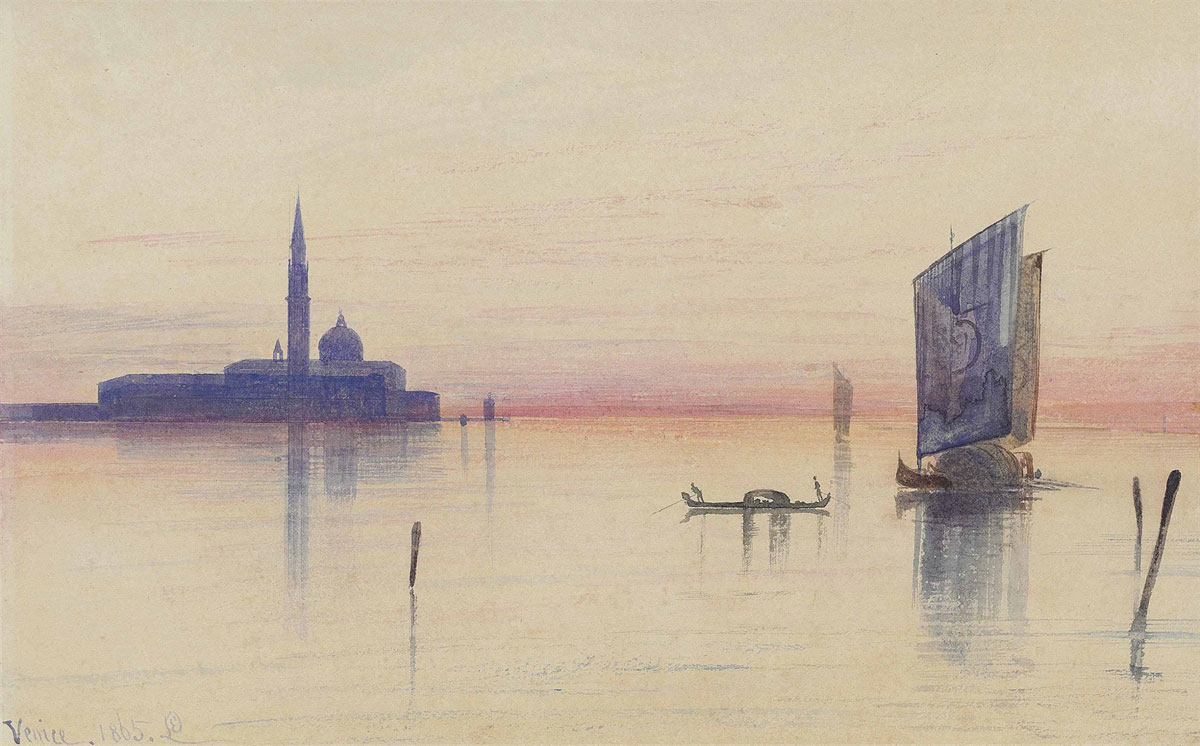
Edward Lear, On the lagoon, looking over to San Giorgio Maggiore, Venice, Italy.
Signed with monogram, inscribed and dated ‘Venice. 1865. EL’ (lower left). Pencil and watercolour. 6 ½ x 10 ¼ in. (16.5 x 26 cm.)

Lear arrived in Venice in the autumn of 1865 after an unsuccessful year in Nice. He took gondolas out into the canals and lagoon in order to capture the interplay of water and architecture unique to Venice. Whilst there he made much of his work in flowing washes of watercolour, such as in the present drawing, capturing the ever-changing light of the city which had so fascinated earlier artists such as J.M.W. Turner and James Abbott McNeill Whistler.

Christie’s.

Posted in Edward Lear | Tagged , , , , | Leave a comment