For sale from Donald A. Heald.

Indian Trees, Palms and Bamboos [cover title of an album of 19 original watercolours mostly of Indian landscape by Edward Lear]
San Remo, Italy: 1878-1882. Folio. (19 x 12 inches). 19 original watercolour drawings (1 of a Jay, 18 depicting various species of Indian, Sri Lankan and Egyptian trees within landscape settings in Shimla, Ratnapura, Kozhikode, Delhi and elsewhere, each after sketches by Lear accomplished between 1854-1874), each on drawing paper and mounted onto larger sheets of the album. (Some toning to the drawings from prior arch-topped passe-partout mounts).
Early elaborate red morocco gilt album, covers with inset marbled paper panels, contemporary red morocco lettering-pieces on upper cover and spine
Lear composed these fine watercolours on a trip to India at the behest of Lear’s friend Lord Northbrook, Viceroy of India, who supplied him £1,000 of commissions. In 1872, Lear’s first attempt to reach the subcontinent was abandoned at Egypt due to ill health, but he tried again the following year. “Lear was in his sixty-second year when he arrived in India on 22 November 1873. He remained there until 11 January, 1875 and was travelling more or less continually … Lear’s tour of India was the last of his great expeditions … He died at San Remo on 29 January 1888, after he had finished his projected oils and water colors of India …” (Edward Lear’s Indian Journal, Edited by Ray Murphy, Introduction, pp. 34-36).

“Lear’s trip to India from 1873 to 1875, his last extended journey, made him one of the most notable British artists to visit the subcontinent during the Victorian era” (Dehejia, p. xii). In India, Lear produced thousands of rough sketches on small sheets (referred to by him as “scraps”) and a smaller number of larger more finished drawings. Of the latter, some were accomplished in India, particularly, as his journal reveals, on rainy days when he was otherwise prevented from drawing outdoors, and others were reworked in the years following his return to San Remo, which are identifiable by their additional dates. The present album is principally comprised of the more finished, larger drawings dating shortly after his return to Italy.

Unlike other artists in India in this period, Lear focussed his work nearly entirely on Indian landscape and not on its architectural monuments. The present album, collected at an early date evidently for its botanical and dendrological content, is representative of his work in the sub-continent, breathtaking majestic mountains vistas and the exotic vegetation of tropical scenery. “Lear described himself as a ‘painter of poetical topography’ and a friend called him a ‘painter of topographical poetry.’ … Behind each choice of subject, each drawn line, each wash of colour, we can feel the personal stamp of the amiable, eccentric, and intelligent observer of a wondrous exotic land. The painter and poet were one and the same man” (Dehejia, pp. 111-112).
The watercolors present here are comprised as follows (titled as per Lear’s captions in the image, the type of tree depicted from later pencil caption on the mount below the image, and with quotes from Lear’s Indian Journal relating to the scenes depicted):
1) [Small bird on a branch with an insect flying nearby]. Signed and dated Sept. 1867. 10 3/8 x 6 1/2 inches.
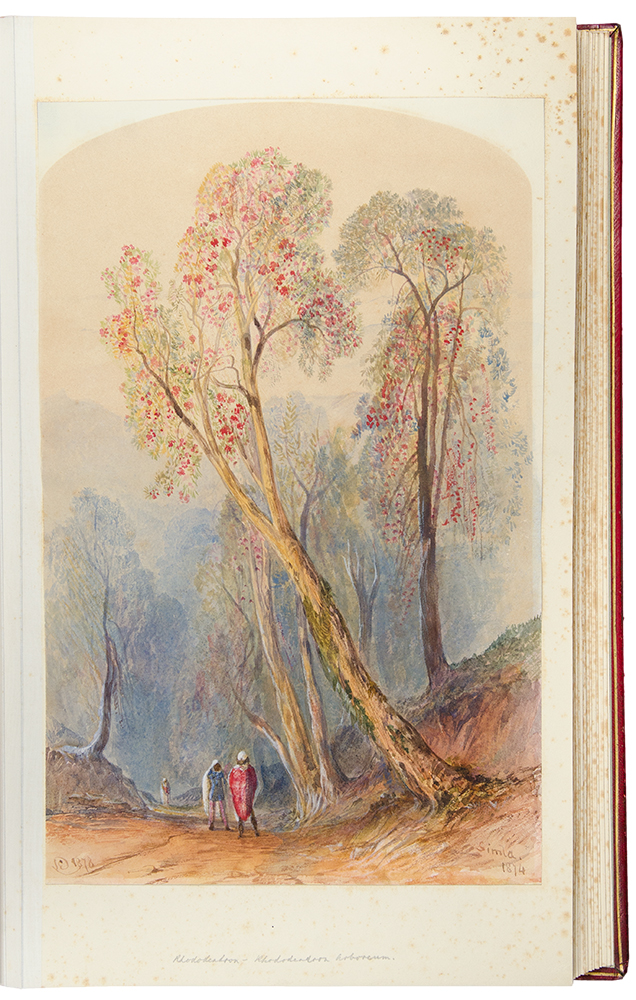
2) “Simla. 1874.” Signed and dated 1878. 15 1/2 x 9 3/4 inches. Rhododendron arboreum. 20 April 1874: “The rhododendra are now 100 times more beautiful than 10 days ago, one mass of ineffable colour. The hills, looking south, are particularly beautiful this evening, being all minus their sharp detail, owing to the haze: and the scarlet flowers come off the vast, dim gray distance like nothing one ever saw or imagined. And it must be owned that the natives of these parts are by far the most picturesque of any I have yet seen, especially the womenkind in their floating mantels, many-coloured trousers and vests and surprising nose rings…”
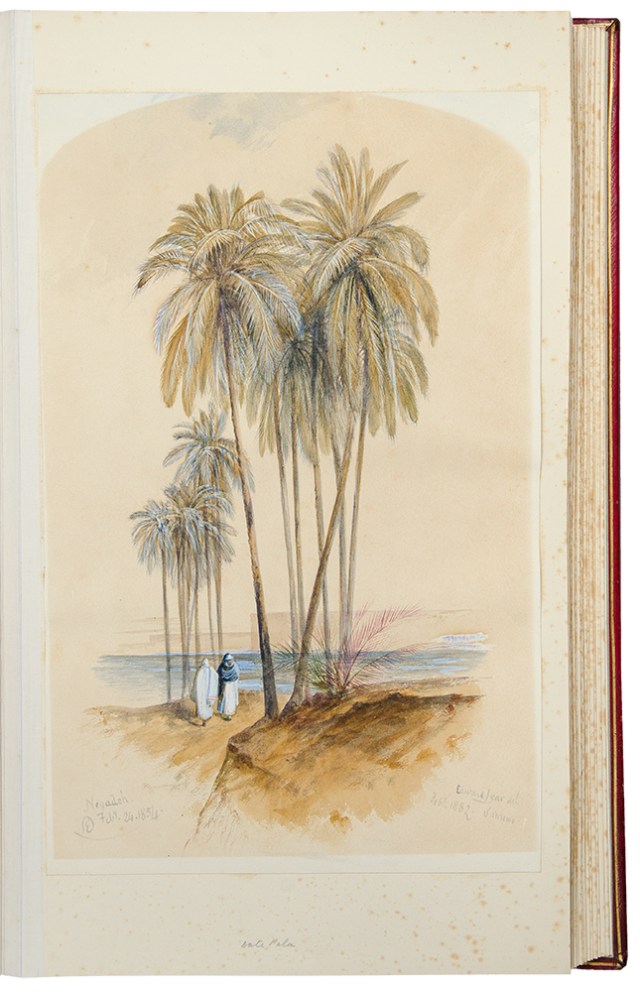
3) “Negadeh [Egypt]. Feby. 24, 1854.” Signed and dated Feb. 1 1882. 15 3/8 x 9 3/4 inches. Date palm.
4) “Ratnapura. 1874”. Signed and dated 1878. 15 3/8 x 9 3/4 inches. Areca palm. 24 November 1874: “After tea, walk out but a thick mist covers everything beyond what is close to the eye. Drew on the banks of the Kalaganga, beautful bamboo and palmy scenery but no more…”

5) “Calicut. 1874.” Signed and dated 1878. 15 3/8 x 9 3/4 inches. Talipot palm. 16 October 1874: “It was, I think, past 4 when, at the end of the grandest tree bordered roads I ever saw, we reached Calicut station. Roads of such redundant beauty one could hardly dream of! India, Indianissimo! Every foot was a picture…”
6) “Dinapor. 1874.” Signed and dated 1878. 15 1/2 x 9 7/8 inches. Palmyra palm. 17 December 1873: “Walked out a bit, hardly knowing what to do. Then resolved to go in a garry to near Dinapore and walk back. So set off to the beginning of the suburban town, and there made a tolerable drawing of big palmyra palms, and the fine plain, a subject quite makeable into a picture.”
7) “Ceylon. 1874.” Signed and dated 1878. 15 3/8 x 9 3/4 inches. Sago palm. 16 November 1874: “Extraordinarily lovely view! Drew three times; what profound depths of green foliage. The vast amount of varied and definite vegetation here is simply amazing, beyond all or any imitation … Flowers, trees, colours, indescribable.”
8) “Mahatta [Egypt]. Feby. 8, 1854.” Signed and dated Feb. 7, 1882. 15 3/8 x 9 3/4 inches. Doum palm.
9) “Barrackpore. 1874.” Signed and dated 1878. 15 3/8 x 9 3/4 inches. Plaintain. 31 December 1873: “The reflections in the water may, and should be perfect, but were not so, because of disturbing washers … Remarked the beauty of white sheets, both in light and shadow; also black bodies and white waist cloths; also, extreme featheriness of coconut palm; depths of brown gray shade; brilliancy of bananas, and general misty grayness…”
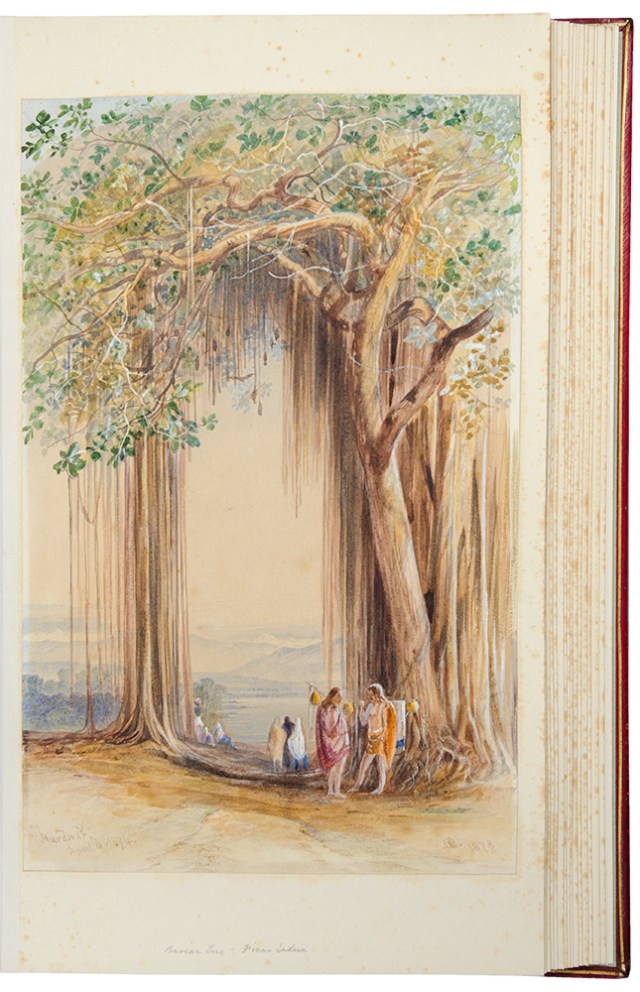
10) “Hurdwar. April 4, 1874. Signed and dated 1878. 15 1/2 x 9 3/4 inches. Banyan tree. 5 April 1874: “Then the variety of costumes, new every moment; some of the yogis like painted North American Indians. The great multitude of bathers is vastly queer! The colours of dresses amazing, women in apricot coloured shawls, rose coloured, scarlet, brown … The mountains came out comparatively clear before lunch, so that I could really get an outline of the upper range, snows and all.”
11) “Below Kersiong. 1874.” Signed and dated 1878. 15 1/2 x 9 3/4 inches. Screw pine. 28 January 1874: “The variety and beauty of the foliage above, below and around this descent road is wondrous! And of the weather prove fine, I can’t help thinking of going up to the screwpines tomorrow … to draw my last inspiration from the soon-never-to-be-seen-anymore woods of the eastern Himalayas.”
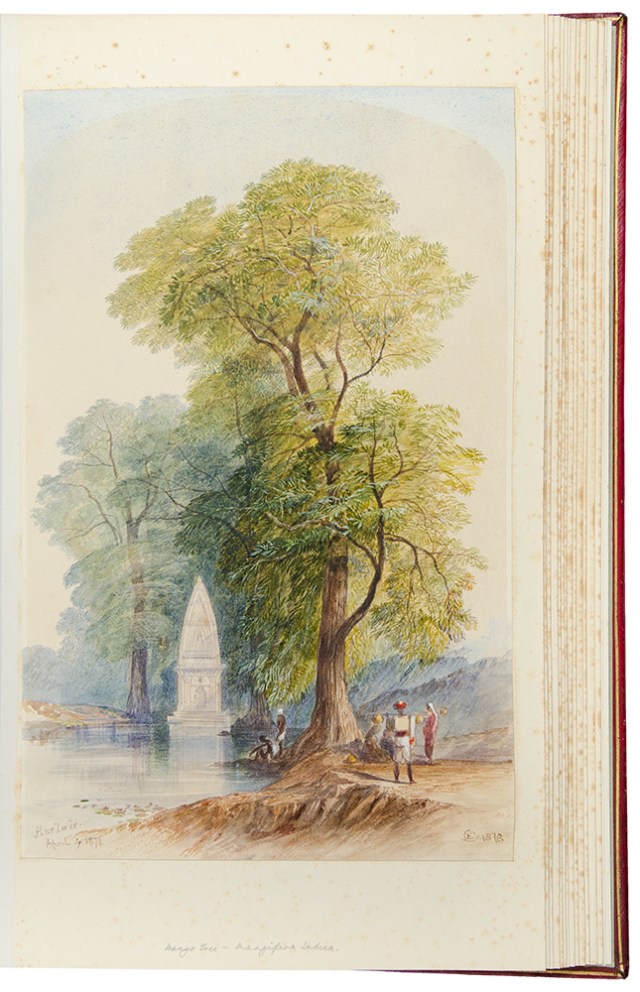
12) “Hurdwar. April 4, 1874. Signed and dated 1878. 15 1/2 x 9 3/4 inches. Mango tree. 4 April 1874: “Then we drove to near Jehallipur, and I was set down to draw my temple and mango grove with policemen to watch that no harm betided me!”
13) “Galle, Celyon. Nov. 1874.” Signed and dated 1878. 15 1/2 x 9 3/4 inches. Breadfruit tree. 17 November 1874: “Endless beauty of coconut roads, still water and seashore; some scattered roadside villages, and every now and then long, pale blue waves, foam and silvery sand. Reached Belligam, a clean Resthouse in a compound where vast breadfuit trees congregate…”
14) “Simla. April 20, 1874. Signed and dated 1878. 15 1/2 x 9 3/4 inches. Deodar cedar. 20 April 1874: “Began to pen out cedars … The hills, looking south, are particularly beautiful this evening, being all minus their sharp detail, owing to the haze…”
15) “Calcutta. 1874.” Signed and dated 1878. 15 1/2 x 9 3/4 inches. Bamboo. 1 January 1874: “Botanical gardens flat and nowise beautiful, except for the many good trees. Immense banyan tree. Drew vast bamboo till 11…”
16) “Tellichery. October 1874.” Signed and dated 1878. 15 3/8 x 9 3/4 inches. Traveller’s tree. 22 October 1874: “The plentitude of palmery here is over whelming! Those deep grey-green misty hollows full of endless vistas and series fo palm leaves and stems! Came Mr. Barrow, Superintendent of Schools, who took me and Giorgia to see the Traveller’s Friend – a wonderful sort of tree; a kind of plaintain, but growing queerly enough in a single fan, or peacock’s tail out of one stem only – 26 leaves in all … Altogether the tree seemed alquanto miraculous.”
17) “Delhi. 14 March 1874.” Signed and dated 1878. 15 3/8 x 9 3/4 inches. Babul tree. 13 March 1874: “In the garden are some good trees, very like walnut, … the noise from the multitude of pigeons here is wondrous, and parrots abound…”
18) “Darjeeling. 1874.” Signed and dated 1878. 15 3/8 x 9 3/4 inches. Tree fern. 17 January 1874: “Wonderful, wonderful view of Kinchinjunga … Set off with Giorgio, down as far as where some tree ferns grow, also magnificent groups of trees; but all were more or less in gray mist till 3, when Kinchinjunga began to appear again and grew continually more and more lovely.”
19) “Narkanda. 30 April 1874.” Signature and date faded. 15 3/8 x 9 3/4 inches. Pine trees. 30 April 1874: “Although these Himalyan pines are brighter and more cheerful than those of Switzerland, they are just as monotonous in form…’
Cf. Ray Murphy, editor. Edward Lear’s Indian Journal. (New York, 1954); Vidya Dehejia, Impossible Picturesqueness: Edward Lear’s Indian Watercolours, 1873-1875 (New York, 1989).
See previous post on the same album.
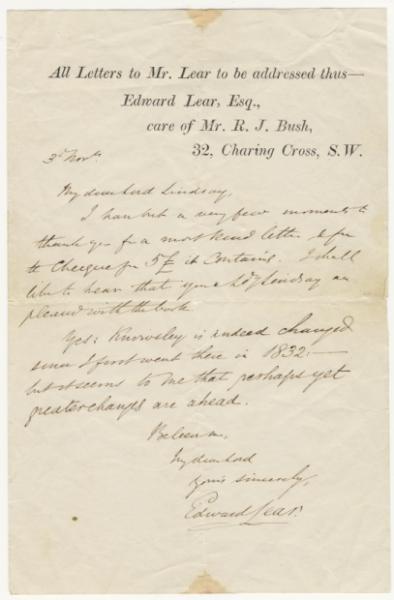
While working on this series Edward Lear probably asked for assistence from Sir Joseph Hooker, director of the Kew Botanic Gardens, see a letter to the scientist of 1878 published in part on the Kew website.




 A Blog of Bosh