Edward Lear, View of Bellagio, Lake Como, Lombardy, Italy.
Inscribed and dated ‘Lago di Como/ Bellaggio/ 26. May 1867. 6. 7. PM./ & 27th. May. 10/.11.30 AM./ (is not all the background too high & large?’ and further inscribed in Greek (lower left) and numbered ‘(169)’ (lower right) and further inscribed with colour notes throughout. Pencil, pen and brown ink and blue, yellow, brown and grey wash. 13 x 21 7/8 in. (33 x 55.6 cm.)
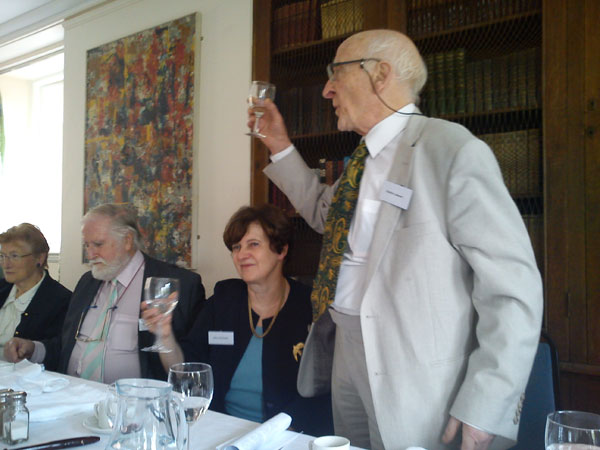
On 6 July 2016 a celebration took place at Somerville College Oxford to celebrate the Edward Lear archive of Vivien Noakes, which has generously been given to the College by Michael Noakes. The archive includes copies of some 2,000 letters written by Lear and over 30,000 documents. Its initial arrangement and description is the work of Charles Lewsen, here proposing a toast at the event. To his left in the picture is Alice Prochaska, Principal of Somerville, who described how the College is now cataloguing and digitising part of the archive for use by scholars. Michael Noakes, to her left, was present together with members of his family and those who had evidenced to the College the value of preserving and opening this archive to wider use.
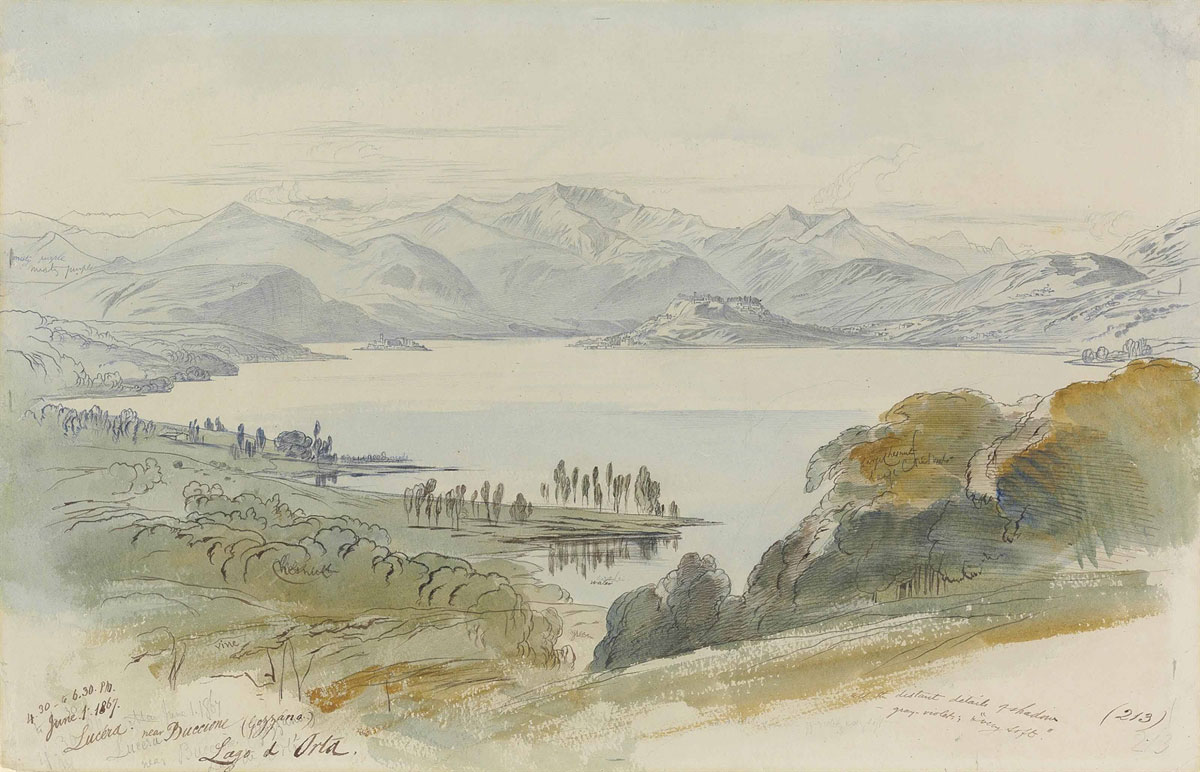
Edward Lear, View of Buccione, Lago d’Orta, Novara, Italy.
inscribed and dated ‘4.30 – to 6.30. PM./ June.1.1867./ Lucéra./ near Buccione (Gozzano.)/ Lago d’Orta’ and further indistinctly inscribed in pencil (lower left) and further inscribed with colour notes and numbered ‘(213)’ (lower right).
Pencil, pen and brown ink and watercolour. 14 x 21 ¾ in. (35.5 x 55.3 cm.)
Following his trip to Egypt in 1867, instead of continuing to Palestine, as he had originally planned, Lear travelled to the Italian Lakes, which he had previously visited in 1839 and again in 1844. The cool palette, with its soft blues and purples and yellows was perfectly suited to the subject matter and is in marked contrast to the bolder palette employed by the artist while in Egypt. Lear ended his tour of the Italian Lakes at Lago d’Orta. He stayed there for a few days before beginning his journey back to England.
Edward Lear, View of Florence from San Miniato, Italy.
Dated ‘June.12th.’ (lower left) and further inscribed with colour notes.
Pencil, pen and brown ink and watercolour. 13 5/8 x 21 ½ in. (34.6 x 54.6 cm.)
In 1861 Lear was asked to make a large oil painting of Florence from the gardens of Villa la Petraja for his friend and patron Lady Waldegrave. The painting was sold in these Rooms, 17 June 2014, lot 9.
Lear, keen for a diversion following the death of his eldest sister, Ann, who had been a substitute mother to him since childhood, welcomed the opportunity of travelling again. He arrived in Florence on 8 June and spent the rest of the month sketching the city and its surroundings. The present watercolour dated 12 June depicts a view over the city looking south west from the Piazza Michelangelo, looking towards the Ponte Vecchio, with the tower of the Palazzo Vecchio to the right hand side.
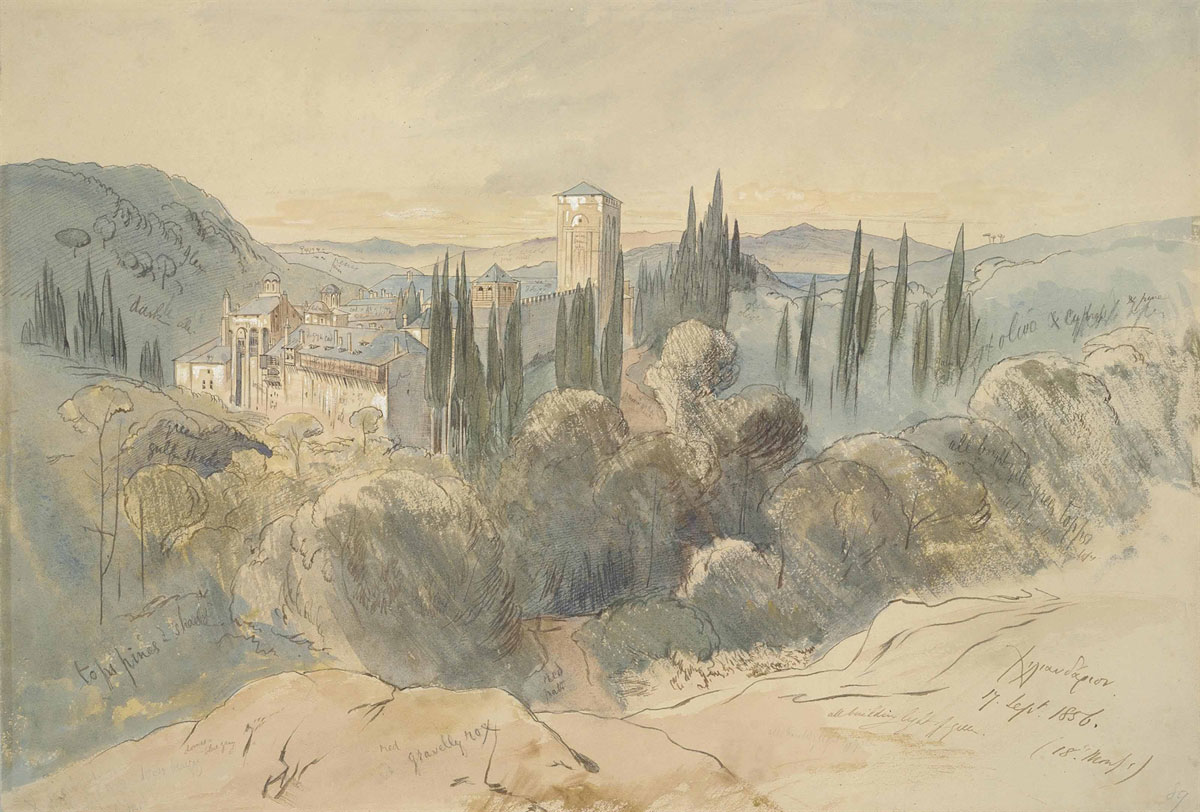
Edward Lear, The Monastery of Chilandari, Mount Athos, Greece.
Inscribed and dated ‘Chiliandarion / 17. Sept. 1856./ (18.”Monastery)’ (lower right) and further inscribed with colour notes and numbered ’84’ (lower right).
Pencil, pen and brown ink and watercolour heightened with white. 14 3/8 x 21 in. (36.5 x 53.3 cm.)
Chilandari stands on the North-East side of Mount Athos and was founded in the 12th Century by Stefan Memanja, Prince of Serbia and his son Rastko. It played a key role in the Greek struggle for Independence and during the two World Wars and is ranked 4th in the hierarchy of the monasteries on Mount Athos.
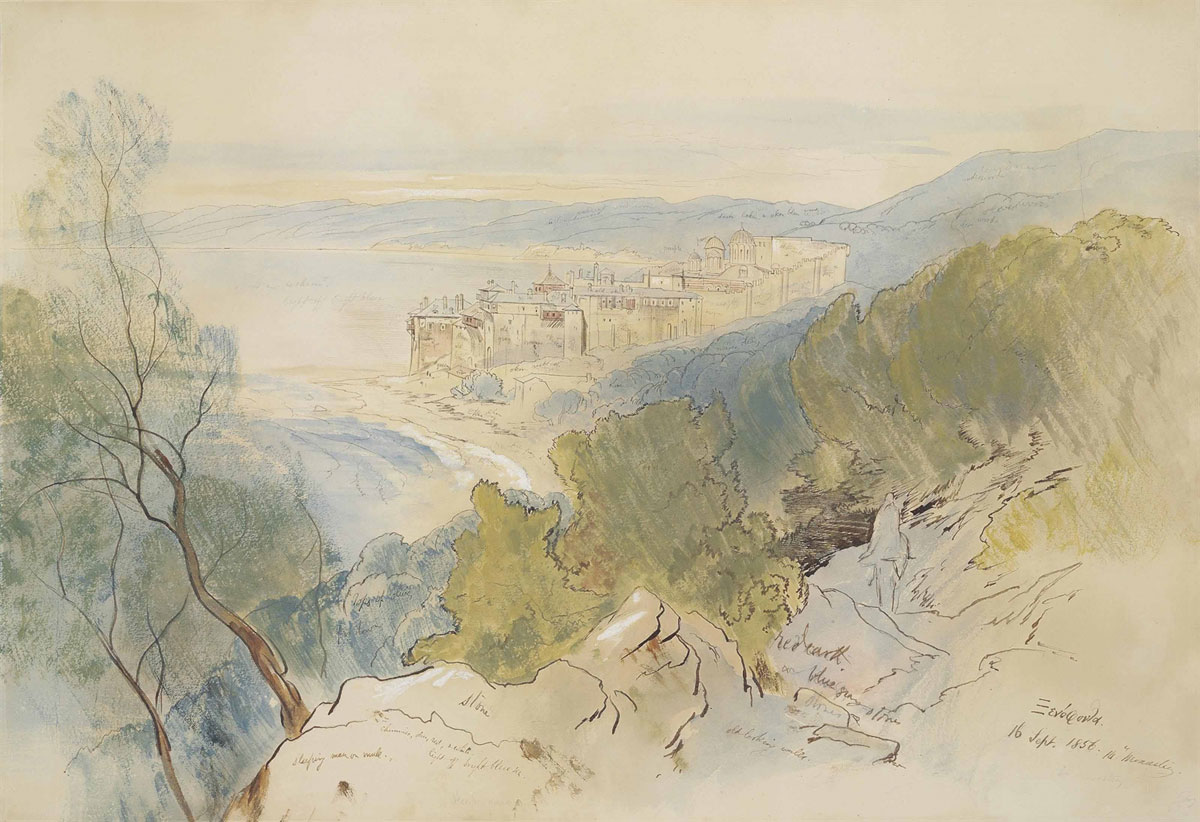
Edward Lear, The Monastery of Xenophontos, Mount Athos, Greece.
Inscribed ‘Xenophonta’ (in Greek) and inscribed and dated ’16 Sept. 1856. 14.’ ‘Monastery.’ (lower right), further inscribed with colour notes and numbered ’83’ (lower right).
Pencil, pen and brown ink and watercolour, heightened with touches of white. 14 ½ x 21 in. (36.8 x 53.3 cm.)
During Lear’s long tour of Mount Athos in September 1856 he travelled throughout the peninsular and succeeded in visiting all twenty principal monasteries and many of their dependencies. He produced a series of fifty drawings of the monasteries and landscapes, of which the present drawing and lot 116 are part. He apparently intended to publish a volume of his tour of Mount Athos but this was never fulfilled, although he did adapt several of his drawings for his series of illustrations to Tennyson’s poems.
That he did not pursue this project may have been in part due to his ambivalent feelings about the monastic life on Mount Athos, which he expressed in a letter to Chichester Fortescue, ‘However wondrous and picturesque the exterior & interior of the monasteries, & however abundantly & exquisitely glorious & stupendous the scenery of the mountain, I would not go again to Ayios Oros for any money, so gloomy, so shockingly unnatural, so lying, so unatonably odious seems to me the atmosphere of such monkery’ (Lady Strachey (ed.), Letters of Edward Lear, London, 1907, p. 41). Yet despite his feelings about monastic life and the isolation of the inhabitants of the ‘Holy Mountain’, Lear was received warmly wherever he went and found the landscape and buildings beautiful.
The monastery of Xenophontos was founded in the 10th or 11th Centuries and lies on the Western shore of the region. It is ranked 16th in the hierarchy of the monasteries on Mount Athos.
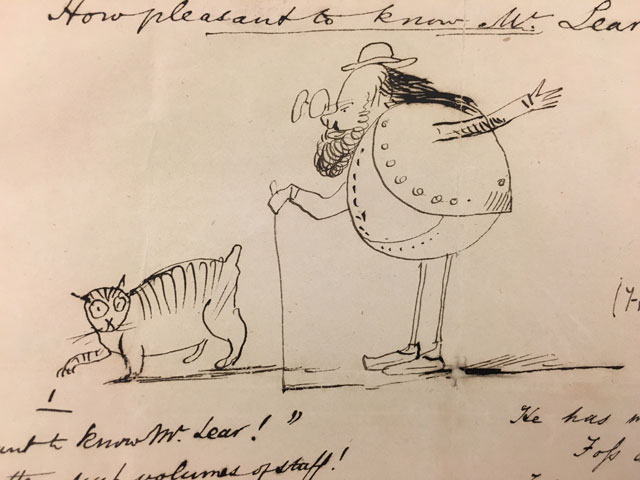
In a recent post celebrating Edward Lear’s 204th brithday on the Untold Lives blog at the British Library Alexandra Ault, Curator of Manuscripts and Archives 1601-1850, posts a nice self-caricature of Lear and his cat Foss from a letter to William Bevan, the British vice-consul in Sanremo, sending the text of “How Pleasant to Know Mr Lear” — Bevan’s eldest daughter had helped with the composition of the poem — and stating:
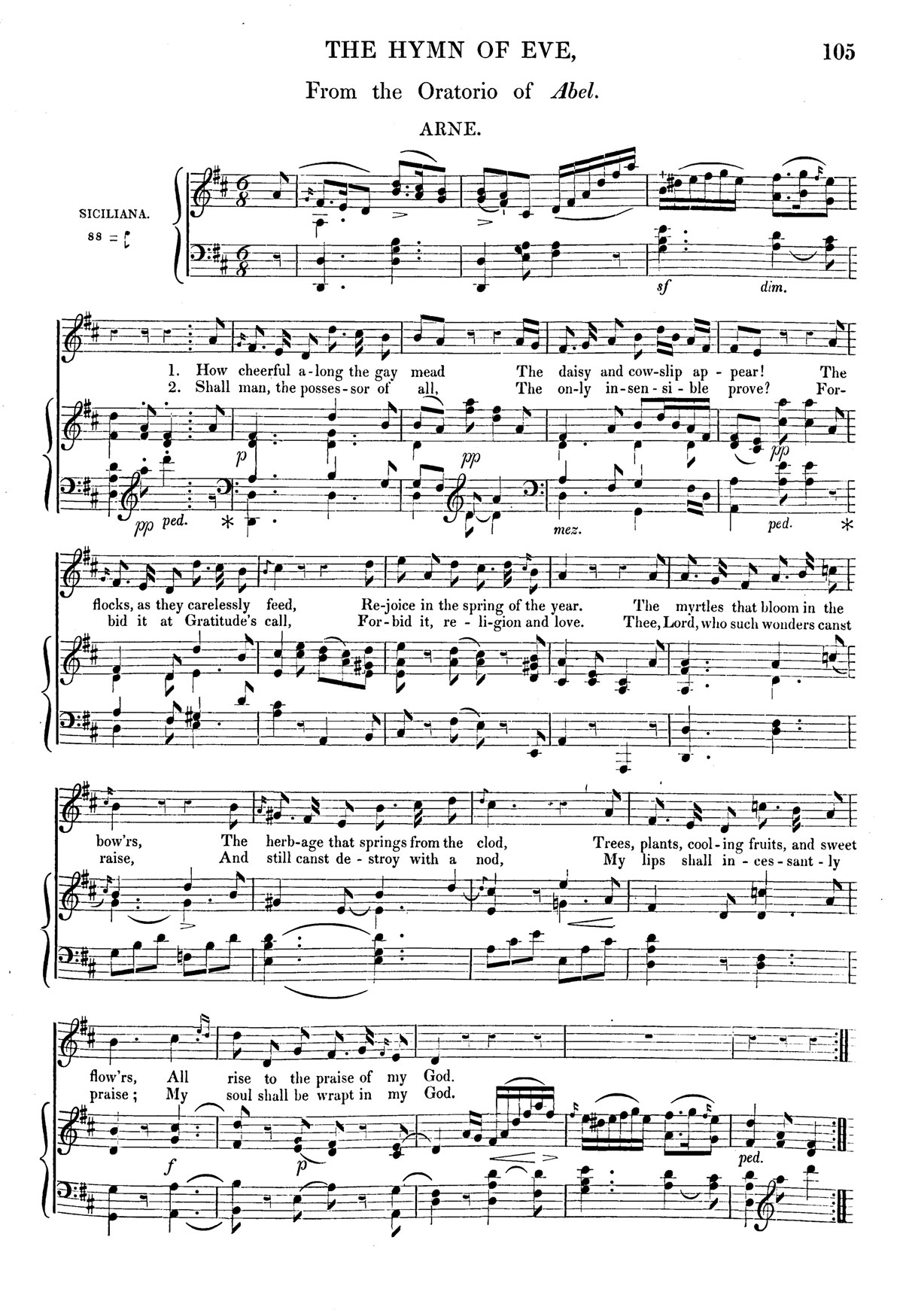
I disclose you a Pome, which you may or may Knott send to the Lady who says “How pleasant to know Mr Lear,” It may be sung to the air “how cheerful along the Gay Mead”.
At Hymnary.org is the text for “How Cheerful along the Gay Mead,” no. XIX in A Collection of Psalms and Hymns for Publick Worship (1789), with a couple of scores. Under the title of “Hymn of Eve,” it is the only surving music from Thomas Arne‘s oratorio Abel, first performed in Dublin in 1744 and in London in 1855:
It has always irked Paul that posterity regards him as the tuneful, cosy, safe side of the Lennon–McCartney partnership and John as the rebel, experimenter and iconoclast. The casting had been decided in Liverpool, then Hamburg, where he’d always hung back, feeling himself a provincial outsider, while John hung out with the arty in-crowd. After the migration south John had had his usual shaggy head start, cast as the ‘intelligent’, ‘clever’ or ‘deep’ Beatle, as opposed to the merely ‘cute’ one.
In 1964, he’d become the first pop musician to publish a book and the only one ever to have it launched at a Foyle’s bookshop literary lunch attended by the cream of the capital’s intelligentsia. John Lennon in His Own Write was a collection of his cartoons and nonsense writings, with a deferential foreword by Paul, recollecting their first meeting at Woolton church fête (and characterising himself that day–unbelievably to millions of young women around the world–as ‘a fat schoolboy’). The book was a massive bestseller and a critical triumph, its author hailed as a joint reincarnation of Edward Lear and James Joyce.
But by the mid-Sixties, the elastic-sided boot was firmly on the other foot. As Swinging London approached its zenith, McCartney was at the epicentre of its cultural avant-garde while Lennon rarely emerged from suburban Surrey. ‘John was basically a lazy bastard,’ their former assistant Tony Bramwell remembers. ‘He was quite happy to stay down in Weybridge, doing fuck-all.’
[1994:]
From there, she [Heather] joined Paul in Los Angeles where he was to record a new album with the producer David Kahne. The title, Driving Rain, seemed an odd choice as its theme was how Heather had rescued him from tempests of grief; the tracks included ‘Back in the Sunshine Again’ (‘You gave me the strength to get out of bed’), ‘Riding into Jaipur’ (‘Riding with my baby/ Oh, what a delight’) and ‘Heather’, identifying the two of them with Edward Lear’s ‘Owl and the Pussycat’ (‘I will dance to a runcible tune with the queen of my heart’).
Philip Norman, Paul McCartney: The Life. New York: Little, Brown, 2016.
Here are the song lyrics:
“Heather”
I’m gonna fly to the moon
Check in outta space
Find me a suitable plot
Build myself a place
There I will stay
For a year and a day
Until the cares of my life blow away
And I will dance to a runcible tune
With the queen of my heart
This is clearly a different song from the 1968 one of the same title, see here, and listen to the older one:


 A Blog of Bosh