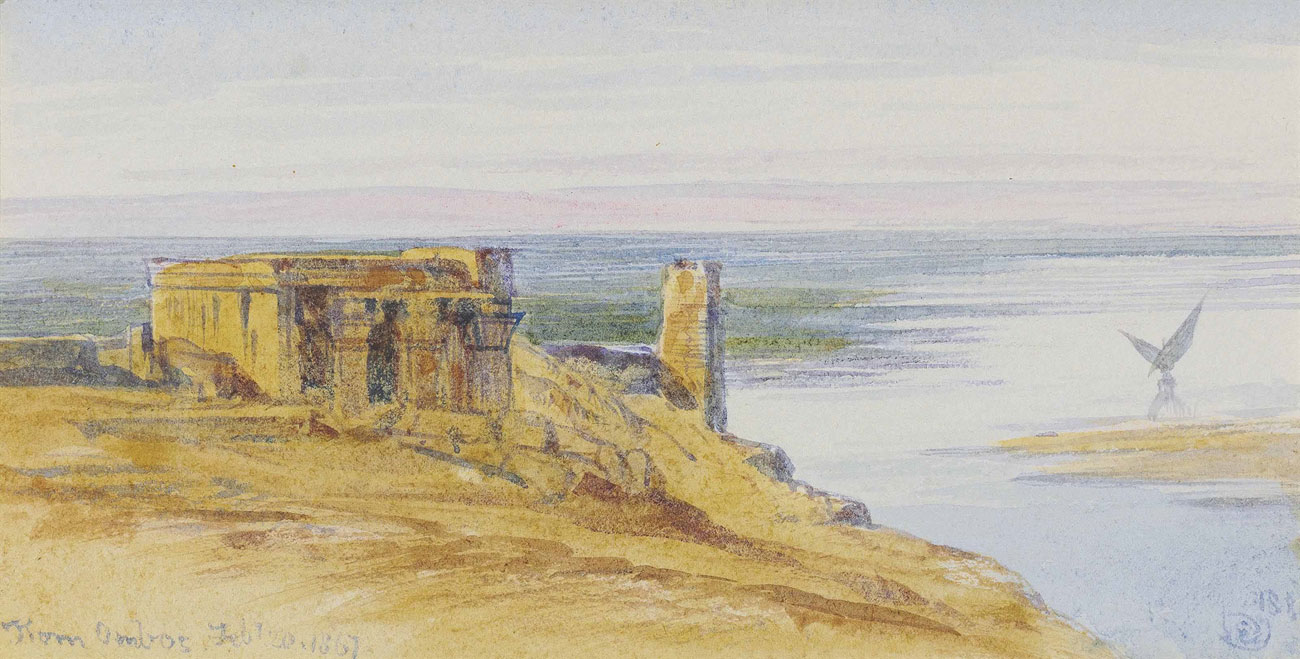
Edward Lear, Kom Ombo (1884)

el_kom-ombo-s

Edward Lear, Kom Ombo, Egypt.
Signed with monogram and dated ‘188[4]’ (lower right) and inscribed and dated ‘Kom Ombos. Feby 20. 1867′ (lower right) and further inscribed ’43. Kom Ombos.’ (verso). Pencil and watercolour. 3 7/8 x 7 ¼ in. (9.8 x 18.4 cm.)

Kom Ombo stands between Aswan and Edfu, about 48 km north of the Aswan. It stood on an important ancient crossroads between the caravan route from Nubia and the trails from the gold mines in the eastern desert areas. The temple complex was constructed during the Graeco-Roman period in the 2nd Century BC and the main buildings stand on a sandy hill overlooking the surrounding countryside and the Nile which runs between steep, narrow banks of sandstone.

Christie’s.

Posted in Edward Lear | Tagged , , , , | Leave a comment

Edward Lear, View from Dabod (1880)

el_dabod-s

Edward Lear, View from Dabod, looking south, Egypt.
Signed with monogram and dated ‘1880’ (lower right); and inscribed and dated ‘from/ Dabod 17 Feby. 1867’ (lower left), and further inscribed and numbered ‘,35. From Dabòd, looking South.’ (verso). Pencil and watercolour. 3 7/8 x 7 ¼ in. (9.8 x 18.4 cm.)

The Temple of Dabod, begun in the early 2nd Century BC, was originally located about 10 km south of Aswan on the western bank of the Nile. During the building of the Aswan High Dam circa 1960, the temple was dismantled and subsequently given to Spain, in gratitude for their assistance in saving Abu Simbel. It was subsequently erected in the Parque del Oeste, Madrid.

Christie’s.

Posted in Edward Lear | Tagged , , , , | Leave a comment

Edward Lear, A Felucca on the Nile (1884)

el_felucca-s

Edward Lear, A felucca on the Nile, Abu Simbel in the distance, Egypt.
Signed with monogram and dated ‘1884’ (lower right) and inscribed and dated ‘Ipsam [?] Feby 9 1867’ (lower left). Watercolour heightened with white. 3 ¾ x 7 ¼ in. (9.5 x 18.4 cm.)

In this distant view of Abu Simbel Lear concentrated on the way the sculptures relate to their landscape and the overall topography of the area. Indeed in his diary entry for 9 February Lear wrote ‘on deck till 1.30. Last memorials of Abou Simbl [sic] -(the position of which I certainly never saw given in any drawing – tho of near views many)’. There is an on-the-spot sketch of the same subject, from almost the same viewpoint, but without the felucca, in the Yale Center for British Art, New Haven.

This watercolour is of particular interest given that between 1964 and 1968 the entire temple complex was dismantled brick by brick and reassembled on the top of the cliffs, in order to save it from being destroyed by the Aswan High Dam.

Christie’s.

Posted in Edward Lear | Tagged , , , , | Leave a comment

Edward Lear, View of Villefranche

el_villefranche-s

Edward Lear, View of Villefranche, Côte d’Azure, France.
Signed with monogram (lower right). Pencil and watercolour heightened with bodycolour and with gum arabic. 4 5/8 x 7 ¼ in. (11.7 x 18.4 cm.)

Lear spent the winter of 1864-5 in the South of France. He took lodgings in Nice and then travelled along the coast as far as Italy before returning to Nice on New Year’s Eve. The months he spent in the South of France were enormously productive and he executed numerous sketches as well as a number of highly finished watercolours, such as the present work.

Christie’s.

Posted in Edward Lear | Tagged , , , , | Leave a comment

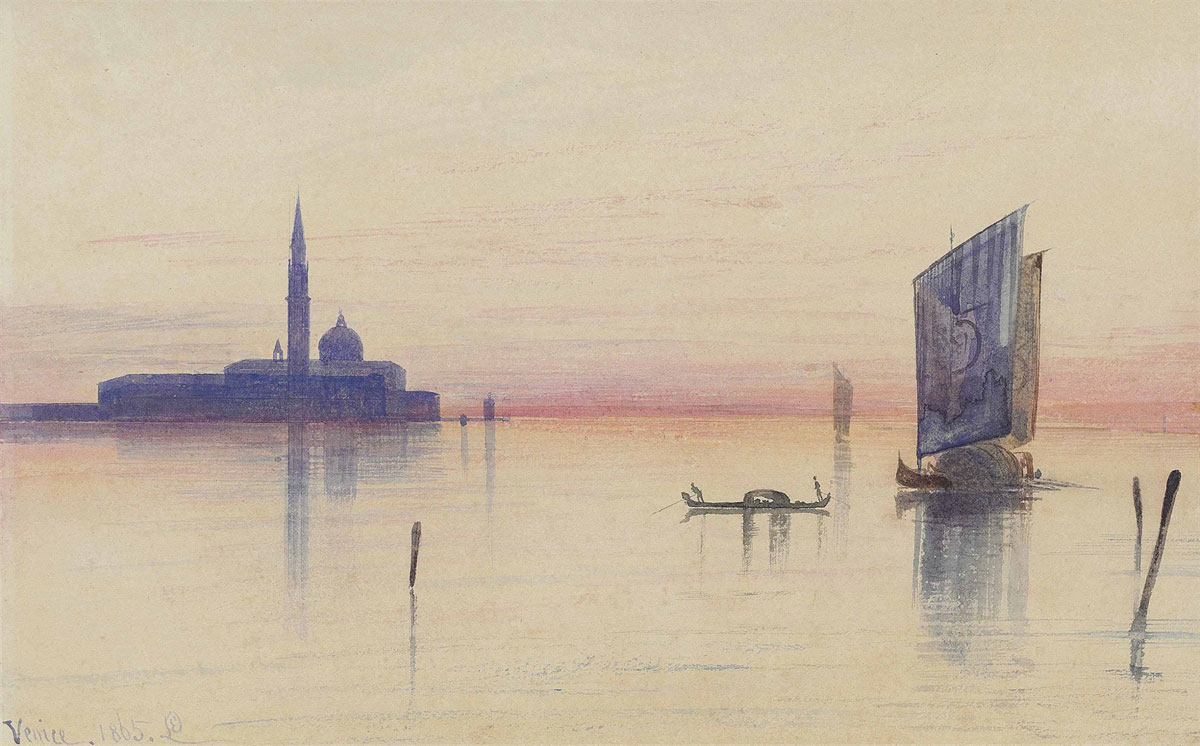
Edward Lear, San Giorgio Maggiore (1865)

el_lagoon-s

Edward Lear, On the lagoon, looking over to San Giorgio Maggiore, Venice, Italy.
Signed with monogram, inscribed and dated ‘Venice. 1865. EL’ (lower left). Pencil and watercolour. 6 ½ x 10 ¼ in. (16.5 x 26 cm.)

Lear arrived in Venice in the autumn of 1865 after an unsuccessful year in Nice. He took gondolas out into the canals and lagoon in order to capture the interplay of water and architecture unique to Venice. Whilst there he made much of his work in flowing washes of watercolour, such as in the present drawing, capturing the ever-changing light of the city which had so fascinated earlier artists such as J.M.W. Turner and James Abbott McNeill Whistler.

Christie’s.

Posted in Edward Lear | Tagged , , , , | Leave a comment

Edward Lear, View of Bellagio (1867)

el_bellagio-s

Edward Lear, View of Bellagio, Lake Como, Lombardy, Italy.
Inscribed and dated ‘Lago di Como/ Bellaggio/ 26. May 1867. 6. 7. PM./ & 27th. May. 10/.11.30 AM./ (is not all the background too high & large?’ and further inscribed in Greek (lower left) and numbered ‘(169)’ (lower right) and further inscribed with colour notes throughout. Pencil, pen and brown ink and blue, yellow, brown and grey wash. 13 x 21 7/8 in. (33 x 55.6 cm.)

Christie’s.

Posted in Edward Lear | Tagged , , , , | Leave a comment

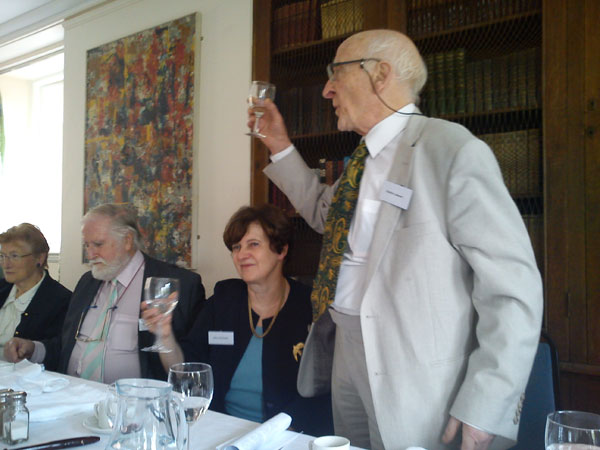
Vivien Noakes’s Edward Lear Archive at Somerville College

Stephen Duckworth reports:

somerville

On 6 July 2016 a celebration took place at Somerville College Oxford to celebrate the Edward Lear archive of Vivien Noakes, which has generously been given to the College by Michael Noakes.   The archive includes copies of some 2,000 letters written by Lear and over 30,000 documents.   Its initial arrangement and description is the work of Charles Lewsen, here proposing a toast at the event.   To his left in the picture is Alice Prochaska, Principal of Somerville, who described how the College is now cataloguing and digitising part of the archive for use by scholars.  Michael Noakes, to her left, was present together with members of his family and those who had evidenced to the College the value of preserving and opening this archive to wider use.

Posted in Edward Lear | Tagged , , , | Leave a comment

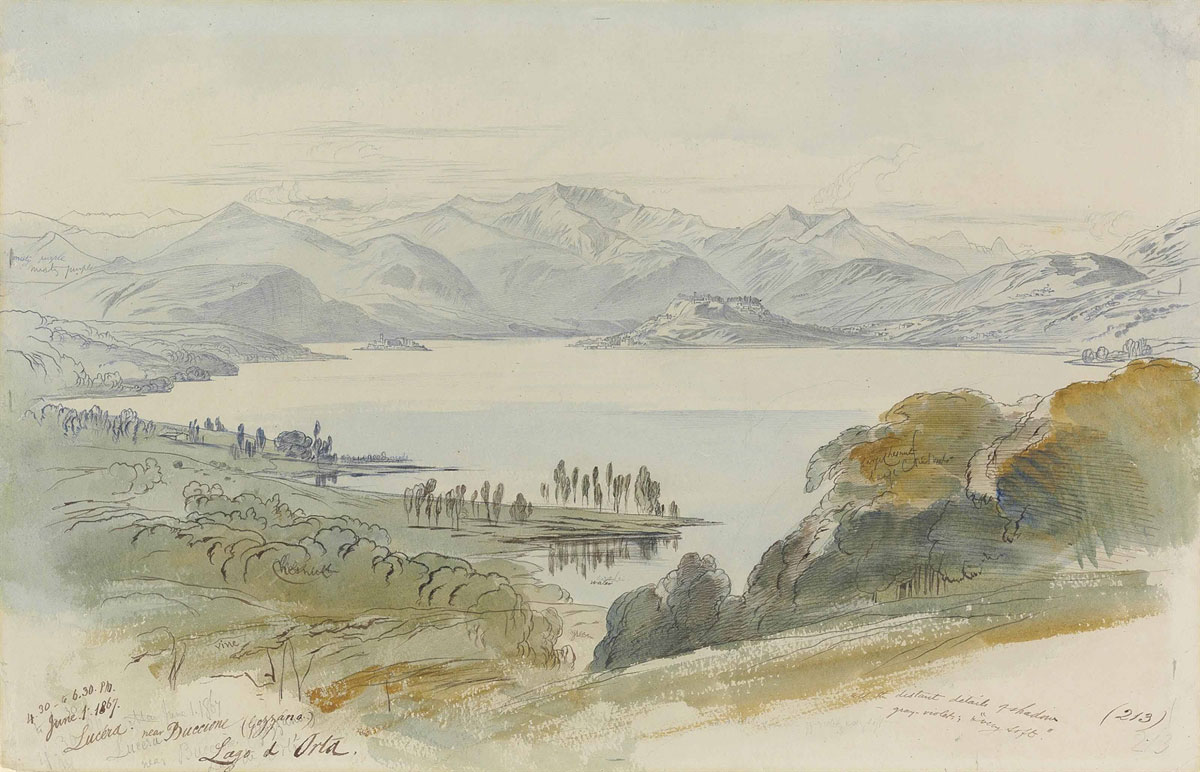
Edward Lear, View of Buccione (1867)

el_buccione-s

Edward Lear, View of Buccione, Lago d’Orta, Novara, Italy.
inscribed and dated ‘4.30 – to 6.30. PM./ June.1.1867./ Lucéra./ near Buccione (Gozzano.)/ Lago d’Orta’ and further indistinctly inscribed in pencil (lower left) and further inscribed with colour notes and numbered ‘(213)’ (lower right).
Pencil, pen and brown ink and watercolour. 14 x 21 ¾ in. (35.5 x 55.3 cm.)

Following his trip to Egypt in 1867, instead of continuing to Palestine, as he had originally planned, Lear travelled to the Italian Lakes, which he had previously visited in 1839 and again in 1844. The cool palette, with its soft blues and purples and yellows was perfectly suited to the subject matter and is in marked contrast to the bolder palette employed by the artist while in Egypt. Lear ended his tour of the Italian Lakes at Lago d’Orta. He stayed there for a few days before beginning his journey back to England.

Christie’s.

Posted in Edward Lear | Tagged , , , , | Leave a comment

Edward Lear, View of Florence fron San Miniato

el_florence-s

Edward Lear, View of Florence from San Miniato, Italy.
Dated ‘June.12th.’ (lower left) and further inscribed with colour notes.
Pencil, pen and brown ink and watercolour. 13 5/8 x 21 ½ in. (34.6 x 54.6 cm.)

In 1861 Lear was asked to make a large oil painting of Florence from the gardens of Villa la Petraja for his friend and patron Lady Waldegrave. The painting was sold in these Rooms, 17 June 2014, lot 9.

Lear, keen for a diversion following the death of his eldest sister, Ann, who had been a substitute mother to him since childhood, welcomed the opportunity of travelling again. He arrived in Florence on 8 June and spent the rest of the month sketching the city and its surroundings. The present watercolour dated 12 June depicts a view over the city looking south west from the Piazza Michelangelo, looking towards the Ponte Vecchio, with the tower of the Palazzo Vecchio to the right hand side.

Christie’s.

Posted in Edward Lear | Tagged , , , , | Leave a comment

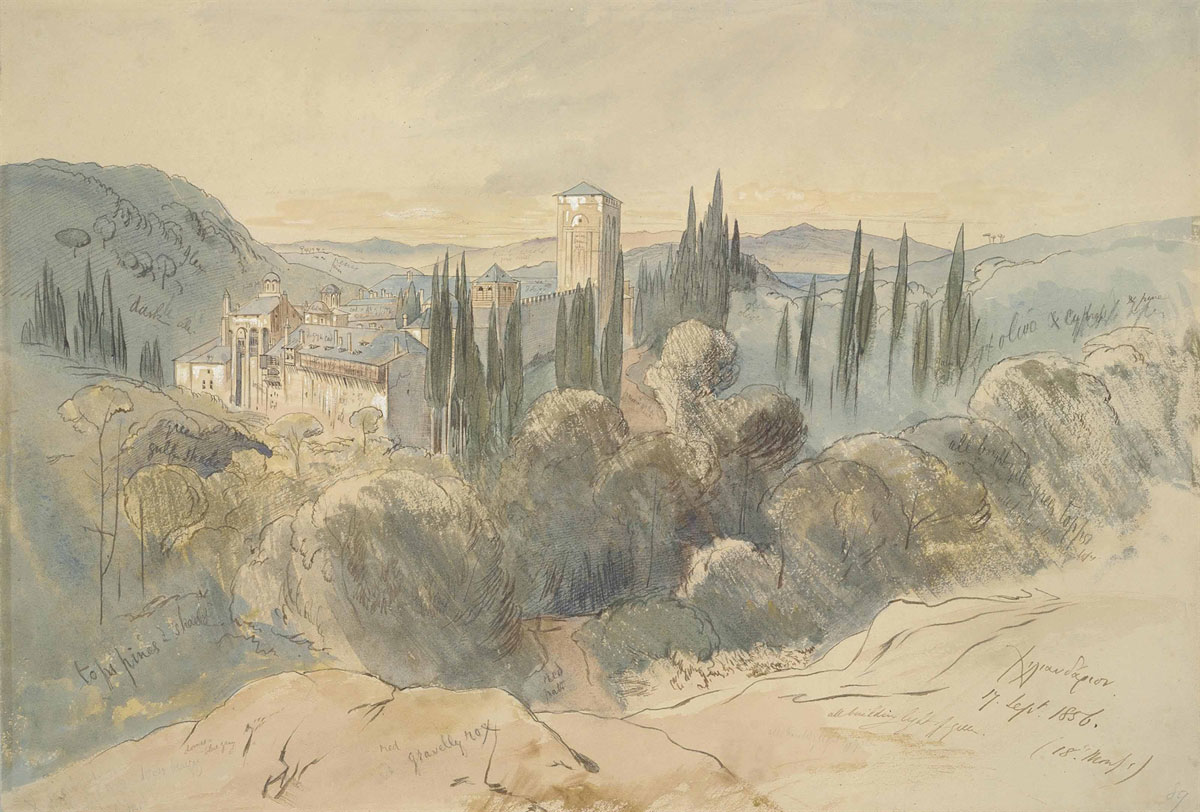
Edward Lear, The Monastery of Chilandari (1856)

el_chilandari-s

Edward Lear, The Monastery of Chilandari, Mount Athos, Greece.
Inscribed and dated ‘Chiliandarion / 17. Sept. 1856./ (18.”Monastery)’ (lower right) and further inscribed with colour notes and numbered ’84’ (lower right).
Pencil, pen and brown ink and watercolour heightened with white. 14 3/8 x 21 in. (36.5 x 53.3 cm.)

Chilandari stands on the North-East side of Mount Athos and was founded in the 12th Century by Stefan Memanja, Prince of Serbia and his son Rastko. It played a key role in the Greek struggle for Independence and during the two World Wars and is ranked 4th in the hierarchy of the monasteries on Mount Athos.

Christie’s.

Posted in Edward Lear | Tagged , , , , | Leave a comment