More to Read (in a few days)

This Book, Marie Duval, edited by Simon Grennan, Roger Sabin and Julian Waite, has been available for some time: it has been a bit of a disappointment as the critical apparatus is almost non-existent. However, this is the only way to get some of Duval’s material in print. Much more is available online t the Marie Duval Archive. I discussed Marie Duval, whom I consider strongly influenced by Edward Lear’s nonsense, and her book A Choice Collection of Queens and Kings, and Other Things here.

James Williams’s long-awaited book on Edward Lear will be published at the end of the month, but on the publisher’s website you can find a lot of information, including an intriguing table of content.

They also tell me that the catalogue on Edward Lear in Amalfi has been printed and will be available soon (I haven’t seen a paper copy yet!). Tonight at 21:00 CET, RTC QuartaRete, a local channel will broadcast a long interview with Federico Guida discussing the book (in Italian of course). The program will be broadcast also on Wednesday 19 at 14:25, Thursday 20 at 23:25, Saturday 22 at 17:25 and Sunday 23 at 18:00.

Posted in Comics, Edward Lear | Leave a comment

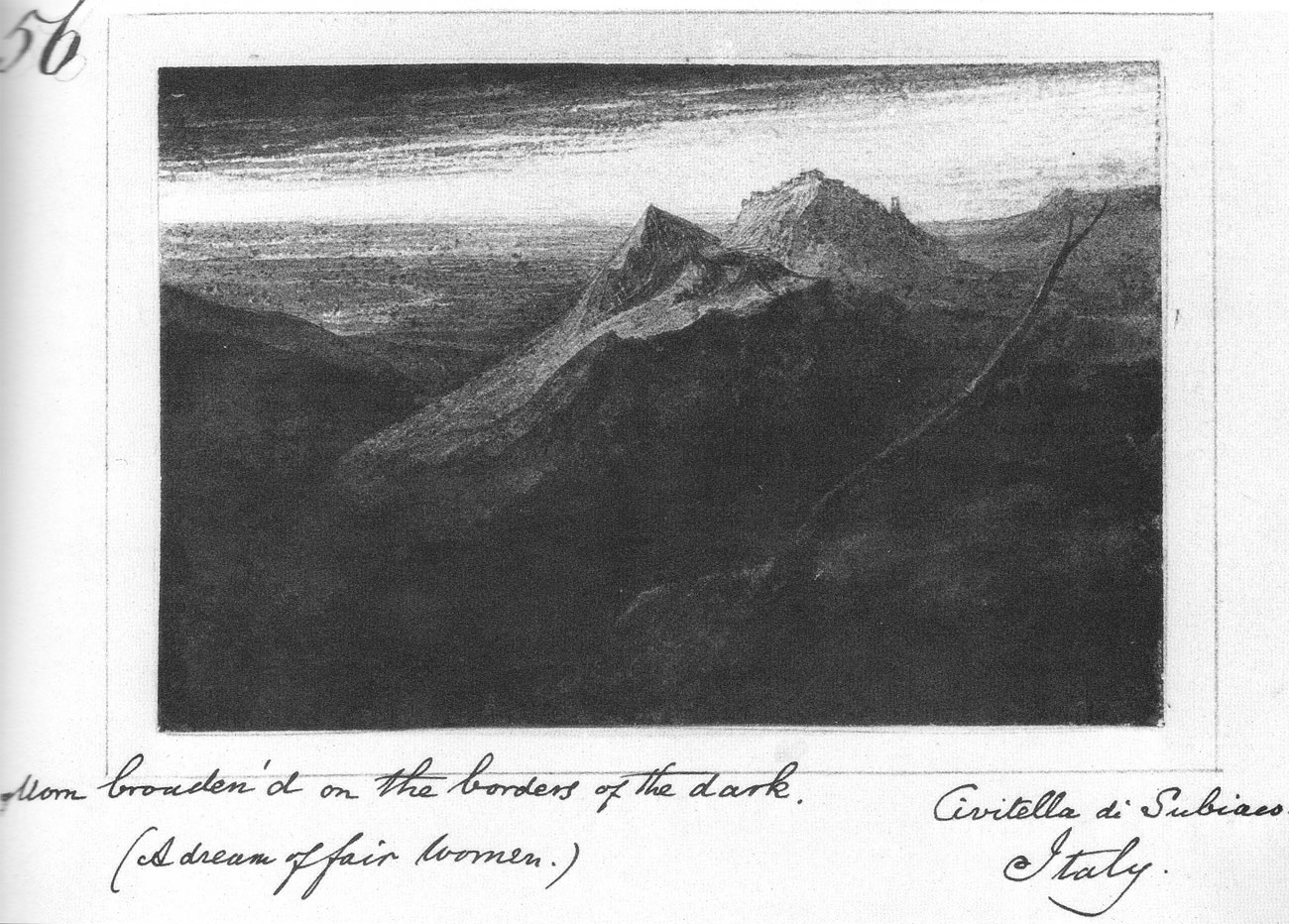
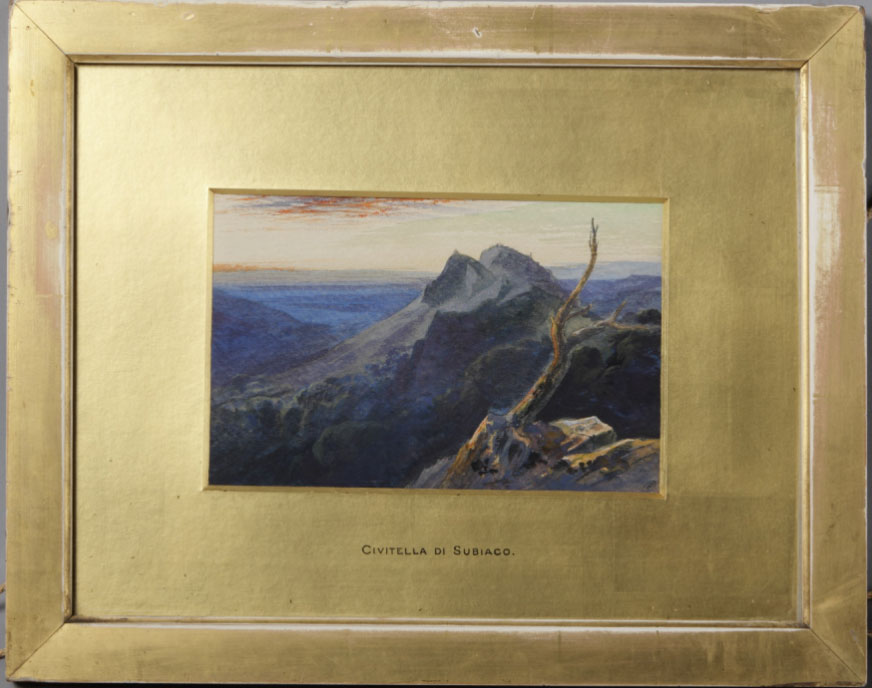
Edward Lear, Civitella di Subiaco

Another picture from Edward Lear’s projected set of Tennyson illustrations which was also realized as a watercolour:

“Morn broaden’d on the borders of the dark,” from Tennyson’s A Dream of Fair Women (from Ruth Pitman’s Edwawrd lear’s Tennyson, p. 101). A colour version is now at Gumby Hall, Lincolnshire:

Posted in Edward Lear | Tagged , , , , , | Leave a comment

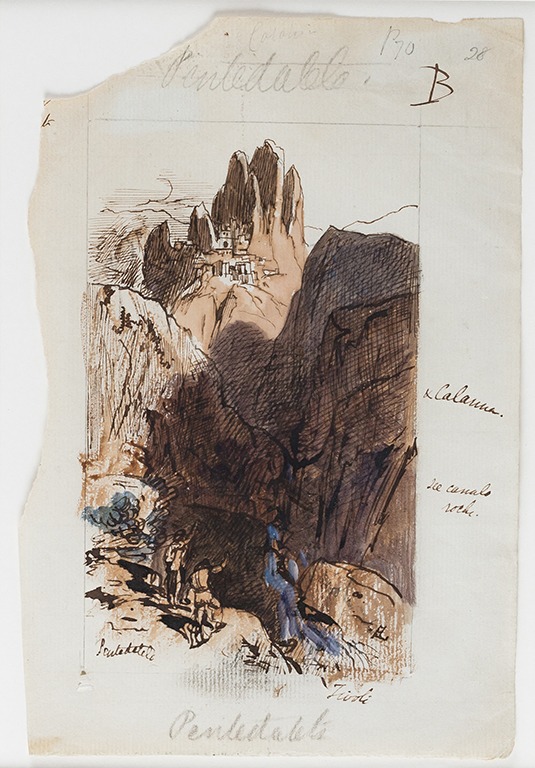
Edward Lear, Pentedatelo

LEAR Edward,‘Pentedatelo’ (sic. Pentedattilo), Calabria.
Ink and watercolour. Signed and inscribed.

Lear’s Diary (30th July 1847) ‘ … the wild crags of Pentedatelo particularly arrested our attention…’

A sketch for the ill.opp.p.190, ‘Pentedatilo’, ‘Journals of a landscape painter in Southern Calabria’, publ. 1852. 8.25×5.5 inches the paper irregular. 6×3.25 inches the image. 16.5×13.5 inches.

Abbot and Holder.

Lear used a different picture of Pentedattilo, in which the “five fingers” are seen from afar, as an image for Tennyson’s The Palace of Art:

We know that he also produced an oil version of this and presented it to Hallam Tennyson and his wife, froma letter of 24 February 1886:

You (& Audrey) are to have the large picture of Pentedatelo or ‘someone pacing there alone’ — wh. indeed was a matter settled long ago — but my omcreasing ill health broke off an arrangement wh. was then being carried out, i.e. — of the picture being presented to you by 30 individual parties.
This I knocked up, & you must now kindly accept the picture as a sort of pro=legacy, & I hope you can place it well.
(Selected Letters, ed. Vivien Noakes, p. 277.)

According to Jasmine Jagger, the picture was received by Hallam and Audrey Tennyson on 11 March 1886 — this is the date used by Hallam when he writes to Lear:

We have just opened the picture case – and both my Father and myself exclaimed “How magnificent!” It is an extraordinarily fine realisation of the stanza. … We shall put Pentedaleto at Aldworth – and I shall always count it as one of my most precious possessions.

We learn from Ruth Pitman (Edward Lear’s Tennyson, p. 29) that “one version — with a ‘red man’ — of ‘someone pacing there alone’ ended up, after Lear’s death, in Tennyson’s last home at Aldworth.”

Jasmine is trying to trace that colour version, does anyone know where it is?

I posted colour image very like the one above last June, but it is missing the ‘someone pacing there alone.’

The watercolour is now with Karen Taylor.

Posted in Edward Lear | Tagged , , , , , , | 3 Comments

Repeated Nonsense: A Learesque Manuscript

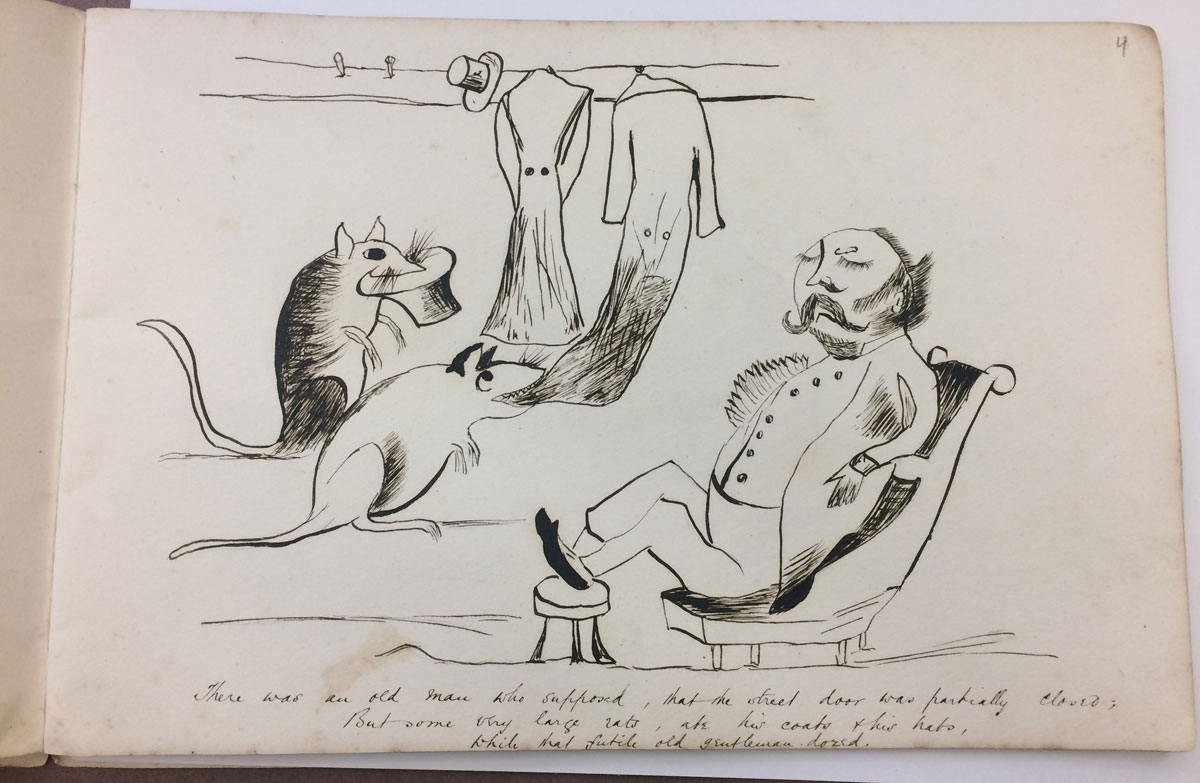
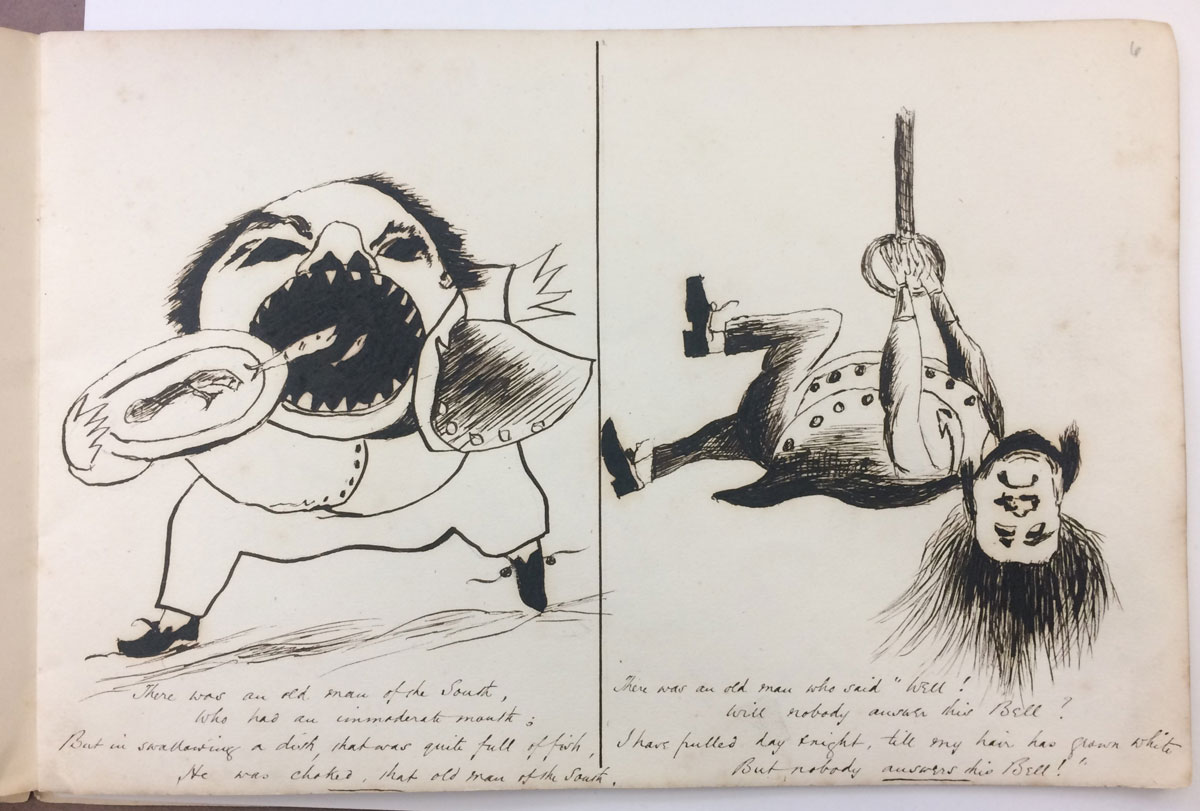
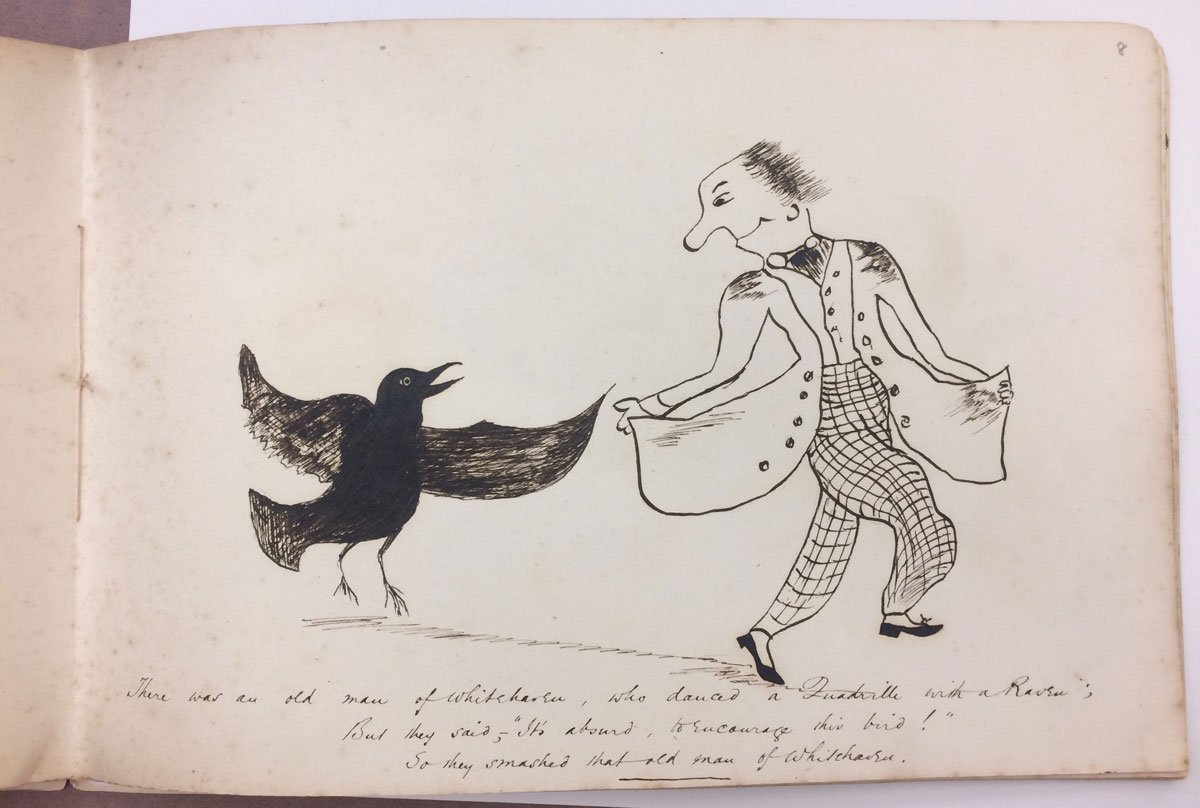
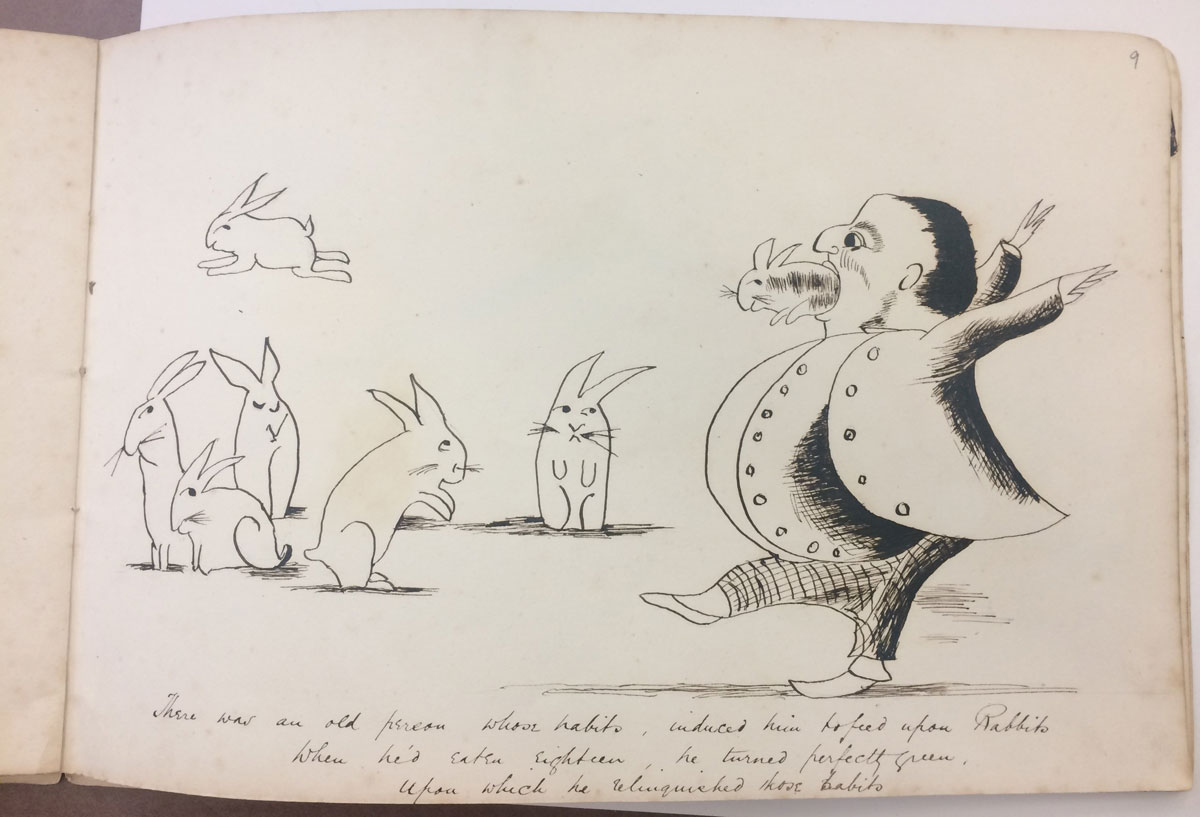
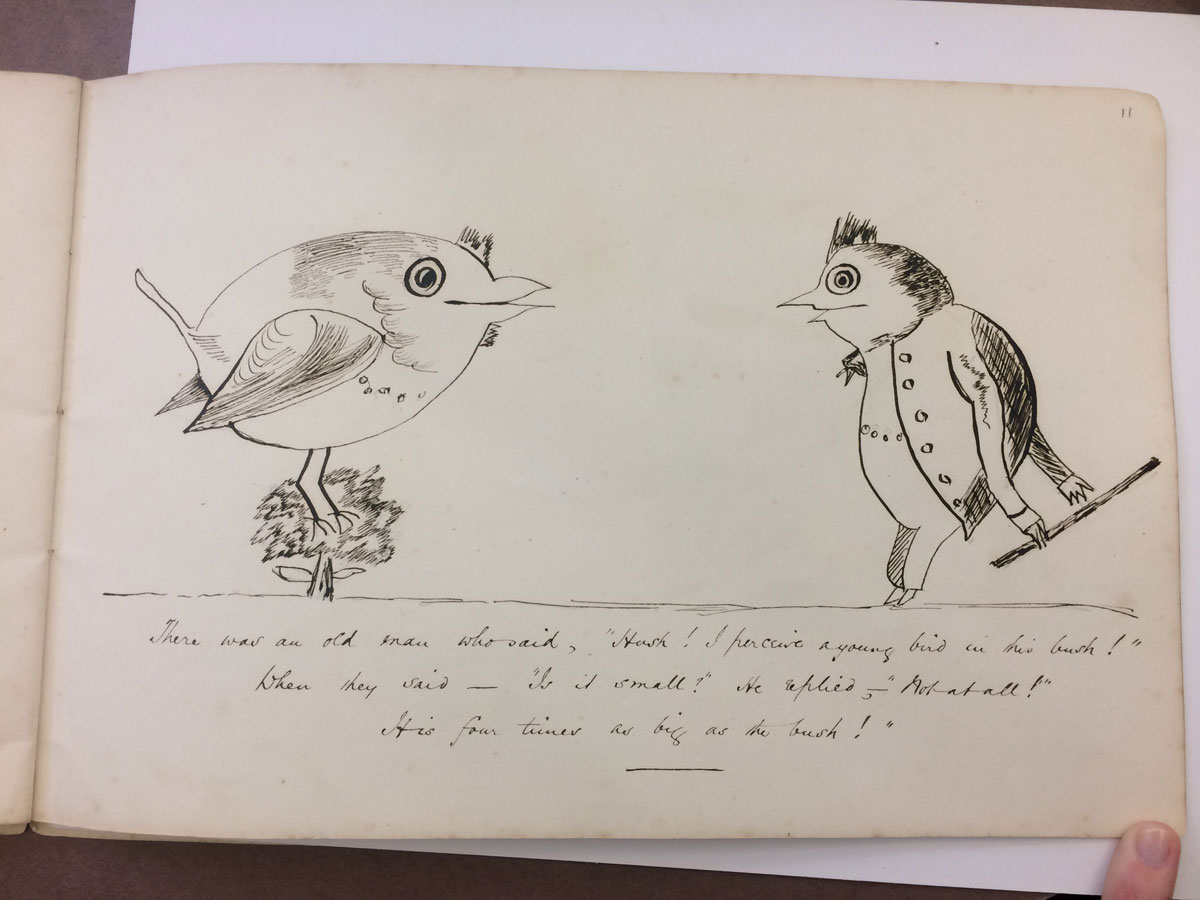
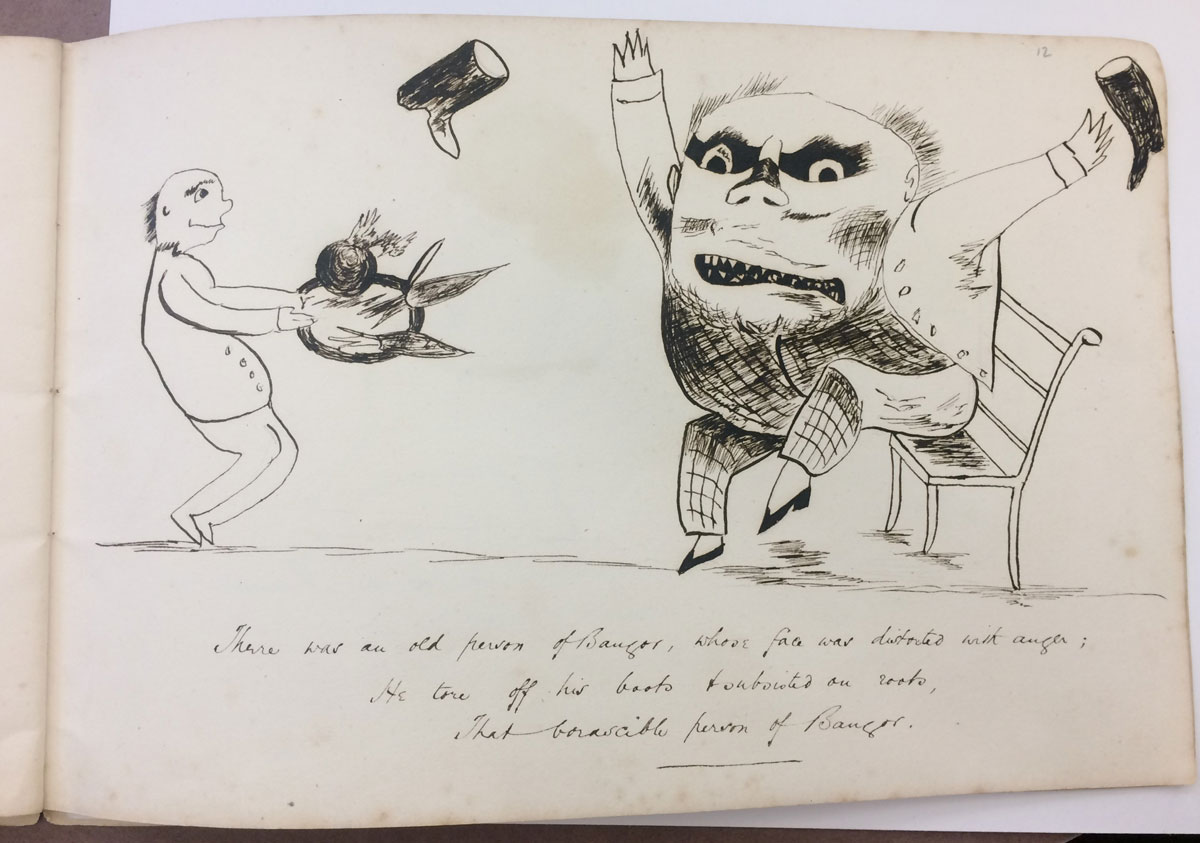
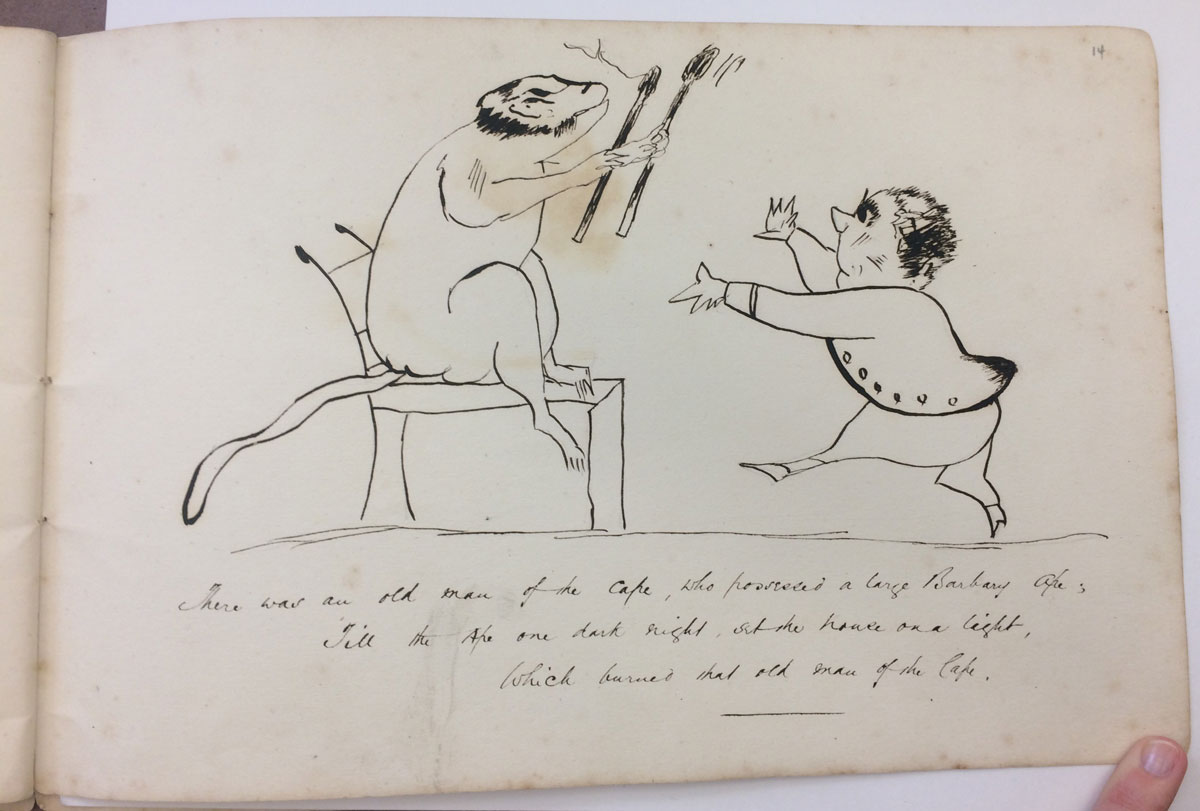
Ekaterina Shatalova (see here) sends the description of a manuscript copying several of Edward Lear’s limericks together with pictures; here they are:

A rather delightful album of 15 original ink drawings repeating some of Lear’s limericks from Book of Nonsense. Late 19th century. Oblong 8vo, plain stiff paper wrappers; varying wear, drawings on rectos only, some ink bleeding to versos of leaves. The artist has copied Lear’s drawings to the best of his or her rude ability, copying the verses out faithfully by hand with the occasional omission of some punctuation marks. The compiler shared the limericist’s appreciation for old men, and includes here specimens from Bangor, the Cape, Coblenz, Jamaica, Kilkenny, Philae, Whitehaven, and the South, as well as men characterized by bovinophobia, hirsute aviaries, patient bell ringing, ornithological observation, erroneous supposition, and leporine diets. The one member of the fair sex included here, possessed of eyes of unique colour and size, testifies to the transgressive power of the female gaze in the Victorian age.

The seller’s advertisement of the album was accompanied by a lovely limerick:

An anonymous lover of Lear
Found the piece of nonsense too dear
So he made his own book
By aping the look
And the verse of that man without peer.

The whole list of the selected limericks:

There was an Old Man with a beard

There was a Young Lady whose eyes

There was an Old Man of Kilkenny

There was an Old Man who supposed

There was an Old Person of Philae

There was an Old Man of the South
There was an Old Man who said, “Well!”

There was an Old Man who said, “How”

There was an Old Man of Whitehaven

There was an Old Person whose habits

There was an Old Man of Coblenz

There was an Old Man who said, “Hush!”

There was an Old Person of Bangor

There was an Old Man of Jamaica

There was an Old Man of the Cape

See also.

Posted in Edward Lear | Tagged , , , | Leave a comment

More Summer Readings

Lecercle, Jean-Jacques. “Le nonsense entre image et texte.” Image [&] Narrative 19.2 (2018): 51-60. [Largely devoted to Edward Lear’s limericks.]

Lecercle, Jean-Jacques. “Bêtise du limerick.” Humoresques 42 (2015-2017): 63-74. [Humoresques. This is mentioned in the article above, I haven’t seen it: if you get a copy I’d like to see it.]

Ekaterina Shatalova won the 2017-2018 Colin Franklin Prize for book collecting, and chose as part of her prize a manuscript album consisting of 15 ink drawings repeating Lear’s Book of Nonsense; her essay: One Very Nonsensical Collection.

Anderson, Emily. “‘There was a young girl of the Somme, / Who sat on a number five bomb’: The Representation of Violence in First World War Trench Newspaper Nonsense Rhymes.” Literature & History Online first (21 August 2018). [Same as above, not seen.]

Also a nice online exhibition:

All the Year Round: Exploring the Nineteenth-Century Periodical, from the University of Otago, NZ;

Posted in Edward Lear, General | Tagged , , | 1 Comment

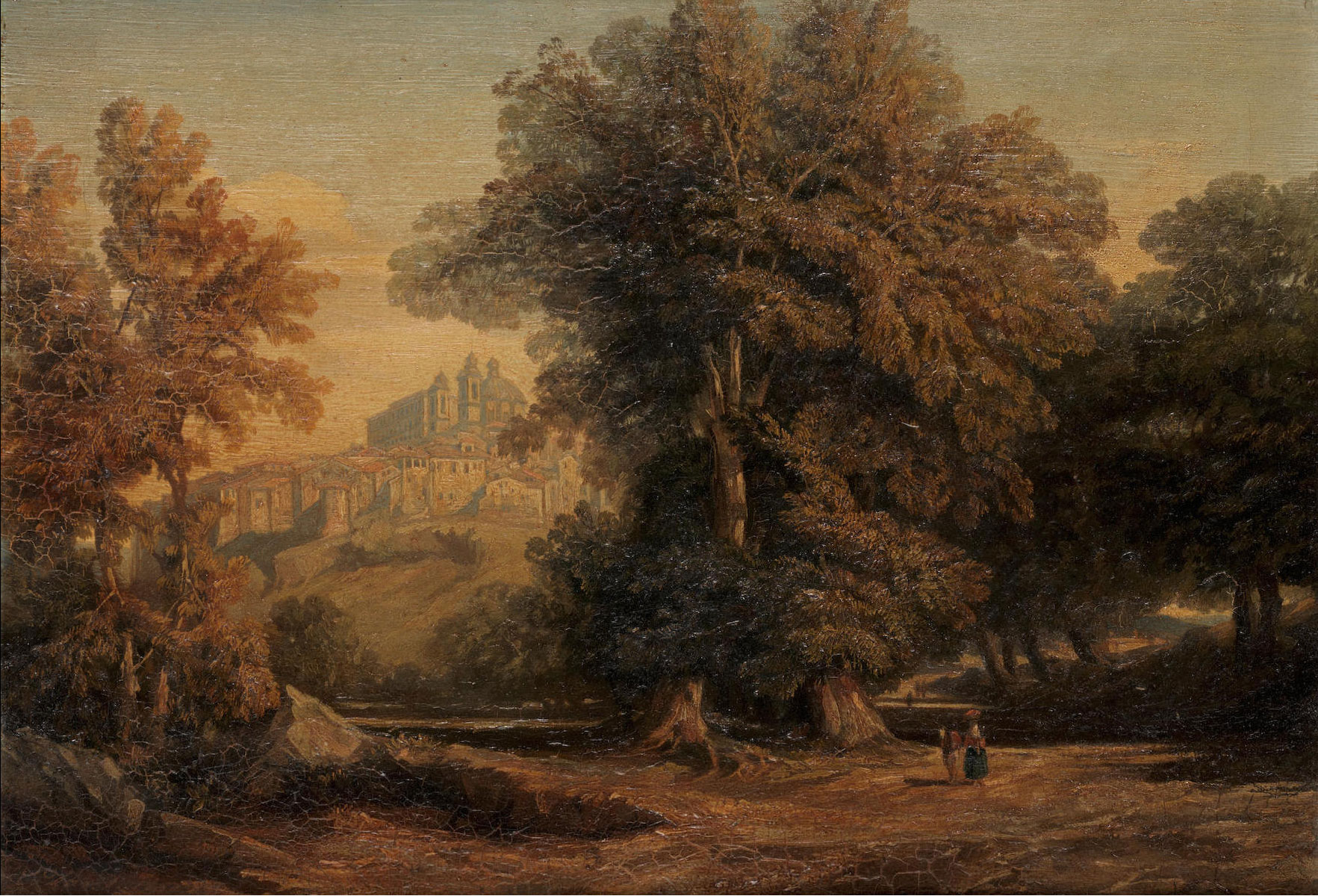
Edward Lear, Val Montone

Edward Lear, Val Montone.
Signed ‘E. Lear’ (lower left); signed and inscribed ‘Please write to me soon/Yours Affs/Edward Lear’ (on an old label attached to the reverse); bears inscription (on the reverse). Oil on canvas. 31 x 43.7cm (12 3/16 x 17 3/16in).

Provenance
Heber-Percy Collection, UK.
Thence by descent.

[Val Montone is] one of the most elegant campagna towns and very curious: it is in a deep dell in the Latin valley – but rises on a mound – crowned with a superb church and castle – through the town itself is wretchedly poor…Fine trees are all around Val Montone – and it is altogether a delightfully quiet place.
(Edward Lear)

A pencil drawing (with white bodycolour) of Val Montone from 1839 is illustrated in Vivien Noakes’ book The Painter Edward Lear (Newton Abbot, 1991, p. 13). Now in the collection of the British Museum, the composition is similar to the present lot. Travellers on a rural path lead the viewer’s eye to the commune of Val Montone, framed between the foliage of magnificent trees. Lear left for Italy in 1837, writing to his sister about the journey from Milan to Florence: ‘I never enjoyed anything so much. Thick woods of oak are on every side, and the road which is very steep and winding, looks quite over all the enormous flat plain’.1

Lear’s earlier oil paintings were dominated by a brown and umber palette and it wasn’t until his interaction with William Holman Hunt, during the 1850s, that he begun to employ more vibrant colours.2 With lovely detail and clarity, the skills gained from his earlier years as an ornithological draughtsman, is evident in the present lot.

1 The Fine Art Society, The Travels of Edward Lear, 17 October – 11 November 1983, Exhibition Catalogue, p. 8.
2 Vivien Noakes, The Painter Edward Lear, Newton Abbot, 1991, p. 13.

Bonhams.

Posted in Edward Lear | Tagged , , , , | Leave a comment

Summer Reading

The New York Times at last reviews Jenny Uglow’s Lear biography, Mr Lear:

David Orr, There Once Was a Man Who Felt Lonely: A Biographer Considers Edward Lear’s Art and Its Sources.

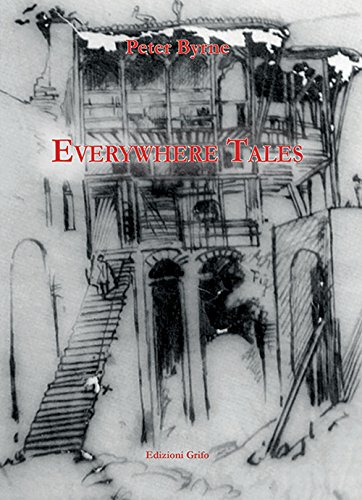
A few week ago Peter Byrne, a frequent commentator on this blog, sent me his latest book, Everywhere Tales, a collection of short stories which opens with one on Edward Lear and Giorgio in Malta, based on Lear’s diaries. It is available, among other online bookshops, from Amazon.it.

Finally, for a philosophical approach to Nonsense you can visit Semiotix: A Global Information Magazine and read Per Aage Brandt’s “A Note on the Meaning of Nonsense“.

Posted in Edward Lear, General, Nonsense Lyrics | Tagged , | Leave a comment

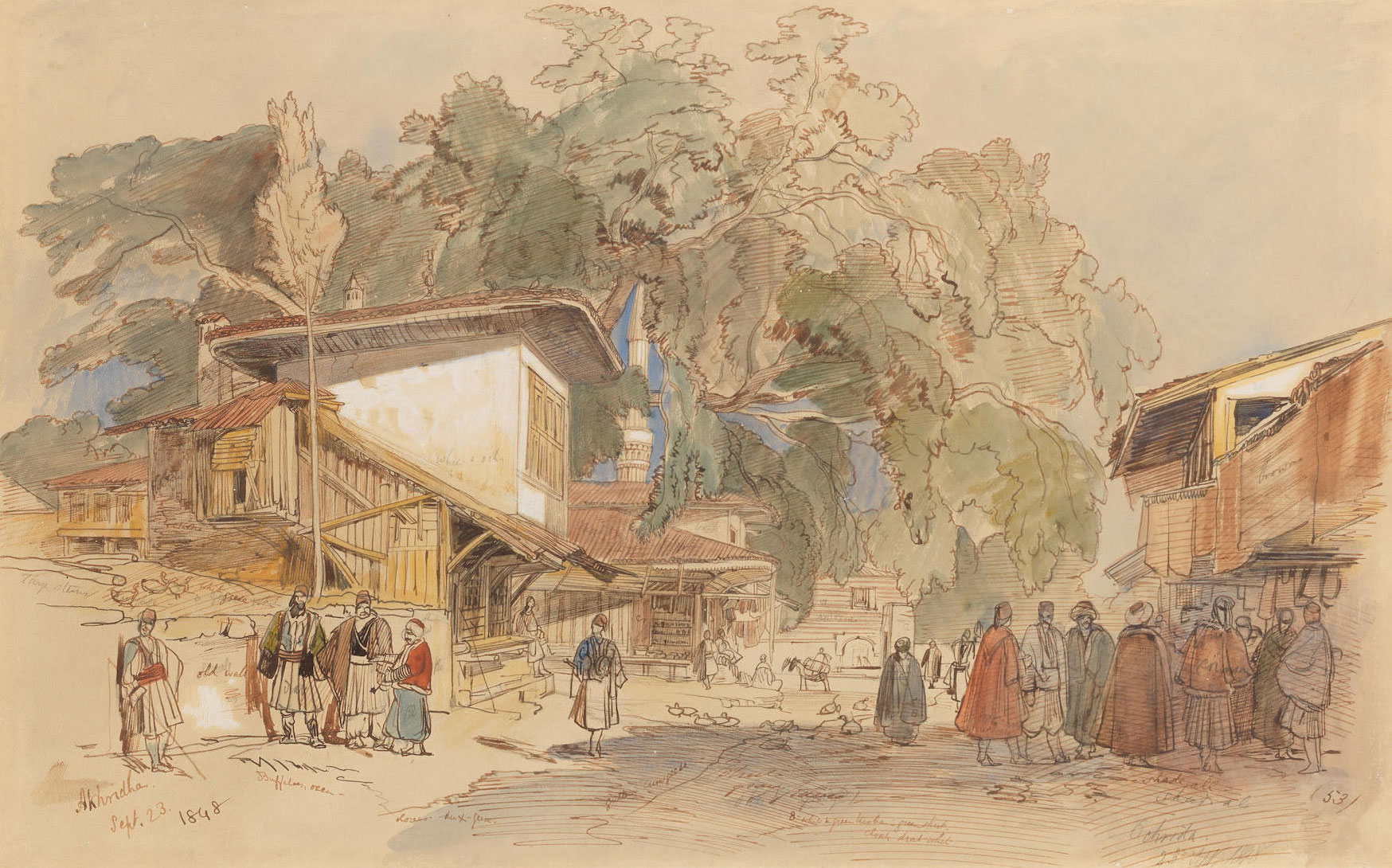
Edward Lear, Akhridha (1848)

Edward Lear, Akhridha.
Inscribed and dated ‘Akhridha/Sept.23./1848’ (lower left); numbered ‘(53)’ (lower right); variously annotated throughout. Pen and brown ink and watercolour heightened with white. 27.3 x 43.8cm (10 3/4 x 17 1/4in).

Provenance
Gilbert Davis Collection.
Private collection, UK.

Exhibited
London, The Fine Art Society, Edward Lear, A Centenary Exhibition, June 1988.

Literature
E. Lear, Journals of a Landscape painter in Greece & Albania, London, 1988, pp. 42-48.
Susan Hyman, Edward Lear in the Levant, Travels in Albania, Greece and Turkey in Europe, 1848-1849, London, 1988 (illustrated p. 84).

Lear set out from Salonika in Greece on 9 September 1848 on a three-month sketching trip; his journey was to take him in a north-westerly direction through Macedonia, into Albania and down its western coast. Travelling on horseback and sometimes on foot, he was accompanied by his dragoman Giorgio who acted as cook, valet, interpreter and guide. They generally stayed at the most rudimentary of roadside shelters along the way, carrying the basic necessities of bedding and cooking utensils with them, and whenever possible – weather permitting – Lear sketched the landscape and people that they encountered. The entry for his journal of September 20 describes a monotonous journey across a plain, but after scaling a mountain pass a very different landscape opened before them. They were approaching Akhridha (modern day Ohrid) and Lear wrote:

‘Soon a new world charmed the eye, and on arriving at the edge of the western face of this high ridge the beautiful plain and lake of Akhridha burst, as it were, into existence…it is scarcely possible to dream of finer scenes than these, their beauty perhaps enhanced by grand storm effects, which gave them more than ordinary magic of colour and variety of interest….Such sublime scenery obliterated from the memory all annoyances of travel and astonished and delighted at every step…Of many days passed in many lands, in wandering amid noble scenery, I can recall none more variously delightful and impressive than this has been’.

Lear was so taken with the town of Akhridha that he spent three days there, remarking in his journal not only on the beauty of the place, but on the unusually lovely local costumes. The present drawing was made on the last day of his stay, September 23 and his journal note records it in detail:

‘There is a street scene below the castle, where a majestic plane shades bazaars rich with every sort of gay-coloured raiment. Through its drooping foliage gleams the bright top of a minaret and below it are grouped every variety of picturesque human beings. To carry away a sketch of this was the work of half the morning.’

Lear’s subsequent journey through Albania was often uncomfortable and the weather was not always kind to him. His sojourn in Akhridha stands out as one of the more enjoyable episodes along the way, despite an incident on his last afternoon when he incautiously decided to sketch some women washing clothes by the lake and was pelted with stones as a result. His main concern was for his spectacles which fortunately survived the attack.

Bonhams.

The Giorgio that accompanied Lear in this journey was not Kokali, who entered his service in 1856, but a Giorgio Bulgaro Cozzacchi. Lear writes to Charles Church on 10 November 1848:

I have been most fortunate in my man ― Giorgio Bulgaro Cozzacchi ― and have had no one fault to find with him in two months.
Posted in Edward Lear | Tagged , , , , | Leave a comment

Edward Lear, Premedi (1857)

Edward Lear, Premedi.
Pen, ink and watercolour. Inscribed and dated 17. April. 1857, in glazed gilt frame, 29cm x 49cm.

The Saleroom.

Posted in Edward Lear | Tagged , , , , | Leave a comment

Edward Lear, Albenga from the Railway (1880)

Edward Lear, Albenga from the Railway.
Pen, pencil and brown ink with watercolour on paper, 13×7.5cm, framed and glazed.

Provenance
Christies May 1972

The Saleroom.

“day was was sloping toward his western bower” is from the last stanza of Tennyson’s “Mariana” (1830): Lear  was probably thinking of using the picture for his Tennyson project.

Posted in Edward Lear | Tagged , , , , , | Leave a comment