
Edward Lear, Mount Etna, Sicily.
June 1847. Pen and brown ink and wash over pencil; 243 by 403 mm.
Edward Lear, Mount Etna, Sicily.
June 1847. Pen and brown ink and wash over pencil; 243 by 403 mm.

Edward Lear, On the Nile, opposite El Ouasta, Egypt
January 1867. Pen and brown ink and watercolour, heightened with white; 62 by 206 mm.

Edward Lear, Flora.
Watercolour over pencil on paper; signed lower left: E Lear., dated lower right: 1831., inscribed with title lower centre. 264 by 212 mm.
Provenance
With Davis Galleries, New York;
sale, London, Christie’s, 25 April 1995, lot 131,
where acquired by the late owners
During the early 1830s Lear was much preoccupied with the study of animals and birds. His most celebrated work in this area was his Illustrations of the Family of Psittacidae, or Parrots which contained forty-two hand coloured lithographs after his watercolours.
For a similar watercolour of the same scale, date and style of inscription see Lear’s Javanese Peacock, now held in the Houghton Library, Harvard University.1
1. V. Noakes, The Painter Edward Lear, London 1991, p. 33.
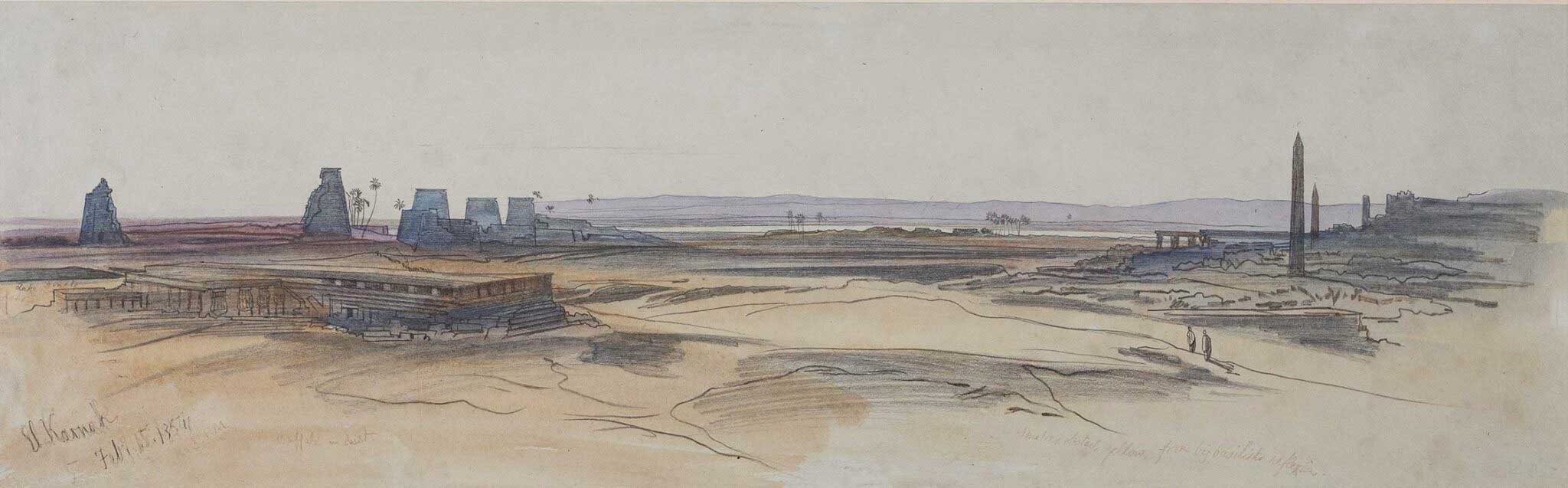
Edward Lear, Eygpt; ‘Karnak’.
Pen, ink and watercolour. Signed, inscribed and dated, ‘Feb 15 1854’. 6×19.5 inches. Framed: 27.5×14.5 inches.
Provenance
Sir Eric Maclagan and by descent; A and H, 2013; a private collection.
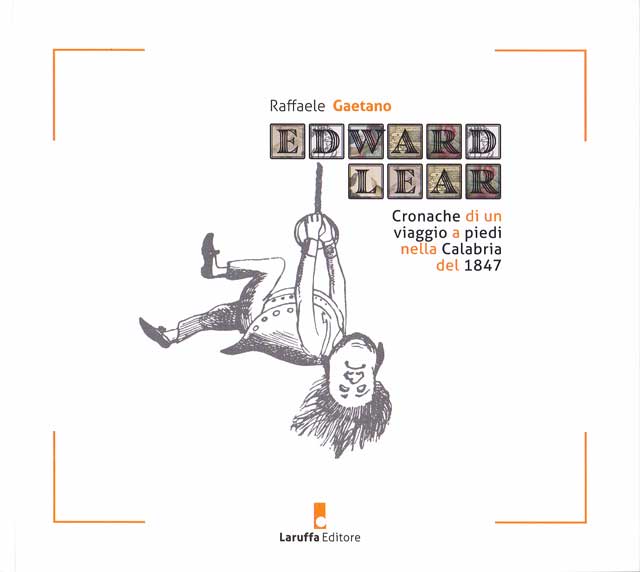
Raffaele Gaetano has just published his third book on Edward Lear, Cronache di un viaggio a piedi nella Calabria del 1847. After his Per la Calabria selvaggia: 109 disegni inediti di Edward Lear. Dalla Collezione della Central Library di Liverpool, in which appeared the previously unpublished Calabrian sketches preserved at the Liverpool Central Library, this one in part takes up the discourse begun with Senza ombre di cerimonie. Sull’ospitalità nei «Diari di viaggio in Calabria» di Edward Lear, which presented several of the people Lear stayed with during his tour, and expands it to include many more people and places, as well as reproductions of sketches and paintings from the Houghton Library archives and present-day photographs of the places he visited. Gaetano follows Lear’s narrative day by day and provides a wealth of information on all aspects of life in the Calabria of the mid Nineteenth century.

Per la Calabria selvaggia, which was originally released in a limited edition has now been republished by Laruffa and, along with this latest volume, will soon be available on Amazon Italy.

Raffaele will be presenting his books in Reggio Calabria on 20 July and in Palmi on 11 August.


Join Poet in the City for a night of poetry and discussion as we celebrate and explore the poetry of Edward Lear, hearing from contemporary poets and writers inspired by the lasting legacy of his sparkling wit and absurd imagination.
Edward Lear: Wandering Nonsense Man will take place at Wilton’s Music Hall, Graces Alley, London, E1 8JB on 11th July, 2022 at 7:30pm, featuring Sara Lodge, Michael Rosen and Lisa Dwan. More information and updates.

Edward Lear, Benares.
Signed with monogram l.l., watercolour over pencil heightened with bodycolour and gum arabic. 25.5 x 40 cm.; 10 x 15 ¾ inches. Date: 1873.
Provenance
Sir Sacheverell Sitwell, Bt. (1897-1988);
Francis Sitwell (1935-2004);
By descent at Weston Hall, Northamptonshire until 2021.
Lear was invited to India by his friend and patron Lord Northbrook who was appointed Viceroy in 1871, and his journey there was the last and longest of his life. He was overwhelmed by the colour and vitality of India and enjoyed the bustle of Viceregal life. After leaving Lord Northbrook, Benares was one of the first places Lear visited, arriving on 12th December 1873.
Lear describes Benares in his ‘Indian Journal’, on December 13-14 1873, (ed. Ray Murphy, 1953, pp. 45-6):‘Nothing short of a moving opera scene can give any idea of the intense and wonderful colour and detail of these Benares river banks…
‘Got a boat, a large one, for on one can have the last idea of this Indian city’s splendour without this arrangement. Utterly wonderful is the rainbow-like edging of the water with thousands of bathers reflected in the river. Then the colour of the temples, the strangeness of the huge umbrellas and the inexpressibly multitudinous details of architecture costume etc. Drew, more or less, as I was slowly row’d up and down the river…How well I remember the views of Benares by Daniell, R.A.; pallid, gray, sad solemn. I had always supposed this a place of melancholy or at least a staid and soberly-coloured spot, a gray record of bygone days,. Instead, I find it one of the most abundantly bruyant, and startlingly radiant of places full of bustle and movement. ‘This drawing used to hang in Sir Sacheverell Sitwell’s study and dressing room at Weston Hall, Northamptonshire, where he did all his writing.
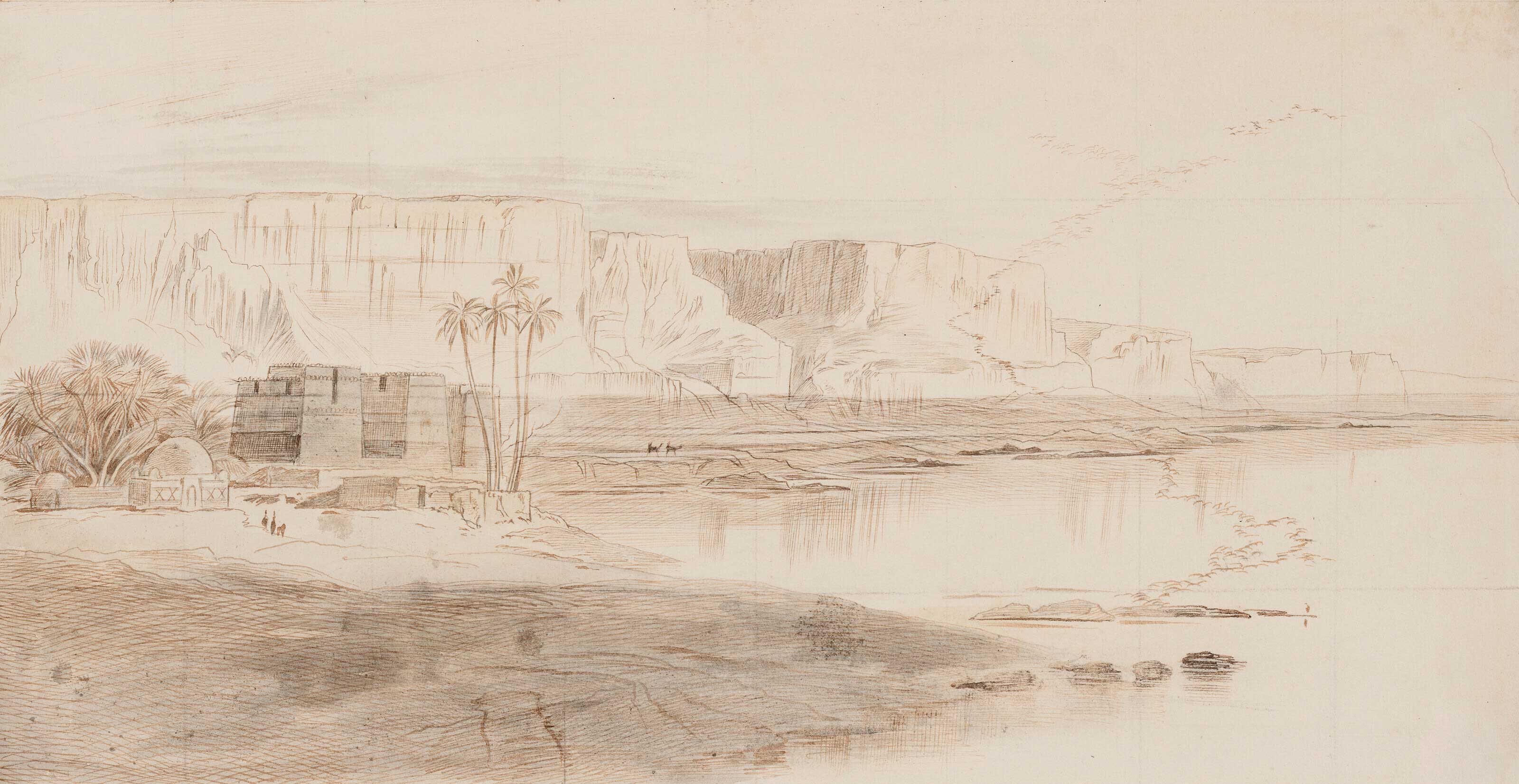
Edward Lear, The Nile at Kasr-Es-Saad, Egypt.
Inscribed and numbered ’23/ Like the crag that fronts the evening’ (upper left) and further inscribed ‘Kasres.Saad. (Egypt.)’ (upper right). Pencil, pen and brown ink, brown and grey wash, lightly squared on paper watermarked ‘JWHATMAN/ 18[?]2’. 13 5⁄8 x 21 1⁄4 in. (34.6 x 54 cm.)
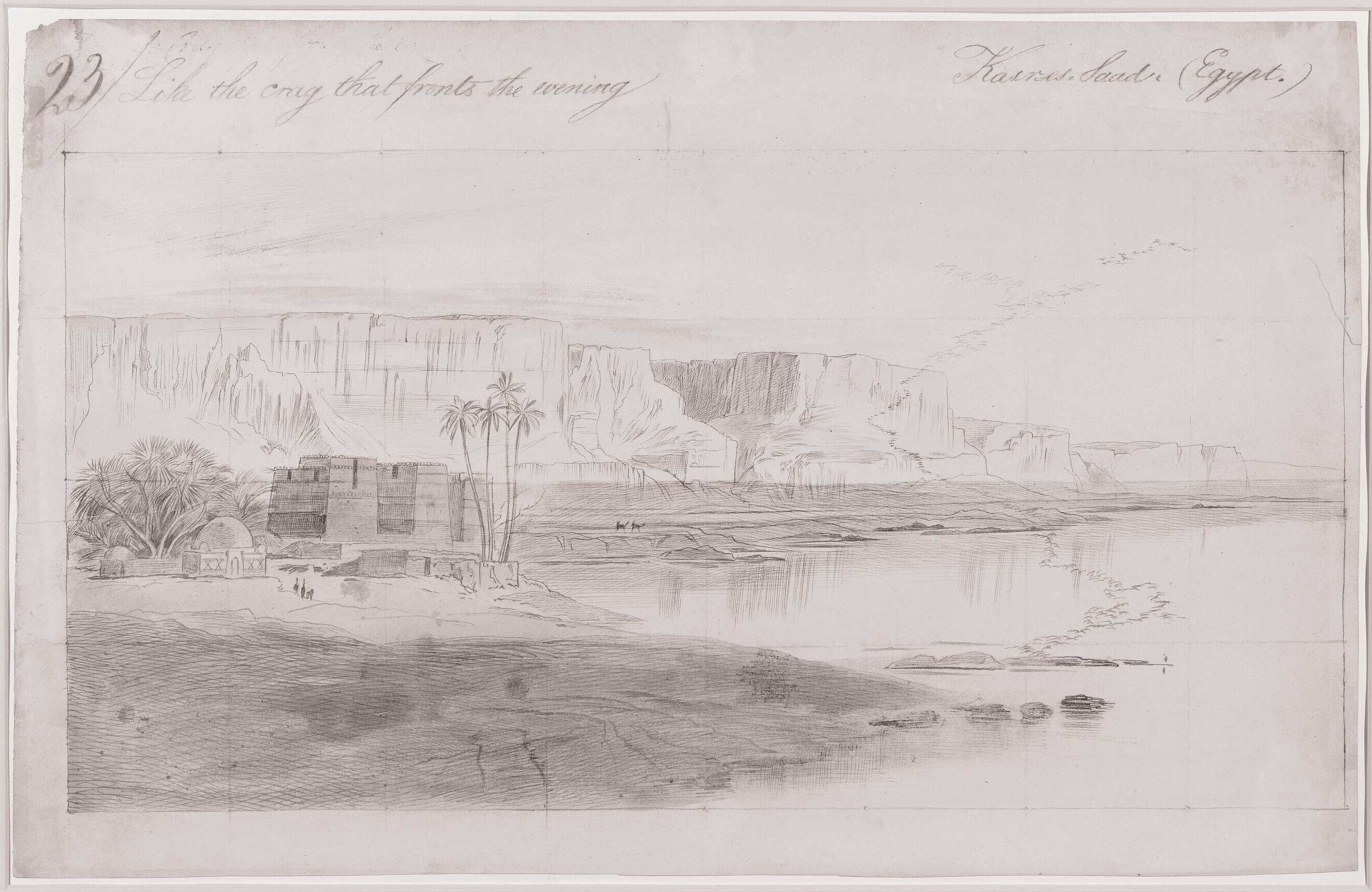
Used to illustrate a line from Alfred Tennyson’s “Eleänore”.
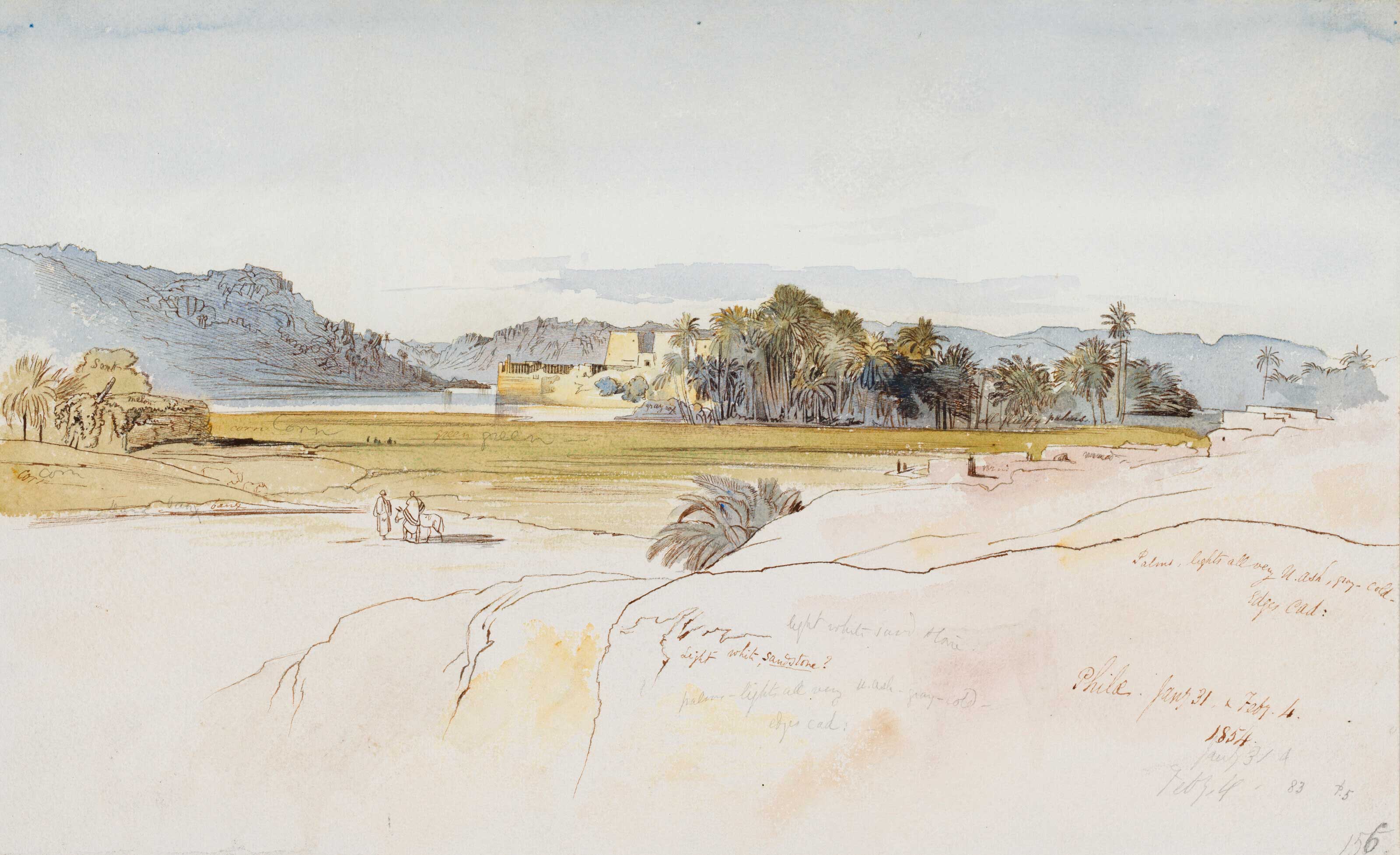
Edward Lear, Philae, Egypt.
Inscribed and dated ‘Philae. Jany 31. Feby. 4./ 1854.’ and numbered ‘156’ (lower right), and extensively inscribed with colour notes throughout. Pencil, pen and brown ink and watercolour. 12 1⁄4 x 19 1⁄2 in. (31.1 x 49.5 cm.)
Provenance
With Agnew’s, London, where purchased for the present collection.
Lear first journeyed to Egypt in January 1849 but was only able to find time to visit Cairo and the Pyramids. At the end of 1853, however, he arrived in Cairo and immediately accepted an offer to travel up the Nile by boat. On reaching Philae the group set up camp and remained on the island for ten days which Lear spent sketching and recording the temples and the surrounding area. He wrote to his sister Ann, ‘It is impossible to describe the place to you, any further than saying it is more like a real fairy island than anything else I can compare it to. It is very small, & was formerly all covered with temples, of which the ruins of 5 or 6 now only remain. The great T. of Isis, on the terrace of which I now am writing, is so extremely wonderful that no words can give the least idea of it’. Lear was much taken by the scenery and the extraordinary light and colours, and completed at least twenty oil paintings of Philae.
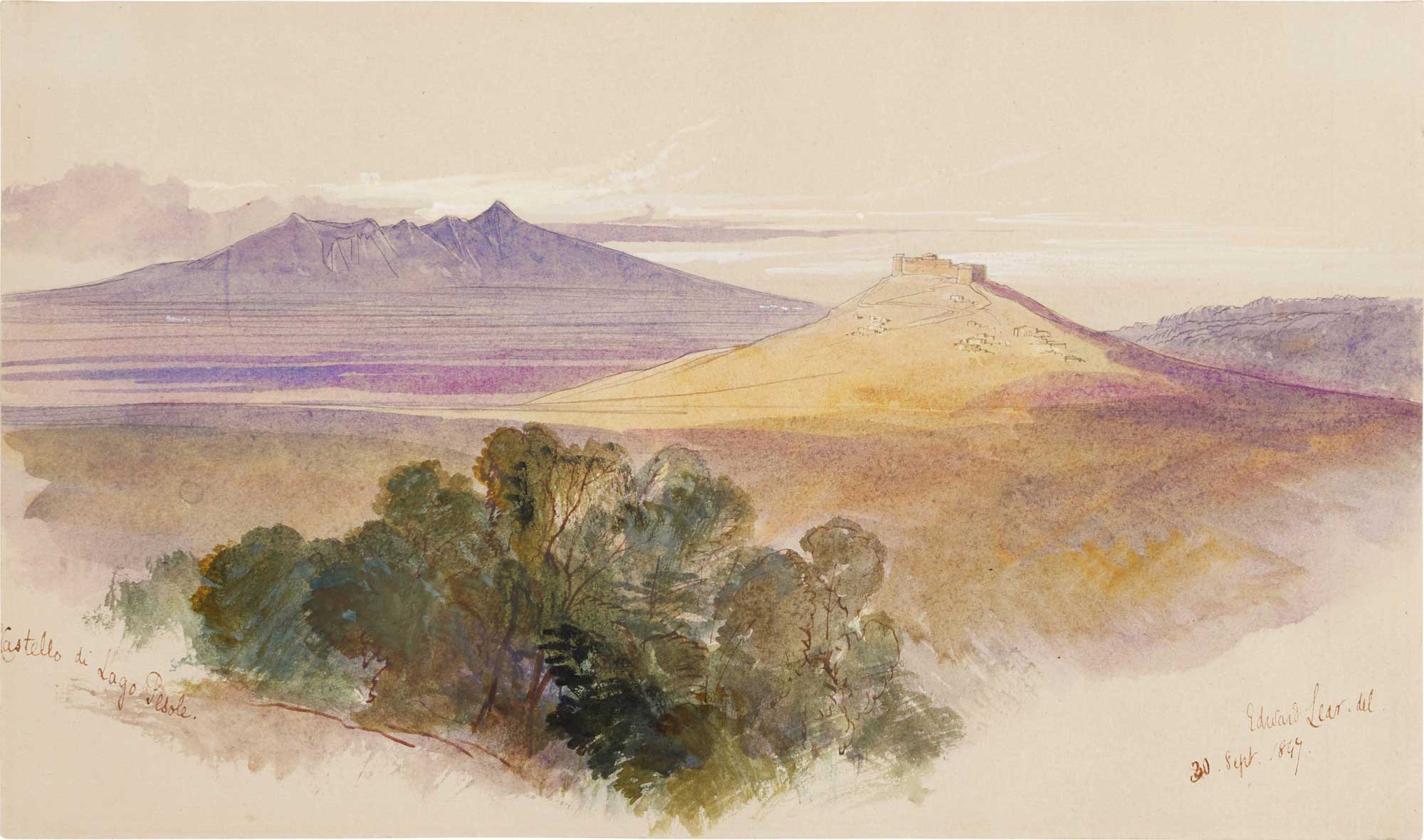
Edward Lear, Castel Lagopesole, Southern Italy.
Pen and brown ink and watercolour; signed lower right: Edward Lear. del. / 30. Sept. 1847, inscribed lower left: Castello do Lago Pesole. 165 by 282 mm.
This finely preserved work was executed on the 30 September 1847, towards the end of Lear’s six week journey around Calabria in Southern Italy.
Painting with purples, ochers and greens, Lear depicts the expansive landscape towards the end of the day. Castel Lagopesole, a hunting lodge of Emperor Frederick II (1194-1250) stands proudly atop the near hill, while in the distance – swathed in mauve – Monte Voltore looms up out of the plain.
 A Blog of Bosh