
Edward Lear, The Black Mountain, Cephalonia
Signed, inscribed and dated ‘Black Mountain/16 May 1863/6.30a.m. 168’ l.r., pen and ink and watercolour 32 x 48cm.
Edward Lear, The Black Mountain, Cephalonia
Signed, inscribed and dated ‘Black Mountain/16 May 1863/6.30a.m. 168’ l.r., pen and ink and watercolour 32 x 48cm.
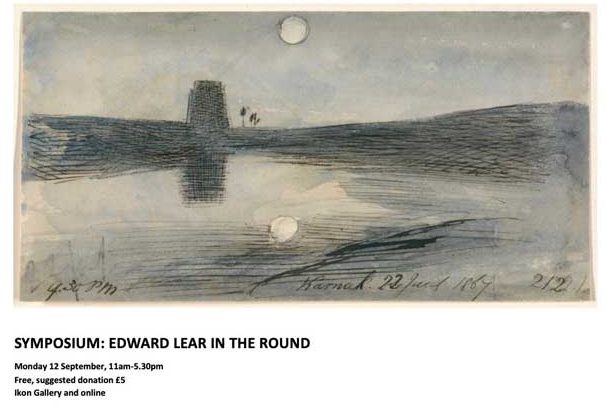
It has now been confirmed that the symposium will be streamed on YouTube. The link is already active and displays a countdown to the start of the stream. You now have no excuse to miss it, even if you are not in the area.
Download the brochure with the schedule and speaker biographies.

Just a quick reminder that the exhibition Edward Lear: Moment to Moment, at the Ikon Gallery in Birmingham will be opening next Saturday, 9 October.

In addition, on Monday, 12 September, there will be a symposium: Edward Lear in the Round.
Speakers include Matthew Bevis (Professor of English Literature, Oxford University), Jasmine Jagger (Leverhulme Early Career Fellow, Department of English and Creative Writing, University of Roehampton), Sara Lodge (Senior Lecturer in English, University of St Andrews), Noreen Masud (Lecturer in Twentieth Century Literature, University of Bristol), Kate Nichols (Birmingham Fellow in British Art, University of Birmingham), Linzi Stauvers (Head of Learning, Ikon Gallery), Jenny Uglow (Author of Mr Lear: A Life of Art and Nonsense (2018)), Jonathan Watkins (Director, Ikon Gallery), Cassie Westwood (Independent scholar) and James Williams (Senior Lecturer in English Literature, University of York).
THURBER MUSES ON HIS INFLUENCES.
THURBER, JAMES. 1894-1961. Typed Letter Signed (“James Thurber”), to Angus Davidson who is preparing a biography on Edward Lear, 2 pp, 4to, n.p., July 7, 1937, toning to both leaves, both leaves laid down to larger board with stains from adhesives.
Thurber writes the author of Edward Lear: Landscape Painter and Nonsense Poet (1938), responding to a query about whether or not Lear’s comedy has influenced him. In part: “I am ashamed to admit that I was not brought up on his writings or drawings, an educational omission which I will never forgive my parents. I began to draw, much the same was as I do now, about 1917, when I was twenty-three years old … I did not see the drawings of Clarence Day until after my pictures began to appear in the New Yorker … I think the drawings of men who cannot really draw—that is, who are not great or natural draughtsmen—are bound to have a similarity, just as the drawings of children invariable have: a simplicity, a directness, a naivete which eludes the easy and practiced hand.”


July 7
1937
Dear Mr. Davidson:
I hope you will excuse a delay in answering your letter which was really unavoidable. I sailed for France on May 14, was lost to the mails for weeks, and only received your letter a few days ago, shortly after arriving in London.
As for Edward Lear, I am ashamed to admit that I was not brought up on his writings or drawings, an educational omission which I will never forgive my parents. I began to draw, much the same way as I do now, about 1917, when I was twenty-three years old. Naturally, there has been a development, but in the main the line is the same and for it I did not have any influence at all of which I am conscious. I did not see the drawings of Clarence Day until after my pictures began to appear in the New Yorker. There is a charming story about that. It seems a friend of Day’s, coming upon some of my drawings, rushed them to his bedside – he was bedbound for fifteen years – and said, “Look at this plagiarizer!” Day looked and said, I am told, “No. He has something I haven’t got.” Certainly I should put it the other way around, but I mention it as an interesting sidelight on an unusual artist and a lovable person.
I think the drawings of men who cannot really draw – that is, who are not great or natural draughtsmen – are bound to have a similarity, just as the drawings of children invariably have – just as the writings of children always have: a simplicity, a directness, a naivete which eludes the easy and practised hand.
I have, of course, known Lear now for a long time, and just the other weekend spent a delightful afternoon going over practically all of his things with Edward ˇ[(David)] Garnett and his children. Lear, I have found, is as well known to ˇ[most] children in the Eastern part of the United States as Carroll, but I come from the Middle West, a benighted section, and was brought up on American comic strips.* Even so, many of the limericks I knew as a child – without the drawing, though. They had just been passed around from mouth to mouth.
I should think it would be a great pleasure to work on a life of Lear, and I am sure the book will be greatly valued.
I am glad that you find pleasure in my work (although it’s really fun) and I thank you for saying so.
Sincerely yours.
James Thurber
* I do not believe there was any influence on my drawings in these comic strips. I just began to draw, idly, almost without thinking, certainly without any plan at all, for fun. I had never had the vaguest idea of having the drawings published. Some were found on my desk at the New Yorker, by E.B. White, a friend and another New Yorker editor, in 1929, and they first appeared in a book we did together called “Is Sex Necessary?” It had an unusual success – drawings and all – to our infinite surprise, and the New Yorker began publishing them – new ones, whenever I did them. It is still a little hard for me to realize that they have gained any recognition at all, as I count myself a writer, who draws for relaxation, as one plays ping pong, lights a pipe, or plays cards. The show of my drawings in London was a great success and I am still – and always will be – somewhat amazed by that.

Edward Lear, Thebes.
Inscribed and dated ‘Thebes.July 4.1848’ (lower left), inscribed and dated ‘Thebes/4 July 1848’ (lower right), variously annotated throughout. Pen and ink and watercolour heightened with white. 23.5 x 43cm (9 1/4 x 16 15/16in).
Provenance
With Spink & Sons, Ltd, London, K3/1749.
Private collection, USA.

Edward Lear, Santa Maura.
Inscribed and dated ‘Santa. Maura./Βασιλικῆ/19. April.1863’ (lower right), variously annotated throughout, with collector’s stamp (upper right). Pen and ink and watercolour heightened with white. 36 x 52.5cm (14 3/16 x 20 11/16in).
Provenance
With P & D Colnaghi & Co. Ltd, London.
Anon. sale, Sotheby’s, London, 20 October 1993, lot 119.
Private collection, Greece.
‘This valley we crossed ― & an ascent to Κονδάρινα followed ― no part is anywhere very interesting. 9 A.M. thence, by particularly vile paths & a steep descent to the shore of Βασιλικῆ. The morning was hot ― & I not very well ― headache & tired. I wish I could reckon on getting back to Sta. Maura on Thursday! However, the plain of Βασιλικῆ & the mountain of Σταυροτὰ are more respectable than anything I have yet seen.’
Edward Lear, diary entry for 19 April 1863.
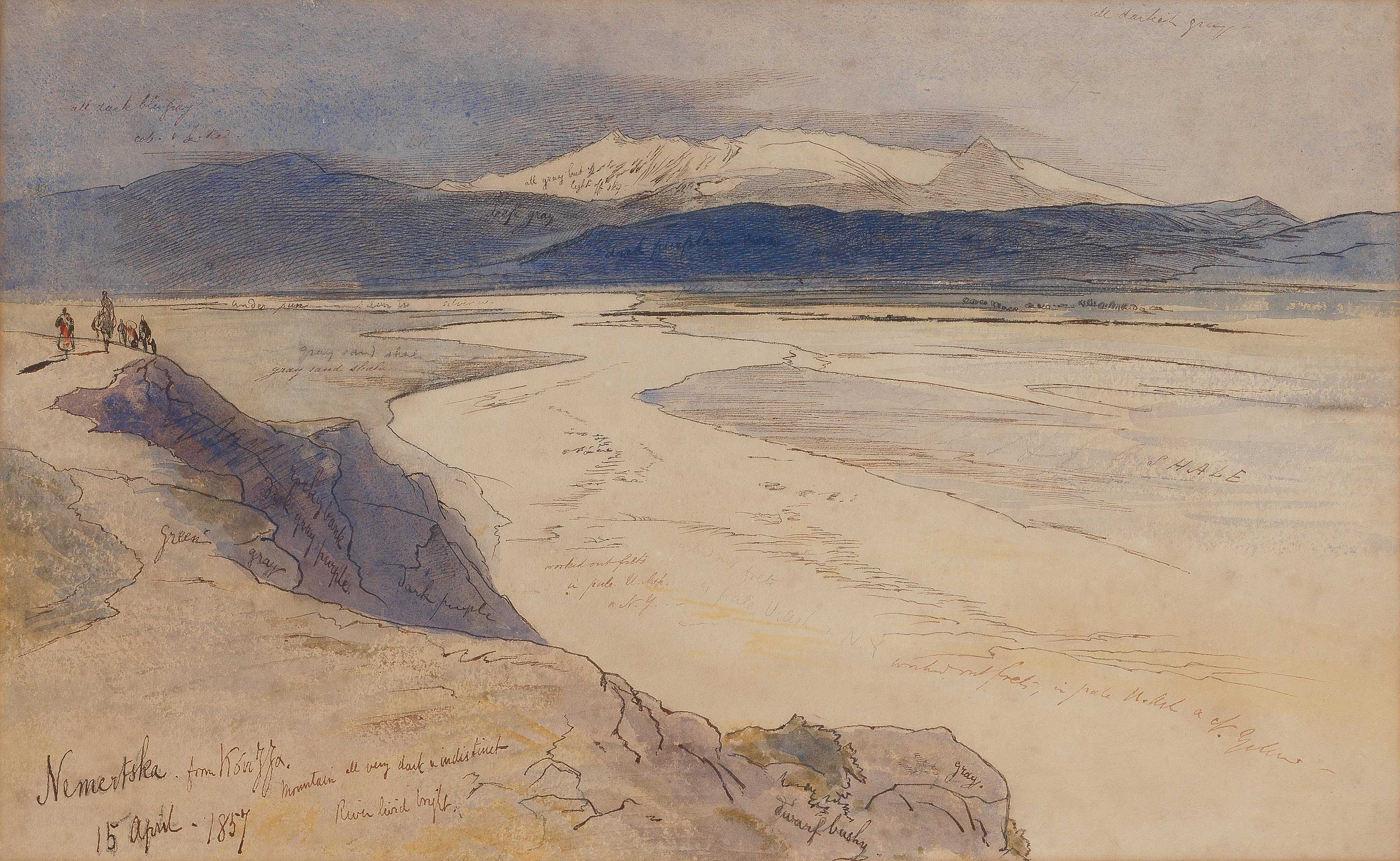
Edward Lear, Nemertska from Kouzza, Albania.
Inscribed and dated ‘Nemertska from Kouzza/15 April 1857’ (lower left), variously annotated throughout. Pen, ink and watercolour. 32.5 x 52cm (12 13/16 x 20 1/2in).
Provenance
Lady Shaw.
Thence by descent.
Anon. sale, Bonhams, London, 23 May 2007, lot 154.
Private collection, Greece.
Lady Shaw met Lear in Corfu and later acquired this watercolour in London.
Lear first visited Albania in 1848 and recorded his visit in Journals of a Landscape painter in Greece and Albania (1951). He returned in April 1857 to visit the Greek mountain region of Epirus and the villages above the River Vikos, a place he missed on his first trip.
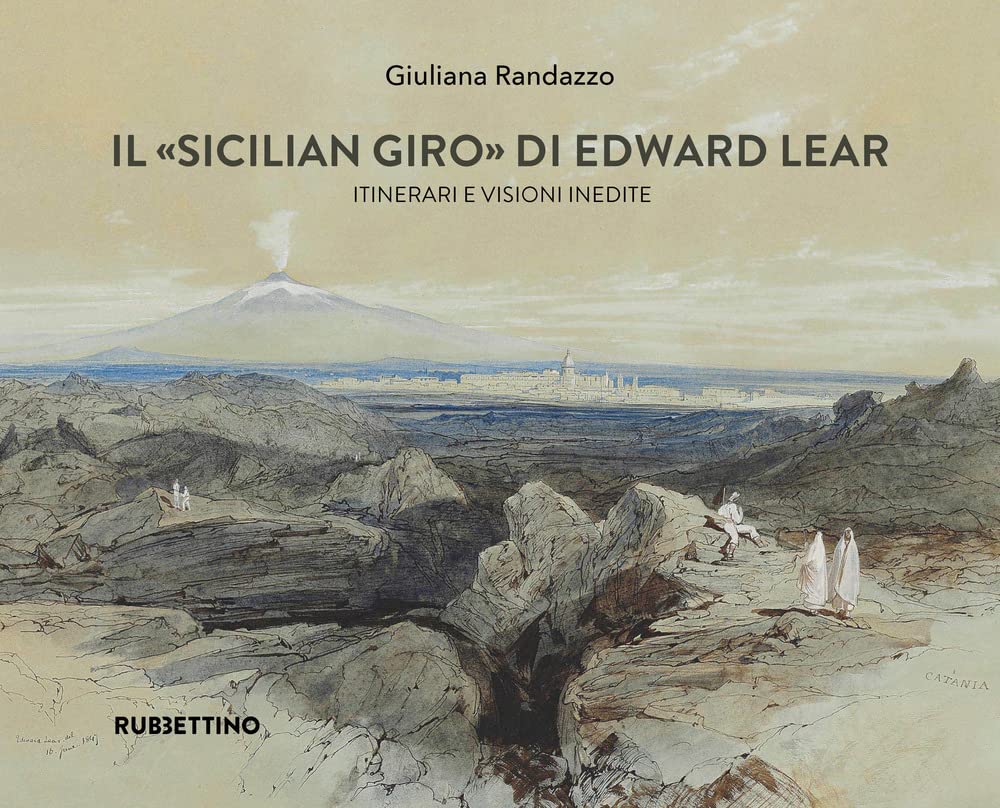
Giuliana Randazzo’s book contains a large collection of landscape pictures, often never before published, drawn by Edward Lear during his two Sicilian trips in 1842 and 1847.
As far as I can see it is only available from amazon.it.
[This is part of a series of previously-unpublished letters to Margaret Knight, who was married to Michelangelo Caetani, Duke of Sermoneta, and to Ada Bootle-Wilbraham, married to Onorato Caetani, Michelangelo’s son, Prince of Teano and then Duke of Sermoneta.
The letters are in the Caetani Archive, Palazzo Caetani, via delle Botteghe Oscure 32, Roma.
An Italian version will appear as an Appendix to my essay “Prima di Gregorovius: Edward Lear, i Caetani, e Ninfa” in a forthcoming volume: Michael Matheus (ed.) Ninfa: Percezioni nella scienza, letteratura e belle arti nel XIX e all’inizio del XX secolo. Regensburg: Schnell & Steiner.]
Villa Emily. Sanremo.
December. 1872.
Dear Princess Teano,
I wrote a letter to the dear Duchess on the 21st of last month, ― to thank her for sending me your photograph, & to tell her why I had not answered her letter earlier, ――― little thinking that she was no longer in our world.
The sad news of her loss I only have heard from Charles Knight & Mrs. C.K. ― but they mention the fact of her death & nothing more: ― & if you could be kind enough to let me have a line to say when & how this occurred, I should be so much obliged to you! ― I am sure you must have loved her as all who ever knew her did, & I know you ^[& the Prince] must feel her loss greatly: but perhaps you would not mind the trouble of telling so old a friend as myself something of her last illness & death. The reason I have never heard of this till now, is that I was on my way to India for a year, to stay with Lord Northbrook, but fate did not allow me to get farther than Suez, whence I only returned here early in November.
I am so glad now that I went to Rome last year ― at least to have seen her once more.
Please tell me how the Duke is ――― it is so very very sad to think of him now. And yet it would be far more so were not you & his son, & Mme Lovatelli & her husband all with him as I hope you are.
Please give my kindest remembrances to the Duke, ― & to all who remember me; if I am offering sympathy of little value, it must be recollected that I ask as I feel, & as it would please me if others acted towards myself.
I have written also to Prince Teano, as someone said you were not at Rome, & I thought that his being a Deputato would ensure letters arriving.
I am in hopes Charley will come here: his wife writes that he is so grieved & sad, ― & I think a change would be good for him. As he don’t care for luxury, I could put him up comfortably here, where, (with due respect a Vossignoria Romana,) we have a better winter climate than ― any place in all Italy: ― vero, ― (unless perhaps it be Taranto.)
I hope your little ones are well: & that Col. & Mrs. Wilbraham are so. They will hardly remember me ― or I would ask you to give them my Xmas good wishes, as I do to yourself & all the Duke’s family.
Believe me,
Dear Princess Teano
Your’s sincerely,
Edward Lear.
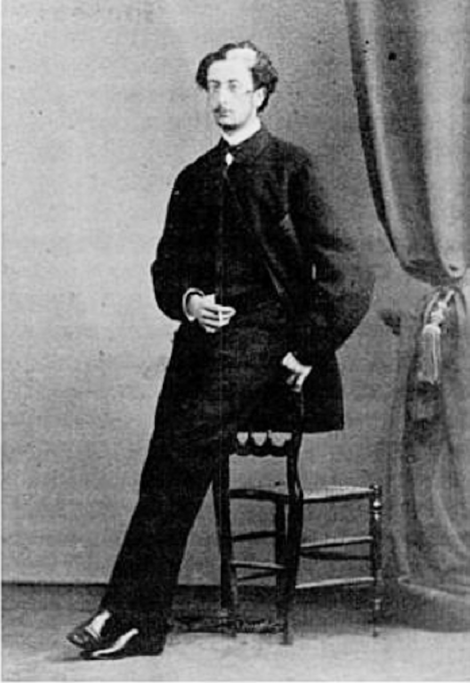
Onorato Caetani, Prince of Teano.
[This is part of a series of previously-unpublished letters to Margaret Knight, who was married to Michelangelo Caetani, Duke of Sermoneta, and to Ada Bootle-Wilbraham, married to Onorato Caetani, Michelangelo’s son, Prince of Teano and then Duke of Sermoneta.
The letters are in the Caetani Archive, Palazzo Caetani, via delle Botteghe Oscure 32, Roma.
An Italian version will appear as an Appendix to my essay “Prima di Gregorovius: Edward Lear, i Caetani, e Ninfa” in a forthcoming volume: Michael Matheus (ed.) Ninfa: Percezioni nella scienza, letteratura e belle arti nel XIX e all’inizio del XX secolo. Regensburg: Schnell & Steiner.]
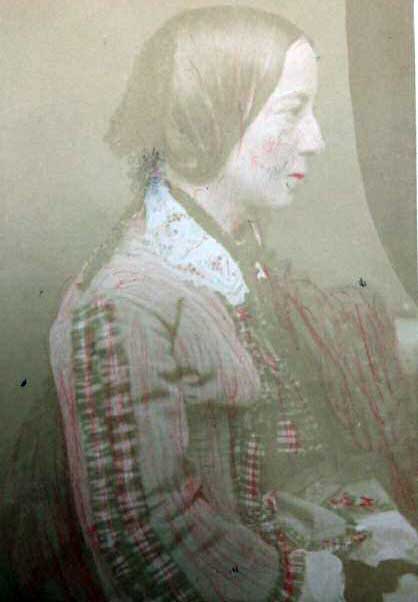
Photo of Margaret Knight Caetani in the 1860s.
Villa Emily.
Sanremo.
Nov.r. 21. 1872
Dear Duchess of Sermoneta,
Your letter of last August ― written after I had told you of my stay with Charley, should have been answered long ago, but I was never able to get a moment while in London, & afterwards I was constantly preparing to go to India ― (I told you Lord Northbrook had asked me there,) or hurrying about paying visits &c. (Bye the bye I just missed the Bertie M.’s at Guy’s Cliffe ―― how we should have sympathized! ―) Then I left in Sept.r to put things in order here for an 18 month’s absence ― & then set off to Egypt ― picking up my old servant at Corfu. But at Suez it appeared to be decreed that I was not to go ― two steamers were full ― (at that season every place is crowded,) & I missed a third: & then, the effects of a bad blow from a fall which received in England weighed also in the balance, ― & finally I believed I had better return ― in spite of the trouble I had given in having introductions written for me, & in spite of the time & money I had lost. I got back here on Nov.r 6 ― after a journey much put out by inundations &c.: & I suppose am now here for the winter. At 60 years of age ― it is almost silly to regret anything ― so I endeavor to think as little about the whole matter as possible.
I hope you will be able to write before long, or cause someone to write, as I should like to hear how you & the Duke & all of you are. I was delighted at the Photograph of Princess Teano, & thank you very much for it. Her face is really lively, & I have set it up on the Chimney-piece here so that I can look at it at any time. ― I should be glad to hear how Charley is, & must write to him soon. Had it not been for the broken railways, & the difficulty of getting on I should have come back here by Naples & Rome & so might have seen you. The other day Glennie & Mrs. G. passed through here, but thought I was in India & “passed by on the other side.” If you will let me know a safe way of sending the Books from here to Rome, I will forward the Corsica,[1] & the 2 Nonsenses.[2] The former is 30 fr. & the 2 latter 15 fr. each ― so that you could easily repay me by a P.O. order on the Post office here. Had I but known Glennie was going through! Gio. Batt: Fornari is the man who has all books here, & I will ask him to forward them. The Corsica will please you, & the other books will delight the small people.
I have just received letters from Lord Northbrooks Children, from Brindisi, so vexed at my non=coming, that I am grieved I ever thought of going, since go I did not, & now shall be able to think of nothing else for the rest of today.
I wish we were a little more settled in our Italy. I found it the opinion of many eminent & thinking men in England that if your V.[3] neighbour & his atrocious goings on are not finally stopped, calamities will one day ensue. While we have so open an enemy in the Centre of our existence & one who would scruple at nothing to regain power, ― we are far from safe. And the worst is that belief in him & his satellites is carried on by all or most Italian mothers & taught to their children, ― so that there will be plenty of material for a bad reaction whenever opportunity occurs. And that party think so too ― we are only ousted for a time ― say they: ― the foundations of our power have never been uprooted ― only the walls shaken down. Naturally the difficulty of an opposite course is immense ― but unless it is courageously taken, I fear bitterly for the future of this country.
Give my kindest remembrances to the Duke ― & to Prince & Princess Teano, & believe me, Dear Duchess of Sermoneta,
Your’s sincerely,
Edward Lear.
_____
[1] Journal of a Landscape Painter in Corsica, 1870.
[2] Nonsense Songs, Stories, Botany and Alphabets, London, 1871, e More Nonsense,
ictures, Rhymes, Botany, etc., London 1872.
[3] Vatican.
 A Blog of Bosh