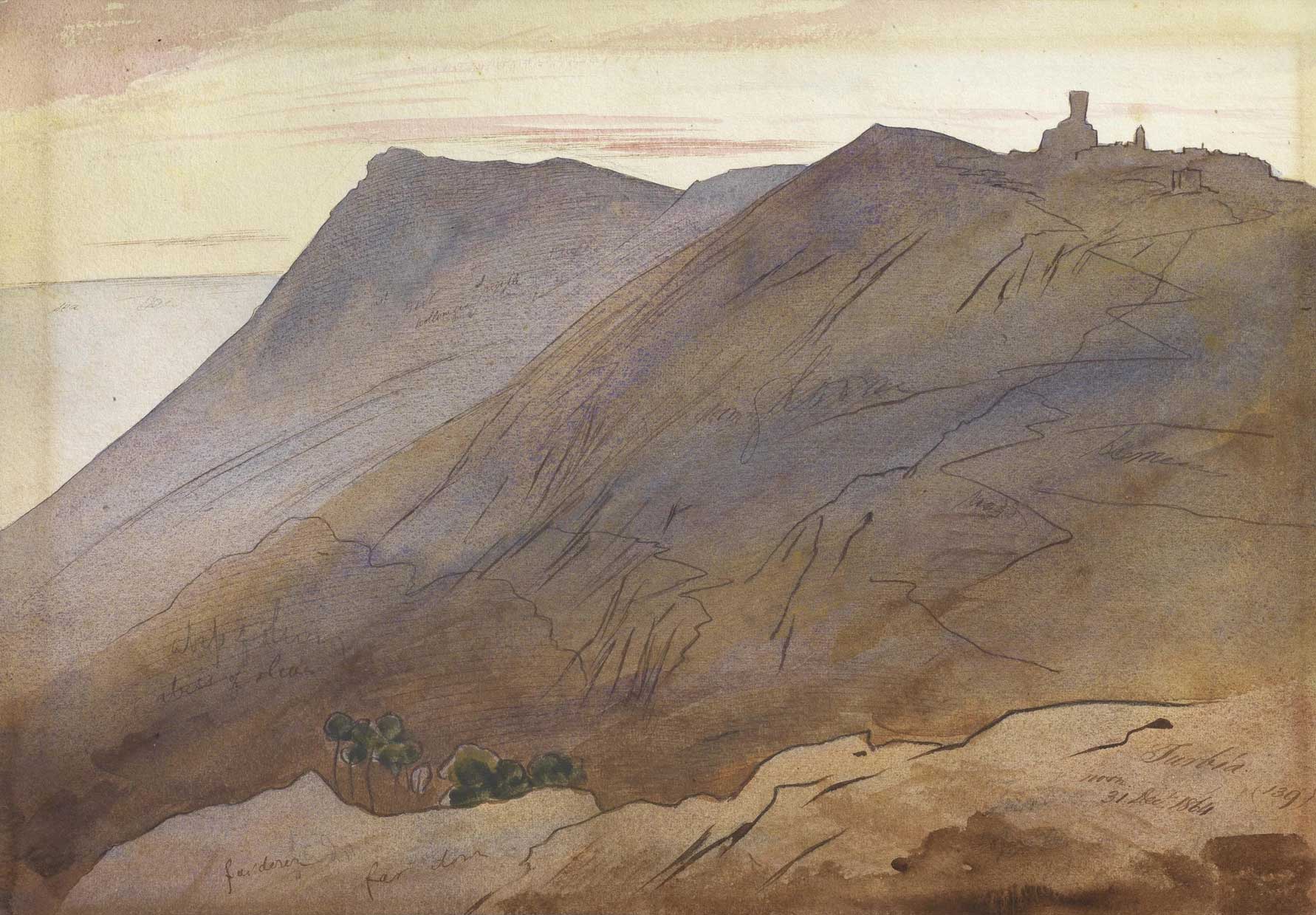
Edward Lear, Turbìa (La Turbie in southeastern France, 31 December 1864.
Watercolour and ink with traces of pencil. 36 x 53.5cm.
Erroneously titled “Turkish Landscape, Dec. 1864” at MutualArt.
Edward Lear, Turbìa (La Turbie in southeastern France, 31 December 1864.
Watercolour and ink with traces of pencil. 36 x 53.5cm.
Erroneously titled “Turkish Landscape, Dec. 1864” at MutualArt.

My essay is now out and available either on Amazon and the publisher’s website.
Marco Graziosi, “Prima di Gregorovius: Edward Lear, i Caetani e Ninfa.” In Ninfa: Percezioni nella scienza, letteratura e belle arti nel XIX e all’inizio del XX secolo, ed. Michael Mateus, Regensburg: Schnell + Steiner, 2022, pp. 165-192.

Edward Lear, A Palm, Agrigento, Sicily (1847).
Ink on paper. 8 3/4 x 6 3/4 in. (sheet), 17 x 14 1/2 in. (frame).

I’m starting a tour of Wales &c. today and will be away for a couple of weeks, but I want to recommend again the Ikon exhibition in Birmingham, and in particular the great catalogue, with essays by Matthew Bevis, Jenny Uglow, Adam Phillips, Hugh Haughton and Stephen Duckworth; don’t miss it if you go, or order it from the bookshop.
Apollo: The International Art Magazine.

Edward Lear, Civita d’Antino
Pencil, chalk and white heightening. Signed, inscribed and dated, 1844. 6.5×11.25 inches. Framed: 15.5×19 inches.
Illustrated
Edward Lear, ‘Excursions in Italy’, 1846, plate 20.
Provenance
John Scandrett Harford (1787-1866), who first met Lear in Italy in 1846.
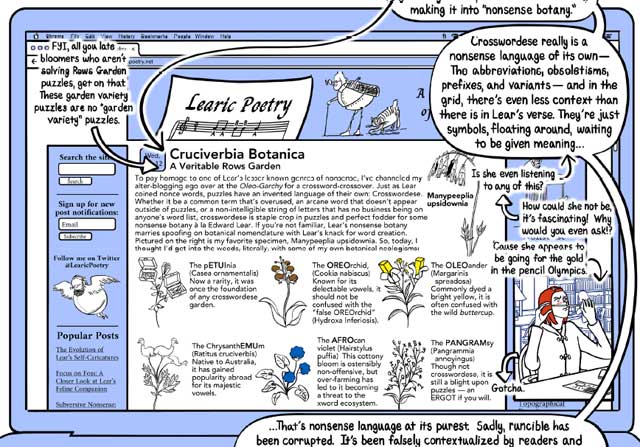
Hayley Gold (@hayleyrabbit) – a sample of her artwork is here above while her books are available here – and I are unconvinced by the seller’s interpretation of the Edward Lear rebus I posted some time ago and have been trying to find a different solution for some time, but without great success. I am therefore reposting it asking for my readers’ help, if they are any better than I am at this sort of thing.
The fact is the sentence resulting from the gallerist’s interpretation does not make much sense, or it is too contorted for what it purports to say; anyway, here is the current solution explained to the best of our understanding:
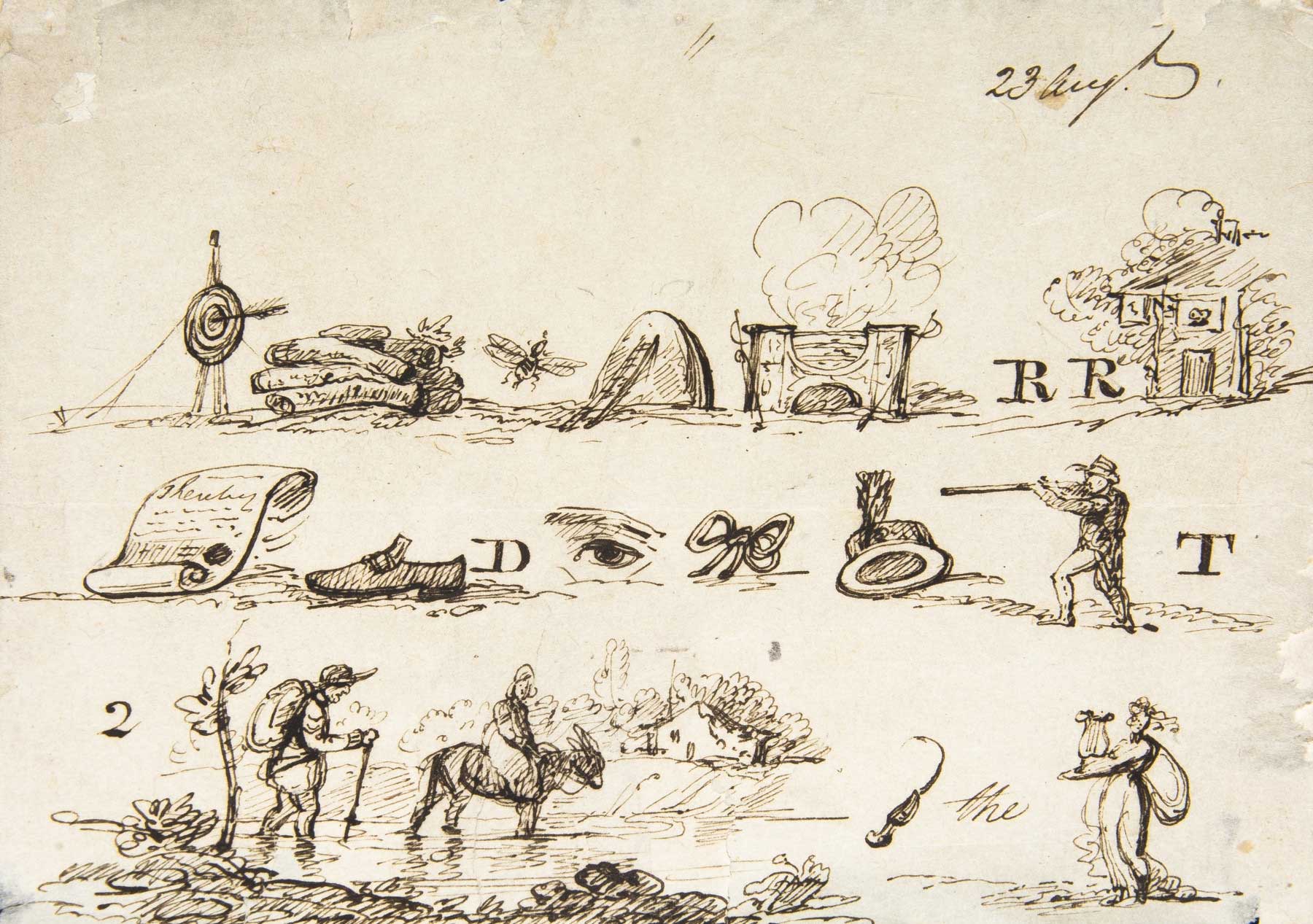
Bull’s eye = “I”
Pile of wood = “would”
Bee = “be”
Haystack = “a”. This one is frankly unconvincing, what is the ladder doing there, such a complex word for an article? [perhaps only “hay” with wrong aitch, that Lear found so oppressing].
Grate = “great”
R R (2Rs) = “arse”. Not likely, Lear, I think, would have drawn an ass.
Inn = “in”
Manuscript = “writing”
Shoe + D = “should”
Eye = “I”
Knot = “not” [couldn’t it be a Ribbon?]
Hat = “at-” [see note on “hay” above + Taking aim = “aim” + T = “attempt” [?!]
2 = “to”
People Fording a stream = “afford” [where does “af-” come from? “a ford” I suppose]
Hook to Catch fish = “catch”
The = “the”
Muse = “Muse”.
Which makes it “I would be a great arse in writing should I not attempt to afford to catch the Muse.”
Are there any experts in rebuses out there that can help us find a better solution? Please let us know.
I have started revising the page on Recording of Edward Lear Poems inserting links to the pieces available on Tidal and/or Spotify (of course they may be available on other services too). Here is a just-published CD which includes the first complete recordings of Stanford’s Nonsense Rhymes, composed, under the pseudonym of Karel Drofnatski, on poems by Lear:
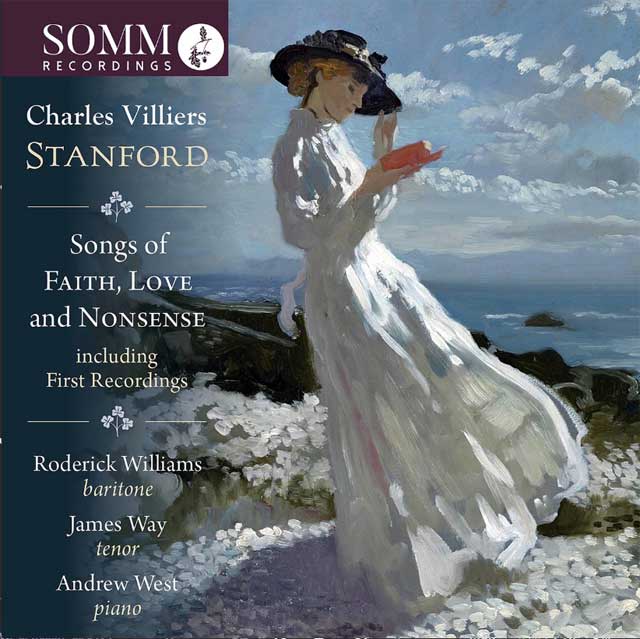
Stanford, Sir Charles Villiers. “Nonsense Rhymes nos. 1-14.” Songs of Faith, Love and Nonsense. Ed. Roderick Williams, baritone; James Way, tenor; Andrew West, piano: SOMMCD 0627, 2021. 

Previously on the Blog of Bosh: Who is Karel Drofnatsky?
From a review from Limelight:
Best of all are the delightful Nonsense Rhymes, settings over the years of limericks by Edward Lear with which the composer would regale his friends at private soirees. Stanford, it’s clear, was both a compositional dictionary and a ready wit. Musical jokes can fall flat but not here. Listen to how subtly he pastiches Grieg in The Hardy Norsewoman (“There was a Young Lady of Norway, who casually sat in a doorway”); or Beethoven’s Pastoral in The Cow and the Coward. I love the Richard Strauss send ups in Gongdicthung (“There was an Old Man with a gong, who bumped at it all the day long”). Equally brilliant is A Visit of Elizabeth (“There was a Young Lady of Joppa, who came a society cropper. One day with a friend, she went off to Ostend, and the rest of the story’s improper,” in which Stanford sets the text to the Prelude from Tristan before bringing in the ‘improper’ Venusburg music from Tannhäuser. Williams and Way have a ball and listeners should too since spotting the quotes is great fun!

Mathias, William. “Learsongs.” Choral Music. Naxos B081KRDQQF, 2020.
Learsongs: No. 1, Calico Pie.
Learsongs: No. 2, The Owl and the Pussycat.
Learsongs: No. 3, The Duck and the Kangaroo.
Learsongs: No. 4, Uncle Arly.
Learsongs: No. 5, The Pelican Chorus.
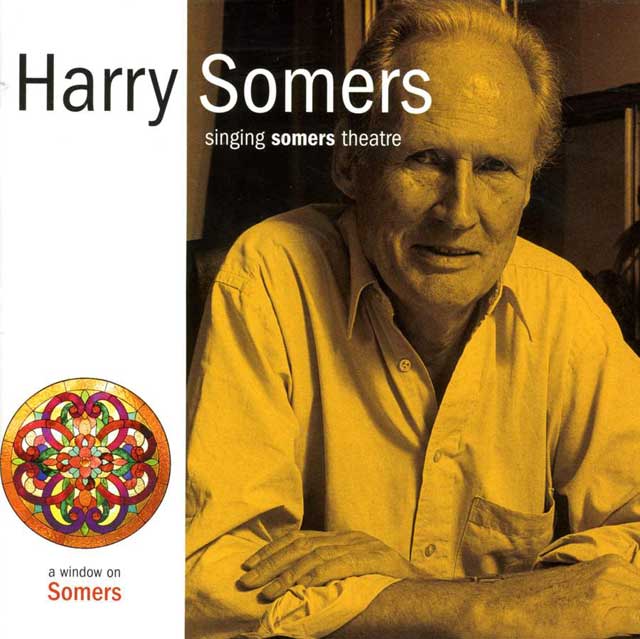
Somers, Harry. “Birminal Trilogy.” Singing Somers Theatre. Russell Hartenberger (percussion), Monica Whicher (soprano), Robert Cram (flute), Ryan Scott (percussion), John Hess (piano), Krisztina Szabo (mezzo-soprano), Michael Colvin (tenor), Julian Armour (cello), Andrew Tunis (piano), Kimberley Briggs (soprano), Tanya Turner (vocals), Barbara Chilcott (narrator), David Dunbar (narrator), Charles Fowler (vocals), Sung Chung (vocals): Centrediscs CMCCD6901, 2012.
No. 1. The Owl and the Pussycat.
No. 2. Pelican Chorus.
No. 3. Abstemious Asses, Zealous Zebras and others.

Ford, Andrew. There was a man lived in the moon : nursery rhymes and children’s songs / traditional tunes arranged by Andrew Ford ; performed by Jane Sheldon and Teddy Tahu Rhodes. ABC Classics 4812235, 2015.
Nonsense 1. The Owl and the Pussycat.
Nonsense 2. The Quangle Wangle’s Hat.
Nonsense3. The Jumblies.

Edward Lear, Pietra Secca (erroneously titled “Pietra Sella” in the auction page).
Signed and dated ‘E Lear 1844’ l.r. and inscribed with title l.l., pencil and charcoal heightened with white 17 x 12cm Provenance: The Estate of Sir Jack and Lady Baer.
If, like me, you only managed to see part of the symposium on Edward Lear in the Round and are a bit overwhelmed by its six and a half hours,maybe you will find my timing breakup of the schedule useful.
Welcome: Jonathan Watkins and Linzi Stauvers 00:4:06
Matthew Bevis – Edward Lear’s Moment 00:08-15
Session 1
Chair: Jonathan Watkins 00:45:52
Jenny Uglow – The Edge of the Sand: Liminal Lear 00:49:34
Kate Nichols – Lear Ruins 01:09:22
Jasmine Jagger – Moving Lines: Lear’s Tennysoniana 01:43:20
Audience Q&A 02:11:08
Lunch (nothing happens here) 02:31:15-03:31:15
Session 2
Chair: Linzi Stauvers 03:31:44
Cassie Westwood – How Not to Know Mr Lear 03:32:45
Noreen Masud – Lear’s Distracted Landscapes 04:00:50
Break (nothing happens here) 04:29:04-04:47:37
Session 3
Chair: Matthew Bevis 04:47:38
Sara Lodge – Edward Lear and Animation 04:48:50
James Williams – Edward Lear in the Mountains 05:24:12
Audience Q&A 05:56:10
Closing session: Matthew Bevis and Jonathan Watkins 06:18:40


 A Blog of Bosh