Meta: Feed Subscriptions and Podcast

In an attempt to get some idea of how many people are actually reading this blog I have decided to provide feed syndication through FeedBurner. Although the previous links will continue to work, if you use a feed aggregator to read A Blog of Bosh I suggest you update your subscription using the link provided on the right.

The switch will also allow me to publish in podcast format: just copy the link in the ipodder image into any podcast aggregator to subscribe.

What? Audio files? Yes, I am going to try and provide a podcast of Edward Lear-related audio material every week. Of course you will also be able to download the mp3 files directly from the blog.

If you do not know what all this is about but are interested in subscribing, I suggest you read the Wikipedia entries on RSS feeds and Podcasting.

Posted in General | Leave a comment

Jim's Big Ego's The Jumblies

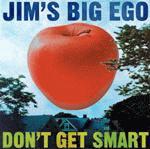
Don't Get SmartJim’s Big Ego have realeased their music under a Creative Commons licence which allows noncommercial distrubution, so here is their Edward Lear-based song, The Jumblies, from the album Don’t Get Smart.

If you want to hear earlier song versions of Edward Lear’s nonsense poems, including Elton Hayes’s and Craig McDonnell’s versions of The Jumblies, visit the “Sounds” section of nonsenselit.org. You will also find readings of Lear’s poems.

Thanks to Michael.

Posted in Edward Lear, Podcasts | Leave a comment

The Runcible Spoon and the Pizzafork

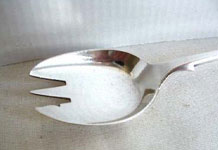
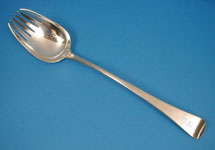
If you thought the runcible spoon (below left: a Victorian example by the renowned manufacturer Elkington & Co. Birmingham, ca 1880; right: George III Silver Runcible Spoon/Fork, John Hutson, London, 1800) was a strange object…

Runcible Spoon, ca 1880   Runcible Spoon/Fork, 1800

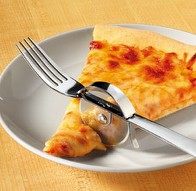
Take a look at this modern gadget, the Pizzafork:

Pizzafork, 2005

(Cory Doctorow, BoingBoing, 19 September 2005.)

Posted in Edward Lear | Leave a comment

Edward Lear in Italy

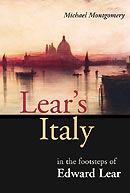
Cover

Michael Montgomery, Lear’s Italy. In the Footsteps of Edward Lear. London: Cadogan Guides, 2005.

When I ordered the book I expected a travelogue comparing present-day Italian places with what Edward Lear saw in his extensive travels (endless migrations) across the country, similar to Michael Booth’s Just As Well I’m Leaving. To the Orient with Hans Christian Andersen, whose author follows the Danish writer on a tour of Italy and the East (Reviews in The Observer, New Statesman, and The Independent).

After a few pages, however, it is obvious that this is not the case; Michael Montgomery, who is writing a screenplay about the “tragic story of Lear’s lengthy and ultimately unfullfilled love affair with Gussie Bethell”, is only interested in Lear’s life and does not know, or care about Italy. In the whole book I spotted no more that three personal remarks about the country, and their quality does not inspire one to wish for more, Mr. Montgomery clearly only has stereotyped opinions of Italy (which also transpires in the very short Independent review), so after quoting Lear’s first impressions of Naples and the asssault on his senses, he writes:

Barring only the advent of cars and cigarettes, and the brooding presence of the Camorra, it seems that little has changed in Naples over the past 150 years (42).

Apart from this, the book is not a disappointment. It strings together passages from Lear’s travel books, letters and diary, providing a lot of new material. In particular the chapters on Lear’s early travels in Florence, Rome and Naples are in great part extracted from never-before-printed letters to his sister Ann and later chapters include long extracts from his equally unpublished diary.

The book is stricly focused on voyage impressions so for the most part it only includes Lear’s observations on landscape, hotels and sometimes the general character of the people, and relates some of his, usually already famous, adventures. Readers interested in Edward Lear, and I do not see who else would buy the book, would probably have preferred to get more about his feelings and personal relationships (Lushington, Fortescue and Baring are mentioned only in passing, though they were probably the most important people in Lear’s life) as well as of his funny letters and drawings.

Posted in Edward Lear | 1 Comment

Lear Illustrated in America

Someone made curious by the announcement in the inside front cover of the January 1870 issue of Our Young Folks (number 61) that “another new contributor, a distinguished English artist, will furnish some laughable verses” would have been happy to find more details in the last page (72):

We shall give, in the February number, a capital specimen of nonsense-poetry, by Edward Lear, an English artist. It will be followed by others from the same hand. The author is one of Tennyson’s intimate friends, and the fact that these verses have been read and laughed over by the poet and his children, adds to their interest.

It takes a genius to write real nonsense. Few besides the immortal “Mother Goose” have ever had the gift of doing so, in a manner acceptable to children. These will be acknowledged genuine by all who can appreciate the ludicrous.

Lear had agreed to let Fields, Osgood, & Co. print some of his as-yet-unpublished nonsense songs in November 1869, after sending copies of his poems to the publisher’s wife, Mrs. Fields, on 14 October 1868 (The Complete Verse and Other Nonsense, edited by V. Noakes, London, Penguin, 2001, pp. 500, 506 and 510). The time of the anonymous publication of the Book of Nonsense was long gone:

You will I know kindly print my name in full “Edward Lear,” wh. will, when I get the Magazine, delight my feeble mind, & console me for remaining in this cold foggy place. After all, small as it may be, one does some good by contributing to the laughter of little children, if it is a harmless laughter.

(Edward Lear to James Fields, 18 November 1869; Vivien Noakes, Edward Lear: The Life of a Wanderer, revised edition,Stroud, Sutton, 2004, p. 203.)

Our Young Folks would publish three of Lear’s most famous songs, with nice original illustrations by J.H. Howard. The first to appear was The Owl and the Pussy-Cat (number 62, February 1870, pp. 111-2):

The Owl and the Pussy-Cat

The March issue (number 63, pp. 146-7) presented The Duck and the Kangaroo:

The sad tale of The Daddy-Long-Legs and the Fly would close the series in April (number 64, pp. 209-12):

Lear received his copies of the magazine in May 1870 and in August he wrote to Fields: “I thought the 3 poems very nicely printed, and capitally illustrated.” (The Complete Nonsense, p. 501.)
Posted in Edward Lear | 2 Comments

Edward Lear and Alice

One of the most common statements to be found in the frquent comparisons between Edward Lear and Lewis Carroll is that there is no proof that they knew each other’s work; for example John Lehman, in Edward Lear and His Work (1977, p. 50), writes:

One of the most interesting unanswered questions of literary history is whether Edward Lear and Lewis Carroll read one another’s works or were in any way influenced by one another. There is no mention of either in the other’s diaries or letters, as far as we have them.

Many, starting with the anonymous reviewer in the Spectator of 9 April 1887, have identified some sort of Carroll influence in Lear’s later production of songs. Lehman goes on:

Nevertheless it is perhaps not too fanciful to see a certain, possibly distant consanguinity between Lear’s songs and such poems by Carroll as “’Tis the Voice of the Lobster”, “Beautiful Soup” (though both were of course parodies) and “Jabberwocky”.

The mystery, at least in what concerns Lear’s knowledge of Alice’s Adventures in Woderland, is now solved; in the latest edition of her biography, Edward Lear: The Life of a Wanderer (2004, p. 203), Vivien Noakes writes:

At the end of August [1869, the letter is dated 25 Aug.] he received a letter from Fortescue. “Have you read ‘Alice in Wonderland’?” it asked. “It is very pretty nonsense.”

And in the footnote to this passage she laconically states that “Lear’s own copy of Alice in Wonderland is now in the USA” (p. 287, chapter 17 note 23). Nothing is said of this copy (are there any annotations?) and Lear’s reply to Fortescue’s letter has not been published, as far as I know, and it might even be lost. So we do not yet know what Lear thought of his “rival” in the field of Nonsense, but we can be sure that he knew the Oxford don’s most important book and that among his friends it was considered to belong to the same genre he had created more than twenty years before with the Book of Nonsense.

Posted in Edward Lear, Lewis Carroll | 3 Comments

:?

I am late on this, as I read about Hu Wenliang’s “novel without words” only today; but I live in Italy and receive the TLS very late… so others have already discussed it: from the dismissing attitude of CHINAdaily
which concludes the article by “doubting Hu’s novel as hype” to the balanced report of BoingBoing, which notes that Hu “claimed that he spent one year to write the novel”.

Anyway, the whole novel, entitled , reads (?) as follows:

:  ?
:  !
“ ‘……’ ”
(、)·《,》
;——

The TLS, whose text is slightly different from the one above, taken from CHINAdaily, justly observes that this is a translation of the original, so I’m afraid we do not have a chance of winning the US$16,900 that Hu promised as a reward for the first correct interpretation (don’t ask me where he is going to get that money, not from this novel, which has been pirated all over the Internet and will probably not sell much). You want to try anyway and need a hint? It is “a special touching love story.”

After an admittedly superficial analysis I am inclined to exclude from the canon of Nonsense literature, though its five-line structure somehow reminds me of the limerick. It is difficult to gather the details (or I would claim the prize), but it is obvious that it starts with a question/problem, immediately followed by a strong statement, then a hiatus/suspension, a quest and a happy conclusion.

If you prefer a more detailed interpretation Jon @ Rogue Semiotics offers the best one I know, though I’m not sure his reading of “touching” was what the author meant.

Posted in General | Leave a comment

Mr Lear: A Song Tribute

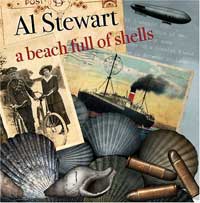
A Beach Full of Shells

Kim Dyer has written to let me know that a new album by Al Stewart, called A Beach Full of Shells (Appleseed Records, 2005), has just been released and it includes a tribute to “Mr Lear”.

You can listen to a passage on Amazon.com; the reviews are very favourable.

Edward Lear has always been a favourite with song writers, as the sadly incomplete Edward Lear and Music page demonstrates, and appeared as a character in the Beatles’ “Paperback Writer”:

Paul wrote “Paperback Writer” as another of his “letter songs.” It is about a novelist who is begging a publisher to publish his thousand page book. In its literal sense, it’s about a paperback writer who has written a novel based on another novel, about a paperback writer. Lennon’s contribution to this song was the phrase “a man named Lear,” and the reference to “The Daily Mail.” The name Lear came from the Victorian painter Edward Lear, who wrote nonsense poems that Lennon loved, and the Daily Mail was the regular newspaper Lennon received. It was recorded on April 13 and 14, 1966.
Oh Look Out! Part 16, 1962-1966 – The Red Album by John T. Marck

BTW, you can listen to two very early recordings of The Owl and the Pussy-cat (Columbia Quartet, 1902, and Haydn Quartet, 1904) in the Sounds section of the site.

Posted in Edward Lear | Leave a comment

Dreaming Alice

Starting on 6 June 2005 BBC Radio 4 will be broadcasting a series of programmes in which contemporary writers give a twist to Alice in Wonderland. You will be able to listen to them on the web for a week from the Programme Info page.

Still available for the next two days the broadcast for Tuesday, 31 May:

Writer and historian Jenny Uglow, author of A Little History of British Gardening, introduces an extract in which Alice encounters The Garden of Live Flowers from Lewis Carroll’s Through the Looking Glass. Read by Patience Tomlinson.

Thanks to A Wasp in a Wig.

Posted in Lewis Carroll | Leave a comment

Let Universe be Books

I have just received Justin G. Schiller Ltd.’s Spring Miscellany catalogue (no. 53) and among the many interesting items listed is an “original ink Manuscript lesson for teaching Logic, conceived in diagram format and dated by Dodgson in the upper right corner ‘5/3/94.'”

Let Universe be Books, a Dodgson MS

On 5 March 1894 Dodgson wrote in his diary:

Gave two Lectures in Logic, one at the High School, to the girls, at 2: the other to Miss Soulsby and four mistresses as well as Edith Lucy and Miss Scott, at 8 p.m.

More from the catalogue entry written with Edward Wakeling’s assistance:

Dodgson here is explaining in a simple way the logic terms “mutually exclusive” and “exhaustive”, as well as their converses. He uses a visual example of books on shelves to get his points across… The term “Universe” in this lesson means every known book that exists…

The MS was once part of the inventory of Blackwells of Oxford, who attended the dispersal auction sale of Dodgson’s library and effects in 1898, and they might have acquired it at this time, perhaps inside one of Dodgson’s books as a page-marker.

Posted in Lewis Carroll | Leave a comment