Lear Alphabet Manuscript and Wasp in a Wig to be Auctioned

Letter P

The Norman and Cynthia Armour Collection of Fine Children’s Books is to be auctioned by Christie’s in New York on 27 April 2005. Among the items there will be the manuscript of a nonsense alphabet. Here is the description for lot 94:

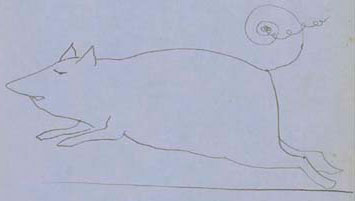
LEAR, Edward (1812-1888). Autograph manuscript for a pictorial nonsense alphabet, ca 1857. 26 separate leaves for each letter of the alphabet, each with large letter in ink at head, a pen-and-ink drawing at center and a quatrain with envoi at foot. Folio, written on blue paper with watermarks “Joynson” or crowned oval with Poseidon at center, each sheet with contemporary linen backing. With added sheets at end to form an album, containing three ink-wash sketches on two leaves of a duck and her young, a rabbit, and a goat and her young; and six hand-colored oval portrait etchings of children, these last sheets watermarked “Smith & Meynier Fiume.” Contemporary half roan, marbled boards (spine mostly perished); modern red quarter morocco folding case. Provenance: Ida Nea Shakespear (signature on flyleaf); sold Sotheby’s London, 20 April 1971, lot 543.

Lear wrote the manuscript during his stay in Corfu and presented it to Ida Nea Shakespear. The drawings and verses are similar to others which have appeared at auction and which Lear published. The most recent appearance at auction for a similar alphabet was at Sotheby’s London, 22 July 1980; this example was prepared for the Tennyson family circa 1855. Two printed examples can be found in Nonsense Songs, Stories, Botany, and Alphabets.

The well-traveled Lear is known to have visited Corfu on numerous occasions, first in 1848, having left Italy when the political situation there became unstable. He next went there in 1855 with Franklin Lushington, whom he’d met in Malta in 1848, though he spent most of this trip there alone and became depressed. His third trip to Corfu was over the winter of 1857. Other trips there were made in 1861, 1862, 1864 and 1877. According to Vivien Noakes, Lear made a number of these delightful alphabets for children up to 1870 (see Noakes, Edward Lear 1812-1888, London, 1985, p. 173).

Other Lear items of interest: William B. Osgood Field’s Edward Lear on My Shelves. Privately Printed [by the Bremer Press, Munich], 1933 (lot 96, $1,500-2,500) and two lots (95 and 97) of Lear or Lear-related books.
Wasp in a Wig

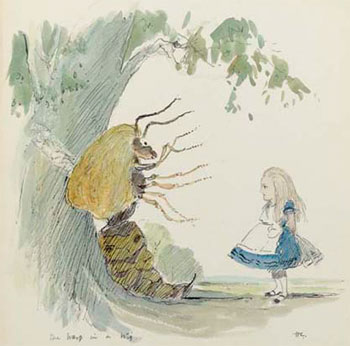
Also up for sale will be the (still controversial?) galley proofs for the Wasp in a Wig episode:

When they came to light at auction in 1974, after missing for over a century, the “discovery” of the present set of proof sent shock waves throughout the world of Carroll scholars and admirers alike. After fruitless attempts of finding any trace of the suppressed material, the draft was presumed lost, and some Carroll scholars even doubted it ever had ever existed. In 1977, the episode was published, with Mr. Armour’s generous permission, by the Lewis Carroll Society of America. The publication prompted an enormous amount of attention, and numerous articles surrounding the publication of the lost episode appeared in the U.K. and America press at the time…

They are expected to fetch between $50,000 and 70,000.
Posted in Edward Lear, Lewis Carroll | 1 Comment

Kinchinjunga to go under the hammer

Edward Lear's Kinchinjunga

The Telegraph of Calcutta reports that one of Edward Lear’s most famous paintings, “Kinchinjunga” (1873), is to be auctioned by Bonhams and is expected to go for a sum between £400,000 and £600,000:

The painting makes the cover of a Bonham’s catalogue, with an article on “Lear’s Indian Summer” by his biographer, Vivien Noakes, who curated a major exhibition, Edward Lear: 1812-1888, at the Royal Academy in London 20 years ago.

Lear went to India in 1873 at the invitation of his friend, Thomas Baring, the first Earl of Northbrook, who had become Viceroy of India the previous year. The painting was bought by another of Lear’s friends, Henry Bruce, who had become Lord Aberdare in 1873.

Posted in General | Leave a comment

A New Dr Seuss Movie in the Making

Horton Hears a Who - cover

A Wasp in a Wig, a new blog centered on Lewis Carroll, has a post about the projected 20th Century Fox production which will follow on Ice Age 2. As Jerry Beck reports at Cartoon Brew Horton Hears a Who had already been adapted by Chuck Jones in 1970.

For the whole story, see the Hollywood Reporter.

Posted in Dr. Seuss | Leave a comment

Lewis Carroll at the Family Records Centre

From the opening page of Carroll’s section at the Family Records Centre:

Lewis Carroll, the author of the Alice books, is probably Britain’s best known writer of children’s fiction. Less well known is the ‘other’ Lewis Carroll, the mathematician, churchman, photographer and Student of Christ Church College, Oxford, who was more familiar to his friends and colleagues as the Reverend Charles Lutwidge Dodgson.

This exhibition tells the story of his life, from his birth at Daresbury, Cheshire, through his long years at Christ Church to his quite sudden death at his sisters’ house in Guildford.

The story is illustrated using documents from the Family Records Centre, The National Archives and elsewhere.

The site also includes an exhibition on Ellen Terry, a famous actress who was also one of Charles Dodgson’s so-called child friends; also see this short biography of Terry at About.com.

Posted in Lewis Carroll | Leave a comment

Carroll and Money

Lewis Carroll - In His Own AccountLewis Carroll – In His Own Account by Jenny Woolf (Jabberwock Press, 2005) is an annotated transcription of Dodgson’s bank account from 1856 to 1900 (two years after his death) and shows that Carroll was in the red for most of this period, thus contradicting “his reputation for financial sharpness” (Jenny Woolf’s piece on the book in the Times Literary Supplement, “Sounds and Sense”, no. 5315, 11 February 2005, a generous excerpt is available through Blogcritics.org).

The book also shows that, notwithstanding the overdrafts, he was generously helping both individuals and institutions, most notably those concerned with “the plight of the many women and children who were trafficked and abused by the Victorian sex trade” and is therefore relevant to the ongoing war over his sexual preferences (see also): “these donations were not made for show, but were kept entirely private.”

Also see an interview with Jenny Woolf in the Camden New Journal and a short post at A Wasp in a Wig.

Jabberwock now has a page which provides errata, new information and “other useful comments” about the book.

Posted in Lewis Carroll | 1 Comment

New Editions

Jean Harrowven’s The Limerick Makers, originally published in 1976 has now been reissued by Borrowdale Press. The book, little more than a small anthology tracing the origins of the form as far back as possible and supporting the Maigue Poets’ hypothesis, was not really convincing or original. The TLS reviewer (28 May 2004) however has been impressed by such “curiosities” as the Latin passage from St. Thomas Aquinas, whose discovery, however, according to A.N. Wilkins, dates back to 1925 and should be attributed to Ronald A. Knox.

What I appreciated in the first edition was the full text of two pre-Lear limerick books, The History of Sixteen Wonderful Old Women (b/w facsimile at Hockliffe) and Anecdotes and Adventures of Fifteen Gentlemen (local colour edition). A third similar book, Anecdotes and Adventures of Fifteen Young Ladies (b/w facsimile at Hockliffe), is also available.

Vivien Noakes’s Edward Lear. The Life of a Wanderer (Collins, 1968) has also been reprinted in a “revised and enlarged” edition (Sutton Publishing, 2004): this is the standard biography and is indispensable for anyone interested in Lear; I’ll be reading it in the next weeks and report if I find any relevant new information.

Posted in Edward Lear | Leave a comment

Alice in Oxford

The original manuscript of ‘Alice’s Adventures Underground’ given to the real Alice – Alice Liddell – by Lewis Carroll as a Christmas present in 1864, is the basis for a new website at http://www.aliceinoxford.net/play.htm. ‘Journeys to Wonderland’ takes children on a multimedia journey, shedding light on Alice’s adventures and telling the stories of Lewis Carrol and the real and fictitious Alices along the way. The website is a partnership between the British Library, Museum of Oxford and South East Museums, Libraries and Archives Council (SEMLAC).

From the BL’s Press Release showing a nice colour reproduction of the first page of Carroll’s manuscript.

The Alice in Oxford site’s main feature is a profusely-illustrated presentation of the story and all the people and places connected with its creation, with activities such as “Make your own Pool of Tears” or “Make a fun ‘Off with your head game'”, but it also includes short biographies of Carroll and Alice Liddell as well as information on Oxford.

Posted in Lewis Carroll | Leave a comment

Kiddie Records Weekly

For the entire 2005 year, Kiddie Records Weekly, part of the Basic Hip Digital Oddio, will be featuring weekly stories and songs from the golden age of children’s records, from the mid 1940s to the early 1950s. Visitors will be able to listen to a low-resolution audio stream or, but only for one week, download a higher resolution version.

The first to go online is WD’s Story of Robin Hood, a 1952 double 78RPM record from Capitol with a 20-page booklet; next, from 10 January, The Adventures of Tom Thumb.

Posted in General | Leave a comment

Lewis Carroll — Pornographer

A picture from the album (the only one I dare reproduce!)

When, on a warm day in the spring of 1882, Christine Horly, whom her friends called Alice Number Three, “passed to a worse life by getting married”, as you can read in her sinful diary of forty years later, she received a secret wedding present, a picture book, … from a by-now bald professor of mathematics, whom she called uncle Lewis; the picture book, here reproduced in part, made of photographs, drawings and cuttings coming from various sources: broadsheets, periodicals, books, newspapers – French, German, Danish, English… Over a thousand pictures, illustrated pages, vignettes and frames covering many pages pasted together to form an extraordinary pirotechnicographic game, a paper museum of the amazing, of unusual “montages”, of surreal and dada intuitions, accompanied by iambs, epodes, nonsense and strambotti as well as cicalate and bazzecole often vey smart. But, most of all, that secret wedding present, represented, and it still does, one of the greatest masterpieces of that privately-produced and clandestine pornography… (p. 91)

So opens a chapter on “Londra, Victorian Hard & Sex Nonsense” in Ando Gilardi’s Storia della fotografia pornografica (Milano, Bruno Mondadori, 2002, pp. 91-128). The reader may well wonder who that “uncle Lewis” might be, but the mystery is clearly revealed only after nine pages of confused invectives against previous critics and after proposing the most fantastic idea of the origins of the limerick (to be discussed in a future post):

Lewis Carroll, genial father of the obscene visual nonsenses [read: limericks, even if they are not formally correct ones], was an enthusiastic but jealous reader of Edward Lear’s nonsense… His biographers… almost always omit to mention that the famous novel written by the “nasty uncle”… is a vast learian nonsense. In Alice’s Adventures in Wonderland… (p. 100)

There can be no doubt that Gilardi is here attributing the scrapbook to Charles L. Dodgson; unfortunately, he does not state its provenance – the reader is perhaps expected to think it is in his possession. He does state that it is hitherto unpublished (he prints a number of pages from it), but also declares that his history of pornographic photography has already been published “in instalments” twenty years earlier and makes obscure references to critics who are not willing to study the book (p. 102).

I have read the chapter at least three times and can’t really make up my mind whether it is a complex joke or Gilardi is serious about what he says; the other chapters in the book suffer from sloppy references, though at times they are a little more detailed, but generally tell a credible history of pornographic photography, the publisher is certainly a reputable one and Gilardi himself is the author of a Social History of Photography.

On the other hand it is difficult to believe that the Reverend Charles Ludwidge Dodgson could have written pseudo-limericks such as:

It is a young lady con the pail
with uccel-cazzon che la beccail
But she said “I don’t te tail te tail
All the birds non tal qual the ti air
Are welcome he untied the calson!”

Unless I miss something, this joycean language, which does not deserve a hint of comment from Gilardi, who translates it very freely to say the least, puts together ungrammatical English and Italian vulgar expressions and appears to have been written by someone who could not even speak decent English or standard Italian. A little strange for someone so evidently striving to imitate the two great Nonsense writers of the age: each rhyme is accompanied by a new version of Lear’s original drawing for the corresponding limerick, with pornographic details, of course.

I should say that unless a very convincing original is produced such material cannot even be taken as having been created in England at the end of the Nineteenth century.

Posted in Edward Lear, Lewis Carroll | Leave a comment

Edward Lear Vase to be Auctioned

A detail of the vase.

Here is the press release I received today:

A chance to own a unique piece of pottery – while helping children in need!

As part of its annual effort to help the BBC’s Children In Need Appeal, the Stoke on Trent (Staffordshire) craft pottery, Moorcroft, has created a one-off, unique vase – which it is auctioning this month.
The vase, created by Moorcroft designer Nicki Slaney, is on the theme of the famous children’s poem by Edward Lear, “The Owl and the Pussycat”.
Because no other copy of this vase does or will ever exist, the bidding is expected to go into the hundreds of pounds, as Moorcroft collectors all over the world join in the auction.
The design is recognisably Moorcroft – but with a little hint of tongue-in-check mischief too!
Nicki said: “It was a great pleasure to be involved in the making of this piece. Edward Lear’s poem has made children laugh for over a hundred years, so it was most suitable for a charity which supports troubled children everywhere”.
Bids are permitted right up to Children in Need day, which this year falls on November 19th.
To make a bid, have a look at the vase in detail, and to check the latest state of the bidding, log on to http://www.bbc.co.uk/stoke and select the “Moorcroft” link.
(November 2004)
For more details…
Go direct to auction webpage

Posted in Edward Lear | Leave a comment