Elton Hayes: The Table and the Chair

Elton Hayes published three 78-rpm records with Edward Lear songs, the first one in October 1950 (Parlophone R 3329) and containing The Table and the Chair and The Jumblies (to be posted next Wednesday).

This was followed by Parlophone R 3602 (December 1952), containing The Broom, the Shovel, the Poker and the Tongs and The Quangle Wangle’s Hat, and Parlophone R 3692 (June 1953), with The Duck and the Kangaroo and The Owl and the Pussy-cat.

All six recordings were finally collected in the EP For The Children, Parlophone (GEP 8551) in 1955.

Posted in Edward Lear, Podcasts | 1 Comment

Mairzy Doats

I’m also resuming the Nonsense Lyrics from the 1940s series after the hiatus due to the site hacking. This week Mairzy Doats ( words and music by Milton Drake, Al Hoffman, Jerry Livingston. Miller Music Corp., NYC, 1943) in Al Trace’s 1944 version.

MAIRZY DOATS
Al Trace

Oh, mairzy doats and dozy doats and little lambsy divey
A kiddle divey, too. Wouldn’t you?
Oh, mairzy doats and dozy doats and little lambsy divey

A kiddle divey, too. Wouldn’t you?

If the words sound queer and funny to your ear,
A little bit jumbled and jivey.
Say, “Mares eat oats and does eat oats
and little lambs eat ivy.”

Oh, mairzy doats and dozy doats and little lambsy divey
A kiddle divey, too. Wouldn’t you?
Oh, mairzy doats and dozy doats and little lambsy divey
A kiddle divey, too. Wouldn’t you?

Posted in Nonsense Lyrics, Podcasts | 1 Comment

The Owl and the Pussy-cat

I am still working on the new nonsenselit.org site, but have decided to take down the “Sounds” section and re-post weekly what was in it here.

This week I’m posting a full BBC Radio 4 program of 2 December 2000 about Lear’s most famous poem, The Owl and the Pussy-cat. It was part of the series Adventures in Poetry and produced by Peggy Reynolds. It’s a big file (about 19 megs), but it’s worth the time to download!

Posted in Edward Lear, Podcasts | Leave a comment

Fol-the-rol-lol

The recently launched Cylinder Preservation and Digitization Project at the University of California, Santa Barbara, provides a great collection of early recordings from the Edison era.

Among these Edward M. Favor‘s Fol-the-rol-lol is one of my favourites, at least since Arthur Deex sent me a cassette with one of the two recorded versions (I’m sorry to say the cassette has gone missing: I have been searching for it at least since I started this podcast).

The one above is the later, longer version of 1908, but do not miss the 1905 one, also available on the site and probably not known to Arthur.

Arthur, the most learned of limerickologists, also sent me an article from his monthly newsletter, The Pentatette; I’m sure he will not be offended if I republish it here:

FOL THE ROL LOL
Arthur Deex

Although all but forgotten today, one of the earliest (if not the original) refrain to the sung limerick was “Fol the rol lol.” When Edward M. Favor, the noted vaudeville comedian and singer, appeared in England and America at the turn of the century (1898 to 1910) his repertoire of “comic song(s) in Irish dialect” included limericks with the “Fol the rol lol” refrain after each pair of five line verses.

In the great “record wars” of 1905-1908, the National Phonograph Co. and the American Gramophone Co. discovered what was to become the first law of canned music — You make more money on records than you do on players. One of the early two minute wax (metallic soap compound) cylinders recorded by Edison in November 1905 was Edward M. Favor singing limericks. As the fever of competition swept though the infant record/recording industry (there were a surprisingly large number of companies) the Indestructable Company threatened to flood the market with its high quality Indestructable Records. Edison responded with a four-minute record, albeit on the same fragile cylinders as its standard two-minute version. In the race to regain its share of the market, Edison sold conversion kits for its older recorders virtually at cost. For five dollars (eight-fifty for fancier models) a gear reducer, reproducer, and a set of ten “specially-recorded demonstration records” could be obtained. By the end of 1908 thousands of the Edison kits had been sold and thousand of Edison recorders could play the new (200 grooves per inch) long playing four minute cylinders.

One of the very first, number fourteen to be specific, of the new Edison “Amberol” records made at the Edison studio and factory in West Orange, NJ, was a four-minute version of FOL THE ROL LOL by Edward M. Favor. Cut in September 1908, this recording was listed as “Fol-the-rol-lol, Limericks. Eighteen verses of nonsense, but the kind of nonsense that is clever and mirth-provoking.” It shared the lime light with such other Amberol favorites as “Gee! But It’s Great to Meet a Friend from Your Home Town” by Billy Murray, “He’s My Soft Shell Crab on Toast” by Marie Dressler, and “Goo-Goo Land” by Harry Fay.

The record began with an announcement by Favor that this was Fol The Rol Lol by Edward M. Favor, presented by Edison. Then he jumped into the limericks (with accompaniment):

I just learned a comical ditty
From some of my friends in the city.
      The verses are short
      And I think that you ought
To admit that the verses are witty

There was a young lady from Pella
Fell in love with a bowlegged fella
      This nutty young chat
      Made her sit in his lap
But she fell staight through to the cella

Fol The Rol Lol – Fol The Rol Lol –
Fol The Rol Lol La La Lonny

Fol The Rol Lol – Fol The Rol Lol –
Fol The Rol Lol La La Lonny

The verses continued in pairs followed by the nonsense refrain…

There was an old woman took stuff…

A Russian he rushed into Russia…

Jim Jones was the son of a brewer…

The was an old lady in Worchester…

A certain young maiden named Emma…

There was a bright youngster from Maine…

There was a young miss from Decatur…

Another young miss from Fall River…

A composer who lived in the ghetto…

There was an old maiden named White…

There was a young man from Woontucket…

There was a young girl from Pawtucket…

A dame in a riverside flat…

There was a young lady in Lynn…

There once was a blushing youg bride…

There was a young lady named Mabel…

The only one familiar to today’s limerick buff is the young lady from Lynn, who was so uncommonly thin… and fell in.

Listening to Favor belting out the verses in his “stage Irish” dialect, brings waves of nostalgia for the music hall circuit when burlesque was a family affair. It is interesting to note that of all the principals – Edward M. Favor, Amberol Records, the “Fol The Rol Lol” refrain, and the limerick – only the limerick remains.

From The Pentatette, March 1985.
Posted in Limerick, Podcasts | Leave a comment

Meta: nonsenselit.org hacked

I’m sorry to say that the main page of nonsenselit.org has been hacked. This has already happened a couple of times since last summer, but I’m not going to repair it this time as I no longer trust PostNuke enough: I’ve been thinking of moving to another CMS for some time and this is a good opportunity. The new, improved site should be up in a couple of days.

In the meantime, the sections devoted to Edward Lear, Peter Newell, TheFlight of Old Woman Who Was Tossed Up in a Basket and Nonsense in the Early Comics are all available as usual.

Posted in General | Leave a comment

Mr and Mrs Spikky Sparrow

The Owl and the Pussycat and Other Nonsense Songs

This week’s song is from a three-record box published by Bluebird Records (made by RCA Victor) in the late 1930s early 1940s.

Mr and Mrs Spikky Sparrow, music by Helen E. Myers, sung by Craig McDonnell.

Posted in Edward Lear, Podcasts | Leave a comment

Nonsense Lyrics: Slim Gaillard

I am starting a new podcast of songs with nonsense lyrics, to be posted on Fridays.

The first is Sam Gaillard, a specialist, with Ra-da-da-da (1942).

Posted in Nonsense Lyrics, Podcasts | 1 Comment

The Courtship of the Yonghy-Bonghy-Bo

Front cover

David DavisThis week’s podcast is The Courtship of the Yonghy-Bonghy-Bò, read by David Davis, side 2 of his 1966 45-rpm record, The Nonsense Songs of Edward Lear Read by David Davis, Delysé DEL 158. Side 1 has The Daddy Long-Legs and the Fly and The Broom, the Shovel, the Poker and the Tongs.

David Davis is familiarly and popularly known as “David” to millions of children. His friendly and natural manner of telling a story over the air has made him beloved by listeners of all ages. (back cover.)

In 1970 an LP was published by Marble Arch (MAL 1272 mono), A Bumper Collection of Nonsense Songs and Poems Read by David Davis: side 1 is devoted to Lear poems (none of the ones in the 45 rpm were republished) and side 2 to Lewis Carroll’s.

Posted in Edward Lear, Podcasts | 1 Comment

Uttered Nonsense

Uttered Nonsense cover

Eight works of Mr Edward Lear, spoken with the utmost gravity by Mr Ivan Smith, and set to music of the most nonsensical nature by John Sangster. These eight word-pieces embedded within fourteen more instrumental excursions which take their titles and their inspiration from the Nonsense Books of Edward Lear.

The double LP, Uttered Nonsense (The Owl and the Pussycat), was published in 1980 by Rainforest Records Australia (RF LP001). Here are the opening pieces from Side Four, an instance each for the instrumental excursions and accompanied readings:

Closing the LP notes, John Sangster (1928-1995) wrote what he probably considered some sort of manifesto for Nonsense music:

From the enjoyment of and love for [Edeard Lear’s] works comes the Uttered Nonsense. Nonsense-Music. Goodness knows there’s not much of it about. Things being what they are nowadays. Nonsense-Music I guess should be at the same time provocative, silly, amusing, curious, thought-provoking, complex and direct, full of quotes and mis-quotes, puns, malapropism, musical spoonerisms, tight-ropes negotiated and bear-traps set up and then avoided, satisfying, adroit, nimble, fanciful, and above all entertaining and jolly.

Posted in Edward Lear, Podcasts | Leave a comment

The Earliest Recordings of The Owl and the Pussy-cat

Edward Lear’s most famous Nonsense song, The Owl and the Pussy-cat, was among the first pieces of music to be recorded.

Label for 1904 Haydn Quartet Owl and Pussycat

I have been able to find three different recordings of the same arrangement for four voices, here they are:

  1. 1902 by the Columbia Quartet (later Peerless Quartet), Columbia A398 (751)
  2. 1904 by the Haydn Quartet, VictorTalking Machine 87
  3. early 1920s by the Big City Four, Pathé 20793

An online directory of the oldest recordings states that the music is by George Ingraham (The Owl and the Pussycat. New York: G. Schirmer, 1886) but, though the score on the Lester S. Levy Sheet Music Collection is for piano and voice and I am no expert, these sound very different to me. However Ingraham is also listed as the composer of The Jumblies (Schirmer’s Octavo Choruses for Men’s Voices; 1st Ser. New York: G. Schirmer, 1891) for four male voices, so he might have written a chorus arrangement for the Owl and Pussycat too.

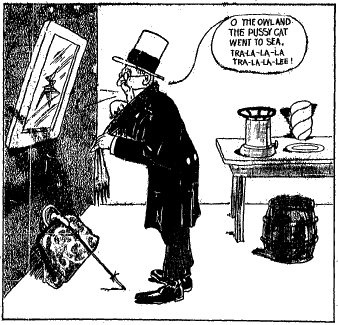
I suspect this is the version Boggs the Optimist is singing in the first panel of a December 29, 1901 comic strip in the Chicago Tribune comic supplement. The strip is from a site I am still working on, Nonsense in the Early Comics, so this is a preview. Thanks to Holmes of Barnacle Press for bringing this to my attention.

Posted in Edward Lear, Podcasts | 2 Comments