Three Lear Limericks

Although it may sound sacrilegious, some artists have actually chosen to re-illustrate the verses in Edward Lear’s A Book of Nonsense. These Latter Day Neo Reform Limericks keep popping up everyday in bookshops.

Janina Domanska

It’s not that Lear didn’t get it, or that Lear couldn’t draw, it’s just that that was then and this is now. When Renaissance artists painted Biblical scenes, they didn’t depict the patriarchs as scruffy, unwashed, nomads, they sketched them as wealthy Italian noblemen wearing proper garb. And so Lear’s old men are drawn according to modern views for modern times. They aren’t better; they aren’t worse; they are just different.

Displayed here are a number of modern illustrations for three of Edward Lear’s most popular limericks — An Old Man with a beard, An Old Man in a tree, and An Old Man who said, “Hush!”

If you have other examples (and there are quite a few) in your collections, please add them to this Blog of Bosh.

Arthur

Posted in Edward Lear, Limerick | Leave a comment

To the Land Where the Jam-tree Grows !?

Nothing […] amused Lear more than the failure of some people to appreciate the utter absence of sense in his nonsense. He used to relate that some one once wrote to him to say that he had marched various botanical and other works without finding any allusion to a “Bong-tree.” Where, his correspondent, asked, did the “Bong-tree” grow?
[Evelyn Baring, “Introduction.” Queery Leary Nonsense. A Lear Nonsense Book. Edited by Lady Strachey. London: Mills & Boon, 1911.]

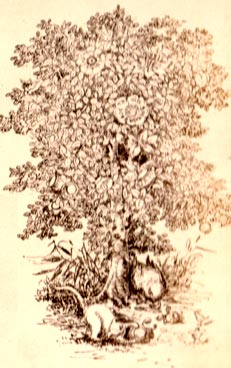
The question is a recurrent one, and I myself have sometimes been asked it, why the Bong-tree? The problem of the Bong-tree is an early one if the producer of The Owl and the Pussy Cat and Other Nonsense Songs, Illustrated by Lord Ralph Kerr (London: Cundall and Co., 1872), which you can see in facsimile in our Picture gallery, felt the need to replace it with a more appetizing and less nonsensical “Jam-tree”.

The Jam-Tree

Vivien Noakes, in her definitive edition (Edward Lear. The Complete Verse and Other Nonsense. London: Penguin, 2001: 507) presents the modern interpretation:

The coach-road along which Lear would have travelled between Liverpool and Knowsley, passes through the village of Knotty Ash, said to have taken its name from a gnarled ash tree which once stood outside the public house beside a group of cottages called ‘The Little Bongs’. The tree was known locally as ‘the ash tree at Little Bongs’, and may have been the inspiration for Lear’s Bong tree.

Noakes prudently adds that “on the other hand, he may just have liked the sound of the word”, and in fact manuscripts at the Houghton Library and Pierpont Morgan Library contain variants (“Phloss tree” and “Palm tree” respectively).

Another influence on the final choice of the name which I have never heard mentioned might be the “Bo-tree”, or Indian fig tree, said to be the tree under which the Buddha became enlightened (Ficus religiosa, family Moraceae). On its eastern side is “the immovable spot on which all The Buddhas have planted themselves! This is the place for destroying passion’s net!”. While Siddartha is sitting there he is attacked by the god Mâra, but his perfection protects him, and the evil god is defeated (Buddhism in Translations. Passages Selected from the Buddhist Sacred Books and Translated from the Original Pâli into English by Henry Clarke Warren. Harvard University Press, 1896. § 8: The Attainment of Buddhaship). Just after attaining buddhaship “the Blessed One sat cross-legged for seven days together at the foot of the Bo-tree experiencing the bliss of emancipation” (§ 9: First Events after the Attainment of Buddhaship).

The quest of the owl and the pussy-cat is more earthly, of course, but it also leads to bliss, and the rhythm of the poem, with its long, repeated sounds at the end of each stanza clearly gives it some sort of ecstatic quality.

Posted in Edward Lear | 1 Comment

Ye Book of Sense

Arthur Deex has digitized two more early limerick books, Ye Book of Bubbles (1864) and Ye Book of Sense (c1870), and writes of the latter:

Book of Sense, p. 17

A Review in the May 88 Pentatette

A recent addition to my collection was a book of limericks that was previously unknown to me: Ye Book of Sense: A Companion to the Book of Nonsense. Philadelphia: Porter and Coates, n.d. Title and thirty-one hand colored plates. Oblong 8vo. c1870.

Its oblong shape [the first books of nonsense / limerick verse were all oblong to accommodate their three or four line format; they remained oblong for a time even after format stabilized at five lines] and the reference in the title to Lear’s Book of Nonsense clearly mark it as one of the earliest American books of limericks.

A reasonably accurate estimate of the publication date of the book requires more than a little conjecture built on observation:

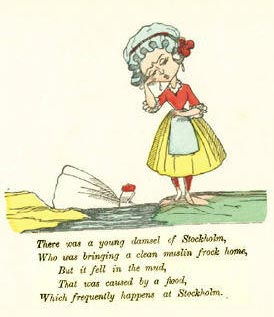
Although the limericks are obviously Lear inspired there are marked changes from the Lear style.

Only seventeen of the thirty-two limericks in the book use the standard Lear first line rhyme word as the fifth line rhyme word.

Ten of the limericks are not geographically oriented.

The clothing styles in the illustrations are not unlike Civil War fashions. There are no uniformed men, however, — in fact most of the men wear full length robes or skirts.

Not as rough in metre and rhyme as the Sanitary Fair limericks, they are completely free of references to soldiers or the Civil War.

To me all this this suggests that they pre- or post- date the war by several years. Because of the maturity of the verses, and by this I mean dissimilarity with A Book of Nonsense, I place it about 1870. The verse on the back cover suggests the same kind of fund raiser as the Sanitary Fair limerick books.

It could, on the other hand, be immediately prior to the Civil War; A Book of Nonsense was, after all, published in 1846 – leaving plenty of time for the notion of the nonsense verse to cross the Atlantic.

And adds in the e-mail:

An interesting side point is that the single vertical picture (p 30) is bound with feet left (toward the spine) and head right (away from the spine). That makes the picture upside down when you read the book. I don’t know if that was intentional or just a mishap down at the binding shop.

There are two known copies of this book in addition to mine: University of Florida and The Newberry Library, Chicago. My estimate of the date of publication is 1870 — U Florida puts it at 1878 and The Newberry, 1860s –so the consensus is 1870 +/- a decade.

Posted in Limerick | Leave a comment

A Limerick Alphabet by Edmund Dulac

Arthur Deex has acquired a very nice copy of a rare book of limericks and has kindly chosen to share it:

Dulac, A Limerick

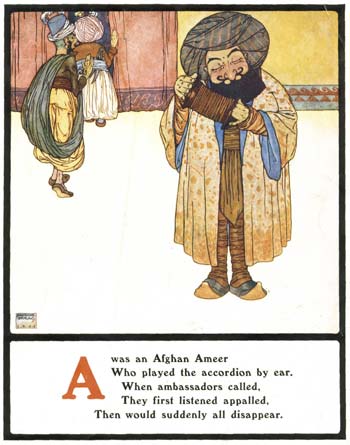
Lyrics Pathetic and Humorous from A to Z by Edmund Dulac (1882-1953) is a delightful Alphabet Book of 24 colorful plates (X, Y & Z are combined), each with a limerick. The book was published in London and New York in 1908 by Frederick Warne & Co. A year later in 1909 a deluxe limited edition of about 160 copies was issued in portfolio form much taller than the standard edition — large quarto, title-page and twenty-four color plates, each mounted on dark green art paper with original parchment endpapers from the book edition also mounted on folded sheets of dark green art paper.

Born in 1882 France, Dulac, a gifted teenage artist, made it through two years of studying law before the boredom of law school and the winning of a prize at the Ecole des Beaux Arts tipped him into an art career and he became a full time art student. His arrival in London in 1904 just as the “color separation” process of reproducing color plates was invented fortuitously placed him at the birth of the illustrated gift-book. Edmund Dulac became one of the five major “Golden Age” gift book illustrators. A gifted caricaturist, Dulac was at his best in Lyrics Pathetic and Humorous.

The Metropolitan Museum of Art in 1980 published the Book of Names and Addresses: With Illustrations and Text Adapted from Lyrics Pathetic & Humorous from A to Z by Edmund Dulac. About a decade later in 1993 Abbeville Press published F was a Fanciful Frog a modern smaller reprint of Lyrics Pathetic and Humorous.

Go see it! And don’t forget that Arthur edits, writes and publishes The Pentatette, a monthly newsletter on all aspects of the limerick.

Posted in General, Limerick | Leave a comment

Edward Lear Music in Sanremo

At the end of 1997, the city of Sanremo held an exhibition of Edward Lear paintings and watercolours; there was also a concert of his Tennyson arrangements and of Dudley Glass’s settings of his poems on 7 December. Here is my recording of the event, not very good quality, I admit, but better than nothing. Note that most pieces are not actually sung, though a singer was available, only the tune is played by the orchestra.

Programme

Poems and Songs, words by Alfred Tennyson, music by Edward Lear

  1. Edward Gray
  2. Tears, Idle Tears
  3. Come not when I am dead
  4. Home they brought her warrior dead
  5. A Farewell
  6. As through the land at eve we went
  7. O let the solid ground not fail
  8. The time draws near

Nonsense Songs, words by Edward Lear, music by Dudley Glass

  1. The Duck and the Kangaroo
  2. The Owl and the Pussy-cat
  3. The Broom the Shovel, the Poker and the Tongs
  4. Calico Pie
  5. The Daddy-Long-Legs and the Fly
  6. The Table and the Chair
  7. The Courtship of the Yonghy-Bonghy-Bò
  8. The Quangle Wangle’s Hat
  9. Mr and Mrs Spikky Sparrow
  10. The Jumblies

Yusiko Ido, mezzosoprano

The Edward Lear Music Ensemble

Vitaliano Gallo, director, fagotto, arrangements
Laura Ondertoller, violin
Wynneford Potter, viola
Davide Galaverna, double bass
Marco Bottini, flute, piccolo
Claudio Quintavalla, trumpets
Sandro Castaldi, percussions
Giovanna Solinas, harp
Roberto Mingarini, piano, director

Posted in Edward Lear, Podcasts | Leave a comment

The Time Draws Near the Birth of Christ

Edward Lear published two collections of arrangements of Alfred Tennyson’s poems. This first, in 1853, included four settings (‘Edward Gray’, ‘A Farewell’, ‘Tears, Idle Tears’, and ‘Sweet and Low’), the second, in 1859, added five more, including the one I am posting this week, for obvious reasons: The Time Draws Near the Birth of Christ. It is a setting of section CIV of In Memoriam.

The song is from a casette published in 1984 by Cabaletta (TCDN 5004) and was performed by tenor Robert Tear, accompanied by Gareth Morrell. Besides all nine Lear settings of Tennyson’s poems, the cassette contains five Liza Lehmann’s arrangements of Belloc’s Cautionary Tales and two more songs by Sterndale Bennett. The recording must be very obscure as I cannot find any reference to it anywhere, except on my page on Edward Lear and Music: time for a reprint?

Posted in Edward Lear, Podcasts | Leave a comment

Nonsense Lyrics: Aba Daba Honeymoon

This week’s nonsense song has much in common with The Owl and the Pussy-cat; Aba Daba Honeymoon is another happy story of love and marriage, in this case between primates. It was written by Arthur Fields and Walter Donovan and brought to success by Ruth Roye, Princess of Ragtime, in 1914. The version I am posting was performed by Arthur Collins and Byron G. Harlan and is taken from the UCSB Cylinder Digitization Project (sheet music at the University of Colorado)

Aba Daba Honeymoon

More information and a somewhat better version at the American Memory site of the Library of Congress; a modern arrangement of the song, by The Fabulous Heftones, is also available under a Creative Commons licence.

Aba Daba Honeymoon

Way down in the Congoland
Lived a happy chimpanzee.
She loved a monkey with long tail
(Lordy, how she loved him!)
Each night he would find her there,
Swinging in the cocoanut tree,
And the monkey gay,
At the break of day,
Loved to hear his Chimpie say:

“Aba, daba, daba, daba, daba, daba, dab,”
Said the Chimpie to the Monk,
“Baba, daba, daba, daba, daba, daba, dab,”
Said the Monkey to the Chimp.
All night long they’d chatter away,
All day long they were happy and gay,
Swinging and singing in their hunky-tonkey way.
“Aba, daba, daba, daba, daba, daba, dab,”
Means “Monk, I love but you.”
“Baba, daba, dab,” in monkey talk
Means “Chimp, I love you, too.”
Then the big baboon one night in June,
He married them and very soon,
They went upon their aba, daba honeymoon.

Well, you should have heard that band
Play upon their wedding day,
Each Chimp and Monkey had nutshells
(Lordy, how they played them)
And now it is ev’ry night,
High up in the cocoanut tree.
It’s the same old thing,
With the same old swing,
When the Monk and Chimpie sing:

“Aba, daba, daba, daba, daba, daba, dab,”
Said the Chimpie to the Monk,
“Baba, daba, daba, daba, daba, daba, dab,”
Said the Monkey to the Chimp.
All night long they’d chatter away,
All day long there were happy and gay,
Swinging and singing in their hunky-tonkey way.
“Aba, daba, daba, daba, daba, daba, dab,”
Means “Monk, I love but you.”
“Baba, daba, dab,” in monkey talk
Means “Chimp, I love you, too.”
Then the big baboon one night in June,
He married them and very soon,
They went upon their aba, daba honeymoon.

“Aba, daba, daba, daba, daba, daba, dab,”
Said the Chimpie to the Monk,
“Baba, daba, daba, daba, daba, daba, dab,”
Said the Monkey to the Chimp.
All night long they’d chatter away,
All day long there were happy and gay,
Swinging and singing in their hunky-tonkey way.
“Aba, daba, daba, daba, daba, daba, dab,”
Means “Monk, I love but you.”
“Baba, daba, dab,” in monkey talk
Means “Chimp, I love you, too.”
One night they were made man and wife,
And now they cry, “This is the life,”
Since they came from their aba, daba honeymoon.
Posted in Nonsense Lyrics, Podcasts | Leave a comment

Elton Hayes: The Jumblies

The second song from Elton Hayes’s first Edward Lear record: The Jumblies.

Posted in Edward Lear, Podcasts | Leave a comment

Gilbert Mack (1912-2005)

Cartoon Brew reports that Gilbert Mack passed away on 5 December 2005 at the age of 93.

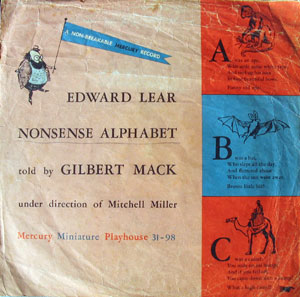
Edward Lear Nonsense Alphabet, told by Gilbert Mack

In addition to movies and lending his voice to several cartoon characters, Mack published 78-rpm records of his readings of two of Edward Lear’s Alphabets; there is no date on the records but they probably appeared in 1948-49. Here is the first one, from a badly scratched copy: Edward Lear Nonsense Alphabet, told by Gilbert Mack under direction of Mitchell Miller (Mercury Miniature Playhouse 31-98).

Posted in Edward Lear, Podcasts | Leave a comment

Nonsense Lyrics: Chi-Baba, Chi-Baba

Sheet Music CoverAl Hoffman and Jerry Livingston, authors of last week’s Mairzy Doats, later teamed up with Mack David to form a trio specializing in nonsense songs: theirs are the famours Bibbidi Bobbidi Boo from Walt Disney’s Cinderella (1950) as well as The Unbirthday Party from Disney’s Alice in Wonderland (1951).

Before these songs, the first two in a series of eight to receive an Academy-Award nomination, however, they wrote Chi-Baba, Chi-Baba (My Bambino Go to Sleep), no. 1 in the charts for three weeks in 1947 thanks to Perry Cuomo‘s performance.

CHI-BABA, CHI-BABA
Perry Como

Many a year ago in old Sorrento
a certain ditty was quite the thing
Whenever a mother rocked her baby in Sorrento
this little ditty she used to sing:

Chi-baba, chi-baba, chi-wawa
An’ chi-lawa kook-a la goombah
Chi-baba, chi-baba, chi-wawa
my bambino go to sleep!

Chi-baba, chi-baba, chi-wawa
An’ chi-lawa kook-a la goombah
Chi-baba, chi-baba, chi-wawa
my bambino go to sleep!

All the stars are in the skies ready to say “goodnight”
can’t you see your doll is sleepy, too?
Close your drowsy little eyes, mama will hold you tight
while she sings a lullaby to you:

Oh, chi-baba, chi-baba, chi-wawa
An’ chi-lawa kook-a la goombah
Chi-baba, chi-baba, chi-wawa
my bambino go to sleep!

(Chi-baba, chi-baba, chi-baba, chi-baba, chi-wawa, and chi-lawa)
Chi-baba, chi-baba, chi-wawa
An’ chi-lawa kook-a la goombah (la goombah!)
Chi-baba, chi-baba, chi-wawa
my bambino go to sleep!

( Chi, chi, chi-baba! )
Chi, chi, chi-baba, chi-baba, chi-wawa
An’ chi-lawa kook-a la goombah (la goombah!)
Chi-baba, chi-baba, chi-wawa
my bambino go to sleep!

All the stars are in the skies ready to say “goodnight, goodnight”
can’t you see your doll is sleepy, too?
Close your drowsy little eyes, mama will hold you tight
while she sings a lullaby to you, ever so sweetly!

Chi-baba, chi-baba, chi-wawa
An’ chi-lawa kook-a la goombah (la la goombah! chi-baba!)
Chi-baba, chi-baba, chi-wawa
my bambino go to sleep!

Chi-baba, chi-baba, chi-wawa
my bambino go to sleep!
Chi-baba, chi-baba, chi-wawa
my bambino . . .
go to sleep!

Posted in Nonsense Lyrics, Podcasts | Leave a comment