
You can now read Philip Hofer’s article on “Peter Newell’s Pictures and Rhymes”, which was published in Colophon. A Book Collectors’ Quarterly in 1934.
You can now read Philip Hofer’s article on “Peter Newell’s Pictures and Rhymes”, which was published in Colophon. A Book Collectors’ Quarterly in 1934.
The Peter Newell section of nonsenselit.org now has a full-size, perfect copy of Peter Newell’s Jungle-Jangle.

Thanks to Bob & Ellen Watters, who kindly contacted me and scanned the book.
I am going to try and upgrade the blog from WordPress 1.5 to 2.0.2 later today, so there might be problems.
One of the questions which are often asked about Nonsense is, Why did it disappear almost completely from literature after the great season of Edward Lear and Lewis Carroll? As M.B. Heyman writes in his thesis (Isles of Boshen: Edward Lear’s literary nonsense in context, University of Glasgow, Faculty of Arts, Department of English Literature, 2005):
If we skip Lear, Carroll, and the rest of the nineteenth century momentarily, we find a curious twist to the course of nonsense. Although literary nonsense drastically changed the face of children’s literature, as a more “pure” form for children it seems to have died away toward the turn of the century. Instead of remaining a children’s genre, nonsense returned to its old adult audience in various forms (p. 3).
After listing a few examples (Edward Gorey, Mervyn Peake, Dr. Seuss and Roald Dahl) he concludes that “the genre has never returned to the kind of success and popularity it had with Lear and Carroll” (p. 4).
I don’t know as to why it disappeared from children’s literature but have an idea about where it went: first it moved to the pages of the Comic Supplements in American newspapers and, when it vanished from them too, around 1910, it became the basic component of cartoons and was at the core of the medium at least until the 1960s when, with the sad demise of the theatre shorts and the advent of the TV cartoon, it was replaced by elementary adventure plots.

ASIFA-Hollywood Animation Archive are getting ready to celebrate Animation’s 100th Birthday on April 6th: the site has a Biopedia (an Alphabetical Biographical Index) and the frequent posts often include wonderful illustrations from animation-related books and sometimes even whole shorts that can be downloaded.
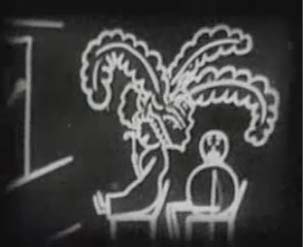
As an experiment in vodcasting, I’m posting a cartoon which perfectly exemplifies the pervasiveness of Nonsense even in the earliest animated films: Émile Cohl‘s Fantasmagorie (1908). You may need to download iTunes to watch it.
The documents section of nonsenselit.org now contains a recent essay on Edward Lear:
Winfried Nöth. “The Art of Self-Reference in Edward Lear’s Limericks.” Interdisciplinary Journal for Germanic Linguistics and Semiotic Analysis 10.1, 2005, pp. 47-66.
Many thanks to professor Nöth and the journal editors for permission to reproduce it.
The Owl and the Pussycat Wen to See… is a musical play adapted from the verses and stories of Edward Lear by Sheila Ruskin and David Wood (who wrote the music and lyrics). The LP (Philips 6308022) was published in 1970 with a colourful hippy-style cover and features Harry Secombe (Narrator), Roy Castle (Owl) and Hattie Jacques (Pussycat): Side 1 & Side 2

The story, as told in the back cover:
Helen Stilwell’s Laughable Looloos 1906 series is now available in full colour at Nonsense in the Early Comics.

The architect, John Prentiss Benson (1865-1947), had always dreamed of becoming an artist like his older brother Frank. In 1905 he lived in Flushing NY with his wife and four children and worked at his architecture firm of Benson and Brockway. He kept a studio in his home where he dabbled with paints, brushes, and canvases. His dabbling in 1904, probably to amuse his children, resulted in The Woozle Beasts (the cover and spine say Woozle Beasts but the title page reads WOOZLEBEASTS: today under the influence of computerese the title would be WoozleBeasts).
On his fifty-sixth birthday in 1921, John received a telegram from brother Frank that read “John, if your are going to paint —PAINT!” And surprisingly, John Prentiss Benson gave up architecture and took up serious painting. He became one of the world’s leading maritime painters with over 500 paintings.
Arthur Deex, author of the preceding blurb, has given in to my insistence and scanned the book, so we are now in a position to offer the largest collection of Woozlebeasts ever published: it includes an almost complete run of the strip as it appeared in newpapers in 1904 (in the Los Angeles Times and Chicago Tribune from 21 August 1904 to 1 January 1905; the New York Herald had started publication on 5 April 1904, according to Allan Holtz’s Stripper Guide) and the 1905 Moffat, Yard & Co. book. Even The Artistic Legacy of John Prentiss Benson. Compiled and edited by Nicholas J. Baker. Sheridan Books, 2003; p. 251, only lists 94 beasts, our index includes 154 as well as three single-panel panoramic cartoons. According to the same source (p. 250) Benson “had a book of original Woozlebeast drawings bound in hard cover and presented to his four children. The inscription written inside the front cover reads as follows: ‘Dedicated to Marjorie, Philip, Gertrude and little Mary – 30 years ago.’ It was signed, ‘John P. Benson, May 13th, 1935.'”
The use of the limerick verse and the careful drawing style clearly differentiate the Woozlebeasts from the average newspaper comic of the period, and place it in the 1904-05 drive to please middle-class readers after the first wave of attacks against the new medium. The short-lived strip would start a minor tradition of depictions of fantastic animals which includes Helen Stilwell’s 1906 Laughable Looloos and Gustave Verbeek‘s The Terrors of the Tiny Tads (28 May 1905-25 October 1914) and The Loony Lyrics of Lulu (17 July 1910-23 October 1910), the latter also using limericks, sometimes written by the readers, to describe invented animals.
I had just finished my previous post when I received the following article from Arthur:
The nonsense craze started by Edward Lear in the 1840s eventually swept through the entire English speaking world. The spread, however, was more of a creep than an explosion in the early years by today’s standards.
In America the earliest books of limericks were published in New York and London simultaneously:
Parkes, Harry. Random Rhymes. London & New York: Frederick Warne & Co., c1860.
Rummical Rhymes with Pictures to match set forth in fayre prospect Alphabetically & Geographically. New York: Hurd Houghton, 1862 and Dean & Son, 1863.
The first American printing of Lear’s A Book of Nonsense was probably:
Lear, Edward. A Book of Nonsense. Philadelphia: Willis P. Hazard, 1863. First American printing. Some distribution with original title-leaf canceled and imprinted “New York: M. Doolady, agent.”
The first distinctly American limerick books were associated with the American Civil War:
Ye Book of Copperheads, Philadelphia: Frederick Leypold, 1863. Reprinted in 1864 in conjunction with the Lincoln-McClellan presidential campaign.
The Book of Bubbles: A Contribution to the New York Fair in aid of the Sanitary Commission. New York: Endicott & Co., 1864.
The New Book of Nonsense: A Contribution to the GREAT CENTRAL FAIR in aid of the Sanitary Commission. Philadelphia: Ashmead & Evans, 1864.
The New Book of Nonsense, like The Book of Bubbles, was produced and sold as a fund raiser for the Sanitary Commission. The Sanitary Commission was a civilian organization in the North dedicated to remedy the “unsanitary conditions” to which Union soldiers were subjected. The nearest thing to the Commission today would be the Red Cross.
The book was clearly an attempt to take advantage of the popularity of Lear’s nonsense books. The printing and binding is very slipshod, with limericks often cropped in part. But the style of the verses and their topics, while many are perhaps shocking today, and certainly politically incorrect, are an excellent window on the way 1860s Americans viewed the world.

A number of early limerick books are now available for your online enjoyment, including the four published in the 1820s that inspired Edward Lear:
Also worth a look are: A Lady. Little Rhymes for Little Folks: or, Poetry for Fanny’s Library. London: John Harris, 1823 [Arthur Deex], which contains a few limericks; and Thomas Hood. The Headlong Career and Woful Ending of Precocious Piggy. London: Griffith and Farran, 1860 [University of Florida], in which the story is told in monorhyme limericks, every single line in the book rhyming with “pig”.
In addition, you can now read three early American books from Arthur’s collection:
Arthur has also provided two very beautiful limerick books from the 1900s:
Not enough? For some time our gallery has been hosting Bennet Cerf’s Pop-up Limericks (New York: Random House, n.d.).
 A Blog of Bosh