The Akond of Swat and the Ghazal

A.E. Stalling has a very interesting post on Edward Lear on her blog at Poetry Foundation. After a short general introduction, she states that

The Akond of Swat, […] with its strict adherence to the form and “exotic” eastern locale, [… is] a ghazal, and consciously so.

The idea, as far as I know, was first advanced by Julie Rybicki in an e-mail to the Edward Lear mailing list on 23 June 2002:

Post the formalism conference I attended, I was/am reading a book called “An Exaltation of Forms: Contemporary Poets Celebrate the Diversity of Their Art” (Edited by Annie Finch & Kathrine Varnes. Ann Arbor: U of Michigan Press, 2002, (USA). I was reading the chapter called “Ghazal: To Be Teased into DisUnity” by Agha Shahid Ali and the form sounded very familiar–and I realized that Lear’s “TheAkond of Swat” fit the form almost perfectly. (Though Lear used twiceas many rhymes than the form requires.)

Put simply, the ghazal is a Middle Eastern poetry form where there are two line stanzas, interchangeable in order, that all end with the same word or phrase. (“The Akond of Swat”). Right before this 2nd line “chorus” is a monorhyme (In Lear, “squat, hot, trot, cot, dot, blot, plot,” etc.)

Even Lear’s suggestions for how the poem should be read/performed(having the chorus shouted out, p. 526 of Noakes’ notes in “TheComplete Verse and Other Nonsense”) sound like the traditional way Ghazals were performed with a poet and an audience. Since Lear composed the poem in India, one of the countries where Ghazals have been traditionally written, it is possible he ran into some ghazals in his travels and borrowed the form.

Or not, who knows. But I always thought that poem had a very unusual form and it’s interesting that the form pre-existed Lear’s poem. (The form is medieval.)

Julie’s opinion that the Akond of Swat fits “almost perfectly” a ghazal is, in my opinion, to be preferred to Stalling’s firm statement, following which she even identifies a particular form of Ghazal as the source:

Actually, when I approached Dick Davis, the poet and Persian scholar, about the ghazal-ness of the “Akond of Swat,” he agreed with me, but pointed out that “To be really picky Lear probably meant the poem as a qasideh, not a ghazal. The qasideh and ghazal are formally identical (except the qasideh is usually much longer than the ghazal) and are distinguished by subject matter – the ghazal being erotic/lyrical, the qasideh being a praise poem. The A of S is clearly a mock praise poem.”

Lear’s poem certainly sounds like a ghazal, but if we consider its lineation several differences crop up. The ghazal is a “short poem in lyric form” and consists of a limited number of couplets (bayt, pl. abayat), usually between 5 and 17, each of which ends with the same words (radif) preceded by the rhyme proper (qafiya); the first couplet (matla) respects these restrictions in both lines, the last (maqta) very often contains a reference to the poet’s name: a sort of signature (L.P. Elwell-Sutton, The Persian Metres. Cambridge: Cambridge University Press, 1976, p. 245). Here is a modern example by Agha Shahid Ali (1949-2001), Ghazal (for Daniel Hall), it first appeared in the Boston Review (24.2, April-May 1999):

I’ll do what I must if I’m bold in real time.
A refugee, I’ll be parolled in real time.

Cool evidence clawed off like shirts of hell-fire?
A former existence untold in real time . . .

The one you would choose: were you led then by him?
What longing, O Yaar, is controlled in real time?

Each syllable sucked under waves of our earth–
The funeral love comes to hold in real time!

They left him alive so that he could be lonely–
The god of small things is not consoled in real time.

Please afterwards empty my pockets of keys–
It’s hell in the city of gold in real time.

God’s angels again are-for Satan-forlorn.
Salvation was bought but sin sold in real time.

The throat of the rearview and sliding down it
the Street of Farewell’s now unrolled in real time.

I heard the incessant dissolving of silk-
I felt my heart growing so old in real time.

Her heart must be ash where her body lies burned.
What hope lets your hands rake the cold in real time?

Dear Friend, the Belovèd has stolen your words–
Read slowly: the plot will unfold in real time.

This ghazal consists of eleven abayat, the qafiya (|-old|) and radif (“in real time”) recur in lines 1-2 (the matla), 4, 6 and so on.

In order to read The Akond of Swat as a ghazal we must take the refrain “the Akond of Swat” as the radif; Lear however has increased the complexity, and the comic effect, of the metre by choosing a qafiya (“squat,” “hot,” “trot,” and so on) which rhymes with the radif and having them preceded by a separately rhyming couplet. The main difference from the strict ghazal is the fact that the qafiya and radif are added to the couplet structure rather than “forming an integral part” of the second line (Elwell-Sutton, The Persian Metres, p. 225).

Lear had probably seen a number of ghazals in Englsh as there had been a fad for Persian poetry at the turn of the century; however there was no consensus on the form such translations should take and most had used widely differing metres.

After discussing the idea with Julie, and planning an article on the subject which was never completed, we came to the conclusion that the metre of the Akond had a much more complex origin than the simple imitation of an eastern verse form, but of this more in a future post.
Posted in Edward Lear | 1 Comment

Animation Links

A few more interesting posts from the incredibly lively world of animation blogs:

Michael Sporn has four new nonsense-related articles:

  1. Fantasia Program 1 & 2: a souvenir booklet sold with the initial roadshow presentation of Fantasia.
  2. Alices: on the clash on Alice animations between Disney and Lou Bunin.
  3. Belloc’s Bestiary.
  4. Steig’s Bdsplr: on William Steig’s children books.

mickey_thro_the_mirror.jpg

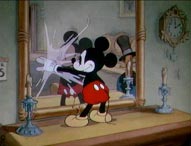
Mark Meyerson has three posts on Walt Disney’s classic short Through the Mirror, featuring Mickey Mouse: 1, 2, 3, 4.

Posted in Comics, General | Leave a comment

More Early Essays on Edward Lear

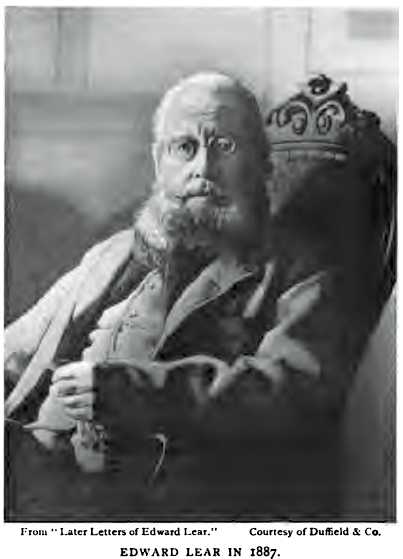
Edward Lear in 1887

Two new early essays on Edward Lear are available at the nonsenselit.org’s library:

Holbrook Jackson, “Masters of Nonsense.” All Manner of Folks: Interpretations and Studies. London: Grant Richards Ltd., 1912; pp. 30-44.

Hildegarde Hawthorne, “Edward Lear.” St. Nicholas: A Monthly Magazine for Boys and Girls, Volume XLIV, part I, November 1916 – April 1917; pp. 71-3.

Posted in Edward Lear | Leave a comment

The Quadrille

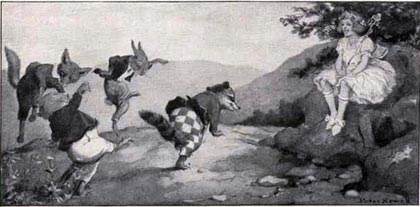
Here is a poem, made of three limericks, by Louise Ayres Garnett and illustrated by Peter Newell. I’m taking it from an eBay auction, the description dates it to 1922 but does not say where it is taken from:

Garnett - Newell, The Quadrille (1922)

Four quadrupeds danced a quadrille
On the summit of Somebody’s hill,
And a lily-white queen
Looked on at the scene
And envied the quadrupeds’ skill.

For they’d hop and they’d circle and leap,
And yet perfect time they would keep;
And all were so deft
In the “Allemande left”
That they vowed they could do it asleep.

They said to the queen, “Will you dance?
We’ve many new figures from France.”
She replied, “If I could,
I feel that I should;
But it’s hard with just two legs to prance!”

Posted in Peter Newell | Leave a comment

Nonsense Poetry in Schools

A controversy seems to have been raised by the Ofsted report on poetry in schools, which maintains that British pupils are not prepared to appreciate classic poetry because of a focus on a few poems, which are considered not “genuinely challenging.”

When it comes to citing these supposedly unstimulating poems, newspapers, in particular the Times that started it all and Reuters, have chosen to emphasize nonsense such as Lewis Carroll’s “Jabberwocky” and Edward Lear’s “The Owl and the Pussy-cat.”

While the report itself does not sound so negative as the newspapers have chosen to make it appear, see the summary, it seems to me that the problem is not so much nonsense poetry, which might also be considered too challenging, as the lack of variety. On the other hand, the fact that the same poems are chosen in most schools simply means that teachers prefer to support an established canon: not necessarily a bad thing, in my opinion, unless it is the result of indolence.

Posted in Edward Lear, General, Lewis Carroll | Leave a comment

Animation News

Animation is one of the liveliest subjects on the Internet at the moment; among the mass of interesting posts, Michael Sporn’s two new articles (1 & 2) on the representations of the blank map in Lewis Carroll’s The Hunting of the Snark are not to be missed.

Blank Map in Carroll’s Hunting of the Snark

Of great interest to nonsense-lovers should also be the production sheets for Disney’s Alice in Wonderland, Hans Perk has scanned and published 75 of them so far.

Posted in Comics | Leave a comment

Lear and Penrhyn Stanley at Glendalough

Part of Stanley’s first Long Vacation (1835) was spent in a visit to Dublin, where he joined his father at a meeting of the British Association. Though unable, as he confesses, ‘to enter into the scientific business from my ignorance of the subject,’ he was keenly interested in seeing the eminent men who were assembled at the meeting, and in hearing the debates on social questions.His stay in Dublin was diversified by a visit to Glendalough and the Seven Churches, in company with his uncle Penrhyn and Mr. Lear.

‘Luggelaugh had been very beautiful, but Glendalough was perfect. You come down between woody hills on a narrow valley, with two lakes glittering in the sunset, closed at the end by the cliffs of Lugduff, and with finely-shaped hills and woody rocks jutting into it. At the entrance of the valley is the Round Tower, and three of the Seven Churches, small and in ruins, but the most interesting ruins I ever saw. The greatest trace of this former fame is preserved in the title of the Archbishop of Dublin, which is Dublin and Glendalough, as the latter was once the Episcopal See. The guide was, however, sufficient to drive away all sentiment. He began by shouting Moore’s poem on Glendalough at the top of his voice, and then went on with a profusion of legends, in one of which Fin McCoul, the Irish giant, cuts a hole in the rock with a sword forged by Vulcan and taken from the anvil by the great huntsman Ramrod (Nimrod), McCoul having previously been at school with the Prophet Jeremiah. He nearly broke my legs by trying to make them meet round a stone cross, which is necessary to secure a beautiful wife and a good fortune.’

He adds a string of similar stories, ending with a description of his
‘ascending shoeless with Mr. Lear along a narrow ledge — a mauvais pas on a small scale — and helped round the corner by an old woman surnamed Kathleen, who popped us into the hole (St. Kevin’s bed) just like a bathing-woman, saying all the time, “Don’t be fearful, my dear.” We drove on to sleep at Belleview, Mrs. Latouche’s place, but owing to the horse being knocked up, and the gradual expansion of miles from six to twelve, did not reach it till 9.30. We met with no sign in our nightly journey that we were travelling through a land of fire and blood, except that, at all houses where the driver knocked to ask the way, he had to say A friend “before the door was opened, and that we were repeatedly told “that there was no danger in the way.”‘

Prothero, Rowland E. The Life and Correspondence of Arthur Penrhyn Stanley: Late Dean of Westminster. New York: Charles Scribner’s Sons, 1884, vol. I, pp. 146-7.

St Kiven, plate 3

The trip probably resulted in Lear’s illustrations for Moore’s “By That Lake, Whose Gloomy Shore,” from vol. 4 of his Irish Melodies.

Posted in Edward Lear | 1 Comment

Carolyn Wells on the Limerick

Oliver Herford for a limerick by Carolyn Wells

A new article is available on the nonsenselit.org bookshelf: Carolyn Wells, “Limericks.” Frank Leslie’s Popular Monthly, vol. 55, no. 5, March 1903, pp. 532-5.

It mostly consists of limericks by authors well-know at the turn of the twentieth century. Worth of a mention is the above carp, drawn by Oliver Herford for a limerick by Carolyn Wells herself, which turns upside down the situation of a famous one by Edward Lear:

Edward Lear, Lady of Welling
There was a Young Lady of Welling,
Whose praise all the world was a-telling;
She played on a harp,
And caught several carp,
That accomplished Young Lady of Welling.

More articles on Nonsense literature.

Posted in Limerick | Tagged , , , | Leave a comment

Animation Backgrounds for Alice in Wonderland

Rob Richards at Animation Backgrounds has reconstructed the environment in which Disney’s 1951 animated Alice in Wonderland is set.

I’m late

Thanks to Michael Sporn.

Posted in Lewis Carroll | Leave a comment

Mungojerrie and Rumpelteazer

LeCain’s Mungojerrie and Rumpelteazer

Michael Sporn has published the second part of Errol LeCain’s illustrations for Mr. Mistoffelees with Mungojerrie and Rumpeltealzer, go see them! Also see previous post.

Posted in General | Leave a comment