Shadows

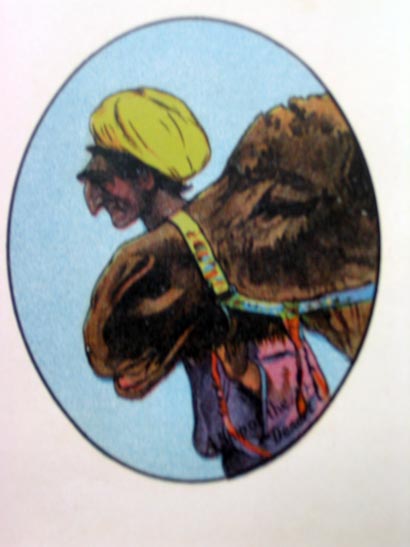
After the success of his two Topsy-Turvys, Peter Newell published A Shadow Book (New York: The Century Co., 1896) in which after looking at a picture, e.g. of an Arab leading a camel,

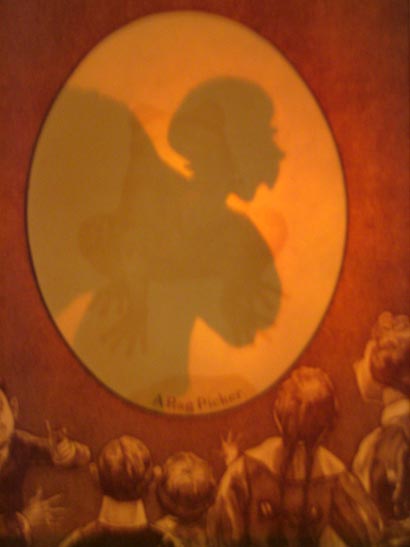
you turn the page and place it in front of a light source, so that the image you now see represents something else, this case “A Rag Picker:”

Unfortunately, the images above were taken with a camera and do no justice to the real book: in many cases the different densities of the tints in the “front” picture produce nuances in the shadow one which enhance the effect. If I ever manage to find a way to get good images without ruining my copy, I’ll post the whole series.

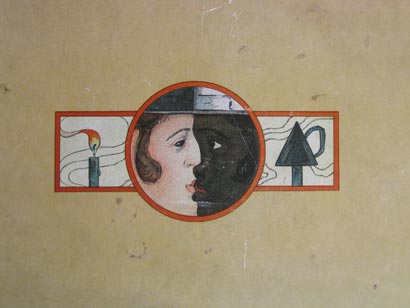
It is likely that the book sold as well as the earlier ones, though it is harder to find as in many cases it was probably burnt by inattentive children who followed Newell’s back-cover suggestion of using a candle:

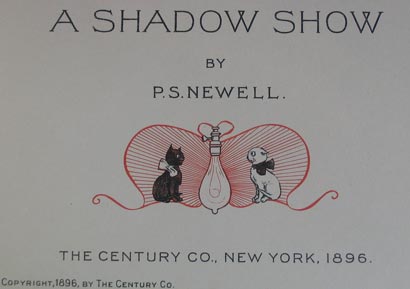
Better luck probably had those who preferred, or could afford, to use a light bulb, as recommended in the title page:

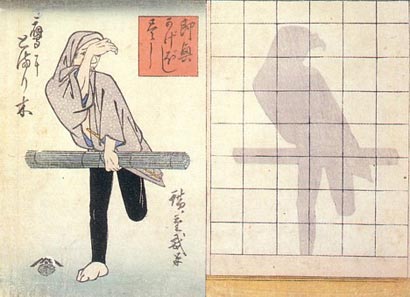
Shadow pictures, Kage-e, seem to have been common in woodblock prints of the Edo period in Japan, according to the pinktentacle blog. Here is one of the several instances posted:

In this case, first you looked at the shadow image cast on a door (in the example a hawk), and then discovered the real subject, a man in a very peculiar attitude.

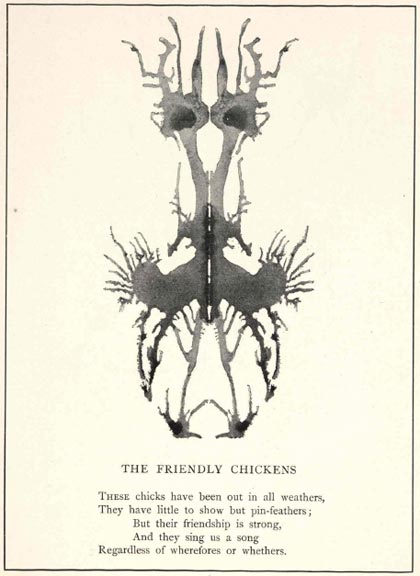
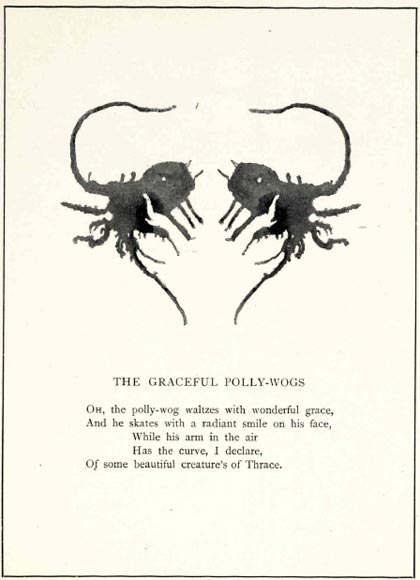
1896 must have been the annus mirabilis of shadow books for the Century Co.: they also published Gobolinks, or Shadow-Pictures for Young and Old by Ruth McEnery Stuart and Albert Bigelow Paine. These were not real shadow pictures, but rather images obtained with a process involving, at least in part, chance:

Drop a little ink on a sheet of white paper. Fold the sheet in the center and press the ink-spots together with the fingers. All of the pictures in this book were made in this manner — none of them having been touched with a pen or brush.

To each of the images thus generated a short poem is added, in some cases a limerick:

On Peter Newell, also see Philip Hofer, “Peter Newell’s Pictures & Rhymes.” The Colophon. A Book Collectors’ Quarterly. Part Nineteen. New York, 1934.

Posted in Comics, Limerick, Peter Newell | Leave a comment

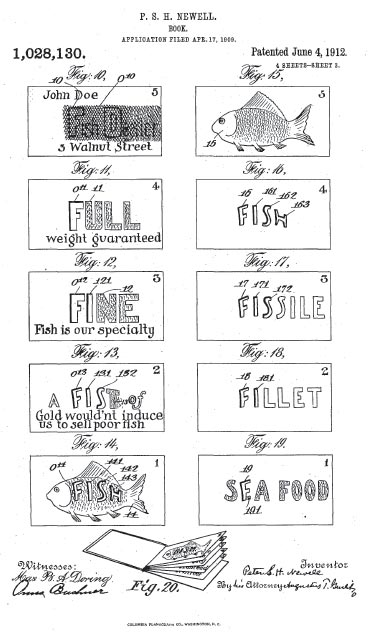
War Games and More Peter Newell Patents

If you enjoyed my previous posts on Peter Newell’s toy and toy-book patents, you cannot miss these on War Games from the Boer War and War Games from World War II from Steve van Dulken’s Patent Blog at the British Library.

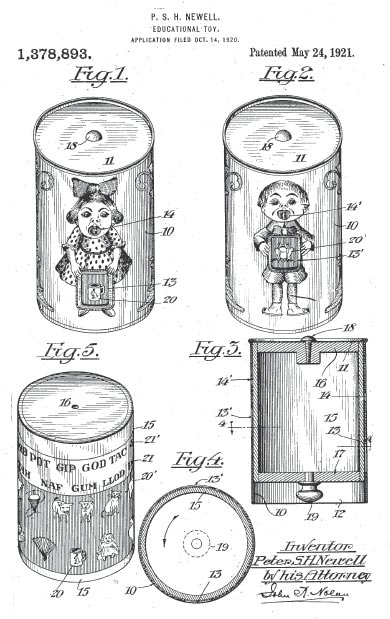
Here, by the way, is another “Educational Toy” patented by Newell in 1921:

Peter Newell's Educational Toy

This invention relates to educational toys intende more especially for children; and the object of my invention is to provide a simple, convenient, attractive and instructive device whereby a succession of figures or pictures representing animals or objects of various kinds can be individually presented to view, together with the letters in sequence of the name of each animal or object thus presented in picture form…

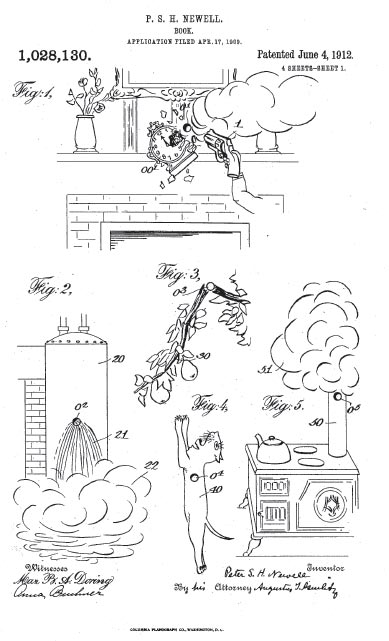
This one, filed under the unlikely title of Vlamoakaph Co, includes the Jungle Jangle patent I already posted as well as one for The Hole Book (with scenes that were not used for the book),

Peter Newell's Hole Book Patent

and applications of the same principle “to commercial as distinguished from literary productions.”

Commercial Application Patent

Posted in Peter Newell | Leave a comment

The Pig-Faced Woman and the Limerick

In the early months of 1815 London was swept by reports of a pig-faced lady living in Manchester Square:

In the earlier part of this century, there was a kind of publication in vogue, somewhat resembling the more ancient broadside, but better printed, and adorned with a rather pretentious coloured engraving. One of those, published by Fairburn in 1815, and sold for a shilling, gives a portrait of the pig-faced lady, her silver trough placed on a table beside her. In the accompanying letter-press, we ore informed that she was then twenty years of age, lived in Manchester Square, had been born in Ireland, of a high and wealthy family, and on her life and issue by marriage a very large property depended. ‘This prodigy of nature,’ says the author, ‘is the general topic of conversation in the metropolis. In almost every company you join, the pig-faced lady is introduced, and her existence is firmly believed in by thousands, particularly those in the west end of the town. Her person is most delicately formed, and of the greatest symmetry; her hands and arms are delicately modelled in the happiest mould of nature; and the carriage of her body indicative of superior birth. Her manners are, in general, simple and unoffending; but when she is in want of food, she articulates, certainly, something like the sound of pigs when eating, and which, to those who are not acquainted with her, may perhaps be a little disagreeable.’ (The Book of Days: A Miscellany of Popular Antiquities. Edited by R. Chambers. London and Edinburgh: W. & R. Chambers, 1832, v. 2, p. 256.)

Captain Gronow in his Recollections and Anecdotes (1863. London: John C. Nimmo, 1900, v.1, pp. 255-7) tells a different story:

Among the many absurd reports, and ridiculous stories current, in former days, I know of none more absurd, or more ridiculous, than the general belief of everybody in London, during the winter of 1814, in the existence of a lady with a pig’s face. This interesting specimen of porcine physiognomy was said to be the daughter of a great lady residing in Grosvenor Square.

It was rumoured that during the illuminations which took place to celebrate the Peace, when a great crowd had assembled in Piccadilly and St. James’s Street, and when carriages could not move on very rapidly, “horresco referens!” an enormous pig’s snout had been seen protruding from a fashionable-looking bonnet in one of the landaus which were passing. The mob cried out, “The pig-faced lady! the pig-faced lady! Stop the Carriage stop the Carriage!” The coachman, wishing to save his bacon, whipped his horses, and drove through the crowd at a tremendous pace; but it was said that the coach had been seen to set down its monstrous load in Grosvenor Square.

John Ashton, in Social England under the Regency (London: Chatto & Windus, 1899, pp. 219-22) adds a few details and also has a print, “Waltzing a Courtship” (1815), showing the supposed pig-faced woman dancing with a “short deformed man,” a caricature of Lord Kirkcudbright (as described under the title “Waltzing in Courtship” as no. 12630 in George. Catalogue of Prints and Drawings in the British Museum. Division I. Political and Personal Satires. v. 9, p. 602).

Waltzing a Courtship

The pose of the two dancers — and in particular their feet, as well as the man’s right arm — is the same Edward Lear would use thirty years later for his dancing characters, e.g.
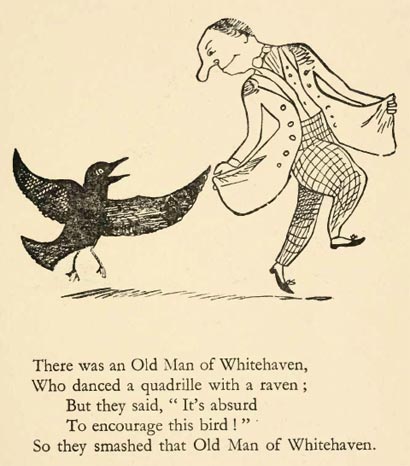
The mingling of human and animal features, though never by simply juxaposing incongruous body parts as here, is also typically learian:

One of Lear’s limerick illustrations even includes a pig-faced woman, though she is not the protagonist:
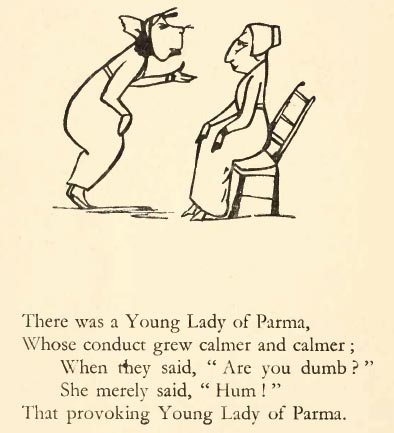
On 15 March 1815 another print appeared which might provide further, more interesting clues on the rise of the limerick book in the early 1820s. This one was by George Cruikshank and put together two deformed figures, the hog-faced lady and the “spanish Mule of Madrid,” a reference to Ferdinand VII, king of Spain (see George, Catalogue of Prints and Drawings in the British Museum. Division I. Political and Personal Satires. v. 9, pp. 513-4, no. 12508, for an explanation):


© Trustees of the British Museum

What makes this print interesting for the history of the limerick is the fact that it contains all the elements of the early, and of Lear’s, collections except the metrical form itself: each picture presents a single peculiar character identified by geographical location, and the whole forms a gallery of lunatics, whose “story” is told in the captions below.

Studies of the origins of the limerick have mostly focused on the rise of the five-line poem, but — given the preponderance of illustration over text in all the early collections and, again, in Lear — it is perhaps time to look in other directions, and none appears more promising than the huge output of satirical prints in the early decades of the 19th century.

(For a full account of the myth of the pig-faced woman, which goes back to the beginnings of the 17th century, see Jan Bondeson, The Two-Headed Boy, and Other London Medical Marvels. Ithaka: Cornell University Press, 2000, pp. 95-119.)
Posted in Edward Lear, Limerick | 1 Comment

A Photographer's Day Out… with Edward Lear

Nancy Hill, a photographer and writer as well as old time fan of Edward Lear’s nonsense, has a new site showcasing her photographic work. Of particular interest are two portfolios: Fools and Limericks.

Posted in Edward Lear, General | Leave a comment

A Short Peter Newell Animation

I did not know that orecchio acerbo, who published my Italian translation of Peter Newell’s Slant Book last year, had also produced a short booktrailer which you can see on YouTube:

You can also download a pdf of the Italian edition of the whole book from orecchio acerbo’s site.

Posted in Peter Newell | Leave a comment

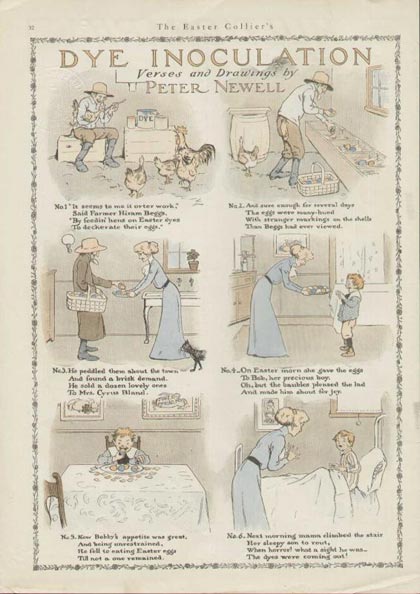
Dye Inoculation by Peter Newell


Newell, Dye Inoculation

No. 1
“It seems to me it orter work,”
Said Farmer Hiram Beggs,
“By feeding Hens on Easter dyes
To deckerate their eggs.”

No. 2
And sure enough for several days
The eggs were many-hued
With stranger markings on the shells
Than Beggs had ever viewed.

No. 3
He peddled them about the town
And found a brisk demand.
He sold a dozen lovely ones
To Mrs. Cyrus Bland.

No. 4
On Easter morn she gave the eggs
To Bob, her precious boy,
Oh, but the baubles pleased the lad
And made him shout for joy.

No. 5
Now Bobby’s appetite was great,
And being unrestrained,
He fell to eating Easter eggs
Till not a one remained.

No. 6
Next morning mama climbed the stair
Her sleepy son to rout,
When horror! what a sight he was —
The dyes were coming out!

The Easter Collier, p. 32.

I don’t know the date, as I got this image from an eBay auction; it appears in the Beineke’s library catalogue of Peter Newell’s family papers among the unidentified or unpublished comic strips.

Posted in Comics, Peter Newell | Leave a comment

Joge-e: Two-Way Pictures

In the second half of the nineteenth century the west shows a sudden interest in images that can be seen upside down. There are several examples, the most famous being probably Peter Newell’s Topsys and Turvys (New York: The Century Co., 1893), followed by a second volume in 1894, and Gustave Verbeek’s comic strip, Upside-Downs Of Little Lady Lovekins And Old Man Muffaroo (1903-1905). At least another book had been published previously, Upside Down, or, Turnover Traits from Original Sketches by the Late William McConnell (London: Griffin and Farran, 1868), with texts by Tom Hood, in which each of the 15 pictures is meant to represent both a person and an animal to which it is compared.

As Greedy as a Pig (William McConnell)

This kind of picture appears to have been very popular in Japan from the beginning of the century, according to a post at the Pink Tentacle blog:

Joge-e, or “two-way pictures,” are a type of woodblock print that can be viewed either rightside-up or upside-down. Large numbers of these playful prints were produced for mass consumption in the 19th century, and they commonly featured bizarre faces of deities, monsters or historical figures (including some from China). Only a few examples of original joge-e survive today.

Joge-e

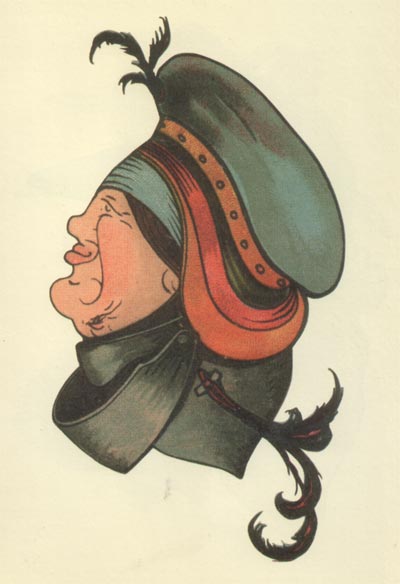
All of these images represent only the faces of characters, just like the pictures in Dreh’ mich um, rund herum! by Otto Bromberger, published in Germany in the 1890s.

Turn me round (Bromberger)

Other interesting items at Pink Tentacle include:

Mythical 16th-century disease critters
Edo-period monster paintings by Sawaki Suushi

Posted in Gustave Verbeek, Peter Newell | 1 Comment

Edward Lear to the Rev. Ellis Ashton

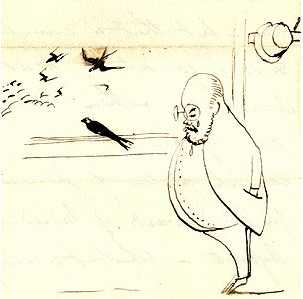
Here is a previously unpublished letter by Edward Lear which was offered some time ago on eBay. It includes one of his delightful self-caricatures representing the painter watching the swallows.

15 Stratford Place,
Oxford Street, W
4 Sept. 1865.

My dear Mr. Ashton,

You are right about me & the swallows – for I AM here still. You see the said swallows are better off than Landscape painters in this — that they can fly OVER Quarantines, & are not obliged to live IN them. I was going off to Dalmatia, when the Cholera put a seal on all the Shore Ports & landings — & then I fixed on Spain, where, as precisely the same thing has occurred. — I am obliged to remain here — I am in consequence dreadfully cross & disagreeable.

It is very kind of you to remember the Photograph — which is very nice, & extremely interesting. I agree with Sir Thomas that he did NOT improve much at all after he had painted that portrait.

There were 507 people at my Studio this season, (including yourself,) so you can suppose that the Contrast of London daily life is sufficiently great. Except Digby Wyatt — Admr. Robinsons, & the Edgar Drummonds I know no one here — but that is enough: — & so I go into the near Country now & then — but generally am at work on a largish picture of Jerusalem for Mr. Edwards of Mosedale House Aigburth — which I wish you & Lucy may see whenever it is done. My kindest regards to her, & believe me,

Dear Mr. Ashton,
Your’s affectionately,
Edward Lear

Lear watching the swallows

Lear wrote this letter — addressed to the Rev. Ellis Ashton, Vicarage, Huyton, Prescot, Lancashire — while in England and unsure on where to go next. He would finally set off for Venice after receiving a commission from Lady Waldegrave for a painting of the lagoon city.

Among the people he mentions are Sir Digby Wyatt — whom he had met in Rome in the 1840s — Admiral Sir Robert Spencer Robinson and Edgar Drummond — a member of the banking family that managed Lear’s money.

The painting of Jerusalem Lear was working on at the time would give him some problems, as in a letter to Lady Waldegrave of 23 January 1866 he was complaining that “these things and Mr. Edwards not paying me, with flies and a pain in my toe all affect me at once.” And again on 13 February: “And Mr. Edwards, for whom I painted the Jerusalem, from July to November, and for whom I made it so large a picture on account of auld lang-syne, has never paid for it.” This should be Samuel Price Edwards, collector of tariffs and duties at Liverpool Port.

[This letter was sold for £4,000 at Dreweatts & Bloomsbury Auctions on 24 October 2007.]

Posted in Edward Lear | Leave a comment

Poems and Essays in Honour of Edward Lear

In July 2000 Charles Lewsen gave a performance at the Redgrave Theatre in Bristol of the solo theatre piece, How Pleasant to Know Mr. Lear, first given in 1968 at Hampstead Theatre and the Edinburgh Festival, and subsequently at venues throughout Britain, and festivals in Tel Aviv and Charleston, South Carolina. One such performance also resulted in a difficult-to-find LP.

The Bristol performance was given in aid of the Friends of the Bristol Oncology Centre, who published an illustrated Souvenir Programme with a range of poetic and scholarly insights into aspects of Lear including his epilepsy, and what is probably the only tribute to Foss by a poet other than Lear.

Now Mr. Lewsen informs me that some copies of the “Poems and Essays in Honour of Edward Lear” are still available and can be obtained contacting:

The Friends of the Bristol Oncology Centre
Horfield Road, Bristol BS2 8ED
phone & fax 0117-928 3432

Detailed contents and ordering information.

Posted in Edward Lear | Leave a comment

The Adventures of Edward Lear

You may remember that a few months ago I posted on a projected TV series on Edward Lear’s journey through Albania in 1848. A promo of the documentary is now available on YouTube.

Posted in Edward Lear, Podcasts | Leave a comment