A Hidden Drawing and a Self-Caricature by Edward Lear

At the end of the month Bonhams will be auctioning three interesting items of leariana. The most surprising is perhaps a letter to Mrs. Digby Wyatt, wife of Matthew Digby Wyatt, “a British architect  and art historian who became Secretary of the Great Exhibition, Surveyor of the East India Company and the first Slade Professor of Fine Art at the University of Cambridge.” The conclusion of this Finnegans Wake-like letter is “My love to Digby, & respects to” followed by what may at first appear as a blot, but is actually a small picture of the Digby Wyatts’ dog:

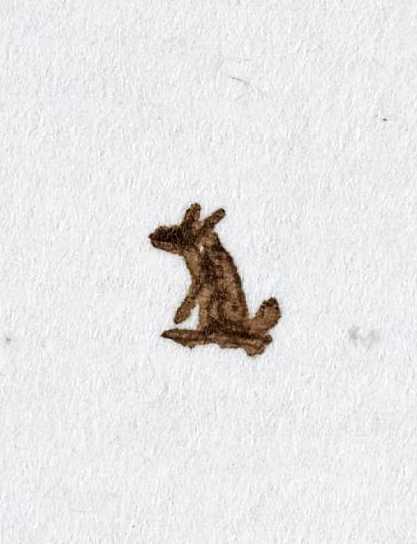
Here is the description from Bonhams’s site, which also includes transcripts of parts of the letter:

LEAR, EDWARD (1812-1888, self-styled ‘Dirty Landskip painter’, nonsense poet and travel writer) DELIGHTFUL PHONETIC AUTOGRAPH LETTER SIGNED (‘Edward Lear’), WITH A SECRET DRAWING OF THE WYATTS’ DOG, to ‘Mrs [later Lady] Digby’ [Mrs Digby Wyatt], written partly in his phonetic spelling, informing her of his intention the day before ‘to try if Yewanddigby were aTome’, but he was waylaid by an old ‘Corfiot=Maltese’ friend, so he is now writing to see if they will be ‘shayvoo’ next Sunday (‘…andifso I will charter the Hanson of rapidity, and be driven to the haunts of hospitality in the verdant recesses of the deer frequented groves of Tavistock Park on that day…’), expressing himself pleased with a letter from Constance about some old designs he had sent her, regretting that she did not see his picture ‘Venice Canal’ which has left Austria and is now in 7 Carlton Gardens, and telling her about his low mood (‘…I have been having no end of despair at the darkness of late – & thort I shudavadda Phittavasmer again today as I have frequently had of late. But I can’t get away yet for 3 or 4 weeks…’); he ends with giving his love to Digby and respects to [small ink mark which when enlarged is a charming secret drawing of their dog], and in a postscript (‘P.Eth’) reports that he has had a ‘thaddakthident, & have broken off my front teeth, so that I thall never thpeak plain again’ (‘Thith Cometh of biting crutht’), 3 pages, octavo, largely blank area down right-hand side of the third page professionally cleaned to remove tape successfully, 15 Stratford Place, Oxford Street, ’22toothoktobr.’ 1866

On sale is also a letter to Mrs. Bright written shortly after his sister Ann’s death, see the moving diary entry recently published in my Edward Lear’s Diaries blog. Only short extracts are transcribed and no image is provided in this case: “…I am a total recluse here, a purpus to work hard: keeping a frightful bulldog on the stairs & filling the town with tobacco smoke to prevent intruders…”

Finally another surprising item, which might have been part of a letter or perhaps of a picture story, in which Edward Lear implores his Italian banker, Sig. Bartolomeo Asquasciati, about his bank account. Top left are Sig. Asquasciati’s feet (“Piedi di Sigr. Asquasciati Bartolomeo”). The item description trancribes the surname as “Asquaciuli,” but I am quite sure the name is “Asquasciati,” a family of that name living in Sanremo at the end of the 19th century: the only Bartolomeo Asquasciati I found, however, a solicitor and banker in Sanremo, lived between 1877 and 1933 and so must be the son of Lear’s banker.

Below the self-portrait: “Il Sigr Orduardo Lear pregando il Sgr Bartolomeo Asquasciati per il suo Conto del Banco” (Mr. EL imploring Sig. BA about his bank account).

The picture is undated but must be from Lear’s later years, when he had been living in Sanremo for years, though his Italian was still far from perfect.
Posted in Edward Lear | Tagged , , , | Leave a comment

Vivien Noakes Obituaries

Read the Guardian obituary online. The Times also had a full page on 4 March, but it is available only to subscribers: here is the link, just in case.

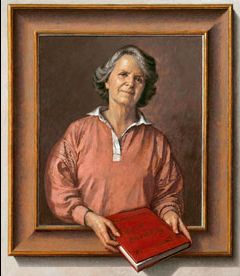
Above is a 1995 portrait of Vivien by her husband Michael.

Posted in Edward Lear | Tagged , | Leave a comment

Blessed Be Nonsense!

NONSENSE

Blessed be nonsense! And blessed be he who invented it! But who was he? Was he pliocene or miocene? Were little Tubal Cain and his sister Naamah sung to sleep by anything deliciously silly? Did anybody draw funny caricatures of the Dinotherium and the Iguanodon in those days? And would sixty-five Pterodactyls sitting in a row, on a rail, fast asleep, make as effective a picture as Edward Lear’s picture of the sixty-five parrots whose two hundred and sixty tail-feathers were “inserted” in the bonnet of Violet, in that most exquisitely nonsensical story “The Four Little Children,” in that most exquisitely nonsensical book, Nonsense Songs, Stories, Botany, and Alphabets, by Edward Lear; J. R. Osgood & Co., Boston? The world, especially this American world, owes more than it knows to the man who makes it laugh. This summer has owed largely to Edward Lear. Anything so funny has not been seen for many a day, as are some of these nonsense songs and stories, with their attendant pictures. The voyage of the Jumblies is perhaps the best of the songs; the Jumblies who went to sea in a sieve with

“Forty bottles of ring-bo-ree.
And no end of Stilton cheese :”

they were gone twenty years or more, and when they came back,

“Every one said, ‘How tall they’ve grown:
For they’ve been to the Lakes and the Torribfe Zone
And the hills of the Chankly Bore.'”

Perhaps there is an under-thought of moral in the story of the Jumblies. Perhaps when we welcome back Jumblies who have been to the hills of Chankly Bore we give them

“A feast
Of dumplings made of beautiful yeast.”

But far the best thing in the book is the story of the four little children who went round the world. Their names were Violet, Slingsby, Guy, and Lionel; but this is of no consequence, neither that they took a small cat to steer their boat The gist of the narrative is that they took “an elderly Quangle Wangle” as cook. What is a ” Quangle Wangle?” That is precisely the joke. It isn’t anything. It is a mysterious, formless, bodiless, comic demon! But in every picture, from behind the convenient shelter of sail or tea-kettle appear the fearful, inexplicable, useful, culinary hands of the Quangle Wangle! There is positive genius in this conception all through; and when at last the discomfited party, having lost their boat by a bite from a Seeze Pyder, return home on the back of an elderly rhinoceros who happened to be passing, and we see the Quangle Wangle riding placidly and shapelessly astride the rhinoceros’s big horn, the triumph is complete!
We should distrust the past and despair of the future of any man who could not laugh at the Quangle Wangle! and we wish every melancholy man had its portrait in his hands this minute.

Scribner’s Monthly, vol. II, no. 6, October 1871, p. 668-669.

Posted in Edward Lear | Tagged , , | Leave a comment

Mccoola’s Limerick Illustrations

Marika Mccoola’s portfolio on CMYK includes several beautiful illustrations for limericks by Edward Lear.

Posted in Edward Lear, Limerick | Tagged , , | Leave a comment

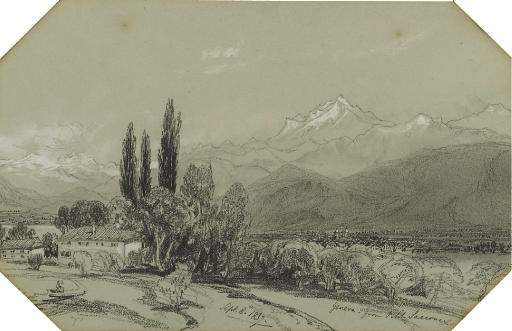
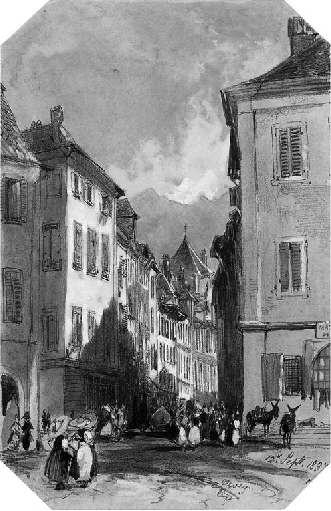
Geneva and Vevey

I have already posted several of Edward Lear’s pictures of Switzerland (1, 2, 3), but so far none from his first visit in 1837 while he was travelling to Italy for the first time. He left London in July and travelled via Brussels, Luxembourg and Frankfurt, where he was on 25 August; he reached Italy in September, was in Florence in early November, and finally reached Rome on 3 December.

Geneva, from Petit Sacconex, Switzerland (1837)
dated ‘Sept.8th.1837.’ (lower centre)
pencil, heightened with touches of white on grey paper, corners cut
6 x 9 3/8 in. (15.2 x 3.8 cm.)

A Street Scene in Vevey, Switzerland
signed and dated ‘Vevey/12th. Septr. 1837′ (lower right)
pencil and watercolour heightened with white, corners cut
10 x 6½ in. (25.4 x 16.5 cm.)

Vevey is situated at the foot of Mount Pélerin towards the Eastern end of Lake Geneva, at the mouth of the Veveyse Valley, a little to the North-West of Montreux. Lear travelled through Vevey on his way to Rome in 1837. This watercolour, although presumably at least begun on the spot, is much more fully coloured than Lear’s later in situ sketches, achieving the status of a finished watercolour.

Posted in Edward Lear | Tagged , , | 1 Comment

Vivien is No Longer with Us

I have just heard from Charles Lewsen that Vivien Noakes died yesterday afternoon. There is no need to empahsize how important she was, and is, to all students of Edward Lear. I’ll just say that she was always supportive and generous to anyone interested in learning on Lear.

Though I corresponded with Vivien for many years, I only met her and her husband Michael once, at their new house in Malvern: the day I passed with them was full of intelligent conversation and enlightening information.

It is very sad to think that Vivien is no longer there to help you.

Charles’s email:

Vivien died yesterday afternoon, four months after she was found to have a cancer, and about a month after she suffered a stoke. All three of the children are with Michael. If followers of the website want to write to him, his address is Eaton Height, Eaton Road, Malvern, Worcs WR14 4PE.

Posted in Edward Lear, General | Leave a comment

More Mr. Lear

Here is another song from the Mr. Lear show in Paris, and an invitation for tomorrow’s performance:

Posted in Edward Lear, Podcasts | Tagged , , | Leave a comment

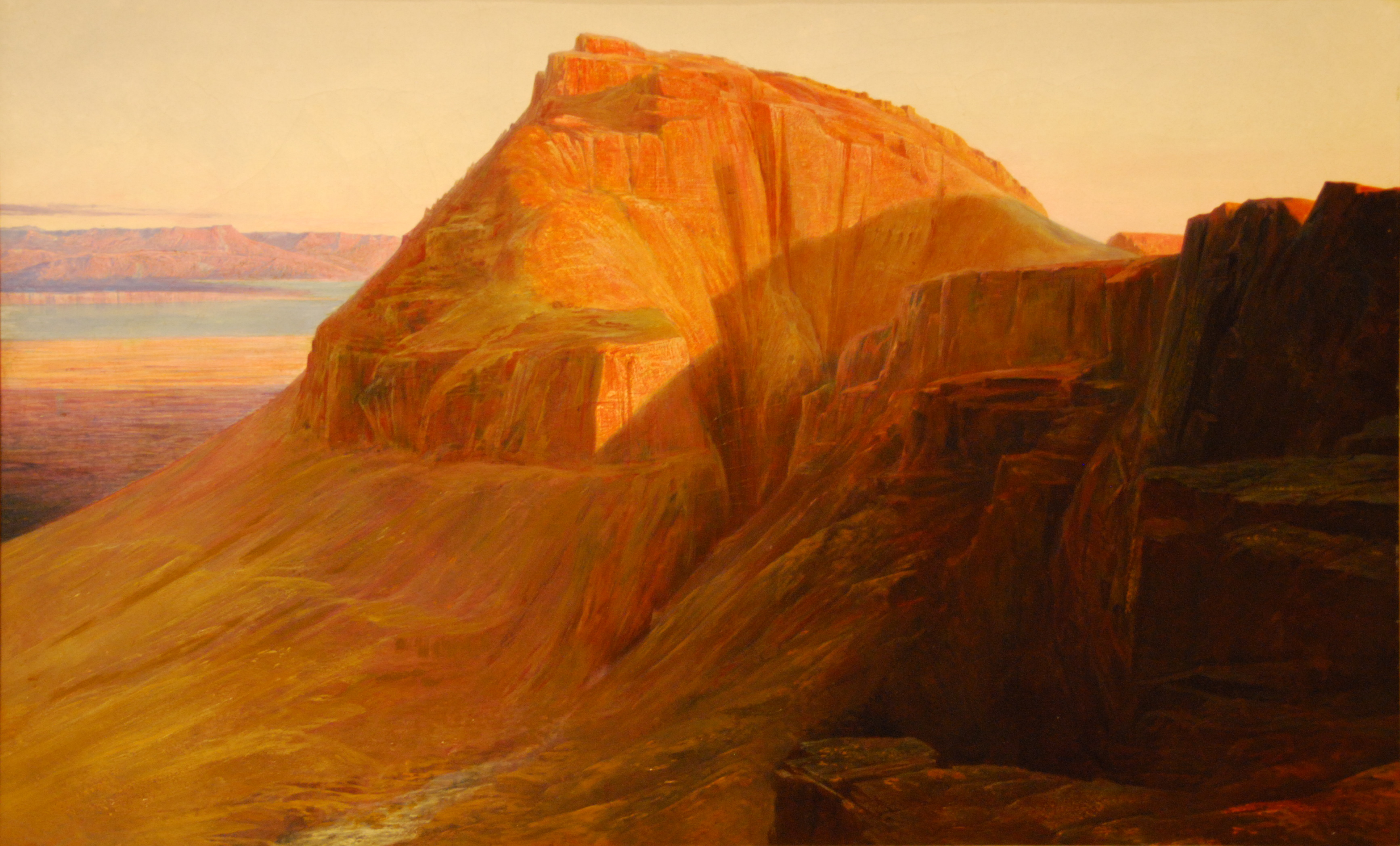
Reviews of Edward Lear’s Masada

Masada was probably the painting that decided Edward Lear’s fortune as a painter, and its effect was far from positive; however, 11 February 1861 was a particularly happy day for Lear as the Times published a “favourable notice” of his “Rock Fortress of Masada, on the Dead Sea” then on show at the British Institution:

… for truth and conscientious work, perhaps the most noticeable thing in these rooms, is Mr. Lear’s large picture of the ‘Rock Fortress of Masada, on the Dead Sea’ (349). The time is early morning; from a foreground of arid cliff rise  the yellow sandstone buttresses, on the very top of which stand perched the scanty ruins of the stronghold of Eleazar, overlooking the deep slaty blue of the plain that stretches to the Dead Sea, whose steely waters are  backed by the wall-like mountains of Moab. Overhead is a limpid, gray sky, with a few wreaths of cloud.
“Exhibition of the British Institution.” The Times, 11 February 1861, 10.

Unfortunately, as far as I know, this was the only favourable review he had. That same day, The Morning Chronicle also published a review of the exhibition, by someone who evidently did not much appreciate landscape painting:

One large and ambitious landscape will force itself upon attention; it will not, we think, win admiration, although it is painted by a name which has always been associated with the idea of a highly-promising painter. “The Fortress of Masada on the Dead Sea,” by Edward Lear (349), is a painful failure, because the price set upon the picture (£525) shows that Mr. Lear looks upon it as an important work. It is one of those pictures in which art is sacrificed in the attempt to attain the absolute representation of a peculiar and arbitrarily chosen aspect of nature.
Upon the whole we are inclined to think that the most noticeable landscape in exhibition is the one by T. Danby, which we have before alluded to…
“Exhibition of the Works of British Artists at the British Institution.” The Morning Chronicle, 11 February 1861.

On 2 March The Illustrated London News also made a negative mention of Lear’s painting:

A large waste of canvas is that of Mr. Edward Lear’s, presenting a view of “The Fortress of Masada, on the Dead Sea” (349), and which is hung in the centre of one of the walls in the middle room, a place altogether unsuited for pictures of these dimensions. This old fortress, situated on an almost isolated rock of about 1500 feet in height, was built in the second century before Christ by Jonathan Maccabeus, and subsequently enlarged and strengthened by Herod the Great. After the destruction of Jerusalem by Titus it was one of the last strongholds of the Hebrews, who, when at last obliged to surrender it, slew their wives and children, and afterwards themselves, rather than they should fall into the hands of their cruel enemies. The place has been ever since desolate, and, as may be judged by the nature of the site, presents few opportunities for the painter’s art. The picture consists of one huge mountain peak, backed by an indistinct blue expanse of sky and stagnant water, and in the foreground a mass of granulated iron, or volcanic rock. It is a pity to see time and materials misapplied to the extent they are here upon such a work.
“British Institution. [Third Notice.]” The Illustrated London News, 2 March 1861, p. 201.

The Saturday Review would also find the subject objectionable in its later notice of the exhibition:

“The Fortress of Masada, on the Dead Sea” (349), by Edward Lear, is a spot to which some memorable historic associations are attached. The word “Masada” is said in Stanley’s Sinai and Palestine to mean the lair, or fastness, and the place was so called as being emphatically the stronghold of the country. It was to Jerusalem what Königstein has been to Dresden in modern times ― an impregnable fortress to which the treasures were sent for security whenever danger was impending. Mr. Lear has conveyed with fine effect the singular and desolate aspect of the now unoccupied heights, and has introduced two figures, which are, we presume, intended to recal [sic] the time when a remnant of the Jews had taken refuge there  from the armies of Titus. We cannot help thinking that these figures rather distract from the impressiveness of the scene by giving an air of unreality; and their historical propriety is at least questionable, as the summit of the hill was then fortified and surrounded with towers, so that the place cannot have had its present wild and deserted appearance…
“British Institution.” The Saturday Review, 6 April 1861, p. 341.

Posted in Edward Lear | Tagged , , , | 1 Comment

Nonsense for Chrismas 1874

On 16 December 1874, Judy ran a review of nursery rhyme books, which includes a reference to Edward Lear. He is mentioned as the author of… Alice in Wonderland. While I have often received e-mails asking about the famous poems by Lewis Carroll, “The Owl and the Pussy-cat” this is the first time I have seen the Alice books attributed to Lear. It shows, if it were still necessary, that “nonsense” as a genre quickly became part of the literary landscape, notwithstanding the differences between Lear and Carroll that are so obvious today. Here is the article:

NONSENSE FOR BIG AND LITTLE BABIES

I hate and despise the good and clever hard-headed matter-of-fact idiot who sees nothing to admire and laugh over in nursery books. There are some solemn noodles, too (I’d stuff them with straw had I my way), who cannot discriminate between delicious nonsense and unmeaning tomfoolery, as there are great literary creatures who sneer at low comedy and fancy the while they can write tragedy, as though a sense of humour were not absolutely necessary in such a case to keep the Great Creatures’ feet upon the right side of the narrow boundary line separating the sublime from the ridiculous.
Thank Heaven, I am not as one of these. My head is bald, my beard is white, my waistcoat protuberates at the lower buttons, and my gay old joints are somewhat creakily inclined, yet I can roar at nursery nonsense as though I were a big baby, which, to tell the truth, I dare say I am. In fact I know I am, and some of these fine days I will take you ― if you are very good and pretty ― into a little back room of mine, where there is a little shelf full of choice volumes, which are very dear to me. CHRISTINA ROSSETTI’s charming “Sing-Song,” gracefully illustrated by ARTHUR HUGHES; half a dozen delightful books full of CHARLES BENNETT’s grotesque and fanciful pictures; TOM HOOD’s “Loves of Tom Tucker;” EDWARD LEAR’s “Alice in Wonder Land;” RICHARD DOYLE’s “Fairies;” and a score of other old friends of mine. Every season my good bookseller, knowing my little weaknesses, sends me a huge parcel of baby literature to select from, and every now and then I add something to that sacred shelf. Let us see; what have we here this merry Christmas time in the year eighteen hundred and seventy-four? Firstly, “The Marquis of Carabas, his Picture Book” (ROUTLEDGE), with thirty-two pages of illustrations by WALTER CRANE, relating to “Puss in Boots,” “Old Mother Hubbard,” “Valentine and Orson,” and an absurd “A B C.” Mr. Crane’s fun is not of a very boisterous nature, but there is some quaint  quiet humour about him, and his drawing and colouring are, as a general rule, admirable, and the details delightful. Both this and the “Goody-Two Shoes” volume (ROUTLEDGE) will be vastly admired, both by the young folks and their papas and mammas.
“Gingerbread” (ROUTLEDGE), a shilling book full of coloured pictures by BUSCH, is of course, being BUSCH’S, awfully droll; and I do not see how you could well help laughing at the great cat-and-mouse tale, even if you are not a baby.
“Old Nursery Rhymes, with the Old Tunes,” set to music (ROUTLEDGE), is a capital idea worked out by E.G.D., and will, no doubt, be as great a hit as the “Little Niggers” and other books on somewhat the same principle.
The “Comptown Races” and the “Funny Little Darkies” (NIMMO) are bright and gorgeous, but hardly seem suited for children. ERNEST GRISET’s “Funny Picture Book,” however, is wonderfully comic and grotesque. It might perhaps, in some cases, have been better without the words; but it is, unfortunately, observable in nearly every nursery book. ERNEST GRISET was never seen to greater advantage than in this droll volume.
“A Choice Collection of Queens and Kings, and other Things” (CHATTO & WINDUS), is a book I find it rather difficult to describe, for I believe it is intended for the special edification of big babies only. It is written, the title-page says, by S.A. the Princess HESSE SCHWARTZBOURG, but I can find no such personage in the “Almanac de Gotha,” and do not believe there ever has been such a princess. Yet she is undoubtedly a foreign lady, with a language peculiar to herself, and a solemnity in talking downright nonsense truly royal. The three sapient gentlemen who made a sea voyage in a washing-tub would surely have stayed at home had they lived in the same period as Her Royal Highness, and helped her through some of the social problems she propounds. Those who would study the cruel perplexities of the Queen of Quildiqued, who could not sneeze without here head, and so, whene’er she caught a cold, she gave it (whether the head or the cold is not distinctly stated) to a friend to hold; or of the King of Hoddidoddi, who wore his head upon his body, though people said, when he was dead, he wore his body on his head; or of the Queen of Kalliboo, who dreamt she was a Wankipoo, yet, strange to say, when she awoke, she thought she was a Queekiquoke; yet, stranger still, her aged mother vowed she was neither one nor t’other. Those who would go deeper into these matters, and learn what Wankipoos, and Queekiquokes really are, and where and how you catch them, had better seek information in the proper quarter.
It is true that there are not wanting solemnly heavy respectable persons who may say that life is too short, and there are too many other serious things to think about; but I am not quite so sure this is the case, and I am inclined to agree with the Lord High Chamberlain, Fo Fel, who had secret he would tell, ―

He said, Kochiki hiki Pum,
But other people said Ko Fum;
Myself (SAYS THE PRINCESS), I rather think Ko Foo,
But that, my dears, ’twixt me and you.

I don’t at all see, for my part, why, this Christmas time, we should not put aside all unpleasant and difficult subjects, and try to settle this momentous question.Ought it to have been Ko Fum of Ko Foo, or was the Lord Chamberlain really right for once in his life?
Judy, or the London Serio-Comic Journal, Wednesday, 16 December 1874, p. 90.

By this time, Judy was owned by the Brothers Dalziel. For a previous review of Edward Lear’s nonsense books in the same paper see this post.

Posted in Edward Lear, Lewis Carroll, Nonsense Lyrics | 2 Comments

Edward Lear and Phonetics

John Well’s phonetic blog discusses what we can learn on Victorian pronunciation from Edward Lear’s limericks.

The Opinionator NY Times blog suggests that Victorian naturalists might be a model for some of Lear’s most famous characters: The Brittle-Stars Danced. The Stingray Smoked a Pipe.

The Financial Times has an article by Jackie Wullschlager on the new Birmingham exhibition of Pre-Raphaelite drawings: The Poetry of Drawing: Pre-Raphaelite Designs, Studies and Watercolours.

Posted in Edward Lear | Tagged , , , | Leave a comment