Edward Lear and the Brothers Dalziel

So far, Lear has mentioned his nonsense rhymes very little in the Diaries; for instance on 19 September 1860, while at Little Green with the Hornbys, one of the families that most appreciated his nonsense, he writes:

I sang nonsense for the children: & afterwards much Tennyson for the elders.

On 30 January 1860, he records taking part in an old-friends meeting at the Knights in Rome and unsuccessfully using the Book of Nonsense as a means of identifying himself:

[At] 8 to Knights, Charles, & Helen, ― Monsignor Pentini, ― D.F. Chigi, the 2 Bertie Mathews, & Karristy. All there had never met all together since 1843, & 1844 ― 16 years ago. Pentini was as ever, kindly & good, ― but did not recognize me all thro’ dinner, tho’ very much interested about Terra Santa ―: afterwards, being shown the “Book of Nonsense,” he suddenly became enlightened, ― but partially confounded me with Abeken, [Probably Wilhelm Ludwig Abeken, an archeologist who was also in Italy in the years around 1837. ] & asked after my “Leone & Scimia.”  ―

On 1 February 1861, however, we suddenly read:

I came to Dalzell’s [sic], & gave the 2 nonsenses to woodcut.

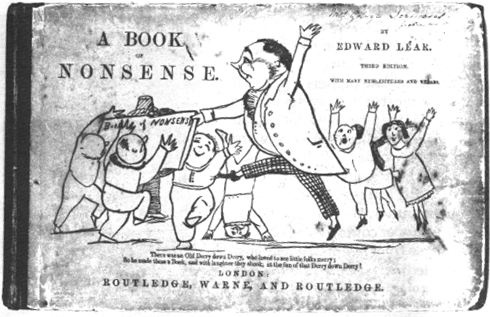
Lear had clearly started planning a new edition of the Book of Nonsense and was thinking of using woodcuts rather than the lithographic process he had used for the 1846 and 1855 editions, probably in order to reduce costs.

There will be more references to work on new “nonsenses” in the coming weeks, but you will have to wait for those; however, here is a passage from a letter he wrote to Emily Tennyson on 6 March:

… since I asked people to come  & see my pictures, they come, ― horridly & disjointedly; sometimes 20 at a time ― of all kinds of phases of life: sometimes ― for 3 hours no one comes: ― so then I partly sleep, & partly draw pages of a new Nonsense book. If I sleep, I wake savagely at some newcomer’s entrance, & they go away abashed. If I write nonsense, I am pervaded with smiles, & please the visitors.
[V. Noakes. Edward Lear 1812-1888 at the Royal Academy of Arts. London: Roayal Academy of Arts, 1985. 170.]

The Brothers Dalziel are probably the best-known wood engravers of the Victorian age ― they did volumes of illustrated Tennyson poems and Carroll’s Alice books for example. In their 1901 memoir, they wrote of their role in the publication of this third edition:

Early in the Sixties we made the acquaintance of Edward Lear, who was a landscape painter of great distinction, a naturalist, a man of high culture, and a most kind and courteous gentleman. He came to us bringing an original chromo-lithographic copy of his “Book of Nonsense”  ― published some years before by McLean of the Haymarket. His desire was to publish a new and cheaper edition. With this view he proposed having the entire set of designs redrawn on wood, and he commissioned us to do this, also to engrave the blocks, print, and produce the book for him. When the work was nearly completed, he said he would sell his rights in the production to us for £100. We did not accept his offer, but proposed to find a publisher who would undertake it. We laid the matter before Messrs. Routledge & Warne. They declined to buy, but were willing to publish it for him on commission, which they did. The first edition sold immediately. Messrs. Routledge then wished to purchase the copyright, but Mr. Lear said, “Now it is a success they must pay me more than I asked at first.” The price was then fixed at £ 120, a very modest advance considering the mark the book had made. It has since gone through many editions in the hands of F. Warne & Co.
Lear told us how “The Book of Nonsense” originated. When a young man he studied very much at the Zoological Gardens in Regent’s Park. While he was engaged on an elaborate drawing of some “Parrots,” a middle-aged gentleman used to come very frequently and talk to him about his work, and by degrees took more and more interest in him. One day he said, “I wish you to come on a visit to me, for I have much that I think would interest you.” The stranger was the Earl of Derby. Lear accepted the invitation, and it was during his many visits at Knowsley that these “Nonsense” drawings were made, and the inimitable verses written. They were generally done in the evening to please the Earl’s young children, and caused so much delightful amusement that he redrew them on stone, and published them as before stated. That is how this clever, humorous book came into existence; a work that will cause laughter and pleasure to young and old for all time. John Ruskin says of Lear’s “Book of Nonsense “:
“Surely the most beneficent and innocent of all books yet produced is the ‘Book of Nonsense,’ with its corollary carols, inimitable and refreshing, and perfect in rhythm. I really don’t know any author to whom I am half so grateful for my idle self as Edward Lear. I shall put him first of my hundred authors.”
[The Brothers Dalziel. A Record of Fifty Years’ Work in Conjunction with Many of the Most Distinguished Artists of the Period. 1840-1890. London: Methuen and Co., 1901. 317-318.]

Posted in Edward Lear | Tagged , , , | 1 Comment

Edward Lear Reviewed in Judy

A BOOK OF NONSENSE

There was once upon a time — I think it was last Tuesday week — a silly old bald-headed gentleman, who took a Brompton omnibus, and found another silly old bald-headed gentleman inside laughing fit to crack his sides over a child’s book of nonsense. “Oh, you great old stupid simpleton, to laugh so!” said the first old gentleman to himself; and then he added in a minute or two, “I should very much like to see what it’s all about.”

What is it all about, eh?

Well, it is about Mr. and Mrs. Spiky Sparrow, if you must know, and the Duck and the Kangaroo, and the Jumblies and Calico-pie; and there’s a receipt to make Crumbobblious Cutlets worth thinking over, and pictures of the Bacopipia Gracilio and Cockatooca Superba, and some account of some surprising animals — as, for instance, the pig whose tail was so curly, it made him surly (cross little pig!); and the whale with the long tail, whose movements were frantic across the Atlantic (monstrous old whale!); without mentioning the ape, who stole some white tape, and tied up his toes in four beautiful bows (funny old ape!). But now I see I have not made even a passing allusion to the four little children who went round the world in a boat, painted blue with green spots, and came back on the other side by dry land; and actually now I have not alluded to the seven families of the lake Pipple-popple, and of the dire fate which befell them; but the fact is, I have no breath left.

What is it all about? Well, it is a book of nonsense songs and stories, ridiculous botany, and preposterous alphabets, by Mr. Edward Lear, whose other book of nonsense all the world must have bought by this time; and I should advise big babies not to lose such an opportunity of getting a right down good laugh themselves by buying this book, nominally for any little babies they may know of, but really to read and roar over themselves in secret before giving it up, as that great big bald-headed old silly was doing when I caught him at it in the omnibus.

How many hundred nursery books are published in a year I have no notion, but I should think it will be many a long year before such a genuine child’s book makes its appearance again. It always has been thought to be beneath great minds to be funny, and some dull fools say fun is out of fashion, but the world likes laughing yet, and will until the end of time. To wag one’s head, and shake the bells, may not be dignified, but it is vastly profitable. A poor ambition it must seem to you stately ones, but lucrative and pleasant withal when you’re used to it.

Judy, or the London Serio-Comic Journal, Wednesday, January 18, 1871; pg. 114.

Posted in Edward Lear | Tagged , , , | 1 Comment

Master Drawings in NY

The NY Times reports that the Master Drawings New York 2011 show is in full swing, and features an Edward Lear watercolour of “The Cedars of Lebanon:”

Edward Lear, The Cedars of Lebanon

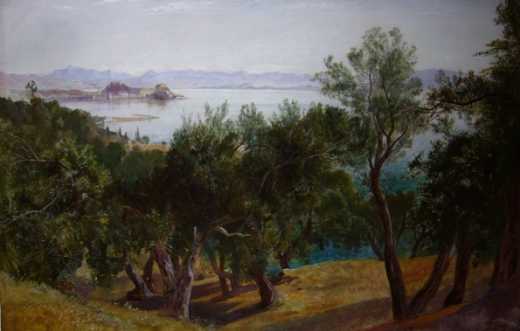
Andrew Wyld, a London dealer, among many interesting pictures, has several more Edward Lear drawings, among them an oil of “Corfu from the Village of Ascension:”

and “Lake Lugano from Monte Generoso,” drawn in 1878, much later than the 1854 watercolours I have been posting:

Posted in Edward Lear | Tagged , , , | Leave a comment

The Day of the Wombat

Peacay of BibliOdyssey posts “some delightful scratchy illustrations from the 1962 book by Ruth Park, ‘The Adventures of the Muddle-headed Wombat'” in honour of Australia Day.

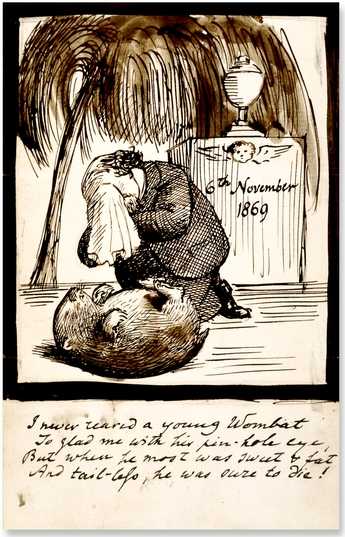
So here is my homage. Dante Gabriel Rossetti’s lament for the death of his wombat, a beast which, according to some, also appears in Carroll’s Alice:

© Trustees of the British Museum

‘I never reared a young wombat
To glad me with his pin-hole eye,
But when he was most sweet and fat
And tail-less he was sure to die’

The inscribed verse is a parody of Thomas Moore’s Lalla Rookh (1817): ‘I never nurs’d a dear gazelle / To glad me with its soft black eye, / But when it came to know me well / And love me, it was sure to die!’ Instead of being layed to rest in the handsome tomb we see here, the unfortunate marsupial was actually stuffed and placed in Rossetti’s entrance hall.

I can’t remember where I got the image above, but it is in the same note as an essay by Harold White Fellow on “Rossetti’s Wombat: A Pre-Raphaelite Obsession in Victorian England,” in the National Library of Australia site. Of particular interest for lovers of Edward Lear:

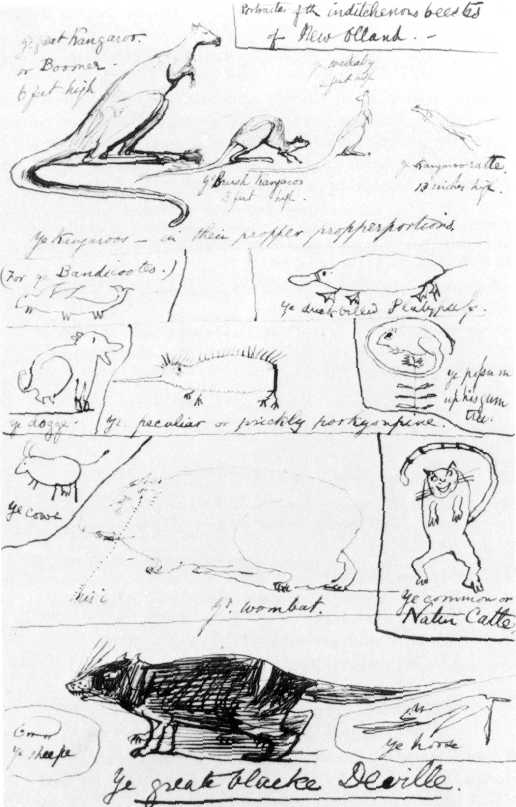
But the most important development in the establishment of the wombat’s English reputation was the appearance in 1855 of John Gould’s de luxe The Mammals of Australia. Gould was in Australia much earlier, in the 1830s, and it was certainly through Gould that the artist Edward Lear, who illustrated Gould’s Birds but unfortunately not the Mammals, made a wonderful sheet of whimsical drawings of the ‘Inditchenous Beestes of New Olland’, a rarity which is today in the collection of the Pierpont Morgan Library in New York. These are plausibly accurate caricatures of various species of kangaroo and wallaby, the platypus, the ‘possum up his gum tree’ and the Tasmanian Devil. There are also mad renderings of the bandicoot, echidna and native cat, not to mention representative appearances in the margin of the cow, the dog, the sheep and the horse. Splendidly rotund and occupying the largest amount of space towards the bottom centre of the sheet is the wombat, with his ‘i’.

Below is a small scan of the Lear image, which was published in the Academy of Art exhibition catalogue.

Posted in Edward Lear, Lewis Carroll | Tagged , , , , , | Leave a comment

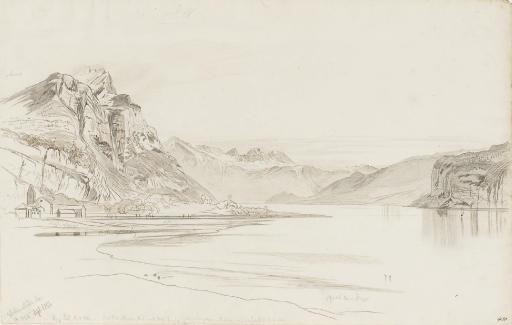
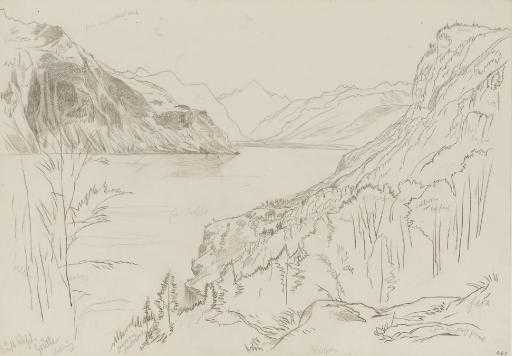
View of Wallenstadt See and View of Grütte

Two more views from Edward Lear’s 1854 tour of Switzerland.

View of Wallenstadt See, Switzerland
inscribed and dated ‘Wallenstadt See./24 & 25 Sept. 1854’ (lower left) and numbered ‘430’ (lower right) and extensively inscribed with colour notes and indistinct inscription ‘I see FL, Chapman, HL & 2 Miss … pale powdery snow with pines …’ (lower centre)
pencil and pen and brown ink on paper
12¾ x 20¼ in. (32.3 x 51.4 cm.)

View of Grütte, Switzerland
inscribed and dated ’15th & 16 Sept./Grütte./evening’ (lower left) and numbered ‘443’ (lower right) and further inscribed with colour notes and ‘pines always intensely small’ (upper left)
pencil and pen and brown ink
13¾ x 19¾ in. (34.9 x 50.1 cm.)

Posted in Edward Lear | Tagged , , , | 1 Comment

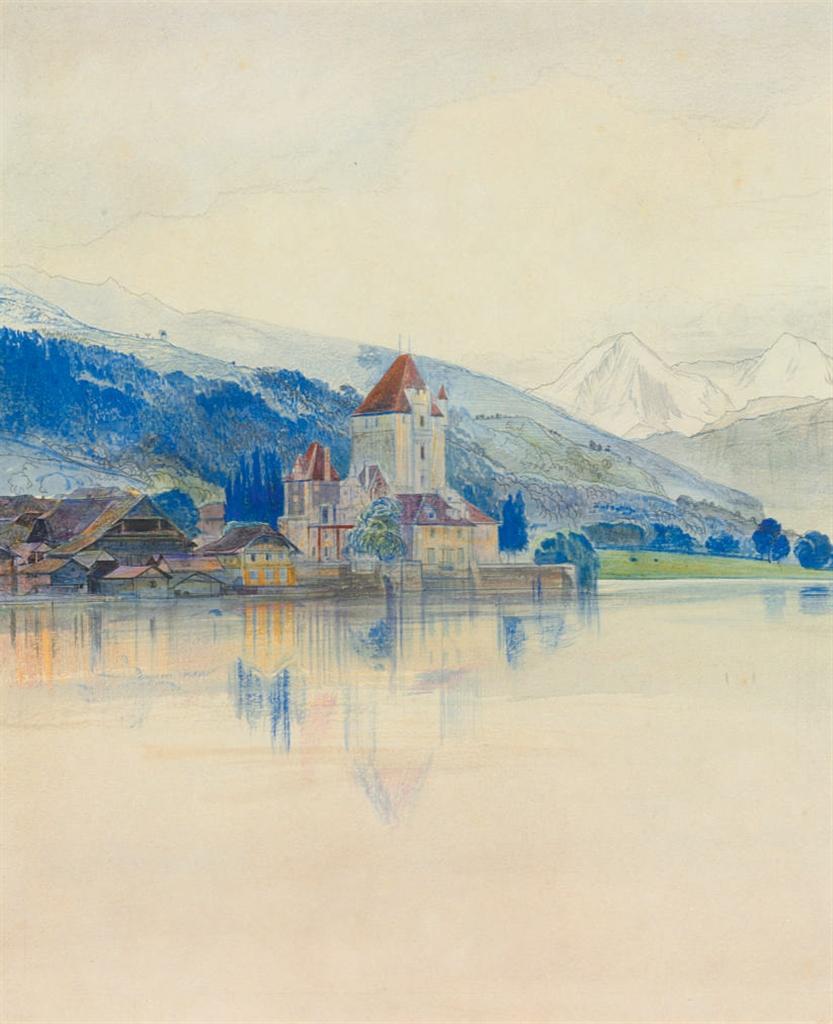
Lake Thun with the Schlöss Oberhofen

Lake Thun with the Schlöss Oberhofen
pencil and watercolour on paper
12 3/8 x 10¼ in. (31.4 x 26 cm.)

Lear left London for a walking tour of Switzerland on August 1854. On 6 August he wrote to his sister Ann ‘I had no idea really of the beauty of Switzerland – for I never was in the really fine parts, except in 1841 – when I came thro’ by night … The Lake of Thun is one of the most beautiful of all the Swiss Lakes; -such a wonderful pea-blue sea-green!’

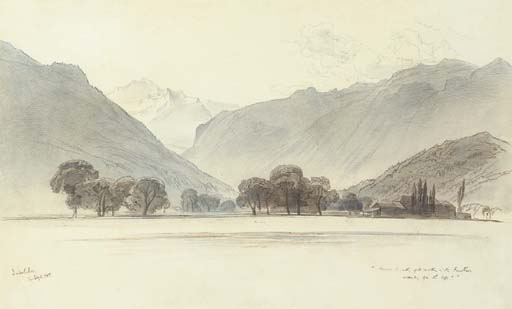
To Ann: “I set out to walk to Interlacken[sic]… along the north side of the Lake which is like a garden or park till, towards the east end, when one walks through beautiful shady woods.”

View of Interlaken, Switzerland
inscribed and numbered ‘Interlaken/2.Sept.185’ (lower left) and further inscribed ‘How is the father of the [?] mother in the Faulhorn/ascending on the top?’ (lower right) and further inscribed with colour notes
pencil, blue and brown ink and grey and blue wash
11 x 18¼ in. (28 x 46.5 cm.)

Posted in Edward Lear | Tagged , , , | 1 Comment

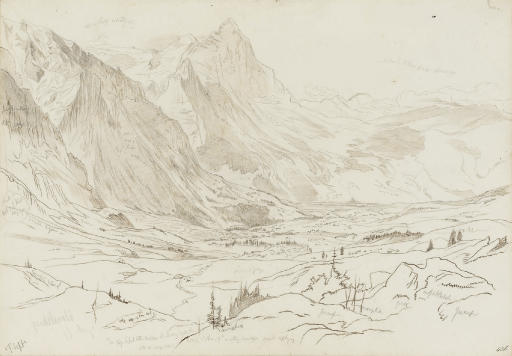
View of Gründelwald, Switzerland

View of Gründelwald, Switzerland
inscribed and dated ‘Gründelwald/13 Augt and 7. Septr.’ (lower left) and numbered ‘436’ (lower right) and extensively inscribed with colour notes and ‘all[?] white misty sky’ (upper left) and identifications of plants including ‘juniper, moss & bluebells’
pencil and pen and brown ink
13¾ x 19¾ in. (34.8 x 50.1 cm.)

Lear travelled to Switzerland in the company of his childhood friend Bernard Husey Hunt from 1 August until the beginning of October 1854. The two met at Thun, where Husey joined Lear who was taking in the clean, clear air. By mid August they had set out to walk over the Bernese Alps and across the Rhône Valley to Piedmulera, a few miles from Lake Maggiore. Then they turned west along the valley of Anzasca to the foot of Monte Rosa and up through Saas and the Stalden Pass to Zermatt. There Hunt left him and Lear travelled north on his own to Interlaken and after returned home. He wrote to William Holman Hunt of his experience in the Alps: ‘I was tired of hearing them talked of without having seen them. Now that I have done so, I feel I was right in coming, as there is so much of the astonishing & majestic in Swiss scenery that no landscape painter who wishes his mind to open to the admiration & comprehension of all kinds of nature, should pass through life without seeing this country’ (V. Noakes, The Life of a Wanderer, London, 2006, p. 109).

Lear wrote to his sister Ann that Grundelwald is ‘a wonderful valley with glaciers … they are like mardepore corals – only 15 to 40 miles long, & look as if made of wedding cake.’

Posted in Edward Lear | Tagged , , | 1 Comment

Mr. Lear Show-Case, Some Extracts

Benjamin Charavner sent out some extracts from the show I mentioned a few weeks ago, Mr. Lear Show-Case; the recording, as he notes, is not high quality, but acceptable: “c’est juste une photo sonore d’un moment qui fut, pour tout le monde, réjouissant.”

The piece will be performed again on 13 February at the “Combustibles” (“chouette salle de concert vers le ‘Baron Rouge’,” for those in Paris at the time).

Here are the five songs:

Brussels
Cold are the Crabs
Oh! Pan!
The Akond of Swat
The Umbrella-Maker

Posted in Edward Lear | Tagged , , | Leave a comment

Bye Bye Pussycat

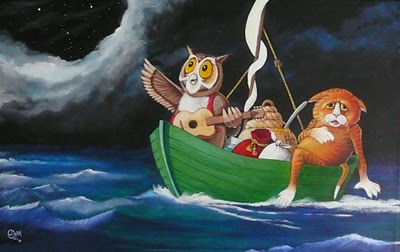
Stevyn Colgan annouces that he is closing down his Runcible Spoon blog, devoted to interpretations of the poems of Edward Lear and posts a best-of selection, as well as a step-by-step illustration of how he did his own version of “The Owl and the Pussy-cat.” It’s a real pity to see the site go.

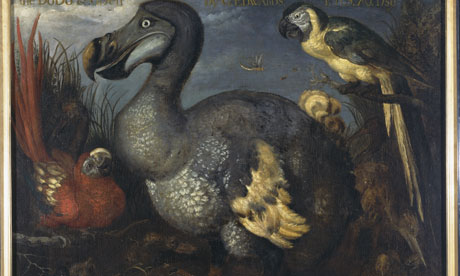
Meanwhile, the Guardian announces that the Dodo gets a new lease of life.

Posted in Edward Lear | Tagged , , | Leave a comment

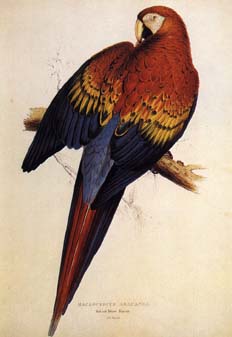
Lear’s Macaw is no longer Lear’s

It is old news, apparently, but I only found out today: the Lear Macaw is now officially to be called the Indigo Macaw, according to this article, reviewing Whose Birds by Bo Boelens and M. Watkins (Yale University Press, 20049).

Posted in Edward Lear | Tagged , | 1 Comment