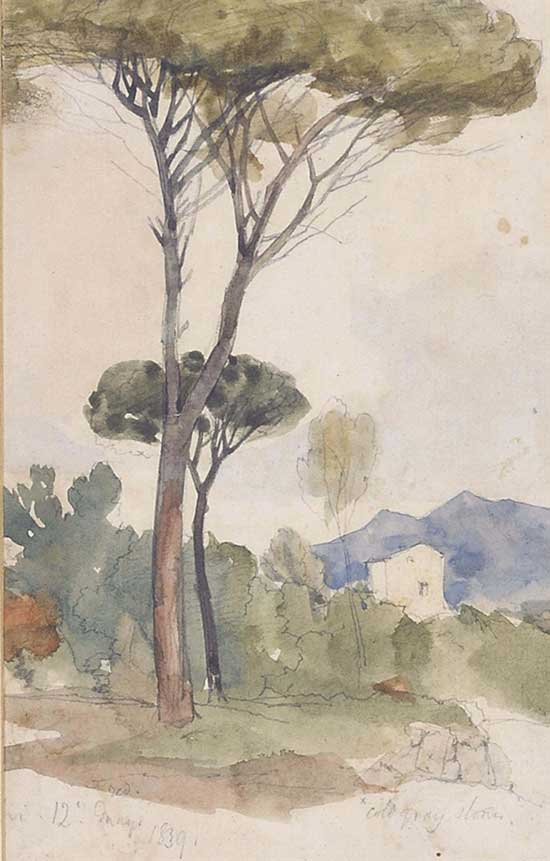
Cypress trees. Inscribed and dated ‘..vi 12 th May 1839.’ (lower left) and variously inscribed with colour notes. Pencil and watercolour. 5¾ x 3½ in. (14.7 x 8.9 cm.).

Cypress trees. Inscribed and dated ‘..vi 12 th May 1839.’ (lower left) and variously inscribed with colour notes. Pencil and watercolour. 5¾ x 3½ in. (14.7 x 8.9 cm.).
Tomorrow, 30 January, two separate events will mark the beginning of Edward Lear’s bicentenary celebrations. You will have to choose, if you are in London, don’t miss

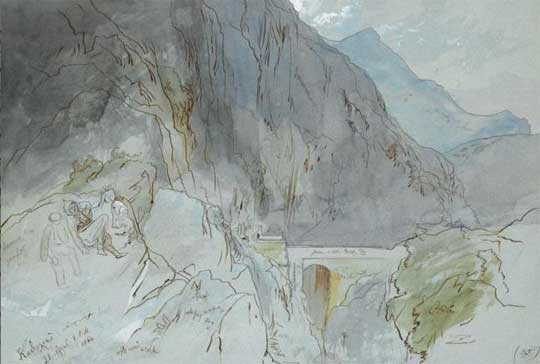
Edward Lear, Katholikó Akrotiri, Crete (1864)
Edward Lear and His Cretan Drawings, a lecture by Stephen Duckworth. Modern Greek Seminars, King’s College, London. 5.30 pm.
If you are in Oxford:
Edward Lear’s Origins, a lecture by James Williams, of Brasenose and Jesus Colleges. Oxford Children’s Literature and Youth Culture Colloquium, Seminar Room A, English Faculty Building. 5.15 pm. Directions & map.
More details in the home page, or on Facebook.

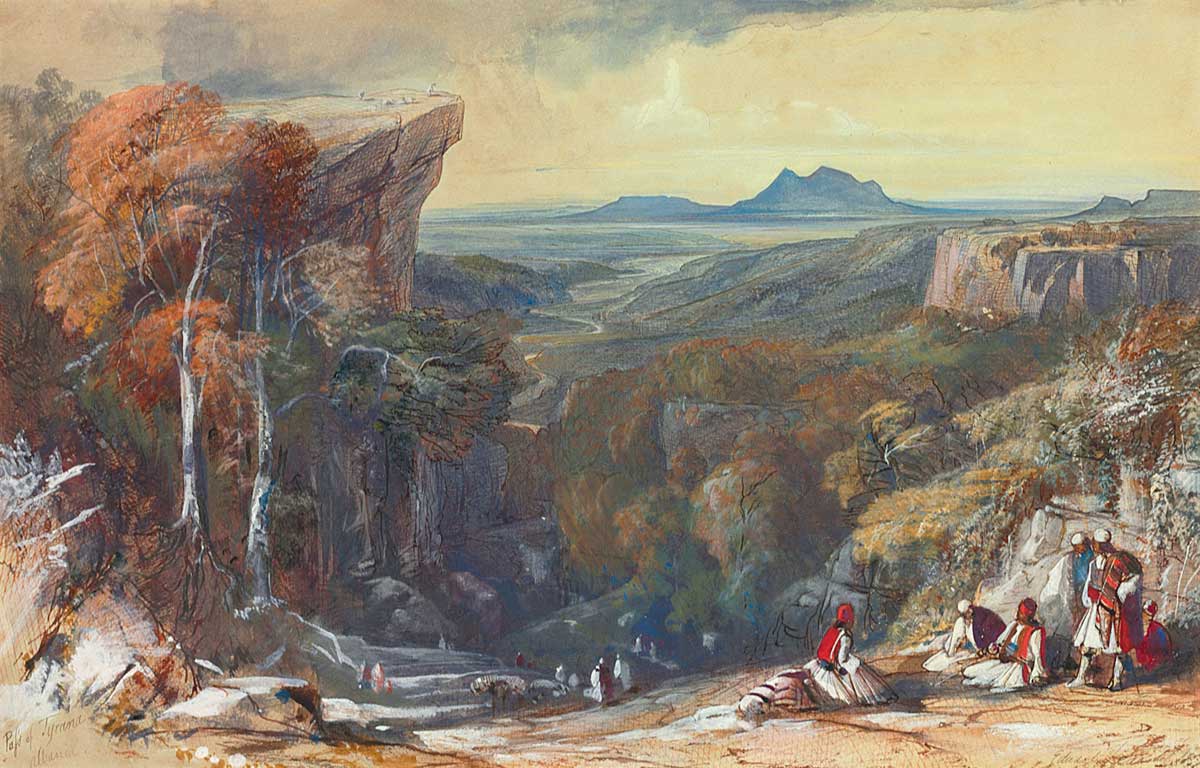
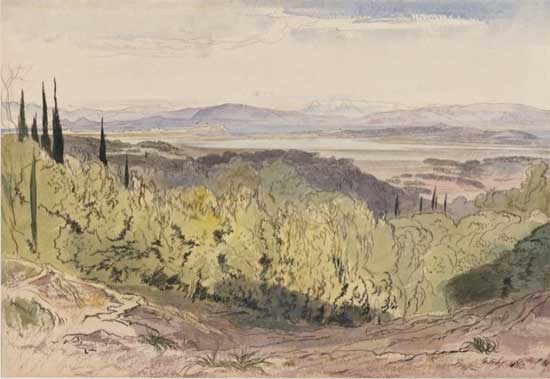
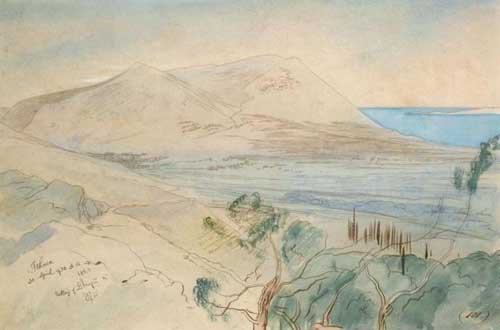
Ithaca, Ionian Islands. Inscribed and dated l.l.: Ithaca/ 30. April. 9.30.A.M. 1863/ Valley of Elaupio/ OE…, numbered l.r.: 101, further inscribed with notes. Pen and brown ink and watercolour over pencil heightened with bodycolour.
In 1863, the date of the present work, Lear was 51 years old. Between 1862 and early 1864 he had largely divided his time between Corfu and England. However, from April to May he conducted a brief tour of the other Ionian islands. Ithaca lies to the north-east of Kefalonia and Lear described it as ‘Ulysses’ Kingdom’. He was clearly inspired by the island for in letter to Ann, his wife, he wrote: ‘[Ithaca] is a little island and charmingly quiet. I delight in it,’ (see Angus Davidson, Edward Lear, 1968, p.50).
I found these two pictures on my hard disk; which I probably saved them from eBay auctions. They are from a set of six postcards from Helen Stilwell’s Laughable Looloos, a series of cartoon that was published in the New York World from 13 May to 25 November 1906, I have posted most of the newspaper strips here.

Helen Stilwell, I have found out, married comic strip artist Gene Carr on 22 August 1906 (they divorced in 1937), and was “a school teacher of Red Bank, and has since been living at Red Bank. Mrs. Carr is generally supposed to be the writer who signs her name Betty Vincent to many stories which are published by the same newspaper for which Carr works” (The New York Times, 28 July 1908, reporting on Carr being suspected of murder, but being “proved not the man”).

A view of the Valley of the Nera, near Rome.
Signed with monogram, inscribed and indistinctly dated ‘Valley of the Nera/18…’ (lower right) and with the artist’s notation ‘River’.
Pencil heightened with white on buff paper. 10 1/8 x 13¾ in. (25.9 x 35 cm.).
Lear most likely made this drawing during his first few years in Italy, circa 1838-39, when he would often travel through the Campagna.
Tivoli, a view from the Villa d’Este looking across the Campagna.
Inscribed ‘Villa D’Este. Tivoli’ (lower left) and signed and dated ‘1839./Edward Lear’ (lower right).
Pencil heightened with white on grey-green paper. 6 5/8 x 13 1/8 in. (16 x 33.4 cm.).
This highly finished pencil drawing is typical of the artist’s early style. The technique and composition of such works shows the influence of James Duffield Harding with a vigorous use of soft dark lines, white chalk highlights and tinted paper.
Montenegro
Signed with monogram, and signed again and inscribed ‘MONTENEGRO./A drawing made by me in 1870-72/from sketches made on the spot in 1866./Edward Lear/Purchased by Thomas Baring Esq.re MP’ (verso).
Watercolor and bodycolor, watermark ‘J WHATMAN’, on paper laid down on a panel support. 30 x 48 in. (76.2 x 121.9 cm.).
Lear visited Montenegro late in April 1866, during a tour of the Dalmatian coast on his way from Malta to Trieste, and subsequently back to London. His diary describes, on 26 April, the road up from the coastal town of Cattaro ‘to Montenegro & really as it ended in cloud it suggested a far more convenient and elegant ascent for the legend of Jacob’s dream than the conventional ugly ladder generally used …’. Lear walked ‘a mile or so along the Lake, for so it seem…. The vast semicircle of mountain crags is most striking’ (R. Pitman 1988, p. 137).
This large watercolor seems to be the work referred to by Lear in a number of letters of the 1870s and 1880s. On 26 July 1870 Lear wrote to his patron Lord Derby from Cuneo saying that ‘My new painting room at Sanremo will not be ready (I fear) for early work in oil this winter … but I was about until it be so to do 2 large (for watercolour,) drawings in order to try – (vainly I fear,) to get elected Associate at the Old W/color Society: The stained paper for these 2 is (I believe) already on its way out, & I have already made the rough designs for the drawings – Montenegro & Corfu …’.
Later the same year, on 11 December 1870, Lear wrote to Lady Wyatt from San Remo that ‘I am at work, – when I work wh is very irregularly, – on a large W.Color picture of Montenegro: and though parts are done – parts ain’t …’. He adds, ‘The Montenegro is a cold and gloomy scene – as it is intended to be, for it is so in reality: and I have done one bit of rock so well you sprain your ankles directly you look at it. In the foreground I had taken a gt deal of pain in a large figure of a Montenegrine, & he was really like life. But some days back as I went into the next room I heard an odd trumpetty noise, and coming back, he had put out his hand, & had taken my pockethankerchief off the table, and was blowing his nose violently! … I instantly had to sponge out the whole man, for I thought, if he can take up a handkf, he may take up spoons or money. So I killed him, and I wonder where his better part has gone to. O dear! I wish I had done this dreadful drawing! & that I had sold it!’.
In a letter to Baroness Burdett-Coutts from San Remo of 7 February 1883 Lear mentions a large unfinished drawing of Corfu from Viro, adding that ‘The fellow drawing of this, Montenegro, – belongs to Earl Northbrook’. Thomas George Baring, later 1st Earl of Northbrook, was one of Lear’s closest friends, inviting him to India as his guest between 1873 and 1875 when he was Viceroy and Governor-General there (see Noakes, p. xl and passim). Many of the drawings in the Houghton Library, Harvard University, now the most important collection of Lear’s work, previously belonged to Lord Northbrook, and were still housed in the wooden drawers which Lear had made for his move into Villa Emily, San Remo, when they were sold (Royal Academy, Edward Lear 1812-88, exhib. cat., London, 1985, p. 12).
The work included in the Fine Arts Society Exhibition in 1983 was described in the catalogue as an oil on canvas, 24 x 48in., but a label on the back of this watercolour shows that it was this work
A study for the present watercolor was sold in these Rooms, 15 June 2011, lot 36.
Here are some links to articles on Edward Lear and nonsense for your weekend reading:
Francesca Bombassei Gonella. “‘Everything’s Got a Moral, If Only You Can Fint It’: Modernità, interculturalità e sovversione del canone nella letteratura vittoriana per l’infanzia: Lewis Carroll, George MacDonald ed Edward Lear.” Scorci improvvisi di altri orizzonti: Sguardi interculturali su letterature e civiltà di lingua inglese. Ed. Mario Faraone. Morrisville, NC: Lulu, 2008. (In Italian, Google Books)
Richard Cronin. “Edward Lear and Tennyson’s Nonsense.” Tennyson among the Poets: Bicentenary Essays. Ed. Robert Douglas-Fairhurst and Seamus Perry. Oxford: Oxford University Press, 2009. (Google Books)
Kirby Olson. “Edward Lear: Deleuzian Landscape Painter.” Victorian Poetry 31 (1993). In Comedy After Postmodernism: Rereading Comedy from Edward Lear to Charles Willeford. Lubbock, Texas: Texas Tech University Press, 2001. (Google Books)
Dirce Waltrick do Amarante. “Edward Lear e seu ‘nonsense’ errantE.” Aletria – Revista de Estudos de Literatura 20 2 (2010). (In Portuguese)
Limericks by Edward Lear. “Genre Readers’ & Writers’ Workshop.” Pelham, NY: Benchmark Education, 2011. (An elementary introduction to limericks, Google Books)
View of Monte Pellegrino, Palermo, 1847.
Dated ‘July 13, 1847’ and further inscribed ‘(235)’ twice (lower right) .
pencil and oil on paper, laid down on board. 8½ x 15¼ in. (21.6 x 40 cm.).
Lear visited Sicily for the first time in 1842. This oil sketch was done during his second trip to the island in 1847, perhaps unusually, in situ. Lear typically sketched out-of-doors and then finished his oils in his studio. In this case, the seemingly rapidly executed brushstrokes on a sheet of paper laid down on board suggests that he made this oil sketch outside of Palermo. Monte Pellegrino is located on the Bay of Palermo and is home to the sanctuary of Saint Rosalia, the patron saint of the city. The numbering ‘235’ is Lear’s own numbering of his works. Every time he entered a new country, he would start numbering his sketches beginning at ‘1’.