Edward Lear, View of Gwalior, India (1880)

View of Gwalior, India, 1880.
Signed in monogram ‘EL’ (lower right) and inscribed ‘Gwalior’ (lower left).
Oil on canvas, unlined (Prepared by Charles Roberson 99, Long Acre London)
9¼ x 18¼ in. (23.5 x 46.3 cm.).

Throughout his life Lear was the most unlikely inveterate traveler. Besieged by ill health, poor eyesight and without sufficient funds, he nevertheless traveled through most of Europe — including remote and unpopulated areas of Eastern Europe — as well as areas of the Middle East and North Africa. His most far-flung trip would be his last when in 1873 he set out for India under the patronage of Lord Northbrook, who had just been appointed Viceroy of India the year before. Lear had made an unsuccessful attempt to reach the Subcontinent in 1872 but was forced to turn back at the Suez Canal. He spent about fifteen months in India and Ceylon and was dazzled by the cacophony of colors and costumes, architecture and landscape. He made at least 1,500 drawings while in India, the majority of which are in the Houghton Library at Harvard University.

In February 1874 Lear was in Gwalior, a city in present-day Madhya Pradesh south of Agra, site of the Taj Mahal. He was ill when he arrived, but was still able to sketch and write about his journey. Lear wrote of Gwalior in his diary ‘…[I] moved “athwart” the plain to a rising ground covered with Musselman tombs, — some very pretty, — others mere heaps of stone, — all more or less in decay. Here I got a very good distant view of Gwalior Fortress’ (I.J., Ms., 22.ii.74). Indeed it is this view we see in the present lot: the Chambal river is in the foreground with elephants wading in the water. In the distance, a plateau rises from the vast landscape, on top of which is the Gwalior Fort, first built in the 8th century, overlooking the city, its minarets puncturing the hazy skyline.

Lear’s preliminary sketch of Gwalior first done in situ and then ‘penned out’ (i.e., his pencil lines gone over with pen and ink and then filled in with watercolor) is dated 22 February 1874, 2:30pm (The Houghton Library, Department of Printing and Graphics, Harvard University; see V. Noakes, Edward Lear, 1812-1888, New York, 1986, p. 64, 34f). It was the basis for this oil, believed to have been executed in 1880 (dated on the frame) after the artist had returned to Italy, his adopted home. Both the stretcher and the frame (fig. 1) — apparently original to the painting — are inscribed ‘The Duke of Westminster/Grosvenor House’, indicating the painting’s first owner. A larger version (82.5 x 165.8 cm.) of this composition, also in oil and dated 1884, is in the collection of the Brighton Museum and Art Gallery (FA000039).

Christie’s.

Posted in Edward Lear | Tagged , , , | 1 Comment

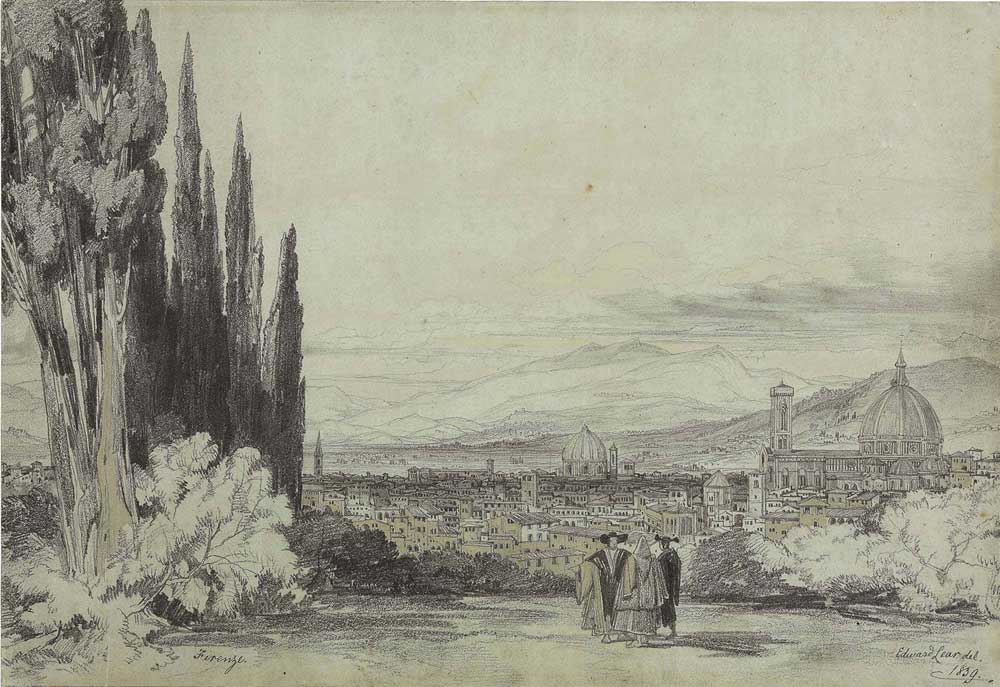
Edward Lear, A View of Florence (1839)

A view of Florence with the Duomo in the distance.
Signed and dated ‘Edward Lear. del./1839.’ (lower right) and inscribed ‘Firenze.’ (lower left). Pencil, ochre wash, heightened with white (partly oxidized) on light green paper. 9¼ x 13½ in. (23.4 x 34.2 cm.).

In the spring of 1839 Lear left southern Italy on a walking tour towards Florence. Even during his early travels Lear displayed a restlessness – never staying in one place for more than a few months – that would characterize his career until the last decade of his life.

These early years in Italy were a period of unusual financial stability for the artist due in part to his growing number of students and from the sale of his topographical landscape drawings and the publication of two illustrated books on Italy, Views of Rome and its environs (1841), and Illustrated excursions in Italy (1846).

Christie’s.

Posted in Edward Lear | Tagged , , | Leave a comment

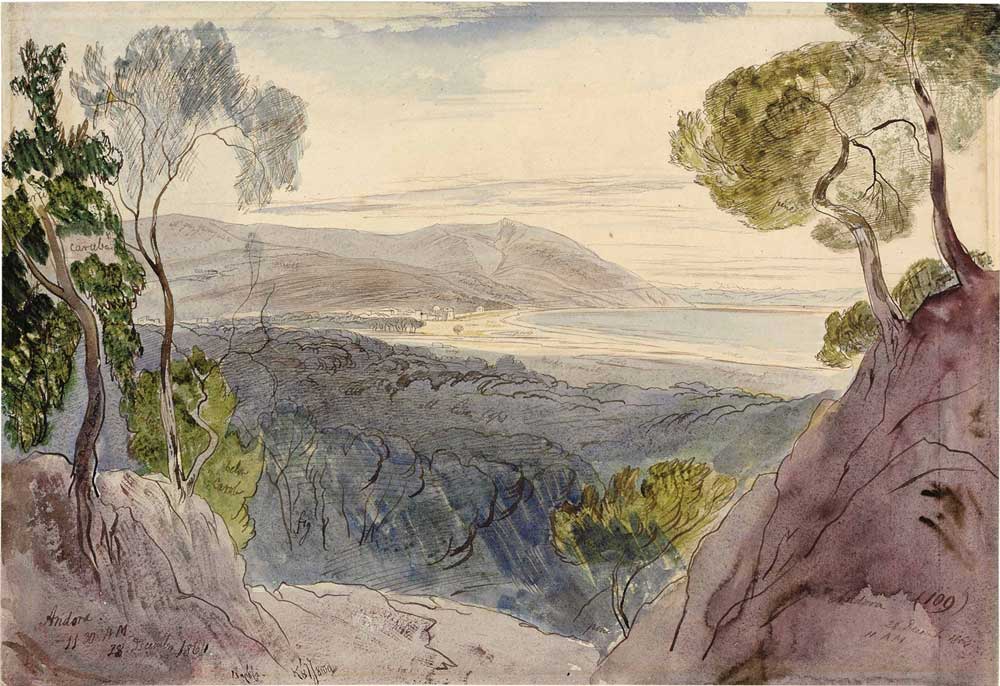
Edward Lear, Andora, Italy (1864)

Andora, Italy. Inscribed and dated ‘Andora/28 December 1864/11 AM’ (lower right) and inscribed again and dated ‘Andora/11 30 AM/28 December 1864’ (lower left) and numbered ‘(109)’ (lower left) and further inscribed with color notes.
Pencil, pen and brown ink, watercolor.
14 1/8 x 20½ in. (35.9 x 52.2 cm.).

Lear left England in November 1864, to spend the winter in the Riviera. Shortly after his arrival he settled down to draw 240 ‘Tyrants’, this task left him exhausted and he decided to spend a few weeks walking along the coast.

At the end of November he set off with his servant Giorgio to walk to Genoa; they walked between sixteen and twenty miles a day, returning to Nice on New Year’s Eve with 145 drawings. As he wrote to William Holman Hunt from the Promenade des Anglais on 7 January 1865, ‘One of my aims this winter was to ‘get’ all the Corniche or Riviera di Ponente; .. that I have done both ways with 145 sketches & better health than before – also less abdomen’. These sketches he ‘penned out’ in the evenings for his possible, but never realised, book (V. Noakes, ed., Edward Lear, Selected Letters, Oxford, 1988, pp. 202-3).

Lear’s technique would be to make a quick pencil sketch with color notations. Back in his studio – or even in his tent later that evening if he was on a long walking trip – he would have ‘penned out’ the composition. That is, he would go over his pencil lines and even his color notations in pen and ink, and fill in the composition with watercolor following his notes. These ‘penned out’ drawings were not meant to be exhibited or sold, but were rather the basis for watercolors commissioned by Lear’s patrons who would visit his studio and choose from among a group of them. Indeed, it was not until 1929, when two large collections belonging to the descendants of Lord Northbrook and Franklin Lushington came up for sale, that this aspect of Lear’s oeuvre became known to the general public.

Christie’s.

Posted in Edward Lear | Tagged , , , | 2 Comments

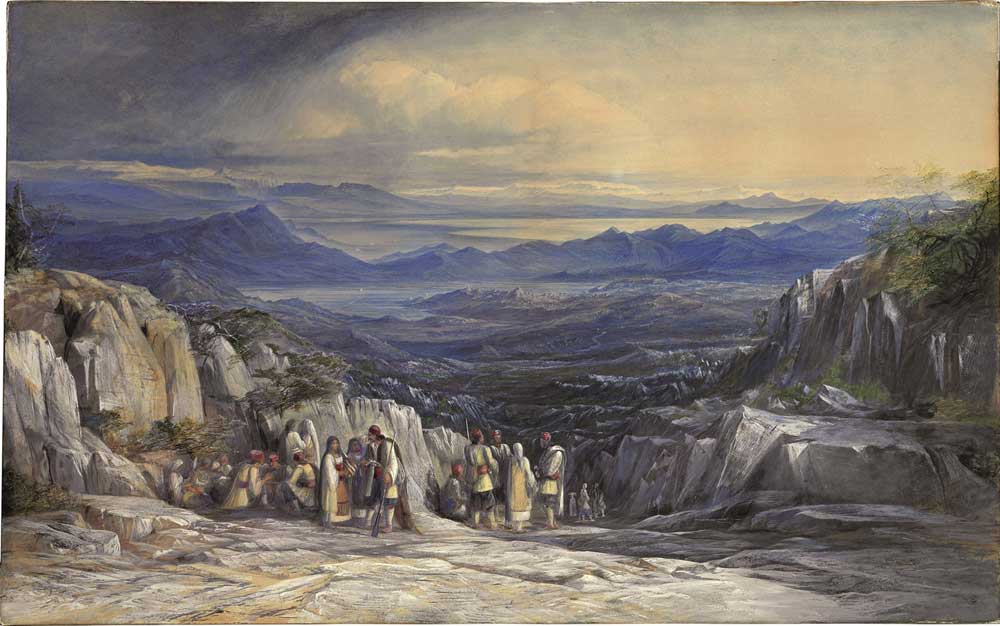
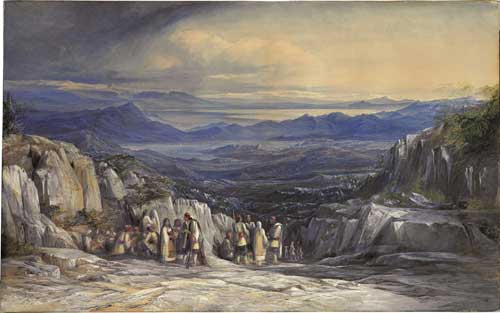
Edward Lear, View of Mount Olympus

View of Mount Olympus, Macedonia and Thessaly, near the Gulf of Salonika
signed in monogram and dated ‘EL·1864’ (lower right).
Oil on panel (Prepared by Charles Roberson 99, Long Acre London)
7 x 11 in. (17.7 x 27.9 cm.).

Lear visited Greece and the Greek islands many times, making so many compositions of various sites throughout the country that he lamented at one point that he would only be remembered for his Greek views. He first visited Greece in the 1840s, and for long periods of time in the late 1850s and early 1860s made the island of Corfu his home base. In 1864 he voyaged to northern Greece to sketch Mount Olympus — the subject of this oil sketch and the highest mountain in the country, located between Thessaly and Macedonia. He described his journey in his diary:

Starting at about seven, we held a southward course; the plain was one unvaried green undulation. Larissa, and even Olympus, except now and then its highest peaks, are soon lost to sight — and it is only from some eminence — that anything like a satisfactory drawing can be made — yet the very simplicity, the extreme exaggeration of the character of a plain is not without its facination; and the vast lines of Thessaly have a wild and dream-like charm of poetry about them, of which it is impossible for pen or pencil to give a fully adequate idea. (Journals of a landscape painter in Albania, pp. 416-417).

A preparatory sketch in pencil, pen, ink and watercolor, made in situ during the 1849 visit described above, and now in the Houghton Library at Harvard University (see P. Hofer, Edward Lear as a landscape draughtsman, Cambridge, 1967, pl. 49) was the basis for Lear’s oil sketch made some fifteen years later. The composition was also the basis for an illustration done by Lear in 1885 of one of Tennyson’s poems. Re-using earlier sketches for later studio compositions was typicial of Lear’s working method.

Christie’s.

Posted in Edward Lear | Tagged , , , | Leave a comment

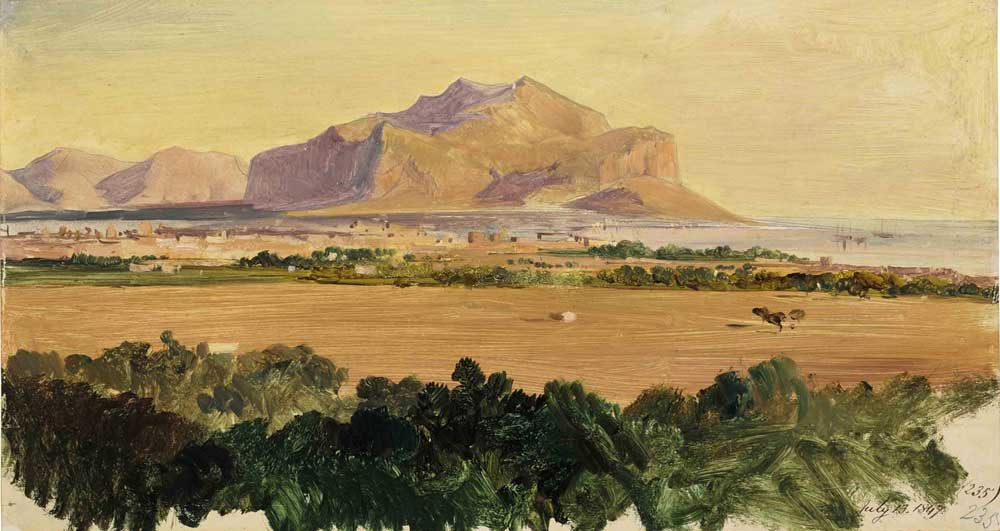
Edward Lear, Fishermen’s Houses on the Bosphorus (1848)

Fishermen’s houses on the Bosphorus (recto); A seated figure gazing at a low horizon (verso), signed and dated ‘E. Lear. del./1848.’ (lower right) and inscribed ‘Bosforo’ (lower left).
Pen and brown ink, watercolor, heightened with white (recto), pencil (verso)
4 1/8 x 8 3/8 in. (10.3 x 21.4 cm.).

In the spring of 1848 Lear left Rome. After sailing to Corfu and then to Athens he reached Constantinople at sunrise on 1 August. He then fell ill and was cared for by Lady Canning in the British Ambassador’s summer residence at Therapia, finally settling at the Hotel d’Angleterre in Pera, the European quarter of Istanbul, on 1 September. He used the hotel as a base for exploring the city and the Bosphorus and for buying silks and exotic local delicacies. (For Lear’s sojourn in Constantinople, see S. Hyman, Edward Lear in the Levant, London, 1988, pp. 54-62).

During the late 1840s Lear’s style was evolving from the meticulously topographical and essentially monochromatic pencil drawing of his early years to a slightly looser, more atmospheric manner enhanced by the use of watercolor. As with his early drawings however, Lear made his sketches in situ and then added the watercolor later. In the present drawing, the single date of 1848 in the lower right corner indicates that Lear probably made this watercolor not too long after his preliminary sketch and while he was still in Constantinople.

Christie’s.

Posted in Edward Lear | Tagged , , | Leave a comment

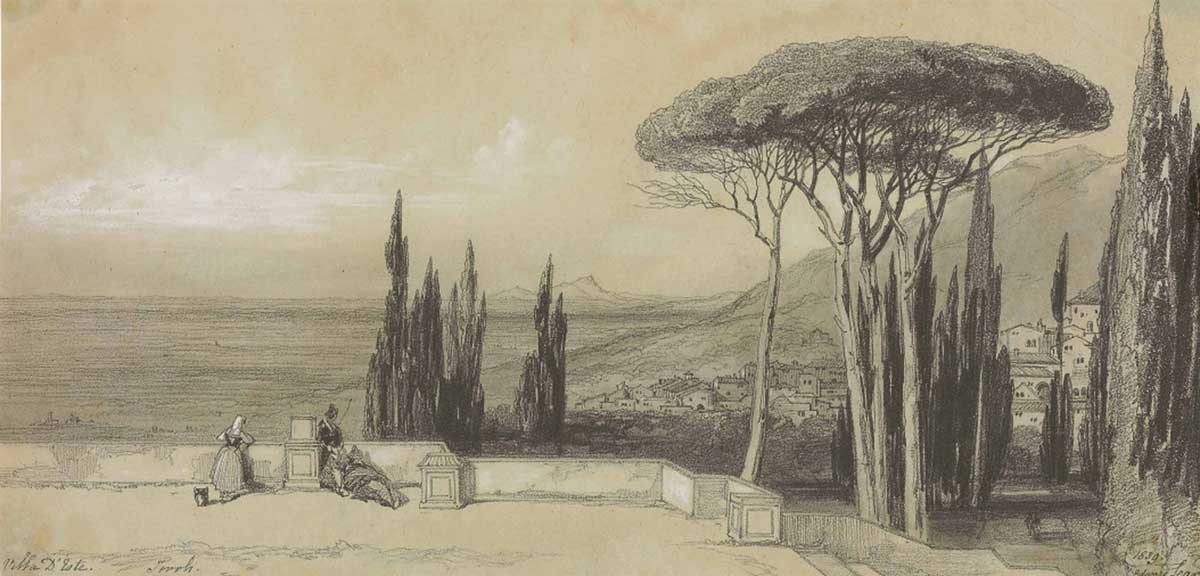
Edward Lear, Villa d’Este, Tivoli (1840)

Edward Lear, Cypresses at the Villa d’Este, Tivoli
signed and dated ‘E. Lear 1840’ (lower left) and ‘E.LEAR.1841′ (lower right) and numbered ’10’ (lower left)
oil on canvas, unlined
18 x 12¾ in. (45.7 x 32.4 cm.)

Exhibited: London, Gooden & Fox, Ltd., Edward Lear, 1812-1888: A loan exhibition, 15 October-1 November 1968, no. 109, plate XIII.

Edward Lear first arrived in Italy in 1837 and is documented as having visited Tivoli for the first time the following year. Despite his many subsequent voyages throughout Europe, North Africa, the Middle East and India he always returned to Italy, making it his adopted home and the source of innumerable picturesque drawings, watercolors, oil sketches and paintings. His view of the Villa d’Este through the allée of cypress trees is one of the most iconic Roman subjects — depicted by artists from Jean-Honoré Fragonard in the eighteenth century to Lear’s near-contemporary and fellow countryman, William John Thomas Collins, and countless artists in between. But it is also a rare early example of Lear working in oil, for in the 1830s and early 1840s he worked almost exclusively in pencil and watercolor and did not receive any formal training in oil paint until around 1848.

The two dates of ‘1840’ and ‘1841’ on this canvas probably refer to the date of a drawing, most likely done in situ at Tivoli in 1840, which then became the basis for this oil painting completed in his studio in 1841. Lear practiced this technique throughout his career — often creating finished watercolors or oils months and sometimes years after his first studies.

This composition was also used by Lear to illustrate Tennyson’s ‘The splendour falls on castle walls’.

Christie’s.

Posted in Edward Lear | Tagged , , | 1 Comment

Edward Lear, Bocche di Cattaro

Edward Lear, Bocche di Cattaro (1866). Aberdeen Art Gallery.

Jennifer Melville, Lead Curator of the Aberdeen Art Gallery, will be giving a lunchtime talk on this picture on 30 May 2012, see the Bicentenary Events board for more information.

Meanwhile a View of Beirut (1861 ca.) by Edward Lear is on show at the Whitechapel Gallery in Simon Schama’s exhibition Travelling Light. See The Guardian, Financial Times.

Posted in Edward Lear | Tagged , , , | Leave a comment

Matt Black’s The Nonsense Olympics

Next year, in case you didn’t notice, will be Edward Lear’s bicentenary as well as the year of the Olympics, so I was not surprised to find a square volume entitled The Nonsense Olympics. A Tribute to Edward Lear by Matt Black, with illustrations by Jackie Prachek (Upside Down Books, 2011).

The wonderful booklet, which you can have for just £5.00, consists of several limericks and some other poems, Ano Lympi Calphabet and some nicely illustrated puns: ideal reading if you intend to celebrate, or if, like “the old woman from Goring,” you think “sports are tiring and boring, / Except ones I invent.”

Posted in Edward Lear, Limerick | Leave a comment

A Peter Newell Gag Cartoon

Mistah Washington, I mek you 'quainted wid my sistah, Miss Budy Cooper.

Mr. Wahington, bowing low.- 'Happy t' meet you, Miss Coopah!'

Newell, Peter. [ORIGINAL DRAWINGS, SIGNED] Two-Panel Black Gag Cartoon. New York: 1892. Original pen and ink drawings.  One signed in ink, one in pencil.   Source unknown, but perhaps the illustrations were for one of the magazines that Newell drew for: Harper’s Weekly, New York Graphic, Scribner’s Magazine, etc. Beautifully matted, framed and glazed, the images measure 12″ x 9 1/2″ each.

From an eBay auction.

Posted in Comics, Peter Newell | Leave a comment

Edward Lear Memorial in Westminster Abbey

Did you know there was a plaque in honour of Edward Lear in Poets’ Corner at Westminster Abbey?

I did not, and just found out from several articles on the new Ted Hughes memorial, the one in the Guardian provides the image above.

Posted in Edward Lear | Leave a comment