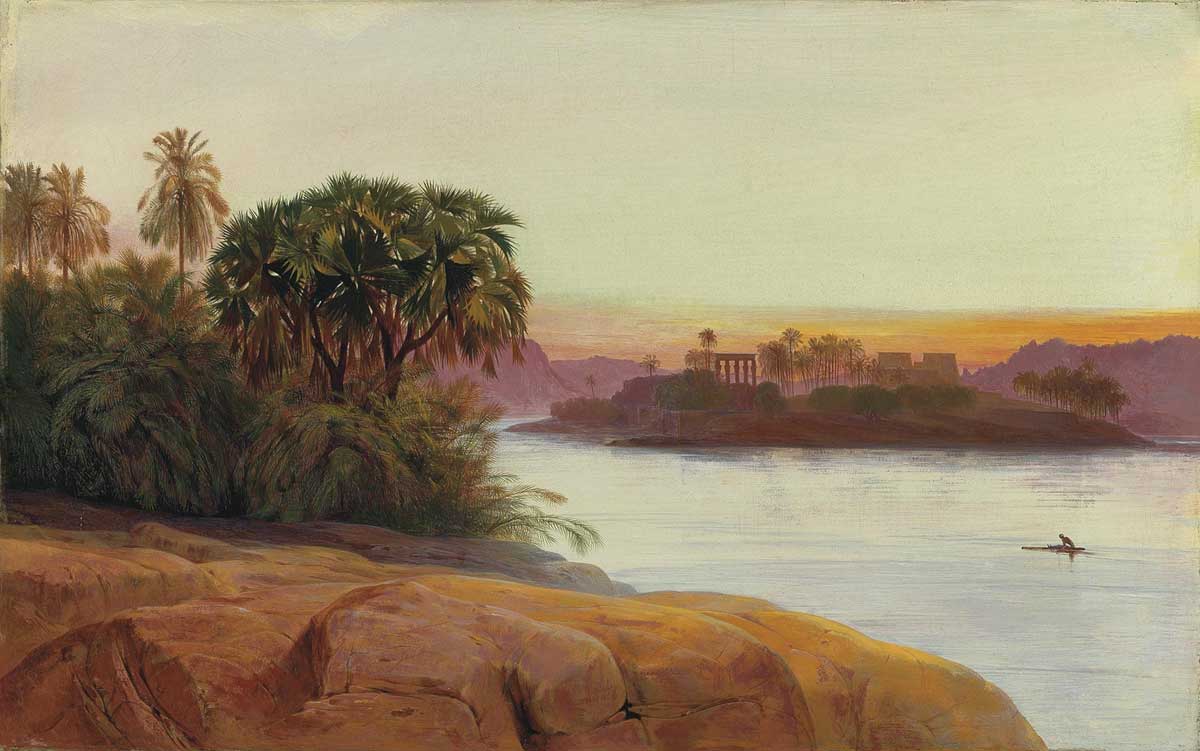
Philae on the Nile
Signed with initials and dated ‘EL/1856’ (lower left) and inscribed ‘Edward Lear/July 1856’ (on a label attached to the reverse).
Oil on canvas
13½ x 21¼ in. (34.5 x 61.6 cm.)
Philae on the Nile
Signed with initials and dated ‘EL/1856’ (lower left) and inscribed ‘Edward Lear/July 1856’ (on a label attached to the reverse).
Oil on canvas
13½ x 21¼ in. (34.5 x 61.6 cm.)
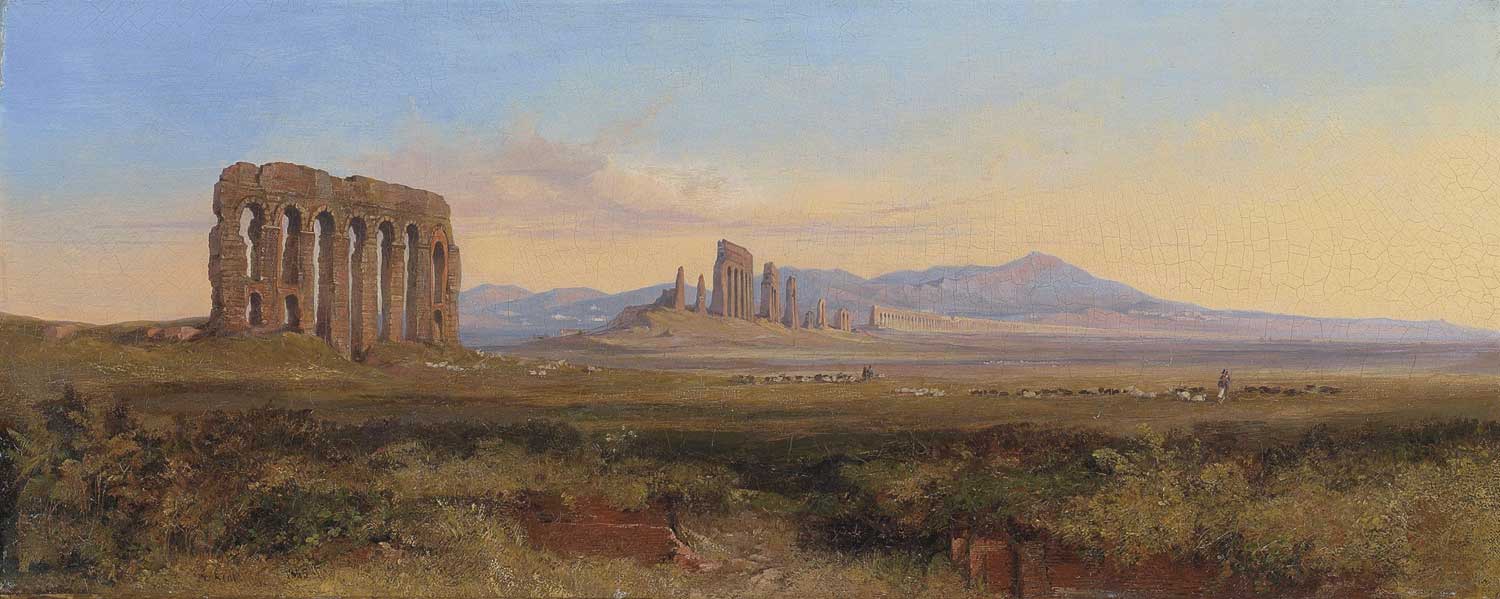
In the Campagna, near Rome
Indistinctly inscribed and dated ‘E Lear. Del. 1845’ (lower left) and inscribed ‘Edward Lear/1844’ (on a label attached to the reverse).
Oil on canvas
11½ x 29 in. (29.2 x 73.7 cm.)
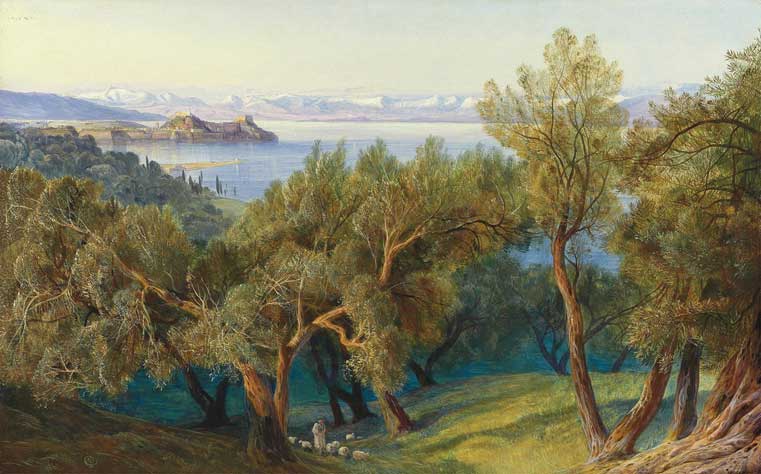
Corfu from the village of Ascension
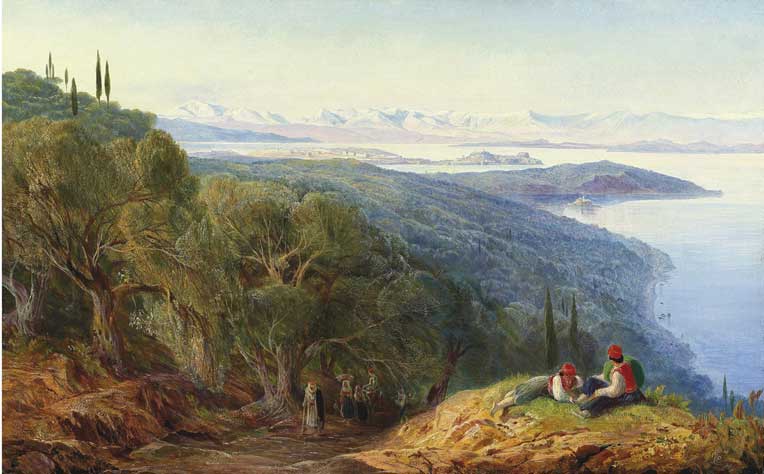
Corfu from the Benitza Road, on the hill of Gastouri
Signed with monogram and dated ‘1862’ (one lower left and one lower right), one inscribed ‘Corfu from Ascension/Painted by me in Corfu, 1862./Edward Lear.’ (on a label attached to the stretcher), the other inscribed ‘Corfu from Gastouri./Painted by me at Corfu in 1862./Edward Lear.’ (on a label attached to the stretcher).
Oil on canvas
13½ x 21¼ in. (34.3 x 54 cm.)
I do not have much time for posting at the moment, though I regularly update the list of events for the 2012 bicentenary. Here are a few interesting items on Edward Lear and nonsense in general:
“Jumblies and Jabberwockies. The Nonsense Verse of Edward Lear and Lewis Carroll, ” a chapter from Morag Styles’s From the Garden to the Street: Three Hundred Years of Poetry for Children. London: Cassell, 1998. Available from Google Books.
Wong, Mou-lan. “Trauma, Travel, and Regeneration: Picturesque and Nonsense in Edward Lear” (pdf). The 19th Annual English and American Literature Association Conference: Trauma and Literature. 12 November 2011.
“National and Cultural Peculiarities of English Hunor.” In a collection of essays in Russian. 2011.
Let me also suggest that you take a look at these two online exhibitions at Houghton Library:
The Adventures of Thackeray in His Way through the World.
“Let Satire be my Song.” Byron’s English Bards, and Scotch Reviewers.
THE author of a suggestive and interesting paper in the current number of the Quarterly Review, entitled “Nonsense as a Fine Art,” [pdf download] discourses with considerable plausibility on the “infinite worth” of Sense’s antithesis. But in calling Nonsense “a source of universal delight,” we think he somewhat overshoots the mark. We are entirely in accord with him in placing the late Mr. Edward Lear in the van of nonsense-writers pure and simple. But, after all, was not his popularity due in great measure to the pictorial embellishments of his text, which, being idealised versions of the scrawlings of a clever child, were exactly in harmony with the requirements of his juvenile readers? Are grown-up people, as a rule, entertained by sheer nonsense? Is it not the minority who revel in such lines as:—
“The soup-ladle peeped thro’ a heap of veal-patties,
And squeaked with a ladle-like scream of surprise.”
or:—
“And as it was too late to dine,
They drank some Periwinkle wine,
And played an hour or two or more,
At battlecock or shuttledore.”
or:—
“‘O shovely, so lovely,’ the Poker he sang,
‘You have perfectly conquered my heart.
Ding-a-dong! ding-a-dong! If you’re pleased with my song,
I will feed you with cold apple-tart’.
When you scrape up the coals with a delicate sound.
You enrapture my life with delight!
Your nose is so shiny! your head is so round!
And your shape is so slender and bright.
Ding-a-dong! ding-a-dong!
Ain’t you pleased with my song ?'”
We contend that persons may appreciate works of wit and humour, and yet fail to be tickled by such delicious absurdities as those we have just quoted; and such a contention, so far as we can see, is negatived by the drift of the article in the Quarterly, which defines Nonsense as “the flower and fruit of wit and humour, when these have reached the final stage of their growth to perfection.” This is very gratifying to those of us who delight in Mr. Lear; but is it not rather hard to deny to a man a keen sense of wit because he cannot see the fun of such an expression as “a himmeltanious chatterclatter-blattery noise,” or of the following description of the Plum-Pudding Flea as “an object of an interesting and obese appearance, having a perfectly round body exactly resembling a boiled plum-pudding, with two little wings and a beak, and three feathers growing out of his head, and only one leg.” The Plum-Pudding Flea, we may further remind our readers, had a habit of staring in a “vacant and voluminous manner.” Let us take one more passage, that which describes the Clangle-Wangle, “or, as it is more properly written, Clangel-Wangel:”—”They live in the water as well as on land, using their long tail as a sail when in the former element. Their speed is extreme, but their habits of life are domestic and superfluous, and their general demeanour pensive and pellucid. On summer evenings they may sometimes be observed near the lake Pipple-Popple standing on their heads and humming their national melodies: they subsist entirely on vegetables, excepting when they eat veal, or mutton, or pork, or beef, or fish, or saltpetre.” What would a Frenchman, with all his esprit, make of this? Can we find in the literature of that undoubtedly most witty nation any parallel or analogue to such a passage as that we have quoted? Is it not claiming too much to say that Mr. Lear has made the name of Nonsense classical by his books? We take it to be an evidence running counter to the Quarterly Reviewer’s assumption—that nonsense is the final outcome of wit and humour—that it is easier to find a parallel to Lear’s work in German than in French literature. With all their admirable qualities, the Teutons cannot be pronounced a witty race. Their wittiest writers were Jews, Heine and Saphir; and the ordinary German witticism reminds us of the old description of a joke which was so heavy that it “took two men to carry it to the window, and then it killed a policeman.” But that they have a capacity for producing first-rate literary and artistic nonsense, no one acquainted with contemporary German literature can deny. The contributions to Fliegende Blätter, perhaps the best comic paper on the Continent, frequently evince the possession of nonsensical talent of a high order. The closest parallel of all, however, is to be found in the delightful Münchener Bilderbogen of Wilhelm Busch, the author of the famous “Music Lesson,” and hundreds of other sets of pictures hardly inferior to it in whimsicality. Three in particular, “The Elephant and the Moor,” “Diogenes and the Naughty Boys of Corinth,” and “The Alphabet,” remain in our memory as worthy pendants to the work of Lear with pen and pencil, for the German humorist’s pictures are accompanied by a doggerel text of a charmingly inconsequent order.
American humour is seldom void of intention; and we doubt, therefore, whether Lear is much appreciated by Transatlantic readers. But on turning over the pages of Artemus Ward, we have come across some passages which seem to come under the head of pure nonsense. “Their meraklis ‘scape,” he says, in the paper headed “Ossawatomie Brown,” “reminds me of the ‘scape of De Jones, the Coarschair of the Gulf—a tail with a yaller kiver, that I onct red. For sixteen years he was confined in a loathsum dunjin, not tastin of food durin all that time, when a lucky thawt struck him! He opened the winder and got out.” The allusion to “sixteen solitary hossmen, ridin four abreast,” may also be included under this head, as well as that paragraph in his “Bogfry,” where he says,—”I am an early riser, but my wife is a Presbyterian.” From the inimitable “Lecture” we may be allowed to quote one favourite passage:—”Mr. Kimball had a son—a lovely young man—who was married to ten interesting wives. But one day—while he was absent from home—these ten wives went out walking with a handsome young man—which so enraged Mr. Kimball’s son—which made Mr. Kimball’s son so jealous—that he shot himself with a horse pistuel. The doctor who attended him—a very scientific man—informed me that the bullet entered the inner parallelogram of his diaphragmatic thorax, superinducing membranous hemorrhage in the outer cuticle of his basiliconthamaturgist. It killed him. I should have thought it did.” And here Artemus Ward would call for “soft music,” and his pianist would play the “Dead March” from Saul, or “Poor Mary Anne.” Excellent nonsense, too, are many of the comments in his programme, e.g.:—”One of the figures in the foreground is intended for Heber C. Kimball. You can see, by the expression of his back, that he is thinking what a great man Joseph Smith was.” The “Essy” on “Science and Natural History” is a wonderful bit of fooling, notably the concluding portion:— “As regards Bears, you can teach ’em to do interestin things; but they’re onreliable. I had a very large grizzly bear once, who would dance and larf, and lay down, and bow his head in grief, and give a mournful wale, etsetry. But he often annoyed me. It will be remembered that on the occasion of the first battle of Bull Bun, it suddenly occurd to the Fed’ral soldiers that they had business in Washington which ought not to be neglected, and they all started for that beautiful and romantic city, maintainin a speed durin the entire distance that would have done credit to the celebrated French steed ‘Gladiateur,’ Very nat’rally our Gov’ment was deeply grieved at this defeat; and I said to my Bear shortly after, as I was givin a exhibition in Ohio,—I said, ‘Brewin, are you not sorry the National arms has sustained a defeat?’ His business was to wale dismal, and bow his head down, the band (a barrel-organ and a wiolin) playing slow and melancholly moosic. What did the grizzly old cuss do, however, but commence darncin and larfin in the most joyous manner? I had a narrer escape from being imprisoned for disloyalty. I will relate another incident in the career of this retchid Bear. I used to present what I called in the bills a Beautiful living Pictur— showing the Bear’s fondness for his master: in which I’d lay down on a piece of carpeting, and the Bear would come and lay down beside me, restin his right paw on my breast, the Band playing ‘Home, Sweet Home,’ very soft and slow. Altho’ I say it, it was a tuchin thing to see. I’ve seen Tax-Collectors weep over that performance. Well, one day I said, ‘Ladies and gentlemen, we will now show yer the Bear’s fondness for his master,’ and I went and laid down. I tho’t I observed a pecooliar expression into his eyes, as he rolled clumsily to’ards me, but I didn’t dream of the scene which follerd. He laid down, and put his paw on my breast. ‘Affection of the bear for his master,’ I repeated. ‘You see the Monarch of the Western Wilds in a subjugated state. Fierce as these animals natrally are, we now see that they have hearts and can love. This bear, the largest in the world, and measurin 17 ft. round the body, loves me as a mer-ther loves her che-ild!’ But what was my horror when the grizzly and infamous Bear threw his other paw under me, and riz with me to his feet. Then claspin me in a close embrace, he waltzed up and down the platform in a frightful manner, I yellin with fear and anguish. To make matters wuss, a low scurrilous young man in the audiens hollered out: ‘Playfulness of the Bear! Quick Moosic!’ I jest ‘scaped with my life. The Bear met with a wiolent death the next day, by being in the way when a hevily loaded gun was fired off by one of my men.”
This may not quite come under the head of “Nonsense Pure and Simple,” for it is, after all, but an exaggerated account of what might happen. But it is exquisitely funny, though it was written by a dying man, whose sense of the ludicrous was as unquenchable as that of Hood. The fact, then, that so undoubtedly humorous a race as the Americans should not succeed in producing the purest sort of nonsense, tells against the position of the Quarterly Reviewer. Furthermore, it will be generally conceded that the sense of humour is stronger in men than in women. And whereas few women thoroughly appreciate Artemus Ward, Lear’s nonsense-books are generally popular with the gentler sex.
The Turk, who looks upon the eccentricities of the English, particularly of young Englishmen, as symptoms of mental aberration, and often alludes to them as the deli Inglizli (mad English), has yet in him a vein of sympathy for the ludicrous which approximates in some instances quite closely to our nonsense-worship. Many of the tales of the Hodja Nassreddin—the Turkish Joe Miller—seem destitute of any intention, moral or otherwise, but depend for their power of amusing the Turk upon the absolute inanity of a remark, or the insufficiency of a reply. Here is one of the funniest of the collection:—
“In Ramazan, the Hodja said in himself, ‘Why should I do as the people do, and keep the fast?’ But he took an earthen pot and began putting pebbles therein, one every day. And the Hodja’s little daughter, imitating him, used also to put two or three pebbles in the pot. One day they asked the Hodja, ‘What day of the month is it?’ And he answered, ‘Patience a little, and I will see:’ and going home, he emptied the pot and counted, and found a hundred and twenty pebbles Then he said in himself, ‘If I say there are so many, the people will call me a fool:’ so returning, he told them, ‘To-day is the forty-fifth day of the month.’ But they said, ‘ The month has but thirty days, and lo! thou sayest that it is the forty-fifth!’ And the Hodja answered them, saying, ‘I indeed spoke with moderation, for if ye consider the reckoning of the pot, it is the hundred and twentieth day!'”
We may add in this connection that some of the jokes in the humorous columns of their newspapers, which convulse Turkish readers, appear to foreigners to be perfectly idiotic. Can it be that the point lies in the utter pointlessness, and have we here an appreciation of nonsense for nonsense’ sake?
Some of the best nonsense on record was improvised spontaneously, or supposed to have been, as in the case of the rhapsody in which the Great Panjandrum figures. A delightful piece of improvised nonsense was the bogus game of cards invented by Mr. Burnand. We quote from the lately published “Reminiscences” of Mr. Toole :—
“It was at an evening party. Four gentlemen had been playing whist in a very serious, not to say ostentatious way, and for pretty large stakes. When they went down to supper we took their table, myself, Burnand, and several others. Burnand suggested that we should all put on the table little piles of money, reckoning how much we each contributed, so that we could redistribute it when our bogus game was over. It was understood that during the game we all acquiesced in anything any player did: that we should deal as many or as few cards as we liked; and that any player, at an opportune moment, should triumphantly lay down any card and take the stakes, whatever they were, collecting from each heap besides what there was in the pool. We had about thirty pounds on the table. We were just in the full swing of our fun, invented for the unostentatious whisters, when they came up from supper. They came straight to the table and looked on. Burnand dealt: he gave three cards to some, four to others, and only took two himself. We all looked at our cards very carefully, and laid each card down with a great show of caution. Burnand, as the dealer, waited until we had all exhausted our cards, when he said triumphantly,’Oh, indeed; you call for the Three of Hearts; very well, here it is!’ upon which we were all very much cast down, and he swept the board; but returned a sovereign to me, and ten shillings to another player, because we were ‘fifth and third out.’ Then I dealt, giving each three cards. We went through the same mystery of care and caution, laid down our cards in a curious way, Burnand putting all his down together, the others playing, as it seemed, all out of turn, and Burnand suddenly crying out, ‘It’s a double Corsican—it’s Johnnie’s!’—’Of course it is,’ I said, with well-feigned surprise and delight.—’It’s the first time we have had a double Corsican,’ said Burnand.—I quietly took up the pool, and asked for two pounds each, in addition. We carried the game on for some time with enthusiasm, the lookers-on occasionally asking questions which we were too busy to answer. At last I suggested that a little supper would be a good thing; and then Burnand, in an off-hand manner, told the inquiring lookers-on that the game was the new Corsican game of ‘Bolo’ and ‘Catchorka.’ They said it seemed a very exciting game. Burnand said it was the only game at cards. They said they would like to learn it. He advised them to get Collins’s book on it from Longmans; and we went down to supper. The fun of the whole thing was the acting of Burnand, his by-play, his asides. We all played up to him with perfect sincerity.”
The last sentence hits the mark. Good nonsense must have the ring of sincerity about it. Only very clever actors could have carried through such a joke without breaking down. Lear’s nonsense-poems seem to have an intention where none exists. The suavity and sonority of the diction, and a certain picturesqueness of atmosphere, delude one into sympathy with his fantastic dramatis personae. In conclusion, then, we are led to the conviction that just as the best nonsense—Lear’s verses, “The Rose and the Ring,” and “Alice in Wonderland”—was written primarily for children, so it will be best appreciated amongst adult readers by those who retain a childlike freshness of imagination. Such a quality is, no doubt, highly to be prized, but, as we have endeavoured to show, it is not the inevitable concomitant of a keen wit or a strong sense of humour.
The Spectator. Volume 61, no. 3149, 3 November 1888, pp. 1503-1505.
EDWARD LEAR, the artist, author of Journals of a Landscape Painter in various out-of-the-way countries, and of the delightful Books of Nonsense, which have amused successive generations of children, died on Sunday, January 29, at San Remo, where he had lived for twenty years. Few names could evoke a wider expression of passing regret at their appearance in the obituary column, for until his health began to fail him he was known to an immense and almost a cosmopolitan circle of acquaintance, and popular wherever he was known. Fewer still could call up in the minds of intimate friends a deeper and more enduring feeling of sorrow for personal loss, mingled with the pleasantest of memories; for it was impossible to know him thoroughly and not to love him. London, Rome, the Mediterranean countries generally, Ceylon and India, are still all dotted with survivors among his generation who will mourn for him affectionately, although his latter years have been spent in comparatively close retirement. He was a man of striking nobility of nature, fearless, independent, energetic, given to forming for himself strong opinions, often hastily, sometimes bitterly; not always strong or sound in judgment, but always seeking after truth in every matter, and following it as he understood it in scorn of consequence; utterly unselfish, devoted to his friends, generous even to extravagance towards any one who had ever been connected with his fortunes or his travels; playful, lighthearted, witty, and humorous, but not without those occasional fits of black depression and nervous irritability to which such temperaments are liable.
Great and varied as the merits of his pictures are, Lear hardly succeeded in achieving any great popularity as a landscape painter. His work was frequently done on private commission, and he rarely sent in pictures for the Academy or other exhibitions. His larger and more highly finished landscapes were unequal in technical perfection; sometimes harsh or cold in colour, or stiff in composition; sometimes full of imagination, at others literal and prosaic; but always impressive reproductions of interesting or peculiar scenery. In later years he used in conversation to qualify himself as a “topographical artist”; and the definition was true, though not exhaustive. He had an intuitive and a perfectly trained eye for the character and beauty of distant mountain lines, the solemnity of rocky gorges, the majesty of a single mountain rising from a base of plain or sea; and he was equally exact in rendering the true forms of the middle distances and the specialities of foreground detail belonging to the various lands through which he had wandered as a sketcher. Some of his pictures show a mastery which has rarely been equalled over the difficulties of painting an immense plain as seen from a height, reaching straight away from the eye of the spectator until it is lost in a dim horizon. Sir Roderick Murchison used to say that he always understood the geological peculiarities of a country he had only studied in Lear’s sketches. The compliment was thoroughly justified; and it is not every landscape painter to whom it could honestly be paid.
The history of Lear’s choice of a career was a curious one. He was the youngest of twenty-one children, and, through a family mischance, was thrown entirely on the limited resources of an elderly sister at a very early age. As a boy he had always dabbled in colours for his own amusement, and had been given to poring over the ordinary boys’ books upon natural history. It occurred to him to try and turn his infant talents to account; and he painted upon cardboard a couple of birds in the style which the older among us remember as having been called Oriental tinting,# took them to a small shop, and sold them for fourpence. The kindness of friends, to whom he was ever grateful, gave him the opportunity of more serious and more remunerative study, and he became a patient and accurate zoological draughtsman. Many of the birds in the earlier volumes of Gould’s magnificent folios were drawn for him by Lear. A few years back there were eagles alive in the Zoological Gardens in Regent’s Park to which Lear could point as old familiar friends that he had drawn laboriously from claw to beak fifty years before. He united with this kind of work the more unpleasant occupation of drawing the curiosities of disease or deformity in hospitals. One day, as he was busily intent on the portrait of a bird in the Zoological Gardens, an old gentleman came and looked over his shoulder, entered into conversation, and finally said to him, “You must come and draw my birds at Knowsley.” Lear did not know where Knowsley was, or what it meant; but the old gentleman was the thirteenth Earl of Derby. The successive Earls of Derby have been among Lear’s kindest and most generous patrons. He went to Knowsley, and the drawings in the Knowsley Menagerie (now a rare and highly-prized work among book collectors) are by Lear’s hand. At Knowsley he became a permanent favourite; and it was there that he composed in prolific succession his charming and wonderful series of utterly nonsensical rhymes and drawings. Lear had already begun seriously to study landscape. When English winters began to threaten his health, Lord Derby started a subscription which enabled him to go to Rome as a student and artist, and no doubt gave him recommendations among Anglo-Roman society which laid the foundations of a numerous clientele. It was in the Roman summers that Lear first began to exercise the taste for pictorial wandering which grew into a habit and a passion, to fill vivid and copious notebooks as he went, and to illustrate them by spirited and accurate drawings; and his first volume of Illustrated Excursions in Italy, published in 1846, is gratefully dedicated to his Knowsley patron.
Only those who have travelled with him could know what a delightful comrade he was to men whose tastes ran more or less, parallel to his own. It was not everybody who could travel with him; for he was so irrepressibly anxious not to lose a moment of the time at his disposal for gathering into his garners the beauty and interest of the lands over which he journeyed that he was careless of comfort and health. Calabria, Sicily, the Desert of Sinai, Egypt and Nubia, Greece and Albania, Palestine, Syria, Athos, Candia, Montenegro, Zagóri (who knows now where Zagóri is, or was?), were as thoroughly explored and sketched by him as the more civilized localities of Malta, Corsica, and Corfu. He read insatiably before starting all the recognized guidebooks and histories of the country he intended to draw; and his published itineraries are marked by great strength and literary interest quite irrespectively of the illustrations. And he had his reward. It is not any ordinary journalist and sketcher who could have compelled from Tennyson such a tribute as lines “To E. L. on his Travels in Greece”:—
Illyrian woodlands, echoing falls
Of water, sheets of summer glass,
The long divine Peneïan pass,
The vast Akrokeraunian walls,Tomohrit, Athos, all things fair,
With such a pencil, such a pen,
You shadow forth to distant men,
I read and felt that I was there.
Lear was a man to whom, as to Tennyson’s Ulysses,
All experience is an arch wherethrough
Gleams that untravelled world.
After settling at San Remo, and when he was nearly sixty years old, he determined to visit India and Ceylon. He started once and failed, being taken so ill at Suez that he was obliged to return. The next year he succeeded, and brought away some thousands of drawings of the most striking views from all three Presidencies and from the tropical island. His appetite for travel continued to grow with what it fed upon; and, although he hated a long sea-voyage, he used seriously to contemplate as possible a visit to relations in New Zealand. It may safely, however, be averred that no considerations would have tempted him to visit the Arctic regions.
A hard-working life, chequered by the odd adventures which happen to the odd and the adventurous and pass over the commonplace; a career, brightened by the high appreciation of unimpeachable critics; lightened, till of late, by the pleasant society and good wishes of innumerable friends; saddened by the growing pressure of ill health and solitude; cheered by his constant trust in the love and sympathy of those who knew him best, however far away; such was the life of Edward Lear.
The Saturday Review of Politics, Literature, Science and Art. Volume 65, no. 1684, 4 February 1888, pp. 130-131.
# Oriental tinting was a painting technique much in vogue in England in the 1820s and 1830s. As W. Morgan, a drawing master in Torquay, explained in his 1830 work The Art of Oriental Tinting, it was a ‘method of applying watercolour which gives [the drawings] a softness and brilliancy almost surpassing nature in the effect produced.’ The method involved transferring a drawing with oriental [tracing] paper to ivory paper, velvet, or other surface, and working up the colours to the desired brilliancy. Because the design was traced, it appealed to and was practiced by talented amateurs (Christie’s).
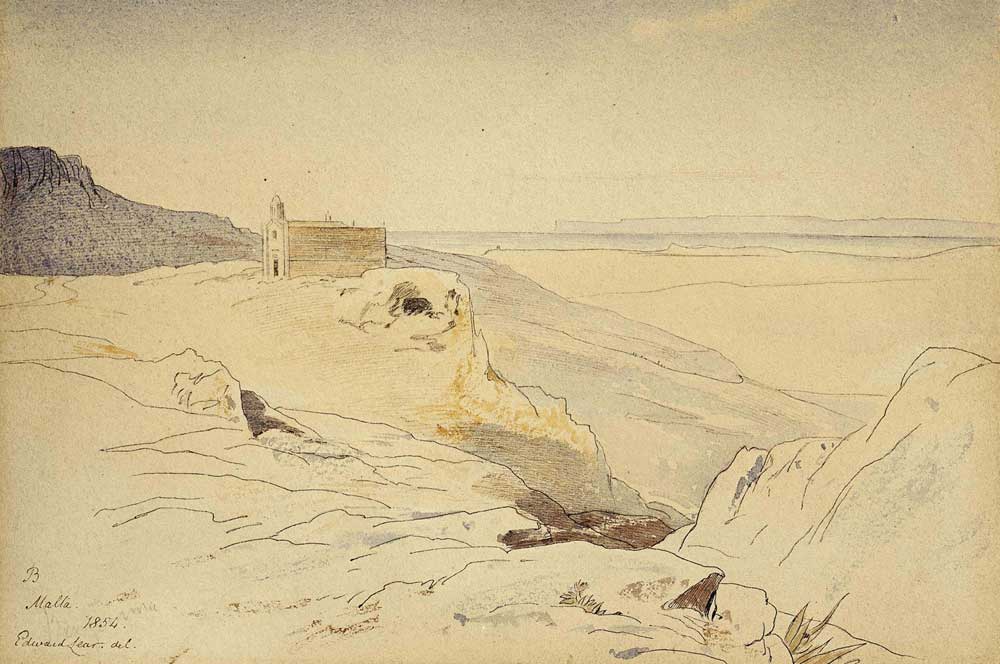
Study of a mountain church, Malta (1854)
Stephen Duckworth has sent me a list of paintings, watercolours and drawings by Edward Lear (pdf) in UK public collections. We will try to keep you updated on which are going to be displayed during 2012.
MR. LEAR has followed up his delightful “Book of Nonsense” by a new one, called “Nonsense Songs, Stories, Botany, and Alphabets,” [R.J. Bush, Charing Cross.] which contains many great triumphs of the scientific feeling for nonsense, and we are disposed to say,—though this is somewhat rash, without the co-operation of a jury of children,—some decided failures also. The old “Book of Nonsense” contained no failures. The present writer has seen an eminent statesman, great in finance, unequalled on the Bank Act, laugh over it the whole of a summer morning (when out of office). It is true that if the delightful legend which attributes its origin to the intense desire of the late Lord Derby to betray the present Lord Derby in his boyhood into a nonsensical mood, has any foundation in fact, the book most likely failed in its immediate purpose, for no one could be so exceeding sober as that usually prudent statesman who had ever had a hearty laugh over one of Mr. Lear’s nonsense rhymes. But it is not the first time that great unintended fruits have been reaped from an enterprise which had apparently ignominiously failed. The whimsical has probably no charms for Lord Derby, to whom the following nonsense verse would be quite appropriate:—
“There was a young man of Coblence
Who had such confounded good sense!
When they dared him to fight
He said, ‘Have I the might,
Can I spare the pounds shillings and pence!'”
But the rest of the world, old and young, have really enjoyed in their leisure hours Mr. Lear’s capital nonsense. Who has not been struck by that remarkable prophecy of the grotesque medicinal alternative presented (more than once since Solferino) to the Austrians?—
“There was an old man of Vienna
Who lived upon tincture of Senna,
When that didn’t agree
He took Camomile tea,
That nasty old man of Vienna.”
And who has not moralized over that pathetic parable of the results of a rash or ill-assorted marriage, in demoralizing even the sincerity of the sufferer?—
“There was a young person of Gretna
Who jumped down the crater of Etna,
When they asked ‘Is it hot?’
He replied ‘It is not!’
That mendacious young person of Gretna.”
In the “Book of Nonsense” Mr. Lear never went beyond the limits of true nonsense. His delightful rhymes and delightful pictures defied sense,—which is just what nonsense ought to do,—but the defiance was in itself at once acknowledgment and rebellion. What we want from Nonsense is exactly this,—a gay rebellion against sense. But there is no relief to the mind unless there be enough sense in the nonsense to make the nonsense visible, just as,
“Glowing embers through the room
Teach light to counterfeit a gloom.”
Thus nothing can be more admirable than Mr. Lear’s Nonsense Botany. His picture of “the Bottleforkia Spoonifolia” is one which would make Dr. Hooker roar; the thing looks so like a new botanical genus, with its bottle-shaped calyx, and fork-shaped stamens, and spoon-shaped leaves, and sounds so like a true genus as well. So again, the “Manypeeplia Upsidownia” is so delicious a caricature of the fuchsia that we are not sure it would not engender a new sense of humour in that pendulous plant, and make its petals quiver with suppressed mirth. The “Piggiwiggia Pyrarnidalis ” might at a little distance betray a Campanula into something like recognition of kindred; and as for the “Plumbunnia Nutritiosa,” it is a sort of gigantic strawberry with a mottled and darker colour, and the same sort of leafy calyx. The nonsense botany is genuine nonsense,—extravagant enough to make the most prosaic man laugh; but yet nonsensical precisely because it recognizes the laws of sense, and directly traverses them. But is there any real science of nonsense in nonsense cookery of the following kind ?—though we feel pretty sure that Mr. Lear would not let it appear in public if it had not already proved its power to amuse:—
“To Make An Amblongus Pie.
“Take 4 pounds (say 41/2 pounds) of fresh Amblongusses and put them in a small pipkin.
“Cover them with water and boil them for 8 hours incessantly, after which add 2 pints of new milk and proceed to boil for 4 hours more.
“When you have ascertained that the Amblongusses are quite soft, take them out and place them in a wide pan, taking care to shake them well previously.
“Grate some nutmeg over the surface, and cover them carefully with powdered gingerbread, curry-powder, and a sufficient quantity of Cayenne pepper.
“Remove tho pan into the next room, and place it on the floor. Bring it back again, and let it simmer for three-quarters of an hour. Shake the pan violently till all the Amblongusses are become of a pale purple colour.
“Then having prepared the paste, insert the whole carefully, adding at the same time a small pigeon, 2 slices of beef, 4 cauliflowers, and any number of oysters.
“Watch patiently till the crust begins to rise, and add a pinch of salt from time to time.
“Serve up in a clean dish, and throw the whole out of window as fast as possible.”
That seems to us a trifle nearer to the grave talk of an idiot asylum, than to the nonsense of sane people. Yet we are far from denying that children would laugh over it. There is such a fund of animal spirits in children, that they will laugh almost for the sake of laughing on the slightest excuse, and the mystification about the Amblongus, the careful directions, “remove the pan into the next room, place it on the floor, bring it back again,” and finally, “throw the whole out of window as fast as possible,” might tickle the very easily tickleable childish fancy. There is something in a child’s mind which exactly corresponds to the sensitiveness of the soles of its feet or the armpits to gentle tickling. If you suddenly substitute a flat no-meaning where the law of association led them to expect meaning, children will laugh, often almost hysterically. But the question is not so much ‘Will a child laugh at this?’ as ‘Is it the sort of nonsense at which it ought to laugh?’ And we can’t think it is. There is not the trace of that gaiety and elasticity of feeling in the author which is the sine qua non of all good nonsense. Only compare it with this delightful ballad from the same book, which is of the very essence of first-rate nonsense!—
Said the Duck to the Kangaroo,
‘Good gracious! how you hop!
Over the fields and the water too,
As if you never would stop!
My life is a bore in this nasty pond,
And I long to go out in the world beyond!
I wish I could hop like you!’
Said the duck to the Kangaroo.‘Please give me a ride on your back!’
Said the Duck to the Kangaroo.
‘I would sit quite still, and say nothing but “Quack,”
The whole of the long day through!
And we’d go to the Dee, and the Jelly Bo Lee,
Over the land and over the sea;–
Please take me a ride! O do!’
Said the Duck to the Kangaroo.Said the Kangaroo to the Duck,
‘This requires some little reflection;
Perhaps on the whole it might bring me luck,
And there seems but one objection,
Which is, if you’ll let me speak so bold,
Your feet are unpleasantly wet and cold,
And would probably give me the roo-
Matiz!’ said the Kangaroo.Said the Duck ,’As I sate on the rocks,
I have thought over that completely,
And I bought four pairs of worsted socks
Which fit my web-feet neatly.
And to keep out the cold I’ve bought a cloak,
And every day a cigar I’ll smoke,
All to follow my own dear true
Love of a Kangaroo!’Said the Kangaroo,’I’m ready!
All in the moonlight pale;
But to balance me well, dear Duck, sit steady!
And quite at the end of my tail!’
So away they went with a hop and a bound,
And they hopped the whole world three times round;
And who so happy, — O who,
As the duck and the Kangaroo?
The four pictures which illustrate this delightful ballad are as good as the ballad itself. First, there is the Kangaroo towering up in lofty, prim reserve above the suppliant Duck in its nasty pond, which looks the very picture of urgent humility,—of passionate plebeian yearning; while the Kangaroo’s small elegant head reared at a vast height above the Duck, and her dropped paws, indicate respectively aristocratic breeding and a certain indifference to the Duck and her humble sphere. In the second picture, where the Duck’s wheedling is evidently taking effect, the condescension with which the Kangaroo stoops from her immense height to listen to the Duck’s pleadings, and the lackadaisical expression with which she takes pity on the poor waddling thing,—who is drawn in an attitude inexpressibly vulgar, cook-maidy, and self-humiliated, as she approaches the Kangaroo,—are quite irresistible. Mr. Lear has never drawn anything more humorous. In the third drawing, the Duck is well in the saddle at the tip of the Kangaroo’s tail, while the Kangaroo, who is jumping along, looks affectionately and anxiously back to see that the Duck is comfortable in its new and somewhat hazardous position, while the Duck, who has entirely lost its crestfallen and dispirited air, looks the very picture of cosy satisfaction. In the last drawing something of the élan of adventure has come upon the Kangaroo, who leaps away with the full enthusiasm of travel, and eager forward glance into the new world; while the Duck, who has got all its desires fulfilled, is the image of petted and luxurious happiness. It is quite impossible to conceive happier illustrations of the true science of nonsense than this ballad, or that of “The Owl and the Pussy Cat,” who go to sea together, the owl playing love ditties on the guitar to his love, to which the pussy, in the true spirit of woman’s lights, replies by pressing an immediate marriage on the “elegant fowl,” —or that of “the Jumblies,” who go to sea in a sieve, afford us.
All nonsense should be audacious and capricious defiance of sense, but never go far enough from sense to lose the feeling of the delightful freedom which is implied in the rebellion. Mr. Lear is a little too fond of inventing absurd words or using existing words in an absurd sense. The discovery of “The Co-operative Cauliflower” by the four little children who explore the world, is not a bad idea, and perhaps there is enough ghost of suggestion to be nonsensical about the statement that the Co-operative Cauliflower arose and hurried off “in a somewhat plumdomphious manner towards the setting sun;” but when the children promise a testimonial to Lionel “as an earnest token of their sincere and grateful infection,” the Malapropism has no particular fun as being out of character with the story; and so, too, of the statement that “they cooked their provisions in the most translucent and satisfactory manner and that after stuffing their rhinoceros, they placed it outside their father’s door as a “Diaphanous Doorscraper.” We can’t laugh at this, and we doubt if children could. Anything that gives to nonsense the air of far-fetchedness destroys its exhilarating character. It must bubble up from a real spirit of extravagance and joyous rebellion against sense, or it is not true nonsense. The sense of effort destroys its true character. Nonsense written for the sake of nonsense is not good, and has a tendency to become gibberish; nonsense written for the sake of defying sense, is one of the most delightful of the many forms in which human liberty asserts itself. The lower animals are capable of plenty of sense, but only just touch the verge of nonsense. A retriever who runs off with your boot to express her delight that you are going to put it on, reaches indeed the very verge, but hardly passes it. An animal capable of true nonsense, as distinguished from mere high spirits, would be the equal of man. And in spite of little failures here and there, the ideal of nonsenseis attained by Mr. Lear, who, in this respect, may be said to stand at the very summit of the human race.
The Spectator. Volume 43, no. 2216, 17 December 1870, pp. 1505-1506.
Sing-Song: a Nursery-rhyme Book. By Christina G. Rossetti. With 120 Illustrations by Arthur Hughes. Routledge.
The Princess and the Goblin. By George Macdonald. Strahan.
Through the Looking-glass, and what Alice saw there. By the Author of Alice’s Adventure in Wonderland. Macmillan.
More Nonsense; Pictures, Rhymes, Botany, &c. By Edward Lear. Bush.
It is pleasant to see children’s literature get better as it does year by year in England. This season in particular has produced a crop of books that are delightful for them— for the children—but more delightful still, perhaps, for some among their elders; since no child, in the most enchanted eagerness of its single-minded attention and fancy, knows so full or so subtly mingled a pleasure in the best of these things as the properly constituted grown-up reader. The adult spirit here finds the reward of its affliction of self-consciousness. While the attention, the fancy, can let themselves go, and be as those of a child, following the fun or movement of the tale with all the old mirth, the old breathlessness, there lingers, beneath such abeyance of criticism, a more complex self looking on somewhere in the background, aware of the revival of ancient spells, and pleased to feel them work:—you have your own enjoyment to enjoy as well as its object, you have a hundred causes of pathetic entertainment side by side with the old absorption.
The volume written by Miss Rossetti, and illustrated by Mr. Hughes (not, by the way, a matter of story-telling but of song-singing), is one of the most exquisite of its class ever seen, in which the poet and artist have continually had parallel felicities of inspiration—each little rhyme having its separate and carefully engraved head-piece. In the form of the poetry the book answers literally to its title, and consists of nothing but short rhymes as simple in sound as those immemorially sung in nurseries—one only, of exceptional length, containing as many as nine verses—and having always a music suited to baby ears, though sometimes a depth of pathos or suggestion far enough transcending baby apprehension. But both in pictures and poetry, provided they have the simple turn, and the appeal to everyday experience and curiosity, which makes them attractive to children at first sight and hearing, the ulterior, intenser quality of many of these must in an unrealised way constitute added value, we should say, even for children. The pieces range, indeed, as to matter, from the extreme of infant punning and catchy triviality to the extreme, in an imaginative sense, of delicate penetration and pregnancy, with an almost equal grace of manner in either case; here is an example of the latter:—
“What are heavy? sea-sand and sorrow:
What are brief? to-day and tomorrow:
What are frail? spring blossoms and youth:
What are deep? the ocean and truth.”
And this is illustrated with one of the best of Mr. Hughes’ landscape cuts—a still, flat sea flooded with moonlight, under a black sky, with a child’s sand-castle going to pieces at its edge. There are some dealing with death—a motherless baby, a ring of three dancers from which one is caught away—in just the right mood of tender thought and plaintive wonder, striking the mere note of loss, unexplained disappearance, the falling of an unknown shadow, with the loveliest feeling; and many about out-door things, birds and flowers, animated with an intimate fanciful charity, or having sometimes a little ethical conclusion, of which the lesson cannot fail to find its way home. In tuning the simplest fancies or hints of fragmentary idea, Miss Rossetti cannot lose the habit or instinct of an artist; and the style and cadence of these tiny verses are as finished and individual, sometimes as beautiful in regard of their theme, as they can be, and not much recalling any precedent, except in a few cases that of Blake. We would direct the reader to pp. 6, 13, 21, 38, 40, 120, for perfect scraps of art in their way. Mr. Hughes’ illustrations, many of them lovely and full of imagination as we have said, and always seconding the suggestion of the verse, are not quite equal, and the sentiment is sometimes in advance of the design: but what can be more delightful than the child feeding birds at the winter window on p. 8, or its vis-à-vis supping porridge in the ingle, or the lambs and ducklings of pp. 27 and 29, or the landscapes of pp. 35 and 79, or the pathetic dance of p. 73, or the pancake-making (79), or, indeed, a full half of them all.
Mr. George Macdonald is a poet also, and in his Light Princess had already achieved a humorous and imaginative success in that most difficult of all tasks, the invention of contemporary mythology for children. We should say that with this writer, more than most, it was hit or miss; other pieces in the volume containing The Light Princess we should count misses. Here, again, and on a larger scale than before, the hit is palpable and delightful. The Princess and the Goblin does not perhaps contain any invention so felicitous as that of the child to whom an evil fairy had denied the physical property of gravity; but it is a thoroughly beautiful and enjoyable story, and its machinery of princess and nurse, heroic miner-boy, evil subterranean goblins, and beneficent supernatural grandmother in her tower, thoroughly calculated to take hold of the imagination of readers of all ages. The suppressed personage within our grown-up reader will be knowing enough to observe, from his background, that there is allegory in all this; aware of the religious and ethical pre-occupations of the writer’s genius, he will guess what the beneficent grandmother is meant more or less explicitly to stand for—will, if he chooses, be able to note how it is even the moral and religious foundation that has stimulated the writer’s invention and developed the turns and incidents of the story. But all this really does not at all spoil this charming fable, as it has so many others; the narrative and scenic parts of it are conceived with a vividness of their own, alongside of the ethical part of the conception; the characters are delightfully dramatic, and there is nothing strained in the tone of purity and elevation which is given to them. Against unction, when unction passes into such bright imaginative devices as these, and only gives a peculiar ring and fervour to their pathos or their humour, the most uncompromising opponent of moral story-writing can have nothing to protest. Mr. Macdonald in this story is long, detailed; but he has the art of having been there (so to speak); and the attention never flags during all the adventures of the little Irene with her mystic friend in the tower, and the brave Curdie with his goblin enemies in the mine. The sympathetic talent of Mr. Hughes in this volume again has been employed in furtherance of the writer’s fancy,and his designs (though not so fully in his choicest manner, perhaps, as those we last spoke of) are very delicate and ingenious.
We pass from poetical enchantment to prose fun in passing from the work of Mr. Macdonald to that of Mr. “Lewis Carroll”—from the transformation scene to the harlequinade, if one may venture that imperfect parallel. Through the Looking-glass is a sequel to Alice in Wonderland, and has the misfortune of all sequels—that it is not a commencement. An author who continues himself loses the effect, although not the merit, of his originality; and in its originality lay half the charm of the old “Alice.” No reader will have the sense of freshness and the unforeseen, amid the burlesque combinations which the little lady encounters in her new dreamland, which he had amid those of the old; hence the inevitable injustice of a comparison. But, making allowance for the sense of repetition, we think the invention here shows no falling-off in ingenuity or in the peculiar humour, which mixes up untransformed fragments of familiar experience with the bewilderment of the polite child amid people of irregular manners and a topsy-turvy order of existence. There is perhaps a little too much complication in the machinery of chess-board geography prevailing in Looking-glass Land, and a somewhat meaningless eccentricity in some of the transformations; but the ingenuity which traces out the remotest consequences of its data cannot be too much praised,—as the property of space in Looking-glass Land by which to walk towards a thing is to move away from it, and the inverse disposition of the letters in the amazing nonsense-poem of “Jabberwocky.” The introduction and conclusion of the adventure are particularly well devised and written. Every reader will be charmed to meet his old friends the Hare and the Hatter (still engaged upon his tea and bread and butter) dignified with the Anglo-Saxon orthography Haigha and Hatta (Alice has evidently been having lessons in English history); and amused at the forms under which the child’s matter-of-fact dream realises the ideas of Tweedle-dum and Tweedle-dee, Humpty Dumpty, and all the provoking brotherhood of mythic personages who insist on taking all words literally, and regarding every question as a riddle. If this prose extravaganza, this matter-of-fact absurdity, has a certain ugliness at times which seems to run near the edge of the vulgar, that is its only weak point. The clever and mannered humour of Mr. Tenniel’s designs illustrates their theme to perfection.
A stout, jovial book of More Nonsense, by Mr. Edward Lear, transcends criticism as usual. We may just indicate the interest of the preface, in which the author explains the genesis of this class of composition; we may point out the great felicity of some of the new botanical figures and names — “Nastycreechia Krorluppia,” “Stunnia Dinnerbellia,” and the rest; we may protest, with deference, against the absence of the charms of rhyme in the alliterative pieces at the end of the volume; and then leave the reader to his unmolested entertainment.
Sidney Colvin.
The Academy. A Record of Literature, Learning, Science, and Art. Volume III, no. 40, 15 January 1872, pp. 23-24.
[The idea of “correcting” Edward Lear’s nonsense, which I discussed while reviewing John Crombie’s nice booklet, is as old as Lear’s books. Here is a review from 1871.]
Mr. Lear commences his new book of nonsense with an amusing account of the obstinacy of a fellow-traveller some few years ago on the line between London and Guildford, who had taken it into his head that there was no such artist in existence as Edward Lear, and that the real author of the Book of Nonsense was the late Earl of Derby, which he proved (after a fashion) by pointing out to his fellow-travellers that ‘Lear’ was only an anagram on ‘Earl,’ and as the late Earl’s Christian name was Edward, ‘Edward Lear’ was a mere tacit confession by the noble author of his responsibility for all this fun. A lady in the carriage objected that some friends of hers told her they knew Mr. Lear. ” ‘Quite a mistake! Completely a mistake,’ said the old gentleman, turning rather angry at the contradiction. ‘I am well aware of what I am saying. I can inform you no such a person as Edward Lear exists.’ Hitherto I had kept silence, but as my hat was, as well as my handkerchief and stick, largely marked inside with my name, and as I happened to have in my pocket several letters addressed to me, the temptation was too great to resist, so flashing all these articles at once on my would-be extinguisher’s attention, I speedily reduced him to silence.” Let us add that Mr. Lear has taken his revenge on the old gentleman by drawing him, in caricature, on the cover and above the introduction, as engaged in peering into the inside of Mr. Lear’s hat and lifting up his hands in foolish surprise at the confutation he reads there. The two ladies (rather young and pretty) are looking on with a certain feminine hero-worship at the victorious artist’s performance; but the boys whose ‘Book of Nonsense’ led to this éclaircissement, and who must heartily have enjoyed the scene, are unfortunately not included in the sketch. The old gentleman, however, will go down to posterity as the very type of thick-headed credulity and self-opinionated tenacity,—the kind of man who builds so firm a structure of belief on a petty coincidence that one is quite aghast to consider the materials of which unswerving British faith is made. Certainly, there was far more sense in Mr. Lear’s nonsense than in that old gentleman’s dogged sense; and again, there was more nonsense in his sense than in Mr. Lear’s nonsense. Indeed, he is in every respect so instructive an old gentleman that we almost feel disposed to think of him as created for the purpose of standing in a kind of “pre-established harmony” with Mr. Lear’s book,— as a sort of embodied proof of the danger of making nonsense out of sense by laying too much emphasis upon it, and, comparatively at least, of the wisdom of turning sense into nonsense.
And this, Mr. Lear, in his ‘Nonsense Botany’ at least, has done most efficiently. Nonsense is a result of the elasticity of the mind, a rebound from sense. If the old gentleman had had any elasticity of mind, instead of dwelling so morbidly on the fact that ‘Lear’ is an anagram on ‘Earl,’ he might have observed that Lear is also an anagram on Real, and that in that manner it could just as well be proved that Lear was the ‘real’ author, as that the author was Edward an Earl. Mr. Lear has this elasticity of mind. He cannot see the grand Latin names attached to all the delicate little plants, such as, for instance, Potentilla frigida, Campanula excisa, Azalea procumbens, and the rest,—without at once being carried away by the impulse to make our rather artificial and grandiloquent science see the absurd side of its own pedantry, and accordingly in his Nonsense Botany he draws us the most delightful pictures of plants, only a little more artificial than the real, and gives us the most exquisite scientific names for them. Thus we have the Stunnia Dinnerbellia, a hanging Campanula of gigantic size, with the tongue ready to give out a tremendous peal; the Sophtsluggia glutinosa, a flabby Arum ; the Arthbroomia rigida, a very stiff Goat’s-beard, with a perfect besom at the top; the Enkoopia Chickabiddia, a kind of monster double anemone, with a coop of hen and chickens in its calyx; the Jinglia Tinkettlia, a species of river-flag flowering in a bunch of kettle-shaped blossoms; and best of all, perhaps, the Nastycreechia Krorluppia, a vegetable Mercury’s wand, precisely resembling a thoroughly stripped branch of a shrub all covered with caterpillars. It is impossible to give any conception of the infinite fun in these ‘Nonsense Botany’ pictures,—we have mentioned but a few,—without seeing them; but certainly they, with their admirably chosen names, are delightful specimens of the purest nonsense, such nonsense as Mrs. Elliot had in view when she said:—
“Sense may be all true and right,
But Nonsense, thou art exquisite!”
It takes only sense to appreciate sense, but it takes sense, and something more, a power of joyous rebellion against sense,—of vital rebound from it,—to appreciate true nonsense. The power of nonsense is given only to those who, having sufficient fundamental sense to feel the extremely narrow limits of all sensible thinking, have enough quicksilver in the heels of their mind to feel also the charm of a free gallop into the impossible. Humour and wit deal also with the incongruous, but keep mostly within the bounds of the possible, dwelling on the paradoxes of feeling and thought and speech which actually present themselves in real life. But the very charm of Nonsense consists in the joyous defiance of possibility,—and of children’s nonsense in the defiance of possibility in modes easily intelligible to children. No one has ever succeeded better in such nonsense than Mr. Lear, and we regard his ‘Nonsense Botany’ as the climax of even his efforts. There is a touch of subtlety about it which, without rendering it in the least degree obscure to childish apprehension, will give a freshness of flavour to their enjoyment.
The new Rhymes and their illustrations are also, for the most part, very good, though we fancy there is a certain decline in the perorations of these rhymes, as compared with those of our old friend the first Book of Nonsense. It is difficult to find anything here quite as good as,—
“There was a young person of Norway,
Who casually sat in a door-way;
When the door squeezed her flat,
She cried out, ‘What of that?’
That courageous young person of Norway;”
—or as,
“There was a young person of Sweden,
Who went by a slow train to Weedon;
When they cried out ‘Weedon Station!’
She made no observation,
But thought she would go back to Sweden.”
Perhaps the following is as good as any in the new volume:—
“There was a young person whose history
Was always considered a mystery;
She sat in a ditch, although no one knew which,
And composed a small treatise on history.”
The third line, and the picture of this very self-complacent femme savante composing by the light of a very gorgeous setting sun in a ditch,—whereof it is quite certain that nobody could possibly tell which it is,—are quite up to the high level of Mr. Lear’s best nonsense. But as we said, there is too much tendency to negligence about the winds-up, which is a very critical point in these rhymes. Take this, for instance, which opens remarkably well:—
“There was an old person in grey,
Whose feelings were tinged with dismay;
She purchased two parrots, and fed them with carrots,
Which pleased that old person in grey.”
The last line is very feeble, and there is a want of consecutiveness between the tinge of dismay and the action taken thereon, which is not the sort of want of consecutiveness that the higher Nonsense demands. The true line of direction in which Mr. Lear’s excellent nonsense-opening produces itself, is more nearly, we take it, this,—
“She said, ‘Surely this gloom is a shadow of doom!’
And rent her apparel of grey.”
Again, Mr. Lear is a little too much disposed to verbal nonsense, which is, we admit, not unfrequently a success with children, but depends for its success entirely on the private intelligence between the inventor and the children to whom it is confided. This nonsense therefore is not a sufficiently generalized kind of nonsense for public use, and should be kept in the secret department of the nonsense-producer. Take this, for instance:—
“There was an old person of Ware,
Who rode on the back of a bear:
When they asked, ‘Does it trot?’ he said, ‘Certainly not!
He’s a Moppsikon Floppsikon bear!'”
We don’t say that Mr. Lear was wrong in revealing this rhyme to his young friends, with great show of mysterious intelligence as to the import of the terms, but we do say it is not public nonsense,—it is merely not sense, which is very different. So, again, with this rhyme:—
“There was an old man of Cashmere,
Whose movements were scroobious and queer;
Being slender and tall, he looked over a wall,
And perceived two fat ducks of Cashmere.”
We couldn’t laugh at that without a previous initiation, even if it did not contain the manufactured word ‘scroobious.’ It may have taken very well with children whose minds were prepared by mysterious hints to receive it, but in relation to the public opinion of children it is too near the mere negative of sense to do Mr. Lear credit. We should say the same of a good many of the descriptions of the alphabetic pictures, such as,—
“The Rural Runcible Raven,
Who wore a white wig and flew away
With the carpet-broom;”
—or,
“The Fizzgiggious Fish,
Who always walked about upon stilts,
Because he had no legs.”
Verbal nonsense is dangerous ground, and at all events requires the aid of living humour of manner, and a good mutual understanding between the teller and those to whom it is confided, to carry it off at all.
On the whole, however, this book is a delightful addition to the capital nonsense Mr. Lear has furnished for us in such abundance, and the “Nonsense Botany” is nonsense and something more, true humour as well. If sufficient attention were devoted to the editing of the rhymes, we submit that several of them might be greatly improved in a new edition. Good nonsense requires either inspiration or a good deal of musing to produce it.
The Spectator, volume 44, no. 2269, 23 December 1871, pp. 1570-1571.
 A Blog of Bosh