The Padloctopus and the Alligatorang-oorang

Here is the 15 March 1914 strip for Gustave Verbeek‘s Terrors of the Tiny Tads; below an example of Thornton Fisher’s The Wishing Wisp (see yesterday’s post):

TTT_1914-03-15-s

Posted in Gustave Verbeek | Tagged , , | Leave a comment

Polly Sleepyhead Passes Through a Small Cyclone

Another late strip from Peter Newell‘s series Polly Sleepyhead; it is from 1907, but I do not know the date:

polly-mine-s

Posted in Comics, Peter Newell | Tagged , | Leave a comment

More Wishing Willy

Here is the second episode of Peter Newell’s Wishing Willy, I do not have any more, though there were six, if Allan Holtz‘s American Newspaper Comics: An Encyclopedic Reference Guide is correct. Help in finding the missing ones (and better scans of these) would be appreciated.

PN_shing-willy-1913-08-10-s


Even though the strip was not successful, it might have provided inspiration for Thornton Fisher‘s Wishing Wisp, which started in the New York Herald on 31 August 1913 and ran until 12 April 1914. Fisher was “one of the worst hacks of the comic strip world” according to Holtz. Judging by the examples on Barnacle Press, however, The Wishing Wisp was not really that bad, at least as far as the drawing is concerned.

Posted in Peter Newell | Tagged , | 1 Comment

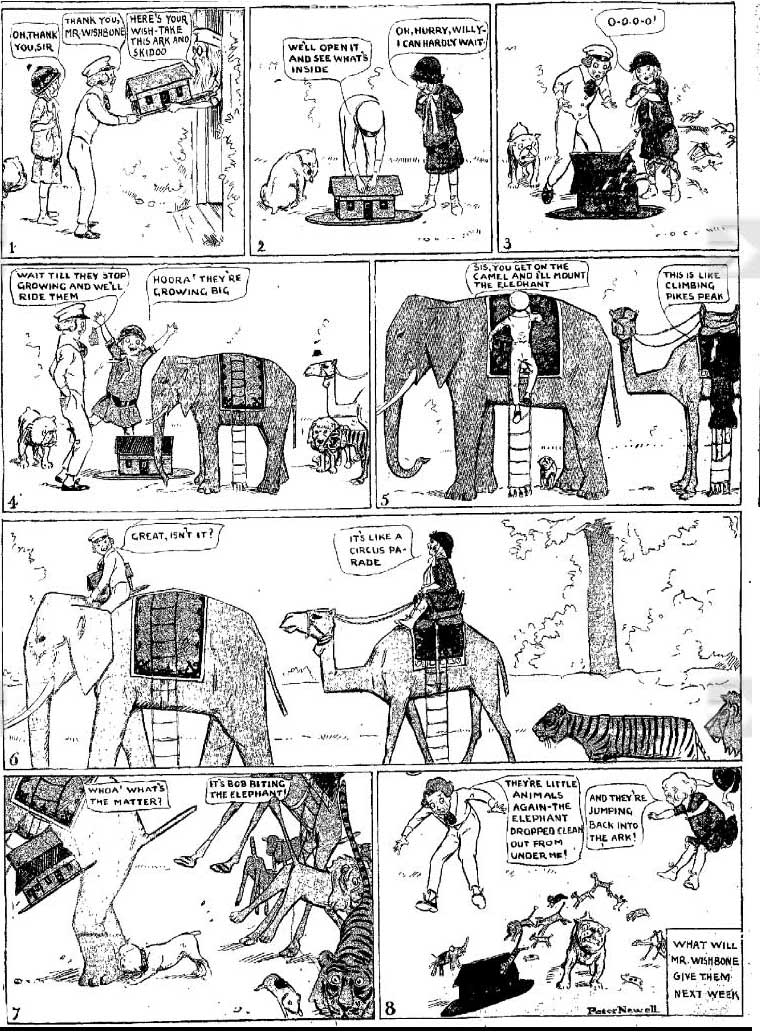
Peter Newell’s Wishing Willy

In addition to The Naps of Polly Sleepyhead (1906-1907), Peter Newell produced a second newspaper strip, Wishing Willie (or Willy), published in a few papers, e.g. the Atlanta Constitution, between 3 August and 7 September 1913: a grand total of six episodes, so it must not have been very successful.

The strips tell the misadventures of Willy, his sister, and their dog Bob with objects given to them by “Wishbone and Company.”

Here is the first episode:

PN_shing-willy-1913-08-03-s


More Naps of Polly Sleepyhead in full colour; the link above will take you to an almost complete run in b/w on nonsenselit.org.

Posted in Peter Newell | Tagged , | 1 Comment

A New Edward Lear Exhibition

I have not even finished posting material from the bicentenary year (see below) and a new exhibition opens:

Edward Lear and his Contemporaries will be open from 21 January to 15 February 2013 at the World Land Trust Gallery, Blyth House, Bridge Street, Halesworth, Suffolk IP19 8AB. Here you can download an exhibition poster and get information on the connected limerick competion. You can also read an introduction.

More reading about last year’s final events:

Serious Nonsense, a short article from American Scientist, January-February 2013, vol. 101, no. 1, p. 28.

Resoconto seminario “Secondo centenario della nascita di Lear” at the Dipartimento di Agraria of the Università Mediterranea, Reggio Calabria, held by Salvatore Di Fazio. Here are pdf files of Prof. Di Fazio’s own article in the newspaper La Sicilia of 30 December 2012: page 16 & page 17. All of this is in Italian, of course.

dh_el

You may have noticed that I have moved the bicentenary events from the home page, but you can still reach the list.

Also, I have not been posting much lately, as I had to urgently update the nonsenselit.org page: it is still not final, but take a look and let me know what you think.

Posted in Edward Lear | Tagged , , | Leave a comment

Edward Lear, Paxos

el_paxos-s


Edward Lear, Paxos.
Dated and numbered ‘5.45 April 8./1863/(21)’ (lower right) and inscribed ‘The campanile is only very faintly seen at times,/through the veil of olives. It is ochkry [sic] w_ gy.’ (lower right) and extensively inscribed in Greek and with color notes (lower left). Pencil, pen and ink and watercolor heightened with touches of bodycolor, on buff paper. 14¾ x 21½ in. (37.5 x 54.6 cm.)

Lear wrote of Paxos, ‘The difficulty in making Paxos picturesque. It reminds one of a Cornwall or Devon Cove without its picturesque houses. Great quiet is its characteristic.’

Christie’s.

Posted in Edward Lear | Tagged , , , | Leave a comment

Edward Lear, Ithaca

el_Ithaca-s

Edward Lear, Ithaca.
Inscribed and dated ‘Ithaca/30.April. 1863/4.30. P.M.’ and further inscribed in Greek (lower left) and numbered ‘(105)’ (lower right) and extensively inscribed with color notes. Pencil, pen and black ink and watercolor. 14¼ x 20½ in. (36.2 x 52.1 cm.)

Lear had long been drawn to the idea of visiting Greece, with its ancient history and spacious landscapes. As a boy in the 1820s Lear had followed the Greek struggle for freedom from Turkish control. He was to make his first trip to Greece in 1848. Lear returned to Corfu for the summer of 1857 and again for the winters of 1858-59, 1861 and 1862-3 and the island was to provide him with the nearest he got to a winter base until finally settling in San Remo in 1870. During these visits, Lear also explored the other Ionian islands twice, once in 1848 and again between March and June in 1863 after which he returned to England. The latter trip was undertaken in the knowledge that the British were undertaking negotiations to hand over rule to the Greeks which would bring Lear’s time in the Ionian islands to a close. The result of this final Spring tour was another volume of lithographic views, Views of the Seven Ionian Islands, published in 1863.

Lear visited Ithaca from 26 April until 1 May 1863. It is famous as the island of Odysseus, and when Byron visited the island in August 1823 he found it so beautiful that he considered buying it and living there permanently. Lear also thought it was a magical place, writing on 27 April of the ‘pretty prettiness of Ithaca’ and on 29 April: ‘Truly — a very queer magical sight is this view! Dreamlike in its wan delicate pallor — all the gray [sic] sea so far below motionless as a surface of polished marble.’

Christie’s.

Posted in Edward Lear | Tagged , , , | Leave a comment

The Akond Illustrated

Several months ago Amit Sheokand sent me the image below, showing manuscript illustrations for Edward Lear’s The Akond of Swat:

ahkond-s

It is from a diary by one Ellen Burchett and has autographs by various people from 1923-1930. Amit, whowould like more information on the person or her family, says this is the only Lear-related material in the diary.

More on the “Akond of Swat:”
The Akond of Swat and the Ghazal.
The Ladies and Scott, a parody.
Video based on Ken Nordine’s version of the poem.

Posted in Edward Lear | Tagged , , , | Leave a comment

Parrots, Music, and More

Robert Peck has kindly obtained permission to upload his article on Edward Lear’s ornithological illustrations from the latest issue of Landscope (vol. 28 no. 2, summer 2012-13): A Passion for Parrots (pdf file, 1.19MB). A great Christmas present for all of us!

If you want a soundtrack for your, or your children’s Christmas, Bertram Wooster has just released an album, Popetry, which includes two arrangements of Edward Lear poems: The Owl and the Pussycat and The Duck and the Kangaroo. You can listen to all tracks for free, or grab the whole at a honest price.

AFC_760x380-e1346162188291_Slingsby

Slingsby’s poster for Ode to Nonsense

Slingsby, a theatrical company based in Adelaide, South Australia, has started a series of posts, 21 Reasons to Love Edward Lear, to prepare the launch of their new production, Ode to Nonsense, which “sails cheeriously along with runcible spoons, fizzgigious fish and gosky patties, and delves into Lear’s inner conflicts. On his return from exotic travels with manservant Giorgio, Lear is reunited with his lifelong, unconfessed love Gussie.”

Posted in Edward Lear | Tagged , , , , | 1 Comment

A Passion for Parrots

Robert McCracken Peck has another gorgeously illustrated article in Landscope (vol. 28, no. 2, summer 2012-13, pp. 11-17), the quarterly journal of Western Australia’s Department of Environment and Conservation: A Passion for Parrots: Edward Lear Down Under. Unfortunately the magazine appears to be print only, from the link above you can buy a copy, and here is a working sketch of a sulphur-crested cockatoo, from Houghton Library MS Typ 55.9 (62), that illustrates the article:

sulphur-crested-cockatoo

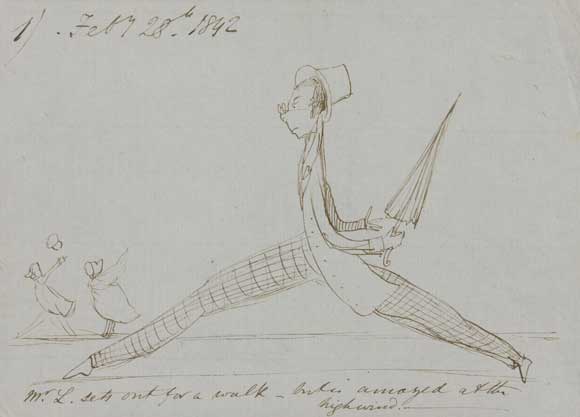
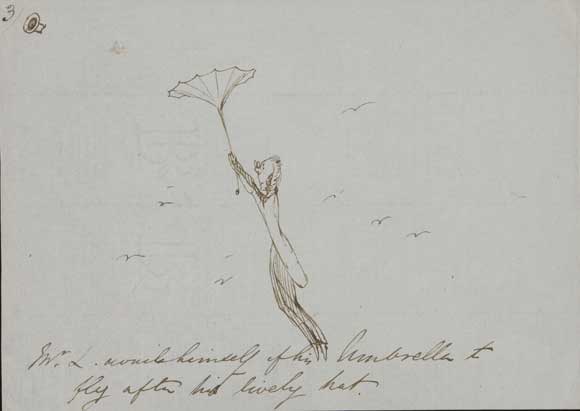
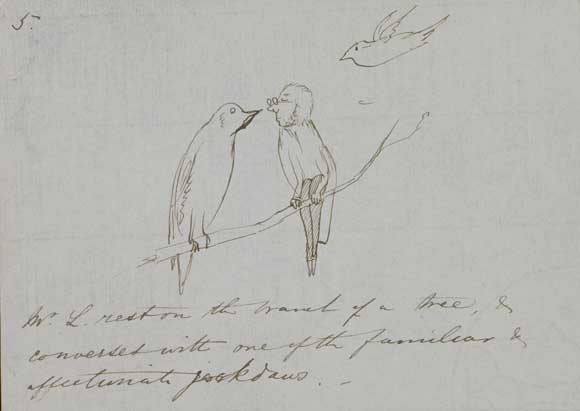
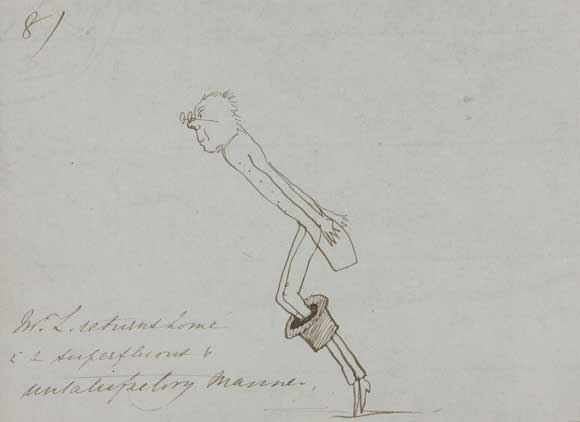
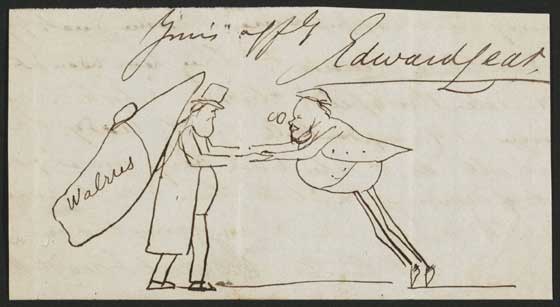
As a bonus, here is an Edward Lear self-caricature I found on my hard disk; unfortunately, I can’t remember where I got it:

k0105

Posted in Edward Lear | Tagged , , , | 1 Comment