Edward Lear’s Southern Italy Landscapes

paesaggio-calabria-sicilia

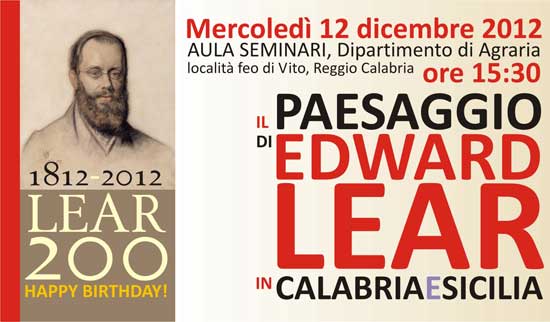
At long last, someone has remembered to celebrate Edward Lear in Italy: prof. Salvatore Di Fazio, who teaches Rural Architecture and Landscape at the University of Reggio Calabria, will give an open lecture on “Il paesaggio di Edward Lear in Calabria e Sicilia / Edward lear’s landscape in Calabria e Sicilia.” Relevant information in the banner above, or you can download the poster.

I’m afraid not many will be able to attend, but they can listen to this interesting radio programme: Edward Lear Poet and Scientific Illustrator, broadcast on December 8 by the Science Show on Australia’s Radio National. Or read this short article, Edward Lear, Illustrator, by Robert McCracken Peck, from Explore 34 (3).

Posted in Edward Lear | Tagged , , | 1 Comment

This is an empty post

Empty post

Posted in Uncategorized | Leave a comment

Something to Read

I do not have much time for posting at the moment, but here are a few recent items that might be of interest:

Peter Byrne has an interesting article on “Edward Lear of the Disappearing Nose” at Swans.com

A short piece on Edward Lear from the November 1 issue of The Scientist magazine: “Poetry and Pictures, circa 1830.”

According to this article in the London Evening Standard:

Novelist Andrew Sinclair […] has already written the script for a half-hour ITV film about Lear’s time in Corfu.

The Morgan Library & Museum has recently opened an exhbition on Beatrix Potter: The Picture Letters, which includes a set of illustrations for Edward Lear’s “The Owl and the Pussy-cat.” Be sure to browse to the February 27 and March 4, 1897 letters to Noel Moore. Here is a review of the exhibition from artdaily.org.

David Attenborough has a long article in The Telegraph on Edward Lear as an ornithological illustrator, promoting the Folio Society’s recent publication of an expensive collection of bird illustrations from his collection: Birds drawn for John Gould by Edward. Also see this clip from the BBC Entertainment & Arts News as well as this article from the Guardian.

Not strictly Lear news, but of interest: “Phonics could speak to children’s knack for nonsense” again from the Guardian.

Posted in Edward Lear | Tagged , , , , | 1 Comment

Retrospection: On Lear’s Irish Sources Again

Earth has no green such as once it wore,
When my young life with love was crowned;
And the very breeze, thro’ the summer trees,
Comes with a ’plaining sound.

When I hear the glad shouts of revelry
To the bride in her bridal wreath,
I know not why, but she seemeth aye
Like a victim bound for death.

Once hope threw her spell around this heart,
Once genius made me proud;
I was not born to bear the scorn
Of the rude unmannered crowd.

Now, hope from my breast is a banished thing,
To the winds of my genius given;
And I long to rise, thro’ the cloudless skies,
To the sunlit isles of heaven.

O sweet may the flowers be in India’s bowers,
Where the bulbul tells her tale,
But sweeter to me is the moss-rose tree
That grows in my native vale.

Can I ever forget the oak they set
At the hour when I was born?
Or the bank whence I rolled, in the days of old,
To the well beside the thorn?

Methought I knelt on the grassy knoll
Where I never may kneel more,
And I prayed, and was blest with that holier rest
Whose halcyon reign is o’er.

And my mother watched me silently
With her gentle eye and brow:
O for an hour of such balmy power
To calm my spirit now!

Methought I roved with the dearly-loved
O’er her native hill of heath,
And I felt her hand give its pressure bland –
That hand now cold in death.

A fair girl was reading the Word of God –
My Sister! that form was thine;
And a deeper spell, as her accents fell,
Breathed over the sacred line.

O, earth has no green such as once it wore,
When my young life with love was crowned;
And the very breeze, thro’ the summer trees,
Comes with a ’plaining sound.

[ Fenton, George Livingstone.] “Retrospection.” In The Mahabaleshwar Hills, and Other Poems. By an Indian Chaplain.  For private circulation only. London: Provost and Co., [1876]. 34-35.

Mr. Q. – hopefully not a descendant of the cruel spy at the center of Luther Blissett’s novel of that title – kindly comments on a previous post of mine on the Irish sources of Edward Lear’s early picture stories, and convincingly suggests that the poem that sounded like Mangan’s to me – “A Dream,” in The Dublin University Magazine: A Literary and Political Journal. (Volume I, Issue 2. February 1833, p. 145) – might be by the more obscure George Livingstone [or Livingston] Fenton. Here is his comment in full, in case you are too lazy to click on the link above:

Hey, what an interesting post !- and there might be a solution to your puzzle over authorship.

It is true that Clarence Mangan made great numbers of oversettings from the German (some of genuine Teutonic provenance, others the result of his hood-winking his readers through “reverse plagiarism”); quite true as well that he translated Kerner, Schiller, Freiligrath and so on, and that many of these works comprising his well-regarded Anthologia Germanica were published serially in The Dublin University Magazine, a publication then associated with Trinity College Dublin — which is also called Dublin University.

However, the poem from 1833 shown above doesn’t feel like Mangan. It lacks the “intensity” which Yeats so prized in his compatriot’s verses.

Some time spent looking into the mystery just now has revealed a considerably altered version of “A Dream” published in London in 1876 under the title “Retrospection” in a volume modestly called, The Mahabuleshwar Hills, and Other Poems. By an Indian Chaplain. Therefore I believe the mawkish poem that Edward Lear was mocking was penned by George Livingstone Fenton, an English versifier and kinsman to the family of Staffordshire poets named Fenton (or sometimes, ffenton).

G. L. Fenton had attended Trinity College Dublin (where Mangan worked in the library). He later served as Anglican chaplain on the Bombay Ecclesiastical Establishment in India. What is presented in the Dub. U. Mag. Feb. 1833 as “A Dream” seems to contain much of the second half of “Retrospection”; but the line in the latter that reads “Methought I knelt on the grassy knoll”, for example, had done worse time as “I was kneeling again on the grassy knoll” in the poem “A Dream”; additionally, several distinguishing details are absent from “A Dream” — such phrases as “India’s bowers”, “the bulbul” and “the Word of God”.

If disinclined to conspiracies about “grassy knolls”, the pondering modern might assume that the good Reverend simply revised and Orientalised his own immature verse for inclusion —nostalgically dressed as “Retrospection”— in the later publication (“An obstacle that came between Him, and ourselves, and it”). Cheers, ~Q~

Further research reveals that Lear and Fenton must have known each other later in life as, after getting back from India in 1866, before Lear travelled there, Fenton was chaplain in San Remo 1869-1885; see Reilly, Catherine W. Mid-Victorian Poetry, 1860-1879: An Annotated Biobibliography. London: Mansell, 2000. 161.

Fenton was not very successful as a poet if even the Calcutta Review could open an article on his Weeds of Poesy (1860) ridiculing his sentimentality. It is so savage I cannot resist quoting the first paragraph in full:

We have had another addition to the Gallery of Indian Poets. G. L. F. is decidedly of the lackadaisical and sentimental school. He is in love with melancholy, and adopts as his motto, “The flower of my life is past. Led by a late-earned experience, I will renounce earthly things. I will weep and no longer sing.” He has wept to some effect—he has wept a whole volume of Weeds. These obnoxious vegetable productions were culled in the woodland rambles of G. L. F.’s early boyhood. “A few of them,” he tells us, have sprung up amid the thorns of youth and manhood.” Poor G. L. F. ! thorns were bad enough, but to be afflicted with weeds at the same time must have been unbearable, unless the weeds were of that kind which have the property of smoothing the thorny path of life, and calming the ruffled brain. This bouquet of thorns and weeds G. L. F. “casts on the waters, not of the great sea of the world” in case they should be lost altogether, but “of the narrower humbler rivulets of Friendship and of Love,” where he hopes some kind stranger passing by or whose house may be on the bank of the rivulet may pick them up and rescue them from oblivion. Some of them have floated our way, though we cannot be certain how they have reached us. They cannot have been borne along by the Hooghly, because that is scarcely a “narrow, humble rivulet,” nor can they have come up the river carried along in triumph by the lore, because they were never cast on the “great sea of the world.” However, the green bouquet is in our hands, and let us be thankful for it whatever way it may have come.
(“Weeds of Poesy, by G.L.F. Bombay, Smith Elder and Co. “The Calcutta Review, 35, September-December 1860, no. 72, December 1860. xix-xxiv.)
Posted in Edward Lear | Tagged , , , | 5 Comments

The Nonsense Songs of Edward Lear – A Song-Cycle

I am terribly late announcing this, but I hope many of will be able to attend.

The Nonsense Songs Of Edward Lear – A Song-Cycle By David Lawrence

The first performance of this work, composed to mark the 200th anniversary of Lear’s birth, is to take place in Cork, Republic of Ireland on Wednesday November 7th. It will be performed by Eoghan Desmond (Baritone) and Colin Nicholls (Piano). Further details can be obtained from: David Lawrence, telephone 0044-1544-370330 (UK) or from Kay Desmond, telephone 00353-21487-5310 or 00353-86607-3645 (Ireland).

The work, which is about 90 minutes long, consists of settings of:

How Pleasant to Know My Lear
The Nutcrackers and the Sugar-Tongs
The Jumblies
The Pelican Chorus
The Pobble who has No Toes
The Quangle-Wangle’s Hat
The New Vestments
Mr and Mrs Discobbolos (Parts 1 & 2)
The Courtship of the Yonghy-Bonghy-Bo
Incidents in the Life of Mr Uncle Arly

The work explores the tragicomedy of Lear’s poems.

Posted in Edward Lear | Tagged , , | 1 Comment

Forthcoming Bicentenary Events

I have today updated the events section of the Edward Lear 1812-2012 Facebook page and find there are still a lot of celebrations and lectures for those who have missed the previous ones.

I had my dose a couple of weeks ago, when I was in London to visit the Royal Society exhibition, a very informative lecture by Stephen Duckworth on Lear and Crete (to be repeated soon at the Ashmolean) and, of course, the Oxford Bicentennial Conference.

No report could do justice to the several interesting papers that were read, and the lively discussions that followed, so I will not try. It was a great opportunity to meet both fans of Edward Lear and academics working on the different aspects of his production. Photographs and further information will soon be available at the official conference website.

Coming soon:

October 12 – November 17th 2012
Happy Birthday Edward Lear
The Concourse Gallery, Michael Andrews Building, Southampton Solent University, SO14 0YN.

Southampton Solent University is collaborating with Paper Galaxy (Andrew Baker & Linda Hughes) to celebrate the bi-centenary of the birth of Edward Lear with an exhibition of work over 40 british artists including Glen Baxter,  Linda Hughes, John Vernon Lord, Morten Morland, Simon Pemberton and Vaughan Oliver.

There is more than one defining Victorian writer celebrating his bicentenary this year. Edward Lear, who gave us ‘The Owl and the Pussycat’ and ‘The Dong With a Luminous Nose’, developed the limerick into a staple of nonsense verse, and whose drawings are still instantly recognisable, was born 200 years ago on 12 May – a milestone that threatens to pass quietly, overshadowed by his contemporary Dickens.

A number of artists who teach at Solent University including printmaker Louise Weir (Bish),  Ceri Amphlett,  illustration Course Leader Jonny Hannah,  Head of School of Art & Design Peter Lloyd and printmaker Charles Shearer have also contributed works to the show.

The pictures, inspired by Edward Lear’s work, encompass all styles and contemporary interpretations. The artist Phil Shaw, who has contributed to the exhibition, said: “The remarkable thing for me about Lear is that he manages somehow to combine mirth with melancholy, innocent optimism with sad reality. Even as a child I recognised that ‘The Dong With a Luminous Nose’ was the story of a real man’s lost love… At the age of thirteen I developed epilepsy and Lear, who suffered from the condition all his life, gave me something extra, a sense that despite everything, life was fun. Happy 200th birthday Edward.”

As a visual artist, Lear is known for his landscape paintings and natural history illustration, but it is his quirky nonsense drawings, with their unique blend of pathos and unashamed happiness, that inspire so many contemporary illustrators. Roger McGough, poet, broadcaster and president of The Poetry Society has said: “Any journey with Lear is a pea-green delight.”

This exhibition was first shown at the Poetry Society Cafe, London.

In addition, BBC Radio 4’s Poetry Please will be wholly devoted to Edward Lear on 14 October, at 4.30 pm, and the broadcast will be repeated on 20 October at the same time. The programme will also be available via iPlayer.

Posted in Edward Lear | Tagged , , | 1 Comment

No More Naps for Polly

In the last episodes of Peter Newell’s The Naps of Polly Sleepyhead the naps disappear, not only from the title: she is now the intended victim of Tom and Dicky’s practical jokes, but she regularly manages to inadvertedly turn the tables on them.

Here are two strips from 1907:

Posted in Comics, Peter Newell | Tagged , | Leave a comment

The Tiny Tads Meet the Piccoloafer and the Magpiano

Gustave Verbeek’s The Terrors of the Tiny Tads strip for 17 September 1913, from the Boston Sunday Post.

Posted in Comics, Gustave Verbeek | Leave a comment

Edward Lear, View of Modica

View of Modica, Sicily.
Inscribed and dated ‘Modica/8 June 1867’ (centre right) and with colour notes throughout. Pencil and pen and brown ink. 12 x 18 in. (30.4 x 45.7 cm.)

Christie’s.

Posted in Edward Lear | Tagged , , | Leave a comment

Edward Lear, Waiee, Bombay Presidency

Edward Lear, Waiee, Bombay Presidency, India.
Pencil and grey wash on paper with watermark ‘J WHATMAN/1881’. 15¼ x 22¼in. (39 x 56.5cm.)

Probably dating from late 1884 or early 1885, this work is based on an earlier drawing Lear executed in India — hence the absence of annotations. Lear had travelled in India between 1873 and 1875. He docked at Bombay on 22 November 1873 from where he travelled north to Lucknow to join the Vice-regal party of Lord Northbrook. This is a preliminary sketch for one of the Tennyson drawings subtitled as above to illustrate the lines from the poem Mariana “…. the day, was sloping towards his western bower.”

Christie’s.

Posted in Edward Lear | Tagged , , , , | Leave a comment