Edward Lear’s Letters in Italian 2: 22 March 1845 to A.M. Ricci

This is the second surviving letter Edward Lear wrote to Angelo Maria Ricci, again mentioning a mysterious project to illustrate the seventh book of the Aeneid, which was never completed, and which ― from the tone of the letter ― Lear himself seems to have already placed on hold. He is sending a copy of his Views in Rome and Its Environs (London: Thomas McLean, 1841) to thank Ricci for help in finding contacts while travelling around central Italy. The letter is also at Biblioteca comunale di Rieti, Fondo Ricci, F=1=16/212.

1072d. Via Felice

Sabato sera. 22 marzo. 1845

Illustrissimo e stimatissimo Sigre Cavaliere,

Non avendo avuto la fortuna di trovarla in casa oggi ― (dove mi farò presto il dovere di ripassare per salutarla,) bisogna che ella prenda l’incommodo di leggere un altro biglietto mio barbarico ― e per dir vero ― giacché in questi mesi non ho parlato altro che Inglese, meglio sarà che mi spiega con la penna che a voce. ― Voleva dunque pregarla di accettare quella opera litografica illustrativa dei contorni di Roma, ― in segno della mia riconoscenza per la lettera da lei scritta con tanta bontâ e cortesia sopra il 7° libro di Virgilio. Pensando, durante l’inverno, di passare in Rieti con qualchi amici, sempre ritardai di mandare il libro, sperando di aver avuto il piacer di presentarlo in persona.

Ma intanto, essendo necessario il mio andare fra poco in Inghilterra, voglio profittare della sua presenza in Roma, di pregar la di farmi questo favore, accettando questa collezione di vedute in memoria che io sarò sempre grato per le sue bonta ― non solamente per la lettera, ma per tante altre amabilissime ospitalità.

Pensai di fare un viaggio per Norcia in Ascoli ― ma non sarà possibile quest’anno, e così, la povera “Nursia” andrà senz’esser illustrata. Piuttosto faro una scappata a Monte Circeo, Piperno, ed al Monasterio di Fossa Nuova, ― e se ella potrebbe indirizzarmi a qualchi autori ove fanno menzione di quel luogo interessante ˇ[(cioè Fossanuova)] mi farebbe un gran piacere. Per la vicinanza di Sermonetta, Norba etc. ― avrò ricordo al P. [Prefetto?] di Teano, che m’ha promesso il suo aijuto.

Non volendo più incomodarla colla mia scritturaccia, ma sperando dentro oggi o domani di salutarla, passo a sottoscrivermi,

Illustrissimo signor Cavaliere ―
Suo obbligatissimo ed affentuosissimo

Odoardo Lear.

1062do V. Felice
Lunedì
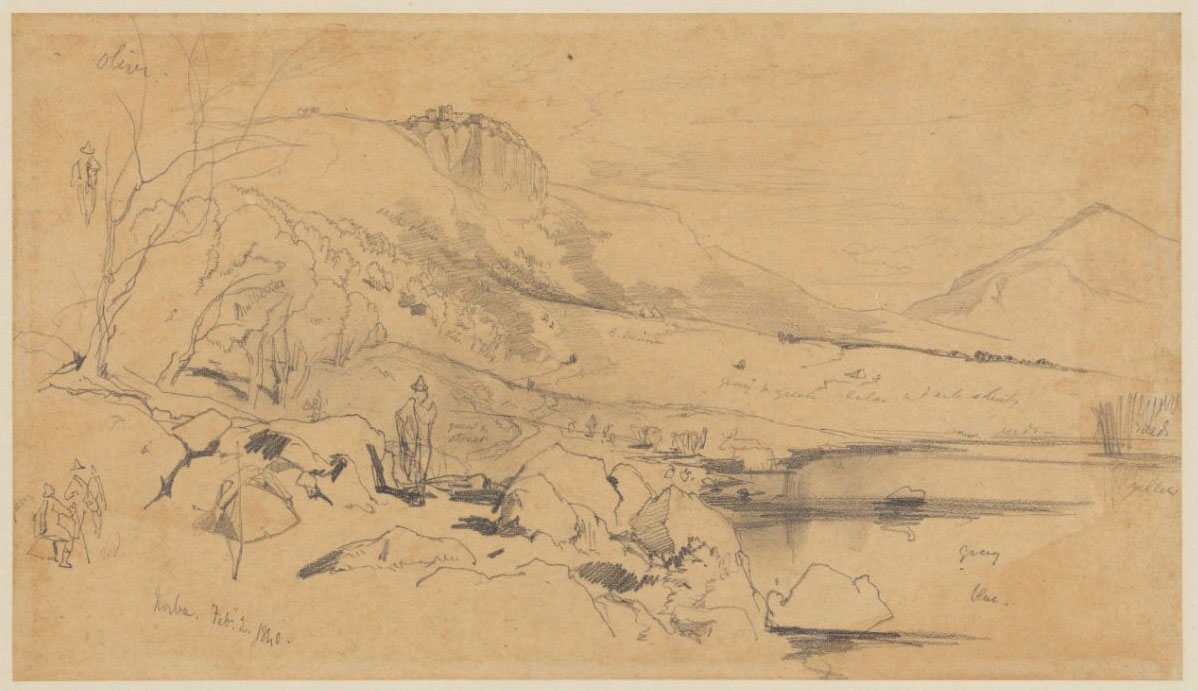
Edward Lear, Norba, 2 February 1840. Houghton Library, Harvard College Library.

Edward Lear, Norba, 2 February 1840. Houghton Library, Harvard College Library.

And here is my translation:

107sd. Via Felice

Saturday night. 22 March. 1845

Illustrissimo e stimatissimo Sigre Cavaliere,

As I had the misfortune of not finding you at home today ― (and I shall dutifully come again for a visit,) you will be forced to read another one of my barbarous notes ― and to be honest ― as I have only spoken English in the last few months, you will be better off if I write than if I speak. I would be very pleased if you accepted my lithographic illustrations of the environs of Rome, ― as a token of my gratitude for the nice and kindly letter you wrote about Virgil’s 7th book. As I hoped to pass through Rieti with some friends during the winter, I delayed sending the book, hoping I would be able to present it to you in person.

But, as I shall have to go to England shortly, I shall take the opportunity afforded by your being in Rome to ask you to do me the favour of accepting this collection of landscapes as a reminder of my continued gratitude for your kindness ― not only for the letter, but also for your many generous kindnesses.[1]

I had thought of going to Ascoli via Norcia ― but this will not be possible this year, so poor “Nursia” will not be illustrated. I shall rather go to Monte Circeo, Piperno, and to the Monastery of Fossa Nuova, ― and I would be very grateful if you could suggest any authors who mention that interesting place ˇ[(i.e. Fossanuova)]. As for the surroundings of Sermonetta, Norba etc. ― I shall apply to the P. [Prefect] of Teano who promised to help me.

I do not want to bother you with my horrible handwriting, while hoping to be able to greet you today or tomorrow, I assure you I remain,

Illustrious signor Cavaliere, ―
Your obliging and affectionate

Edward Lear.


[1] “Ospitalità” literally means hospitality, but the context makes it clear that Lear never actually visited Ricci in Rieti.
Posted in Edward Lear | Tagged , , | Leave a comment

More on Edward Lear’s Aeneid Project

In the letter to Angelo Maria Ricci I posted a few days ago Edward Lear refers to problems with his eyesight. Stephen Duckworth kindly e-mailed me about this:

I’ve just checked my list of (some of) his drawings by year and journey.   He was active in October 1844 – I’ve a record from Houghton of a drawing at Leonessa 3 October, but then the next dated drawings I have found (again at Houghton) are in March 1845 when he did a whole series in the Alban Hills, commencing with Cicero’s Villa on 3 March. He then did a fresh series in the Volscian mountains from end of March to early April.  Could either of these be linked to Virgil?

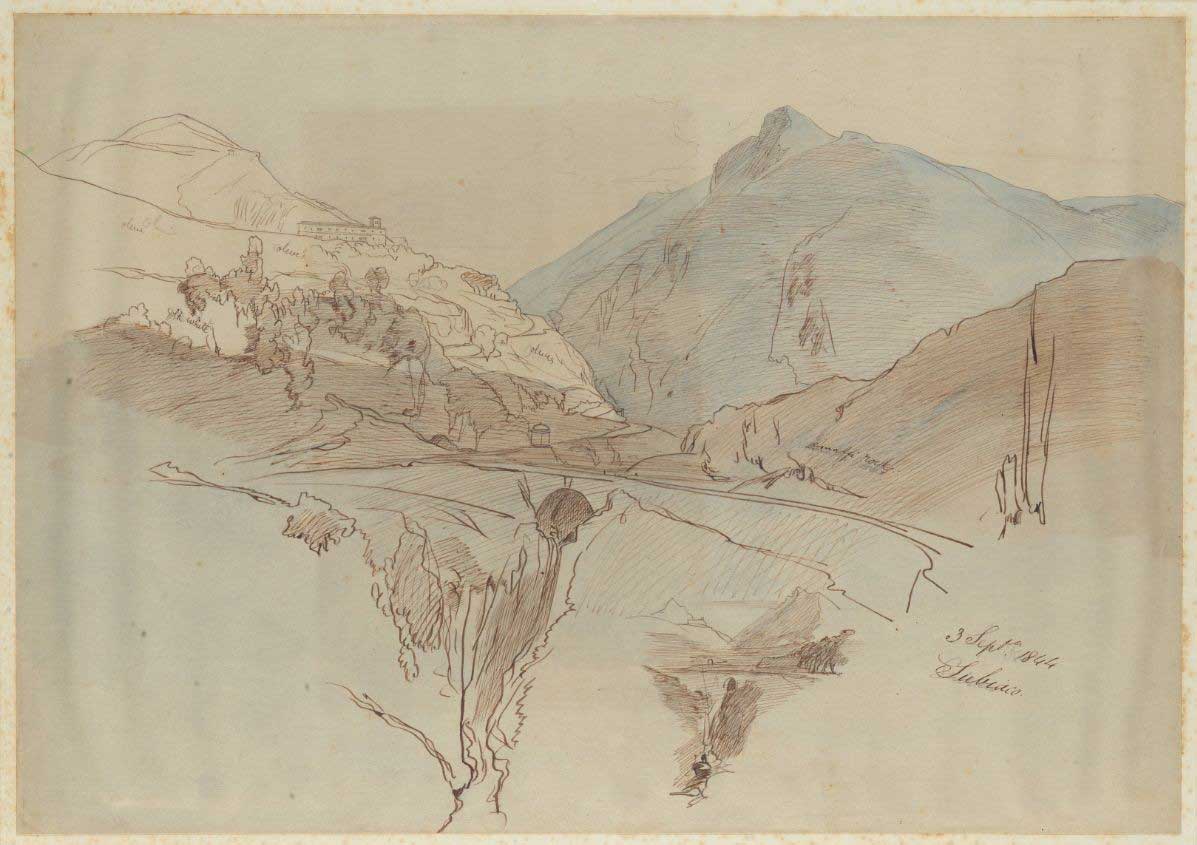
Edward Lear, Subiaco, 3 September 1844.

Edward Lear, Subiaco, 3 September 1844.

I could not find the Le0nessa drawing in the catalogue of digitized watercolours at Houghton, the last picture before 18 December (when Lear wrote) and 15 November (when the lost Ricci letter was written) is from Subiaco, dated 3 September. The next dated catalogue entry is Madonna del divino amore, 25 January 1845.

Edward Lear, Madonna del divino amore, 25 January 1845.

Edward Lear, Madonna del divino amore, 25 January 1845.

Both pictures might well be related to the Virgil project, as they are from the area around Rome where the events of the seventh book of the Aeneid take place, though the Madonna del divino amore is a very unlikely subject for such a work.

Posted in Edward Lear | Tagged , , , , | 1 Comment

Edward Lear, An Album of Indian Watercolours

inidan-album-s


Indian Trees, Palms and Bamboos. An album of original watercolour drawings.

Sold at Sotheby’s, London, 14 May 2013:

Folio (484 x 300mm.), 19 original watercolour drawings, one of a Jay dated 1864, the others of various species of Indian and Sri Lankan trees in locations including Shimla, Ratnapura, Kozhikode, Delhi and elsewhere, mounted in a slightly earlier morocco gilt album, covers with inset marbled paper panels, contemporary red morocco lettering-pieces on upper cover and spine, the paper toned.

Provenance

Henry Rogers Broughton, 2nd Baron Fairhaven; thence by family descent

Catalogue Note

Striking studies of trees, made on a demanding journey begun late in Lear’s life. The trip was at the behest of Lear’s friend Lord Northbrook, viceroy of India, who supplied him £1,000 of commissions. In 1872, Lear’s first attempt to reach the subcontinent was abandoned at Egypt due to ill health, but he tried again the following year.

“In October 1873 Lear and [his servant] Giorgio Kokali left once more for India… This time the journey was uneventful, and they docked in Bombay in late November. It was the start of a fifteen-month journey in which they travelled from the west to the east, and from the north to the south of the subcontinent, fulfilling a rigorous itinerary for a man who was now in his sixties. When they reached Ceylon in November 1874, Kokali became ill with dysentery, and Lear realized that they had had enough; they sailed from Bombay in January 1875” (ODNB).

Posted in Edward Lear | Tagged , , , | 4 Comments

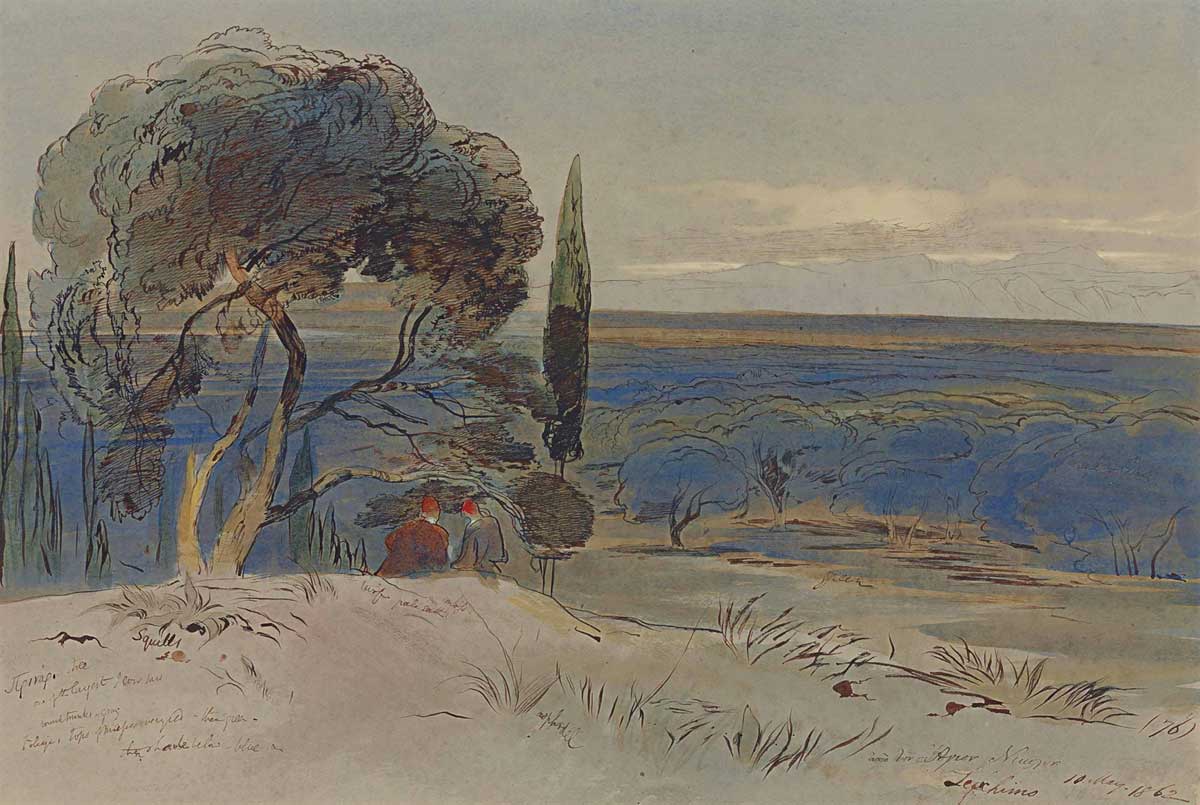
Edward Lear, Corfu, 10 May 1862

1862-05-10_Corfu-s

A landscape in Corfu with two figures sitting on a hillside.
Numbered, inscribed in Greek and dated ’10. May. 1862 (76)’ (lower right) and further inscribed in Greek and with colour notes. Pencil, pen and brown ink and watercolour heightened with bodycolour. 14 x 20¾ in. (35.5 x 52.2 cm.).

Diary entry for 10 May 1862.

Christie’s.

Posted in Edward Lear | Tagged , , , , | 1 Comment

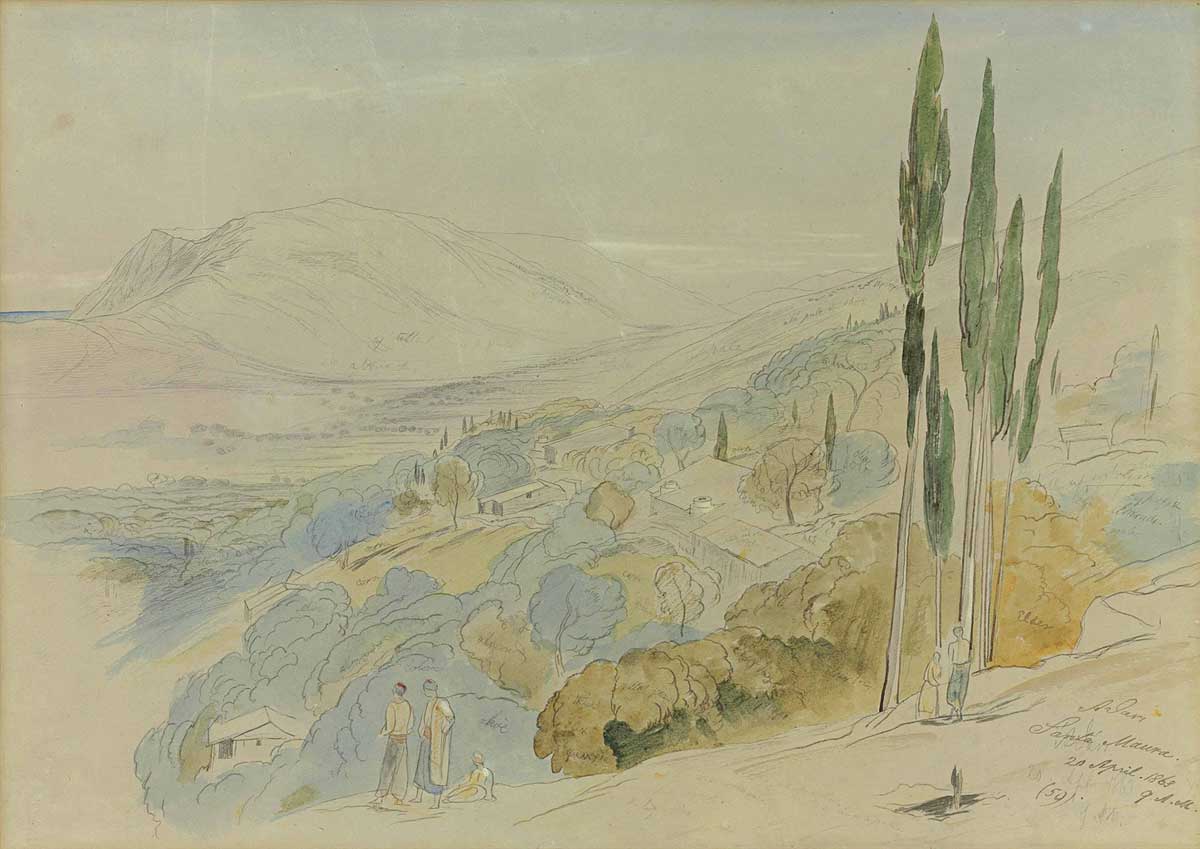
Edward Lear, A View of Sta Maura

I hope I’ll be able to post Edward Lear’s second letter to A.M. Ricci tomorrow. For the moment, enjoy this watercolour I did not have when posting Lear’s diary entry for 20 April 1863.

1863-04-20_Akarnia-s


A view of Santa Maura, Akarnia.
Numbered, inscribed and dated ‘Akarnia/Santa Maura/20 April.1863/9.A.M./(59). (lower right) and further inscribed with colour notes. Pencil, pen and brown ink and watercolour heightened with bodycolour. 13¾ x 19¼ in. (34.9 x 48.8 cm.)

Christie’s.

Posted in Edward Lear | Tagged , , , , | Leave a comment

Edward Lear’s Letters in Italian 1: 18 December 1844 to A.M. Ricci

Edward Lear wrote at least two letters to Angelo Maria Ricci, discussing a project of his I had never read about. They are both at Biblioteca comunale di Rieti, Fondo Ricci, F=1=16/212 (many thanks to Ms Carla Moroni for supplying scans of the originals and granting permission to post them here).

ricci_a

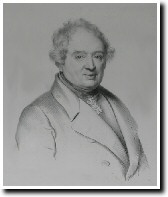
Angelo Maria Ricci (Mopolino di Capitignano, L’Aquila 1776 ― Rieti 1850) studied in Rome and became a member of the Accademia dell’Arcadia. He then moved to Naples, where he was given the chair of Rhetorics at the local university. In 1818, his health failing, he retired to Rieti, where he died in 1850. He wrote two epic poems, Italiade (1819) and San Benedetto (1824), and a treatise Della vulgare eloquenza (1819), as well as a Manzoni-inspired novel, Gli sposi fedeli (1837). He also produced six volumes of Poesie varie (1828-1830) and one of Poesie sacre (1849). [Also see a short Italian Wikipedia entry. A full biography is available via Google Books, where you can also read several of his books.]

In 1844-45, Edward Lear was evidently planning to illustrate the seventh book of Virgil’s Aeneid, and had asked Ricci, a Virgil expert, to help him select places worth drawing and to provide letters of introduction. Lear never realized the illustrations and probably abandoned the plan in the early stages owing to an eye infection, as he explains in the letter:

Al Illustriss.mo e Dottiss.mo Signore
il Sig.re Cavaliere A.M. Ricci.
in Rieti

1072d. Via Felice

Roma ― Dec.bre 18. 1844.

Sig.re Cavaliere illustrissimo ed amabilissimo,

Già avra pensato che il mio non rispondere alla sua pregiata lettera del 15 Nov.bre ˇ[non] sarà stato senza qualche cagione di premura: ― essendosi ella cosi amichevolmente ricordata del mio pensiero (da illustrare il 7mo libro di Virgilio,) mi sarebbe stato anche un piacere che un dovere ˇ[di] mandarle subito i miei ringraziamenti per tanta bontâ!

Ma ― tutto ciò che si vuole in questo mondo non si può fare: e mi rincresce, che, avendo per piû di 6 settimane sofferto moltissimo di una debolezza di vista, ― o piuttosto di quasi=infiammazione degl’occhi ― mi e stato assolutamente vietato il scrivere ― il leg[g]ere, ed il disegno. Bella vita! ―

Meno male che mi restava la musica! ― e poi ― se fosse ciò tolta ― vi è sempre il pensare. ――

Ora ― mi trovo a poco a poco amegliorandosi gli occhi, ― ma non posso molto travagliare: ― prendo, intanto, quest’occasione di ringraziare tanto e tanto la sua amabilità, preso che abbia tante pene per la parte mia.

Sono disgustato che non posso scrivere quel che la sua lettera domanda: si sa che sempre mi mancavano le parole ― maggiormente senza gli occhi come si può far altra che spedirle una propria bestialità?

Così sarà veramente questa lettera ― ma ella avrà la compiacenza di perdonarmi fin che mi ritorna il potere di più rispondere. Anche temo che il carattere sarà troppo cattivo per l’indovinare suo.

Fra tutti gli siti numerati in sua epistola ― certi sarebbero difficili ad ottenere. Monte Circeo ― Albunea ― Laurentum, Ardea, Nemi, etc. ― sono tutti poco lontano ― ma, cosa diremo di Atina, Mutasca ― e Norcia?

Per ora perdo la speranza di visitare quei luoghi: ― ma credo che abbia già disegnato tutti gli altri. intanto ripeto che la lettera mi sarebbe stato di grandissimo valore ― anche se fosse stato scritto da chichessia: essendo la sua ― si può figurarsi come l’ho pregiato.

Vorrei assai sapere se ella si troverà in Roma quest’inverno, e la prego di avere la bonta di avvertirmi del suo arrivo ― che posso passar a salutarla.

E, finora ― non vedo, (ne sento notizie di) ― Don Celestino [Ricci, fratello del poeta] ― che giornalmente aspetto. Al suo venire ― se sento da lui che ella non verrâ ― allora scrivero di nuovo a Rieti, più non mi permettendo gli occhi adesso.

Mi creda,
illustrissimo sig.r Cavaliere,
sempre suo servo obbligatissimo

Odoardo Lear.

My translation:

1072d. Via Felice

Roma ― December 18. 1844

Signore Cavaliere illustrissimo ed amabilissimo,

You will have come to the conclusion that my lack of a reply to your kind letter of 15 November was due to some pressing reason: ― as you were so friendly as to remember my project (to illustrate the 7th book of Virgil) it would have been a pleasure as well as a duty to send my thanks for such kindness immediately!

However ― one cannot do all he wants in this world: and I am sorry to say that, as I have suffered from a weakness of my eyesight ― or rather my eyes were nearly inflamed ― I have been utterly forbidden to write ― read, and draw. What a life!

Music was left, at least! And then ― if even that were taken away ― the ability to think would be left.

My eyes are now slowly improving, ― but I cannot work much: ―  for the moment, I take this opportunity to thank you for your great friendliness, for the inconvenience you have suffered for my sake.

I am disgusted of being unable to answer what you asked in your letter: you know that my language has always been insufficient. Without my eyes, what else can I do but send a beastly reply?

Such will be this letter ― but you will be so kind to pardon me until I am able to send a more detailed reply. I also fear that my handwriting will be much too bad for your guessing.

Of all the places listed in your letter ― some would be difficult to obtain. Monte Circeo ― Albunea ― Laurentum, Ardea, Nemi etc. ― are all not very far from here ― but, what about Altina, Mutasca ― and Norcia?

I have no hope of visiting these places at the moment: ― but I think I have already drawn all the others. At present let me repeat  how valuable any letter would have been to me ― whoever had written it: as it was from you ― you may easily guess how much I appreciated it.

I would be very happy to know whether you will be in Rome this winter, and would be pleased if you could kindly let me know of your arrival ― so that I can come and visit you.

So far, I have not seen, (nor do I have any news from) ― Don Celestino [Ricci, the poet’s brother] ― whom I expect to see any day now. When he arrives ― if I hear from him that you are not coming ― I shall write to you in Rieti again, as my eyes will not let me do more at present.

I remain,
illustrious signor Cavaliere,
your most obliging servant

Edward Lear.

Posted in Edward Lear | Tagged , , | 2 Comments

Slingsby’s Ode to Nonsense

ode-to-nonsense

Ode to Nonsense, the first opera devoted to Edward Lear’s life, will premiere at Her Majesty’s Theatre on 26 April, and will be on until 4 May.

You should watch the Making-of videos on Vimeo (Episode 1, Episode 2), as well as read the following articles, that provide a lot of interesting information:

Posted in Edward Lear | Tagged , , , | Leave a comment

Alfred Z. Baker’s Images à renversement

Antoine Sausverd over at Töpfferiana has unearthed some contributions by Alfred Zantzinger Baker to the French children’s magazine La jeunesse illustré, 1906-1907 (Gallica).

I have now created a set of pages which, besides providing information on Baker and his toy books, allow you to have fun rotating the images to read the stories (Javascript provided by my son Riccardo).

JI_199_1906-12-16

From The World Encyclopedia of Cartooning:

Baker, Alfred Zantzinger (1870-1933) [was] an American cartoonist born in Baltimore, Maryland. Baker pursued seriously art and was exhibited at age 23 in the National Academy he joined the staff of Puck in 1898. As a cartoonist he did not confine his work to one outlet, and at the turn of the century Baker was appearing frequently in the pages of Puck, Judge, Life, Scribner’s, Harper’s, Century and St. Nicholas. His books include The Moving Picture Book (1911), The Moving Picture Glue Book (1912) and The Torn Book (1913). His innovations, such as die-cutting and 3-D drawings with glasses, are surpassed in the children’s book genre only by those of the imaginative Peter Newell. Baker’s work was among the freshest and cleverest of American cartooning at the turn of the century, and retains these characteristic even under modern scrutiny.

Baker’s career was strictly connected to Peter Newell’s, with whose daughter he eloped, then married, and finally divorced. As the image above clearly shows, he was also strongly influenced by Gustave Verbeek.

Posted in Comics, Gustave Verbeek, Peter Newell | Tagged , , , , | 1 Comment

Edward Lear’s 1863 Tour of the Ionian Islands

In the spring of 1863, just before the Ionian Islands were ceded to Greece, Edward Lear started a tour of the seven islands which would result in a book of lithographs, Views in the Seven Ionian Islands, published in December of that year.

1863-03-31_Europoulos

You can now follow his day-to-day progress across the archipelago at the Edward Lear’s Diaries blog. I have been looking for Lear’s sketches online and will add them whenever I can. For more on the Ionian Islands, see DT Ansted’s The Ionian Islands in the Year 1863. Ansted also appears in Lear’s journal (24.ii, 26.ii, 1.iii, and 7.iii 1863)  and thanks him for his help while visiting Corfu.

Also, I don’t remember mentioning this article from the TLS blog before: Edward Lear in Corfu, by Adrian Tahourdin.

31651753

I have recently posted two of Lear’s previously-unpublished picture stories (and more are to follow); if you are interested in the subject, Anna Henchman’s recent talk at INCS 2013, “Fragments out of Place: Body Parts and the Logic of Nonsense in Edward Lear,” discusses at some length one of the earliest-published picture stories: The Adventures of Mr Lear, the Polly and the Pusseybite. She has kindly sent me an abstract:

Like waste, nonsense is matter out of place. Rearranged body parts, dismemberment, beheading, and other forms of bodily distortion appear throughout Edward Lear’s nonsense verse. “Elastic” bodies are squeezed, broken, dissolved, smashed, and rolled up tight. Heads are giant, small, square, or “fanned off.” In “The Adventures of Mr Lear, the Polly and the Pusseybite,” three bodies are “dashed to atoms” only to be refastened: Lear’s head is stuck to the parrot’s body, the parrot’s head to a cat body and human legs, and the cat head perches on Lear’s armless frame. The rearrangement retains what Richard Owen defined as a “homologous” relationship in 1843: arms go where wings used to; heads replace heads. Lear’s acute awareness of relations–between parts and wholes, claw and hand, individual and species–grows out of his work illustrating animals and plants for Charles Darwin and others.
This chapter places Lear’s manipulation of bodies and words in the context of two Victorian preoccupations: comparative anatomy and the evolution of both species and language. It links Lear’s play with body parts to his rearrangement of parts in language: placing familiar morphemes such as “om-,” “-ferous,” and “-ible” adjacent to out-of-place roots. Bodies and words share several characteristics: they are products of evolution, can be broken into parts (organs, limbs, or morphemes), and function as individual units that are inseparable from the larger systems of which they are a part.
Lear’s bodily distortions make freshly visible the logic of ordinary bodies, a logic that distributes a set number of limbs to a particular species. He distorts bodies and words to destabilize everyday ideas about individuality and wholeness: that individuals are intact, autonomous, distinct from others, and easily categorized, and even that one can easily distinguish between wholes and parts.

Posted in Edward Lear | Tagged , , , | 1 Comment

Edward Lear’s Romulus and Remus

The following is another picture story available from the Beinecke Rare Book and Manuscript Library, where you will find higher resolution scans.

It is the incomplete (or unfinished) companion to Edward Lear’s other Roman history: The Tragical Life and Death of Caius Marius Esqre  late her Majesty’s Consul-general  in the Roman states: illustrated from authentic sauces, consisting of 23 pictures which Lear drew for the family of Edward Penrhyn at East Sheen on 30 October 1841 (published in a limited edition by Justin G. Schiller in 1983; the MS is now at Cotsen Children’s Libary, Princeton University).

Romulus and Remus was presumably made in the same context and, the paper bearing a partial watermark (“[18]41”), at the same time. It is a parody of the traditional story of the founding of Rome according to Livy (The History of Rome Book I, 1.3 and 1.4) and anticipates such comic histories as Gilbert Abbot à Beckett’s Comic History of England and Comic History of Rome (both illustrated by John Leech).

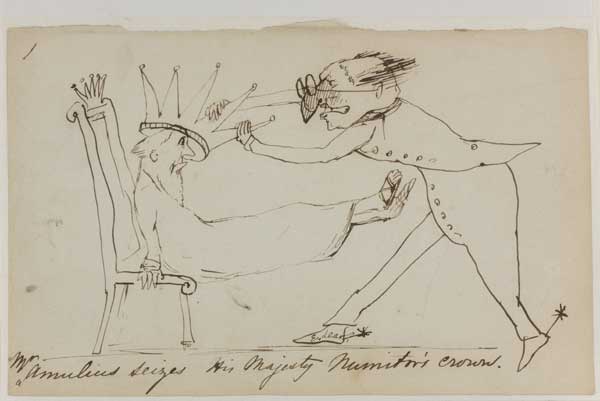
1. Mr. Amulius seizes his majesty Numitor's crown.

1. Mr. Amulius seizes his majesty Numitor’s crown.

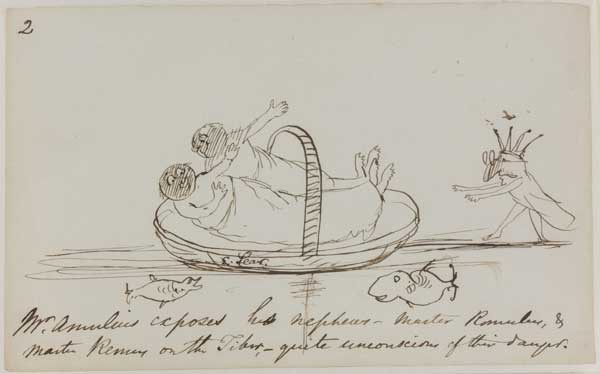
2. Mr. Amulius exposes his nephews, Master Romulus & Master Remus on the Tiber, quite unconscious of their danger.

2. Mr. Amulius exposes his nephews, Master Romulus & Master Remus on the Tiber, quite unconscious of their danger.

3. Master Romulus & Master Remus is suckled by a great wolf.

3. Master Romulus & Master Remus is suckled by a great wolf.

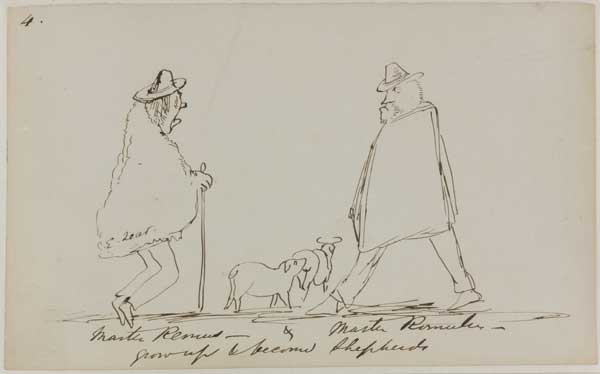
4. Master Remus & Master Romulus grow up and become shepherds.

4. Master Remus & Master Romulus grow up and become shepherds.

Posted in Edward Lear | Tagged , , , | Leave a comment