Mr Lear Recovers his Hat

I have updated the Manuscripts page with information on the Edward Lear material available at the Beinecke Rare Books and Manuscript Library. Among the many items which are also part of the Beinecke Digital Collections are at least three picture stories.

Here is a previously-unpublished one in which Lear loses and then recovers his hat; it was drawn and sent to Lady Susan Percy on 28 February 1842, with a note mentioning the “frightful facts which occurred 3 or 4 hours ago” (M. Montgomery, The Owl and the Pussy Cats: Lear in Love, the Untold Story, 2012, p. 44).
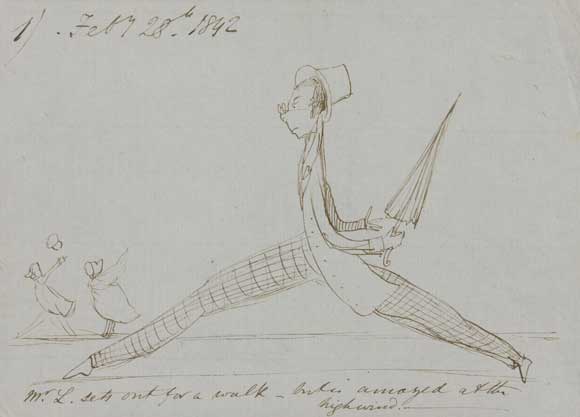
1. Mr. L. sets out for a walk --but is amazed at the high wind.

1. Mr. L. sets out for a walk –but is amazed at the high wind.

2. Mr. L. loses his hat & contemplates the flight thereof from a serene staircase.
2. Mr. L. loses his hat & contemplates the flight thereof from a serene staircase.

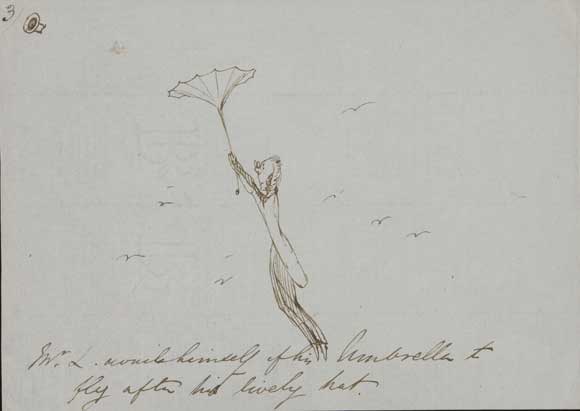
3. Mr. L. avails himself of his umbrella to fly agter his lively hat.

3. Mr. L. avails himself of his umbrella to fly agter his lively hat.

4. Mr. L. is joined in the chase of his lively hat by some familiar & affectionate jackdaws.
4. Mr. L. is joined in the chase of his lively hat by some familiar & affectionate jackdaws.

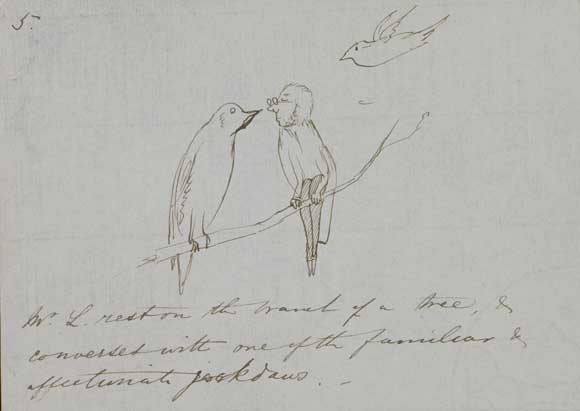
5. Mr. L. rests on the branch of a tree & converses with one of the familiar & affectionate jackdaws.

5. Mr. L. rests on the branch of a tree & converses with one of the familiar & affectionate jackdaws.

6. Mr. L. descends to the earth & recovers his lively hat by means of 2 ingenious infants.

6. Mr. L. descends to the earth & recovers his lively hat by means of 2 ingenious infants.

7. Mr. L. is shocked to find a hole in his lively hat.
7. Mr. L. is shocked to find a hole in his lively hat.

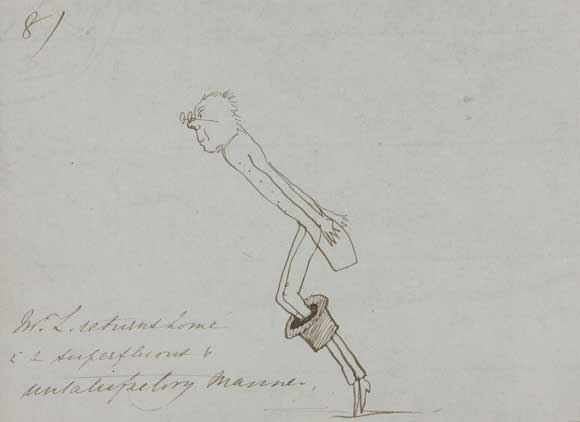
8. Mr. L. returns home in a supurflous & unsatisfying manner.

8. Mr. L. returns home in a supurflous & unsatisfying manner.

Higher-resolution images are available from Beinecke’s Digital Collections, and you can even download a pdf file of the whole story.

Posted in Edward Lear | Tagged , , | 2 Comments

More Edward Lear Manuscripts from Houghton

Near Cervia, 7 May 1867. Houghton Library MS Typ 55.26 NI.L10

Near Cervia, 7 May 1867. Houghton Library MS Typ 55.26 NI.L10

Houghton Library is proceeding with the digitization of their Edward Lear manuscript holdings, and a few days ago a new resource was made available: Edward Lear Landscape Drawings, 1838-1884.

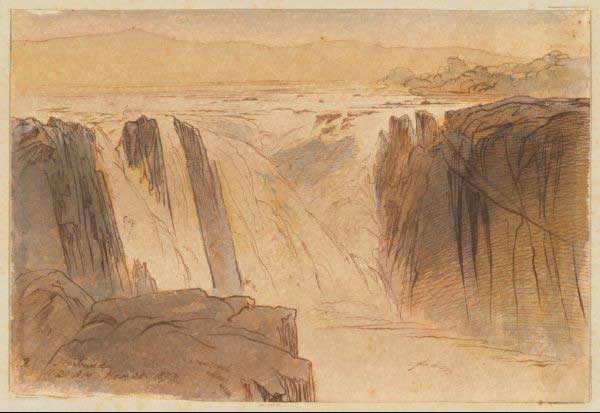
EL_Narbada

Near Jabalpur: Falls of the Narmada, 28 November 1873. Houghton Library MS Typ 55.26 NII.R1.

The document contains over 3,500 links to good-resolution scans of Lear’s drawings arranged in chronological order, an invaluable resource. Read Houghton Library Blog’s announcement.

When I heard about this, I suddenly realised that I had not annouced several other resources that the library had been placing online, in particular Edward Lear miscellaneous drawings, 1849-1866 (MS Typ 55.14) which includes a wealth of drafts and proofs of the nonsense.

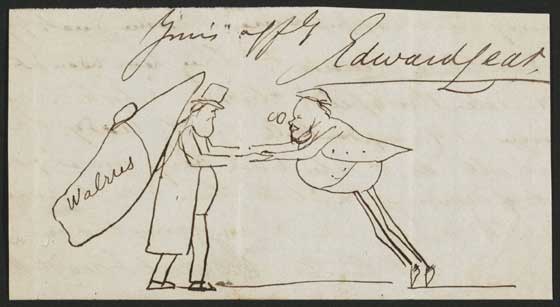
EL_Walrus

Edward Lear self-caricature and signature. Houghton Library MS Typ 55.14.

I have therefore decided to publish a document I have been preparing for some time. It contains a list of some of the Lear manuscripts in public collections I know of. This is clearly far from complete, and at the moment only includes the Houghton material, and not even all of it, but I’ll keep updating the list in the coming weeks.

Posted in Edward Lear | Tagged , , , , | 2 Comments

Edward Lear’s Greek Journals

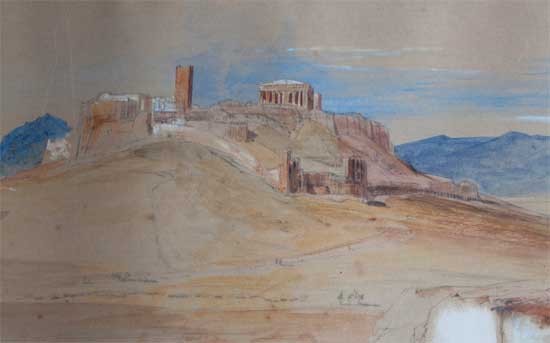
Detail from a sketch of Athens dated 5, 6 & 7 June 1848. Private collection.

Detail from a sketch of Athens dated 5, 6 & 7 June 1848. Private collection.

The journals Edward Lear kept before 1858 are lost. Though we know that in 1885 he still had “60 volumes of Diaries” (letter to Fortescue, 30 April 1885, Selected Letters, p. 269), these were destroyed or distributed among Lear’s friends by his executor, Franklin Lushington. He probably gave the 1848 journal to Charles M. Church, who had travelled in Greece with Lear in that year, and between 1907 and 1915 Church prepared a memoir of his experiences of the journey:

“WITH EDWARD LEAR IN GREECE: Being recollections of travel in Hellenic lands two generations ago, with extracts from his Journals and Letters, and illustrated by his sketches”.

Church, as the title suggests, had probably also been given the sketches Lear made at the time. Unfortunately the book was never published, and only a (later) typescript remains in the Westminster School Archive, London. The drawings have also been dispersed.

Now Rowena Fowler has edited part of the text, including all the Lear entries that Church reproduced, and identified several of the drawings. The result is published on a dedicated website maintained by the Wesmister School which provides a fitting conclusion to the bicentennial celebrations of last year and an important addition to my transcription project.

Posted in Edward Lear | Tagged , , , , , | 1 Comment

The Padloctopus and the Alligatorang-oorang

Here is the 15 March 1914 strip for Gustave Verbeek‘s Terrors of the Tiny Tads; below an example of Thornton Fisher’s The Wishing Wisp (see yesterday’s post):

TTT_1914-03-15-s

Posted in Gustave Verbeek | Tagged , , | Leave a comment

Polly Sleepyhead Passes Through a Small Cyclone

Another late strip from Peter Newell‘s series Polly Sleepyhead; it is from 1907, but I do not know the date:

polly-mine-s

Posted in Comics, Peter Newell | Tagged , | Leave a comment

More Wishing Willy

Here is the second episode of Peter Newell’s Wishing Willy, I do not have any more, though there were six, if Allan Holtz‘s American Newspaper Comics: An Encyclopedic Reference Guide is correct. Help in finding the missing ones (and better scans of these) would be appreciated.

PN_shing-willy-1913-08-10-s


Even though the strip was not successful, it might have provided inspiration for Thornton Fisher‘s Wishing Wisp, which started in the New York Herald on 31 August 1913 and ran until 12 April 1914. Fisher was “one of the worst hacks of the comic strip world” according to Holtz. Judging by the examples on Barnacle Press, however, The Wishing Wisp was not really that bad, at least as far as the drawing is concerned.

Posted in Peter Newell | Tagged , | 1 Comment

Peter Newell’s Wishing Willy

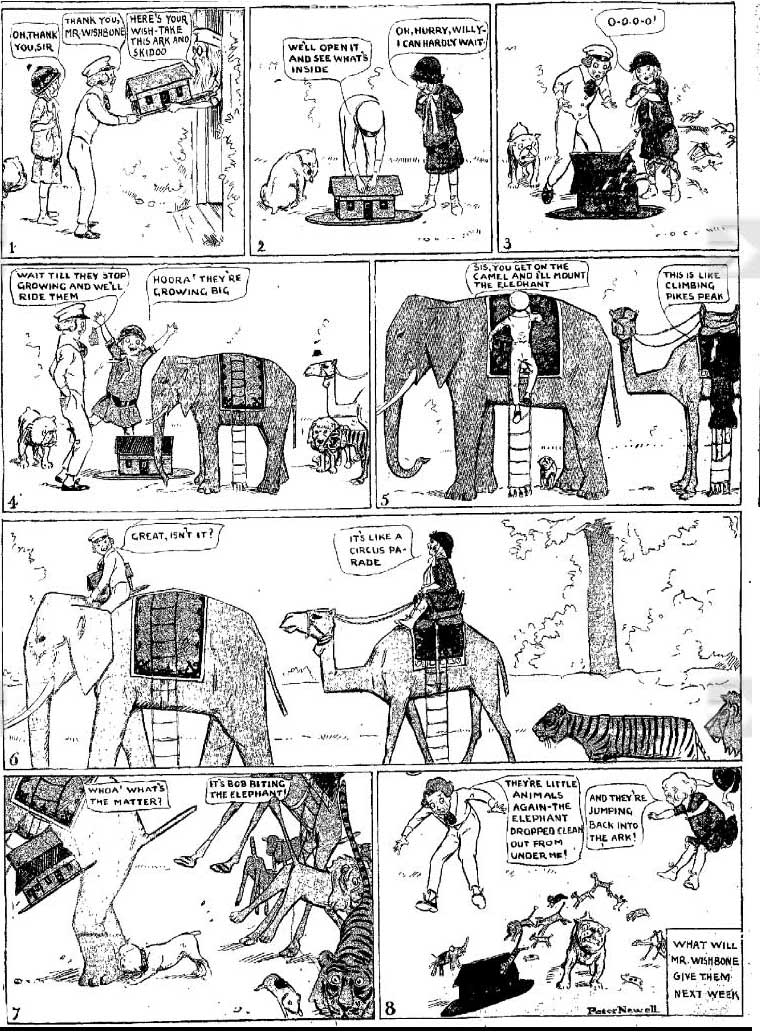
In addition to The Naps of Polly Sleepyhead (1906-1907), Peter Newell produced a second newspaper strip, Wishing Willie (or Willy), published in a few papers, e.g. the Atlanta Constitution, between 3 August and 7 September 1913: a grand total of six episodes, so it must not have been very successful.

The strips tell the misadventures of Willy, his sister, and their dog Bob with objects given to them by “Wishbone and Company.”

Here is the first episode:

PN_shing-willy-1913-08-03-s


More Naps of Polly Sleepyhead in full colour; the link above will take you to an almost complete run in b/w on nonsenselit.org.

Posted in Peter Newell | Tagged , | 1 Comment

A New Edward Lear Exhibition

I have not even finished posting material from the bicentenary year (see below) and a new exhibition opens:

Edward Lear and his Contemporaries will be open from 21 January to 15 February 2013 at the World Land Trust Gallery, Blyth House, Bridge Street, Halesworth, Suffolk IP19 8AB. Here you can download an exhibition poster and get information on the connected limerick competion. You can also read an introduction.

More reading about last year’s final events:

Serious Nonsense, a short article from American Scientist, January-February 2013, vol. 101, no. 1, p. 28.

Resoconto seminario “Secondo centenario della nascita di Lear” at the Dipartimento di Agraria of the Università Mediterranea, Reggio Calabria, held by Salvatore Di Fazio. Here are pdf files of Prof. Di Fazio’s own article in the newspaper La Sicilia of 30 December 2012: page 16 & page 17. All of this is in Italian, of course.

dh_el

You may have noticed that I have moved the bicentenary events from the home page, but you can still reach the list.

Also, I have not been posting much lately, as I had to urgently update the nonsenselit.org page: it is still not final, but take a look and let me know what you think.

Posted in Edward Lear | Tagged , , | Leave a comment

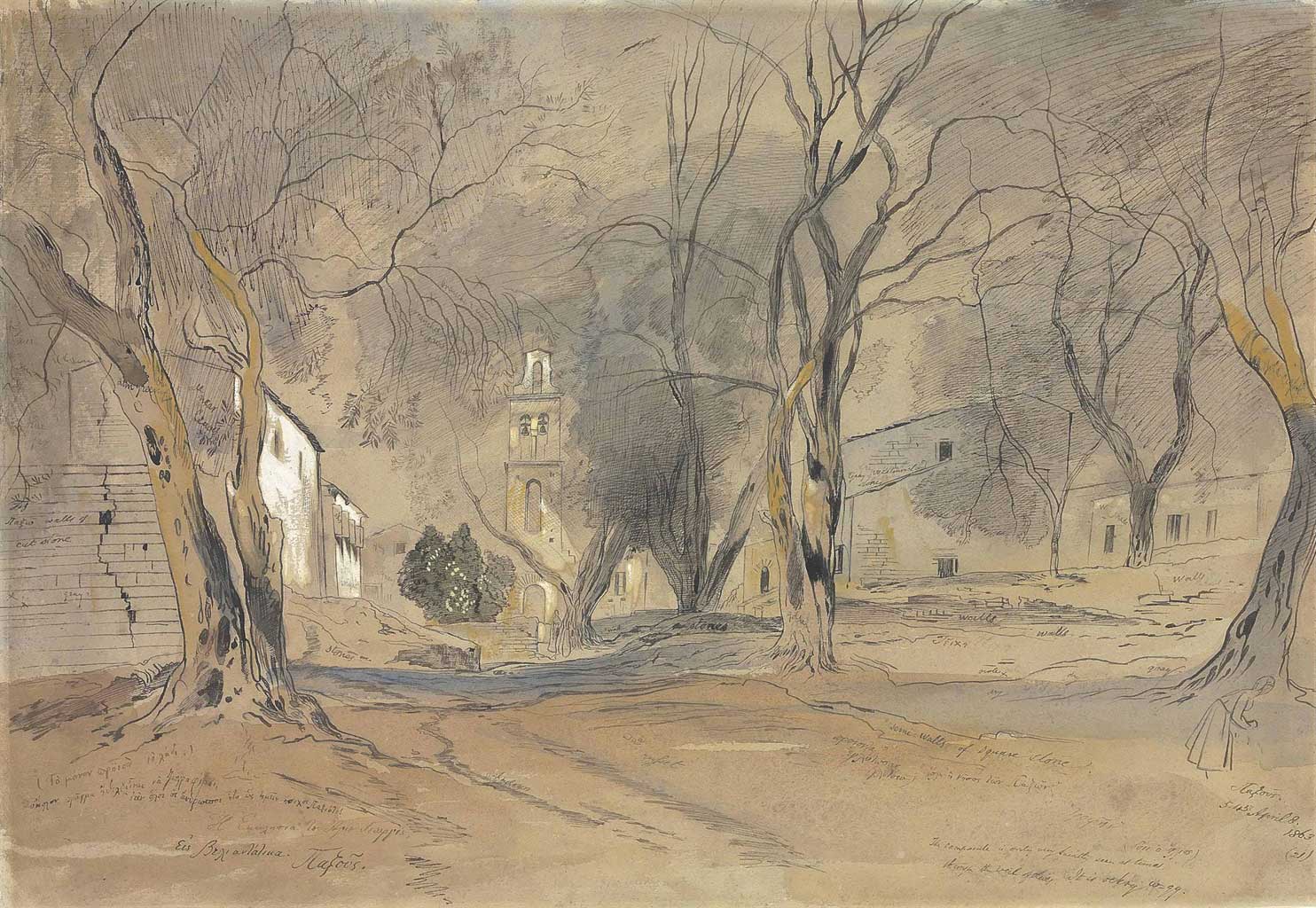
Edward Lear, Paxos

el_paxos-s


Edward Lear, Paxos.
Dated and numbered ‘5.45 April 8./1863/(21)’ (lower right) and inscribed ‘The campanile is only very faintly seen at times,/through the veil of olives. It is ochkry [sic] w_ gy.’ (lower right) and extensively inscribed in Greek and with color notes (lower left). Pencil, pen and ink and watercolor heightened with touches of bodycolor, on buff paper. 14¾ x 21½ in. (37.5 x 54.6 cm.)

Lear wrote of Paxos, ‘The difficulty in making Paxos picturesque. It reminds one of a Cornwall or Devon Cove without its picturesque houses. Great quiet is its characteristic.’

Christie’s.

Posted in Edward Lear | Tagged , , , | Leave a comment

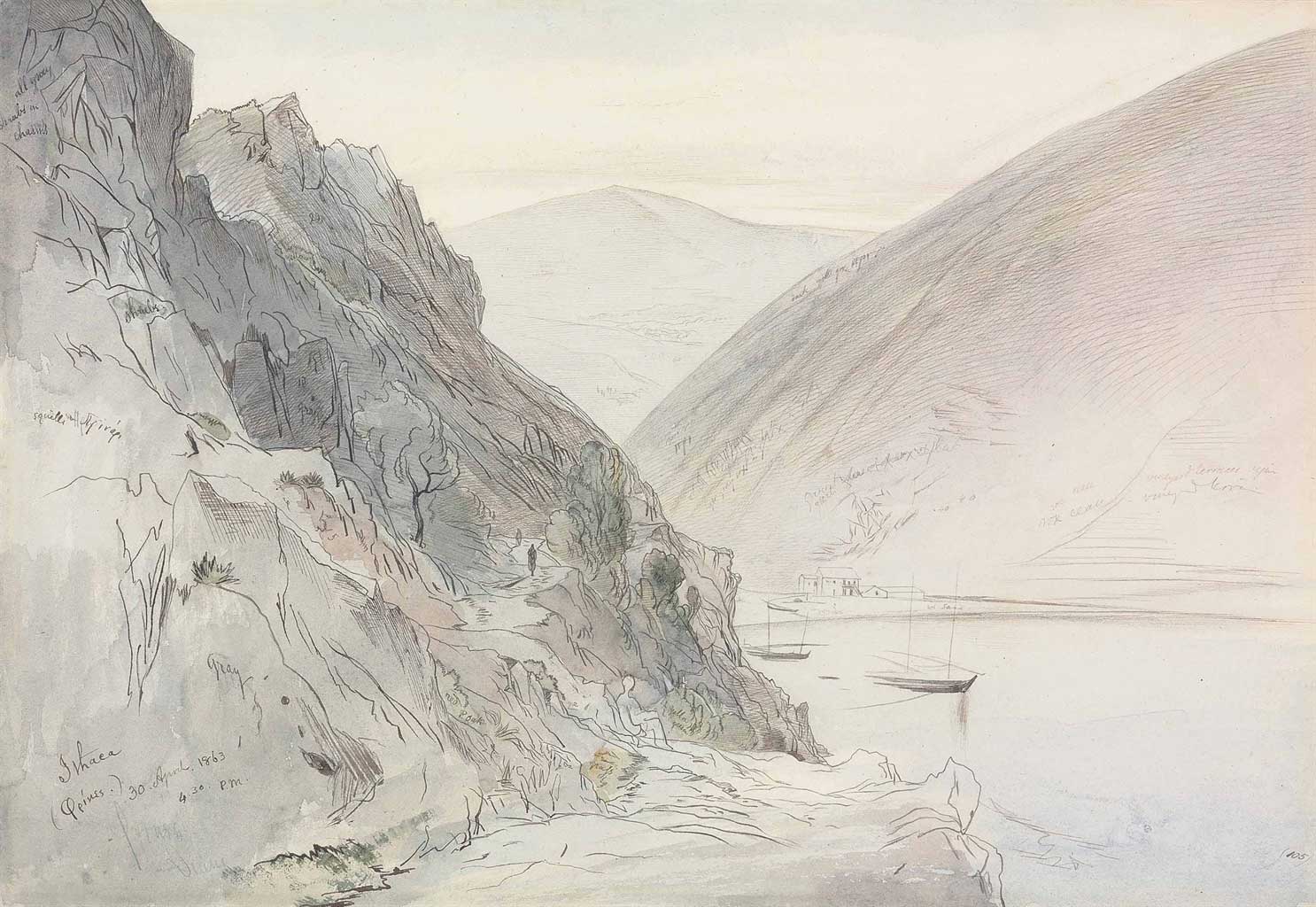
Edward Lear, Ithaca

el_Ithaca-s

Edward Lear, Ithaca.
Inscribed and dated ‘Ithaca/30.April. 1863/4.30. P.M.’ and further inscribed in Greek (lower left) and numbered ‘(105)’ (lower right) and extensively inscribed with color notes. Pencil, pen and black ink and watercolor. 14¼ x 20½ in. (36.2 x 52.1 cm.)

Lear had long been drawn to the idea of visiting Greece, with its ancient history and spacious landscapes. As a boy in the 1820s Lear had followed the Greek struggle for freedom from Turkish control. He was to make his first trip to Greece in 1848. Lear returned to Corfu for the summer of 1857 and again for the winters of 1858-59, 1861 and 1862-3 and the island was to provide him with the nearest he got to a winter base until finally settling in San Remo in 1870. During these visits, Lear also explored the other Ionian islands twice, once in 1848 and again between March and June in 1863 after which he returned to England. The latter trip was undertaken in the knowledge that the British were undertaking negotiations to hand over rule to the Greeks which would bring Lear’s time in the Ionian islands to a close. The result of this final Spring tour was another volume of lithographic views, Views of the Seven Ionian Islands, published in 1863.

Lear visited Ithaca from 26 April until 1 May 1863. It is famous as the island of Odysseus, and when Byron visited the island in August 1823 he found it so beautiful that he considered buying it and living there permanently. Lear also thought it was a magical place, writing on 27 April of the ‘pretty prettiness of Ithaca’ and on 29 April: ‘Truly — a very queer magical sight is this view! Dreamlike in its wan delicate pallor — all the gray [sic] sea so far below motionless as a surface of polished marble.’

Christie’s.

Posted in Edward Lear | Tagged , , , | Leave a comment