A New Collection, with a Never-before-Seen Portrait of Edward Lear

On the 1st August 2010 Vivien Noakes received an email telling her of some pictures owned by descendants of Sarah Street, née Lear. A further email yielded a few details; but the onset of Dr. Noakes’s final illness aborted the correspondence. It was not until June 2012 that communication with the family could be renewed; and several months passed before photography was possible. Now, after more than three years, the Blog of Bosh can show several unfamiliar pictures of the Lear family, and a few of Edward Lear’s possessions.

Sarah, Edward’s second oldest sister, emigrated to New Zealand in the 1850s, but remained in contact with the family. It was her great grand-daughter, Lily Bowen who conveyed the mixture of fact and lore that would be the main source for the family history in Angus Davidson’s biography; and it was Mrs. Bowen who identified the subjects of several photos and portraits in the collection, which will be shown in the coming posts.

We do not need Mrs. Bowen’s word, to identify what is probably the first portrait of Edward Lear, painted by his sister Ann when he was nine.

Photograph by Stephen A'Court.

Photograph by Stephen A’Court.

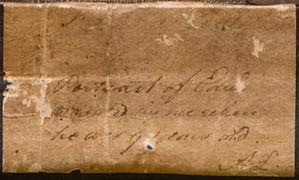
There is a label on the back, written by Ann herself which identifies the model and his age:
anns-EL-label

Portrait of Edwd. Painted by me when he was 9 years old. A.L.

The painting shares some of the features of watercolour drawings by Ann and Edward in an album at Houghton, in which coloured birds are portrayed in front of imaginary landscapes.

0_anns-bird-s

Harvard University – Houghton Library / Lear, Edward. Depictions of birds, plants, and insects. 1828-1836. MS Typ 55.4. (Signed “A. Lear.”)

On the background to the portrait Ann lavished more detail: the spring to the left, the white specks on the bay – on examination they are revealed as stylized whale sprays – and the temple among the trees to the right of Edward’s head hint at a shared fantasy world.

whales

el-face-temple

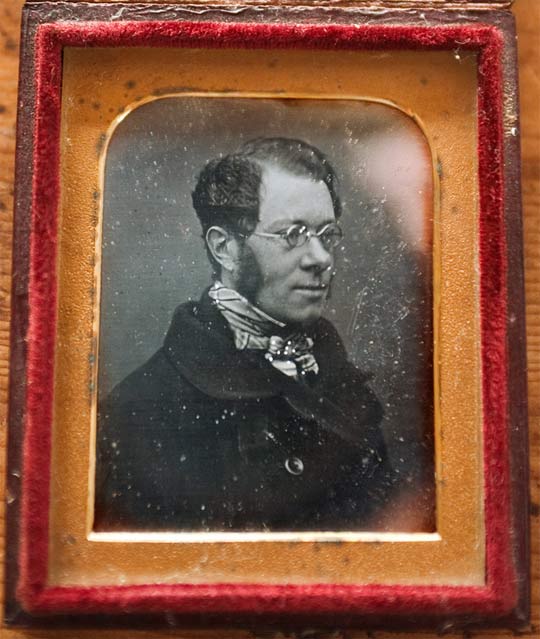
Except that she gives a hint of the Lear-family nose, one cannot judge the accuracy of Ann’s depiction of her nine-year-old brother – of whom it is hard to find traces in a photograph that shows Lear in early manhood, at about the time perhaps of the Marstrand portrait in the National Portrait Gallery.
Photograph by Stephen A'Court.

Photograph by Stephen A’Court.

The following show Lear in middle age:

el-middle-1-s       el-middle-2-s

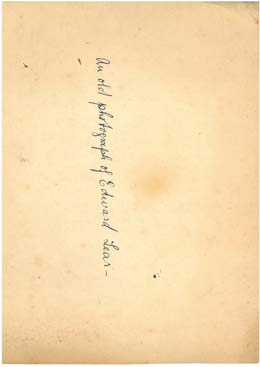
A postcard-sized photograph from the same collection, labelled on the back: “An old photograph of Edward Lear.”

el-post-f-s      el-post-b-s

Neither Lear’s ring nor his watch is shown in the above pictures: we know that Ann left him her gold watch, and the ring appears to be made in the same style, so he might have acquired both at the time of her death.

el-ring

el-watch-1     el-watch-2

But he may well have purchesed his  tableware when he settled in Sanremo:

el-ware-1

   el-cup-1  el-cup-2  el-cup-3

el-plate

More portable than the tableware, and surely intended to be as constant a companion as the ring and the watch, is the prayer book:

book-tp

This was given to Edward by a member of the Hornby family, relatives of the Stanleys.

book-dedication

“G. Hornby” was in all probability the “Geoff H.” of the Diaries, i.e. Geoffrey Thomas Phipps Hornby (1825-1895), sometime commander of the Neptune (Diary 10.ii.82); an “old and trusted friend” that Lear had in all likelihood first met in his Knowsley days in the early 1830s.

Accompanying Lear to church, the book may have been dumb witness to his frettings at the length of sermons, and fumings when the Athanasian Creed was said.

Posted in Edward Lear | Tagged , , , | 7 Comments

The Natural History of the Wheelbarrow

Detail of a bas-de-page scene showing a demon carrying souls to Hell in a wheelbarrow, from the ‘Taymouth Hours’, England (London?), second quarter of the 14th century, Yates Thompson MS 13, f. 139v.

Detail of a bas-de-page scene showing a demon carrying souls to Hell in a wheelbarrow, from the ‘Taymouth Hours’, England (London?), second quarter of the 14th century, Yates Thompson MS 13, f. 139v. British Library.

Tommy Thumb's Pretty Song Book. London: M. Cooper, c 1744. From The Annotated Mother Goose.Ed W.S. and C. Baring-Gould.

Tommy Thumb’s Pretty Song Book. London: M. Cooper, c 1744. From The Annotated Mother Goose.Ed W.S. and C. Baring-Gould.

Joshua Kirby Baldrey (1754-1828), H-st-gs ho, rare H-st-gs!, 1788. Etching. Hastings at wheelbarrow in which sit George III and Thurlow. “What a Man buys he may sell”

Joshua Kirby Baldrey (1754-1828), H-st-gs ho, rare H-st-gs!, 1788. Etching. Hastings at wheelbarrow in which sit George III and Thurlow. “What a Man buys he may sell.” Graphic Arts Collection, Princeton University Library.

The History of Sixteen Wonderful Old Women. London: J. Harris and Son, 1820.

The History of Sixteen Wonderful Old Women. London: J. Harris and Son, 1820.

The Only True Mother Goose Melodies. Boston: Munroe & Francis, 1833.

The Only True Mother Goose Melodies. Boston: Munroe & Francis, 1833.

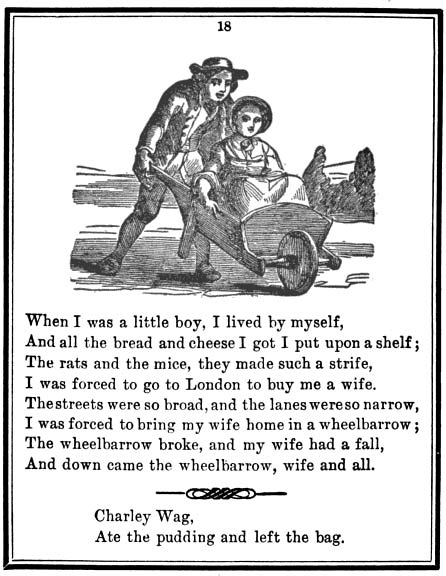
lear-harrow

Edward Lear, undated limerick, prepared for More Nonsense (1872) but not used. From Teapots & Quails.

Posted in Comics, Edward Lear | Tagged , , , , | 4 Comments

More to Read on Lear and Nonsense

When I last posted news of essays on Edward Lear I forgot to mention the following I learned about from John Varriano’s essay:

Fiorentino, Emmanuel. “Edward Lear in Malta.” Proceedings of History Week 1984  (1986): 33-40. Available online as a pdf facsimile and as text.

Meanwhile, Peter Byrne has published an essay discussing Lear’s relationship with Alfred Tennyson:

Byrne, Peter. “Pursuing Tennyson in Tight Shoes.” Able Muse: A Review of Poetry, Prose & Art 16 (2013): 89-99. The journal is available online, but the article is not.

Which reminds me that Victorian Celebrity Culture and Tennyson’s Circle (London: Palgrave Macmillan, 2013), by Charlotte Boyce, Páraic Finnerty and Anne-Marie Millim includes a chapter on the same subject:

Finnerty, Páraic. “‘This Is the Sort of Fame for Which I Have Given my Life’: G.F. Watts, Edward Lear and Portraits of Fame and Nonsense.” pp. 53-96. You can read part of the chapter on Google Books.

The same is true for “Professionals and Amateurs, Work and Play: William Rowan Hamilton, Edward Lear and James Clerk Maxwell,” chapter 1 of The Poetry of Victorian Scientists: Style, Science and Nonsense by Daniel Brown. Google Books.

Finally, you may find the following of interest: Three Principles Underlying Iconicity in Literature: The Poetics of Nonsense in Children’s and General Literature, by Daniel Kies.

Posted in Edward Lear | Tagged , , , | 2 Comments

George Thomas Lanigan’s Ahkoond of Swat

From American Notes and Queries, vol. 4, no. 6, 7 December 1889, pp. 67-8.
Ahkoond of Swat. — Can you give me a poem of this title by the late George Lanigan?Frank E. Marshall.
Philadelphia, Pa.

A gentleman on the editorial staff of the Philadelphia Record has kindly furnished the following facts:”Shortly after his death all of the short poems by George T. Lanigan were sent out to Chicago to the head of a publishing house, the name of which escapes me at the moment. He was a personal friend of the family, and so prevailed upon them to give him the cherished literary remains, with the intention of issuing the poems in book form. But the firm failed; their property was seized by the Sheriff and sold, and Lanigan’s poems were irretrievably lost in the confusion that ensued.
“It is strange, but every fragmentary rhyme written by Mr. Lanigan has thus perished, except ‘The Ahkoond’ and ‘The Young Orlando,’ to be found in ‘Play-Day Poems,’ edited by Rossiter Johnson.

A THRENODY.

‘The Ahkoond of Swat is dead.’—London Papers of January 22.

WHAT, what, what,
What ’s the news from Swat?
Sad news,
Bad news,
Comes by the cable led
Through the Indian Ocean’s bed,
Through the Persian Gulf, the Red
Sea and the Med-
iterranean—he ’s dead;
The Ahkoond is dead!

For the Ahkoond I mourn,
Who wouldn’t?
He strove to disregard the message stern,
But he Ahkoodn’t.

Dead, dead, dead;
(Sorrow Swats!)
Swats wha hae wi’ Ahkoond bled,
Swats whom he hath often led
Onward to a gory bed,
Or to victory,
As the case might be,
Sorrow Swats!
Tears shed,
Shed tears like water,
Your great Ahkoond is dead!
That Swats the matter!

Mourn, city of Swat!
Your great Ahkoond is not,
But lain ’mid worms to rot.
His mortal part alone, his soul was caught
(Because he was a good Ahkoond)
Up to the bosom of Mahound.
Though earthy walls his frame surround
(Forever hallowed be the ground!)
And sceptics mock the lowly mound
And say “He ’s now of no Ahkoond!”
His soul is in the skies,—
The azure skies that bend above his loved
Metropolis of Swat.
He sees with larger, other eyes,
Athwart all earthly mysteries—
He knows what ’s Swat.

Let Swat bury the great Ahkoond
With a noise of mourning and of lamentation!
Let Swat bury the great Ahkoond
With the noise of the mourning of the Swattish nation!

Fallen is at length
Its tower of strength,
Its sun is dimmed ere it had nooned;
Dead lies the great Ahkoond,
The great Ahkoond of Swat
Is not!

From American Notes and Queries, vol. 4, no. 8, 21 December 1889, p. 89.

The above poem was also printed in Humour of the North. Selected and arranged by Lawrence J. Burpee. Totonto: The Musson Book Company, 1912. See gutenberg.ca.

From American Notes and Queries, vol. 4, no. 11, 11 January 1890, p. 132.

ANOTHER THRENODY

“Dirge of the Moolla of Kotal, rival of the Akhoond of Swat”

I

Alas, unhappy land: ill-fated spot
Kotal—though where or what
On earth Kotal is, the bard forgot;
Further than this indeed he knoweth not—
It borders upon Swat!

II

When sorrows come, they come not single spies,
But in battal-
Ions: the gloom that lay on Swat now lies
Upon Kotal.
On sad Kotal whose people ululate
For their loved Moolla late.
Put away his little turban,
And his narghileh embrowned,
The lord of Kotal—rural urban—
‘S gone unto his last Akhoond,
‘S gone to meet his rival Swattan,
‘S gone, indeed, but not forgotten.

III

His rival, but in what?
Wherein did the deceased Akhoond of Swat
Kotal’s lamented Moolla late,
As it were, emulate?
Was it in the tented field
With crash of sword on shield,
While backward meaner champions reeled
And loud the tom-tom pealed?
Did they barter gash for scar
With the Persian scimetar
Or the Aghanistee tulwar.
While loud the tom-tom pealed—
While loud the tom-tom pealed,
And the jim-jam squeeled,
And champions less well heeled
Their war-horses wheeled
And fled the presence of these mortal big bugs o’ the field?*
Was Kota’s proud citadel—
Bastioned, walled, and demi-luned,
Beaten down with shot and shell
By the guns of the Akhoond?
Or were wails despairing caught, as
The burghers pale of Swat
Cried in panic, “Moolla ad Portas?”
—Or what?
Or made each in the cabinet his mark
Kotalese Gortschakoff, Swattish Bismarck?
Did they explain and render hazier
The policies of Central Asia?
Did they with speeches from the throne,
Wars dynastic,
Entents cordiales,
Between Swat and Kotal;
Holy Alliances,
And other appliances
Of statesmen with morals and consciences plastic
Come by much more than their own?
Made they mots, as “There today is
No more Himalayehs,”
Or, if you prefer it, “There today are
No more Himalaya?”
Or, said the Akhoond, “Sah,
L’Etat de Swat c’est moi?”
Khabu, did there come great fear
On thy Khabuldozed Ameer
Ali Shere?
Or did the Khan of afar
Kashgar
Tremble at the menace hot
Of the Moolla of Kotal,
“I will extirpate thee, pal
Of my foe the Akhoond of Swat?”
Who knows
Of Moolla and Akhoond aught more than I did?
Namely, in life they rivals were, or foes,
And in their deaths not very much divided?
If anyone knows it,
Let him disclose it!

* Are now become the “mortal bugs o’ the field.”

Both poems also appeared in Carolyn Wells’s A Nonsense Anthology. New York: Charles Scribner’s Sons, 1919. Google Books.

Information on George Thomas Lanigan is hard to come by; her is what The Oxford Companion to American Literature writes (according to answers.com):

(1845–86), Canadian-born journalist and humorist, began his newspaper career in his native country but continued it in St. Louis, Chicago, New York, and Philadelphia. His verse Fables by G. Washington Aesop (1878) shows his wit and his facility, as does his improvisation occasioned by the headline The Ahkoond of Swat Is Dead, entitled Threnody for the Ahkoond of Swat (1878) and containing the lines The great Ahkoond of Swat Is not!

Posted in Uncategorized | 2 Comments

The Tiny Tads Visit the Butterflybrary

ttt1910-2-s


Another unusual adventure of Gustave Verbeek’s Tiny Tads from 1910.

Posted in Comics, Gustave Verbeek | Tagged , , | 1 Comment

Something to Read

The holidays are over, but if you are still looking for some good Edward Lear reading here is a list of relatively new items:

image_provider

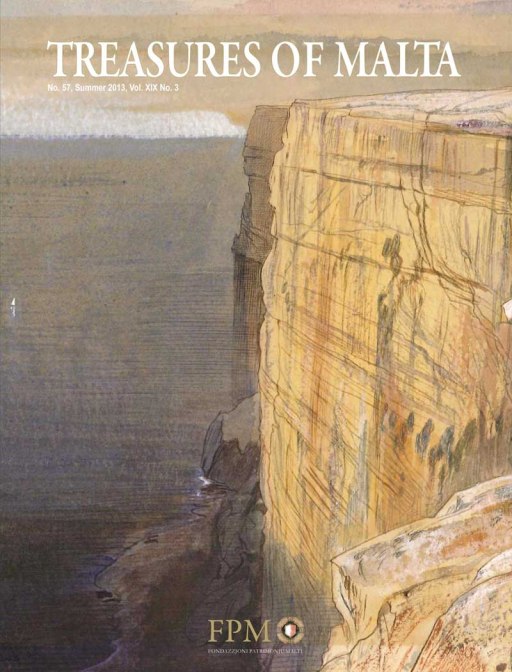
John Varriano has a long article in the Christmas 2013 issue of Treasures of Malta on “Edward Lear in Malta: New Revelations.” The Fondazzjoni Patrimonju Malti will also publish his next book, Edward Lear in Malta, some time in the spring. He is also working on an exhibition in autumn 2014 at Palazzo Falson Historic House Museum, Mdina, and one on “Edward Lear in the Holy Land” for the Mount Holyoke College Art Museum in the spring of 2015.

Lear_Suli

“Edward Lear in Greece” is the title of the exhibition at the Scottish National Gallery which opens on 15 February. “This exhibition comprises an outstanding group of 32 watercolours of mainland Greece, Crete and the Ionian islands, from the collection of the distinguished historian Sir Steven Runciman.”

Carol Rumens’s poem of the week column in The Guardian for 30 December 2013 was devoted “Edward Lear’s The New Vestments: the Artistry of an Extraordinary Suit.”

Meanwhile, Anna Henchman’s paper on Lear’s dismembered bodies I mentioned in a previous post has been published as “Edward Lear Dismembered: Word Fragments and Body Parts” in Nineteenth-Century Contexts: An Interdisciplinary Journal, Volume 35, Issue 5, 2013, pp. 479-487.

9781780765693

Also, Tauris Parke Paperbacks has reprinted Peter Levi’s Edward Lear: A Life with a new foreword by Robin Hanbury-Tenison.

9781849631464

I do not think I mentioned Louise Schweitzer’s One Wild Flower, “a study of Victorian Nonsense,” published by Austin Macauley in 2012.

51YoB+hM4tL

But the best book on Edward Lear I read in 2013 was not published in 2013 and is not about Lear at all: Sara Lodge’s Thomas Hood and Nineteenth-Century Poetry: Work, Play and Politics, Manchester University Press, 2007, sheds light on the influence of Thomas Hood and his circle on Lear’s early nonsense pictures and poems. You can get a print-on-demand copy at a reasonable price from many sellers on Abebooks.

Posted in Edward Lear | Tagged , , , , , | Leave a comment

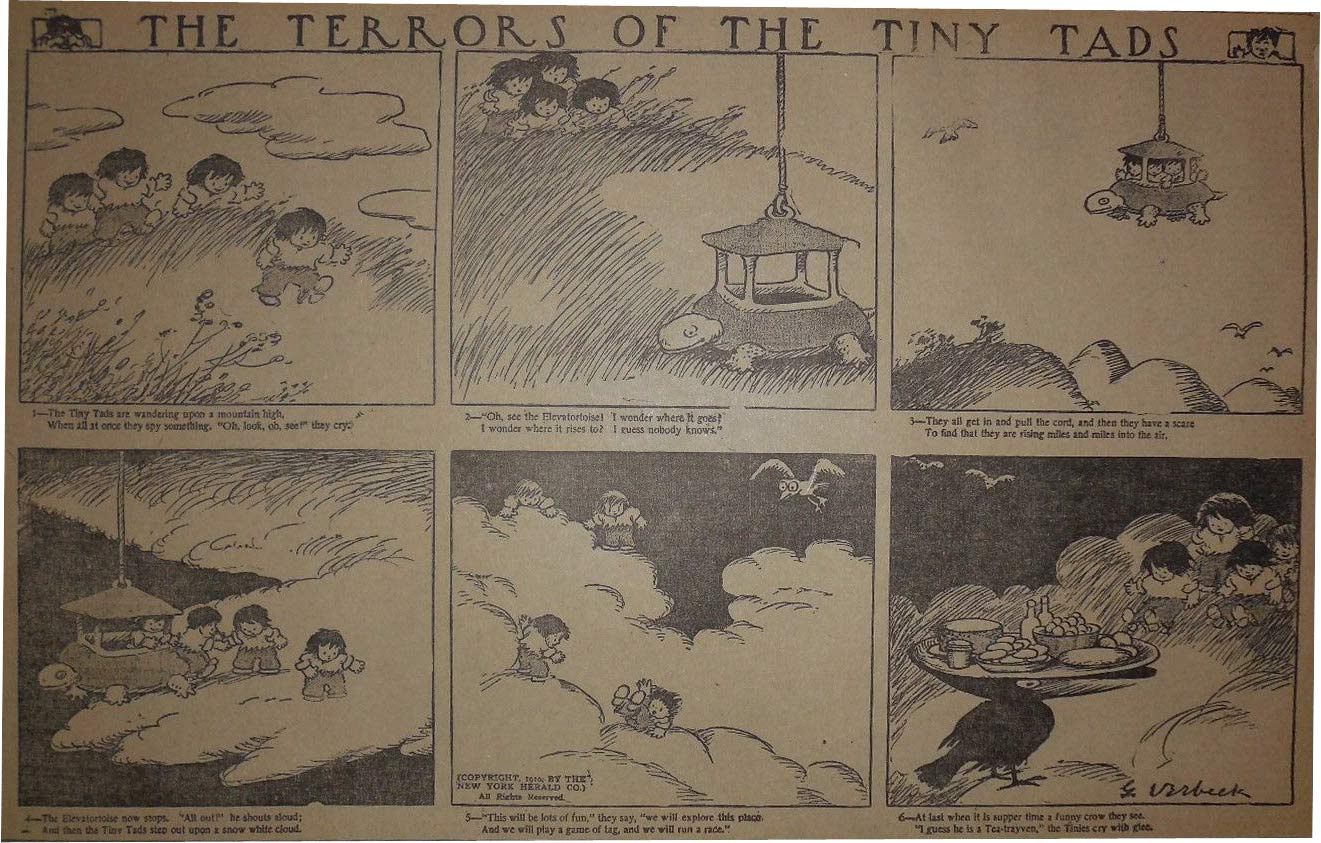
The Tiny Tads Travel to the Clouds

ttt1910-1-s

An unusual 1910 episode from Gustave Verbeek’s Terrors of the Tiny Tads.

Society is Nix from Sunday Press, which I mentioned in the previous post, has been reviewed in the New York Review of Books blog.

Posted in Comics, Gustave Verbeek | Tagged , , | Leave a comment

Gustave Verbeek’s Cruel Tales and the Nonsense Tradition

[I wrote this short article for The Upside-Down World of Gustave Verbeek: The Complete Sunday Comics 1903-1905, edited by Peter Maresca, foreword by Martin Gardner. Palo Alto, CA: Sunday Press Books, 2009, where it appeared under the title “Verbeek’s Loony Lyrics and the Nonsense Tradition.” The book is still available, together with other very nice collections of early comic strips. The latest, Society is Nix, recently reviewed in the NY Times, is of particular interest for nonsense-lovers.]

loonylit-s

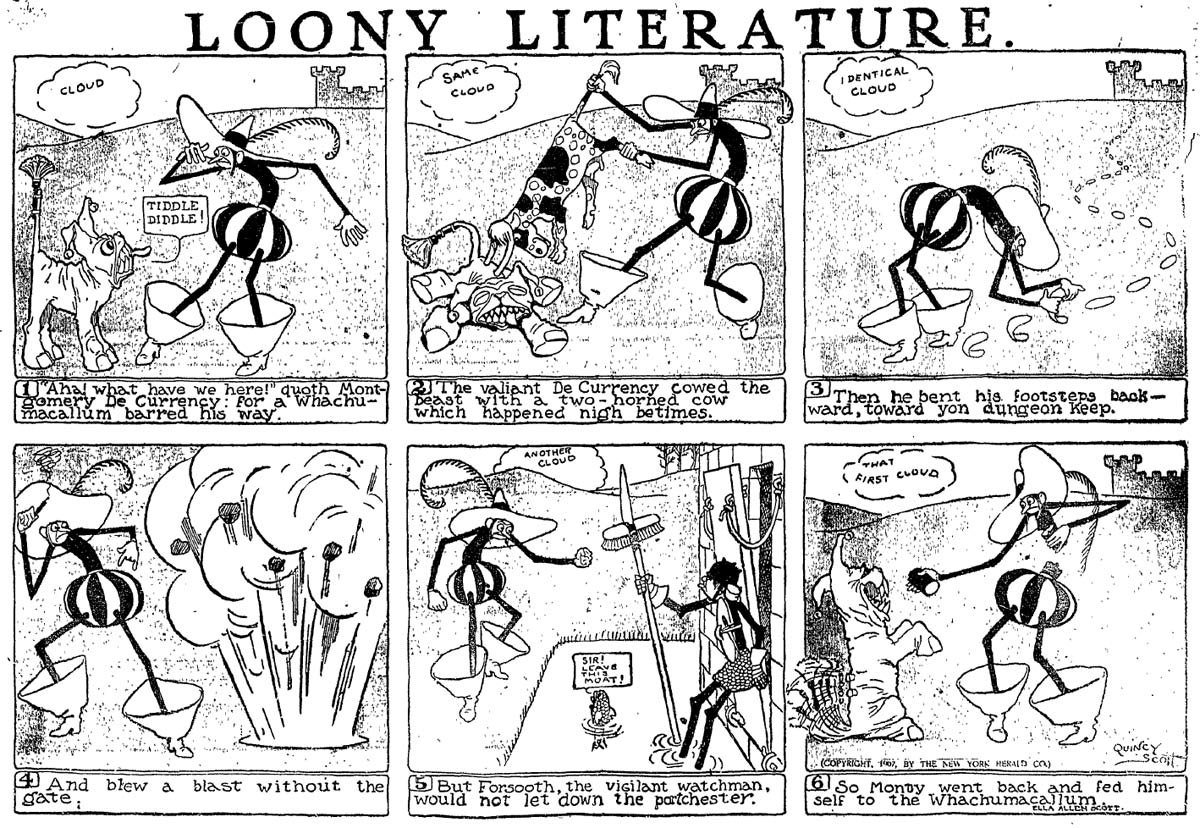
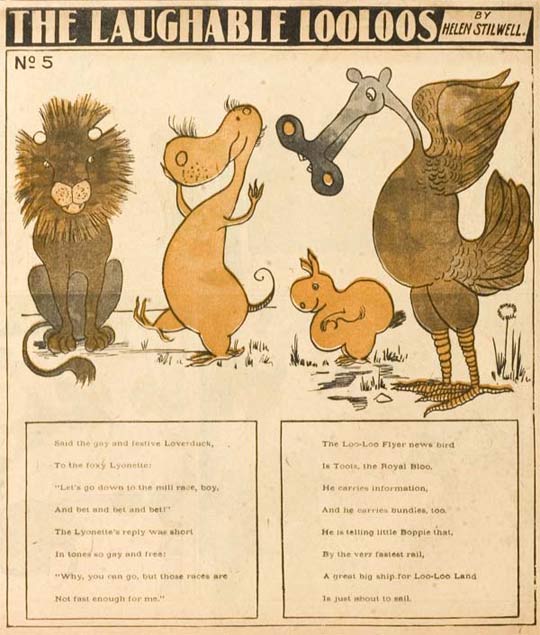
Gustave Verbeek’s last contribution to the Sunday supplements, The Loony Lyrics of Lulu (July 17 – October 23, 1910), followed in the tracks of previous l-alliterating nonsense strips such as The Laughable Looloos (1906) and Loony Literature (1907). While taking advantage of a recurring fad for reader-contributed limericks, the strip also looked back to Edward Lear, whose Book of Nonsense (1846) had marked the beginning of Victorian Nonsense and popularized the limerick. This association of nonsense techniques and contemporary trends had always been a characteristic of Verebeek’s production.

looloos_05

Nonsense literature and newspaper comics share a predilection for rigid structures ― a six-panel strip and a five-line limerick both exploit their limited space as a stage for endless variations on a formula. Like comics, moreover, the Nonsense of Edward Lear and Lewis Carroll was almost invariably narrative, while the new American school of Nonsense ― which included successful humorists such as Guy Wetmore Carryl, Carolyn Wells, Gelett Burgess and Peter Newell ― often limited itself to descriptions of unlikely creatures.

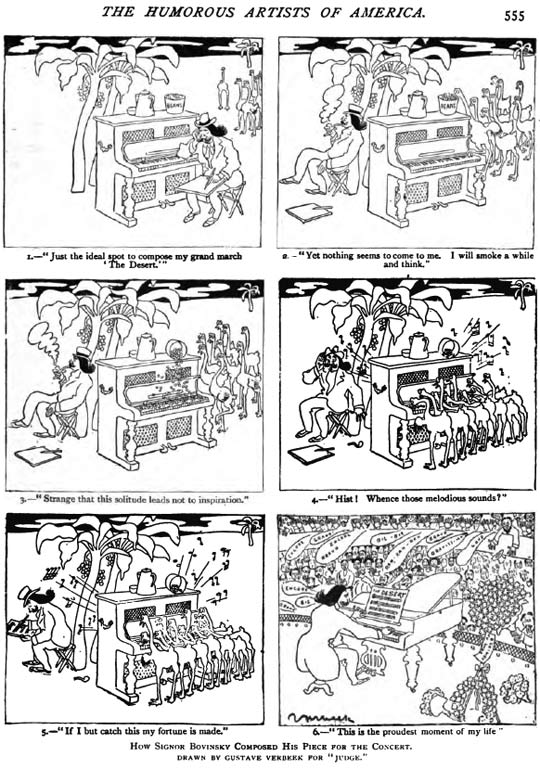
bovinsky

Verbeek belonged to this later generation, shared their interests and used the same themes; in a long three-part article in the Strand, “The Humorous Artists of America” (March-May, 1902), he is mentioned last, as the most cosmopolitan, and a follower of Caran d’Ache. The sequential page chosen as a sample of his production ― one from a series for Judge and the only one of its kind in the whole survey ― emphasizes his early interest in graphic storytelling. It is therefore not surprising to find that his three strips for the New York Herald all turned traditionally single-panel techniques ― double-sided images, mixed animals and limericks ― into narrative devices.

The Upside-Downs were meant to captivate and surprise the newspaper’s middle-class readers, who expected more than the pranksters proliferating in other newspapers: Verbeek dropped the balloon, which he had used in his previous strip for the New York World, Easy Papa (May 25, 1903 ―February 1, 1903), and used reversible images to tell a simple story.

Inspiration for this virtuoso novelty comic probably came from the sheets of Joge-e ― two-way pictures ― popular in mid-19th-century Japan, and from western satires dating back to the 18th century, revived in  Upside Down, or, Turnover Traits from Original Sketches by the Late William McConnell (1868), and brought to America by Newell with his two Topsys and Turvys (1893 and 1894).

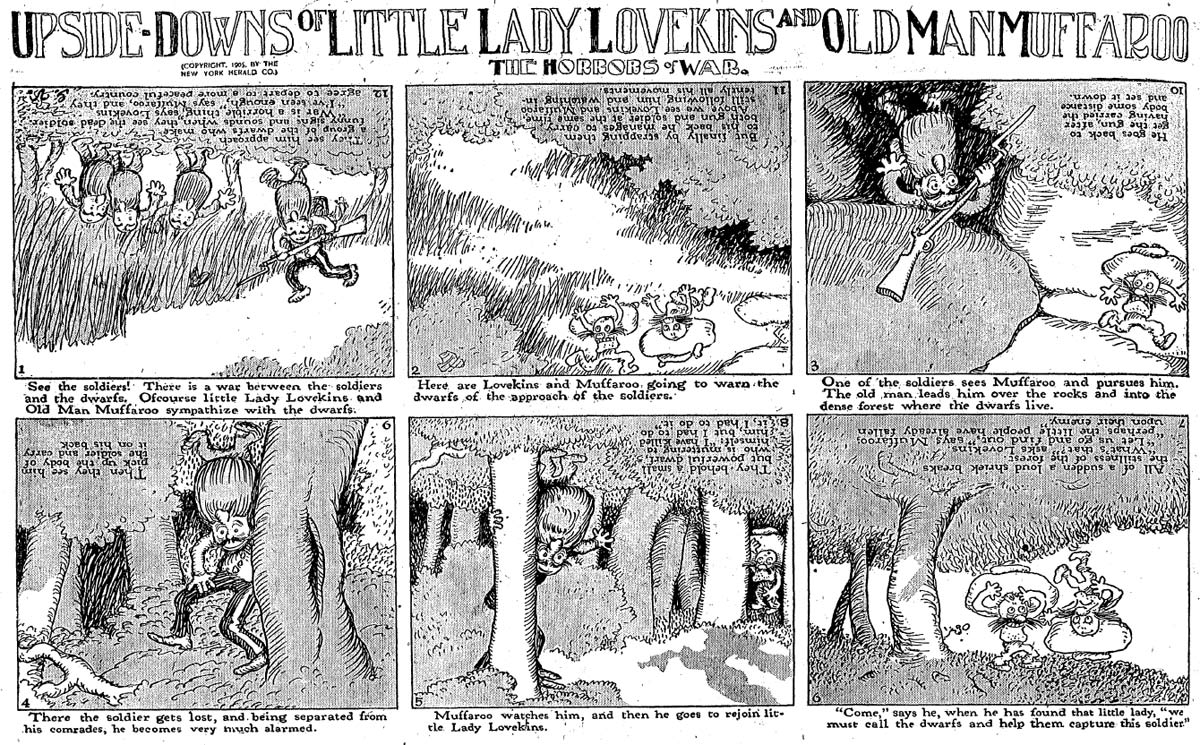
While the new Nonsense writers and illustrators stressed their protagonists’ cuteness, most explicitly perhaps in Newell’s wildly successful Pictures and Rhymes (1900), in the Upside-Downs and The Terrors of the Tiny Tads the recurrent, unjustified violence is reminiscent of Victorian Nonsense, whose most memorable characters ― Carroll’s Humpty Dumpty, for instance, or Lear’s oppressive “they” ― were often antagonistic and unpleasant. The pranks featured in many of the early comics often involve aggressive behaviour, but never bloodshed as in the “Horrors of War” episode of the Upside-Downs (January 15, 1905).

horrors-s

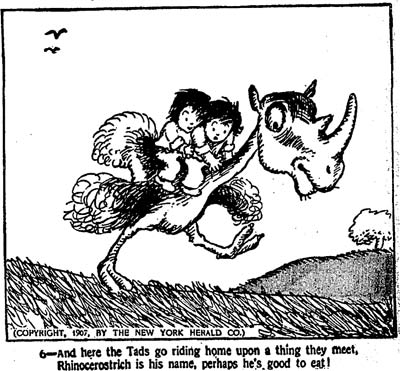
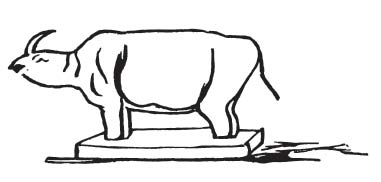
Just as Lear’s “they” do not hesitate to “smash” the “Old Man” who danced a quadrille with a raven, the Tads are always happy to kill and feed on the animals they meet, even when they are not threatening. The unfortunate destiny of the Rhinocerostrich (June 16, 1907), who takes them home only to be eaten, is remarkably similar to that of the equally helpful rhino in Lear’s “Four Children Who Went Round the World:” they, “in token of their grateful adherence, had him killed and stuffed directly.”

rhinoscerostrich

lear-rhino

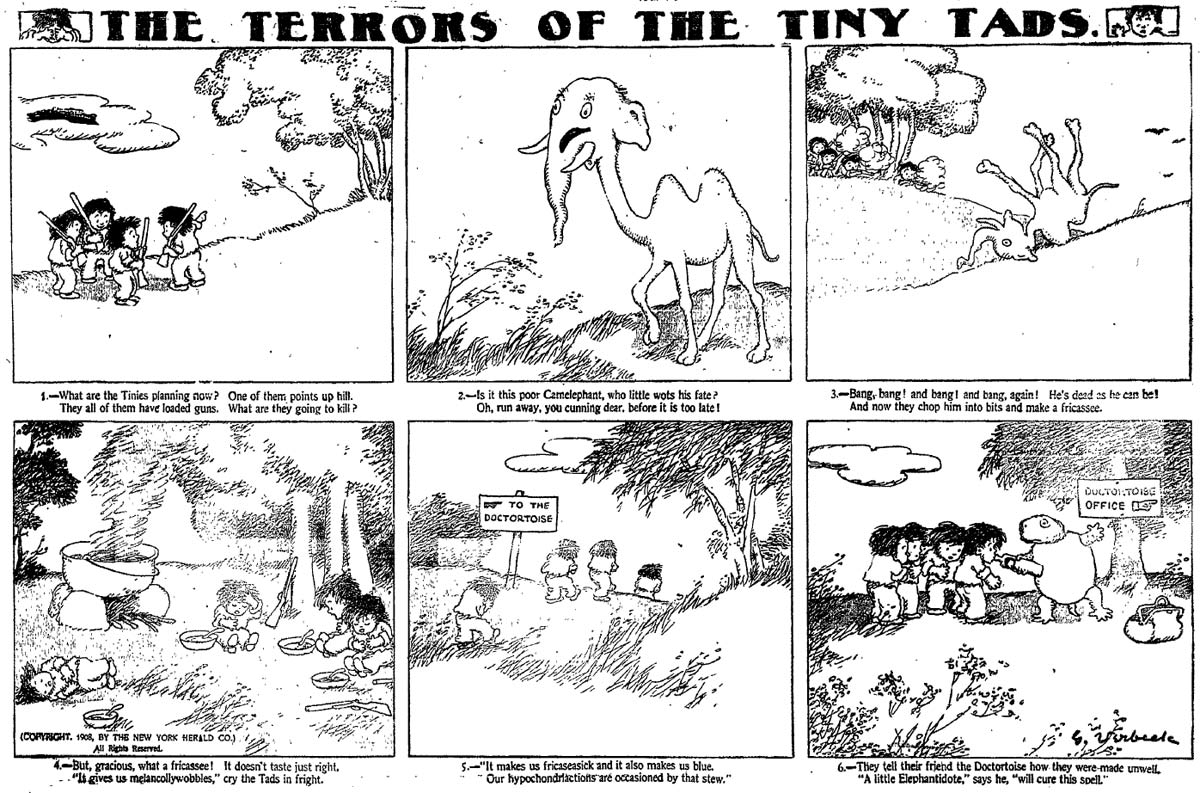
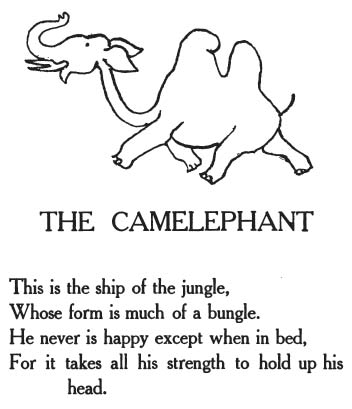
Verbeek’s captions ― like Lear’s and Carroll’s language ― are very explicit in their uncanny terseness, the Tads hunt an inoffensive Camelephant (January 5, 1908): “Bang, bang! and bang! and bang, again! He’s dead as he can be! / And now they chop him into bits and make a fricassee”.

camelephant-s

These “jumbled beasts” ― the real protagonists, given the Tads’ lack of personality ― descend from the linguistic inventions in Lear’s “Nonsense Botanies” and Carroll’s Through the Looking-Glass (1872): chapter 2, “Looking-Glass Insects,” with its verbal hybrids illustrated by Tenniel, is Verbeek’s ultimate source, probably filtered through Kenyon Cox’s Mixed Beasts (1904), where several of the Tads’ creatures ― the camelephant itself, for instance ― make their first appearance.

coxcamel

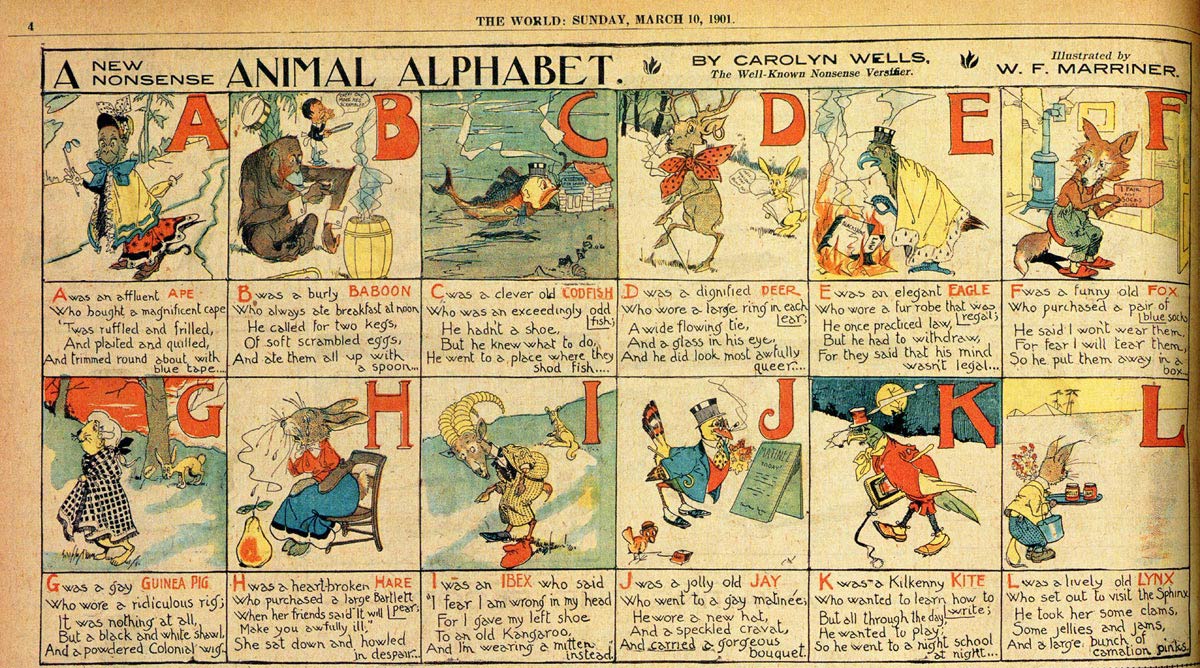
Verbeek had also contributed to Carolyn Wells’s Folly for the Wise (1904) which included a section entitled “Compound Zoology,” in which animals such as the “Mint-Julepard” and the “Neck-Tiger” were described in short poems, mostly limericks. The five-line poem appeared regularly in the comic supplements: Wells herself had published a New Animal Alphabet in the World (1901); the idea had been used, among others, by DeVoss Driscoll in his stylish Animal Antics (1903-04) and applied to fantastic creatures by J.P. Benson in The Woozlebeasts (1904-05).

anialph-s

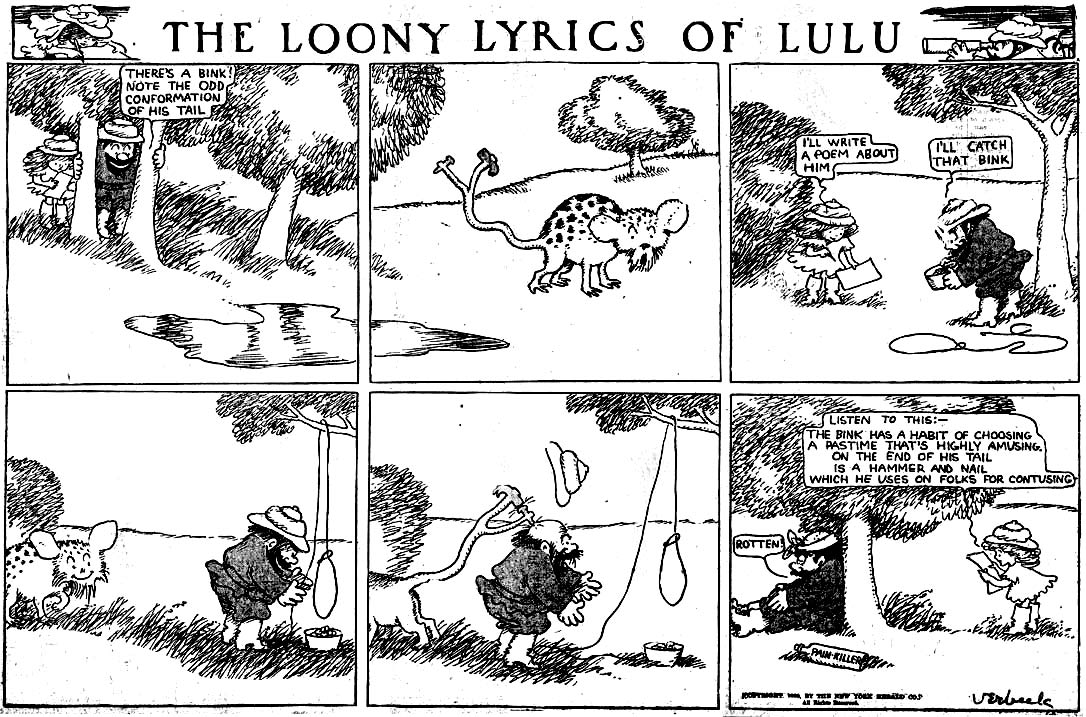
In The Loony Lyrics of Lulu Verbeek took the single-panel association of limerick and animal and again placed it within a narrative frame: Lulu composes a limerick while her father unsuccessfully tries to capture the beast described in it ― the limerick, traditionally relegated to the captions, is moved into the balloons, which the artist brings back for the occasion.

bink-s

Lulu’s lyrics and the dialogue are delightfully incongruous but her adventures no longer contain the violent scenes of his earlier strips, the hunter is fooled but never seriously hurt. By 1910 the Tads themselves had evolved and their rounded, cutified figures had nothing in common with the wiry teenagers of the early episodes; they had even almost completely given up hunting. Times were changing and the disturbing experiments of Nonsense were no longer welcome in the comics: time for adventurous cartoonists to move on.

Posted in Comics, Edward Lear, Gustave Verbeek, Lewis Carroll, Nonsense Lyrics | Tagged , , , , , , , , | 4 Comments

2013 in review

The WordPress.com stats helper monkeys prepared a 2013 annual report for this blog.

Here’s an excerpt:

The concert hall at the Sydney Opera House holds 2,700 people. This blog was viewed about 28,000 times in 2013. If it were a concert at Sydney Opera House, it would take about 10 sold-out performances for that many people to see it.

Click here to see the complete report.

Posted in Uncategorized | 2 Comments

Edward Lear, Mdina (1866)

EL_mdina-s


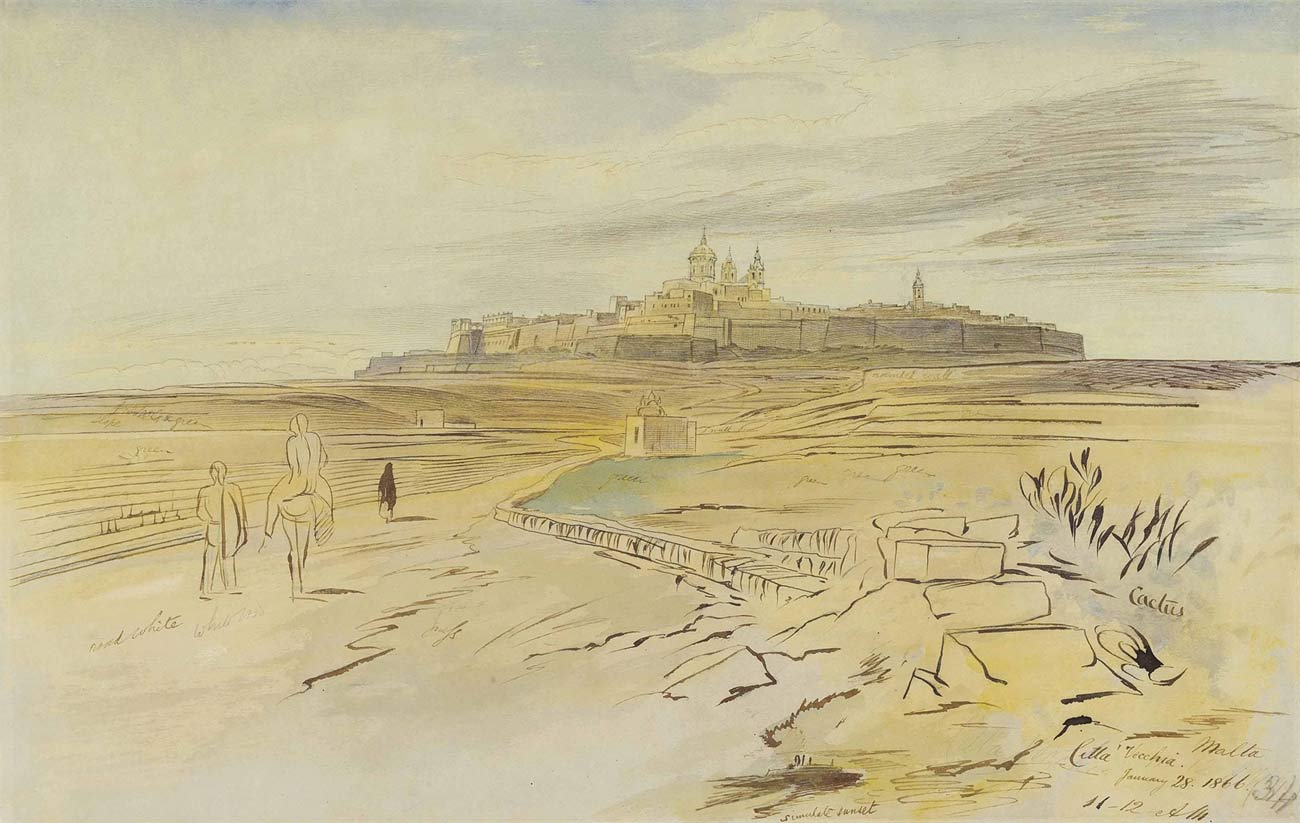
Edward Lear, Mdina or Citta Vecchia, Malta.
Inscribed, dated and numbered ‘Citta Vecchia./Malta/January 28. 1866./ 11-12 AM./ (34)’ (lower right) and variously inscribed with colour notes. Pencil, pen and brown ink and watercolour on buff paper 13 x 20½ in. (33 x 52 cm.)

Lear spent four months from December 1865 – April 1866 in Malta. He had visited the island previously, briefly in 1842, on his way to Greece from Italy and then again en route to Corfu in 1862 and had thoroughly enjoyed the island. This third trip however, was less successful; although the weather was good and he produced many accomplished sketches, most of his previous aquaintances were absent and he was concerned about his sister Ellen’s health.

The ancient city of Mdina or Citta Vecchia was the capital of Malta until 1530. Situated on one of the highest points of the island, it dominates its surroundings.

Christie’s.

Posted in Edward Lear | Tagged , , , , , | 1 Comment