
Another unusual adventure of Gustave Verbeek’s Tiny Tads from 1910.
Another unusual adventure of Gustave Verbeek’s Tiny Tads from 1910.
The holidays are over, but if you are still looking for some good Edward Lear reading here is a list of relatively new items:
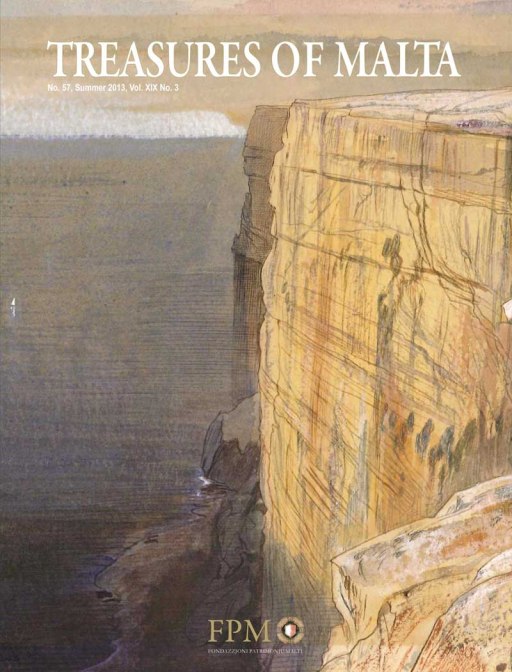
John Varriano has a long article in the Christmas 2013 issue of Treasures of Malta on “Edward Lear in Malta: New Revelations.” The Fondazzjoni Patrimonju Malti will also publish his next book, Edward Lear in Malta, some time in the spring. He is also working on an exhibition in autumn 2014 at Palazzo Falson Historic House Museum, Mdina, and one on “Edward Lear in the Holy Land” for the Mount Holyoke College Art Museum in the spring of 2015.
“Edward Lear in Greece” is the title of the exhibition at the Scottish National Gallery which opens on 15 February. “This exhibition comprises an outstanding group of 32 watercolours of mainland Greece, Crete and the Ionian islands, from the collection of the distinguished historian Sir Steven Runciman.”
Carol Rumens’s poem of the week column in The Guardian for 30 December 2013 was devoted “Edward Lear’s The New Vestments: the Artistry of an Extraordinary Suit.”
Meanwhile, Anna Henchman’s paper on Lear’s dismembered bodies I mentioned in a previous post has been published as “Edward Lear Dismembered: Word Fragments and Body Parts” in Nineteenth-Century Contexts: An Interdisciplinary Journal, Volume 35, Issue 5, 2013, pp. 479-487.

Also, Tauris Parke Paperbacks has reprinted Peter Levi’s Edward Lear: A Life with a new foreword by Robin Hanbury-Tenison.

I do not think I mentioned Louise Schweitzer’s One Wild Flower, “a study of Victorian Nonsense,” published by Austin Macauley in 2012.

But the best book on Edward Lear I read in 2013 was not published in 2013 and is not about Lear at all: Sara Lodge’s Thomas Hood and Nineteenth-Century Poetry: Work, Play and Politics, Manchester University Press, 2007, sheds light on the influence of Thomas Hood and his circle on Lear’s early nonsense pictures and poems. You can get a print-on-demand copy at a reasonable price from many sellers on Abebooks.
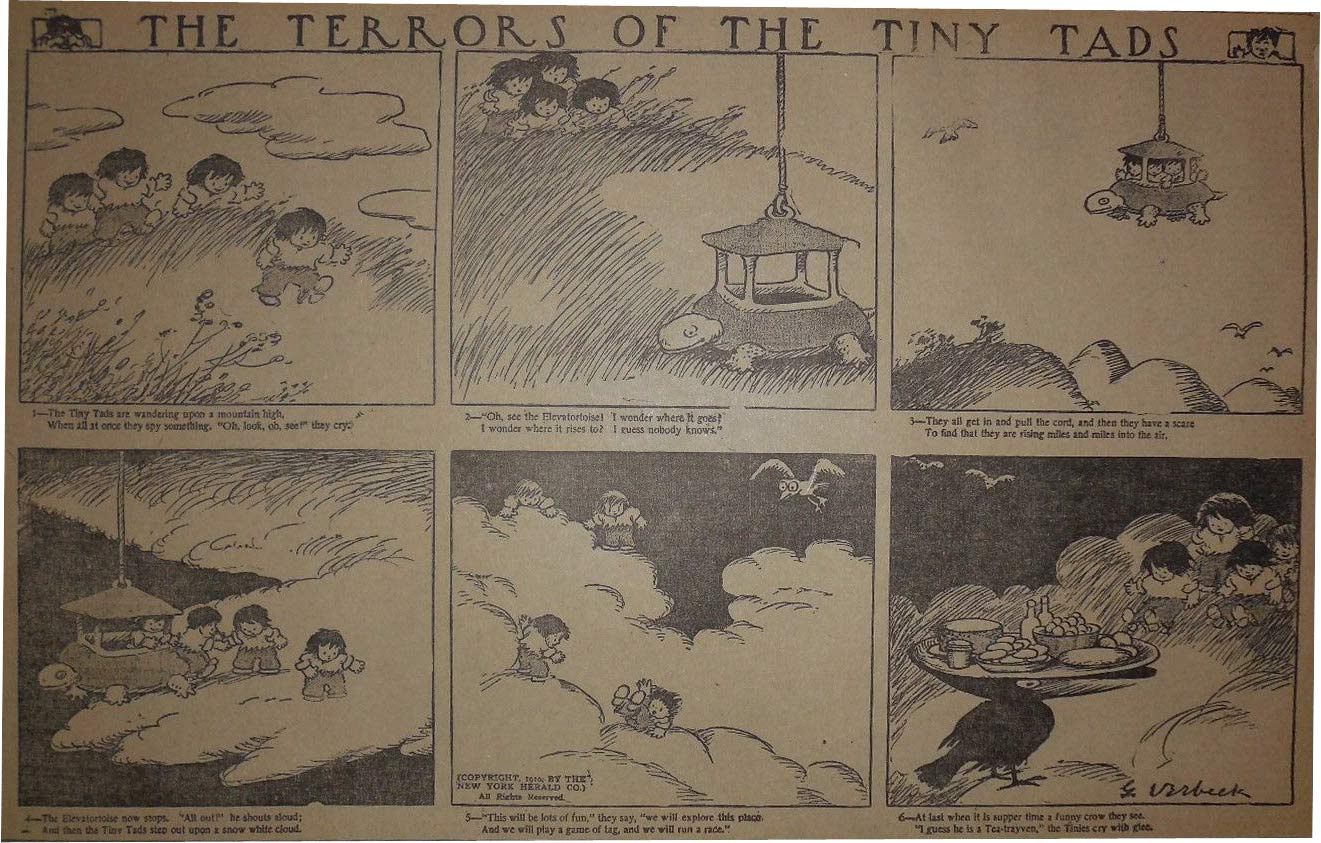
An unusual 1910 episode from Gustave Verbeek’s Terrors of the Tiny Tads.
Society is Nix from Sunday Press, which I mentioned in the previous post, has been reviewed in the New York Review of Books blog.
[I wrote this short article for The Upside-Down World of Gustave Verbeek: The Complete Sunday Comics 1903-1905, edited by Peter Maresca, foreword by Martin Gardner. Palo Alto, CA: Sunday Press Books, 2009, where it appeared under the title “Verbeek’s Loony Lyrics and the Nonsense Tradition.” The book is still available, together with other very nice collections of early comic strips. The latest, Society is Nix, recently reviewed in the NY Times, is of particular interest for nonsense-lovers.]
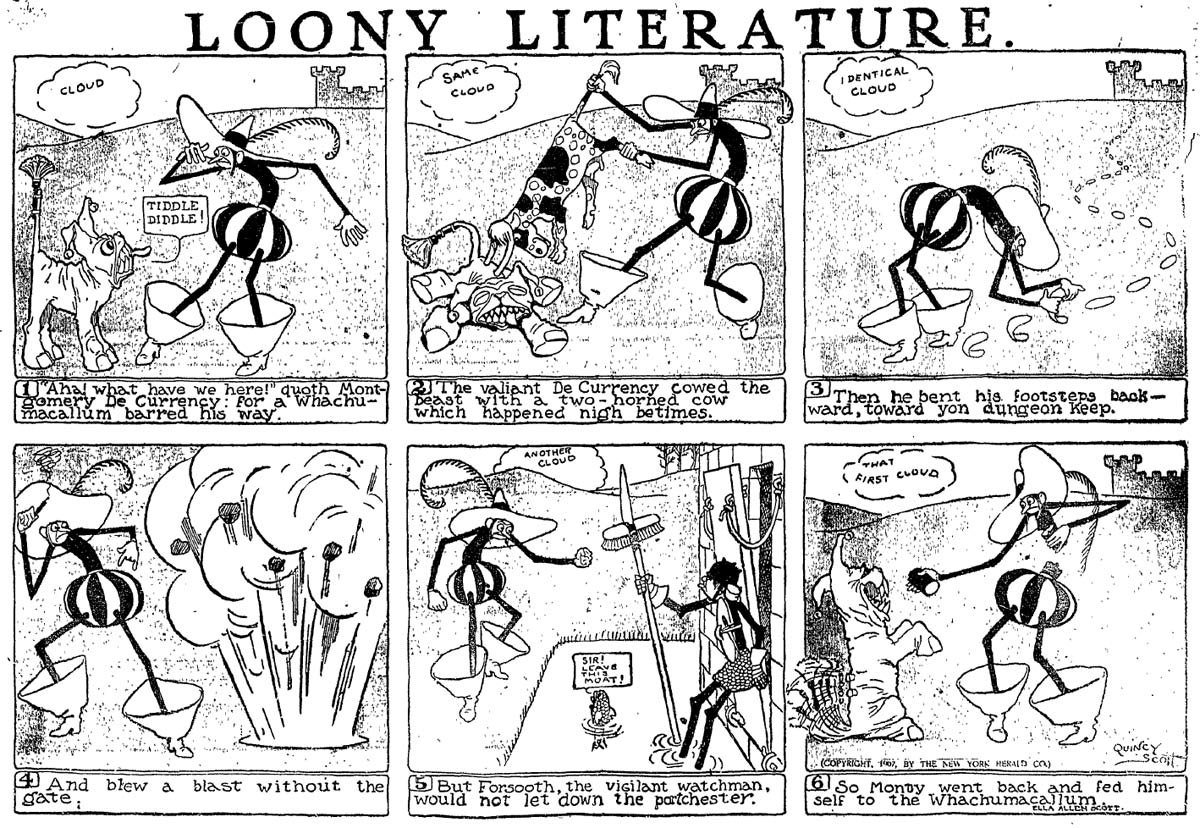
Gustave Verbeek’s last contribution to the Sunday supplements, The Loony Lyrics of Lulu (July 17 – October 23, 1910), followed in the tracks of previous l-alliterating nonsense strips such as The Laughable Looloos (1906) and Loony Literature (1907). While taking advantage of a recurring fad for reader-contributed limericks, the strip also looked back to Edward Lear, whose Book of Nonsense (1846) had marked the beginning of Victorian Nonsense and popularized the limerick. This association of nonsense techniques and contemporary trends had always been a characteristic of Verebeek’s production.
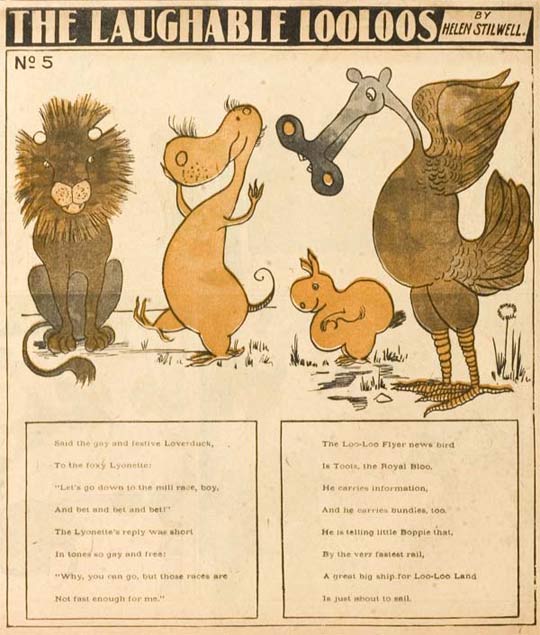
Nonsense literature and newspaper comics share a predilection for rigid structures ― a six-panel strip and a five-line limerick both exploit their limited space as a stage for endless variations on a formula. Like comics, moreover, the Nonsense of Edward Lear and Lewis Carroll was almost invariably narrative, while the new American school of Nonsense ― which included successful humorists such as Guy Wetmore Carryl, Carolyn Wells, Gelett Burgess and Peter Newell ― often limited itself to descriptions of unlikely creatures.
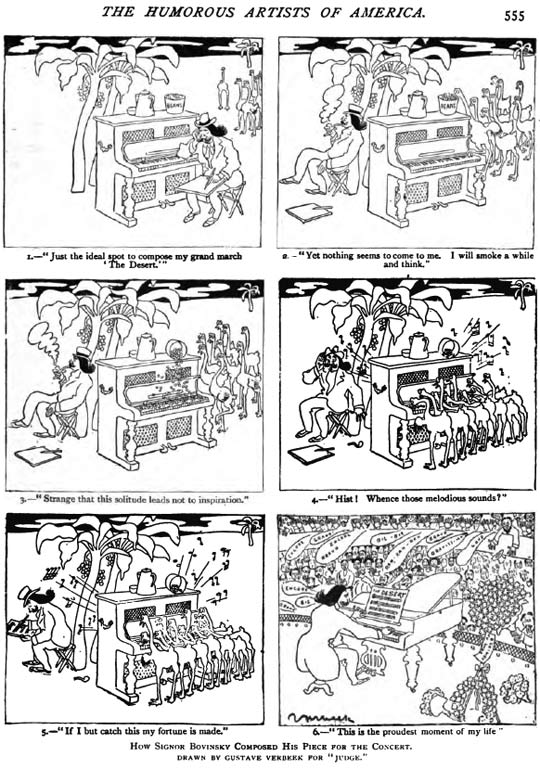
Verbeek belonged to this later generation, shared their interests and used the same themes; in a long three-part article in the Strand, “The Humorous Artists of America” (March-May, 1902), he is mentioned last, as the most cosmopolitan, and a follower of Caran d’Ache. The sequential page chosen as a sample of his production ― one from a series for Judge and the only one of its kind in the whole survey ― emphasizes his early interest in graphic storytelling. It is therefore not surprising to find that his three strips for the New York Herald all turned traditionally single-panel techniques ― double-sided images, mixed animals and limericks ― into narrative devices.
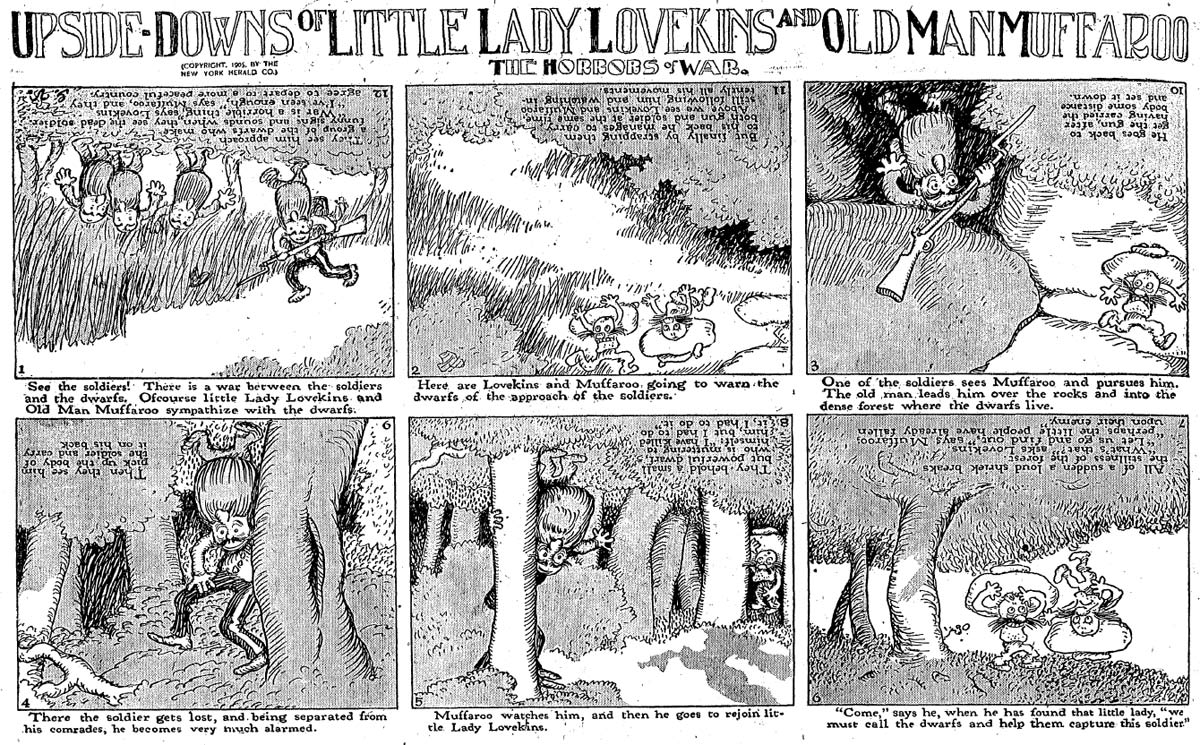
The Upside-Downs were meant to captivate and surprise the newspaper’s middle-class readers, who expected more than the pranksters proliferating in other newspapers: Verbeek dropped the balloon, which he had used in his previous strip for the New York World, Easy Papa (May 25, 1903 ―February 1, 1903), and used reversible images to tell a simple story.
Inspiration for this virtuoso novelty comic probably came from the sheets of Joge-e ― two-way pictures ― popular in mid-19th-century Japan, and from western satires dating back to the 18th century, revived in Upside Down, or, Turnover Traits from Original Sketches by the Late William McConnell (1868), and brought to America by Newell with his two Topsys and Turvys (1893 and 1894).
While the new Nonsense writers and illustrators stressed their protagonists’ cuteness, most explicitly perhaps in Newell’s wildly successful Pictures and Rhymes (1900), in the Upside-Downs and The Terrors of the Tiny Tads the recurrent, unjustified violence is reminiscent of Victorian Nonsense, whose most memorable characters ― Carroll’s Humpty Dumpty, for instance, or Lear’s oppressive “they” ― were often antagonistic and unpleasant. The pranks featured in many of the early comics often involve aggressive behaviour, but never bloodshed as in the “Horrors of War” episode of the Upside-Downs (January 15, 1905).
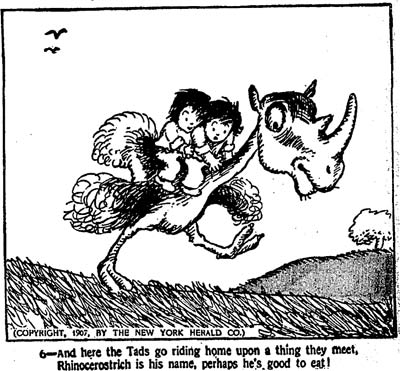
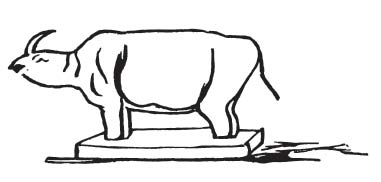
Just as Lear’s “they” do not hesitate to “smash” the “Old Man” who danced a quadrille with a raven, the Tads are always happy to kill and feed on the animals they meet, even when they are not threatening. The unfortunate destiny of the Rhinocerostrich (June 16, 1907), who takes them home only to be eaten, is remarkably similar to that of the equally helpful rhino in Lear’s “Four Children Who Went Round the World:” they, “in token of their grateful adherence, had him killed and stuffed directly.”
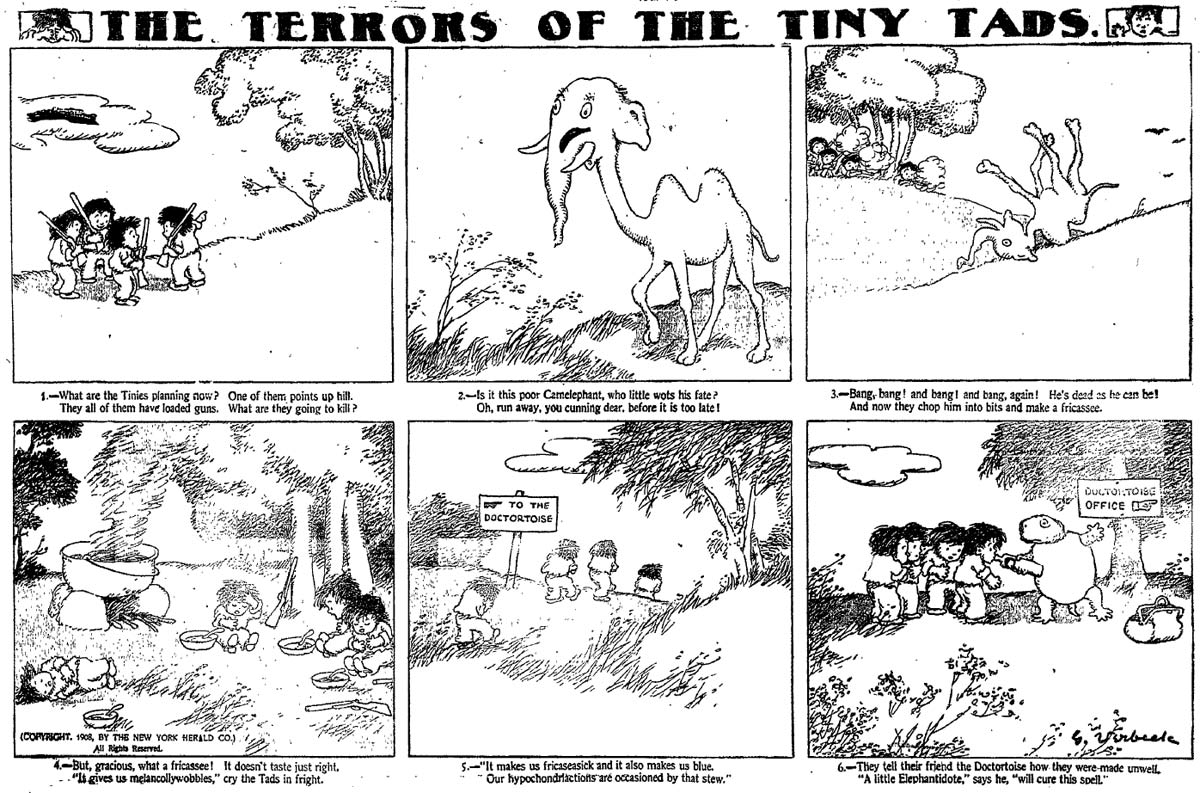
Verbeek’s captions ― like Lear’s and Carroll’s language ― are very explicit in their uncanny terseness, the Tads hunt an inoffensive Camelephant (January 5, 1908): “Bang, bang! and bang! and bang, again! He’s dead as he can be! / And now they chop him into bits and make a fricassee”.
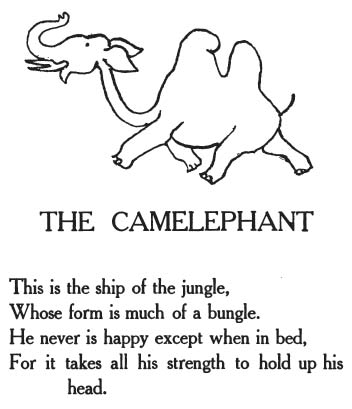
These “jumbled beasts” ― the real protagonists, given the Tads’ lack of personality ― descend from the linguistic inventions in Lear’s “Nonsense Botanies” and Carroll’s Through the Looking-Glass (1872): chapter 2, “Looking-Glass Insects,” with its verbal hybrids illustrated by Tenniel, is Verbeek’s ultimate source, probably filtered through Kenyon Cox’s Mixed Beasts (1904), where several of the Tads’ creatures ― the camelephant itself, for instance ― make their first appearance.
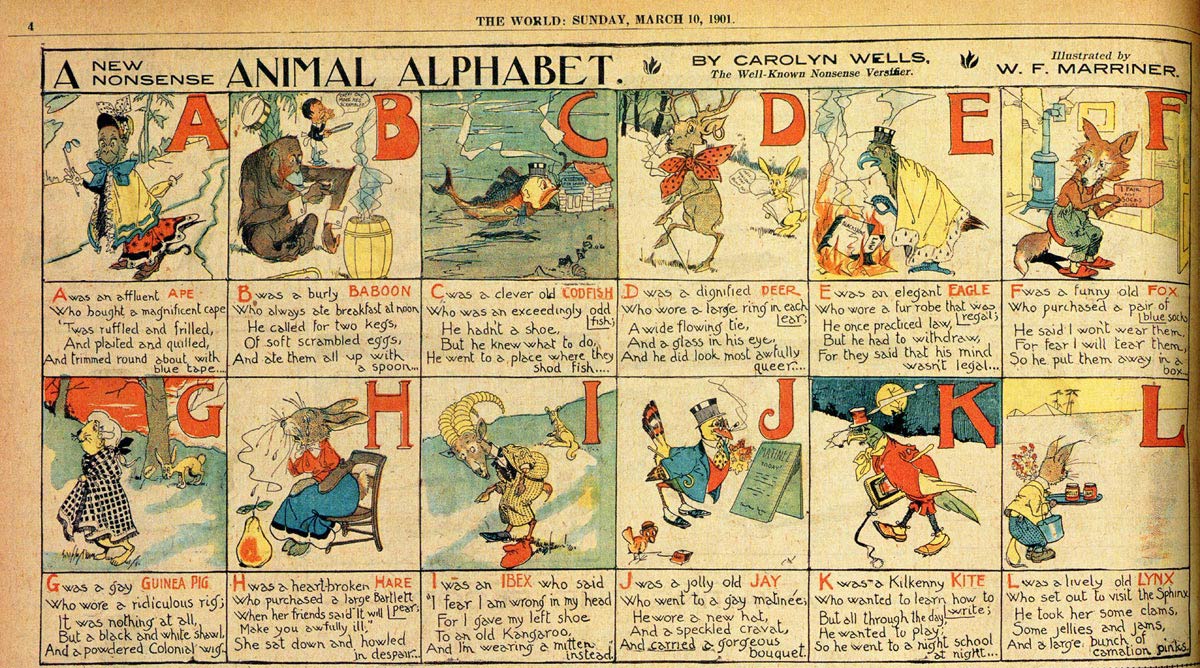
Verbeek had also contributed to Carolyn Wells’s Folly for the Wise (1904) which included a section entitled “Compound Zoology,” in which animals such as the “Mint-Julepard” and the “Neck-Tiger” were described in short poems, mostly limericks. The five-line poem appeared regularly in the comic supplements: Wells herself had published a New Animal Alphabet in the World (1901); the idea had been used, among others, by DeVoss Driscoll in his stylish Animal Antics (1903-04) and applied to fantastic creatures by J.P. Benson in The Woozlebeasts (1904-05).
In The Loony Lyrics of Lulu Verbeek took the single-panel association of limerick and animal and again placed it within a narrative frame: Lulu composes a limerick while her father unsuccessfully tries to capture the beast described in it ― the limerick, traditionally relegated to the captions, is moved into the balloons, which the artist brings back for the occasion.
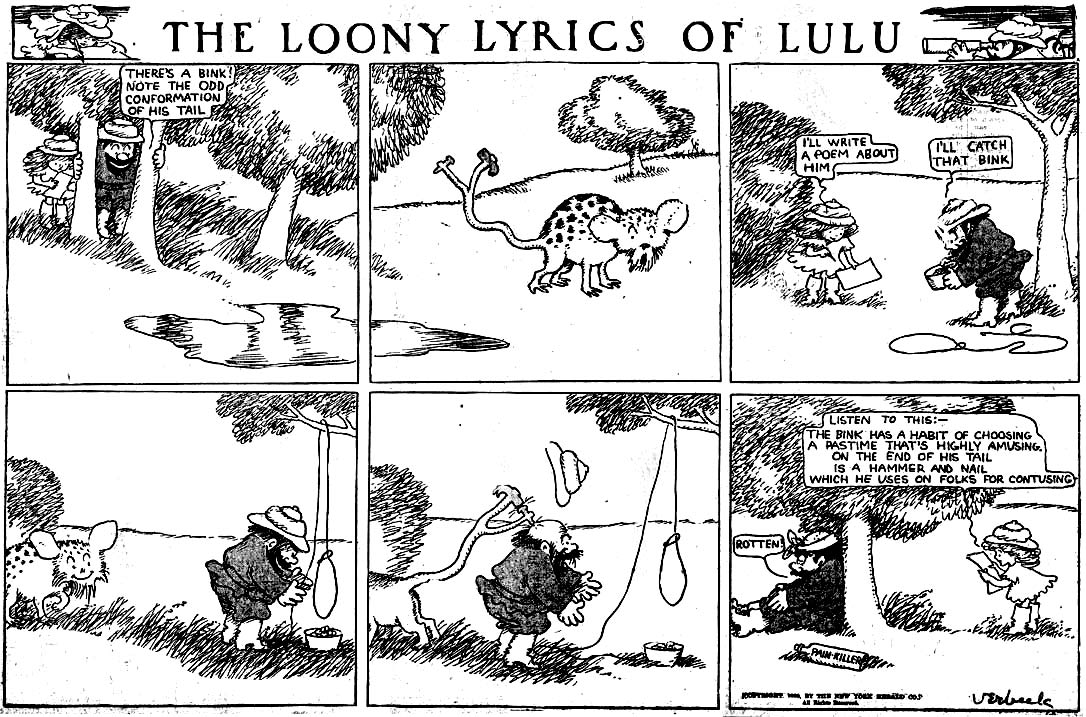
Lulu’s lyrics and the dialogue are delightfully incongruous but her adventures no longer contain the violent scenes of his earlier strips, the hunter is fooled but never seriously hurt. By 1910 the Tads themselves had evolved and their rounded, cutified figures had nothing in common with the wiry teenagers of the early episodes; they had even almost completely given up hunting. Times were changing and the disturbing experiments of Nonsense were no longer welcome in the comics: time for adventurous cartoonists to move on.
The WordPress.com stats helper monkeys prepared a 2013 annual report for this blog.

Here’s an excerpt:
The concert hall at the Sydney Opera House holds 2,700 people. This blog was viewed about 28,000 times in 2013. If it were a concert at Sydney Opera House, it would take about 10 sold-out performances for that many people to see it.
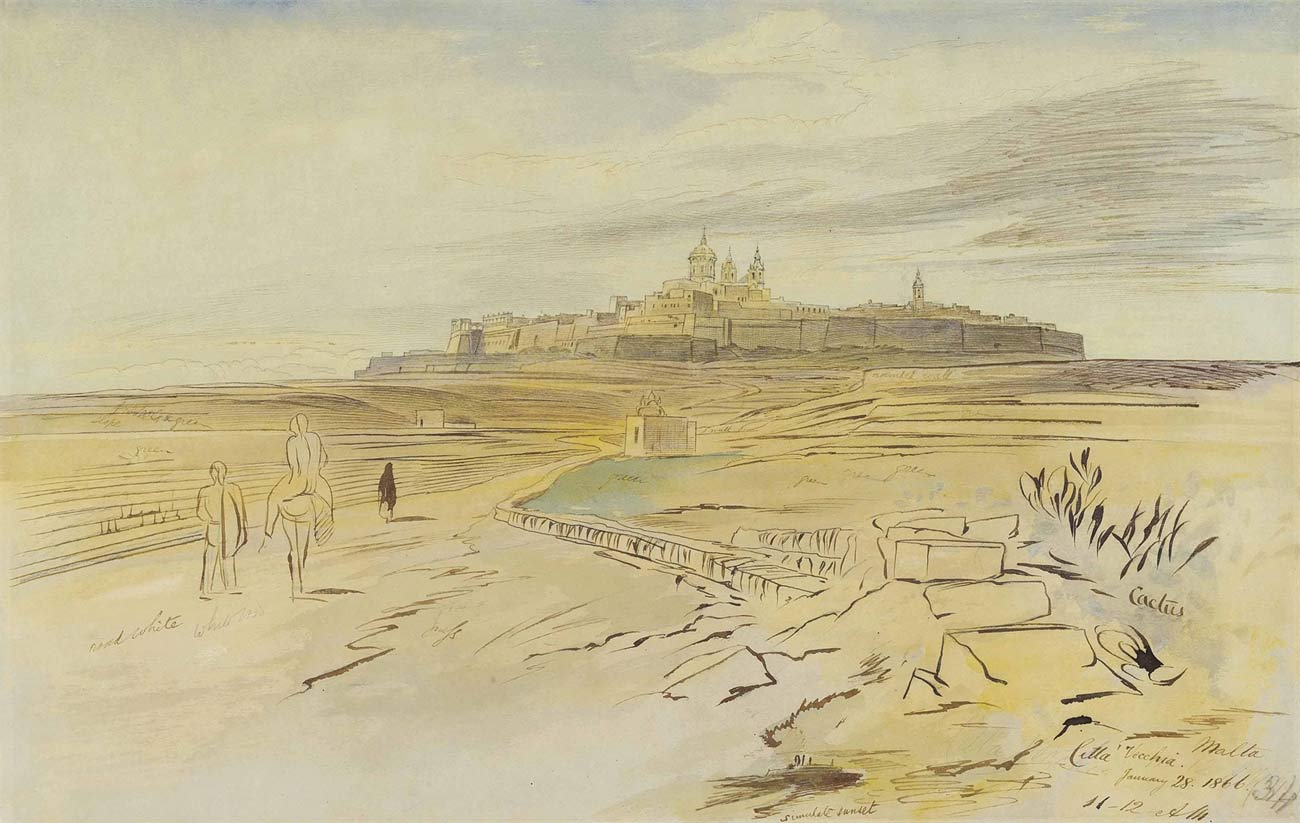
Edward Lear, Mdina or Citta Vecchia, Malta.
Inscribed, dated and numbered ‘Citta Vecchia./Malta/January 28. 1866./ 11-12 AM./ (34)’ (lower right) and variously inscribed with colour notes. Pencil, pen and brown ink and watercolour on buff paper 13 x 20½ in. (33 x 52 cm.)
Lear spent four months from December 1865 – April 1866 in Malta. He had visited the island previously, briefly in 1842, on his way to Greece from Italy and then again en route to Corfu in 1862 and had thoroughly enjoyed the island. This third trip however, was less successful; although the weather was good and he produced many accomplished sketches, most of his previous aquaintances were absent and he was concerned about his sister Ellen’s health.
The ancient city of Mdina or Citta Vecchia was the capital of Malta until 1530. Situated on one of the highest points of the island, it dominates its surroundings.
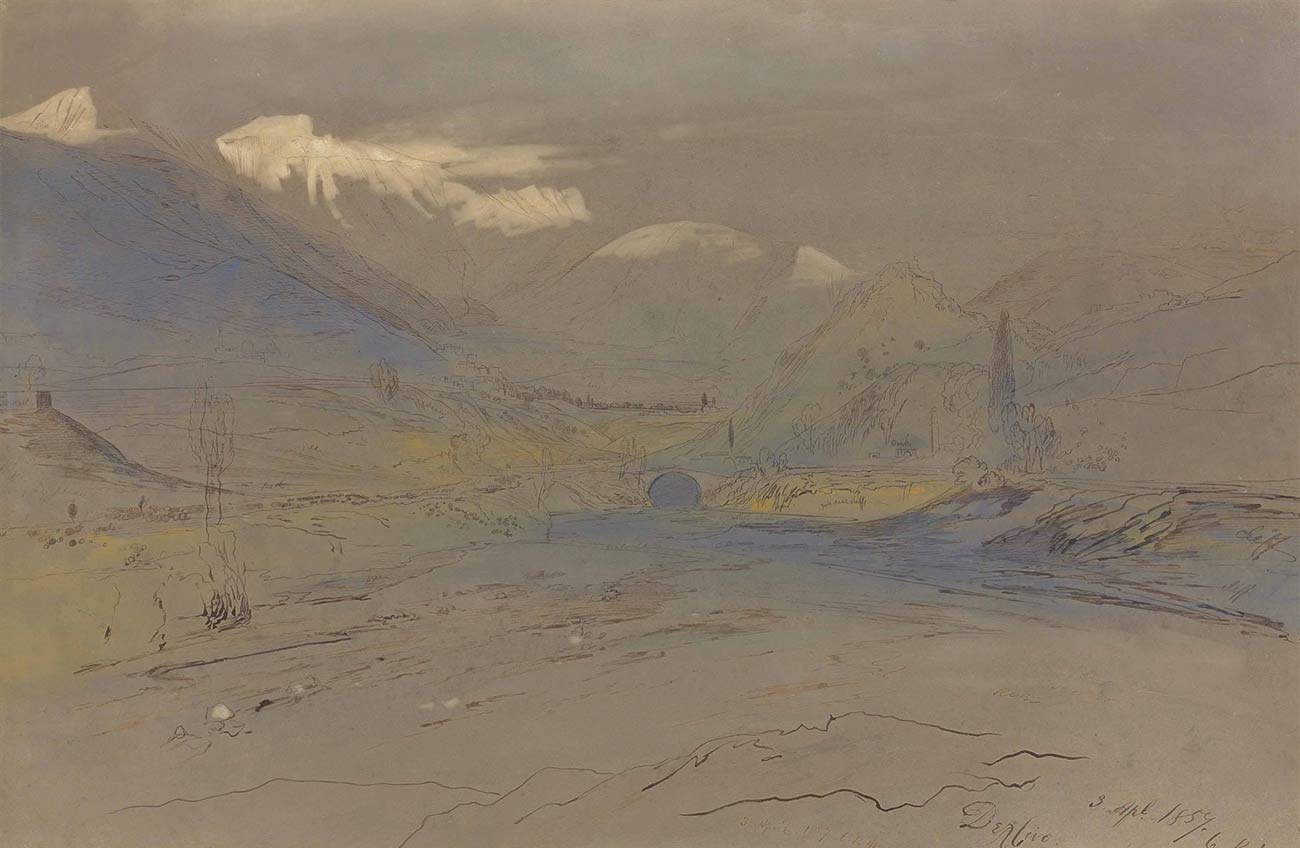
Edward Lear, Delvinë or Delvino, Albania.
Dated ‘3 April 1857/ 6. p.m.’ (lower left), and 3 Ap1. 1857. 6 p.m’ (lower left) and inscribed ‘Deilino’ (lower left) and further inscribed with colour notes. Pencil, pen and brown ink and watercolour heightened with bodycolour, on buff-paper.
In 1855 Lear arrived on the island of Corfu, where he based himself on and off for the next three years, although he continued to travel extensively throughout Greece, the Middle East and Albania. In April 1857 he embarked on a three week trip to Albania. In a letter to his sister Ann he wrote ‘On the 1st I go across, with Edwards (Mr Lister Turker’s godson) & George, to Yannin, by Delvino: I can do nothing with that magnificent lake without having seen the mountains with snow on, & so go I must’ (E. Lear, The Corfu Years, Denise Harvey , Greece, 1988, p. 107).
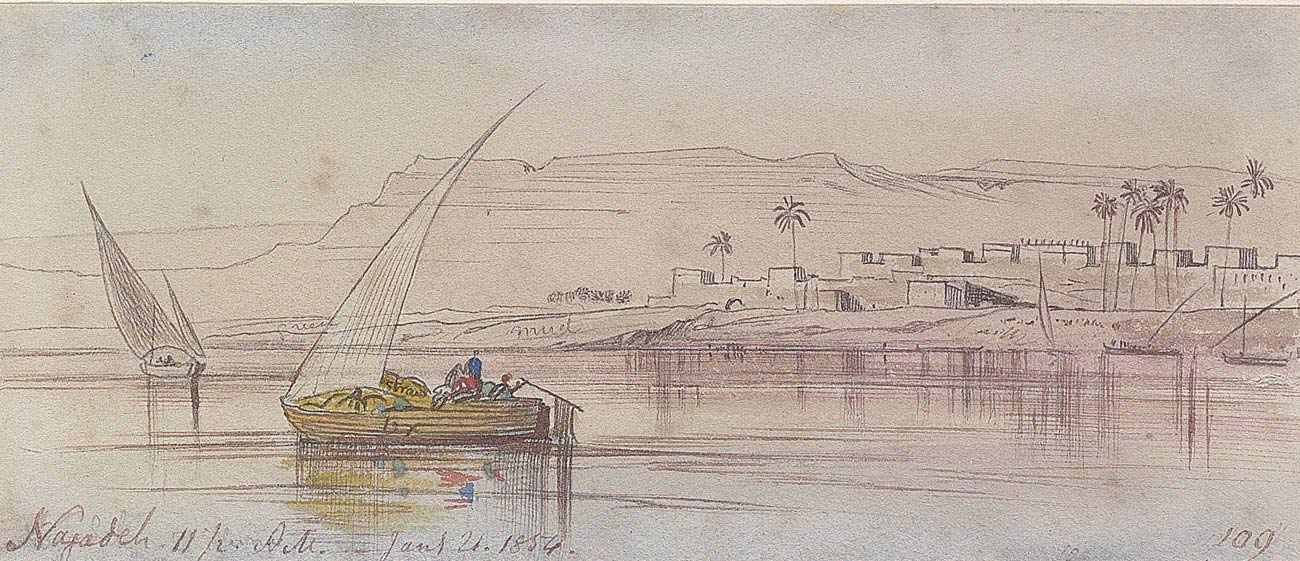
Edward Lear, View on the Nile.
Inscribed and dated ‘Nayadeh 11½ am Jan .. 21. 1854’ (lower left) and numbered ‘109’ (lower right) and inscribed ‘Uppermost’ and numbered ’23’ (verso of the sheet). Pencil and watercolour heightened with bodycolour. 2? x 6? in.; and A scene on the Nile.
Shortly after Christmas 1953, Lear set off up the Nile with a party he had met in Cairo, travelling leisurely by boat as far as Aswan and the first cataract. Lear was clearly captivated by the form of the Egyptian boats; in his letter of 4 January 1854 to his sister Ann he wrote ‘the most beautiful feature is the number of boats, which look like giant moths, -& sometimes there is a fleet of 20 or 30 in sight at once’.
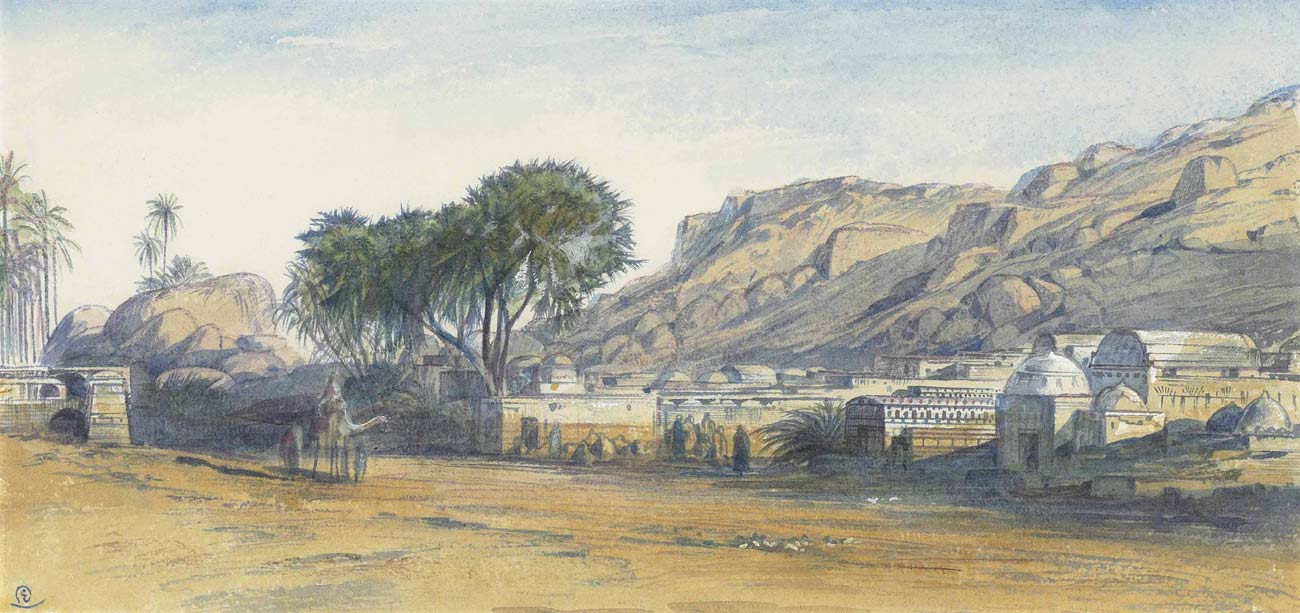
Edward Lear, Mahatta, Nubia.
Signed with monogram (lower left) and with inscription ‘No 2/Mahatta. Nubia’ (on the verso). Pencil and watercolour heightened with touches of white. 7? x 15 in. (18.1 x 38.1 cm.)
The present highly finished watercolour, would have been executed following Lear’s third visit to Egypt in 1866-7 and would have been carefully worked up from the rapid on the spot sketches the artist created.
During this trip he ventured further south than previously, travelling through Nubia (now part of Southern Egypt) as far as the second cataract. The landscape of Nubia fascinated Lear, who wrote to Lady Waldegrave, ‘Nubia delighted me, it isn’t a bit like Egypt except that there’s a river in both. Sad, stern, uncompromising landscape, dark ashy purple lines of hills, piles of granite rocks, fringes of palm, and ever and anon astonishing ruins of oldest temples’ (Lady Strachey, ed., Later Letters of Edward Lear, London, 1911, p. 83).

Edward Lear, A view of a market place in a continental town, possibly Trier, Germany.
Signed and dated ‘E. Lear. del 1838.’ (lower right). Watercolour, 6? x 6? in. (12 x 16 cm.); watercolour of a continental village (verso).
The present watercolour was executed while the artist was undertaking his first prolonged overseas trip in the summer of 1837. Apart from two visits to England in 1841 and 1845-6, Lear spent the next decade based in Italy, recording and exploring the continent. The excitement that Lear gained from this early trip and his desire to explore the world was to remain with the artist throughout his life.
 A Blog of Bosh