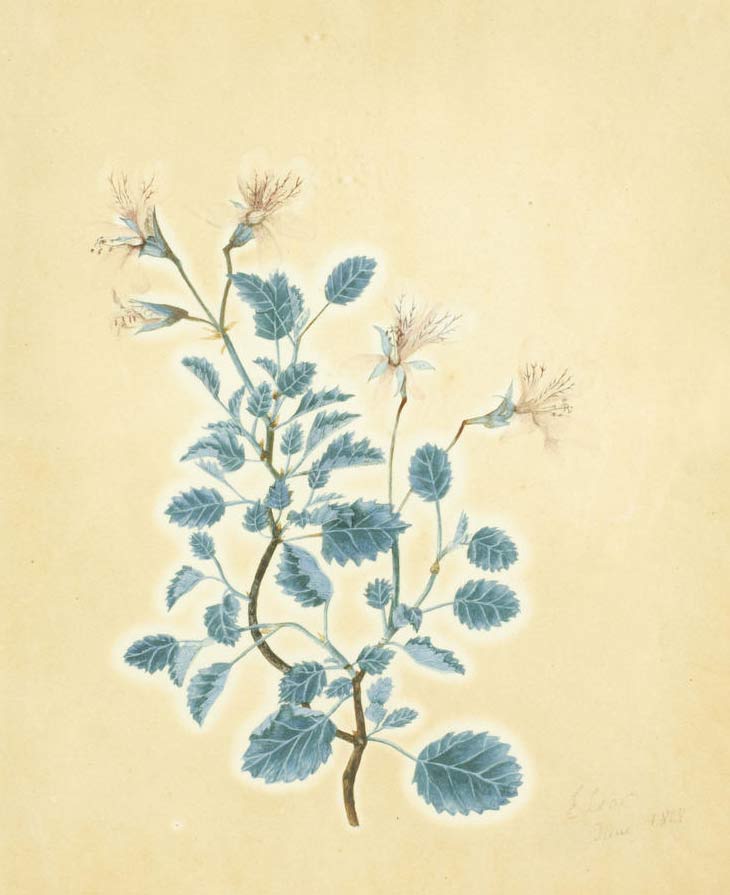
Edward Lear, An early botanical study.
Signed and dated “June 1828.”
To be auctioned at Bonham’s.
After a long incubation, I first heard about plans for it about two years ago, I am pleased to announce that the Edward Lear Society has finally seen the light of day with a very nice website, where you will find information on Edward Lear and the society itself: here is the form to become a member, with previews of the society’s initiatives.
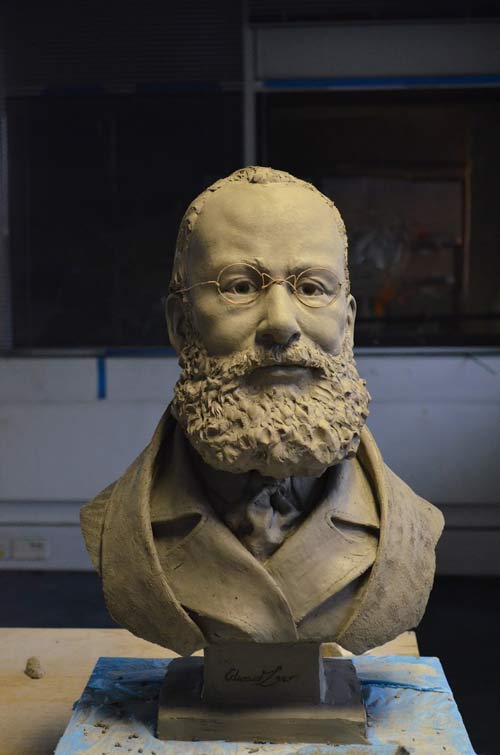
Click on the picture for more images of the bust.
Mr Derek Johns, one of the founding members, also e-mailed me to report on the first event:
Last Friday evening [30 May 2014] at the Anagnostiki Reading room in Corfu, the bronze bust of Edward Lear was unveiled after opening speeches by George Poulimenou of the Committee, Spiro Flamburiari and a short lecture on the life and artistic works of Lear by myself. The evening finished with a song cycle of works by the Corfiot composer Napoleon Lambelet whose fame was greater in London and especially at the Coliseum, then in Corfu sung by the leading Soprano on the island Rosa Cappon. She finished the evening off with a rendition of Edward Lear’s the Owl and the Pussycat. Approximately 120 people attended this special evening.
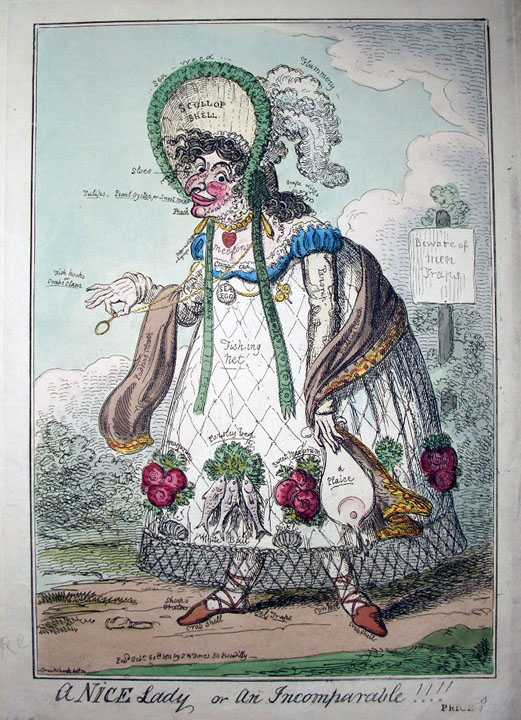
George Cruikshank (1792-1878), A Nice Lady or an Incomparable!!!! Hand-colored etching. Published by S. W. Fores, London, 20 October 1818. Princeton University Library, Graphic Arts blog.

George Cruikshank, An Exquisite Dandy – Prodigious!!! A Nice Gentleman, (12 September 1818). TARA.
See the Graphic Arts blog for a detailed description of the above prints.
Edward Lear, “The New Vestments,” Laughable Lyrics, 1877.
There lived an old man in the kingdom of Tess,
Who invented a purely original dress;
And when it was perfectly made and complete,
He opened the door, and walked into the street.
By way of a hat, he’d a loaf of Brown Bread,
In the middle of which he inserted his head;–
His Shirt was made up of no end of dead Mice,
The warmth of whose skins was quite fluffy and nice;–
His Drawers were of Rabbit-skins, — so were his shoes,
His stockings were skins — but it is not known whose;–
His Waistcoat and Trowsers were made of Pork Chops;–
His Buttons were Jujubes, and Chocolate Drops;–
His Coat was all Pancakes with Jam for a border,
And a girdle of Biscuits to keep it in order;
And he wore over all, as a screen from bad weather,
A Cloak of green Cabbage-leaves stitched all together.
He had walked a short way, when he heard a great noise,
Of all sorts of Beasticles, Birdlings, and Boys;–
And from every long street and dark lane in the town
Beasts, Birdles, and Boys in a tumult rushed down.
Two Cows and a half ate his Cabbage-leaf Cloak;–
Four Apes seized his Girdle, which vanished like smoke;–
Three Kids ate up half of his Pancaky Coat,–
And the tails were devour’d by an ancient He Goat;–
An army of Dogs in a twinkling tore up his
Pork Waistcoat and Trowsers to give to their Puppies;–
And while they were growling, and mumbling the Chops,
Ten boys prigged the Jujubes and Chocolate Drops.–
He tried to run back to his house, but in vain,
Four Scores of fat Pigs came again and again;–
They rushed out of stables and hovels and doors,–
They tore off his stockings, his shoes, and his drawers;–
And now from the housetops with screechings descend,
Striped, spotted, white, black, and gray Cats without end,
They jumped on his shoulders and knocked off his hat,–
When Crows, Ducks, and Hens made a mincemeat of that;–
They speedily flew at his sleeves in trice,
And utterly tore up his Shirt of dead Mice;–
They swallowed the last of his Shirt with a squall,–
Whereon he ran home with no clothes on at all.
And he said to himself as he bolted the door,
‘I will not wear a similar dress any more,
‘Any more, any more, any morre, never more!’
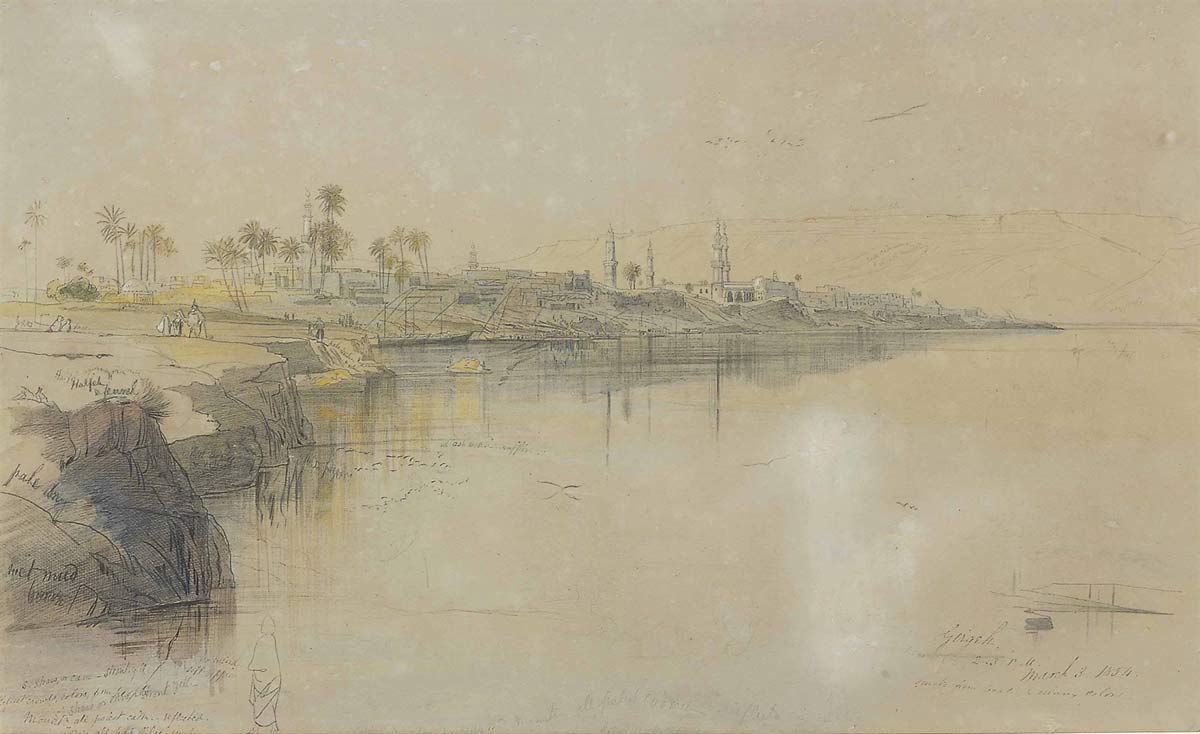
View at El Luxor on the Nile.
Inscribed and dated ‘El Luxor./4.15.pm. 22 Jany 1867’ (lower left) and numbered ‘208’ (lower right) and extensively inscribed with colour notes. Pencil, pen and brown ink and watercolour on paper. 6¾ x 9¾ in. (17.2 x 24.7 cm.)
On Lear’s last trip to Egypt in the winter of 1866-67 he ventured further afield to Wadi Halfa and major sites such as Luxor. Lear was amazed by the Nile scenery and the richness of colour, writing that the ‘pale rock and gritty sand is blazing bright –while all below is a dark depth. The farthest range of hills is sandy pale, with grey from crowds of rock’ (E. Lear, Diary, 25 February 1867). In Luxor Lear was met by a cousin from Canada, Archie Jones, and they travelled away from the green banks of the Nile into the Nubian desert before turning north again towards Cairo.
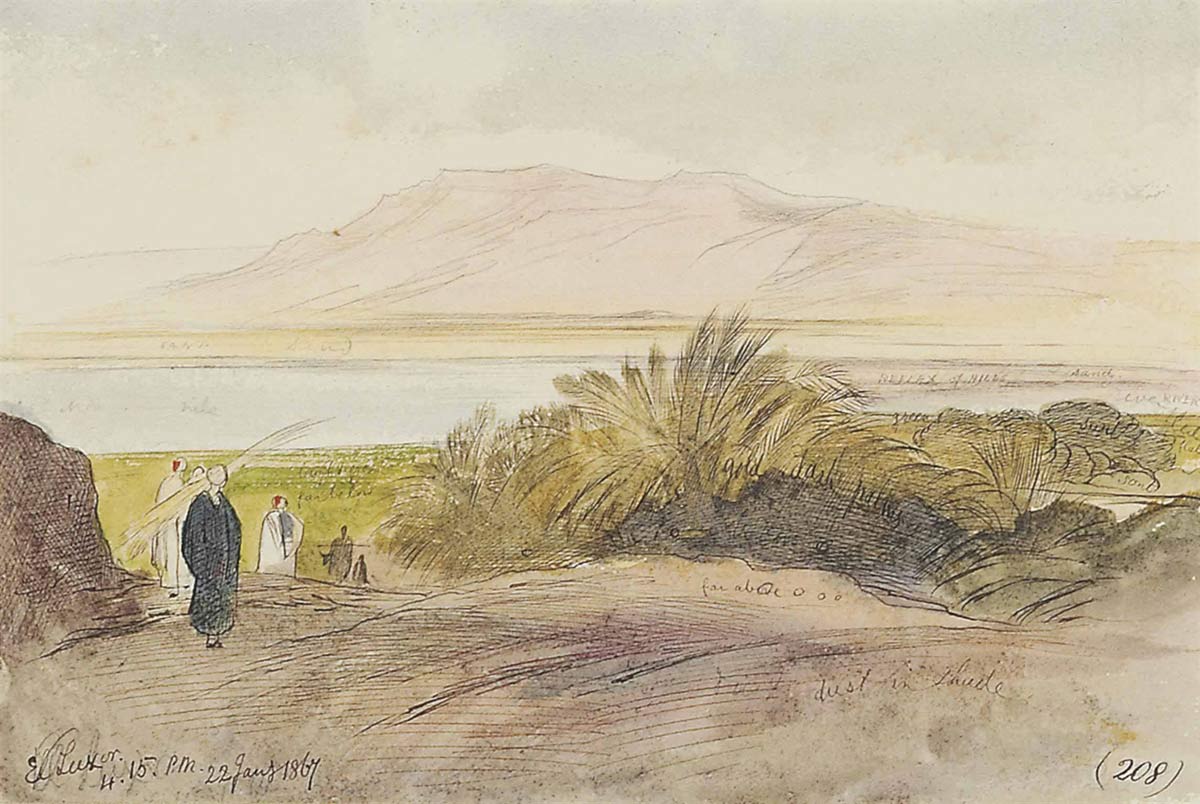
Girzeh, Egypt.
Inscribed and dated ‘Girzeh/2-3 p.m./March 3 1854.’ (lower right) and extensively inscribed with colour notes. Pencil, pen and brown ink and watercolour heightened with bodycolour on paper. 11.1/2 x 18.7/8 in. (29.2 x 48 cm.)
A “signed two-page letter” by Edward Lear is being sold on eBay; it is pasted to the front end paper of the first American edition of the Nonsense Books (Boston: Roberts Brothers, 1888).

It is an invitation to Mr. and Mrs. C. Perkins to go and see Lear’s Palestine sketches. It was written in the winter 1858-1859, when Lear was in Rome: his diary shows that he regularly saw C. Perkins from 29 December 1858 to 24 April 1859. Perkins visited the studio with his wife on 22 January and again, with other men, on 16 March 1859, and the letter was probably sent in January.


The text reads:
9 4 Piano V. Condotti.
My dear Sir,
I should ^[had I been able] have called earlier to say what I write in this note, – viz. – that whenever you and Mrs. Perkins will do me the pleasure of calling any morning before 2. P.M. – I shall be most glad to shew you & her – or any of your friends my sketches in Palestine as well as some small paintings. Up till just now, I have not had any accomodation fit to ask Ladies to, in my rooms.
Believe me,
Dear Sir,
Your’s very truly,
Edward Lear.
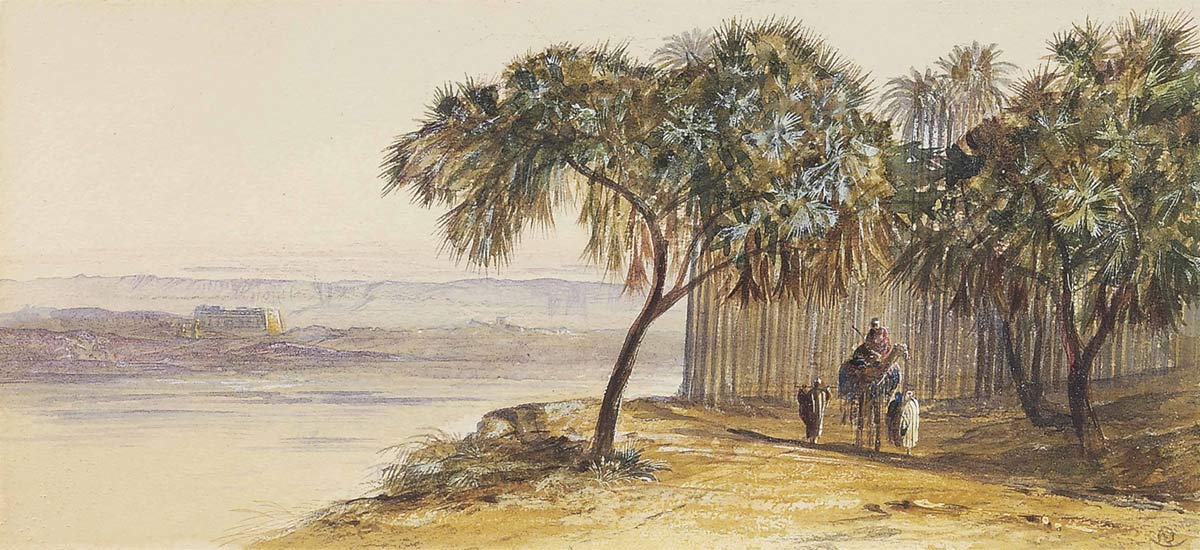
Denderah on the Nile.
Signed with monogram ‘EL’ (lower right) and with inscription ‘DENDERAH NILE’ (on verso). Pencil and watercolour heightened with bodycolour and gum arabic on paper. 7.1/8 x 14.7/8 in. (18.2 x 37.7 cm.)
Lear visited Egypt three times with his first journey in 1849 when he explored Cairo and Mount Sinai. In his second trip, in December 1853, Lear left Cairo for a journey up the Nile to Philae, passing Denderah in the middle of January and again on his return about a month later.
Denderah is on the west bank of the Nile between Abydos and Luxor and is the ancient city of Tantere (Greek Tentyis). However, the temple, which is dedicated to Habdos, goddess of Love, though one of the best preserved in Egypt, is also one of the latest, dating from the 1st century B.C.
Robert Edward Francillon (1841-1919), barrister, novelist and journalist, editor of The Tatler circa 1877 (works at Archive.org); from Mid-Victorian Memories. London: Hodder and Stoughton, 1914. 30-35:
My second author [the first being Thomas Talfourd] was of a very different order. I am certainly not alone in affectionate memories of Edward Lear, When quite a young man, living in London as young men without means or any prospects better than Alnaschar’s do manage to live, he was introduced into my mother’s home circle by her brother Robert, then studying art—my only near relation neither sailor nor lawyer—under (I think) Hulmandel. He at once became an ever welcome visitor: an almost brotherly and sisterly relation grew up between him and the group of bright young girls who then filled with life the house in Queen Square. It was on one of my visits there that I met him for the first time. Marriages, two of them entailing emigration to an island in then distant and remote Ontario, had thinned the group by that time, and the years had not passed over those who were left without a sign. But such changes as these were not of the sort that affected Lear. One has heard a great deal of late about “genius for friendship.” The rather worn-out phrase might well have been invented, in its original freshness, for him. Of his ever-increasing multitude of friends I do not believe that he ever lost one except by death; a new friendship never lessened an old one; and it is impossible to imagine his having ever made an enemy. His correspondence came to be immense—he had at last to settle a scheme for its restriction, lest it should absorb the whole of his time. Whether he kept to such a scheme is more than doubtful. However that may be, he never ceased to write at frequent intervals to my mother so long as both were alive—long and intimate letters, free from the by no means brilliant jocularity of comic spelling which makes his published letters to Chichester Fortescue such wearisome reading. Only an occasional grotesquely coined polysyllable gave the Learian cachet to really amusing and interesting accounts of what he was doing or planning. They were a pleasure to us all. Alas, that such would-have-been valuable contributions to my reminiscences should have disappeared— I cannot think inadvertently, much less intentionally, destroyed.
Lear’s love of children, and his immediate attraction for them, was of the essence of his charm. That first meeting of mine with him is memorable inasmuch as, while talking to my aunts, he amused himself for my benefit by making a pen-and-ink drawing of an Eastern landscape, with camels and palms. I did not listen to the talk: I was wholly absorbed in following the strokes of the pen. I treasured it as long as the wear and tear of nurseries and schoolrooms allowed. Much more interesting, however—indeed they may take rank as pieces of literary history—were Lear’s occasional visits to us at Cheltenham; for we children, my brother, my sister, and myself, were delighted eyewitnesses of the production of some of the earliest pages of the first “Book of Nonsense;” both pictures (so to call them) and rhymes. The current tradition is that these were dashed off for the children of the fourteenth Earl of Derby. No doubt many of them were, for Lear numbered at least three successive earls among his patrons—which in his case invariably meant his attached friends; and his first commission, as an animal painter, had come from Knowsley. But equally without doubt many other children had their part in the fun; and I can answer for the very considerable part accorded to us three. We possessed a good share of the original drawings, made while we stood by the artist’s knee, and their attendant “Limericks” were household words, long before there was any thought of their collection and publication. Alas, again! When the general collection came to be made, our particular one was added to it, and, translated into print, was no longer our very own, that we had watched flow for us from the pen. Apropos of the connection of the House of Stanley with the “Book of Nonsense,” Lear used to tell how, soon after its publication, he was travelling in a railway carriage opposite a family party engaged in enjoying its fun. The father proceeded to explain to the children that its actual author was the Earl of Derby himself, under the pen-name of Edward Lear : a very slight disguise of “Edward, Earl,” “Lear” being of course an obvious anagram of ” Earl.” The veritable author’s assurance that not only was Edward Lear the real name of a real person, but that he himself knew him well, had no effect beyond provoking a little temper. “I have it on the very best authority,” was the unanswerable retort to all he could say. Even when he produced a visiting card, and declared himself to be the man, it was evidently to be regarded as either a lunatic or an impostor. Considering the popular preference of fable, the wilder the better, to fact, it is really surprising that so first-class a myth as the identity of the Rupert of Debate with Derry-down-Derry should have failed to fix itself ineradicably in the public mind.
Lear’s friendship was an inheritance from generation to generation ; and after I came to London in 1863, never again to leave it, I seldom missed seeing him on any of his visits there. It was on his last visit that I saw him for the lasttime. My mature impression of him is that he was, in spite of any superficial evidence to the contrary, a melancholy man, weighed down by a sense of solitude. His innumerable friendships were, I think, too much in the nature of a crowd: and there is no such loneliness as is to be found in a crowd. His gentle and affectionate nature needed marriage, especially if it should give him children of his own instead of all the world’s. But to this there was the oddest of all odd obstacles. He had an ingrained conviction that he was too ugly for any woman to accept him. No doubt he was ugly. His impressionistic self-portraiture on the first page of the “Book of Nonsense” as the “Old Derry-down-Derry, Who loved to see little folks merry,” is scarcely a caricature: and his plainness of face was made the more emphatic by his nearness of sight, awkward slouch, and a style of dress which can only be called careless by courtesy. He may have thought that dress was no concern of one for whom it could do nothing. But though, as a true humorist, he could make himself his own butt, that perverse conviction of his unquestionably rankled. How absurdly, how pathetically perverse it was, experiment would soon have taught him: to say nothing of such precedents as those of Wilkes and Mirabeau to the effect that a man may be as ugly as he pleases—or doesn’t please. But then Lear was constitutionally shy: which is more than can be said of Wilkes and Mirabeau. He would, I am sure, have been a happier man could he have comfortably acquiesced in destiny, like a more than plain-featured but excellent friend of mine, beside whom I was sitting at a smoking concert when the splendidly handsome hero of a recent notorious scandal came into the room. “Ah,” said my friend out of his abundant charity, ” but just think of all the temptations that beset a handsome man like that! We don’t know anything about them—I and you.” I did not make the obvious retort of “Speak for yourself, if you please”: the reflection was so evidently meant, in all simplicity, to help me share his satisfaction in being—as he fancied—immune from the peril of pleasing ladies’ eyes.
But to return for a last moment to Lear. Had he been a veritable Apollo to look at, I do not believe that he would have been a whit different from what he was—one in whom nobody who knew him could imagine a deed, word, or thought that was not kind, generous, unselfish, and pure. I wish I did not fear that while giving so much pleasure and happiness all round, he somehow left himself out of the deal.
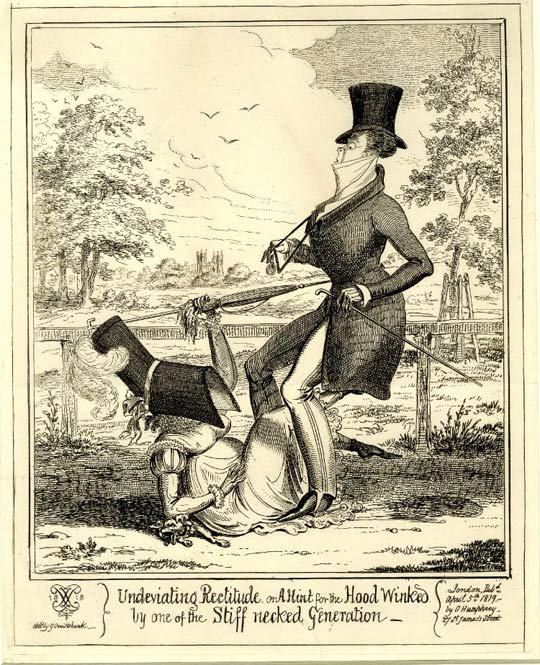
© Trustees of the British Museum
George Cruikshank, Undeviating Rectitude, 1819. British Museum images.


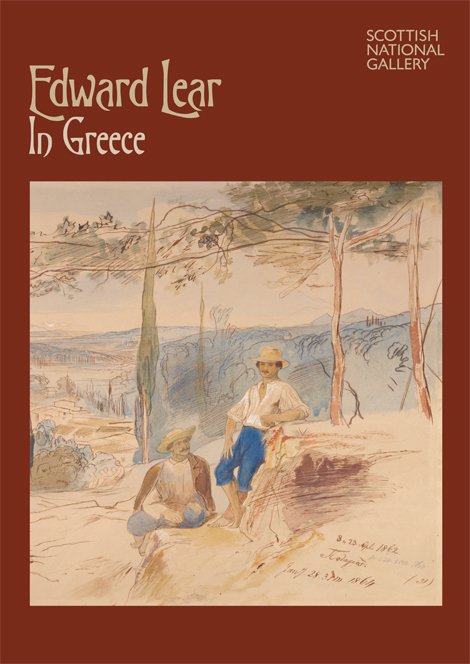
I don’t remember whether I already mentioned the exhibition currently at the Scottish National Gallery, Edward Lear in Greece, featuring pictures from the collection of Steven Runciman. The Gallery will also offer a free lecture on “Edward Lear: Painter of Poetical Topography” by Senior Curator of British Prints and Drawings Charlotte Topsfield; at Hawthornden Lecture Theatre – Gardens Entrance (SNG) on 25 April 2014.
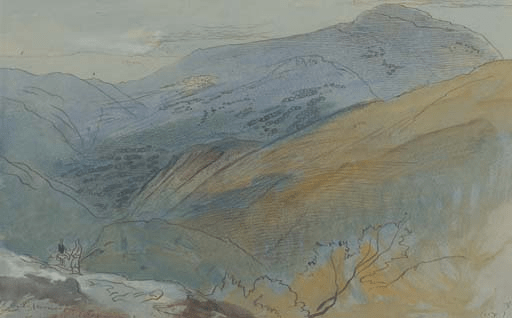
Edward Lear, Palaiukhora, Crete. 29 April 1864. Christie’s.
Stephen Duckworth will be giving a talk on “Edward Lear and his Cretan Drawings” at the Historical Museum of Crete, Andreas & Maria Kalokerinos House (27 Sofokli Venizelou Ave / 7 Lysimachou Kalokerinou Street 71202 Heraklion, Crete) on Wednesday, 14 may 2014 at 19.30.
Meanwhile, issue 10 of the New Escapologist, dedicated to Absurdity has been published.
Aeon Magazine has a very interesting article on repetition in music with some relevance to Nonsense: One more time: Why do we listen to our favourite music over and over again? Because repeated sounds work magic in our brains.
And here is an essay discussing Lear, Lewis Carroll and W.S. Gilbert:
Banerje, Sreeradha. “Elements of Social Concern and Absurdity in Non-sense Poetry of the Late-Victorian Period.” Literary Spectrums: Recent Studies in English Literature. Ed. Partha Kumar Mukhopsfhysy. New Delhi: Sarup & Sons, 2007. 153-166. Google Books.
This is added to the Studies on Nonsense page, together with the results of the latest attempts at refreshing my German:
Lang, Peter Christian. Literarischer Unsinn im späten 19. und frühen 20. Jahrhundert: Systematische Begründung und historische Rekonstruktion. Frankfurt am Main: Verlag Peter Lang, 1982.
Köhler, Peter. Nonsens: Theorie Und Geschichte Der Literarischen Gattung. Heidelberg: Carl Winter – Universitätsverlag, 1989.
Finally, though not strictly related to Nonsense literature, the following book contains a long chapter on Edward Lear as an illustrator of his own work (pp. 205-264), together with analyses of illustrators Linley Sambourne (The Water Babies), Arthur Hughes (At the Back of the North Wind), Tenniel (Alice books), Caldecott, Greenaway and Crane:
Esser-Hall, Gabriele. Untersuchung Zu Formen Visueller Textinterpretation Im Englischen Kinderbuch Von 1846 Bis 1890. Hildesheim: Georg Olms Verlag, 1997.
 A Blog of Bosh