Edward Lear, Jerusalem Looking North West (1859)

EL_Jerusalem-s

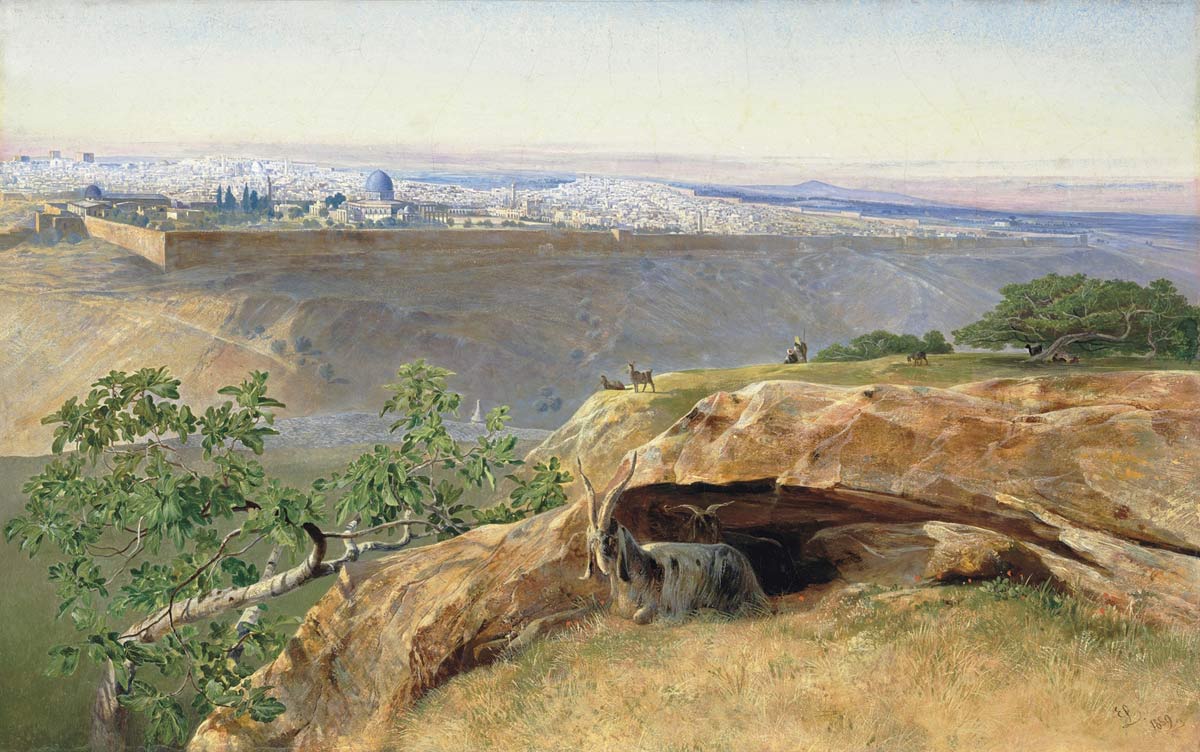
Edward Lear, Jerusalem looking North West.
Signed with monogram and dated ‘EL /1859’ (lower right) and inscribed ‘Jerusalem looking North West’ (on the stretcher) and with inscription ‘Jerusalem looking North West/Painted by Edward Lear from drawings/made there in 1858 for Lord Clermont/Edward Lear 1858 9’ (on a label attached to the reverse). Oil on canvas. 18 ½ x 29 ¾ in. (47 x 75.5 cm.)

This is one of four oil paintings of Jerusalem painted in the immediate aftermath of Lear’s visit there in 1858. It has rarely been on public display. Its south-east viewpoint differs from the north-east position from which the three others were taken. These three were made for Lady Waldegrave (Christie’s, London, 29 July 1977, lot 174); Sir James Reid (Christie’s, New York, 26 January 2011, lot 61) and Bernard Husey-Hunt (Strachey, op. cit., 1907, nos. 148, 149, 152). Some years later, in 1865, a commission from Samuel Price Edwards resulted in the largest of his paintings of Jerusalem (Strachey, op. cit., 1907, no. 218; Ashmolean Museum, Oxford).

Jerusalem, with its powerful biblical associations, was the goal of many artist-travellers to the Near East in the 19th century. Edward Lear, aware of the particular veneration in which the city was held, wrote as early as 1848 of his desire to visit it: ‘How I wish someone would pay my way to Palestine; I should like to see Jerusalem of all things’. After two earlier attempts had failed, his journey was eventually enabled by a commission from Lady Waldegrave, one of the most loyal of his patrons. He reached the city on 27 March 1858, and the next day, Palm Sunday, explored the country immediately outside the walls: ‘We crossed the Kidron & and went up the Mount of Olives – every step bringing fresh beauty to the city uprising behind’ (Lear’s Diary, 28 March 1858, cited in V. Noakes, 1985, p. 149). The city was crowded with Easter pilgrims however – ‘the universal hubbub throughout the place prevents any quiet plan or reasoning’ (Letter to Ann, 30 March 1858, cited in V. Noakes, Edward Lear: The Life of a Wanderer, London, 1979, p. 155) – and he decided to continue his journey south to Petra.

Returning to Jerusalem on 20 April, Lear set about gathering sketches for Lady Waldegrave’s painting, bewildered by the ‘endless histories & poetries’ that the landscape evoked. He had difficulty finding a suitable position outside the city from which to make his sketches but eventually ‘stumbled on an oblique North-East view’. He pitched his tent on the Mount of Olives and spent a fortnight studying every detail of the view, also obtaining photographs to use for later reference. Such painstaking attention to detail emulated the efforts and some of the Pre-Raphaelite methods of his friends William Holman Hunt and Thomas Seddon who, four years earlier, had spent several months camped outside the city.

From this point, as he explained to Lady Waldegrave, could be seen ‘the site of the temple & the 2 domes, – and it shews the ravine of the valley of Jehoshaphat, on which the city looks: – and Absalom’s pillar – (- if so be it is his pillar – ) the village of Siloam, part of Aceldama, & Gethsemane are all included in the landscape. … add to all of which there is an unlimited foreground of figs, olives, & pomegranates, not to speak of goats, sheep & huming beings …’ (Noakes, 1988, p. 151). Although some way further to the South, the present view includes many of the same features, but by placing particular emphasis on the fig-tree and goats in the foreground, Lear enhances its interest. Its lower and closer viewpoint also enables parts of the city to be seen with greater clarity. The contrast between local detail and the wider landscape is further emphasised by the soft afternoon light, throwing the rocky terrain of the foreground into relief against the valley and the city beyond.

Lear took great pains with both this and the commission for Lady Waldegrave, and was rewarded by the appreciation of his patrons, writing later to his friend Chichester Fortescue (soon to be Lady Waldegrave’s husband): ‘I delight in the knowledge of Lord & Lady Clermont constantly enjoying my pictures: – they are a placid duck-like couple…’ (16 February 1862, Strachey, op. cit., 1907, p.227). Thomas Fortescue, 1st Baron Clermont (1815-1887) was Chichester Fortescue’s elder brother, and owned three further paintings by Lear.

We are grateful to Briony Llewellyn for providing this catalogue entry.
Christie’s.

Posted in Edward Lear | Tagged , , , , | 2 Comments

Edible Clothes Redux

When I posted two of George Cruikshank’s caricatures which might have inspired Edward Lear in writing “The New Vestments” I forgot to link to this great article on Lear’s poem by Carol Rumens in the Guardian of 30 December 2013: Edward Lear’s The New Vestments: the artistry of an extraordinary suit.

Posted in Edward Lear | Tagged , , , | Leave a comment

Edward Lear, View of Florence (1861)

EL_Florence-s


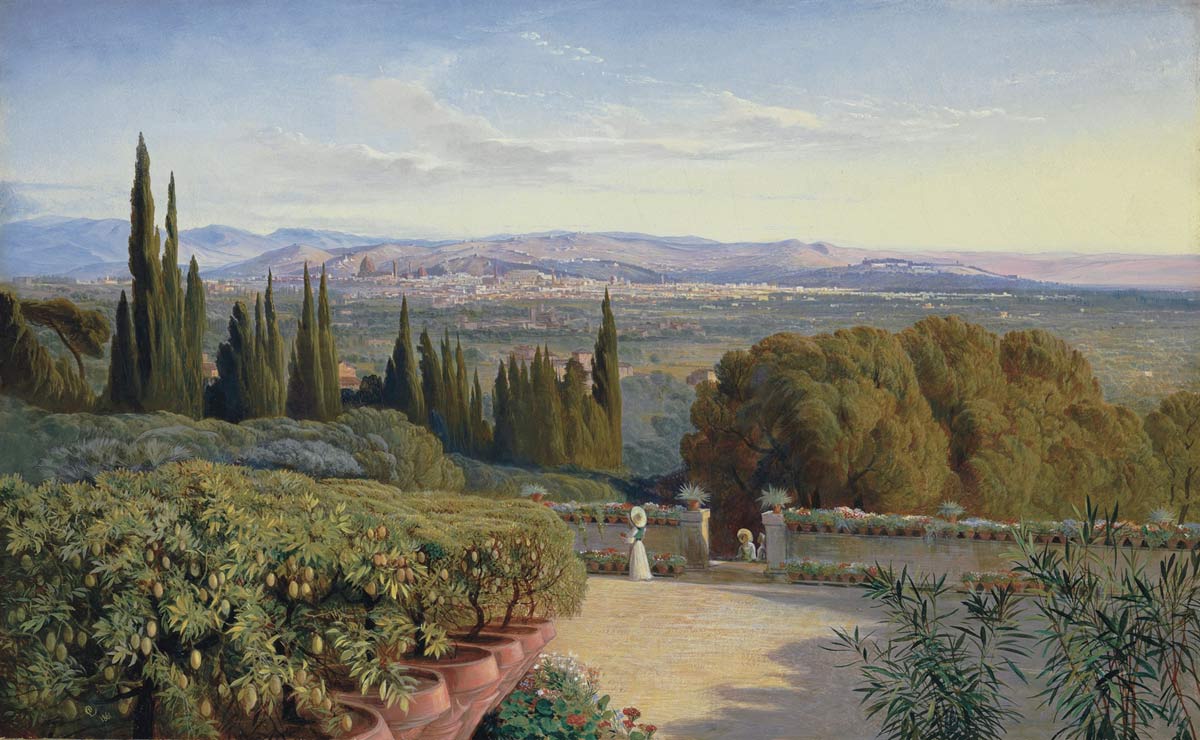
Edward Lear, View of Florence from Villa Petraja.
Signed with monogram and dated ‘EL /1861’ (lower left). Oil on canvas. 18 ½ x 29 ¾ in. (47 x 75.5 cm.)

‘At present I am at work ferociously on the Petraja & I must say it promises well. I worked on the large lemon trees in pots all yesterday, & to-day must fidget over the houses all the long hours. No life is more shocking to me than the sitting motionless like a petrified gorilla as to my body & limbs hour after hour – my hand meanwhile, reck peck pecking at billions of little dots & lines, while my mind is fretting & fuming, through every moment of the weary days work.’ Lear’s letter to his friend Chichester Fortescue, written on 29 August 1861, reports on his progress with his painting of Florence from Villa Petraja. It expresses, with the typically quirky humour for which he is widely known, the painstaking efforts with which he strove to complete his oil paintings to the satisfaction of his clients. By late September he had ‘made the view from Villa Petraja all but a reality’ and by 12 October it was finished (L.E.L., 1907, pp. 189, 196, 199).

The painting of Florence from the gardens of the celebrated Medici Villa La Petraja had been commissioned by the prominent whig-Liberal political hostess Frances, Countess Waldegrave (1821-1879), a staunch supporter of Lear’s and for whom he made six other paintings (including Jerusalem from the Mount of Olives, Sunset, see lot 9). Then married to the elderly but well-connected George Harcourt, she was surrounded by younger admirers and the particular focus of the affections of Chichester Fortescue, who had introduced her to Lear.

Lear was in need of change after the death of his beloved eldest sister Ann, who had been a substitute mother to him since his early childhood, and he welcomed the opportunity to travel to Italy. Reaching Florence on 8 June 1861, he spent the rest of that month making sketches, writing in colourful terms to William Holman Hunt: ‘Plumpudding – treacle, weddingcake, sugar, barleysugar, sugar candy, raisins & peppermint drops would not make a more luscious mixture in the culinary world, than Florence & its Val d’Arno does as Landscape’ (cited in V. Noakes, 1979, p. 184). Evidently he had a sweet tooth, as his diary records ‘the usual four ices’ eaten on his way home (cited in P. Levi, 2013, p. 183). Lear had long admired Holman Hunt and had spent a summer in 1852 at Clive Vale Farm near Hastings watching him paint. Although Lear was no longer painting in the open air by the early 1860s, his Villa Petraja has Pre-Raphaelite resonances, particularly in the attention to naturalistic detail in the foreground. This emphasis on local colour often presented him with a problem of transition between near and far in his landscapes, but Lear resolves it here with a weighty bank of trees in the middle ground, providing a magnificent foil to the campaniles and domes of the distant city.

Lady Waldegrave was pleased with the painting and when Lear wrote to her with his condolences after the death of her husband he expressed his pleasure that she now had the picture ‘of Petraja where you so lately were together…. It seems to me that in converting memories into tangible facts, recollections & past time as it were into pictures, lies the chief use & charm of a painter’s life’ (5 January 1862, L.E.L., 1907, p. 216).

We are grateful to Briony Llewellyn for providing this catalogue entry.
Christie’s.

Posted in Edward Lear | Tagged , , , | Leave a comment

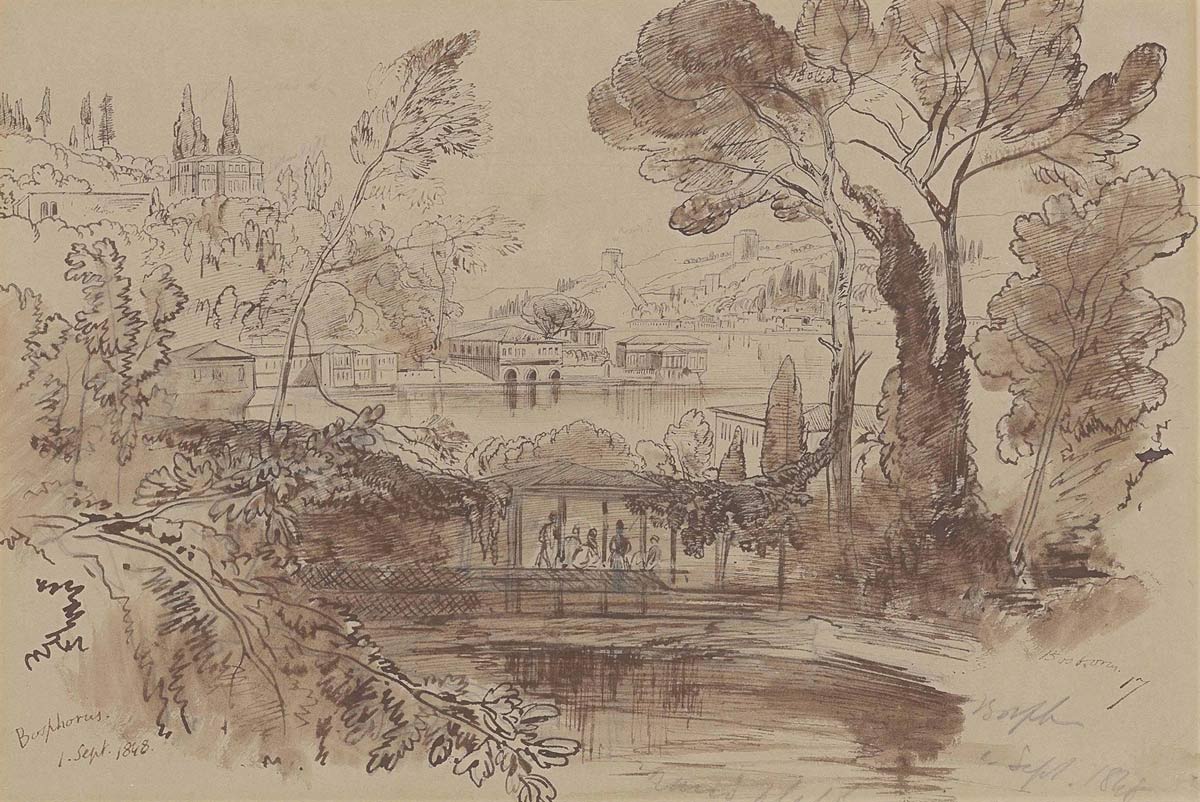
Edward Lear, Anadoluhisari (1848)

EL_Bosphorus-s

Edward Lear, Anadoluhisari, Istanbul, on the Bosphorus.
Inscribed and dated ‘Bosphorus./1. Sept. 1848′ (lower left) and again in pencil (lower right) and numbered ’17’ (lower right) and further inscribed with colour notes. Pencil, pen and brown ink and brown wash on paper. 10 ¾ x 14 in. (27.4 x 35.4 cm.)

Lear visited Constantinople in 1848 as the guest of Lady Canning, the wife of the British Ambassador in Turkey, setting off from Corfu with the Cannings on 30 May 1848 and travelling by way of Athens where he fell ill. Anadoluhisari is the fortress on the Anatolian side of the Bosphorus and gives its name to the Quarter around it. It was built between 1393 and 1394 by Ottoman Sultan Bayezid as part of the preparations for the 2nd Ottoman Seige of Constantinople which took place in 1395. It is the oldest architectural structure in Istanbul.

Christie’s.

Posted in Edward Lear | Tagged , , | Leave a comment

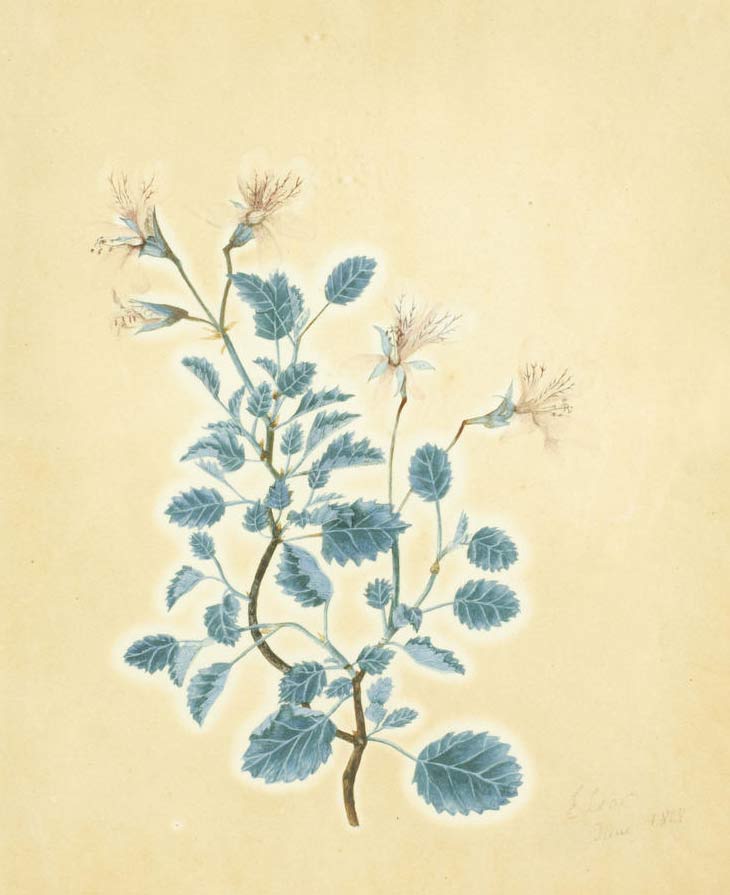
An Early Botanical Study by Edward Lear

el-bot-s

Edward Lear, An early botanical study.
Signed and dated “June 1828.”

To be auctioned at Bonham’s.

Posted in Edward Lear | Tagged , , | Leave a comment

An Edward Lear Society, at Last

After a long incubation, I first heard about plans for it about two years ago, I am pleased to announce that the Edward Lear Society has finally seen the light of day with a very nice website, where you will find information on Edward Lear and the society itself: here is the form to become a member, with previews of the society’s initiatives.

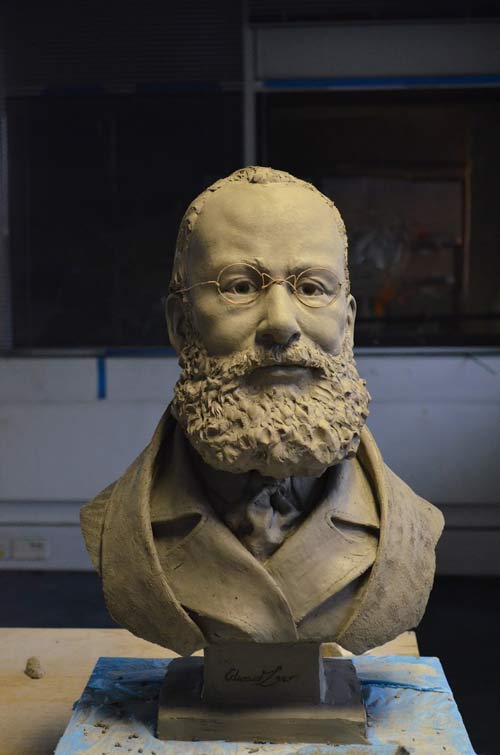
Click on the picture for more images of the bust.

Click on the picture for more images of the bust.

Mr Derek Johns, one of the founding members, also e-mailed me to report on the first event:

Last Friday evening [30 May 2014]‎ at the Anagnostiki Reading room in Corfu,  the bronze bust of Edward Lear was unveiled after opening speeches by George Poulimenou of the Committee, Spiro Flamburiari and a short lecture on the life and artistic works of Lear by myself. The evening finished with a song cycle of works by the Corfiot composer Napoleon Lambelet whose fame was greater in London and especially at the Coliseum,  then in Corfu sung by the leading Soprano on the island Rosa Cappon. She finished the evening off with a rendition of Edward Lear’s the Owl and the Pussycat. Approximately 120 people attended this special evening.

Posted in Edward Lear | Tagged , , , | 2 Comments

Edible Clothes

cruikshankbeware

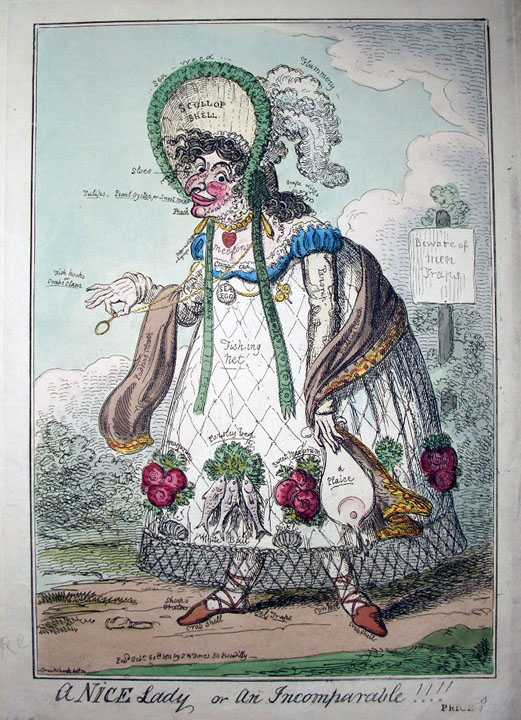
George Cruikshank (1792-1878), A Nice Lady or an Incomparable!!!! Hand-colored etching. Published by S. W. Fores, London, 20 October 1818. Princeton University Library, Graphic Arts blog.

George Cruikshank,  An Exquisite Dandy - Prodigious!!! A Nice Gentleman, (12 September 1818)

George Cruikshank, An Exquisite Dandy – Prodigious!!! A Nice Gentleman, (12 September 1818). TARA.

See the Graphic Arts blog for a detailed description of the above prints.

Edward Lear, “The New Vestments,” Laughable Lyrics, 1877.

There lived an old man in the kingdom of Tess,
Who invented a purely original dress;
And when it was perfectly made and complete,
He opened the door, and walked into the street.

By way of a hat, he’d a loaf of Brown Bread,
In the middle of which he inserted his head;–
His Shirt was made up of no end of dead Mice,
The warmth of whose skins was quite fluffy and nice;–
His Drawers were of Rabbit-skins, — so were his shoes,
His stockings were skins — but it is not known whose;–
His Waistcoat and Trowsers were made of Pork Chops;–
His Buttons were Jujubes, and Chocolate Drops;–
His Coat was all Pancakes with Jam for a border,
And a girdle of Biscuits to keep it in order;
And he wore over all, as a screen from bad weather,
A Cloak of green Cabbage-leaves stitched all together.

He had walked a short way, when he heard a great noise,
Of all sorts of Beasticles, Birdlings, and Boys;–
And from every long street and dark lane in the town
Beasts, Birdles, and Boys in a tumult rushed down.
Two Cows and a half ate his Cabbage-leaf Cloak;–
Four Apes seized his Girdle, which vanished like smoke;–
Three Kids ate up half of his Pancaky Coat,–
And the tails were devour’d by an ancient He Goat;–
An army of Dogs in a twinkling tore up his
Pork Waistcoat and Trowsers to give to their Puppies;–
And while they were growling, and mumbling the Chops,
Ten boys prigged the Jujubes and Chocolate Drops.–
He tried to run back to his house, but in vain,
Four Scores of fat Pigs came again and again;–
They rushed out of stables and hovels and doors,–
They tore off his stockings, his shoes, and his drawers;–
And now from the housetops with screechings descend,
Striped, spotted, white, black, and gray Cats without end,
They jumped on his shoulders and knocked off his hat,–
When Crows, Ducks, and Hens made a mincemeat of that;–
They speedily flew at his sleeves in trice,
And utterly tore up his Shirt of dead Mice;–
They swallowed the last of his Shirt with a squall,–
Whereon he ran home with no clothes on at all.

And he said to himself as he bolted the door,
‘I will not wear a similar dress any more,
‘Any more, any more, any morre, never more!’

Posted in Cruikshank, Edward Lear | Tagged , , , | 3 Comments

Edward Lear, View at El Luxor (1867)

EL_el-luxor-s

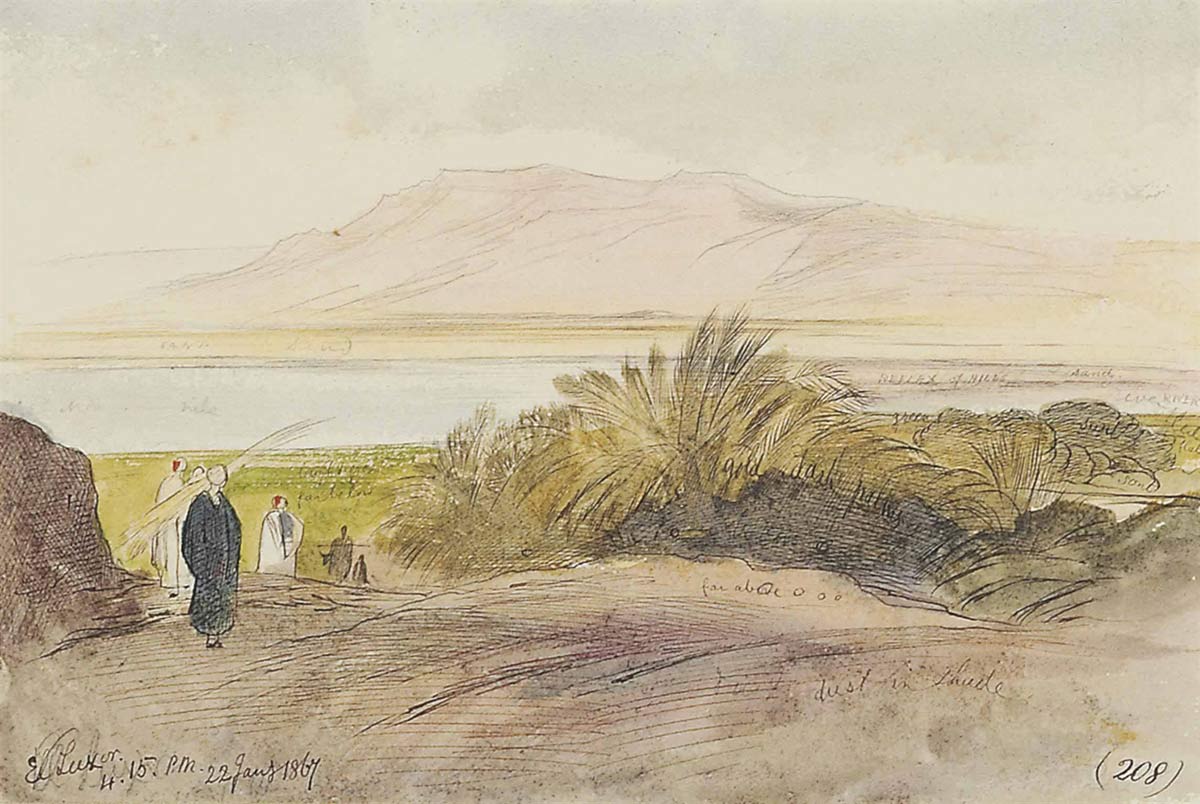
View at El Luxor on the Nile.
Inscribed and dated ‘El Luxor./4.15.pm. 22 Jany 1867’ (lower left) and numbered ‘208’ (lower right) and extensively inscribed with colour notes. Pencil, pen and brown ink and watercolour on paper. 6¾ x 9¾ in. (17.2 x 24.7 cm.)

On Lear’s last trip to Egypt in the winter of 1866-67 he ventured further afield to Wadi Halfa and major sites such as Luxor. Lear was amazed by the Nile scenery and the richness of colour, writing that the ‘pale rock and gritty sand is blazing bright –while all below is a dark depth. The farthest range of hills is sandy pale, with grey from crowds of rock’ (E. Lear, Diary, 25 February 1867). In Luxor Lear was met by a cousin from Canada, Archie Jones, and they travelled away from the green banks of the Nile into the Nubian desert before turning north again towards Cairo.

Christie’s.

Posted in Edward Lear | Tagged , , , , | Leave a comment

Edward Lear, Girzeh (1854)

EL_Girzeh-s

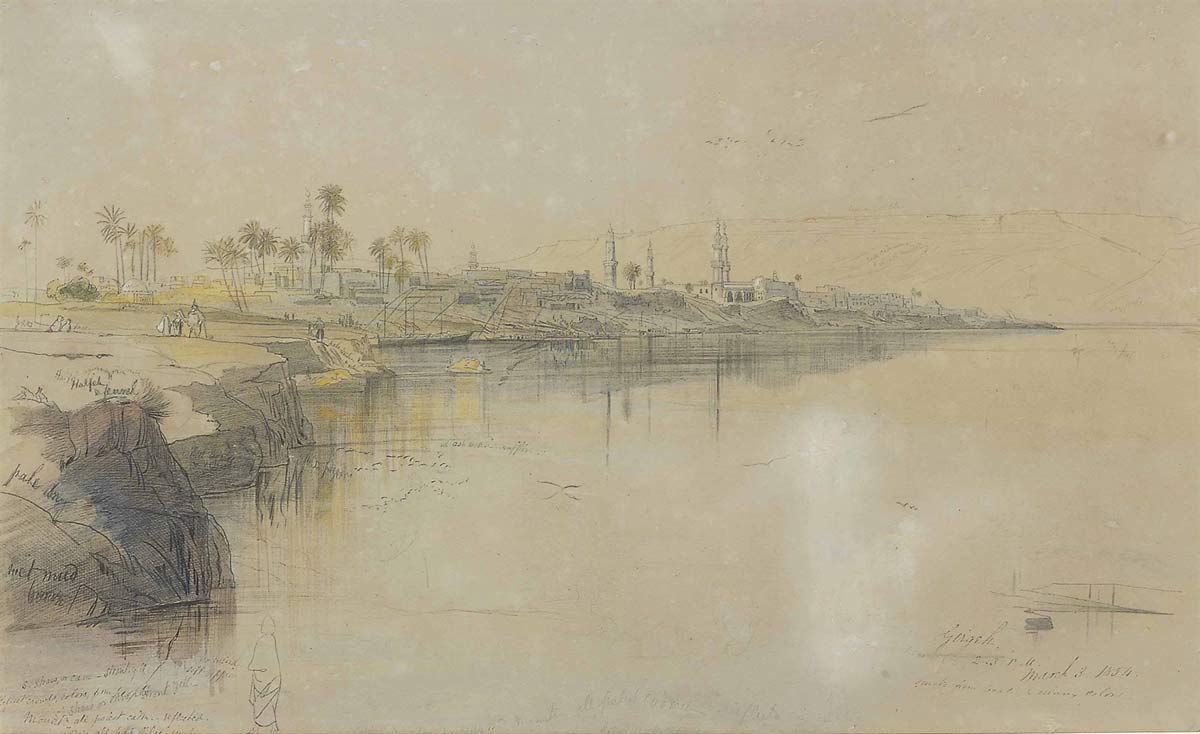
Girzeh, Egypt.
Inscribed and dated ‘Girzeh/2-3 p.m./March 3 1854.’ (lower right) and extensively inscribed with colour notes. Pencil, pen and brown ink and watercolour heightened with bodycolour on paper. 11.1/2 x 18.7/8 in. (29.2 x 48 cm.)

Christie’s.

Posted in Edward Lear | Tagged , , , , | Leave a comment

Edward Lear: An Unpublished Letter

A “signed two-page letter” by Edward Lear is being sold on eBay; it is pasted to the front end paper of the first American edition of the Nonsense Books (Boston: Roberts Brothers, 1888).

el-sig

It is an invitation to Mr. and Mrs. C. Perkins to go and see Lear’s Palestine sketches. It was written in the winter 1858-1859, when Lear was in Rome: his diary shows that he regularly saw C. Perkins from 29 December 1858 to 24 April 1859. Perkins visited the studio with his wife on 22 January and again, with other men, on 16 March 1859, and the letter was probably sent in January.

el-let-1-s

el-let2s

The text reads:

9 4 Piano V. Condotti.

My dear Sir,

I should ^[had I been able] have called earlier to say what I write in this note, – viz. – that whenever you and Mrs. Perkins will do me the pleasure of calling any morning before 2. P.M. – I shall be most glad to shew you & her – or any of your friends my sketches in Palestine as well as some small paintings. Up till just now, I have not had any accomodation fit to ask Ladies to, in my rooms.

Believe me,
Dear Sir,
Your’s very truly,
Edward Lear.

Posted in Edward Lear | Tagged , , , | Leave a comment