John Ashbery, The Dong with the Luminous Nose (1998)

The Dong With the Luminous Nose
(a cento)

Within a windowed niche of that high hall
I wake and feel the fell of dark, not day.
I shall rush out as I am, and walk the street
The lights begin to twinkle from the rocks
From camp to camp, through the foul womb of night.
Come, Shepherd, and again renew the quest.
And birds sit brooding in the snow.

Continuous as the stars that shine,
When all men were asleep the snow came flying
Near where the dirty Thames does flow
Through caverns measureless to man,
Where thou shalt see the red-gilled fishes leap
And a lovely Monkey with lollipop paws
Where the remote Bermudas ride.

Softly, in the dusk, a woman is singing to me:
This is the cock that crowed in the morn.
Who’ll be the parson?
Beppo! That beard of yours becomes you not!
A gentle answer did the old Man make:
Farewell, ungrateful traitor,
Bright as a seedsman’s packet
Where the quiet-coloured end of evening smiles.

Obscurest night involved the sky
And brickdust Moll had screamed through half a street:
“Look in my face; my name is Might-have-been,
Sylvan historian, who canst thus express
Every night and alle,
The happy highways where I went
To the hills of Chankly Bore!”

Where are you going to, my pretty maid?
These lovers fled away into the storm
And it’s O dear, what can the matter be?
For the wind is in the palm-trees, and the temple bells they say:
Lay your sleeping head, my love,
On the wide level of the mountain’s head,
Thoughtless as monarch oaks, that shade the plain,
In autumn, on the skirts of Bagley Wood.
A ship is floating in the harbour now,
Heavy as frost, and deep almost as life!

from John Ashbery’s Wakefulness (1998)

Having contracted his scope and formal means, Ashbery again gave free rein to his expansive impulses in Can You Hear, Bird (1995), which remains his longest collection to date. Organized alphabetically by poem title, the book is informed by the playful formalism of Oulipo, as its dedication to Harry Mathews suggests. The most spectacular instance of Ashbery’s simultaneous attraction to and impatience with formal constraint comes in “Tuesday Evening,” a long nonsense poem whose rhymed quatrains gradually move from strict tetrameter to sprawling Ogden Nash lines. Wakefulness (1998) is the shortest of Ashbery’s recent collections, which may explain why it seems less distinctive in theme and texture than the others, mostly picking up threads from previous books. Its most sustained engagement with poetic tradition comes in “The Dong with the Luminous Nose,” an ingenious cento that patches lines from famous poems by Blake, Wordsworth, Keats, Shelley, Edward Lear, and others into a surprisingly coherent quilt.
Roger Gilbert, “Ludic Eloquence: On John Ashbery’s Recent Poetry.” Contemporary Literature 48.2 (2007). 195-226. 223 n. 15.

Posted in Edward Lear | Tagged , , , | 23 Comments

Christopher Middleton, Edward Lear in February

Since last September I’ve been trying to describe
Two moonstone hills,
And an ochre mountain, by candlelight, behind,
But a lizard has been sick into the ink,
A cat keeps clawing at me, you should see my face,
I’m too intent to dodge.

Out of the corner of my eye,
An old man (he’s putting almonds into a bag)
Stoops in sunlight, closer than the hills.
But all the time these bats flick at me
And plop, like foetuses, all over the blotting paper.
Someone began playing a gong outside, once.
I liked that, it helped; but in a flash
Neighbours were pelting him with their slippers and things,
Bits of coke and old railway timetables.

I have come unstuck in this cellar. Help.
Pacing up and down in my own shadow
Has stopped me liking the weight it falls from.
That lizard looks like being sick again. The owls
Have built a stinking nest on the Eighteenth Century.

So much for two moonstone hills,
Ochre mountain, old man
Cramming all those almonds into a bag.

Christopher Middleton, “Three Poems,” The Paris Review 25, summer-fall 196o. [The online version of this issue also contains freely-available interviews with Boris Pasternak and Robert Frost.]

The text of the poem is actually from Middleton’s obituary from The Paris ReviewDaily.”

Posted in Edward Lear | Tagged , , | Leave a comment

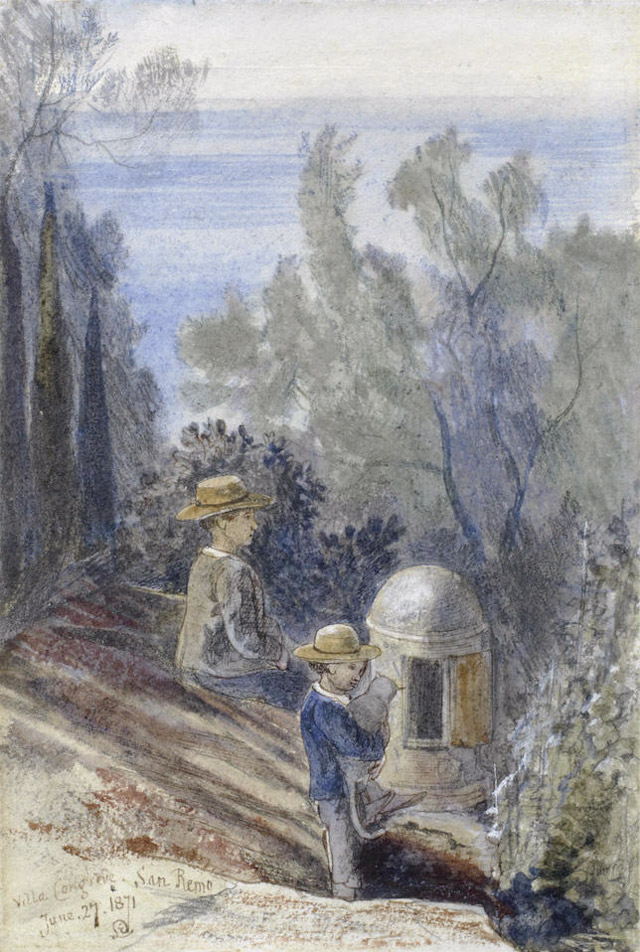
Edward Lear, View over San Remo from Villa Congreve

Over at the Edward Lear Society website an article appeared on 12 October showing a watercolour picture by Edward Lear of a San Remo view which also includes two figures in the foreground:

Villa-Congreve-640x430

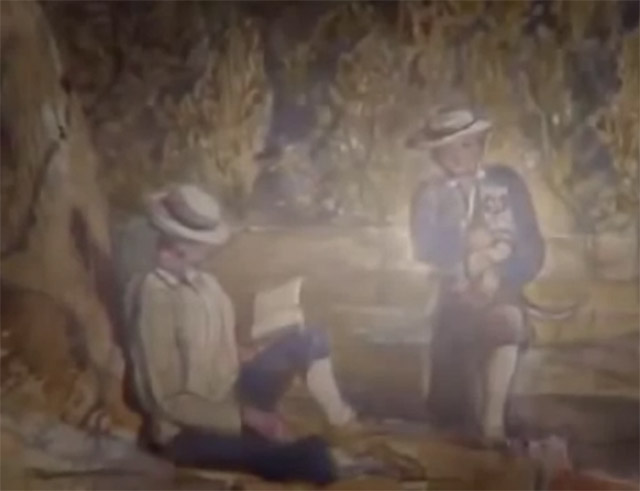
It was shown during BBC One’s Antiques Roadshow, season 37 episode 9, originally broadcast on 23 November 2014 ― you can see the program on YouTube (the Lear picture is presented from 36:15), unfortunately in very low resolution, that’s why the picture with the detail below is so bad.

Michael Montgomery, the author of the Society article states that the people portrayed are Walter Congreve and his second wife, who died in November 1870, so that is the year he thinks the picture was made.

I am quite sure that this identification is wrong: in the video clip Walter Congreve’s descendant clearly implies that the two figures are his “grandfather and great-uncle” (while pointing at the picture). Moreover, if you compare this picture:

el_congreves

with the one sold at Bonhams on 24 November, which I had reproduced in a previous post of 3 November, when I did not yet know of the Lear Society article:

el_congreve

it is easy to see that the children are even dressed the same way, the one with the blue jacket presumably being Arnold, the cat-lover. The Antiques Raoadshow picture also includes a dog (bottom right in the detail above) which is not mentioned in the article.

Given the similarities between the two images I would suggest a slightly later date for the watercolour, June-July 1871. After reading Edward Lear’s diary entry for 27 June 1871, I suspect the “sketch of the 2 boys & the Well” is the one that was sold at Bonhams in which an elaborate covered well is represented, while the one that appeared in the TV show was begun on that day:

Rose at 5.30. Wonderfully lovely morning ― clear & fresh.

Marked out more bits of paper for the 120 AT illustrations, & at 8. went to Congreves, & made a sketch of the 2 boys & the Well, for their Aunt, “No doubt” ― (as the Tines say ―) that garden is a wonderful delight ― but I have known no man but Congreve who could have made it such. Bkft. Hubert’s lesson.

Times of 21st. No letters. Can any earthly colors be lovelier than those of sea sky & earth to day? Nor is the sky “Italian blue” ― only, but full of the most exquisite clouds, as indeed for 3 months it has generally been. Worked at the sketch of this morning, & finished ruling & making my 120 ATs. ― At 3― went with Giorgio, to the view I am trying to do for Miss Congreve, but could do but little in watercolor, owing to flies & other bothers. So I shall do a pencil drawing, & a colored one therefrom.

Lear mentions Miss Congreve’s drawing for the next few days, on 1 July “The Congreve drawing prospers,” but he is still working on it on 4 July, and on 5 July he writes “finished ― as I think, Miss Congreve’s drawing.” Then on 7 July he “packed Miss Congreve’s drawing, & later, gave it to her brother.” The next day he “wrote a long letter to Miss Congreve

It would therefore appear that the picture that Congreve’s descendant brought to Antiques Roadshow was made for his ancestor’s sister (this one shows a landscape) and remained in the family, while the other (which has a well but very little landscape) was perhaps kept by Lear and entered the market with the bulk of the other pictures.

[Note, the post initially stated that the article on the Edward Lear Society website was anonymous; thanks to Stephen Duckworth for correcting me – MG]

Posted in Edward Lear | Tagged , , | 2 Comments

Edward Lear, The Temple of Apollo at Bassae (1854)

el_bassae-s

Edward Lear, The Temple of Apollo at Bassae.
Oil on Canvas. 146.4cm x 229.5cm.
Monogram; lower right; EL.
Date; lower right; 1854-55.
Stretcher, verso; paint; Box 9.
Stretcher, verso; graphite; 30.
Label; stretcher, verso; printed; MAN.
Stamp; canvas, verso; with graphite; Charles Roberson, Long Acre, London.

The Fitzwilliam Museum. Also.

Posted in Edward Lear | Tagged , , , | Leave a comment

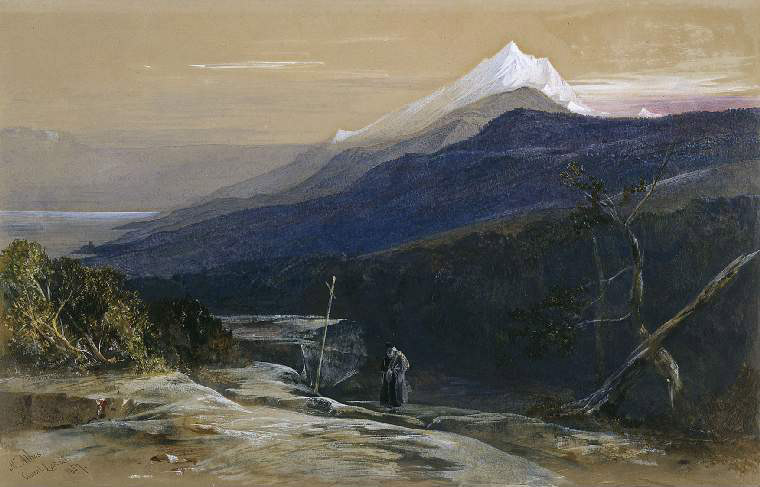
Edward Lear, Mount Athos (1857)

el_athos-s

Edward Lear, Mount Athos.
Black chalk, bodycolour, watercolour on paper. 298mm x 466mm.
Lower left; Mt. Athos.
Signature; lower left, below the above; Edward Lead del.
Date; lower left, below the above; 1857
Verso, mount; MT. ATHO. Rev: W.G.C. Clark / Trinity College / Prior in 1878.

The Fitzwilliam Museum.

Posted in Edward Lear | Tagged , , , , | Leave a comment

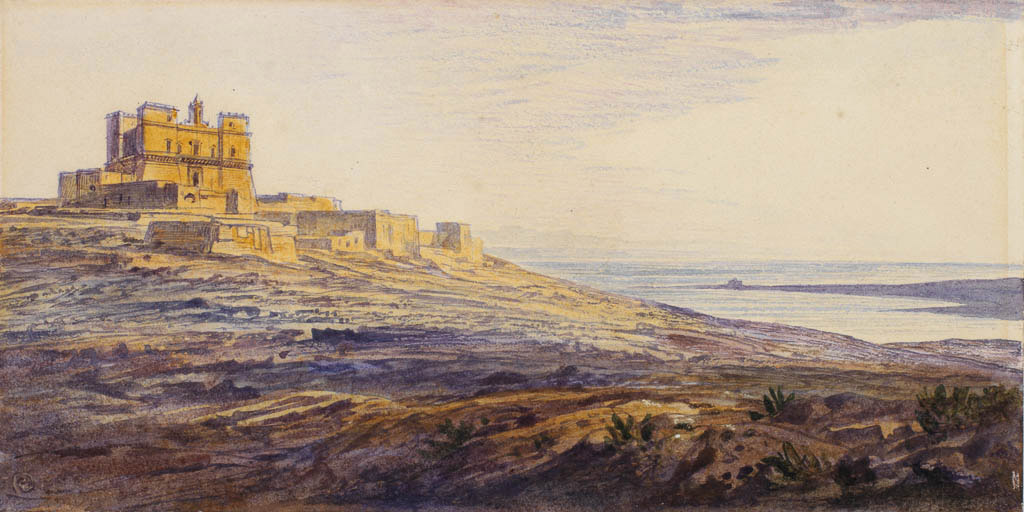
Edward Lear, Selmun Palace, Malta

el_selmun-s

Edward Lear, Selmun Palace, Malta.
Pen and brown ink, watercolour. 103mm x 203mm.

On Lear in Malta.

The Fitzwilliam Museum.

Posted in Edward Lear | Tagged , , , | 1 Comment

More Houghton Manuscripts

In his Course in Nonsense Tom Swifty comments on the feud between Learians and Carrollians:

The nonsense of these two could not have been more different. We can make fun of rules by blithely ignoring them, like Lear, but also by following them too much to the letter, like Carroll. The nonsense of Lear is irrational and gossamer, while Carroll’s is hyperrational and hardcore.Within the genre there is indeed a bit of s schism between the fans of Lear (often artists) and the fans of Carroll (often scientists). Even some biographers cannot bring themselves to mention the other master of nonsense more than once or twice in passing. The combined works of the two nevertheless went on to form the canon of the genre (53).

As I clearly belong to the Lear party I am afraid I have often committed a sin of omission by not reporting on Carroll’s news (this year marks the 150th anniversary of the first Alice book, a fact I never once mentioned so far): the fact is Carroll has so many fans and there are so many events that it is impossible to keep track of them.

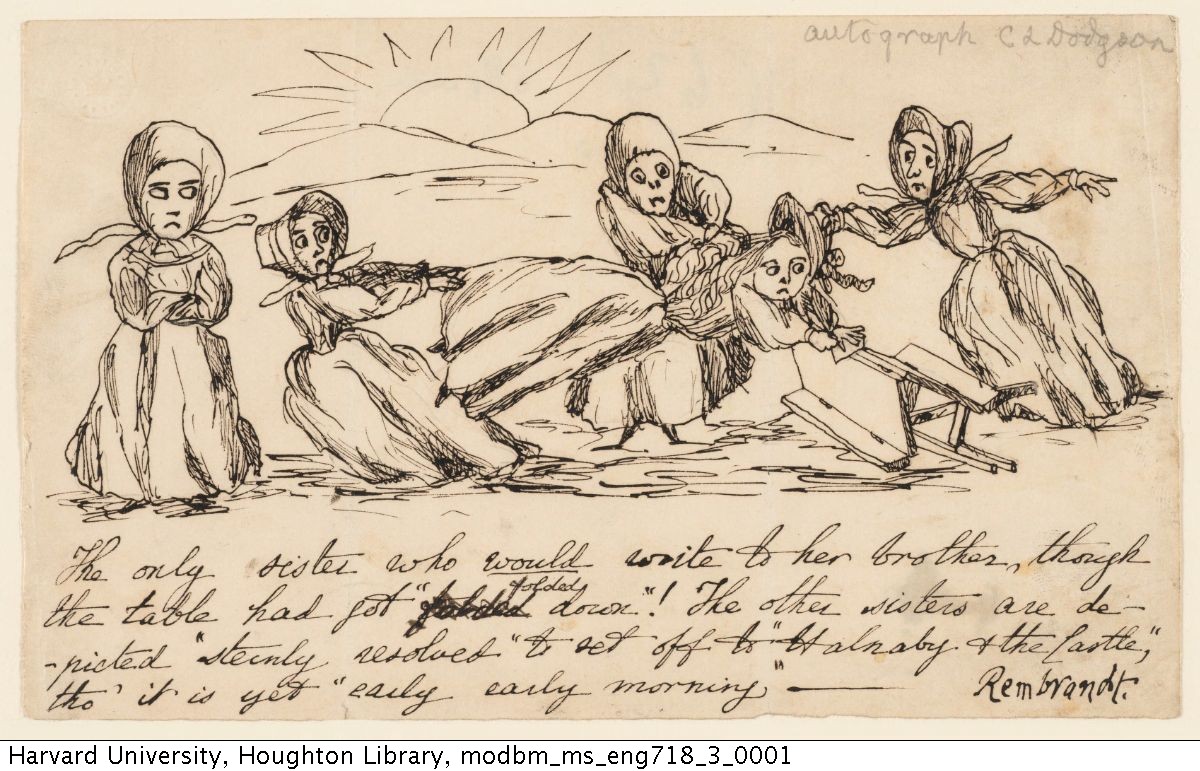
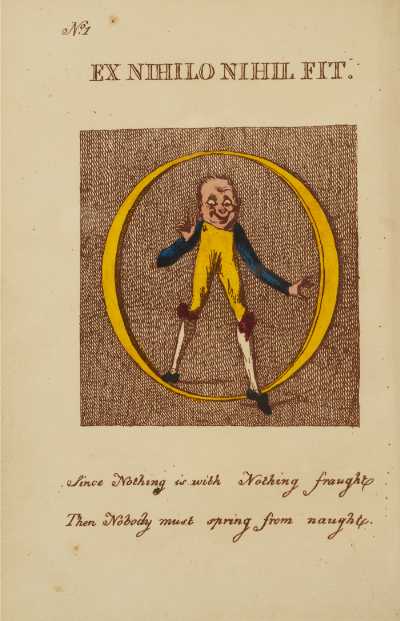
However, I cannot omit reporting on the appearance online of one of Carroll’s early family magazines, for which we must thank Houghton Library. Here is a link to the finding aid for the Harcourt Amory collection of Lewis Carroll (MS Eng 718 – 718.16), which includes a link to a full online facsimile of The Rectory Umbrella (MS Eng 718).

10249973-s

Let me conclude by mentioning that a guide to a “Franklin Lushington photograph album and other material, 1829-1871” (MS Typ 1181) is also now online, though without scans: this does not have much of learian interest except an 1858 photograph taken in Corfu; here is the description:

Photographs depicting Corfu, Malta, San Remo, Comet of 1858, Chigwell, etc… About 20 images taken by Lear or Lushington (who possibly owned a camera together) including: Alfred Tennyson, Lionel Tennyson, Hallam Tennyson, Julia Marshal, Lushington, Edward Lear, and others. Also includes: plant specimens; carte-de-visites (card photographs); some loose graphite sketches (a few watercolor), mostly architectural, signed E or EL (not Lear) but possibly by a Lushington (Edward?); and loose photographs.

Posted in Edward Lear, Lewis Carroll | Tagged , , | Leave a comment

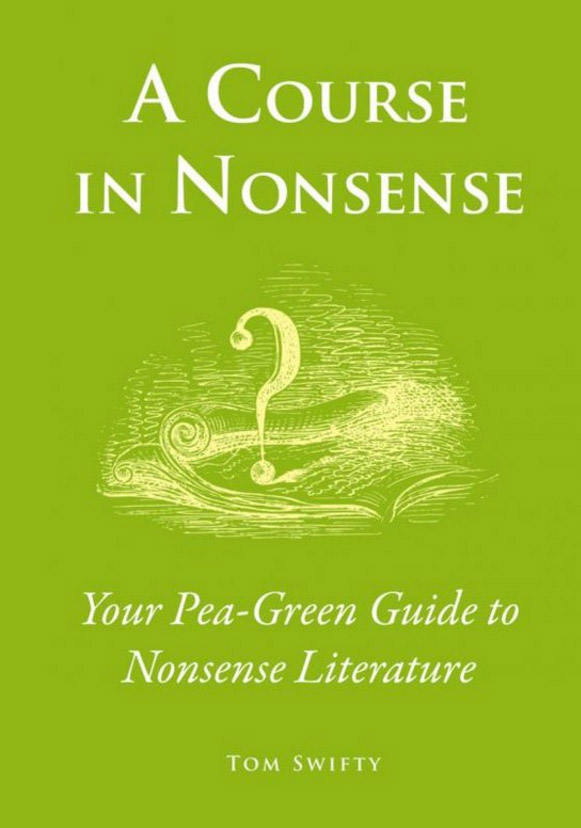
Tom Swifty’s Course in Nonsense

Swifty, Tom. A Course in Nonsense: Your Pea-Green Guide to Nonsense Literature. Rotterdam: Brave New Books, 2015.

course-in-nonsense

Tom Swifty’s book is exactly what it purports to be, a quick introduction to nonsense literature from ancient Greece to modern times.

As the American nonsense poet Dr. Seuss put it, ‘Oh, the thinks you can think!’

This book is a guide to such thinks. It is a reader’s guide with a simple premise: if you like the works of Edward Lear and Lewis Carroll, you may also like these other poems, stories and plays. These pages will show you that there us more to the English school of nonsense than just Lear and Carroll, and that there are more schools of nonsense than just the English one (5).

Although it is presented as a “consumer’s guide” (12) to nonsense and pretends to have no pretense at presenting its own theory of nonsense the volume devotes the first three chapters to showing how nonsense is “a parody of sense” based on three main principles: futility, uselessness and excess.

These opening chapters are then followed by “A Brief History of Nonsense” from Lucian’s True History to the early Victorian age, among the most interesting finds (for me) in this chapter are a “novel within the novel” entitled Il Castello di Grimgothico, or Memoirs of Lady Hysterica Belamour. A Novel inserted in Eaton Stannerd Barrett’s parodistic The Heroine, or Adventures of a Fair Romance Reader (1813) (available at Project Gutenberg in a 1909 edition) and Something Concerning Nobody. Edited by Somebody (1814).

02009_frontis

Full chapters are then devoted to Lear, Carroll, their imitators and finally one each for modern practitioners in England, America, Germany and France: these consist for the most part in short appreciations of several authors.

What I found particularly refreshing was the consistent refusal to find any sort of sense in nonsense: “We are so hopped up on sense that we have difficulty to just let nonsense be. Nonsense is our escape from the clichés of reality, so it seems a tad perverse to want to translate it all back into those terms” (77).

All in all a very useful book with only a major defect, it fails to provide a chapter on Italian nonsense: Burchiello is only mentioned in a bibliographic note, Basile, Campanile, Rodari, Toti Scialoja and Fosco Maraini – to name just a few – are completely ignored, alas. But after all, all countries probably have their own nonsense traditions and even if your name is Tom Swifty, you won’t be able to read it all.

Posted in Edward Lear | Tagged , , , | 2 Comments

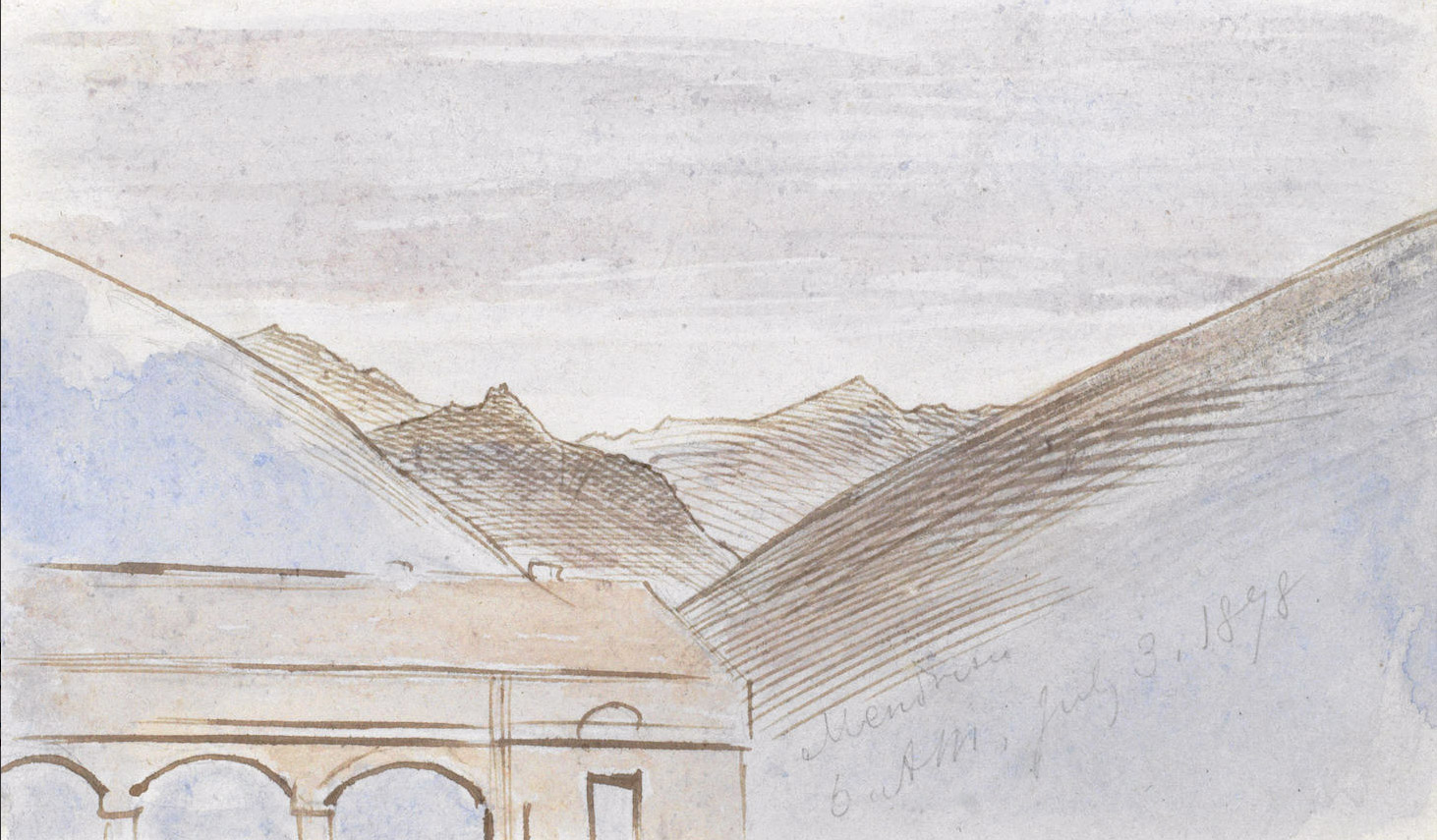
Edward Lear, A View of Mendrisio (1878)

el_mendrisio-s

Edward Lear, A view of Mendrisio, Switzerland.
Inscribed and dated ‘Mendrisio/6 AM, July 3, 1878’ (lower right). Watercolour and ink, unframed. 9 x 15cm (3 9/16 x 5 7/8in).

Bonhams.

Posted in Edward Lear | Tagged , , , | Leave a comment

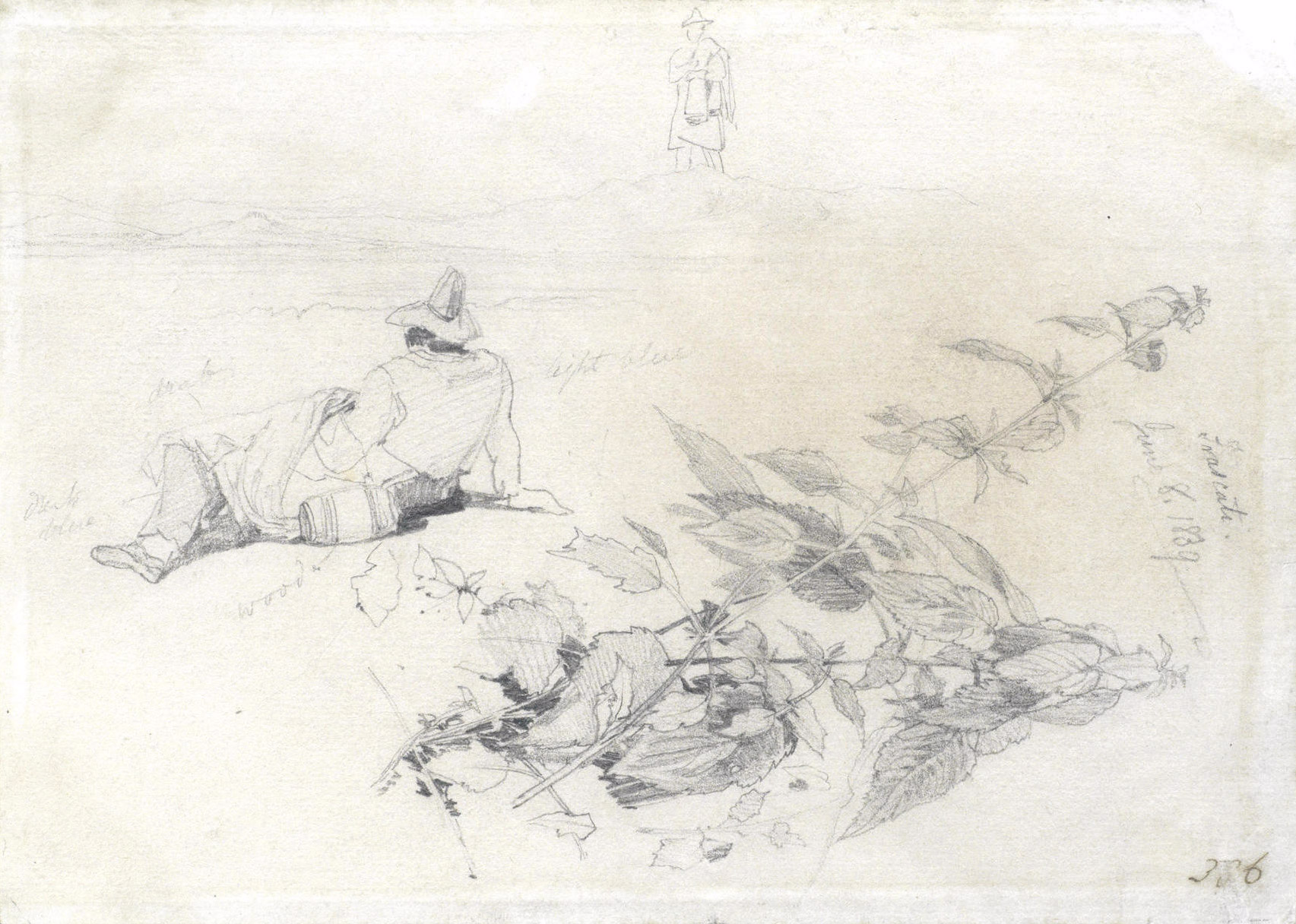
Edward Lear, Study of figures and foliage at Frascati (1839)

el_figures-foliage-s

Edward Lear, Study of figures and foliage at Frascati.
Inscribed and dated ‘Frascati./June 8.1839’ (centre right) and inscribed with colour notes (variously throughout). Pencil. 12.4 x 17.2cm (4 7/8 x 6 3/4in).

Bonhams.

Posted in Edward Lear | Tagged , , | 1 Comment