Edward Lear, Plain of Argos from Mycene (1879)

el_argos-s

Edward Lear, Plain of Argos from Mycenae.
Signed with monogram and dated 1879 (lower left), inscribed ‘Argos from Mycenae/1849 (lower right), also titled beneath mount. Watercolour. 29 x 52.5cm (11 7/16 x 20 11/16in).

The present lot is one of a number of similar views that Lear produced from sketches made during a trip to Argos in the spring of 1849. Executed in 1879, it predates a watercolour of the same subject, 10 ¼ x 20 ½ in., which was sold at Christie’s London, 30 March 1993, lot 84 (this may be the work acquired by the Chazen Museum of Art, Madison, Wisconsin in the same year, although that work is listed as being 19 x 28 in., in the Museum’s records), as well as a large oil of the same subject, 31 ½ x 64in., now in the collection of Trinity College, Cambridge, which was painted in 1884.

Charles Church, later the Dean of Wells, met Lear in 1847; the two men were to become lifelong friends, and Church amassed a considerable collection of his Lear’s work. They embarked on a tour of the Peloponnese in the autumn of 1848, Church acting as guide and interpreter. The trip was a litany of misfortune; firstly, Lear fell from his horse, badly injuring himself, then he had a severe reaction to an insect bite which made him seriously ill; once he recovered, Lear planned to meet up with Church to visit Mount Athos, but the area was closed to travellers due to an outbreak of cholera.

Lear returned to Greece in the spring of 1849, with another great friend, Frank Lushington, a trip that the artist remembered with great fondness, describing, in a letter to his sister ‘a mile of bright scarlet ground. Then half a mile of blue or pale pink… the whole earth is like a rich Turkey carpet.’

Bonhams.

Posted in Edward Lear | Tagged , , , , | Leave a comment

Edward Lear’s Diaries Blog News

Edward-Lear

Tomorrow I will resume posting Edward Lear’s diaries from the date I stopped over a year ago.

I will try to publish two-three entries a day until I reach the end of 1865, at which point Lear will be in Malta: the journal for that period is available in John Varriano’s book, so I will skip it. I expect to be able to begin posting day by day at a 150-year interval again by the summer.

In the next few days Lear will be going on a tour of the French and Italian Riviera and as some of the watercolours for the trip are available on the Houghton Library website, the posts will also be “illustrated.”

I hope you will enjoy the blog and look forward to reading your comments.

Posted in Edward Lear | Tagged , , | 2 Comments

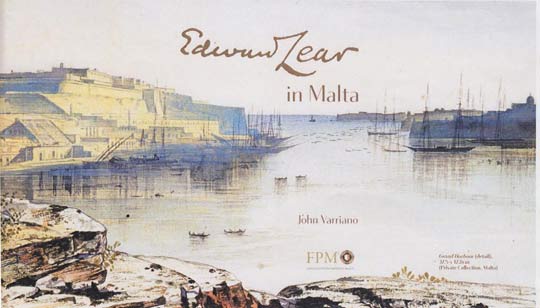
Edward Lear in Malta

I wrote the review below exactly one year ago for a newsletter of the Edward Lear Society that never appeared. Even though it is too late to visit the exhibition, you may still be able to order the book: it contains the full text (but not the dinner-table maps) of Edward Lear’s diary during his 1865-1866 stay in Malta.

I take this opportunity to announce that I will be resuming posting the Diaries in the next two or three days: since they are available in Varriano’s book until the end of March 1866, I’ll try to cover the missing months, from November 1864 (when I had to stop) to December 1865, and hopefully will resume the 150-year delayed publishing at the beginning of next April.

varriano-book

Since the success of the 2009 exhibition on Edward Lear’s tours of Ireland and the Lakes in 1835 and 1836, held in the Wordsworth Museum in Grasmere, The Lake District, in north-west England, studies on Lear as an artist have tended to focus on his visits to specific locations. Sometimes Lear’s name has been used as a basis for a discussion of the history of an area and the conditions of its inhabitants around the time of the painter’s tour, as for instance in Giuseppe Macrì’s recent Il tempo, il viaggio e lo spirito negli inediti di Edward Lear in Calabria (Reggio Calabria: Laruffa, 2012).

This is not the case with John Varriano’s  excellent volume on Edward Lear in Malta, whose publication by the Fondazzjoni Patrimonju Malti was timed to coincide with the opening of an exhibition of Lear’s Maltese watercolours at Palazzo Falson from 18 October 2014 to 4 January 2015: Edward Lear: Watercolours and Words. The book provides a list of all known pictures painted by Lear while on the island, with well-printed, though generally rather small reproductions of those the author was able to locate. The catalogue is organized around extensive transcriptions of relevant passages from Lear’s letters and diaries, although it seems Varriano did not have access to Lear’s unpublished letters to his sister Ann and so missed some relating to Malta. The checklist at the end of the book, which follows Lear’s own numbering, includes over 300 items, many of which cannot be located or identified at present.

Varriano’s “Introduction” is especially skilful in the formal analysis of Lear’s plein air drawings. The watercolours are discussed in the context of the production of other painters working in Malta at the same time ― Michele Bellanti and Giovanni Schranz ― as well as in relation to the tradition of Samuel Prout’s and David Roberts’s “tinted drawings,” in which “the line typically defines formal boundaries with the colour washes remaining secondary.”  More questionable is perhaps Varriano’s definition of James Duffield Harding as a painter who “followed in his [Lear’s] steps,” when Lear is known to have been deeply influenced by Duffield’s manual, Elementary Art; or, the Use of the Lead Pencil Advocated and Explained (1834). However, it would certainly be hard to take issue with the author’s conclusion that Lear’s watercolours “remain a unique hybrid of the Romantic sensibility that attracted him to the poetics of Tennyson, and the earlier, more clear-headed English documentary tradition.”

The introduction also provides an overview of Lear’s visits to Malta, listing a total of seven, most of them just for a few days while sailing to other destinations. Varriano misses the eighth, on 14 December 1866: while he was on his way to Egypt, Lear only stayed an afternoon, but it was quite busy according to the diary entry:

 […] 10. walk deck, Lovely morning. 11. Gozo in full sight. Odd indeed to see places, formerly so uninteresting, now so accurately known, Nadur, Rabats [sic] &c. (Short parenthetical  lunch ― Captn. Guning ― Mrs. G. Sutton’s nephew.) ― & lo! the Sliéma House! ― At 1.30 in harbour, & shortly in a boat & up to palace with one box & hat box. Weather ever lovely. Paolo. Peel ― fat & well. Legh, Major Deedes. At 3, with Peel to Genl. Ridleys ― “same one good soul.” Then P. & I walked out, & I called on H.T. Williams ― (out) ― Lady Houlton (Mrs. Xtian there ― all piny whiny ―) Mrs. Legh ― & Mrs. Goodeve, & Goff. Back at Palace by 6. Mrs. Williams amiably came. As I returned, it rained but I trust, no change of wind. Bowden came, a plenum. At 7. Peel. 7.30 ― Legh & Deedes ― dinner ― which the dinner & champagne ― O! Deedes is a nice kindly sort of man, but poor dear Leghs arguments! At 11 ― John Peel the good & kindly would see me to the boat, & Giuseppe the seal with a big coat ― into the ship. J. Peel is one of a 1000 ― & I grieve to see him only for a moment & no more. Yet, ἒτζι εἶναι [so it is]. ― Now that I am in this vast silent ship at midnight, how strange does this short Parenthesis of Malta life seem!

We also have John Peel’s version of this visit in a letter of 23 February 1867 to his younger brother Archibald, a good friend of Lear’s; the painter is presented in one of his dark moods, though ready to appreciate that champagne:

 Edwin [sic] Lear, when he passed through, dined with me; he was as usual somewhat melancholy, and foretold the death of his remaining relatives, several in number and his own total blindness and impecuniosity like Micawber; however he brightened up, and concealed a good deal of liquor about his person, he is now up the Nile, and I owe him a letter. (Recollections of Lady Georgiana Peel; Compiled by Her Daughter Ethel Peel. London: John Lane, The Bodley Head, 1920. 239)

Peel had been Assistant Military Secretary to Sir Henry Storks, Governor of Malta since November 1864 and the real reason ― together with his A.D.C. Evelyn Baring ― behind Lear’s decision to spend the 1865-66 winter there. Unfortunately, “Sir Storky” and Baring had sailed to Jamaica to investigate the conduct of the Governor, John Eyre, two days before Lear’s arrival on 9 December 1865: “No greater bore could have occurred,” he wrote in his diary.

Lear had never really liked Malta, even though this was where, in February 1849, he first met Franklin Lushington ― to whom he would be deeply attached all his life ― and the 1865-66 stay only confirmed his first impression, as it had been expressed in a long unpublished letter to his sister Ann:

 Dumford’s Hotel, Valletta, Malta
April 9th., 1848.
My Dear Ann,
[…] Malta itself, is an island all over rock & sand & a little soil, & crammed in every crevice with people & houses. Valetta [sic] is the city ― but somehow one never thinks of any other name than Malta. Such a strange place as Valetta I certainly never did see ― & as a town it is perhaps as beautiful as any existing. The houses all look as if built yesterday ― of a beautiful cream coloured stone, with green or white or painted balconies stuck about in every possible corner. The streets have all capital trottoirs, & there is no dirt to be seen. […] All round the town & two harbours the lines of fortifications are most surprising ― you walk in labyrinths, & when you have got outside, it begins all over & over & over again. ― Zig zag ― zig zag ― up stairs & down stairs ― sharp corners & half moons, moats, drawbridges, bastions & towers till you feel as if built up in Valetta for life. As for the country, there is none; stone walls & stone houses & stone terraces for miles, & villages as far as you can see ― so that you may say that all Malta is a great heap of stone in the Mediterranean with a little ground here & there for cultivation. […] (Full letter.)

His next letter to Ann, of 19 April ― from which Varriano quotes ― is probably the best expression of Lear’s contradictory feelings on Malta: “I cannot remember to have left any place with so much regret after so short a stay in it … But I could not live at Malta ― there is hardly a bit of green in the whole island ― a hot sandstone, wall, & bright white houses are all you can see from the highest places…”

John Varriano’s book is a welcome addition to a growing body of literature dealing with Edward Lear’s travels and, notwithstanding some omissions, will no doubt remain the standard treatment of his connection to Malta for several years.

On Lear and Malta here at the Blog of Bosh, and recently: Edward Lear in Gozo.

Posted in Edward Lear | Tagged , , , , , | 2 Comments

The Beatles and Edward Lear

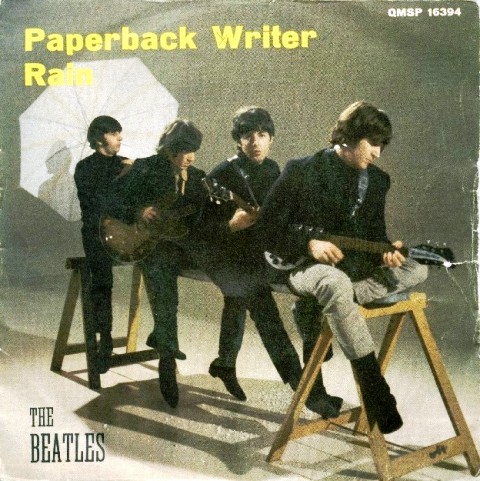
Paperback writer

The first sign of the metamorphosis that was under way in the Beatles’ music came on the group’s first single of 1966, “Paperback Writer” b/w “Rain,” a record that recalled “Can’t Buy Me Love” b/w “You Can’t Do That” in its pairing of songs that matched sharp distinctions of style with close similarities of form. Paul McCartney’s “Paperback Writer” was a satire of pop ambition in the style of “Drive My Car,” set like its predecessor in a musical context of relentless simplicity. Instead of a melody that clamors on one note, the song has a harmony that clamors on one chord, confining itself to long stretches on the tonic relieved by brief forays to the subdominant. This going-nowhere chord progression suggests a harmonic metaphor for unfulfillment that jibes with the lyrics of the song.

Like its budding author-narrator, “Paperback Writer” tries to make the most of its meager resources by heaping an elaborate arrangement on its simple harmonic frame. In the introduction, the song title is triplicated in an a cappella chorale that has Paul, John, and George staggering their entrances like children singing rounds. Their voices invert in a cascade of “writer, writer, writer” as the singers complete their lines, whereupon Ringo comes bolting out of the gate with a beat of almost comic intensity behind a driving, harshly distorted figure on guitar. “Son of Day Tripper” was how Lennon described the song, but the lyric is much wittier than that of the earlier single. There’s a wealth of satiric nuance in the formality of the author’s query on behalf of his “dirty story” with its thinly fictionalized plot and its obsessive dimensions (“a thousand pages give or take a few”). The mangled reference to “a novel by a man named Lear” sounds like a dig at Lennon, whose own paperback writings had drawn comparisons with Edward Lear. But the butt of the joke rests firmly with McCartney himself. He, after all, was the one who wrote the query letters back in the days of the Quarry Men and the Silver Beatles, soliciting work for the band in his most affected grammar-school prose. And the tight fit between the singer and his character helps to drain the condescension from the song. When Paul exclaims the words “Paperback Writer” at the end of every verse, he brings a starry-eyed reverence to this dubious occupational title that almost stands up to the punning counterpoint of “Pay-per-back-er” (sung to the tune of “Frère Jacques”) that John and George provide.

If the words and music of “Paperback Writer” could be said to capture some of the spirit of London in 1966, enlivened by people from all stations of society on the move and on the make, then John Lennon’s “Rain” on the flip side of the single captured the dreamy private languor that formed the flip side of the city’s “swinging” scene. The two tracks are similar in the simplicity of their chord progressions and the fullness of their sound, but the rhythm of “Rain” feels enervated, and the accompaniment eschews the clipped, Mod-like precision of “Paperback Writer” for a more impressionistic wash. Where the one track is a line drawing, the other is a blurry pastel.

In keeping with the allusion to Edward Lear on McCartney’s side of the single, the they who run and hide from the weather in Lennon’s song, the they who “might as well be dead,” resemble the they of Lear’s limericks: “the realists, the practical men, the sober citizens in bowler hats who are always anxious to stop you doing anything worth doing,” as George Orwell once described Them. “Rain” is a postcard from Weybridge, a subversive salutation from the heart of the stockbroker belt. The lyric is more overtly imagistic than in any previous Beatles song, with “rain” and “shine” juxtaposed as mere “states of mind” in a meteorological yin and yang. The accompaniment is more imagistic as well, dominated by droning guitars, long rolls from the drums that rattle through the verses, and lush choral singing in the bridge that fills the air with melismatic sheets of sound: “Ra-a-a-a-a-a-a-a-a-ain—I don’t mind! Shi-i-i-i-i-i-i-i-ine—the weather’s fine!” Another novel element is the treatment of Lennon’s voice, lispy with treble and thickly double-tracked, which seems to be strained through the soup of drums and guitars. “Can you hear me?” John asks in the song’s last intelligible line, introducing a coda in which the drumrolls and the choral voices mingle with an audio hallucination created by rerecording the vocal track backwards. The result is a stream of apparent gibberish that retains the form of speech but reverses the shape of its acoustic “envelope” in a way that suggests another dimension in which time and meaning have turned around.

[Gould, Jonathan. Can’t Buy Me Love: The Beatles, Britain, and America. New York: Harmony Books, 2007. 325-327.]

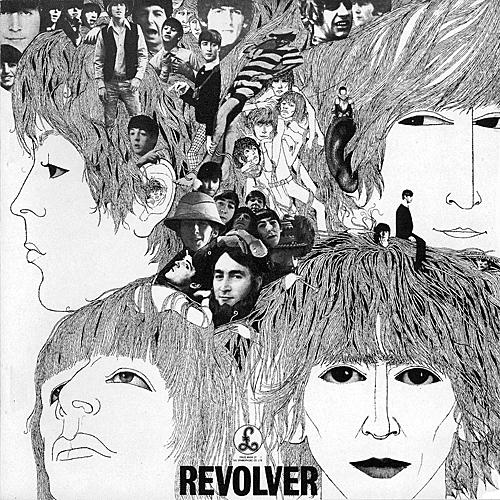
beatles-revolver

From its height of romantic rapture, Revolver next descends to the allegorical depths of the sea. Written by Paul, with help from John, expressly for Ringo to sing, “Yellow Submarine” is by all rights a children’s song, with simple words, simple chords, and a numbingly simple refrain. It is performed in a sing-along manner removed from the context of contemporary pop, sounding more like a throwback to an earlier era of participatory music-making that atrophied—among adults, at any rate—in the era of records and radio. Yet its simplicity and childishness are deceptive, for nothing the Beatles had recorded to date was more dependent on technological sleight-of-hand. “Yellow Submarine” is a simple song transformed by the wonders of multitrack technology into a sophisticated sonic pastiche. In 1966 it stood as a cockeyed monument to the whole self-sufficient and self-absorbed existence the Beatles were creating for themselves at Abbey Road. Sung by anyone else above the age of thirteen, it would have smacked of deliberate camp. But Ringo lacked the vocal resources to be anything but guileless, and he brought to the song the same deadpan quality he brought to the Beatles’ films. In his hands the Yellow Submarine became a satirically updated version of the improbable craft in which Edward Lear put his characters to sea—the Owl and the Pussycat’s pea-green boat, the Jumblies’ unsinkable sieve.

Like “Norwegian Wood,” the song begins by subverting the narrative cliché. “In the town where I was born, lived a man who sailed to sea,” Ringo drones over the strum of an acoustic guitar, “And he told us of his life, in the land of submarines.” Like all good nonsense, the lyrics to the world’s first undersea shanty are based on a single incongruity, taken to its logical extreme: men have been sailing to sea in songs like this for centuries, but not in submarines. The second verse is accompanied by the frothing of the ocean, closing in overhead, while the third competes with a hubbub of conversation, clinking glassware, and jovial bonhomie: “And our friends are all aboard, many more of them live next door / And the band begins to play….” Whereupon a full brass band does just that, shattering the calm of this polite gathering with two bars of booming oompah, which is just enough to conjure the image of tubas in a submarine. Between verses, Ringo stands at the head of a sailors’ chorus, chanting the refrain. There’s also a solo, of sorts, composed entirely of sound effects drawn from the collective unconscious of a generation of schoolboys raised on films about the War Beneath the Seas. Valves squeak, pipes hiss, bells sound, hatches slam, and crisply garbled voices relay terse commands, until the song’s last verse is discharged from this Goonish concerto with the whoosh of a torpedo exiting its tube. Here Ringo is joined by John, who echoes each line in the strained, sardonic voice of an old vaudevillian with the crowd in the palm of his hand. John signs off with a maniacal laugh and the ship’s company falls in for the final refrain, which has taken on an aura of daffy sincerity like some old patriotic number, sung to the tramp-tramp-tramp of marching feet.

[Ibid. 355-356.]

Posted in Edward Lear, Podcasts | Tagged , , , | Leave a comment

“A Master of the Faux Demotic”

Would you believe this is a characterization of Edward Lear?

Miller, Sam. A Strange Kind of Paradise: India Through Foreign Eyes. London: Vintage Books, 2014. 184:

Edward Lear, the English illustrator and poet, a master of the faux demotic and best known for writing nonsense, said after a trip to Agra in 1874, that the world could be divided into two groups of people ― ‘them as has seen the Taj Mahal; and them as hasn’t’. The Taj was firmly on the tourist trail by then, and when, a year after Lear, the future Edward VII popped by, he pointed out, rather wisely, I think that it was commonplace fro every writer ‘to set out with the admissione that [the Taj Mahal] is indescribable, and then proceed to give some idea of it’.

[Note in the same page] Lear’s limericks include Kashmir (‘scroobious and queer’), Madras (‘cream-coloured ass’), Calcutta (‘bread and butter’) but no Delhi ― surely a gift to rhymesters ― or Agra. Lear also wrote a nonsense verse called The Cummerbund: An Indian Poem in which he deliberately misuses every Anglo-Indian word he comes across. It ends “Beware, ye Fair! Ye Fair, beware! / Nor sit out late at night, ― / Less horrid Cummerbunds should come / And swallw you outright.’ A cummerbund is in fact a sash worn around one’s middle, similar in some ways to the Virgin Mary’s girdle.

[Note on pp. 104-105] The Virgin’s girdle was not the corset-like undergarment of moden English innuendo, but a belt or sash, sometimes known as a cincture, or zone in Greek, and said in Mary’s case to have been made of camel hair. As well as the tradition that Thomas received the girdle because he was late getting there [to Palestine to attend the death and assumption to heaven of the Virgin Mary] from India, it’s also said that, as with the resurrection, Thomas doubted what his eyes were seeing ― and that the possession of the Virgin’s girdle convinced him that he wasn’t imagining things. A piece of mary’s cincture is among the relics held at the Monastery of Vatopedi on Mount Athos.

Posted in Edward Lear | Tagged , , | Leave a comment

2015 in review

The WordPress.com stats helper monkeys prepared a 2015 annual report for this blog.

Here’s an excerpt:

The concert hall at the Sydney Opera House holds 2,700 people. This blog was viewed about 29,000 times in 2015. If it were a concert at Sydney Opera House, it would take about 11 sold-out performances for that many people to see it.

Click here to see the complete report.

Posted in Uncategorized | Leave a comment

Edward Lear in Gozo

Edward Lear, Below Rabato, Gozo. 20 March 1866, 9.00am n. 193

Edward Lear, Below Rabato, Gozo. 20 March 1866, 9.00am n. 193

A new essay on Edward Lear has been added to the bibliography:

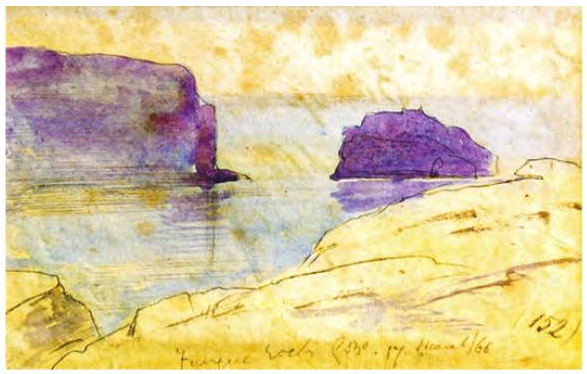
Edward Lear, Fungus Rock, Gozo. 17 March 1866 n. 152.

Edward Lear, Fungus Rock, Gozo. 17 March 1866 n. 152.

Tabone, Joseph Attard. “Edward Lear in Gozo, March 1866.” Every Traveller Needs a Compass: Travel and Collecting in Egypt and the Near East. Eds. Cooke, Neil and Vanessa Daubney. Oxford: Oxbow Books, 2015. 15-21.

Edward Lear, Scklendi, Gozo. 20 March 1866, 11.30 am n. 200.

Edward Lear, Scklendi, Gozo. 20 March 1866, 11.30 am n. 200.

It can be read in full on Google Books (at least here in Italy). Also relevant to Lear and available in full is

Anderson, Sonia P. “Sir John Young, High Commissioner for the Ionian Islands, and His Private Letter Book, 1856–571.” Every Traveller Needs a Compass: Travel and Collecting in Egypt and the Near East. Eds. Cooke, Neil and Vanessa Daubney. Oxford: Oxbow Books, 2015. 1-13.

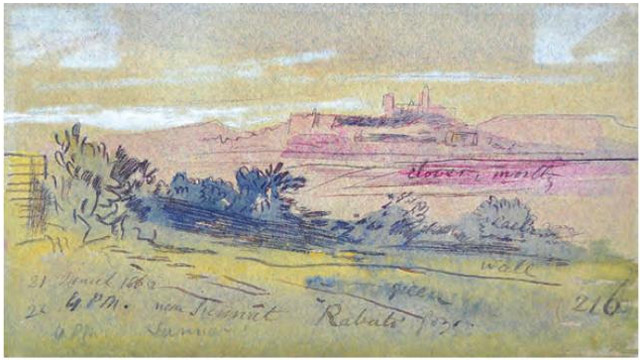
Edward Lear, Near Sannat (Rabato), Gozo. 21 March 1866, 4.00 pm n. 216.

Edward Lear, Near Sannat (Rabato), Gozo. 21 March 1866, 4.00 pm n. 216.

Edward Lear, Near Nadu, Gozo. 23 March 1866, 2.30 pm n. 233.

Edward Lear, Near Nadu, Gozo. 23 March 1866, 2.30 pm n. 233.

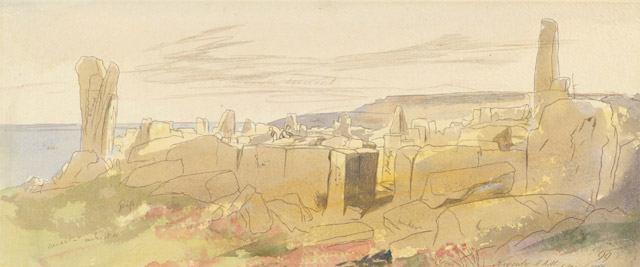
Meanwhile, the National Gallery of Victoria has launched its digital collection, which includes six paintings by Edward Lear, one of Krendy, Gozo (n. 99):

EL-Krendi

Posted in Edward Lear | Tagged , , , , | 1 Comment

Syd Barrett and Edward Lear

syd-barrett-ABC

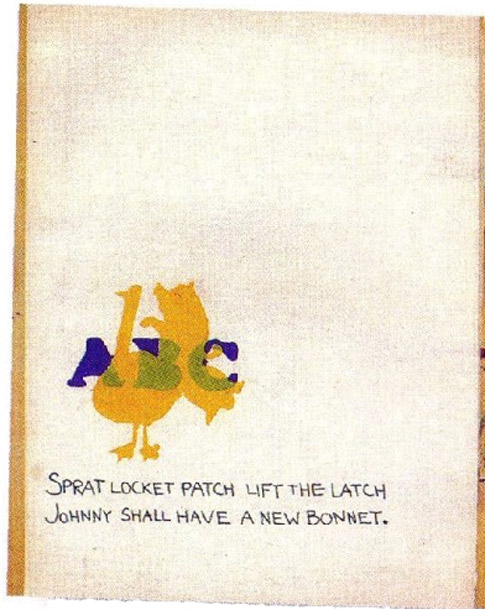
[Syd Barrett’s Fart Enjoy contains] two pages of cut-up nursery rhymes. One reads:

Sprat Locket Patch Lift The Latch.
Johnny Shall Have A New Bonnet

The other reads:

Hark! Jack Was Diddlty Dumpty
All Jolly
To Market To Buy A Plum Cake

The former is accompanied by a drawing of a three-headed creature (turkey, pig and cockerel?) which mimics the style of Edward Lear’s animal grotesques. The letters ABC are stencilled across it – a reference to Cobbing’s recently published ‘ABC In Sound’. The latter is accompanied by a drawing of a rouge-cheeked boy wearing green cap, shorts, sandals and a blue T-shirt.

syd-barrett-J

These cut-ups are composites of eight rhymes: ‘Hark! Hark! The Dogs Do Bark’, ‘Little Jack Horner’, ‘Diddlty Diddlty Dumpty’, ‘We’re All Jolly Boys’, ‘To Market to Market to Buy a Plum Cake’, ‘Lucy Locket Lost her Pocket’, ‘Cross Patch Draw the Latch’ and ‘Johnny Shall Have a New Bonnet’. Syd took these rhymes from Kate Greenaway’s illustrated Mother Goose anthology, where they comprise eight of the first twelve rhymes in the book.

The first edition of Greenaway’s pocket book was published in 1881 and contained fifty-four pages of colour chromolithograph illustrations and rhymes. It ran into numerous reprints. Many households of Syd’s generation would have had one of the many Mother Goose anthologies that had been in circulation since folklorists began collecting nursery rhymes during the Victorian era. These rhymes, frequently dark and macabre in tone, and the lavish illustrations that accompanied them, burned their way into many a young child’s imagination. Nursery rhymes in general, and the Mother Goose rhymes in particular, were integral to Syd’s development as a songwriter. His use of them in the Fart Enjoy booklet gives us the first indication of the centrality of childhood motifs to his work, and they would become a common thematic thread in his lyrics for Pink Floyd. The way they are utilised in Fart Enjoy suggests that Syd, transforming whatever materials he had at his disposal and working, as Andrew Rawlinson put it, ‘in the immediate context’, was now beginning to develop a highly inventive approach to language to match the sophisticated touch and technique of his painting. There was nothing rigorous or methodical about it. Syd simply used whatever was available, in this instance a pocket book of nursery rhymes, and deconstructed it.

[Chapman, Rob. A Very Irregular Head: The Life of Syd Barrett. Cambridge, MA: Da Capo Press, 2010. 63-65. Google Books.]

‘You’ve gotta look at Cambridge really; you’ve gotta look at Lewis Carroll and Edward Lear, more than the lifestyle thing,’ says Pete Brown of Syd’s influences. ‘Maybe it’s inspired by people like Rimbaud and Verlaine and people like that, but I think the English fringe thing is more to do with it, always has been. Language, lateral thinking, looking at the weirdness of British existence, looking at rural or semi-rural peculiarities.’

No account of Syd Barrett’s creative blossoming can take place without examining these earliest and most enduring influences. The lives and works of Edward Lear (1812-88), Charles Dodgson, aka Lewis Carroll (1832-98), Kenneth Grahame (1859-1932) and Hilaire Belloc (1870-1953) form a thematic framework within which Syd’s initial flowering as a songwriter can be contextualized and understood. The songs that were overtly influenced by Belloc, Grahame et al. only constitute a very small body of his oeuvre but these are the songs for which he is best known and on which his reputation as a songwriter largely rests.

‘The English Robin and Puck and Goodfellow thing. The slightly whimsical faery quality that he had,’ notes Emily Young. ‘It’s from the English folk tradition, but not the English workingman one. You’re not quite sure if he will appear or disappear. More of the Irish and Celtic and less of the Germanic. Something of “the trees have secrets”. I think he was absolutely in touch with that.’

As Emily Young suggests, Syd was very precise in his absorption of childhood literature. There is nothing of the Germanic or Norse tradition, no Hans Christian Andersen, no Aesop, no Brothers Grimm and, despite what some have suggested, little or no Tolkien either. He draws very directly upon Belloc, Grahame, Lear and Carroll, and little else but the merest hint of C.S. Lewis and the found material he plundered from a few nursery rhyme pocket-books.

[Ibid. 143-144.]

Edward Lear created a fascinating nonsensical cosmogony of human, animal and plant life, populated by such creatures as the Jumblies, the Quangle Wangle, the Pelican Chorus, the Akond of Swat and, perhaps most famously, the Dong with the Luminous Nose. He wrote nonsense botany, nonsense recipes, nonsense limericks and nonsense songs and constructed an entire nonsense alphabet.

John Lennon was clearly the pop world’s most obvious descendant of Lear. The characters that populate his books John Lennon in His Own Write (1964) and A Spaniard in the Works (1965), such as Eric Hearble, Treasure Ivan, the Wumberlog and Mr Boris Morris, as well as the language that describes them and the sketches that accompany them, are highly reminiscent of Lear. Although the influence was never as overt in Syd’s work (his influences rarely were), he exhibited the same sense of playful absurdity.

Syd’s letters to Libby crackle with the same kind of offbeat wit and invention that characterised much of Lear’s own correspondence. Often Syd is undeniably juvenile ― e.g. a drawing of a limbless man sunbathing is accompanied with the caption ‘Don’t disturb him, he’s quite armless’ ― but then so is much of Lear’s work. Documenting his travels through the Scottish Highlands with his friend Phipps Hornby in 1841 Lear drew a series of bizarre illustrations depicting the two men cramming huge game birds into their knee-high boots (‘P & L being hurried insert the remains of their lunch in their boots’) and Lear being comically poked in the eye by a brush-wielding child (‘L ― on ascending the cabin stairs ― nearly loses his eye by the abrupt and injudicious promission of a new broom in the hands of a misguided infant’). Syd sent Libby illustrations depicting, among other things, a stick man carrying a huge sausage above his head (‘sausage thief running’) being pursued by another stick man (‘copper ― whistle note (G#)’). Another drawing, captioned ‘ A retch [sic] goes to school with his paints in a box while all sleep and are not bothered’, is pure modern-day Lear in its lyrical inventiveness.
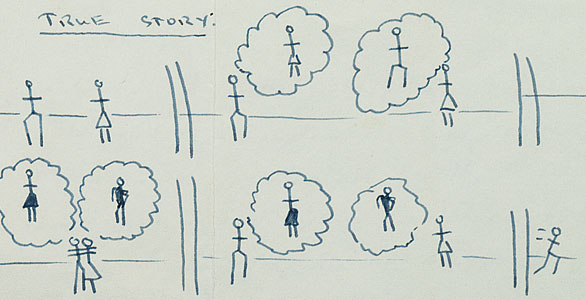
I could not find a decent image of the stickman running away with a sausage, so here's another "sticky" picture story, cf. here.

I could not find a decent image of the stickman running away with a sausage, so here’s another “sticky” picture story, cf. here.

Syd even walked like a Lear illustration. As biographer Vivien Noakes noted, many of Lear’s drawings were suffused with ‘a sense of movement ―the arms are flung spontaneously back like bird’s in flight and the legs stride out or stand poised expectantly on tip-toe as if they are going to be spun round like a child’s top’.

Like Lear, Syd would populate his lyrics with imagery drawn from botany, zoology and nature. Lear and Carroll influenced the clarity of his lyrics too, and, of course, a key chapter in Kenneth Grahame’s Wind in the Willows, ‘The Piper at the Gates of Dawn’, where Rate and Mole embark upon a mystic odyssey downriver and encounter the great god Pan, provided the title of the first Pink Floyd LP. Interestingly enough, Grahame only wrote the ‘Piper’ and ‘Wayfarers All’ chapters in the book almost as an afterthought, in order to give the book its mystic dimension. Coincidentally Syd only named Pink Floyd’s debut LP at the last minute. The album’s working title right up until July 1967 was Projection.

[Ibid. 147-149.]
Posted in Edward Lear, Nonsense Lyrics | Tagged , , , | 1 Comment

Nonsense Programmes

As usual for the Christmas period, the BBC has a few Nonsense-related programmes you can listen to while still available on iPlayer Radio:

Drama of the Week, which you can download as a podcast, is Jeremy Iron’s reading of T.S. Eliot’s Old Possum’s Book of Practical Cats (this was first broadcast on 25 December in two parts).

Lewis Carroll’s The Hunting of the Snark was the Drama for Chrismas Day at 14:15, narrated by Tony Robinson with music by Katie Chatburn, Dorry Macaulay, Kathryn Williams, Stephen Cordiner and Jasper Wilkinson.

On the same day, Words and Music has “Sheila Hancock and Scott Handy read poems and prose on the festive theme of giving and receiving gifts. Through the words of writers from Robert Herrick to O. Henry, and from Edward Lear to Walt Whitman.” Actually, only one Lear limerick (There was an Old Man in a Pew, around 37:00) is read by Scott Handy with a nice music box accompaniment (Angel Polka).


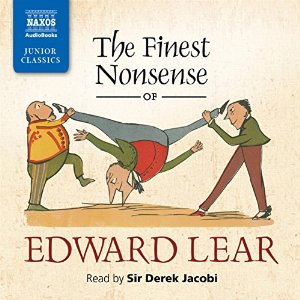
The Finest Nonsense (Lear read by Jacobi)

If you want a decent amount of Lear, Naxos has just published Sir Derek Jacobi’s reading of The Finest Nonsense by Edward Lear (listing of poems from Naxos’s website): you can get it for free with an Audible trial.

Posted in Edward Lear, Lewis Carroll, Podcasts | Tagged , , , | 2 Comments

Benjamin Rabier’s Bullets

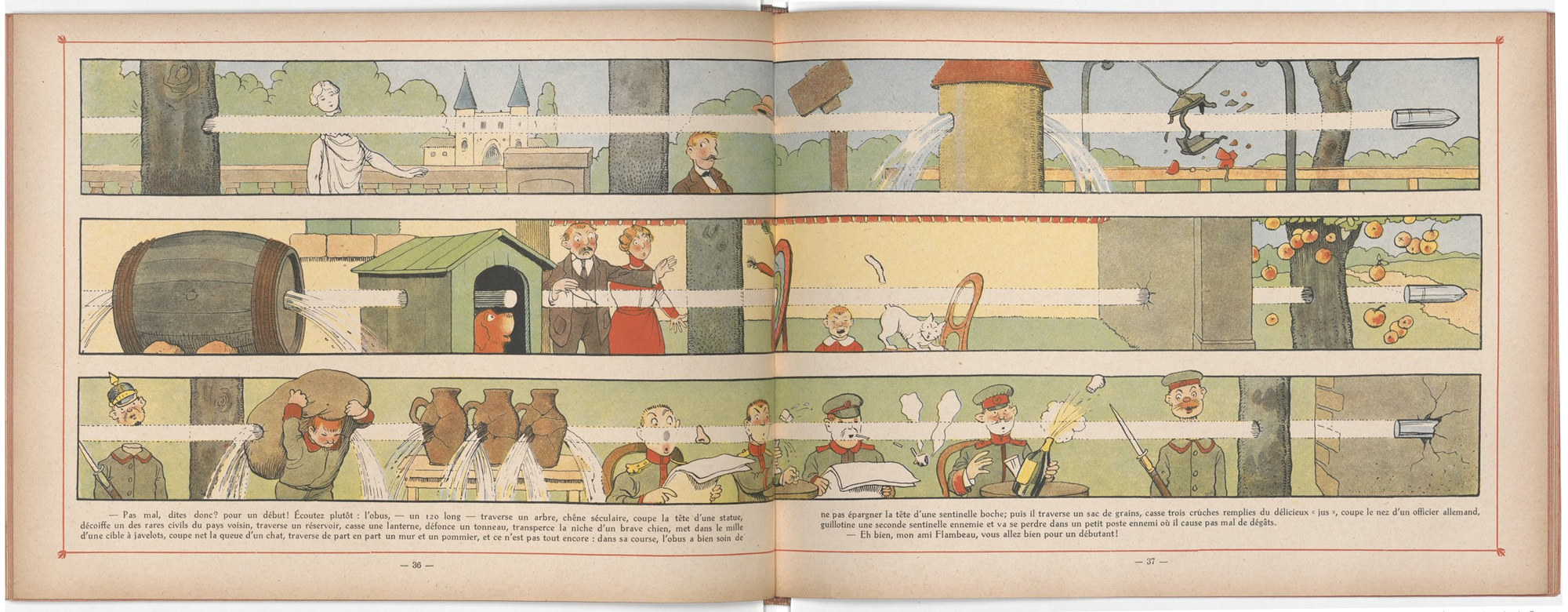
Antoine Sausverd of Töpfferiana has a very interesting post on a pair of strips by Benjamin Rabier which appear to have been influenced by Peter Newell: “Trajectoire,” a single-page story from La Jeunesse illustrée (no. 700, 11 February 1917) follows the route of a bullet through twelve panels.

Even more interesting, and much more stylish, is the use of the same idea in two facing pages (36-37) of the previous year’s album Flambeau Chien de guerre (Tallandier, 1916):

rabier2

There can be little doubt that these were influence by Peter Newell’s Hole Book (1908) and Rocket Book (1912); and how could Rabier have come to know of these books? Probably through Alfred Z. Baker who, after eloping with Newell’s daughter to France, contributed to the same children’s magazine Rabier was working for, La jeunesse illustrée, a series of “Images à renversement” in 1906-07.

Another essential post on Rabier’s use of formal constraints in his strips (his “expériences oubapiennes” as Sausverd calls them).

To celebrate this finding I have added a gallery to nonsenselit.org reproducing the whole Torn Book, another toy book published by Baker in 1913. In this one, part of each page is torn, showing a portion of the image on the next page, which completes the picture

tornbook

Rabier’s Flambeau, chien de guerre is available in full at Gallica.

Posted in Comics, Peter Newell | Tagged , , , , | Leave a comment