J.R. Green on Edward Lear in 1871

Writing to Miss Olga von Glehn from Villa Congreve (also), San Remo, on 10 March 1871, John Richard Green states:

I have just been seeing Lear’s pictures packed off for the Academy. I shall be home just in time for a visit to it with you ― do you remember our visit last year? One of the pictures hangs about me still, a quiet reach of the Nile all dead with evening, behind a fiery blaze of sunset, and in front of it the weird gigantic “wings” of a Nile boat ― dark olive green in colour. There was a strange wild creepiness about the picture, but I doubt whther it will get hung. Lear has “Academy Wednesdays” in the studio of his new house, which he has hung round with 100 of his water-colours from Egypt, Palestine, Montenegro, Greece, Italy, and the Riviera. His whole life seems to have been an artistic “Wanderjahr,” and perhaps it is owing to this that he has preserved such perfect freshness of feeling, his humour and gaiety, his love of children and nonsense. He is delighted just now with the sale of his Christmas book, some 3000 copies have gone, but his profits are only some £60! Still he is happy, and every dayy he comes in and chats and tells me of some new idea for a picture, or of some change in a picture we have seen. Surely nothing is so perfect, so self-sufficing as the artist-life. (Letters of John Richard Green, edited by Leslie Stephen. London: Macmillan, 1901, pp. 290-291. Available at archive.org.)

He continued the letter on 20 March:

Is it possible this letter can still be here, dear Olga, lurking in secret places, when I thought it resting next to your heart or buried under your pillow to woo sweet dreams? What a change since I began it ― Lear vanished and San Remo vanished, and around me instead of the soft circle of its olives the hard red line of the cliffs of Mentone! (Ibid. p. 291.)

In 1871 Lear had four paintings in the Royal Academy:

Cattaro in Dalmatia.
On the Nile near Assioot.
On the Nile, Nagadeh.
On the Nile near Ballas.
(Algernon Graves, The Royal Academy of Arts; a complete dictionary of contributors and their work from its foundation in 1769 to 1904. London: Henry Graves and Co., 1906, vol. V, p. 13.)

The one Green describes might be “On the Nile near Assioot,” perhaps the one sold at Bonhams in 2009, though I do not see “gigantic wings:”
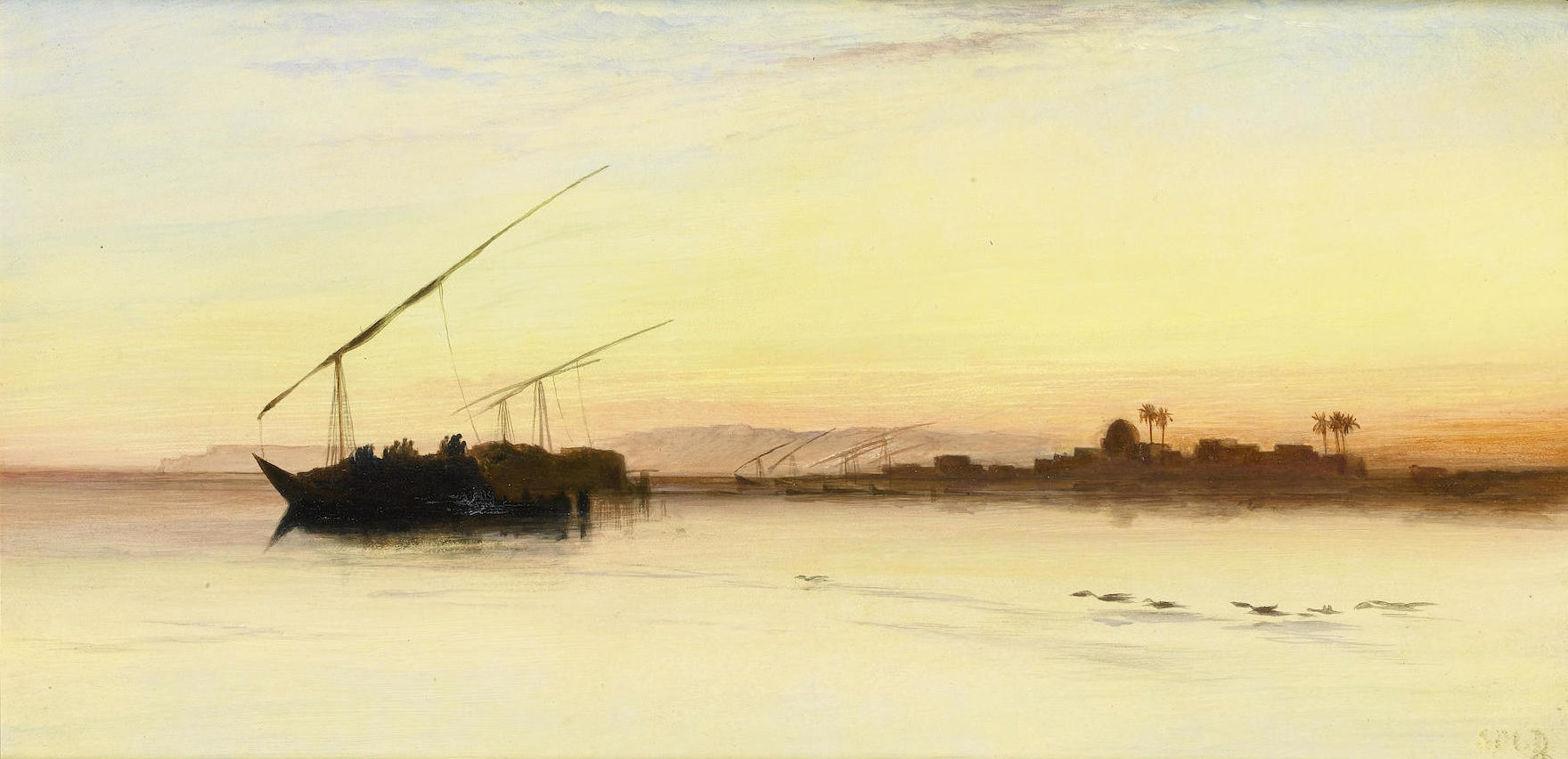
el_Nile-near-Assioot-s

John Richard Green, “the people’s historian,” should be the “reverend” Green which had an important part to play in the scandal of Walter Congreve’s relationship with a servant; on p. 212 we are told that

In 1870 he made his first journey in search of health, and spent the winter mainly at San Remo. The winter of 1871-72 was again spent at San Remo.
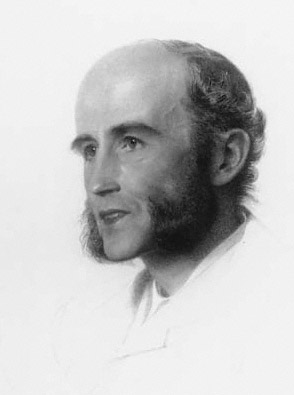
jr-green

John Richard Green (1837–1883), by Frederick Sandys, 1882.

Though at the time he was writing his magnum opus (1869-1874) he should have had “scarcely a hold on life” and been “incessantly vexed by the suffering and exhaustion of constant illness, perplexed by questions as to the mere means of livelihood, thwarted and hindered by difficulties about books in the long winters abroad” (“Introduction” by his wife, Alice Stopford Green, to the first volume of his A Short History of the English People. London: Macmillan, 1902, p. xix) he seems to have had a very active part in Congreve’s affair, at least as it is told in Lear’s diary.

On hearing from Giorgio that Congreve was thinking of bringing back Ellen, the pregnant servant, and marrying her, Lear rushed to Villa Congreve “to see Green,” who, on hearing of this, “owns (& denies not) that E. ― was ‘far from’ unwilling to act in unison with himself or with Lambert” (Diary, 13 December 1871): which seems to mean she was available as a lover to other men.

Lear’s investigation into the affair came to an end on 13 February 1872 when Congreve told him what had really happened, according to Ellen:

Congreve sent a note by the boys ― “anxious to see me ― much cleared up” &c. ― so we were to meet at 4.30, & he came then. He began at once on the misery topic. He had said to E. on going there [Nice, where she was staying] ― “what is there between you & Mr. G. Tell me the truth.” & she said ― [“]O! ― how glad I am you ask! It is the only thing I have concealed from you; & I have never had moral courage to tell you.” ― Then she confessed that early last winter [i.e. 1870-1871] G[reen] had attacked her saying he saw plainly there was something between her & C[ongreve] ― & that he might also share the good. She resisted all this, ― but one night he came to her room, & preventing her alarming the house, lay down on her bed, & told her stories ― some of wh. are unique as ecclesiastical=libidinous. Being fearful of scandal she endured that more than once, getting however, more & more angry ― but as he came at 3 or 4 A.M. he surprised her asleep. One morning he used force, & nearly succeeded, ― but desisted on her violent resistance & commencement of alarming the house. After that, he did not touch or look at her. As the connexion between her & C. never took place till May ― (by day times ― when E. brought some broth to C. he being in bed & unwell,) ― all his inventions about her “details” are sheer lies: ― & not only this, but scores of lies are evident on the whole of his story. By his own account to E. ― he had women, great & lowly ― right & left: ― but he got her to promise silence on what he had done, by appealing to her pity as to if she would like to ruin his professional prospects. It is not possible to put down a 100th part of what C. told me; but I am well sure that G. is a bad fellow out & out.

The story is told in greater detail in Michael Montgomery’s biography (pp. 239-241); however, neither Montgomery nor Levi, the only ones to mention Green, connect the person to the historian: Montgomery even wrongly states that he was “the local Anglican vicar.”

The fact that Green had had “women, great & lowly” throws a shadow on his period as a curate in Stepney:

He served as curate at St Barnabas, Finsbury (1861–3), Holy Trinity, Hoxton (1863–4), and St Peter’s, Stepney (1864–5); in 1865 he was appointed incumbent of St Peter’s. In addition to his religious duties, Green undertook a gruelling regimen of social work among his parishioners, including the district’s many prostitutes.
Anthony Brundage, ‘Green, John Richard (1837–1883)’, Oxford Dictionary of National Biography, Oxford University Press, 2004 [http://0-www.oxforddnb.com/view/article/11391, accessed 14 Feb 2016]

Posted in Edward Lear | Tagged , , , | 1 Comment

Emo Verkerk’s Portraits of Edward Lear

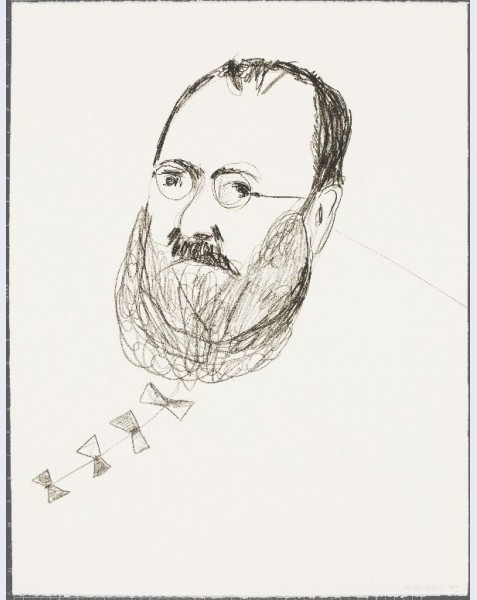
Painter and sculptor Emo Verkerk has produced several portraits of Edward Lear over the years, here are three, from the Gemeentemuseum Den Haag website.Studie voor Portret van Edward Lear (1985)

Studie voor Portret van Edward Lear (1985).
Oil and collage on plastic canvas. 55,5cm x 40cm. Gemeentemuseum Den Haag: 1005685.

Edward Lear 1989

Edward Lear (1989).
Litho, ink on paper. 65,5cm x 50,5cm. Gemeentemuseum Den Haag: 1005496.

Edward Lear 1985-1999

Edward Lear (1985-1999).
Inkjet print on photo paper with glass painting. 86cm x 67cm. Gemeentemuseum Den Haag: 1005688.

Here is an article presenting a recent exhibition of Verkerk’s work.

Posted in Edward Lear | Tagged , | Leave a comment

More Edward Lear Online from Houghton

el_palmA quick note on new Edward Lear materials which Houghton Library have placed online:
Studies of palm trees. 1876. TypDr 805.L513.76p (1-8).

Poems and songs by Alfred Tennyson / set to music, and inscribed to Mrs. Alfred Tennyson by Edward Lear. London: Cramer, Beale & Chappell, 1853-1860. Typ 805L.53.

Gray, John Edward. Gleanings from the menagerie and aviary at Knowsley Hall.Knowsley: Privately Printed, 1846. Typ 805L.46 (B).

Also, the Athos – Agion Oros blog has an article summarising the Edward Lear pictures of Mount Athos they have posted over the last decade: here is a full list of relevant entries.

Posted in Edward Lear | Tagged , , , , | Leave a comment

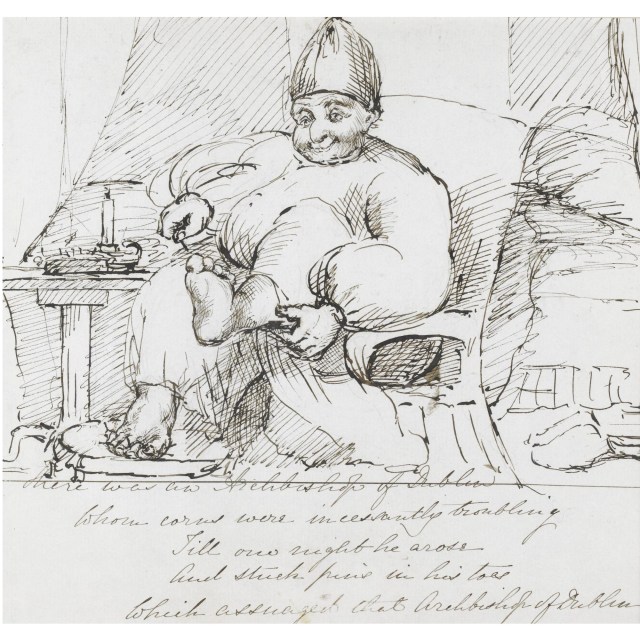
The Archbishop of Dublin (NOT a Lear Limerick)

L09777-154-lr-1

There was an Archbishop of Dublin
Whom corns were incessantly troubling
Till one night he arose
And stuck pins in his toes
Which assuaged that Archbishop of Dublin.

This was listed on at a Sotheby’s auction as one in a pair of illustrated Edward Lear limericks: while the limerick is not bad, it is most definitely not by Lear.

Catalogue description:

Lear, Edward.
TWO ILLUSTRATED LIMERICKS, COMPRISING
i) ‘There was a young lady called Emma’, ink drawing of a bald lady seated at a dressing table, 86 by 105mm. with five-line verse below; ii) ‘There was an Archbishop of Dublin’, ink drawing of a clerical gentleman sticking pins in his toes, 150 by 211mm. with five-line verse below; both unsigned, both on single leaf of paper, mounted, framed and glazed on both sides.

Posted in Edward Lear | Tagged , | 1 Comment

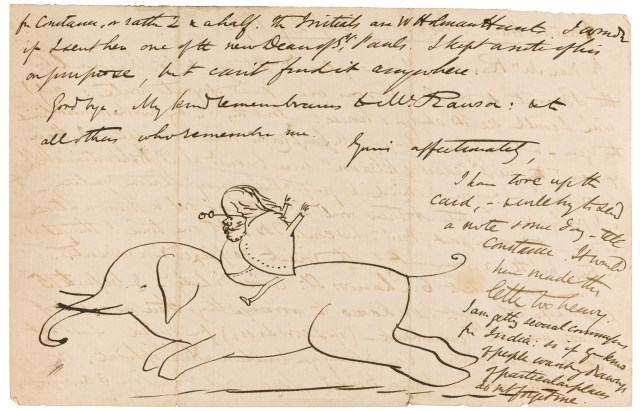
Edward Lear’s Letters to Ellen Rawson & Daughter

177L13406_763R7

This is part of a collection of 11 letters Edward Lear wrote to Mrs. Ellen Rawsom and her daughter Constance which were sold at Sotheby’s on 10 December 2013. Does anyone know where they ended up?

The catalogue description:

SERIES OF 11 AUTOGRAPH LETTERS SIGNED, TO MRS ELLEN RAWSON (6) AND HER DAUGHTER CONSTANCE (5),
one with a pen and ink drawing of Lear astride an elephant, discussing his art (“…My last – & perhaps best, – large oil paintings (Argos, Pentedatelo, Gwalior, & Ravenna,) should have been sold at Christie’s, but just now Christie’s have odiously set forth that they have not been applied to early enough…”) and poetry, his life in Italy (“…I weary exceedingly of living so much alone – tho’ I don’t see how it is to be helped…”) and plans to visit India (“…Can I bring you back a Nelliphant? Or some India Rubber or India Nink?…”), repeatedly promising to send various autographs for Constance’s collection, 40 pages, 8vo and 12mo, San Remo, Genoa, Derby, London, and Brighton, 27 August 1872 to 25 May 1884, also with an autograph address panel by Wilkie Collins, to Lear (postmarked 25 August 1883), marginal nicks and tears, some dust staining

Posted in Edward Lear | Tagged , , , | Leave a comment

There Was an Old Man of Cape Horn…

el_horn-s

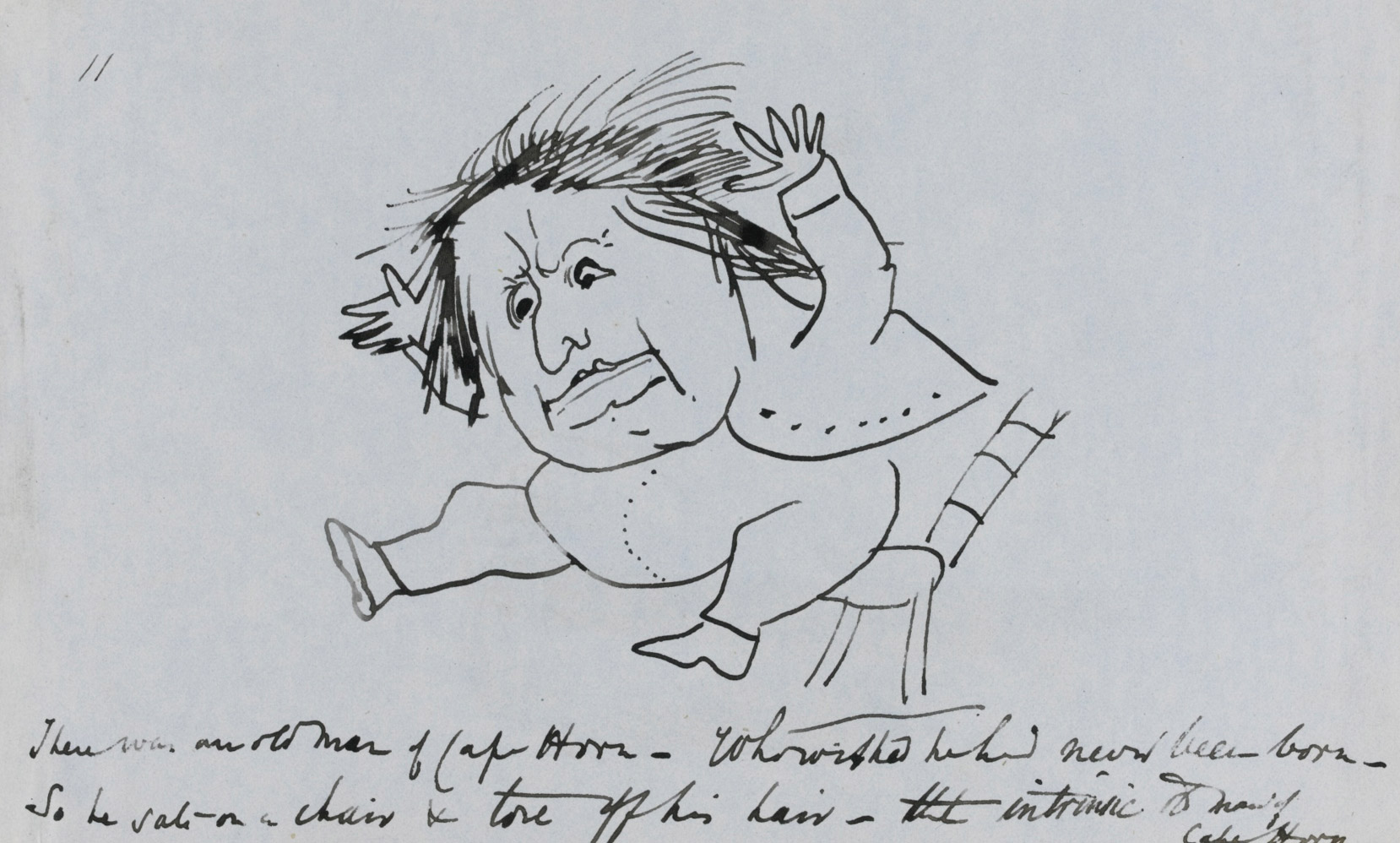
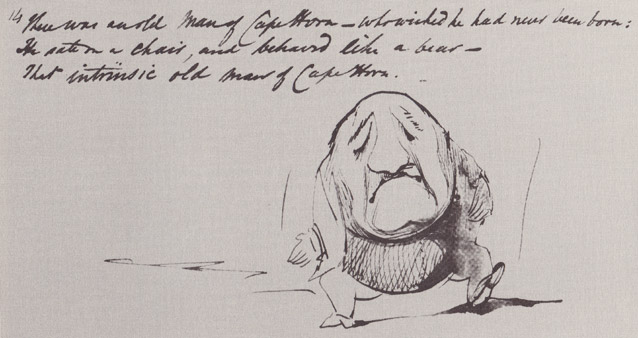
A variant version of both illustration and verse for ‘There was an Old Man of Cape Horn’. As first published in the 1846 edition of A Book of Nonsense, the limerick concludes “So he sat on a chair, till he died of despair, | That dolorous Man of Cape Horn.” The conclusion here reads “So he sate on a chair & tore off his hair – that intrinsic old man of Cape Horn”. Interestingly the Kraus manuscript (Koch Foundation) includes “He sate” before continuing “and behaved like a bear – That intrinsic…” This suggests that both the Krauss manuscript and the present piece are closely connected. The reverse of the leaf includes an abandoned and smudged drawing of a head.

This was sold at Sotheby’s.

Here is the Koch version, from Lear in the Original, p. 71:

el_horn-koch

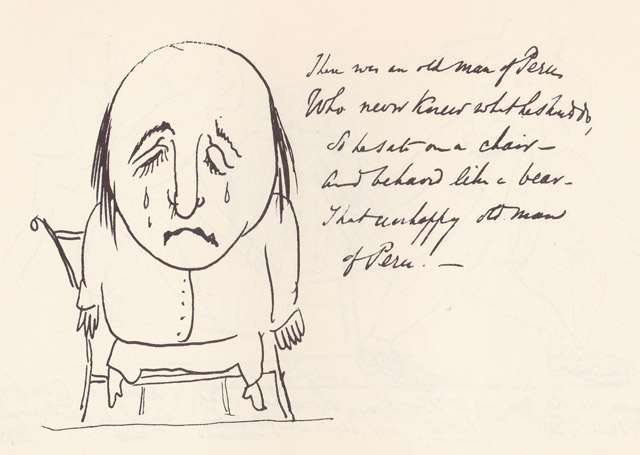
“So he sat on a chair | And behaved like a bear” would in the end become attached to one of the old man from Peru, here in the version on p. 12 of Bosh and Nonsense:

el_peru

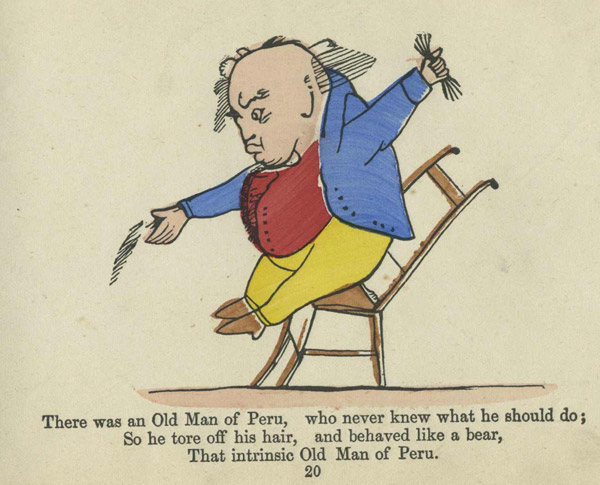
Notice however that the picture at the top is more similar to the final one for the 1846 Book of Nonsense version (here in a later coloured edition):

el_peru-1846

Posted in Edward Lear | Tagged , , | 1 Comment

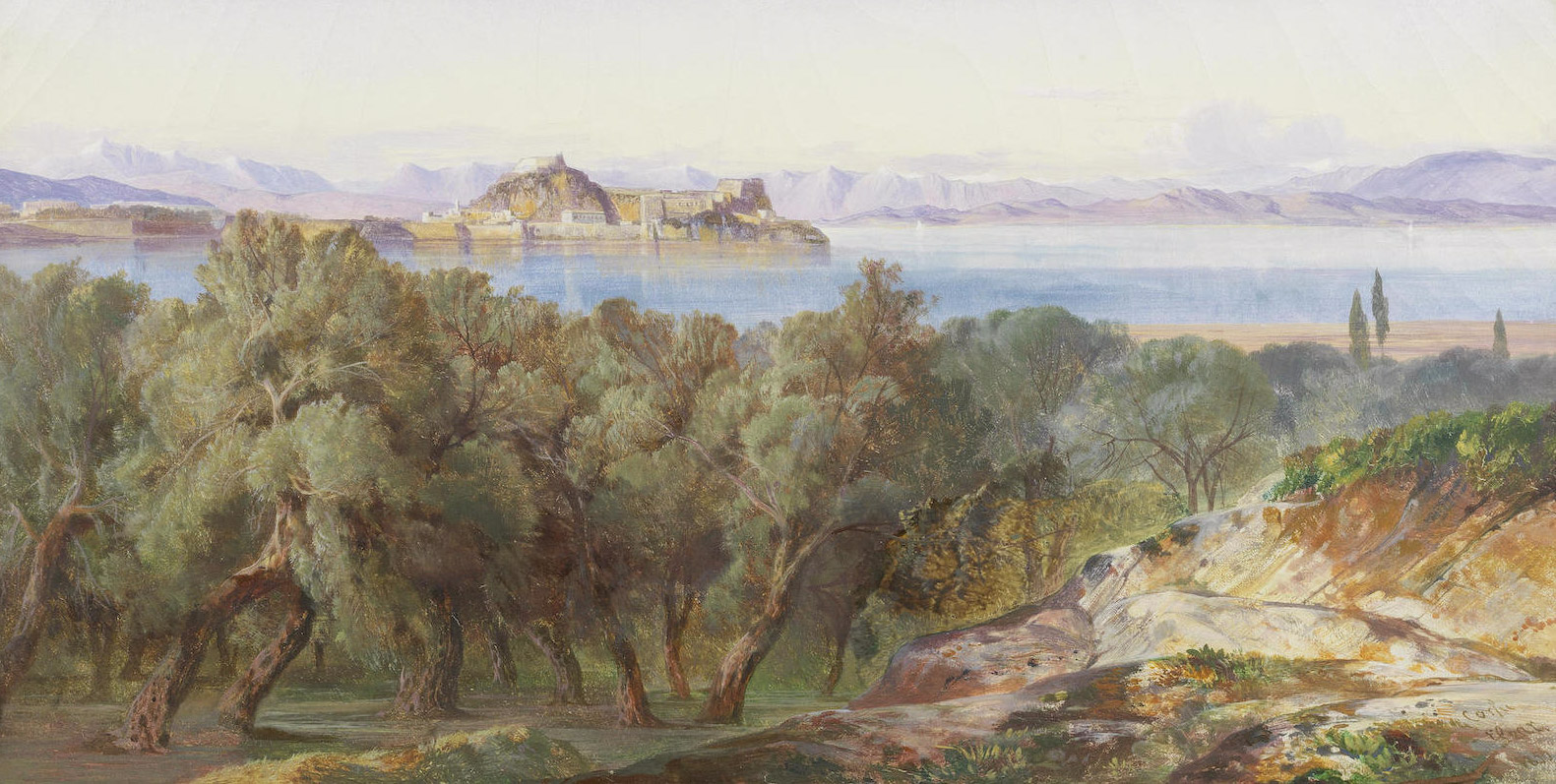
Edward Lear, Corfu (1856)

el_corfu-s

Edward Lear, Corfu.
Signed, inscribed and dated ‘Corfu/ELear./1856′ (lower right). Oil on canvas. 26.5 x 49.5cm (10 7/16 x 19 1/2in).

The present lot shows a distant view of the citadel at Corfu, with the Albanian mountains beyond. Painted from a high position, near the village of Ascension, the composition is typical of the oils and watercolours Lear produced during this period (for example Corfu from the village of Ascension and Corfu from the Benitza Road, on the hill of Gastouri, 1862, Christie’s, London, 15 December 15, 2011, lot 59, and Corfu from the Hill of Gastouri, 1857-58, Christie’s, London, 12 December, 2007, lot 61).

Lear first visited Corfu in 1848, arriving by boat from Naples, and was immediately entranced by it, revealing in a letter to his sister ‘it really is a Paradise’. Lear later wrote that ‘The whole island is in undulations from the plain where the city is, to the higher hills on the west side; & all the space is covered with one immense grove of olive trees-so that you see over a carpet of wood wherever you look; & the higher you go, the more you see, & always the Citadel & the Lake, & then the Straights, with the great Albanian mountains beyond.’

Lear returned to Corfu in December 1855, settling there until 1863, when many British residents left the island with the transfer of sovereignty to Greece. He returned again in 1877.

For a similar composition, painted in watercolour, see Edward Lear: An exhibition of works from the Dayton International Collection, Sotheby’s London, 22-26 March 2004, exhibition catalogue, no.10, illustrated p.22.

Bonhams.

Posted in Edward Lear | Tagged , , , , | Leave a comment

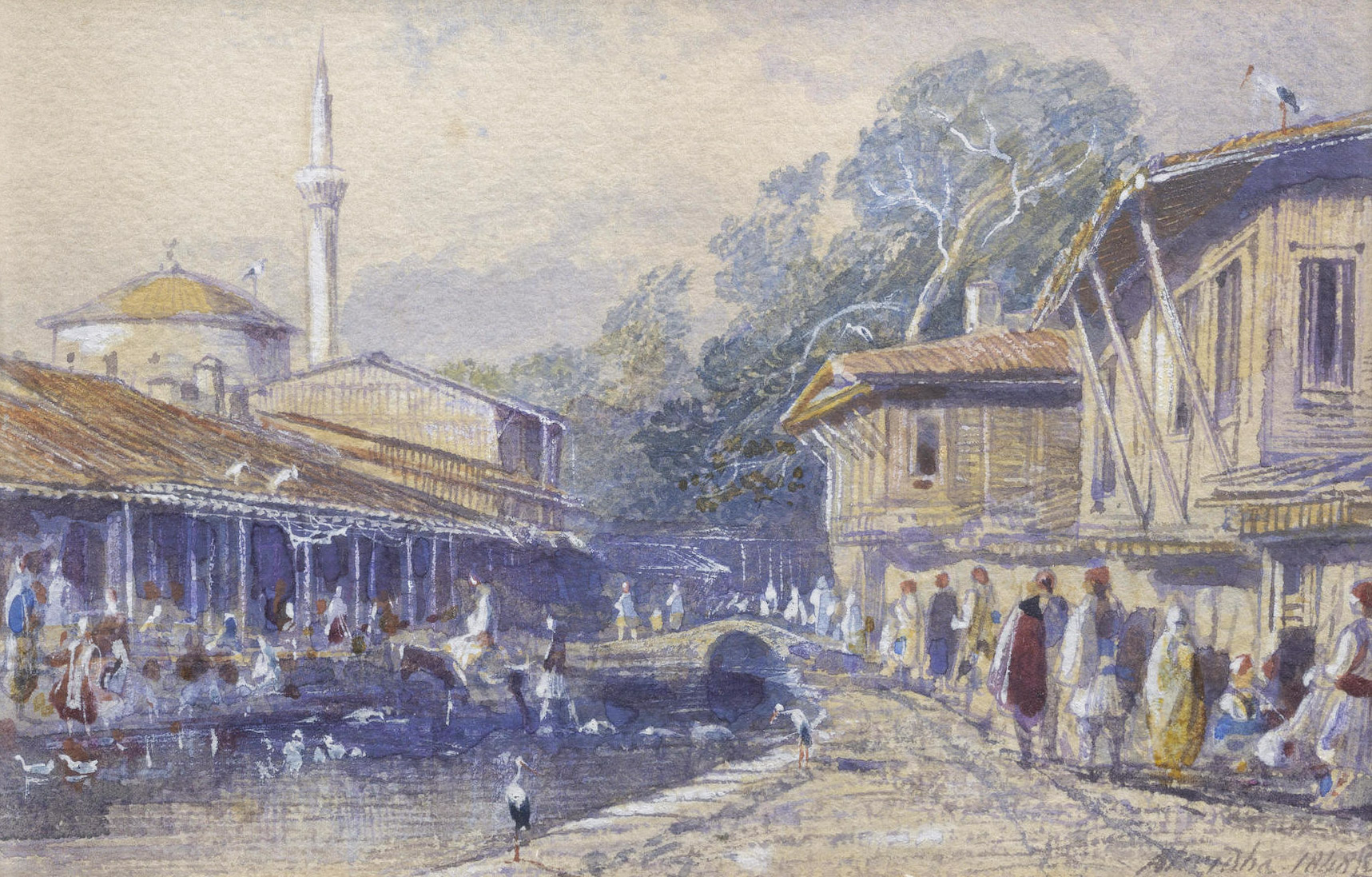
Edward Lear, View of Ohrid, Macedonia (1848)

el_ohrid-s

Edward Lear, View of Ohrid, Macedonia.
Signed with monogram, inscribed and dated ‘Akridha 1848’ (lower right). Watercolour, bodycolour and gum arabic over pencil. 11.5 x 17.8cm (4 1/2 x 7in).

Bonhams.

Posted in Edward Lear | Tagged , , , , | Leave a comment

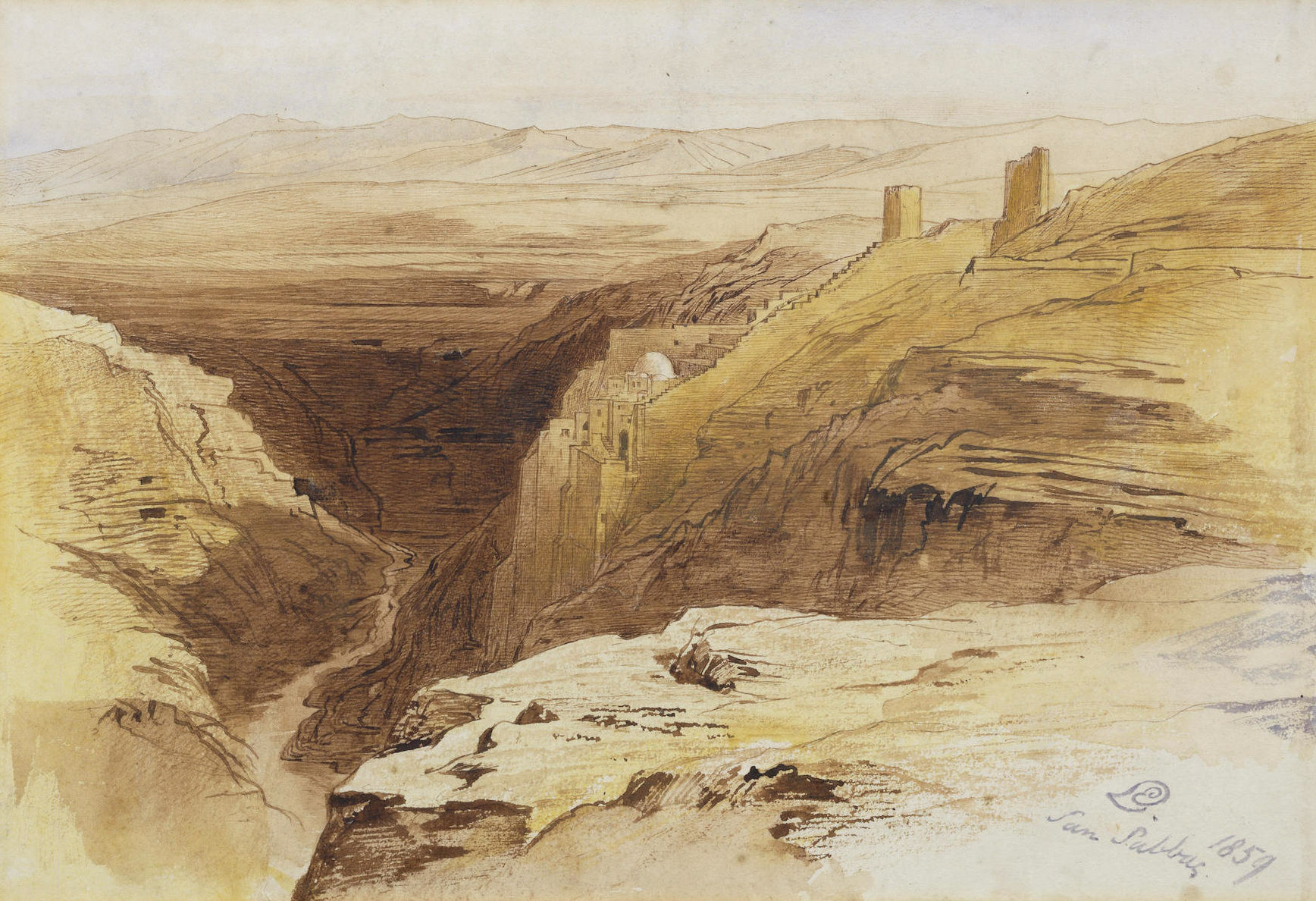
Edward Lear, San Sabbas (1859)

el_san-sabbas-s

Edward Lear, San Sabbas.
Signed with initials, inscribed and dated ‘San Sabbas/1859’ (lower right). Pen, ink and sepia wash. 20.5 x 30.5cm (8 x 12in).

Bonhams.

Posted in Edward Lear | Tagged , , , , | Leave a comment

Edward Lear, Cefalu, Sicily

el_cefalu-s

Edward Lear, Cefalu, Sicily.
Signed with monogram (lower left). Watercolour. 11.5 x 18cm (4 1/2 x 7 1/16in).

Lear visited Sicily on two occasions: in the Spring of 1842 and in the early summer of 1847; in the later visit he travelled with John Joshua Proby (1780-1855), who Lear later discovered was heir to the Earl of Carysfort.

Bonhams.

Posted in Edward Lear | Tagged , , , , | Leave a comment