Katharine West, Nonsense and Wit (1946)

SHOULD the British Council or arty other body concerned with the “projection of Britain” endeavour to make known abroad the unique British heritage of nonsense? Every country has its nursery rhymes and fairy tales; but, as M. Emile Cammaerts writes in The Poetry of Nonsense, “nowhere else in Europe do we witness a movement so popular and so widespread as that started by Edward Lear and Lewis Carroll in the Victorian era…. I have tried in vain,” he continues, “to discover anything similar in French or German literature.” As material for pamphlets and lectures, nonsense has the immense advantage of being unpolitical. For surely even the touchiest of allies could take no offence at the “Young Lady of Russia, who screamed so that no one could hush her,” while Vasco da Gama’s countrymen might be flattered by the conception of the ” Young Lady of Portugal, whose ideas were excessively nautical.” If only we could win the peoples of Europe to enjoyment of Jabberwocky and the Jumblies, might they not be convinced of the child-like simplicity of “perfide Albion”?

I am afraid not. In the first place, there is the insuperable difficulty of translation ; for, though Jabberwocky has on occasion been set as an exercise in Greek verse, the results were not intended for consumption by E.L.A.S. As for the Lear limericks, they are untrans- lateable into any existing language, and would surely lose something of their charm if rendered—however scientifically—into Basic English or Interglossa. Nor can the spirit of the verses be communicated, even to a generation of Europeans which has learned the international language of Surrealism. Nonsense is too invisible and intangible an export, confronted with which foreigners would, I fear, either suspect another subtle English scheme to double-cross them or welcome another proof of our degeneracy. So we must be content to keep our jokes in the Anglo-Saxon family, and may be allowed to pride ourselves a little on the possession of a gift denied to Latins and Scandinavians. To quote M. Cammaerts again: “There seems to be in the English temperament a certain trend of broad humour which predisposes it to appreciate the freaks of the nonsense spirit, and to enjoy a joke even if there is no point in it.”

Although many of the old Mother Goose rhymes were compounded of the genuine nonsense ingredients, Edward Leir was the original begetter of English nonsense as a fine art; and it is just one hundred years since he published, as The Book of Nonsense, the verses and drawings which he had made to delight the thirteenth Earl of Derby’s grandchildren, nephews and nieces. The book was dedicated to the children of these children; and (in passing) Baconians who pin their curious faith on anagrams should take warning from the gentleman who solemnly assured Lear in a railway train that he (Lear) did not exist. “That,” the gentleman said, “is only a whim of the real author, the Earl of Derby. ‘Edward’ is his Christian name, and Lear is only Earl transposed.” The popularity of The Book of Nonsense was immediate with children and adults alike, and in the ensuing century that popularity has never waned. For real nonsense, like all great art, is dateless; and if it is not also universal that (as we have seen) is no fault of the great English masters. Lewis Carroll, whose Alice in Wonderland was published nineteen years later, was no rival to Lear on his own ground. They represent two schools of thought—both perfect nonsense, but different and complementary. Carroll’s magic (for one admirer at least) has always lain in his relentless logic and metaphysical implications. “It’s really dreadful,” Alice once protested, “the way all the creatures argue;” and indeed the Alice books might almost be described as a system of nonsense dialectic. Lear’s characters, on the other hand—though they ask questions, make statements and constantly contradict—seldom argue.

They are creatures of emotion rather than intellect, and express them- selves in action or in poetry rather than in logical thought.

I have been reading The Book of Nonsense and More Nonsense once again, savouring every absurdity and last-line adjective, and relishing the subtle crudity of the drawings. Once again I have analysed that world-wide conflict (first recorded by Mr. Aldous Huxley in a delightful essay) between Lear’s protagonists and public opinion personified as “they.” ” They ” smash the Person of Buda and the Old Man with a Gong; “they” ask impertinent questions and proffer unsolicited advice ; “they” are lavish in their pronouncements of platitude and prejudice. The undiscriminating power of conventional opinion is, however, perhaps best illustrated by the unaccountable things of which “they” sometimes see fit to approve; but such approval, being usually confined to the inhabitants of one place, may be attributed perhaps to local fashion rather than universal human stupidity. For instance, the “Old Person of Skye who waltzed wth a Bluebottle Fly” had the good fortune to entrance “all the people of Skye,” when he and his partner might so easily have been smashed by them. A similar local esteem was won by the “Old Person of Filey, of whom his acquaintance spoke highly,” merely, it would seem, because “he danced perfectly well to the sound of a bell and delighted the people of Filey.” Not all towns were as tolerant nor were many persons as happy in their social environment. The saddest rebuff of any, since it embodied all the harsh, Pharisaic respectability of middle-class life, was experienced by the “Old Person of Bow, whom nobody happened to know; so they gave him some soap and said coldly, ‘We hope you will go back directly to Bow.'” The most entrancing feature of the drawings is their approximation of human to animal types. The old man in a tree, for instance, is horribly bored by a bee which smokes a pipe where its proboscis ought to be, and the “Old man who said, ‘Hush! I perceive a young bird in this bush!'” is as ingenuously round-eyed as the fledgeling, and his walking-stick juts up like a wren’s tail behind his back. The “Old Person of Nice whose associates were usually geese” is simply a gander with necktie and buttons. In one instance the identification of man and bird has even spread from the drawing to the verse:

“There was an Old Man of El Hums, who lived upon nothing but crumbs,
Which he picked off the ground with the other birds round,
In the roads and the lanes of El Hums.”

Some of the drawings remind me of the composite creatures communally evolved in the game of “heads and tails.” They are all as inconsequential as the verses—perfectly fitted to them and infallibly right.

As for the verses, the truest test of their imaginative power is to try to write anything of the sort oneself, or to compare them with the spate of limericks which has flowed since Lear’s day. Many of these later limericks, indeed, have been neat and witty ; but few are nonsense. For they have striven to make a point, and, having succeeded, they belong to the world of wit rather than of nonsense. Wit is an intellectual process controlled by reason, whereas nonsense—like all real poetry—wells up unbidden from the imagination. It was in such later works as The Jumblies, The Dong with the Luminous Nose and The Yonghy Bonghy Bo that the haunting, melancholy beauty of Lear’s nonsense found its full flowering. Yet already in The Book of Nonsense the essential elements are present. Such words as “scroobious” and “ombliferous,” for instance, prefigure “runcible” and the “Attery Squash.” The birds of the air make their first visitations to the “young lady whose bonnet came untied when the birds sat upon it” and to the “old man on whose nose most birds of the air could repose,” just as unaccountably and possessively as they do later to the Quangle Wangle’s hat. While over and over again, in the strange predica- ments of various persons, we are confronted with the ultimate mystery of life.

How blessed are those English children (and perhaps there may be some in the United States and the British Dominions, too) who have grown up under Bong trees and eaten their porridge with runcible spoons! “How pleasant to know Mr. Lear,” if only through his “volumes of stuff;” for, although he is no longer “one of the singers,” he will never be “one of the dumbs.”

Katharine West, “Nonsense and Wit”
The Spectator, 29 March 1946. p. 9.

Posted in Edward Lear, Lewis Carroll | Tagged , , , | 1 Comment

A Few Links

Herbert E. Crowley, Fantastic Animals Left off the Ark, 1911-1924.

Herbert E. Crowley, Fantastic Animals Left off the Ark, 1911-1924.

I have been checking and fixing a few links in the bibliography pages and added a new, interesting article to the Studies on Edward Lear page:

Antinucci, Raffaella. “‘Sensational Nonsense.’ Edward Lear and the (Im)purity of Nonsense Writing.” English Literature 2.2 (2015): 291-311.
Abstract:
The article explores Edward Lear’s contribution to the Victorian aesthetic debate, characterized by a marked resistance to the literary use of sensation (epitomised in Wilkie Collins’ fiction), and in which, according to Bourdieau and to many critics after him, the so-called cultural divide between high art and mass culture originated. In particular, the analysis verifies the degree of ‘impureness’ of Lear’s nonsense, a hybrid genre that has often been apprehended as literarily and socially subversive. After a brief discussion of the main features of this genre and its acknowledged ‘parodic’ quality, the study examines Lear’s engagement with ‘high’ and ‘low’ literary conventions in «Growling Eclogue» and «Mr. and Mrs. Discobbolos» (whose second part was expressly written at Wilkie Collins’ suggestion), with the aim of investigating if and to what extent Lear’s crossing of genres and use of bizarre and at times grotesque literary images blur (and question) the boundaries between élite and popular culture.

costume-sonnino

The Digital Collections of the New York Public Library now include scans of the complete John James Audubon’s Birds of America. The collections also include twenty-five images by Edward Lear, mostly ornithological illustrations, but also two vignettes from Illustrated Excursions in Italy.

costume-nettuno

Finally, if you are interested in early comics and especially nonsensical ones, Matteo Maculotti has written a much-needed introduction (in Italian) to the baffling work of extraordinary artist Herbert E. Crowley, il visionario dimenticato.

w-m-1-s

The first Wiggle-Much strip of 20 March 1910.

It is now possible to read the whole series of Crowley’s enigmatic Sunday comic strip, The Wiggle Much (or Wiggle-Much, New York Herald 20 March – 19 June 1910) thanks to Justin Duerr, whose biography of Crowley is about to be published.

An unpublished Wiggle-Much strip (this is no. 16 and only 14 were published).

An unpublished Wiggle-Much strip (this is no. 16 and only 14 were published).

The Metropolitan Museum of Art has a rich collection of Crowley paintings and drawings which deserves to be seen.

crowley-bottledogs-s

Crowley, Bottledogs! Bottledogs! Who buy bottledogs?, ca1910.

Want something else? Here is the Hathi Trust facsimile of The Coronation Nonsense-Book. In the Style of the Old “Book of Nonsense” by the Late Edward Lear. By the Poet and Painter of “Clara in Blunderland” (Caroline Lewis). London: William Heinemann, 1902.

punch-coronation

Posted in Comics, Edward Lear | Tagged , , , , , , | Leave a comment

John Mole, The Edward Lear Poem (1989)

John Mole, “The Edward Lear Poem.”
The Spectator, 2 December 1989, p. 42.

He kept his wife in a box he did
And she never complained though the neighbours did
Because of the size of the box and the way
He tried to behave in a neighbourly way
But smiled too much of a satisfied smile
For a body to know what to make of his smile.

Then there came such a terrible cry one night
Of the kind you don’t like to hear in the night
Though the silence that followed was broken at last
By the blows of a hammer which seemed to last
For ever and ever and ever and ever
And no one set eyes on that man again ever.

On John Mole.

Posted in Edward Lear | Tagged , , | Leave a comment

John Fuller, Edward Lear in Corsica

John Fuller, “Edward Lear in Corsica.”
Times Literary Supplement, 7 July 1995.
New Selected Poems: 1983-2008. London, Chatto & Windus, 2012.

Is it not unpleasant, at fifty-six years of age, to feel that it is increasingly probablu that a man can never hope to be otherwise than alone, never no, never more? Did not Edgar Poe’s raven distinctly say ‘Nevermore’?
Edward Lear, Journal of a Landscape Painter

With its colourful flora and fauna
How delightful to visit La Corse!
There is silence for once in the corner:
Poe’s raven has cried himself hoarse.

The terrible word that he utters
Brings none of its usual fears.
In Ajaccio, latched are the shutters
And deep are the hats over ears.

For hope is a buoyant statistic
And here they are used to being free.
You are bound to become optimistic
When you wander into the maquis.

The woods breathe a whimsical vapour
That doesn’t compel you to think.
The walks by the shore smell like paper.
The sea is the colour of ink.

The landscape was formed when the planet
Had little but rocks on its mind.
The fall of the coastline granite
Is awesome but not unkind.

When the clock chimes five and a quarter
Already I’ve fought with the sea.
I rise from the vanquished water
And drip from my beard to my knee.

My pride, like a low-tide anemone
Is sailing at less than full rig
And my otherwise pendulous gemini
Are tight as a Cargèse fig.

I shall live in crepuscular mountains
Where the chestnuts are full of white cows.
I shall drink at the pebbly fountains
And put on a peasant’s loose blouse.

I shall draw every day what’s before me.
My spirit will put up a fight.
Not a thing on this island could bore me.
I shall map the behaviour of light.

Here’s the pichet. Now take out the stopper.
Through my breakfast I’ll know who I am.
The honey’s the colour of copper.
The wine is the colour of jam.

The fish are the colour of roses.
The cheese is the colour of cheese.
Its smell has found out where the nose is.
The name of it sounds like a sneeze.

In heaven one stores up treasure
From every shifting mood
That belongs to the landscape of pleasure
With its rituals of air and of food.

The host of the morning croissant,
The sacrament of the pêche,
The globulous soupe des poissons
That is almost an act of the flesh.

The tone of a leaf or a petal,
The wind with its breath of intrigue,
The herbs that seduce from the kettle,
The herbs that define the garrigue.

But it’s on to the col de Bavella!
Where the mountains are pink in the sky
Like the ribs of lady’s umbrella
Left out in the garden to dry.

The easel unfolds like a table.
There is oil, and fresh pigments to crush.
With a sweep of my hand I am able
To lay on the sky with a brush.

In each cloud, in each pine, in each boulder
You may see that the paint hasn’t lied.
Come sir, look over my shoulder:
The hills are like elephant’s hide.

There was a young lady of Zonza —
But I cannot come up with a rhyme.
My verse-making skill has quite gone, sir.
I find that I haven’t the time.

It was something to do with a corset,
Or was it the shape of her toes?
When the memory’s gone you can’t force it.
God knows where the memory goes.

The past is a prison. I’ve tried it.
It is choked up with ash like a grate.
The future has nothing inside it.
The present is hard to locate.

I have made an important decision:
I shall live from now on in my art.
It’s a way to achieve the precision
That’s dulled in affairs of the heart.

The nourishing zest of the highlight
That glints from a rock or a spoon,
The deepening draught of the twilight,
The rich chiaroscuro of noon.

And then, when the starlight is silent
Above the still murmurous sea,
I shall know I belong to this island
And this island belongs to me.

And I shall have found the haven
That glistening granular shore,
Where flown is the ruminous raven
And the echo is: ‘Evermore!’

On John Fuller.

Posted in Edward Lear | Tagged , , , | Leave a comment

Edward Lear (attrib.), Mount Athos (1856)

el_mt-athos-1856-s

Attibuted to Edward Lear, Mount Athos.
Bears signature, date [1856] and inscription, watercolour and pencil. 37.5 x 17.5cm (14 3/4 x 6 7/8in).

Bonahms.

Posted in Edward Lear | Tagged , , , , | Leave a comment

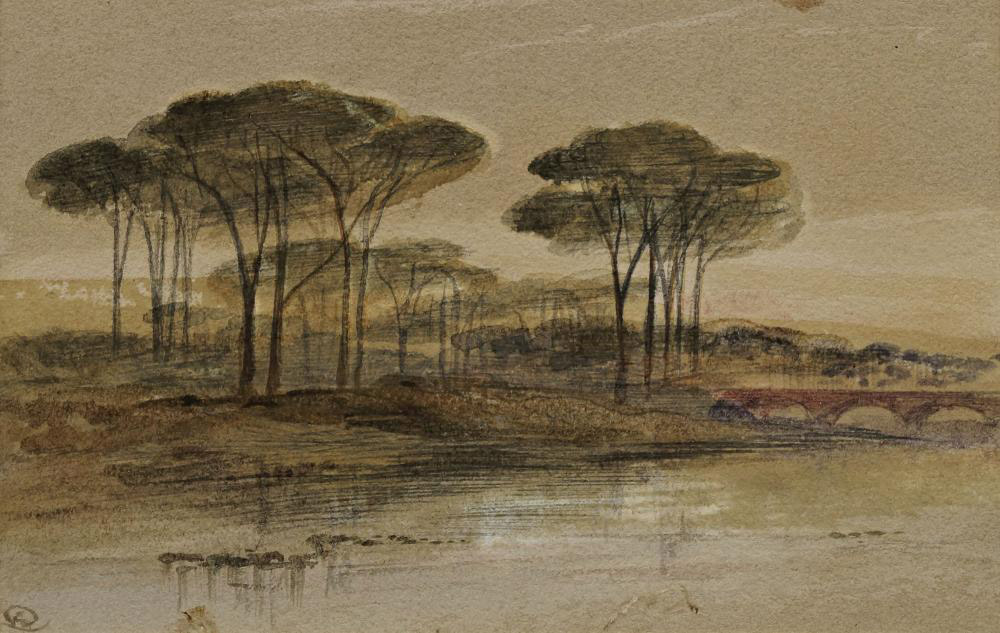
Edward Lear, Ravenna

el_ravenna-s

Edward Lear, Ravenna.
Watercolour, signed with monogram, 11.1x18cm.

Roseberys.

Posted in Edward Lear | Tagged , , , | Leave a comment

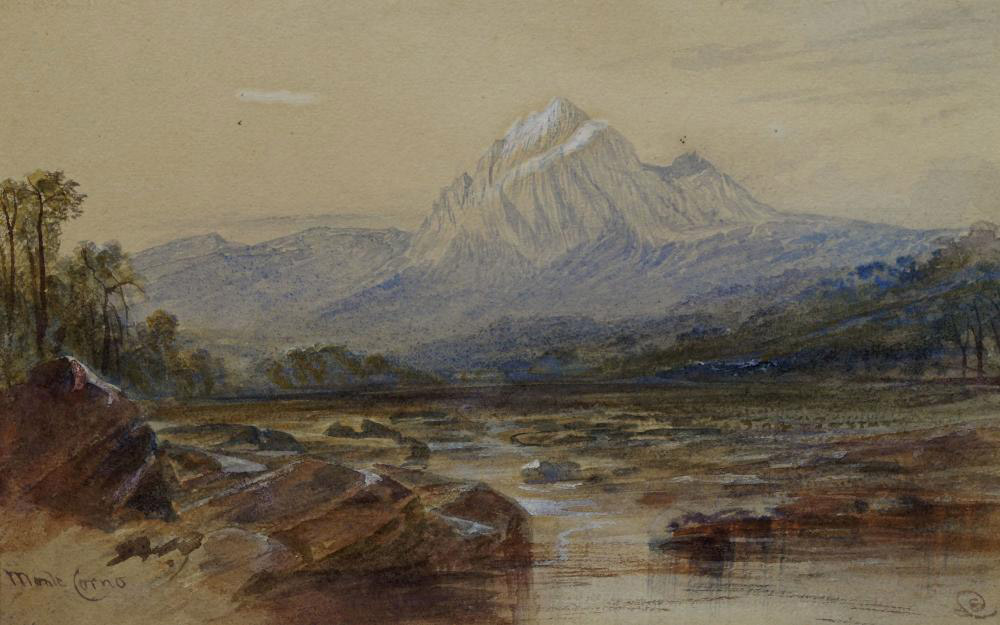
Edward Lear, Monte Corno

el_monte-corno-s

Edward Lear, Monte Corno, or Gran Sasso d’Italia.
Watercolour, signed with mongram and titled, 16.1×25.4cm.

Roseberys.

Posted in Edward Lear | Tagged , , , | Leave a comment

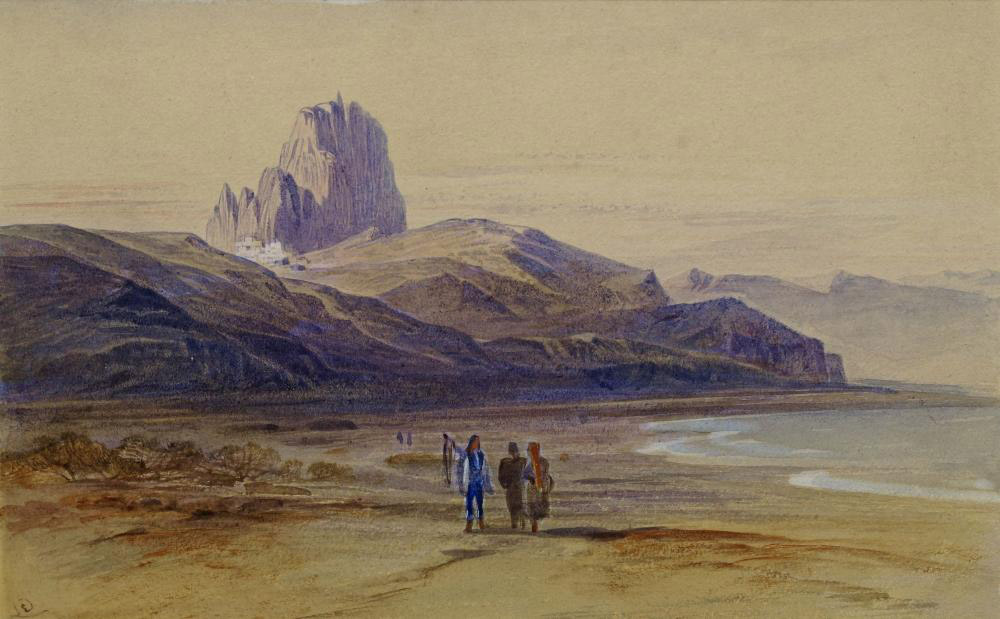
Edward Lear, Pentedattilo

el_pentedattilo-s

Edward Lear, Pentedattilo, Calabria.
Watercolour, signed with monogram, 16.1x22cm.

Roseberys.

Posted in Edward Lear | Tagged , , , | 1 Comment

Edward Lear and the Play of Poetry

Oxford University Press has announced the publication of the book collecting the 2012 bicentenary essays, it will (probably) appear in August and will have 400 pages!

waldegrave

Meanwhile, Bonhams is selling a collection of approximately 8,000 letters addressed to Lady Frances, Countess Waldegrave and Chichester Fortescue, later Lord Carlingford; among many other correspondents, Edward Lear is also mentioned.

Also, Julian Yanover has created a webpage devoted to Lear, which also contains a nice interactive Timeline.

Posted in Edward Lear | Tagged , , | 1 Comment

J.R. Green on Edward Lear in 1871

Writing to Miss Olga von Glehn from Villa Congreve (also), San Remo, on 10 March 1871, John Richard Green states:

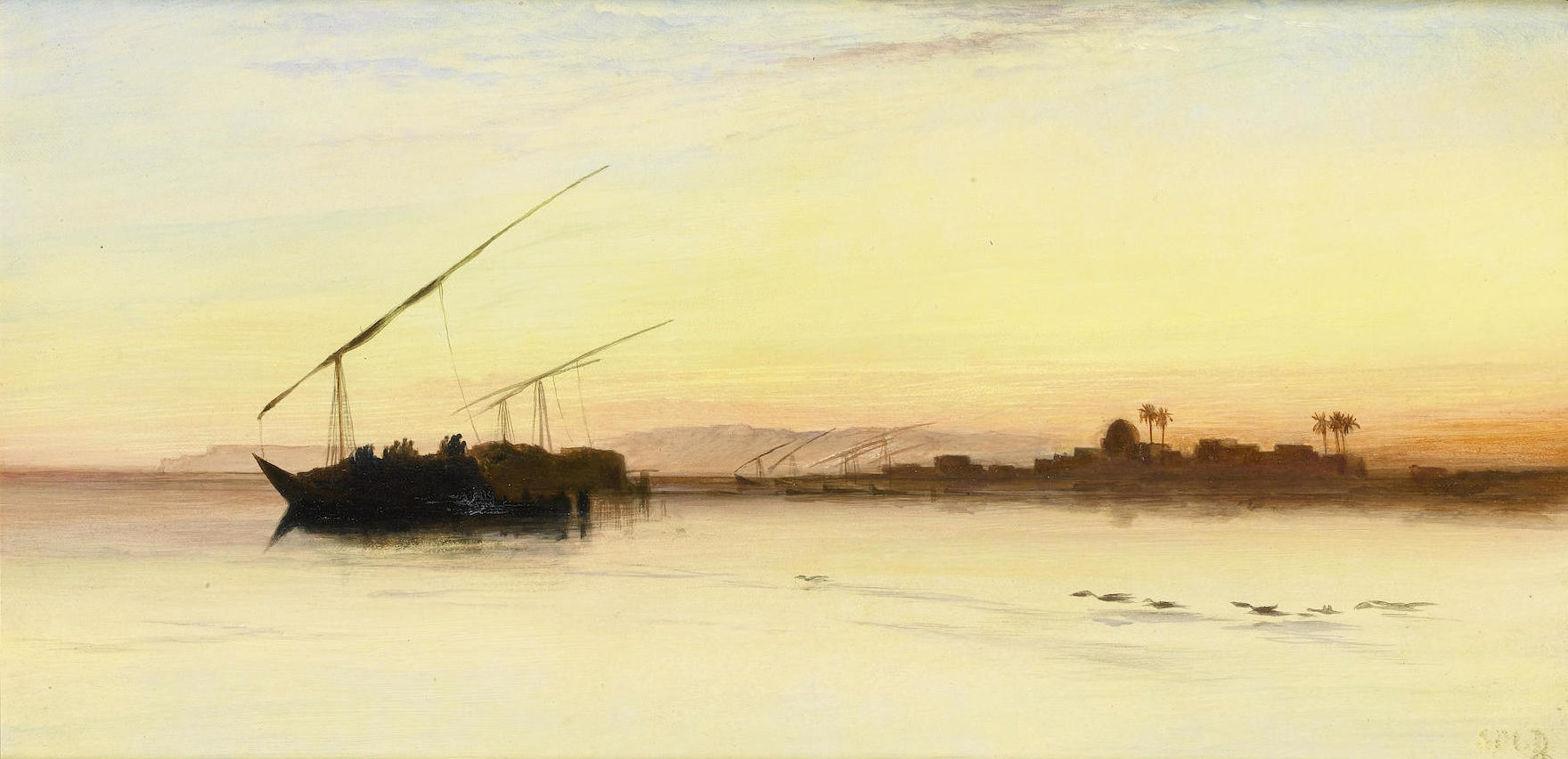
I have just been seeing Lear’s pictures packed off for the Academy. I shall be home just in time for a visit to it with you ― do you remember our visit last year? One of the pictures hangs about me still, a quiet reach of the Nile all dead with evening, behind a fiery blaze of sunset, and in front of it the weird gigantic “wings” of a Nile boat ― dark olive green in colour. There was a strange wild creepiness about the picture, but I doubt whther it will get hung. Lear has “Academy Wednesdays” in the studio of his new house, which he has hung round with 100 of his water-colours from Egypt, Palestine, Montenegro, Greece, Italy, and the Riviera. His whole life seems to have been an artistic “Wanderjahr,” and perhaps it is owing to this that he has preserved such perfect freshness of feeling, his humour and gaiety, his love of children and nonsense. He is delighted just now with the sale of his Christmas book, some 3000 copies have gone, but his profits are only some £60! Still he is happy, and every dayy he comes in and chats and tells me of some new idea for a picture, or of some change in a picture we have seen. Surely nothing is so perfect, so self-sufficing as the artist-life. (Letters of John Richard Green, edited by Leslie Stephen. London: Macmillan, 1901, pp. 290-291. Available at archive.org.)

He continued the letter on 20 March:

Is it possible this letter can still be here, dear Olga, lurking in secret places, when I thought it resting next to your heart or buried under your pillow to woo sweet dreams? What a change since I began it ― Lear vanished and San Remo vanished, and around me instead of the soft circle of its olives the hard red line of the cliffs of Mentone! (Ibid. p. 291.)

In 1871 Lear had four paintings in the Royal Academy:

Cattaro in Dalmatia.
On the Nile near Assioot.
On the Nile, Nagadeh.
On the Nile near Ballas.
(Algernon Graves, The Royal Academy of Arts; a complete dictionary of contributors and their work from its foundation in 1769 to 1904. London: Henry Graves and Co., 1906, vol. V, p. 13.)

The one Green describes might be “On the Nile near Assioot,” perhaps the one sold at Bonhams in 2009, though I do not see “gigantic wings:”

el_Nile-near-Assioot-s

John Richard Green, “the people’s historian,” should be the “reverend” Green which had an important part to play in the scandal of Walter Congreve’s relationship with a servant; on p. 212 we are told that

In 1870 he made his first journey in search of health, and spent the winter mainly at San Remo. The winter of 1871-72 was again spent at San Remo.

jr-green

John Richard Green (1837–1883), by Frederick Sandys, 1882.

Though at the time he was writing his magnum opus (1869-1874) he should have had “scarcely a hold on life” and been “incessantly vexed by the suffering and exhaustion of constant illness, perplexed by questions as to the mere means of livelihood, thwarted and hindered by difficulties about books in the long winters abroad” (“Introduction” by his wife, Alice Stopford Green, to the first volume of his A Short History of the English People. London: Macmillan, 1902, p. xix) he seems to have had a very active part in Congreve’s affair, at least as it is told in Lear’s diary.

On hearing from Giorgio that Congreve was thinking of bringing back Ellen, the pregnant servant, and marrying her, Lear rushed to Villa Congreve “to see Green,” who, on hearing of this, “owns (& denies not) that E. ― was ‘far from’ unwilling to act in unison with himself or with Lambert” (Diary, 13 December 1871): which seems to mean she was available as a lover to other men.

Lear’s investigation into the affair came to an end on 13 February 1872 when Congreve told him what had really happened, according to Ellen:

Congreve sent a note by the boys ― “anxious to see me ― much cleared up” &c. ― so we were to meet at 4.30, & he came then. He began at once on the misery topic. He had said to E. on going there [Nice, where she was staying] ― “what is there between you & Mr. G. Tell me the truth.” & she said ― [“]O! ― how glad I am you ask! It is the only thing I have concealed from you; & I have never had moral courage to tell you.” ― Then she confessed that early last winter [i.e. 1870-1871] G[reen] had attacked her saying he saw plainly there was something between her & C[ongreve] ― & that he might also share the good. She resisted all this, ― but one night he came to her room, & preventing her alarming the house, lay down on her bed, & told her stories ― some of wh. are unique as ecclesiastical=libidinous. Being fearful of scandal she endured that more than once, getting however, more & more angry ― but as he came at 3 or 4 A.M. he surprised her asleep. One morning he used force, & nearly succeeded, ― but desisted on her violent resistance & commencement of alarming the house. After that, he did not touch or look at her. As the connexion between her & C. never took place till May ― (by day times ― when E. brought some broth to C. he being in bed & unwell,) ― all his inventions about her “details” are sheer lies: ― & not only this, but scores of lies are evident on the whole of his story. By his own account to E. ― he had women, great & lowly ― right & left: ― but he got her to promise silence on what he had done, by appealing to her pity as to if she would like to ruin his professional prospects. It is not possible to put down a 100th part of what C. told me; but I am well sure that G. is a bad fellow out & out.

The story is told in greater detail in Michael Montgomery’s biography (pp. 239-241); however, neither Montgomery nor Levi, the only ones to mention Green, connect the person to the historian: Montgomery even wrongly states that he was “the local Anglican vicar.”

The fact that Green had had “women, great & lowly” throws a shadow on his period as a curate in Stepney:

He served as curate at St Barnabas, Finsbury (1861–3), Holy Trinity, Hoxton (1863–4), and St Peter’s, Stepney (1864–5); in 1865 he was appointed incumbent of St Peter’s. In addition to his religious duties, Green undertook a gruelling regimen of social work among his parishioners, including the district’s many prostitutes.
Anthony Brundage, ‘Green, John Richard (1837–1883)’, Oxford Dictionary of National Biography, Oxford University Press, 2004 [http://0-www.oxforddnb.com/view/article/11391, accessed 14 Feb 2016]

Posted in Edward Lear | Tagged , , , | 1 Comment