Edward Lear, View of the Ponte Rotto, Rome (1839)

Edward Lear, View of the Ponte Rotto, Rome.
Pencil, heightened with white; inscribed, signed and dated, lower right: Ponte Rotto Roma. / Edward Lear.del. 1839.

Provenance
Lord Stanley of Alderley,
thence by descent;
H.D. Lyon, London;
with Eugene Thaw, New York,
where acquired in 1976

Sotheby’s.

Posted in Edward Lear | Tagged , , , | Leave a comment

Edward Lear, Goats in the Campagna, near Rome (1839)

Edward Lear, Goats in the Campagna, near Rome.
Black chalk, heightened with white; signed lower right: Edward Lear del. / Roma. 1839 .

Sotheby’s.

Posted in Edward Lear | Tagged , , , | Leave a comment

Edward Lear in Public Collections & How Many Drawings Were There (Updated versions)

Edward Lear, Campagna di Roma (with swan and ruin), 1840. [Houghton Library]

Stephen Duckworth has kindly sent me updated versions of his two essays:

Edward Lear Works in Public Collections and in Other Collections Open to the Public (written with Rowena Fowler),

and

Edward Lear’s Landscape Drawings: How Many Were There?

We should also be looking forward to a new paper on Lear’s studio practice, to appear shortly.

Posted in Uncategorized | Leave a comment

Edward Lear, Kalama (1857)

Edward Lear, Kalama.
Inscribed with title and dated ‘April 6, 1857’, also annotated with notes in brown ink
pen, inks and watercolour. 22 x 31cm.

Provenance
Fine Art Society, March 1946.

The Saleroom.

Posted in Edward Lear | Tagged , , , , | 1 Comment

The Original Wheelbarrow Woman?

If you have been following this blog for some time you may have noticed how insanely partial I am to women who ride around in wheelbarrows, whether these are propelled by kind husbands or terrible devils. I have even posted a short picture story of a mother ape trying to save her little ones from a savage bear with the help of this locomotive instrument, though apparently with only limited success.

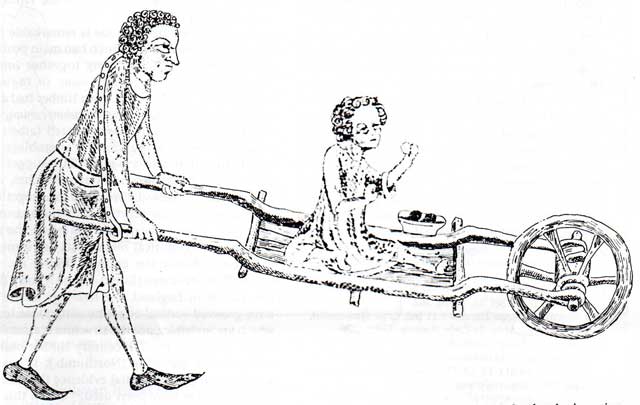
Now I think I have identified the original for all this wheelbarrow pushing: it seems that the first man who pushed, or more prabably pulled, a woman around on this vehicle was Saint Cuthman:

A turning point in Cuthman’s life was the death of his father, which left both him and his mother destitute. They decided to leave their home and journey eastwards – in the direction of the rising sun. By this time, Cuthman’s mother was an invalid and so he had to push her in a wheeled wooden cart. A rope that stretched from the handles to the saint’s shoulders helped carry the burden. When the rope snapped, he made a new one out of withies. The local haymakers laughed at Cuthman’s rather pathetic efforts, but Providence soon responded to their merriment by sending a sudden rainstorm, destroying their harvest. Later versions of the story say that, from that moment onwards, it always rained in that field during the haymaking season.
Cuthman decided that once this replacement rope made of withies broke, it would be a sign from God to settle at that place and build a church. This happened at Steyning, which, according to the Acta Sanctorum, was ‘a place lying at the base of a lofty hill, then woody, overgrown with brambles and bushes, but now rendered by agriculture fertile and fruitful, enclosed between two streams springing from the hill above.’
[From a full Story of St. Cuthman, irrelevant here but not lacking interesting details]

Here is a particularly Lear-like Medieval (?) image of St Cuthman at work:

My inexcusable ignominous ignorance in these matters is obvious if you consider that I found out about Cuthman only by reading Bernard Cornwell’s The Pale Horseman, where reference to him is made in passing by a desperate Alfred the Great, while in lockdown and suffering  withdrawal symptoms after watching the fourth season of The Last Kingdom. However, the saint has also been the protagonist Christopher Fry’s first play, The Boy with a Cart (1938), the cover for which book correctly shows that Cuthman must have pulled the wheelbarrow rather than pushed it.

More wheelbarrows with human cargo:

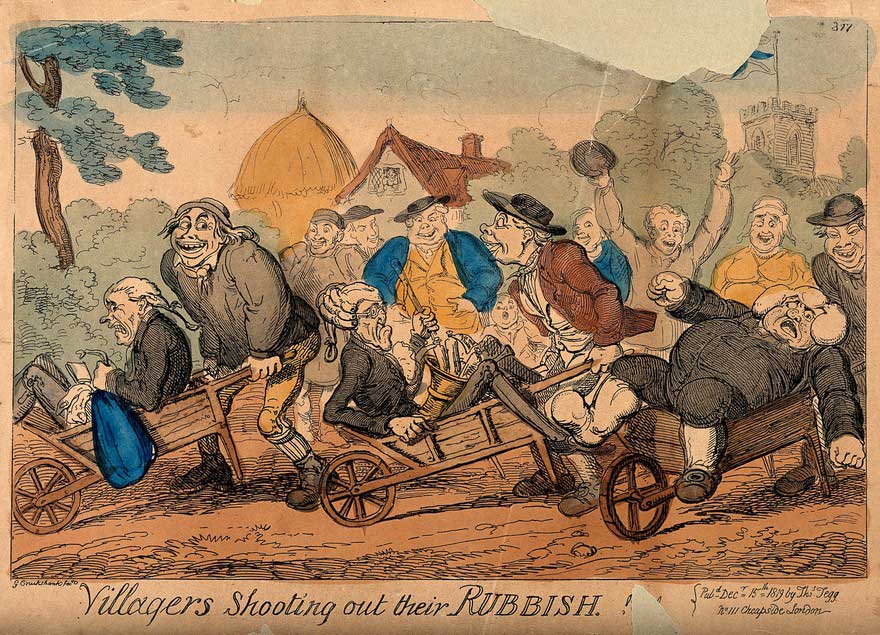
Country folk pushing a lawyer, a physician and a gouty vicar in wheelbarrows out of their village. Coloured etching by G. Cruikshank, 1819:

Doctor Drainbarrel is placed in a wheelbarrow and carted home. Coloured etching by T. Rowlandson after himself, c. 1800:

Etching with engraving by W.Y. Ottley after the Monogrammatist bxg:

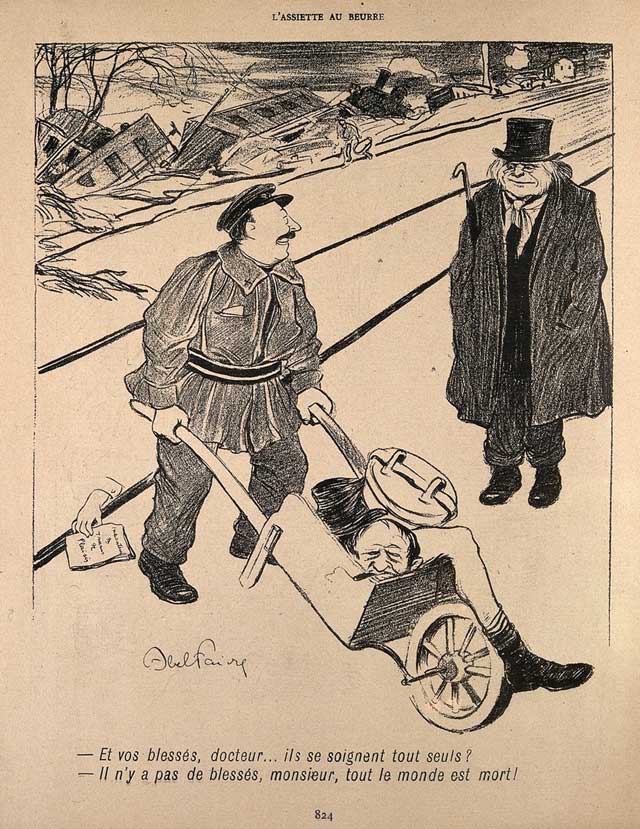
A railway employee (?) wheels away the dismembered body of a man killed in a railway accident; he converses with a physician:

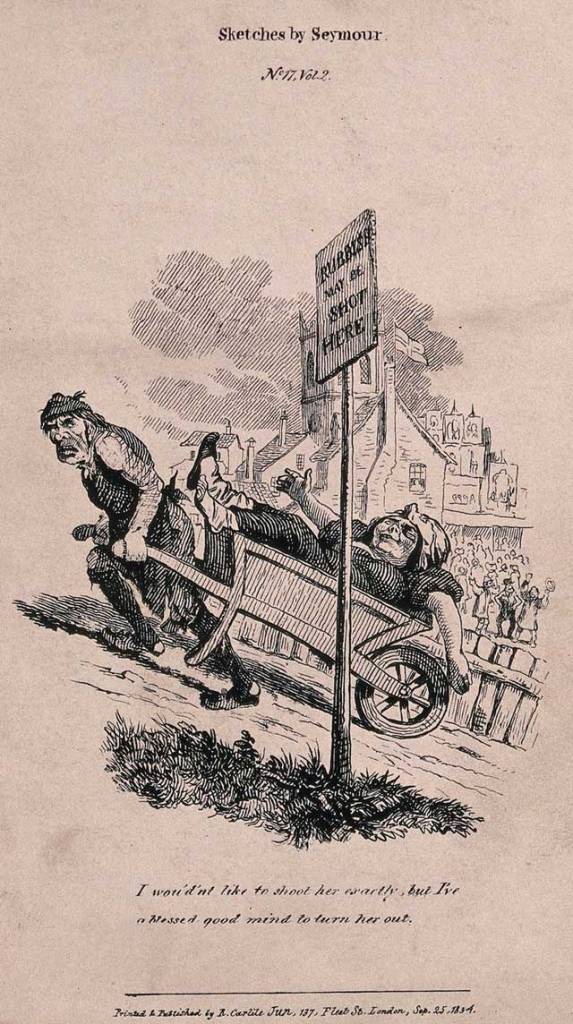
A man has to carry his overweight wife in a wheelbarrow up a steep mountain to the great amusement of onlookers:

All these from the Wellcome collection.

Posted in Edward Lear, General | Tagged , , | 3 Comments

Edward Lear, Venice, looking towards San Giorgio Maggiore

Edward Lear, Venice, looking towards San Giorgio Maggiore.
Inscribed, dated and numbered ’18 – 20. Novr 1865. 3.30-4.30.PM./(43)’ (lower right). Pen, ink and watercolour over traces of pencil, 30 x 49.5cm (11 13/16 x 19 1/2in).

Provenance
Private collection, UK.

Got a gondola for the day … it was very cold … bright gorgeous – but cold weather.
(Edward Lear diaries, 13-16 November 1865).

The present watercolour dates from Lear’s second trip to Venice in November 1865. Lear first visited the city in 1857, returning eight years later on his way to Malta, to make studies for an oil painting which had been commissioned by Lady Waldegrave, one of his most loyal patrons. Lear went out onto the lagoon in a gondola, producing a series of studies of the city’s famous landmarks: see for example Sotheby’s, London, 3 July 2013, lot 184, Christie’s, London, 5 July 2016, lot 121, and Venice 13 November 1865, (private collection, illustrated in Vivien Noakes, The Painter Edward Lear, Newton Abbot, p. 87).

In the present lot, as with others of this series, Lear uses tight hatching lines in sepia ink to depict the landmarks, contrasted with freer areas of wash to portray the sky. As Noakes comments, ‘In much of the work he did in Venice, Lear worked directly in often quite wet watercolour, laying in flowing washes which most accurately captures the shifting colour and light of the canal scenery’1.

1 Vivien Noakes, The Painter Edward Lear, Newton Abbot, p. 87.

Bonhams.

Posted in Edward Lear | Tagged , , , , | 1 Comment

Edward Lear, Orange Grove, Corfu (1863)

Edward Lear, Orange grove, Corfu.
Inscribed and dated ‘Corfu/March.30.1863/Φλαρέλλο./oranges-far-gleam like fireflies/in the shade.’ (lower left); annotated throughout. Pen, ink and watercolour, 31.8 x 49.3cm (12 1/2 x 19 7/16in).

Provenance
Private collection, UK.

Oranges – far – gleam like fireflies in the shade.
(Edward Lear, 1863)

Edward Lear travelled extensively throughout his life, visiting a variety of places, including Italy, Albania, Palestine, Syria, Egypt, India, Greece, Switzerland, Adriatic Sea, Southern France, Malta and Turkey.

Lear first visited Greece in 1848, and during the many years spent there he learnt the language and embraced the culture. His captivation with the country – the beauty, the multitude of colour and shapes, and the hospitality – is explored in his numerous drawings of the landscape and in his detailed letters and diaries.

The present lot, a vibrant depiction of Corfu, was executed on 30 March 1863. In his diary, Lear describes his movements that day and shows enthusiasm for the beauty of Corfu, despite an ‘awful’ sleep; he writes ‘Paradise weather…riz at 8. Man came & packed – or rather put lid on case. Went to Taylors ―: saw Clark & Mrs. Boyd. Called on the 6th ― very pleasant: & found a real grand view of Salvador: ― lunching with Capt. Philipps & Moreland.’

Lear began to draw at 3pm, noting ‘went to the Orange groves below to Cannone round ― & drew till nearly 6. It is not possible to give the brown glory of these woods ― in words ― & the gold sparkle of the fruit. The people were very amiable & nice: a small child ― τὸ παχὺ [the fat one] ― amused me.’

Particularly pertinent to the present lot, Lear writes in a letter to Mrs Beadon, of the beauty and awe-inspiring colours of the island : ‘yet the more I see of this place, so the more I feel that no other spot on earth can be full of beauty & of variety of beauty. For you may pass your days by gigantic cliffs with breaking foam=waves below them ― (as at [Palaiocastrizza],) ― or on hills which overlook long seas of foliage backed by snow covered mountain ridges ― (as at Janina or Gastouri,) or beneath vast olives over branching dells full of fern & Myrtle & soft green fields of bright grass: or in gardens & dark with orange & lemon groves, their fruits sparkling golden yellow against the purple sea & amethyst hills ―― or by a calm sandy shore below aloe=grown [cliff heights]― rippling=sparkling curves of sea sounding gently around all day long.’

Bonhams.
Posted in Edward Lear | Tagged , , , , | 1 Comment

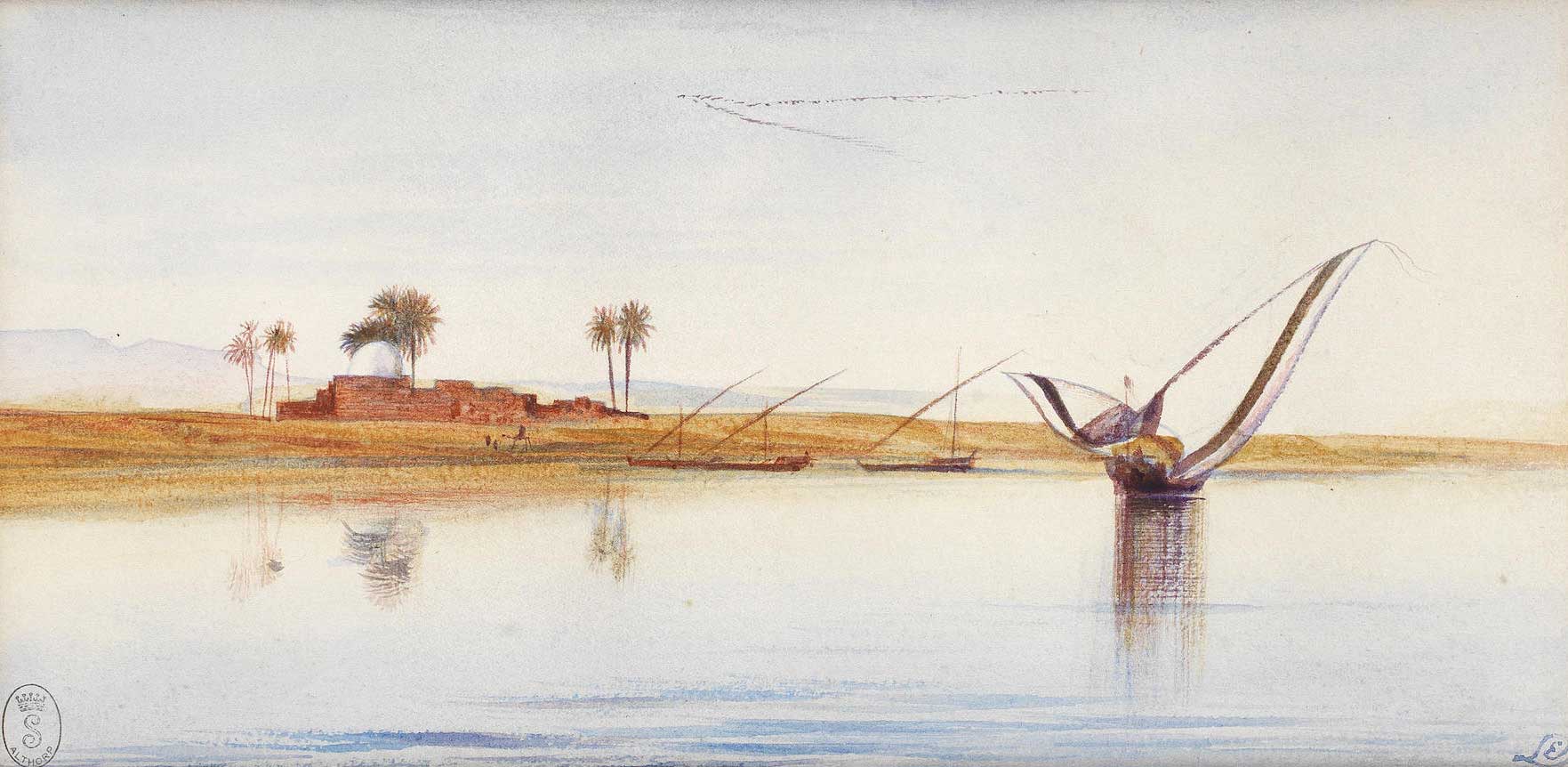
Edward Lear, Boats on the Nile near Deir El Kadige

Edward Lear, Boats on the Nile near Deir El Kadige.
Signed with monogram (lower right); stamped with the collector stamp of Earl Spencer (lower left). Watercolour, 9.7 x 20cm (3 13/16 x 7 7/8in).

Provenance
Edward John Spencer, 8th Earl Spencer Collection, UK (Frits Lugt L.2341a).
Max Harari Collection, UK (acquired from the above).
Thence by descent.

Lear produced a study of of Nile vessels, inscribed and dated ‘Deir Kadige/noon-1.PM./Janry 2 1867’, which shows the dome of the mosque on the river bank (National Maritime Museum collection, PAD9103). For a similar composition to the present lot, painted in 1871, see Sotheby’s, London, 5 March 2014, lot 281.

Bonhams.

Posted in Edward Lear | Tagged , , , , | Leave a comment

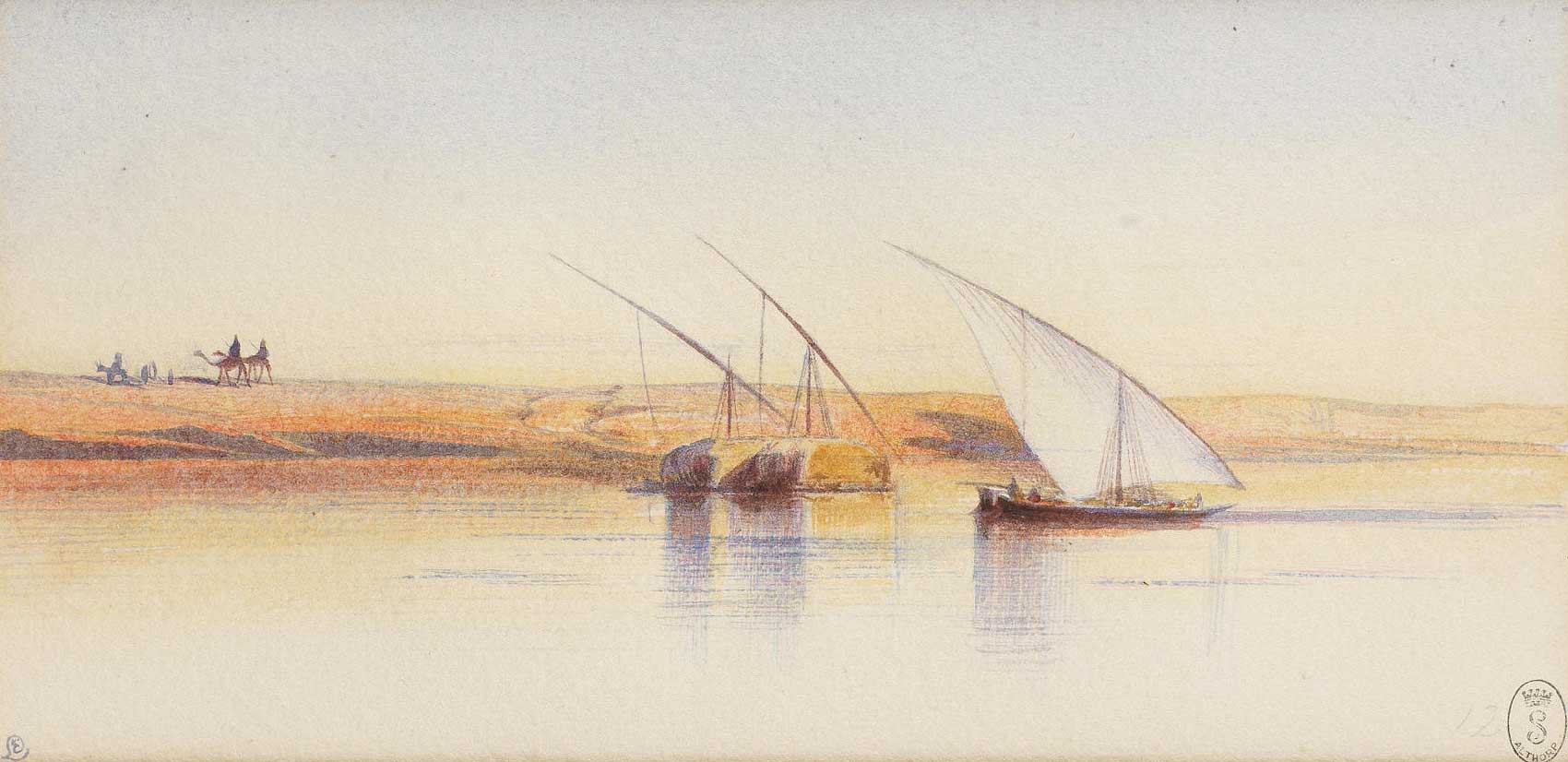
Edward Lear, Boats on the Nile

Edward Lear, Boats on the Nile.
Signed with monogram (lower left); stamped with the collector stamp of Earl Spencer (lower right). Watercolour, 9.7 x 20cm (3 13/16 x 7 7/8in).

Provenance
Edward John Spencer, 8th Earl Spencer Collection, UK (Frits Lugt L.2341a).
Max Harari Collection, UK (acquired from the above).
Thence by descent.

The present lot depicts three gyassis- traditional cargo vessels- two of which are laden with straw; it closely relates to another watercolour, dated 30 December 1853, in the collection of The National Maritime Museum (PAD9111).

Bonhams.

Posted in Edward Lear | Tagged , , , , | Leave a comment

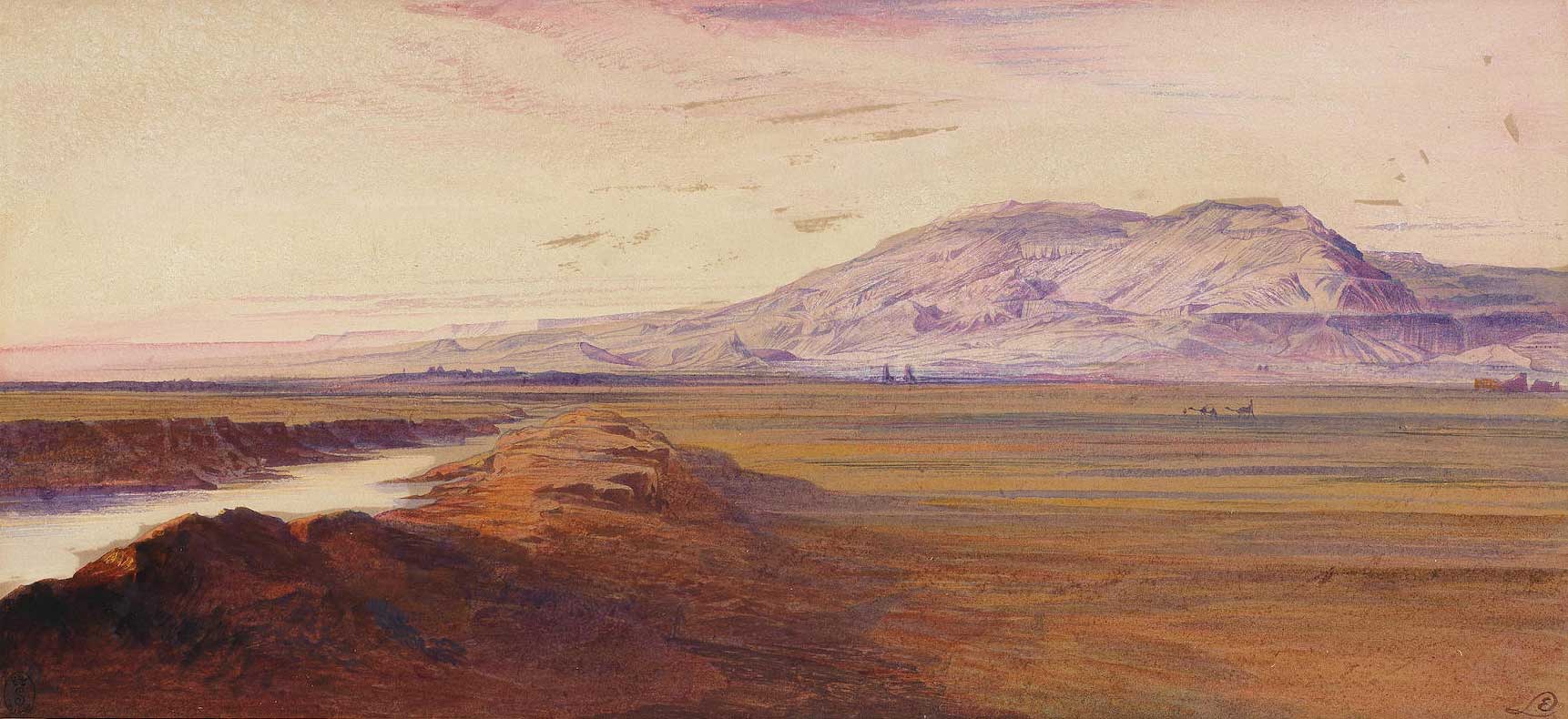
Edward Lear, Plain of Thebes

Edward Lear, Plain of Thebes, Egypt.
Signed with monogram (lower right); signed with monogram (lower left); stamped with the collector stamp of Earl Spencer (lower left). Watercolour, 17.4 x 37.6cm (6 7/8 x 14 13/16in).

Provenance
Edward John Spencer, 8th Earl Spencer Collection, UK (Frits Lugt L.2341a).
Max Harari Collection, UK (acquired from the above).
Thence by descent.

Lear visited Thebes in February 1854, spending ten days sketching the temples, ruins and landscape, as part of his journey along the Nile. A similar composition to the present lot, painted in 1885 and based on sketches made during this visit, is in the collection of the RISD Museum, Rhode Island.

Bonhams.

Posted in Edward Lear | Tagged , , , , | Leave a comment