Edward Lear, Parga, Greece & Monastir, Albania

Edward Lear, Parga, Greece; and Monastir, Albania.
The first, signed with monogram and dated ‘1864’ (lower right); the second, signed with monogram and dated ‘1861’ (lower right). Oil on panel. 6 7/8 x 11 in. (17.2 x 28 cm.); and smaller.

Provenance
with Gooden & Fox, London.

Lear travelled through Albania and Macedonia in 1848 and his journals of that time give an insight into the country and its customs during the 19th century. They detail some of the challenges and romance of travelling through a country previously unseen by many foreigners. He was particularly struck by the beauty of Monastir (Bitola): ‘the bustle and brilliancy….is remarkable…a river runs through the town…. either look up or down the river, the intermixture of minarets and mosques, with cypress and willow foliage, forms subjects of the most admirable beauty.’ (B. Destani (ed.), Edward Lear in Albania: Journals of a Landscape Painter in the Balkans, London, 2008, p. 21). Parga ‘from every point… lovely’ was observed to be ‘very unlike Albanian landscape in general’ (op.cit., p. 184) but rather closer to Calabria and Amalfi. Both the present paintings were worked up from sketches several years later, as Lear found working outdoors in Albania presented one unforseen challenge: many locals thought his activities the work of the devil and he was often driven away from his chosen vantage point.

Christie’s.

Posted in Edward Lear | Tagged , , , , , | Leave a comment

Edward Lear, Near Suez (1849)

Edward Lear, Near Suez, evening, 15 January 1849.
Watecolour with pen in brown ink over graphite on moderately  thick, rough, beige wove paper. 13.3 x 23.2 cm.
Yale Center for British Art. Gift of D. Gallup.

From Braeuner, Hélène. “British Travellers in teh Isthmus of Suez from 1798 to 1859.” In Caroline Lehni (ed.). Geographies of Contact: Britain, the Middle East and the Circulation of Knowledge. Strasbourg: Presses Universitaires de Strasbourg, 2019. 149-160. 155.

Posted in Edward Lear | Tagged , , , , | Leave a comment

Edward Lear, Monte Soratte near Rome

Edward Lear, Monte Soratte near Rome, Italy.
Signed twice with monogram and indistinctly dated ’18[?]’ (lower right) and inscribed and numbered ‘6 SORACTE. [sic.]/Brock.6. Corso d’Italia Rome.’ (on the stretcher). Oil on canvas. 9 ½ x 18 ½ in. (24.1 x 47 cm.)

Provenance
With Thomas Agnew & Sons, London, 1970, where purchased by
Sir John Ward, G.C.M.G., and by descent to the present owner.

Lear first arrived in Rome in December 1837, and he lived in the city on and off until 1848, returning again in the winters of 1859-60, 1871 and 1877. The city and its surroundings inspired his first travel book Views in Rome and its environs, published in 1841, complete with panoramic lithographs of the scenery. Monte Soracte, or Soratte, lies north of Rome near Nepi, halfway to Viterbo. Although the inscription has faded the painting may date to the 1880s: at least one studio drawing of the subject from 1883 is known, presumably based on an earlier sketch, and was sold in these Rooms on 12 November 1996.

Christie’s.

Posted in Edward Lear | Tagged , , , , | 1 Comment

Edward Lear: A Life in Pictures

Christmas came early this year for me; last night I received an e-mail informing me that European Comic Art, 12.2, with my article “Edward Lear: A Life in Pictures” (pp.  17-44) is now published and available online to subscribers. Here is the abstract:

Edward Lear has secured a prominent position in the history of literature and travel writing thanks to his nonsense books and his journals; he is considered one of the most innovative zoological illustrators of the nineteenth century and is being rediscovered as a landscape painter in watercolour and oil. This article argues that he also deserves to be remembered among the precursors of modern comic art. His picture stories, though never published in his lifetime, represent an early instance of autobiographical graphic narrative, while his limericks, never out of print since 1861, introduced a radically innovative caricatural style and a conception of the relationship between pictures and text that strongly influenced modern comic artists.

Posted in Edward Lear | Tagged , , , , | 1 Comment

Two Essays and a Lecture

Ekaterina Shatalova sent me two PDF file containing an interesting article on Edward Lear’s Russian illustrators and her Master’s thesis:

Russian_Illustrators_of_Edward_Lear

Illustrating Nonsense Lear and the Shock of the New

Meanwhile, Robert Peck’s lecture on The Remarkable Nature of Edward Lear is now online here.

Posted in Edward Lear | Tagged , , , , | Leave a comment

Edward Lear, The Pass of Bavella, Corsica

Edward Lear, The Pass of Bavella, Corsica.
Signed with the artist’s monogram EL lower left. Watercolour and pen and brown ink, heightened with white on blue paper. 30 by 46.6cm., 11¾ by 18½ in. framed: 51 by 67.5cm., 20 by 26½in.

Provenance

Probably Richard Bethell, 1st Baron Westbury (1800–1873) or his daughter the Hon. Augusta Bethell, later Mrs Parker (1839-1931)
By family descent to the present owner

Catalogue Note

This large-scale watercolour shows the magnificent forested mountains of Bavella in Corsica. Lear travelled to the island from Cannes on mainland France on the 8 April. He was to spend just under a month there and he was much taken by the landscapes. He was particularly impressed by Bavella, about which he wrote: ‘The colour here is more beautiful than in most mountain passes I have seen, owing to the great variety of underwood foliage and the thick clothing of herbs; forms, too, of granite rocks seem to me more individually interesting than those of other formations; and the singular grace and beauty of the pine-trees has a peculiar charm – their tall stems apparently so slender, and so delicate the proportions of the tuft of foliage crowning them. The whole of this profound gorge, at the very edge of which the road runs, is full of mountain scenes of the utmost splendor, and would furnish pictures by the score to a painter who could remain for a lengthened sojourn.’

1. Edward Lear, Journal of a Landscape Painter in Corsica, London, 1870, p. 91

Sotheby’s.

Posted in Edward Lear | Tagged , , , , | Leave a comment

Edward Lear, Hackwood Park, Hampshire (1865)

Edward Lear, Hackwood Park, Hampshire.
Signed Edward Lear del. lower right;  inscribed and dated Hackwood. July 9 1865 lower left. Pen and brown ink. 18.7 by 36.4cm. 7 by 15½in. Framed: 21.5 by 39cm., 8¾ by 15½in.

Provenance

Probably Richard Bethell, 1st Baron Westbury (1800–1873) or his daughter the Hon. Augusta Bethell, later Mrs Parker (1839-1931)
By family descent to the present owner

Catalogue Note

This fine ‘on-the-spot’ drawing depicts woodland at the ancestral home of the Powlett family: Hackwood Park. At the time of Lear’s visit, in July 1865, the house was let to one of Lear’s patrons, Richard, 1st Baron Westbury (1800-1873), the Lord Chancellor.

Lear is known to have been very fond of Lord Westbury’s daughter, Augusta, who was probably the first owner of this drawing. Lear described her as ‘dear Gussie’ and recorded in his diary that she was ‘absolutely good, sweet and delightful.’1 Unusually for a drawing of this type, Lear has signed the work in full. This may indicate that he presented the drawing to his friend as a gift.

1. V. Noakes, Edward Lear, A Life of a Wanderer, London 1968, p. 177

Sotheby’s.

Posted in Edward Lear | Tagged , , , | Leave a comment

Edward Lear, Valletta, Malta

Edward Lear, Valletta, Malta.
Signed with the artist’s monogram EL lower right. Watercolour and bodycolour. 17.7 by 37.8cm., 7 by 14¾in. Framed: 45.6 by 63.5cm.,18½ by 24¾in.

Provenance

Probably Richard Bethell, 1st Baron Westbury (1800–1873) or his daughter the Hon. Augusta Bethell, later Mrs Parker (1839-1931)
By family descent to the present owner

Catalogue Note

Lear’s first trip to Malta, which he described as ‘that much beloved place’, was in 1848 on his way from Italy to Greece, but on that occasion he had little time for drawing.1 Finding himself in Malta again in 1862, on his way from Corfu back to England, he took the opportunity to make a few drawings of the island. He also spent a lonely winter there from December 1865 to April 1866.

Malta has since the sixteenth century been the headquarters of the Knights of St. John, now known as the Knights of Malta.  Its position in the central Mediterranean with access to central and Eastern Europe as well as Africa, means it has always been of vital naval strategic importance. Charles V gave the islands to the Knights of Malta in 1530, on a perpetual lease, following their expulsion from their previous headquarters in Rhodes by the Ottoman Empire. Ottoman aggression continued and gained an air of invincibility when half the Christian Alliance Fleet were destroyed at the Battle of Djerba in 1560. An attack on Malta was inevitable and had the Turks pressed forward immediately it is impossible to see how they would have been repelled. As it was their delay allowed Alliance forces to rebuild. A vast fleet set sail from Constantinople and arrived off Malta in May. The following siege, which lasted until September, was one of the bloodiest in history and the eventual Maltese victory was received with a mixture of relief and jubilation by the courts of Europe. The city of Valetta was constructed following the victory and named after Jean Parisot de la Valette, the Grand Master, who had commanded the defence of the island. It fortified the Xiberras peninsula and reinforced the knights command of the island. They retained control until 1798 when Malta was taken by Napoleon en route to his invasion of Egypt. Nelson’s great victory at The Battle of the Nile in August of that year was the beginning of the end of French dominance in the Mediterranean. Malta fell to the British in 1800 and was a vital port from which the Royal Navy could disrupt French supply routes, intercept intelligence and maintain the operational fleet. The island was formally handed over to Great Britain in the Treaty of Paris of 1814. During the remainder of the nineteenth century it was ruled by a British Military Governor.

  1. See Lady Strachey, ed., The Letters of Edward Lear, 1907, pp. 243-44

Sotheby’s.

Posted in Edward Lear | Tagged , , , , | Leave a comment

On 12 December… Edward Lear Concert

Sara Lodge will be presenting the last concert of Edward Lear songs of the year on December 12 at at Combermere Abbey in Cheshire, at 7:00pm.
The performers are Sara herself, baritone Edward Robinson and pianist Rachel Fright.
The concert is free but donations to local charities will be encouraged.

Posted in Edward Lear | Tagged , , | Leave a comment

Two Italian Pictures by Edward Lear

As part of London Art Week, Karen Taylor is organizing an exhibition that will include, together with seral other interesting Italian landscapes, two Lears I have not yet posted here.

Edward Lear, Tivoli.
Inscribed and dated l.l.:  Tivoli May 7 1838, pencil and grey wash heightened with white on light grey paper. 18 x 25 cm; 7 1/16 x 9 7/8 inches:

Lear set out for Italy in the summer of 1837. For most of the next ten years the artist wintered in Rome and toured other parts of Italy during the summer. This visit to Tivoli is referred to by Lear in a letter to his sister Ann dated 3rd May 1838; I, and Uwins and Mr Acland set off on Saturday – staying some days at many beautiful places all (of) which I will tell you about. I must now describe my dear Tivoli as I promised the height of landscape perfection (V. Noakes, Edward Lear, Selected Letters, Oxford, 1988, p. 41). The Uwins referred here was James, nephew of the more famous Thomas Uwins R.A. (1782-1857) lived in Italy from 1823-1831, often returning there in the subsequent summers.  ‘Mr. Acland’, Leopold Dyke Acland, was one of Lear’s travelling companions, who, after leaving Tivoli, travelled on to the Bay of Naples in the summer of 1838. Acland joined Lear again for a tour of Sicily in the spring of 1842. Leopold was the son of Sir Thomas Dyke Acland, tenth baronet (1787-1871), a politician and philanthropist who with his wife visited Rome in the winter of 1837 and also patronised Joseph Severn who was friendly with their son Henry, a great friend of John Ruskin.

Provenance
The Acland family;
Fry Gallery;
Private collection, U.K.

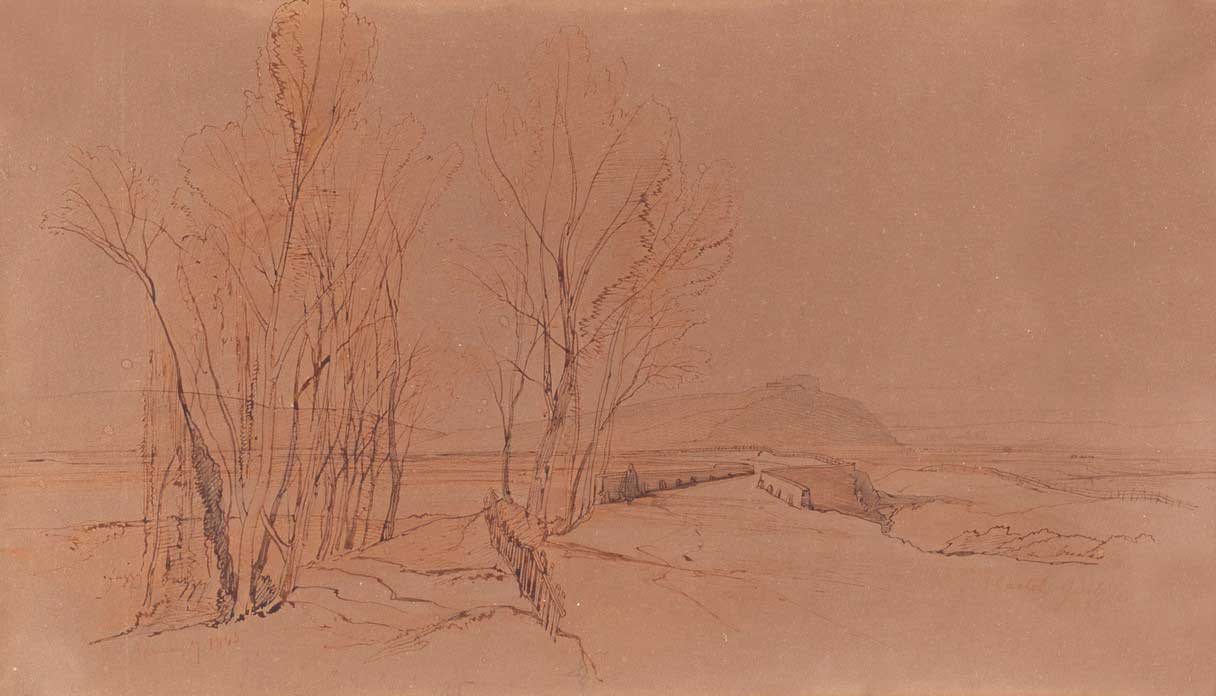
Edward Lear, Val Montone, Italy.
Inscribed and dated l.l.: Val Montone-17 Oct.br 1840., inscribed with artist’s notes, graphite. 26 x 39.7 cm; 10 1/4 x 15 5/8 inches:

Lear went to Italy in the summer of 1837. For most of the next ten years the artist wintered in Rome and toured other parts of Italy during the summer. He spent the winter months in and around Rome making frequent visits to the Campagna. He wrote in a letter to his sister Ann that  Val Montone was: one of the most elegant campagna towns and very curious: it is in a deep dell in the Latin valley- but rises on a mound- crowned with a superb church and castle-though the town itself is wretchedly poor…Fine trees are all around Val Montone- and it is altogether a delightfully quiet place (recorded in the 1930s typescript of the lost manuscript of Lear’s letters to Ann, 11 October 1838).
Another view of Val Montone is included in Views in Rome and its Environs, 1841, plate 25.
Sir Robert Vere ‘Robin’ Darwin KCB CBE RA RSA PRWA NEAC (1910 – 1974) was a British artist and Rector of the Royal College of Art. He was the son of the golf writer Bernard Darwin and his wife the engraver Elinor Monsell and a great-grandson of the naturalist Charles Darwin.

Provenance
Sir Robin Darwin, R.A.;
Lady Darwin;
Spink, where bought by the present owner;
Private collection, U.K.

Exhibited
Royal Academy, London, Edward Lear 1812-1888, 1985, no. 15i, ill p. 92

Posted in Edward Lear | Tagged , , , , | Leave a comment